
TODAY’S GOSPEL READING – 30 OCTOBER
October 30, 2026
FEAST OF SAINT WOLFGANG OF REGENSBURG – 31st OCTOBER
October 31, 2026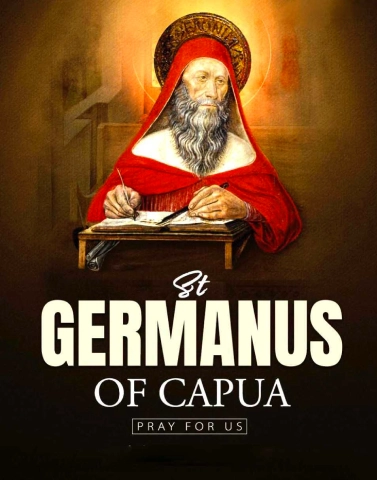
THE WOUND OF DIVISION CAN BECOME A PLACE OF GRACE
Division wounds relationships and weakens the unity God desires among His people. Germanus was sent by Pope Hormisdas to Constantinople in 519 to help heal the division between Rome and the Eastern Church. His mission reminds us that reconciliation begins when we choose love over bitterness.
“Blessed are the peacemakers, for they will be called children of God.”
— Matthew 5:9
Germanus undertook the difficult mission of restoring communion between Rome and Constantinople after decades of separation.
A divided relationship can become a place where God’s healing grace begins.
A PEACEMAKER MUST FIRST BE ROOTED IN GOD
True peace requires patience, prayer and humility. We cannot become instruments of reconciliation if we are controlled by pride or the desire to win every argument. Germanus’s spiritual strength enabled him to undertake a difficult mission with perseverance and wisdom.
“And the peace of God, which surpasses all understanding, will guard your hearts and your minds in Christ Jesus.”
—Philippians 4:7
Germanus remained in Constantinople for more than a year, patiently helping to consolidate the reconciliation achieved through the papal mission.
The more deeply we are rooted in God, the more effectively we can become instruments of peace.
UNITY IS MORE THAN AGREEMENT
True unity requires more than outward acceptance. It demands forgiveness, restored trust and a willingness to remain united despite differences. Germanus’s mission helped restore communion between the Churches of Rome and Constantinople in 519.
“Make every effort to maintain the unity of the Spirit in the bond of peace.”
— Ephesians 4:3
Germanus and his fellow delegates successfully negotiated the restoration of ecclesial communion, helping to end the Acacian Schism.
Unity becomes meaningful when agreements are transformed into lasting relationships.
TRUTH AND CHARITY BELONG TOGETHER
Peace must never be achieved by abandoning truth, nor should truth become an excuse for harshness. Christians are called to defend their faith with courage while treating others with compassion. Germanus demonstrated this through his service to the Church.
“Speaking the truth in love, we must grow up in every way into him who is the head, into Christ.”
— Ephesians 4:15
During his mission to Constantinople, Germanus helped secure acceptance of the profession of faith presented by Pope Hormisdas while working towards the restoration of communion.
Truth gives direction to charity, while charity makes truth fruitful.
THE HIDDEN WORK OF GOD OFTEN TAKES TIME
God’s plans do not always unfold according to our timetable. Reconciliation often requires patience, perseverance and continued effort. Germanus’s mission involved prolonged negotiations, reminding us that important spiritual achievements cannot always be accomplished quickly.
“Let us not grow weary in doing what is right, for we will reap at harvest time, if we do not give up.”
— Galatians 6:9
Germanus remained in Constantinople for over a year after the initial agreement, helping to strengthen communion with the Eastern Churches.
Faithfulness is never wasted, even when the results take time to appear.
CROSSING THE SEA BEGINS IN THE HEART
Germanus crossed the sea to undertake his mission of reconciliation. We too must cross the barriers of pride, resentment and prejudice to reach others. Sometimes peace begins with a conversation, an apology or the willingness to listen.
“If it is possible, so far as it depends on you, live peaceably with all.”
— Romans 12:18
Germanus travelled from Italy to Constantinople, accepting the challenges of a distant and delicate diplomatic mission for the unity of the Church.
The first journey towards reconciliation is the journey beyond our own pride.
LEADERSHIP IS A MINISTRY OF RECONCILIATION
Christian leadership is not merely about exercising authority but about bringing people together in faith and love. Germanus understood his responsibility towards the whole Church and accepted the difficult task entrusted to him.
“Whoever wishes to become great among you must be your servant.”
— Matthew 20:26
As Bishop of Capua and leader of the papal delegation, Germanus served the Church by working towards the restoration of unity between East and West.
A true leader uses authority to build communion rather than deepen divisions.
HUMILITY MAKES DIALOGUE POSSIBLE
Dialogue requires humility and a willingness to listen. We must remain open to understanding others without abandoning our convictions. Germanus’s mission demonstrates the importance of patience, wisdom and respectful engagement.
“In humility regard others as better than yourselves.”
—Philippians 2:3
Germanus accepted the responsibility of leading the papal delegation and worked patiently with the Eastern authorities to resolve a longstanding division.
Humility does not weaken conviction; it enables conviction to serve peace.
PRAYER REACHES BEYOND WHAT WE CAN CONTROL
Prayer places our concerns and relationships in God’s hands. The Church remembers Germanus through the account of his intercession for the deceased Roman deacon Paschasius. His story reminds us of the importance of praying for the departed and trusting in God’s mercy.
“The prayer of the righteous is powerful and effective.”
—James 5:16
According to Saint Gregory the Great, Germanus encountered the deceased deacon Paschasius at a place of thermal baths. Paschasius asked him to pray for him, and Germanus faithfully interceded. After several days, Paschasius was no longer seen there.
Prayer keeps our hearts united with God’s mercy, even when we cannot control the outcome.
HOLINESS IS MEASURED BY FAITHFULNESS, NOT FAME
Holiness is revealed through humble service, sacrifice and fidelity to God’s calling. Germanus is remembered not for seeking recognition but for accepting a difficult responsibility at a crucial moment in Church history.
“Well done, good and faithful servant.”
—Matthew 25:21
Germanus accepted the episcopal office at Capua and devoted himself to serving the Church, eventually undertaking the important mission to Constantinople.
A fruitful life is measured not by applause but by the love and faithfulness with which we serve.
THE COMMUNION OF SAINTS EXTENDS OUR HOPE
Our earthly life is not the end of our journey. We are called to eternal communion with God. The Christian tradition preserves Saint Benedict’s vision of Germanus’s soul being carried to heaven, reminding us of the hope of eternal life.
“For our citizenship is in heaven, and it is from there that we are expecting a Saviour, the Lord Jesus Christ.”
—Philippians 3:20
Saint Gregory the Great recounts that Saint Benedict saw Germanus’s soul ascending to heaven in a fiery globe at the very moment of his death.
The hope of heaven inspires us to live with greater faith, courage and love.
BECOME A BRIDGE WHERE OTHERS BUILD WALLS
Our earthly life is not the end of our journey. We are called to eternal communion with God. The Christian tradition preserves Saint Benedict’s vision of Germanus’s soul being carried to heaven, reminding us of the hope of eternal life.
“Blessed are the peacemakers, for they will be called children of God.”
—Matthew 5:9
Germanus became an instrument of reconciliation between Rome and Constantinople, helping restore a communion that had been broken for decades.
Let us ask Christ for the grace to become bridges of understanding wherever division exists.
PRAYER THROUGH THE INTERCESSION OF ST. GERMANUS OF CAPUA
St. Germanus, faithful bishop and servant of reconciliation, you accepted the difficult mission of restoring communion among divided Christians.
Pray for the Church, that disagreements may never destroy our love for Christ or our respect for one another. Obtain for us the humility to listen, the courage to speak the truth with charity and the patience to persevere when reconciliation takes time.
Pray for families wounded by conflict, communities divided by suspicion and all those working to build peace. Help us overcome pride, resist bitterness and become instruments of understanding and unity.
May our lives bear witness to the unity for which Christ prayed.
Through Christ our Lord. Amen.
St. Germanus of Capua, pray for us.