
TODAY’S GOSPEL READING – 18 JULY
July 18, 2026
Proverbs 19:21
July 19, 2026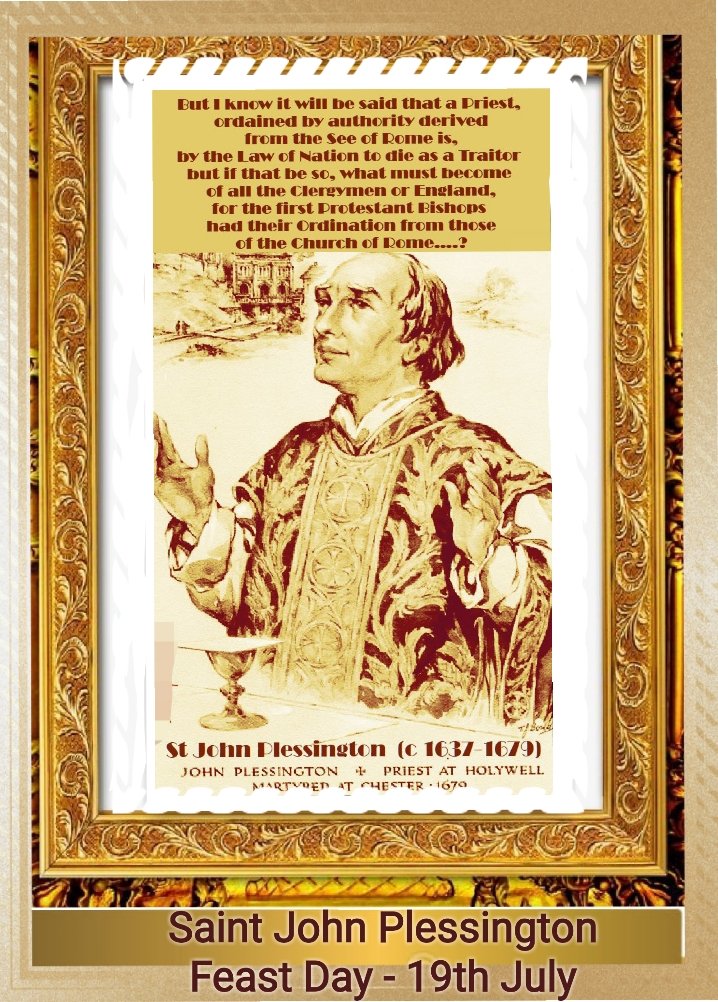
FEAST OF SAINT JOHN PLESSINGTON, PRIEST AND MARTYR
FEAST DAY – 19th JULY
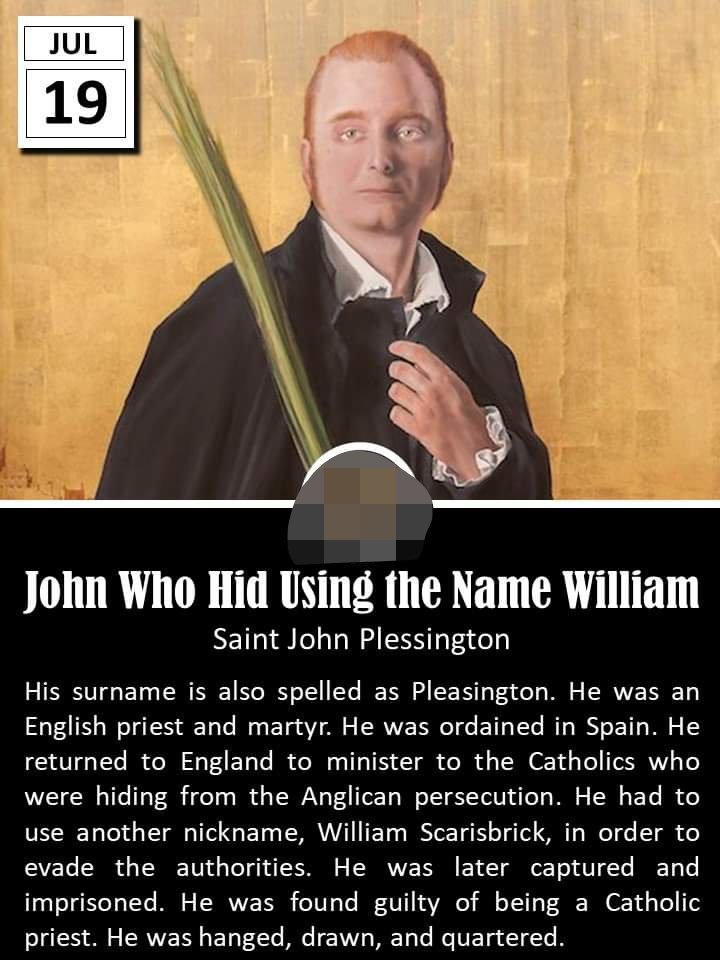
John Plessington (c. 1637 – 19 July 1679), also known as John Plesington, William Scarisbrick and William Pleasington, was an English Catholic priest who was executed by the English Crown for violating the ban on the presence of Catholic priests in the kingdom. He is now honored as one of the Roman Catholic Forty Martyrs of England and Wales.[1]
He was born at Dimples Hall, Garstang, Lancashire, the son of Robert Plessington, a Royalist Roman Catholic, and Alice Rawstone, a family thus persecuted for both their religious and political beliefs. He was educated by the Jesuits at Scarisbrick Hall, then at the Royal College of Saint Alban at Valladolid, Spain, and then at Saint Omer Seminary in France.
He was ordained in Segovia, Spain, on 25 March 1662. He returned to England in 1663 ministering to covert Catholics in the areas of Holywell and Cheshire, often hiding under the name John Scarisbrick. He was also tutor at Puddington Old Hall near Chester. In 1678 a fictitious conspiracy, known as the Popish Plot, was falsely alleged by Titus Oates. It claimed that there was an extensive Catholic plan to assassinate the King, Charles II.
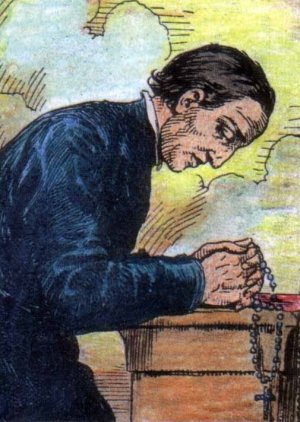
This led to anti-Catholic hysteria and the execution of at least 22 men; St John Plessington was among them. Upon arrest in Chester during the Popish Plot scare caused by Titus Oates, he was imprisoned for two months, and then hanged, drawn and quartered for the crime of being a Catholic priest. From the scaffold at Gallow’s Hill in Boughton, Cheshire, he spoke the following:
But I know it will be said that a priest ordained by authority derived from the See of Rome is, by the Law of the Nation, to die as a Traitor, but if that be so what must become of all the Clergymen of the Church of England, for the first Protestant Bishops had their Ordination from those of the Church of Rome, or not at all, as appears by their own writers so that Ordination comes derivatively from those now living.
Plessington was beatified in 1929 by Pope Pius XI, and canonized and made one of the Forty Martyrs on 25 October 1970 by Pope Paul VI. There is a memorial tablet to him located in the entrance porch of St Werburgh’s Catholic Church, Grosvenor Park Road, Chester, just a short distance from where he was executed. In 1980 his name was added to the base of the granite obelisk nearby that was erected in 1898 for the Protestant martyr George Marsh in Boughton, which has the following inscription:
John Plessington Catholic Priest, martyred here on 19th July 1679. Canonised Saint 25th October 1970

There is now a Catholic school called St. John Plessington in Wirral, England which won TES School of the Year 2010 out of England, Wales, Ireland and Scotland. In the early 21st century, a set of human bones found in an old trunk in Wales came to be regarded as possibly being Plessington’s remains. They had been found in the late 19th century, wrapped in 17th-century clothing, in a pub in Holywell, Flintshire.
This place had been known to be a secret gathering place for the Catholics of the region to worship covertly. This had been the region where he had carried out his ministry before his arrest. Showing signs of violence, the bones had been considered those of some anonymous martyrs of the period and entrusted to a community of the Society of Jesus in nearby Tremeirchion.
When a grave believed to have been Plessington’s was opened in 1962 as part of the process for his beatification, it was found to contain the remains of a younger man. Interest later focused on this set of remains. In 2015, Mark Davies, Roman Catholic Bishop of Shrewsbury, started a campaign to raise the funds for the testing of the DNA of the bones. His feast day is 19 July.
PRAYER
Saint John Plessington, you nurtured and thus saved the souls of many a Catholic, in the dangerous times of persecution, at the risk and cost of your own life, and will always be venerated as a martyr of the Faith.
Pray for us that we will love one another as Jesus loves us, regardless of culture or faith and profess our belief in Jesus the Lord. Amen
++++++++++++++++++++++++++++++++++
ALSO CELEBRATED
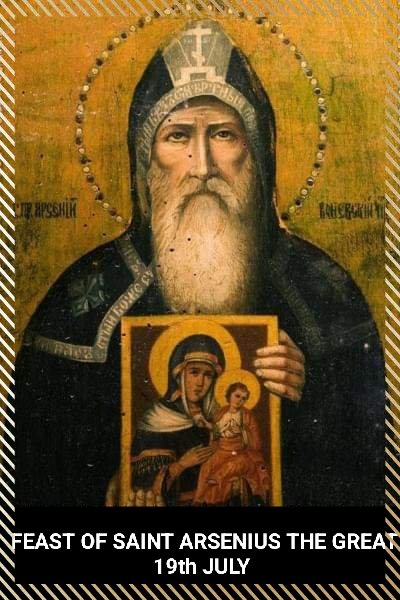
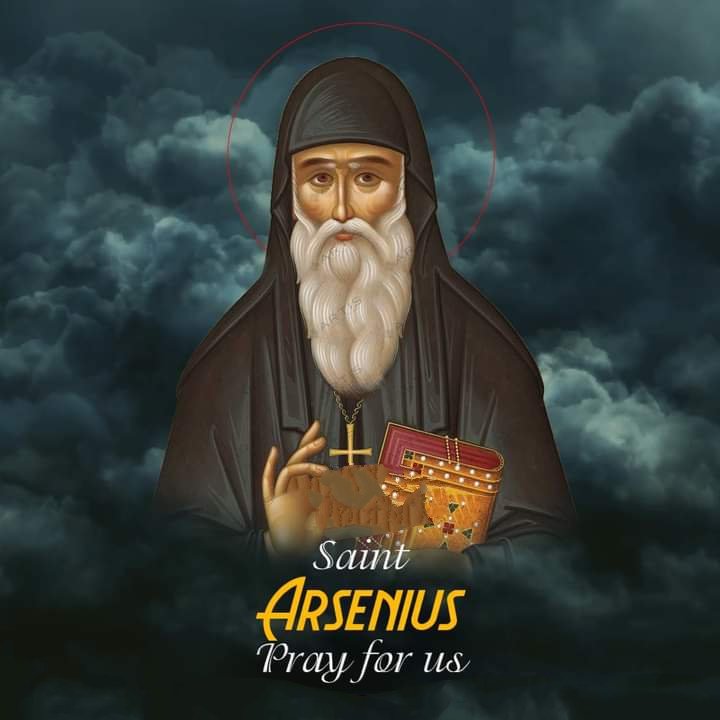
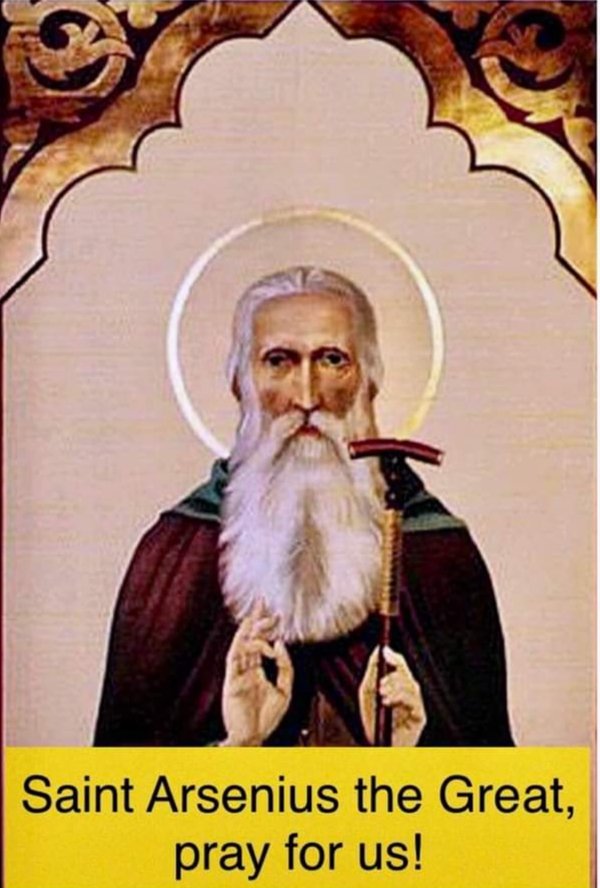
FEAST OF SAINT ARSENIUS THE GREAT
FEAST DAY – 19th JULY
He was born in 350 AD, in Rome to a Christian, Roman senatorial family. He received a fine education, studying rhetoric and philosophy, and mastered the Latin and Greek languages. After his parents died, his sister Afrositty was admitted to a community of virgins, and he gave all their riches to the poor, and lived an ascetic life. Arsenius became famous for his righteousness and wisdom.
Arsenius is said to have been made a deacon by Pope Damasus I who recommended him to Byzantine Emperor Theodosius I the Great, who had requested the Emperor Gratian and Pope Damasus around 383 to find him in the West a tutor for his sons (future emperors Arcadius and Honorius). Arsenius was chosen on the basis of being a man well read in Greek literature.
He reached Constantinople in 383, and continued as tutor in the imperial family for eleven years, during the last three of which he also had charge of his original pupil Arcadius’s brother, Honorius. Coming one day to see his sons at their studies, Theodosius found them sitting while Arsenius talked to them standing. This he would not tolerate, and caused the teacher to sit and the pupils to stand. On his arrival at court Arsenius had been given a splendid establishment, and probably because the Emperor so desired, he lived in great pomp.
While living in the Emperor’s palace, God gave him grace in the sight of everyone, and they all loved him. He lived a lavish life in the palace, but all the time felt a growing inclination to renounce the world. He left Constantinople and came by sea to Alexandria and fled into the wilderness. When he first presented himself to Macarius the Great, the father of the monks of Scetis, he recommended him to the care of John the Dwarf to try him.
Sometime around the year 400 he joined the desert monks at Scetes, Egypt, and asked to be admitted among the solitaries who dwelt there. John the Dwarf, to whose cell he was conducted, though previously warned of the quality of his visitor, took no notice of him and left him standing by himself while he invited the rest to sit down at table.
When the repast was half finished he threw down some bread before him, bidding him with an air of indifference eat if he would. Arsenius meekly picked up the bread and ate, sitting on the ground. Satisfied with this proof of humility, John kept him under his direction and tonsured him into monasticism.
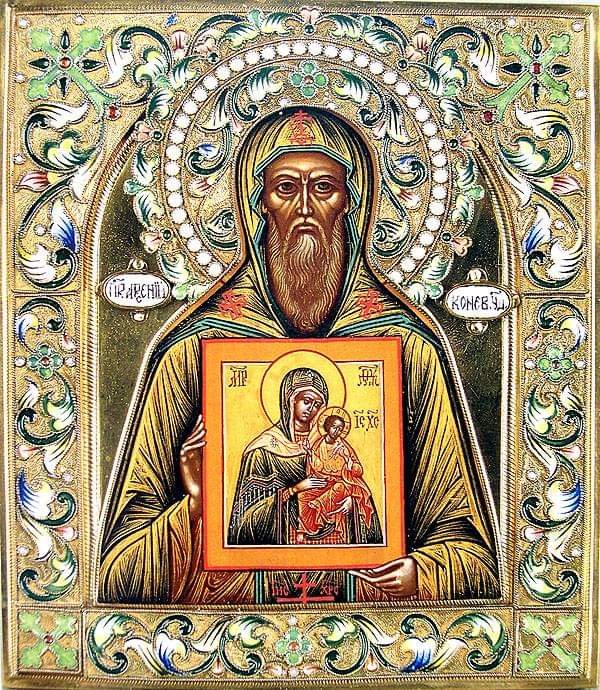
In 434 he was forced to leave due to raids on the monasteries and hermitages there by the Mazices (tribesmen from Libya). He relocated to Troe (near Memphis), and also spent some time on the island of Canopus (off Alexandria). He spent the next fifteen years wandering the desert wilderness before returning to Troe to die c. 445 at the age of around 95.
During the fifty-five years of his solitary life he was always the most meanly clad of all, thus punishing himself for his former seeming vanity in the world. In like manner, to atone for having used perfumes at court, he never changed the water in which he moistened the palm leaves of which he made mats, but only poured in fresh water upon it as it wasted, thus letting it become stenchy in the extreme.
Even while engaged in manual labour he never relaxed in his application to prayer. At all times copious tears of devotion fell from his eyes. But what distinguished him most was his disinclination to all that might interrupt his union with God.
When, after long search, his place of retreat was discovered, he not only refused to return to court and act as adviser to his former pupil, now Roman Emperor, Arcadius, but he would not even be his almoner to the poor and the monasteries of the neighbourhood. He invariably denied himself to visitors, no matter what their rank and condition and left to his disciples the care of entertaining them. A biography of Arsenius was written by Theodore the Studite.
Arsenius was a man who was very quiet and often silent, as evidenced by an adage of his: “Many times have I repented of having spoken, but never have I repented of having remained silent.”
PRAYER
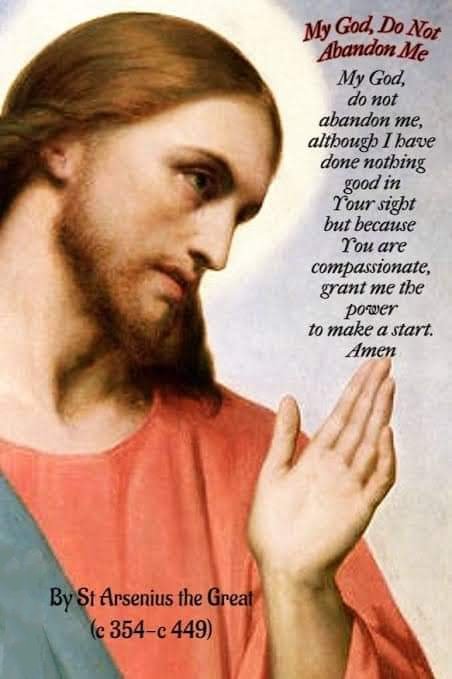
Saint Arsenius, by your exemplary life of silence, humility and fortitude has taught us the observance of virtues we ought to attain, to gain the reward of eternal life.
Pray for us all, to follow your example and renounce the riches of the world to live lives of wisdom and righteousness, in Jesus’ Name. Amen
*********************************
ALSO CELEBRATED:
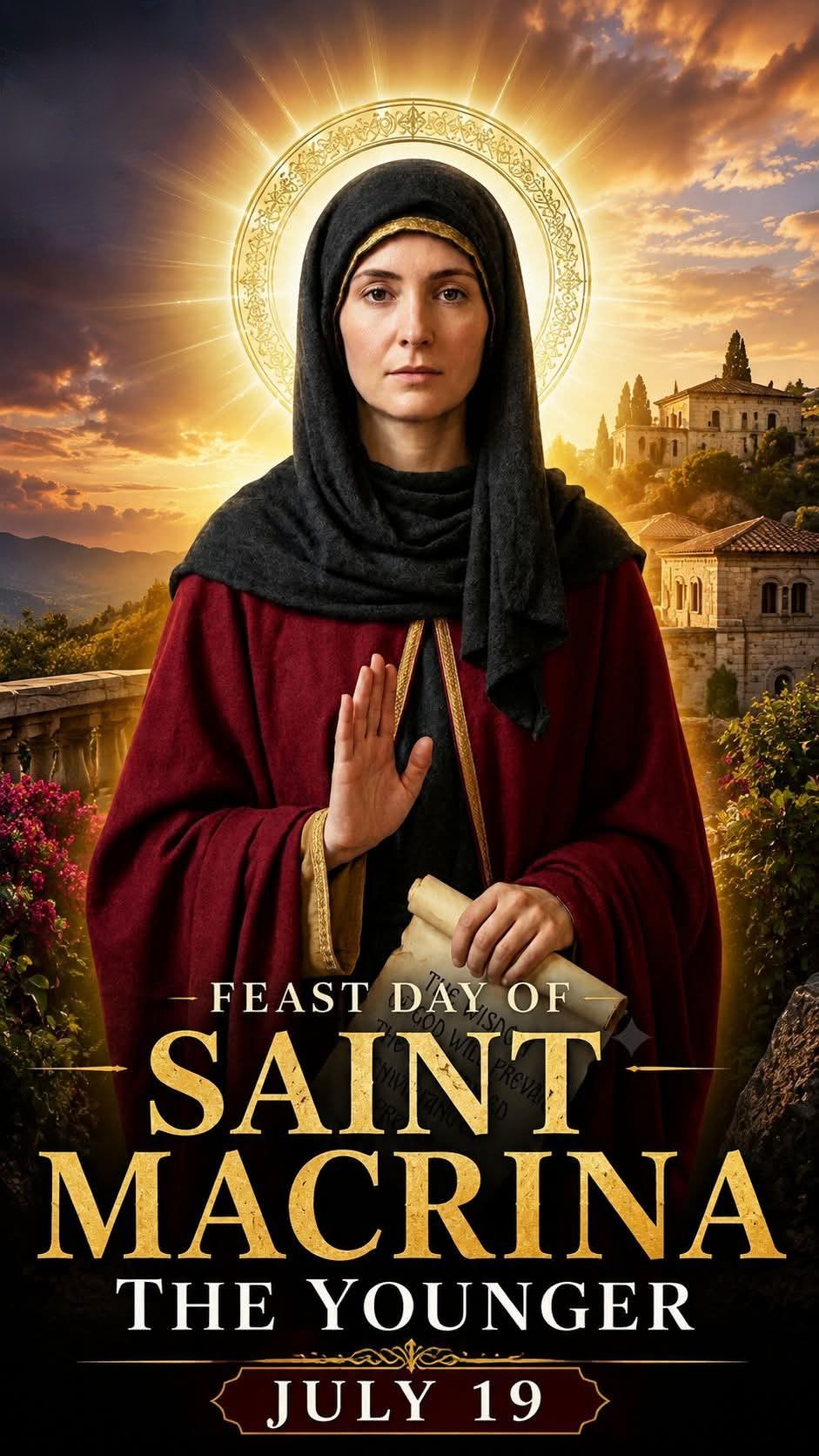
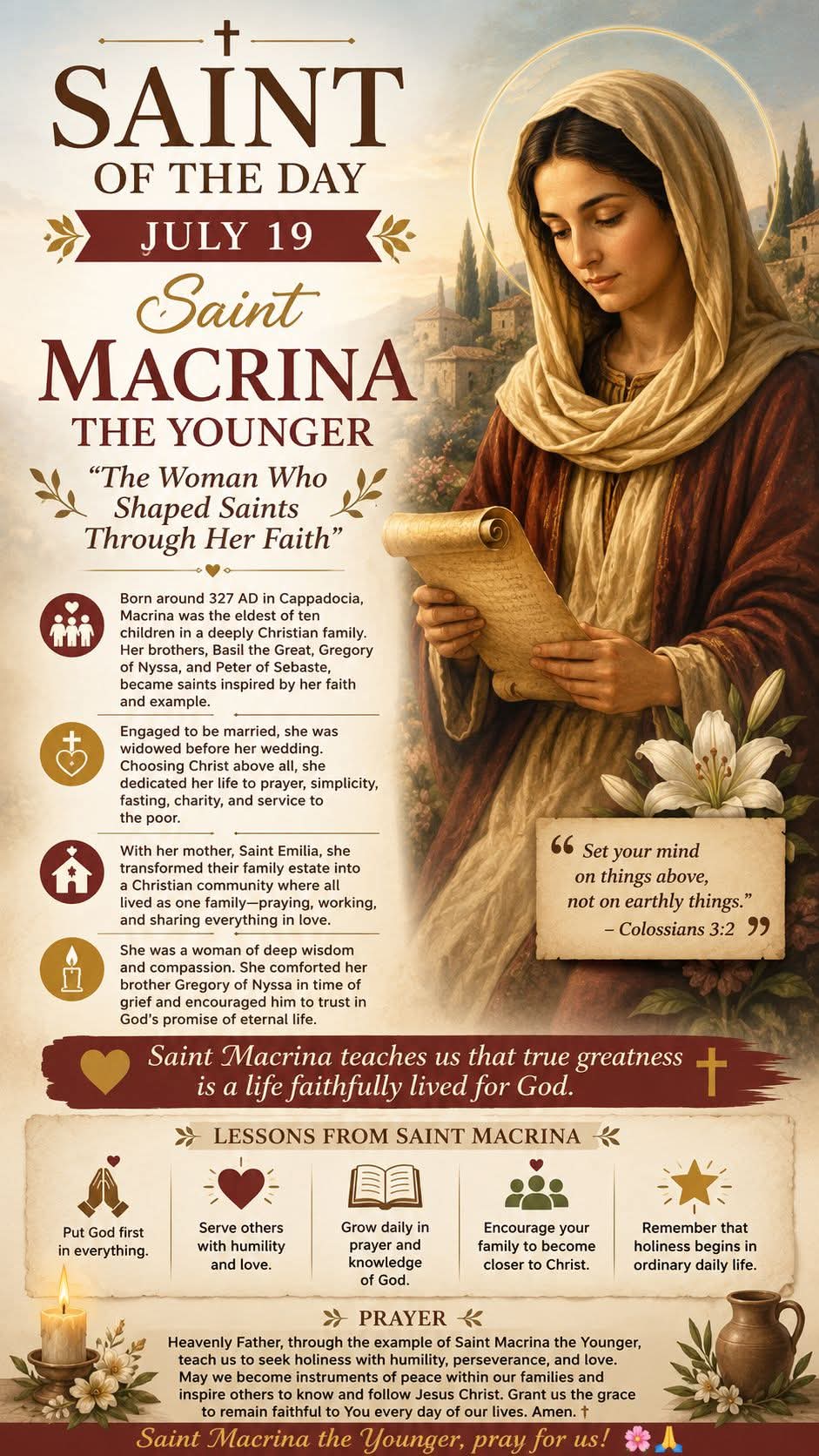
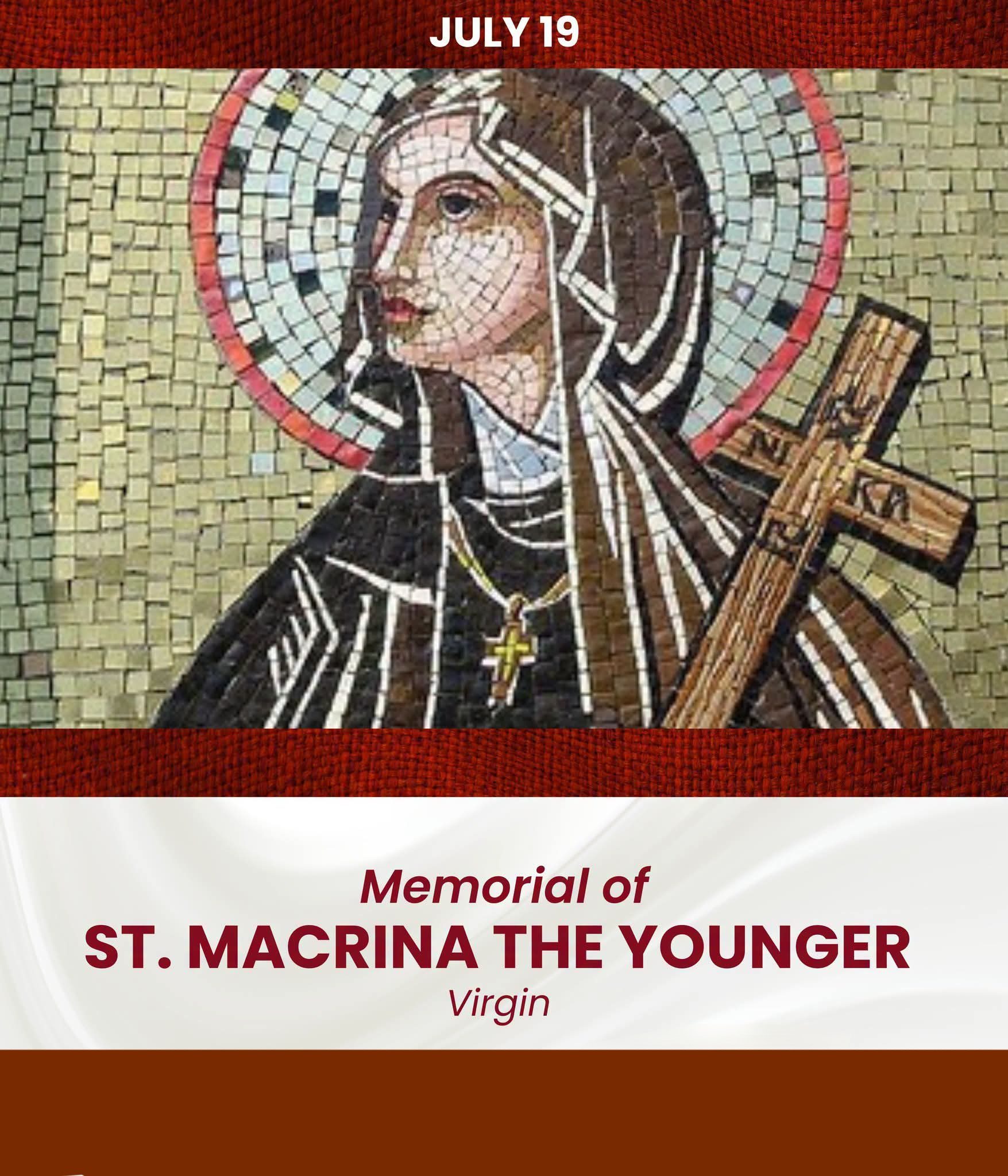
SAINT MACRINA THE YOUNGER – VIRGIN
“The Woman Who Shaped Saints Through Her Faith”
The Catholic Church honors Saint Macrina the Younger, a remarkable woman whose deep faith, wisdom, and holiness helped shape some of the greatest saints in Christian history. Though she never became famous through miracles or public preaching, her quiet life of prayer, sacrifice, and love transformed her family and the Church.
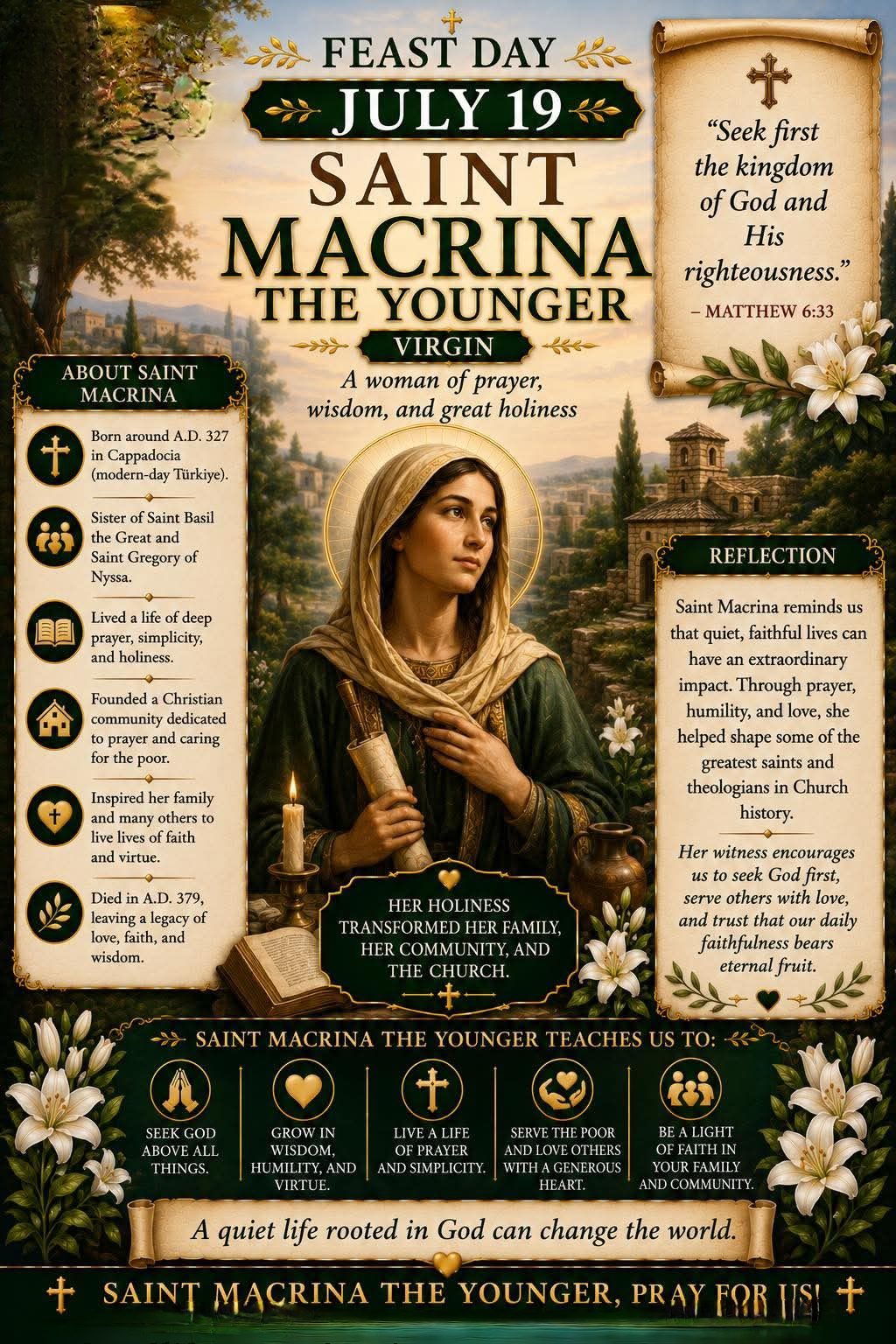
Born around 327 AD in Cappadocia (modern-day Turkey), Macrina came from a deeply Christian family. She was the eldest of ten children, and several of her siblings became saints, including Saint Basil the Great, Saint Gregory of Nyssa, and Saint Peter of Sebaste. Much of their holiness was inspired by Macrina’s example.
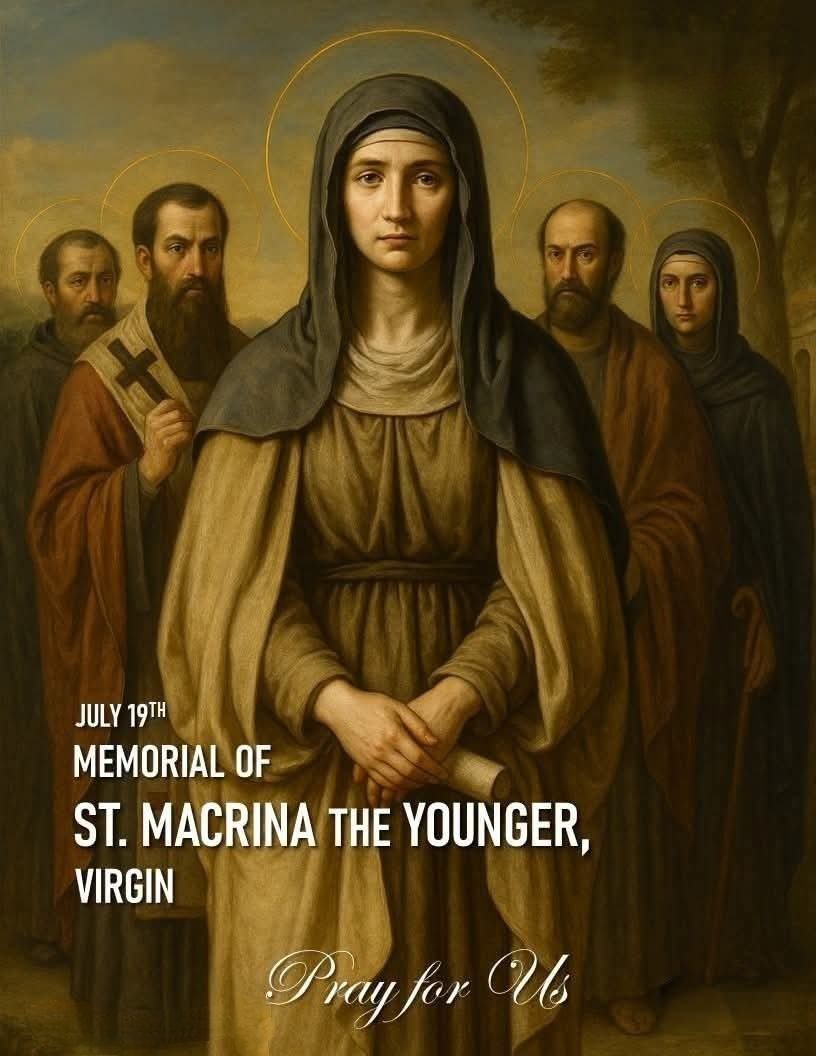
As a young woman, Macrina was engaged to be married. Sadly, her fiancé passed away before their wedding. Instead of seeking another marriage, she chose to dedicate her entire life to Christ. She embraced a life of prayer, simplicity, fasting, charity, and service to the poor.
Together with her mother, Saint Emilia, she transformed their family estate into a Christian community where people lived like one family—working, praying, and caring for one another. Rich and poor were treated equally, showing the love of Christ in daily life.
One of Macrina’s greatest gifts was encouraging others in times of sorrow. When her brother Saint Basil died, she comforted another brother, Gregory of Nyssa, reminding him to trust completely in God’s promise of eternal life. Gregory later wrote about her holy life, preserving her inspiring witness for generations.
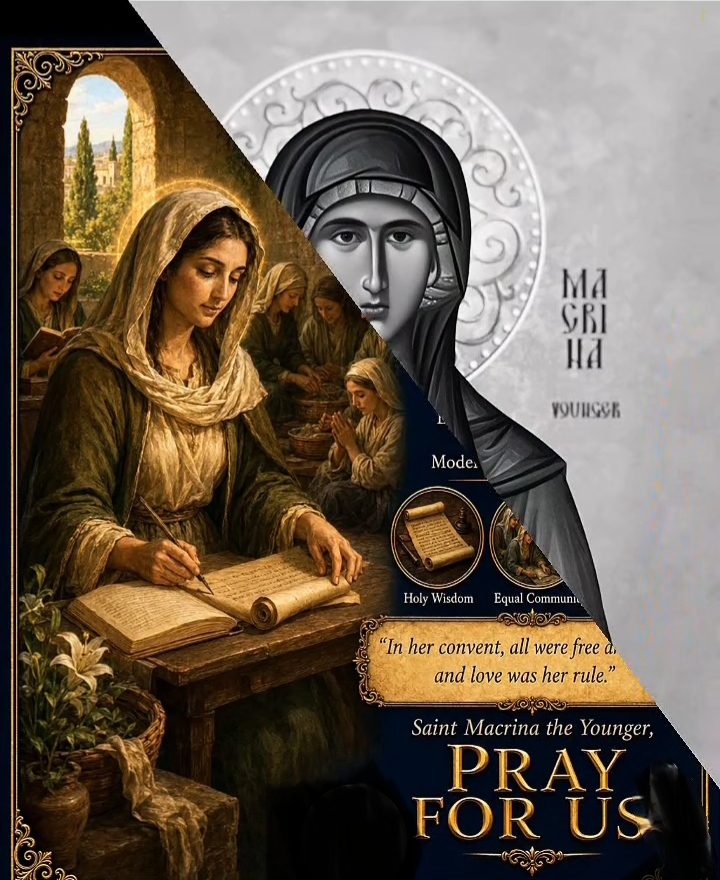
Saint Macrina teaches us that true greatness is not measured by wealth, popularity, or power, but by a life faithfully lived for God. She reminds us that parents, siblings, teachers, and ordinary believers can become saints simply by leading others closer to Jesus.
Lessons from Saint Macrina
Put God first in everything. Serve others with humility and love. Grow daily in prayer and knowledge of God. Encourage your family to become closer to Christ. Remember that holiness begins in ordinary daily life.
CONTEMPLATING THE LIFE OF SAINT MACRINA THE YOUNGER
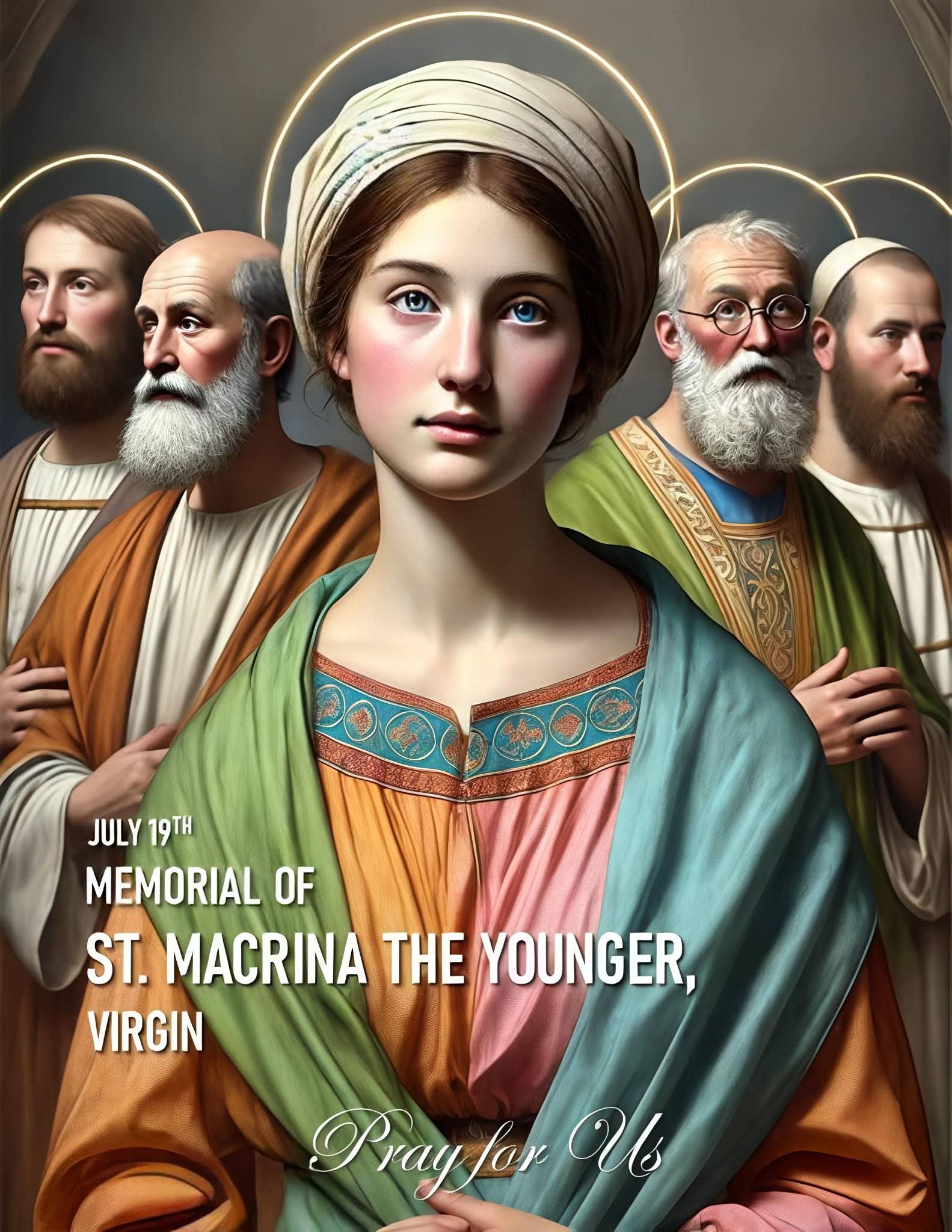
Saint Macrina the Younger (c. 327–379) is one of the greatest yet often overlooked women of the early Church. Though she held no public office, she profoundly influenced Christian history through her holiness, wisdom, and unwavering faith. She was the elder sister of Saints Basil the Great, Gregory of Nyssa, Peter of Sebaste, and several other holy siblings. Her life demonstrates that true greatness is found not in worldly recognition but in faithful service to God.
A CHILD FORMED BY FAITH
Macrina was born into a devout Christian family in Cappadocia (modern-day Türkiye). She was named after her grandmother, Saint Macrina the Elder, who had endured persecution for the faith. Her parents, Saints Basil the Elder and Emmelia, raised their children with deep love for Scripture, prayer, and virtue. From her earliest years, Macrina developed a profound relationship with God, making His Word the foundation of her life.
A LIFE CONSECRATED TO CHRIST
After the death of her fiancé before their marriage, Macrina chose to remain unmarried, considering herself forever united to him before God. She embraced a life of virginity and total dedication to Christ. Rather than seeking comfort or prestige, she transformed her family estate into a community of prayer, work, charity, and simplicity, where both family members and servants lived as equals in Christian fellowship.
THE TEACHER OF HER FAMILY
Macrina became the spiritual guide of her family. When her brilliant brother Basil returned from his studies filled with pride in his academic achievements, it was Macrina’s humility and wisdom that inspired him to pursue a life devoted entirely to Christ. Her influence also deeply shaped Gregory of Nyssa, who later described her as his teacher in the spiritual life. Through her example, she helped form some of the Church’s greatest theologians and bishops.
A MODEL OF PRAYER AND DETACHMENT
Macrina lived a disciplined life centred on prayer, fasting, manual labour, and meditation on Scripture. She embraced poverty with joy, trusted completely in God’s providence, and cared tenderly for the poor and the sick. Her peaceful spirit and freedom from worldly attachments reflected a heart wholly surrendered to Christ.
HER HOLY DEATH
As death approached, Macrina remained calm and filled with hope. Gregory of Nyssa was by her side and later recorded their final conversations in his work, “The Life of Macrina.” Even in her final moments, she spoke about the resurrection, eternal life, and complete trust in God’s mercy. She died with a prayer on her lips, leaving behind a powerful witness of Christian hope and serenity.
HER LASTING LEGACY
Saint Macrina’s influence reaches far beyond her own lifetime. Though she wrote no famous theological works, her holy life inspired those who did. The wisdom, charity, and steadfast faith she cultivated in her family helped shape the theological foundations of the early Church. She remains a shining example of how quiet fidelity can transform generations.
LESSONS FROM SAINT MACRINA
Saint Macrina teaches us that holiness begins at home, that genuine influence flows from humility, and that a life rooted in prayer bears lasting fruit. She reminds us that our greatest achievements are often the souls we help lead to God. Her life encourages every Christian to seek wisdom, practise charity, embrace simplicity, and trust completely in the promises of Christ.
A PRAYER THROUGH SAINT MACRINA
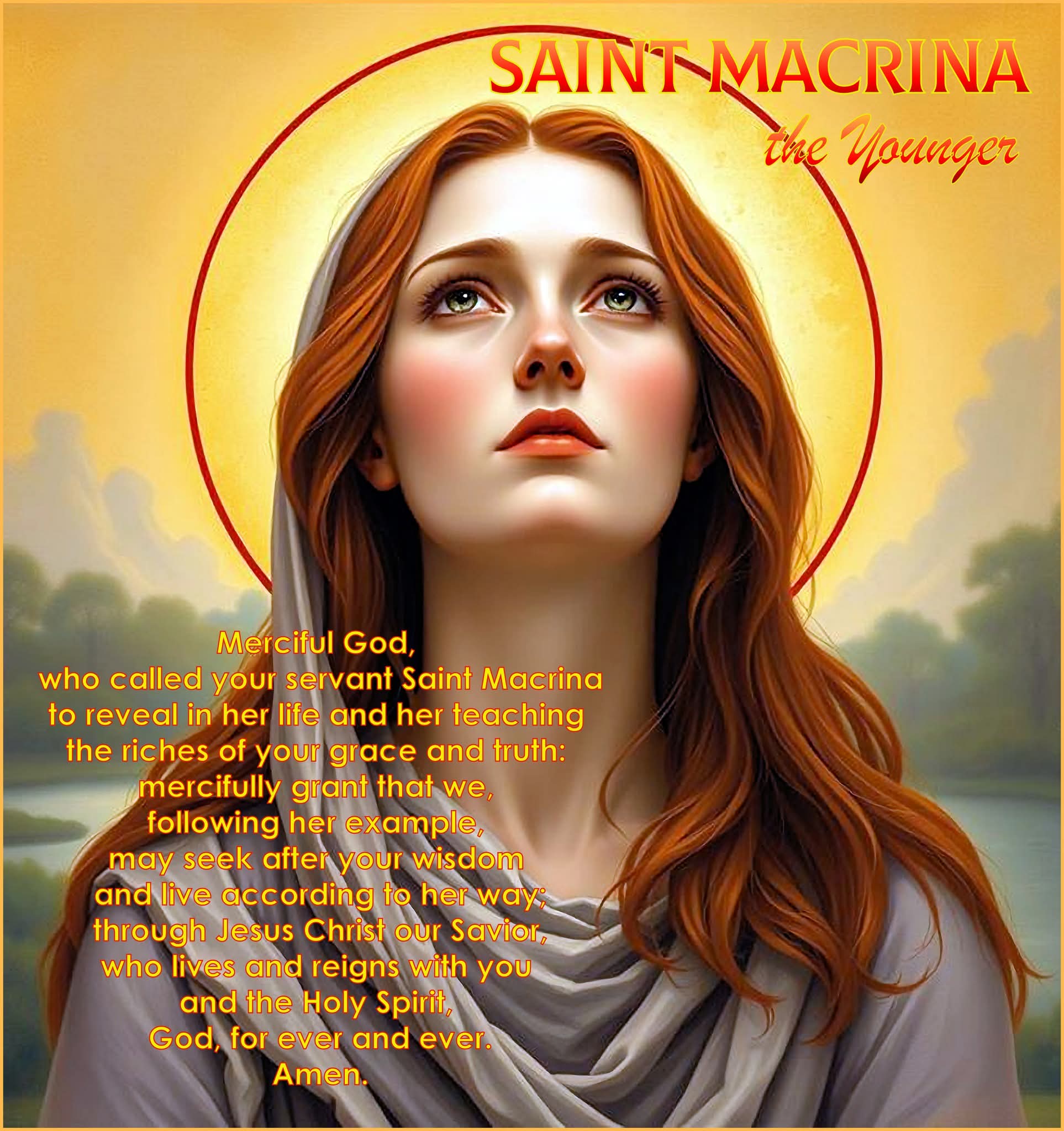
Saint Macrina the Younger, faithful disciple of Christ and wise guide of souls, pray for us. Help us to seek holiness with humility, to love God’s Word deeply, to strengthen our families through faith, and to remain steadfast in hope until we share the joy of eternal life. Amen
PRAYER
Heavenly Father, through the example of Saint Macrina the Younger, teach us to seek holiness with humility, perseverance, and love. May we become instruments of peace within our families and inspire others to know and follow Jesus Christ. Grant us the grace to remain faithful to You every day of our lives. Amen
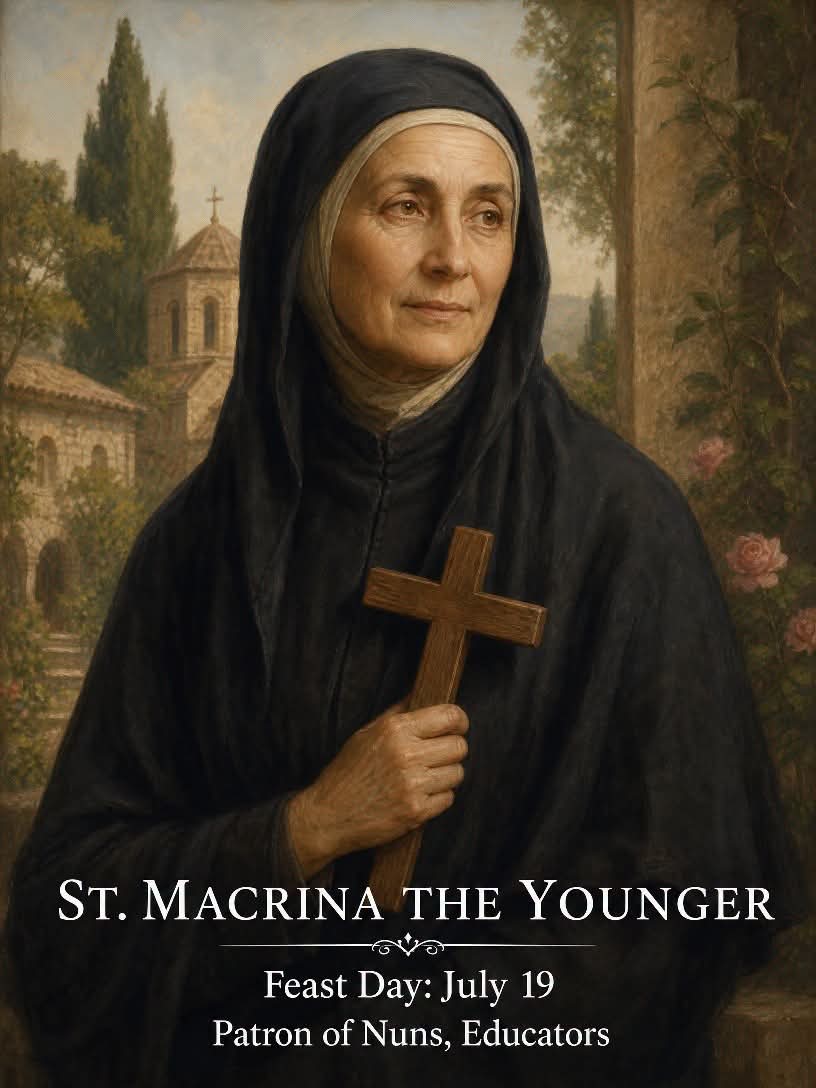
Saint Macrina the Younger, pray for us!