
SOLEMNITY OF THE BAPTISM OF THE LORD
January 11, 2026
1 Timothy 4:12
January 11, 2026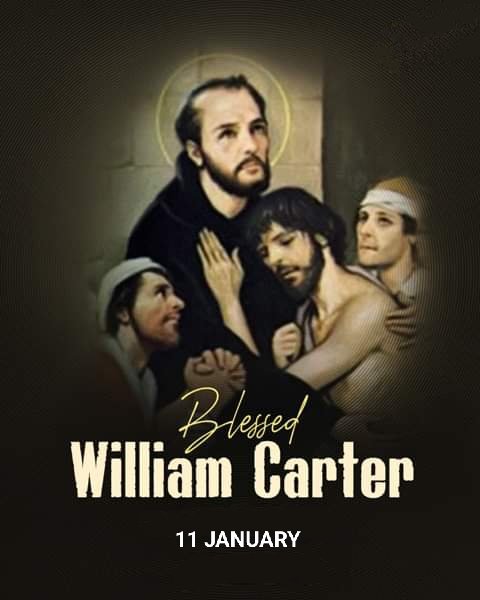
FEAST OF BLESSED WILLIAM CARTER
FEAST DAY – 11th JANUARY
William Carter was born in London in 1548, the son of John Carter, a draper, and Agnes, his wife. He was apprenticed to John Cawood, the queen’s printer, on Candlemas Day, 1563, for ten years, and afterwards acted as secretary to Nicholas Harpsfield, last Catholic archdeacon of Canterbury, while Harpsfield was prisoner in Fleet Prison.
On the latter’s death he married and set up a press on Tower Hill. In September 1578 he was confined for about a month in the Poultry Compter, a small prison run by a Sheriff in the City of London, apparently for failure to attend divine service as established by act of Parliament.
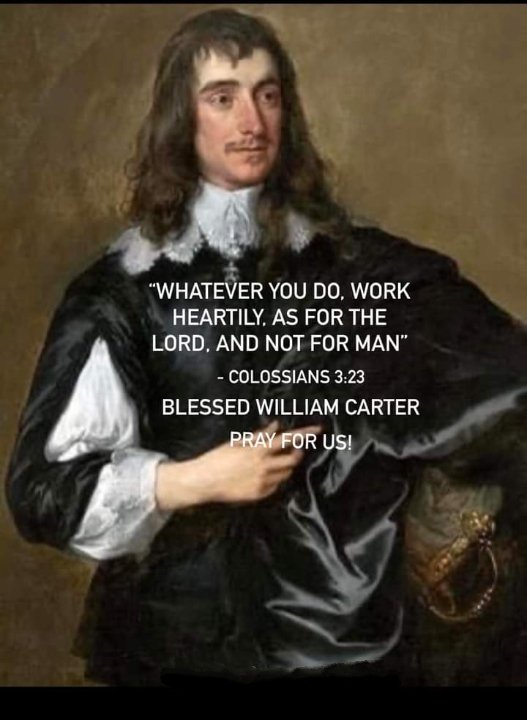
In December 1579 he was committed to the Gatehouse “for not conforming himself in matters of religion”. As the prisons were at that time unusually overcrowded he was released on bond in June 1581.
By that time it had become necessary to provide false information in colophons for safety’s sake. “Carter called himself Johannem Bogardi, and claimed his edition of a Peter Canisius book was actually printed in “Duaci” (Douay).” Among Catholic books he printed a new edition (1000 copies) of Gregory Martin’s “A Treatise of Schisme”, in 1580, for which he was arrested and imprisoned in the Tower of London, in1582, and paid for his own meals there down to midsummer, 1583. His wife died while he was in prison.
Having been tortured on the rack, he was indicted at the Old Bailey, the central criminal court in England, on 10 January 1584, for having printed Dr. Martin’s book, in which was a paragraph where confidence was expressed that the Catholic Hope would triumph, and pious Judith would slay Holofernes. This was interpreted as an incitement to assassinate the Queen.

It was alleged that the book incited violence by Catholics and was written by a traitor and addressed to traitors. At this time, with increasing tensions between Queen Elizabeth I of England and King Philip II of Spain, which would culminate with the sailing of the Spanish Armada four years later, manifestations of Catholic faith in England were often interpreted as treasonable, taking the side of the Spanish enemy and punished accordingly.
While William calmly placed his trust in God, the jury met for only 15 minutes before reaching a verdict of guilty. William, who made his final confession to a priest who was being tried alongside him, was hanged, drawn, and quartered the following day, at Tyburn, January 11, 1584, being executed for treason. He was beatified in 1987.
PRAYER
Eternal Father, in glory and honor of your Holy Name, Blessed William Carter fearlessly and fervently followed the faith, in the midst of persecution and trial. He bore witness to the faith in hope and righteousness.
May we too, by his example, bear all adversity, for the sake of your love. May we hasten towards you, Who are our only purpose, for you alone are life, in eternity, through Jesus Christ our Lord.Amen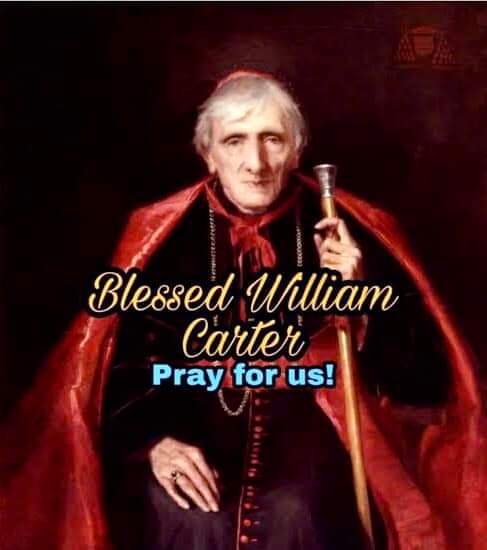
Blessed William Carter, pray for us.
=================================
ALSO CELEBRATED:
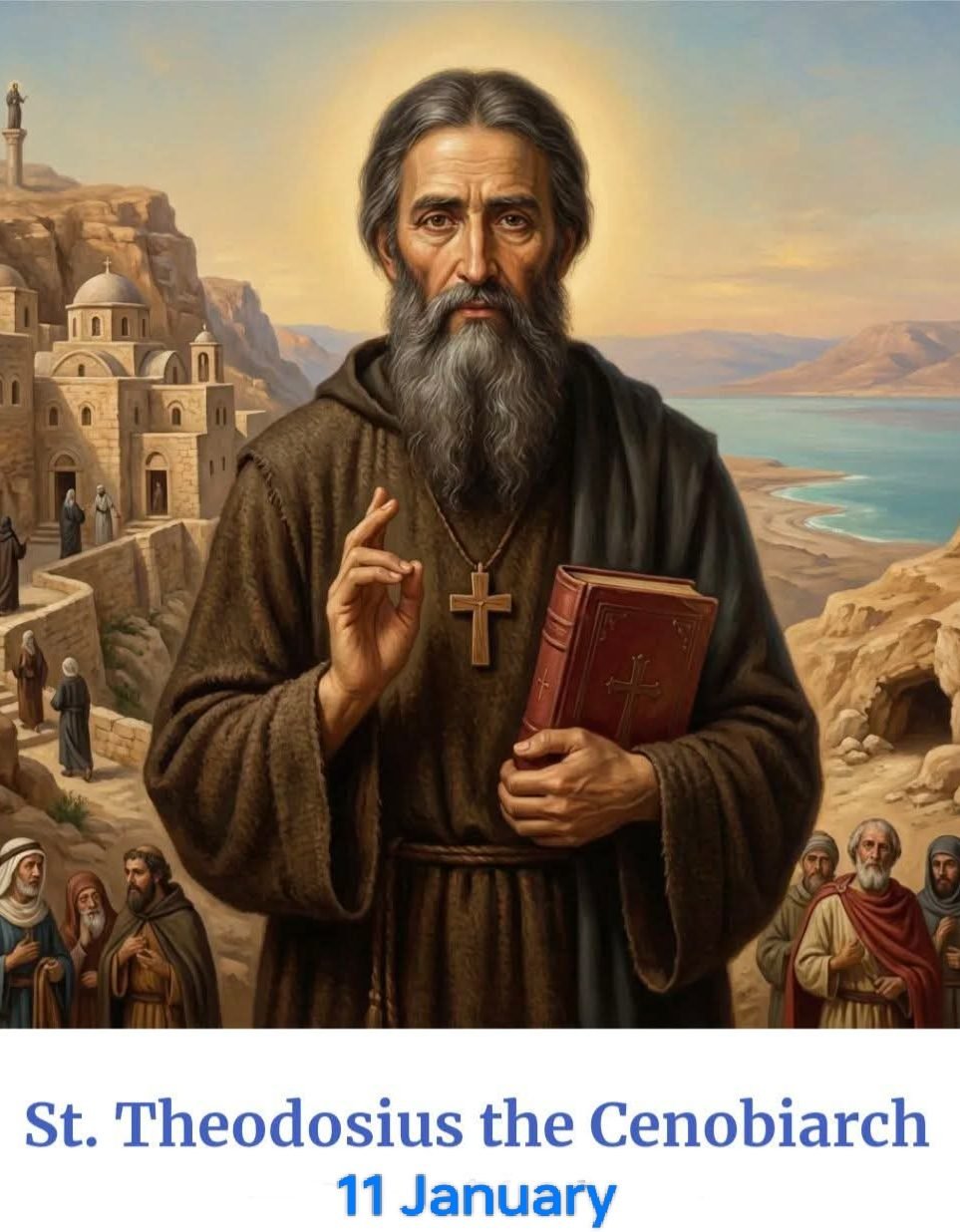
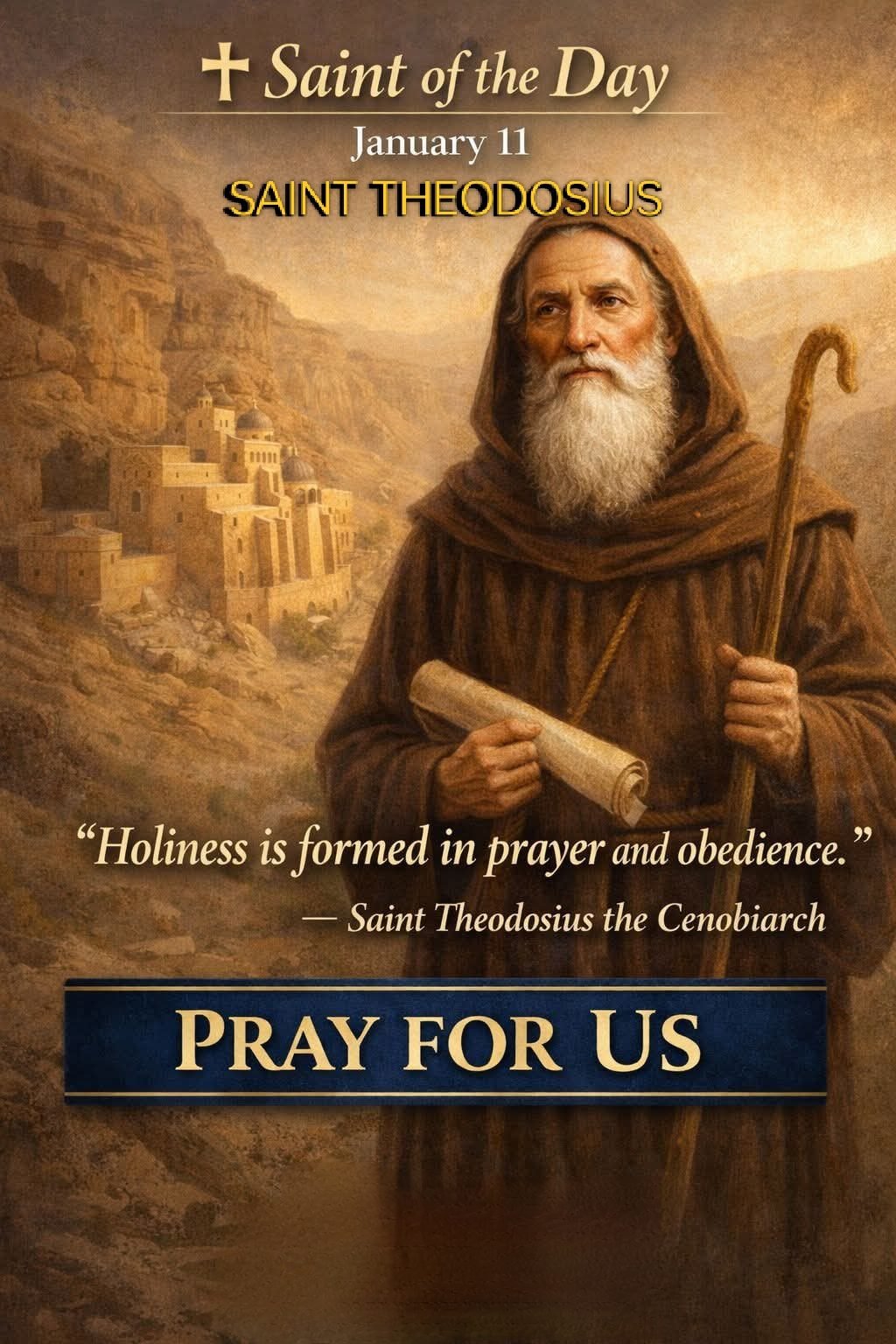
THEODOSIOS THE GREAT, THE CENOBITE – 11 JANUARY
Saint Theodosius the Great lived during the fifth-sixth centuries, and was the founder of cenobitic monasticism. He was born in Cappadocia of pious parents. Endowed with a splendid voice, he zealously toiled at church reading and singing. Saint Theodosius prayed fervently that the Lord would guide him on the way to salvation. In his early years he visited the Holy Land and met with Saint Simeon the Stylite (September 1), who blessed him and predicted future pastoral service for him.
Yearning for the solitary life, Saint Theodosius settled in Palestine into a desolate cave, in which, according to Tradition, the three Magi had spent the night, having come to worship the Savior after His Nativity. He lived there for thirty years in great abstinence and unceasing prayer. People flocked to the ascetic, wishing to live under his guidance. When the cave could no longer hold all the monks, Saint Theodosius prayed that the Lord Himself would indicate a place for the monks. Taking a censer with cold charcoal and incense, the monk started walking into the desert.
At a certain spot the charcoal ignited by itself and the incense smoke began to rise. Here the monk established the first cenobitic monastery, or Lavra (meaning “broad” or “populous”). Soon the Lavra of Saint Theodosius became renowned, and up to 700 monks gathered at it. According to the final testament of Saint Theodosius, the Lavra rendered service to neighbour, giving aid to the poor and providing shelter for wanderers.
Saint Theodosius was extremely compassionate. Once, when there was a famine in Palestine and a multitude of people gathered at the monastery, the monk gave orders to allow everyone into the monastery enclosure. His disciples were annoyed, knowing that the monastery did not have the means to feed all those who had come. But when they went into the bakery, they saw that through the prayers of the abba, it was filled with bread. This miracle was repeated every time Saint Theodosius wanted to help the destitute.
At the monastery, Saint Theodosius built a home for taking in strangers, separate infirmaries for monks and laymen, and also a shelter for the dying. Seeing that people from various lands gathered at the Lavra, the saint arranged for services in the various languages: Greek, Georgian and Armenian. All gathered to receive the Holy Mysteries in the large church, where divine services were chanted in Greek.
During the reign of the Byzantine Emperor Anastasius (491-518) there arose the heresy of Eutychius and Severus, which recognised neither the sacraments nor the clergy. The emperor accepted the false teaching, and the Orthodox began to suffer persecution. Saint Theodosius stood firmly in defence of Orthodoxy and wrote a letter to the emperor on behalf of the monks, in which they denounced him and refuted the heresy with the teachings of the Ecumenical Councils.
He affirmed moreover, that the desert-dwellers and monks would firmly support the Orthodox teaching. The emperor showed restraint for a short while, but then he renewed his persecution of the Orthodox. The holy Elder then showed great zeal for the truth. Leaving the monastery, he came to Jerusalem and in the church, he stood at the high place and cried out for all to hear: “Whoever does not honour the four Ecumenical Councils, let him be anathema!” For this bold deed the monk was sent to prison, but soon returned after the death of the emperor.
Saint Theodosius accomplished many healings and other miracles during his life, coming to the aid of the needy. Through his prayers he once destroyed the locusts devastating the fields in Palestine. Also by his intercession, soldiers were saved from death, and he also saved those perishing in shipwrecks and those lost in the desert.
Once, the saint gave orders to strike the semandron (a piece of wood hit with a mallet), so that the brethren would gather at prayer. He told them, “The wrath of God draws near the East.” After several days it became known that a strong earthquake had destroyed the city of Antioch at the very hour when the saint had summoned the brethren to prayer.
Before his death, Saint Theodosius summoned to him three beloved bishops and revealed to them that he would soon depart to the Lord. After three days, he died at the age of 105. The saint’s body was buried with reverence in the cave in which he lived at the beginning of his ascetic deeds.
PRAYER
By a flood of tears you made the desert fertile, and your longing for God brought forth fruits in abundance. By the radiance of miracles you illumined the whole universe! Our Father Theodosius, pray to Christ God to save our souls!
Planted in the courts of your Lord, you blossomed beautifully with virtue, and increased your children in the desert, showering them with streams of your tears, O chief shepherd of the divine flock of God. Therefore, we cry to you: “Rejoice, Father Theodosius.”