
Day Twenty of Lent – The Innocence of the Lamb of God
March 12, 2026
Romans 5:1
March 12, 2026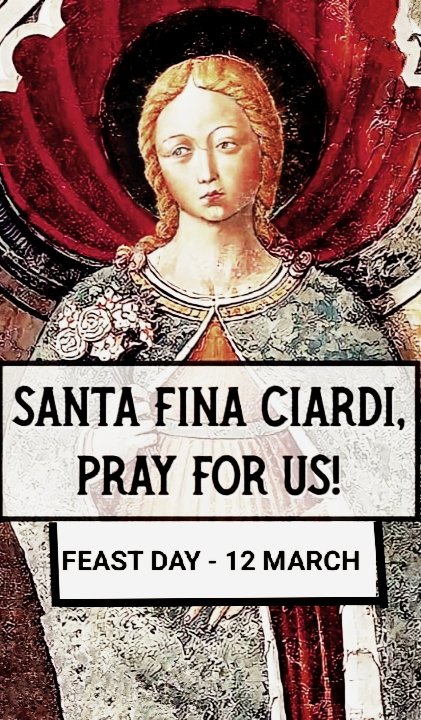
FEAST OF SAINT SERAPHINA (FINA)
FEAST DAY – 12 MARCH
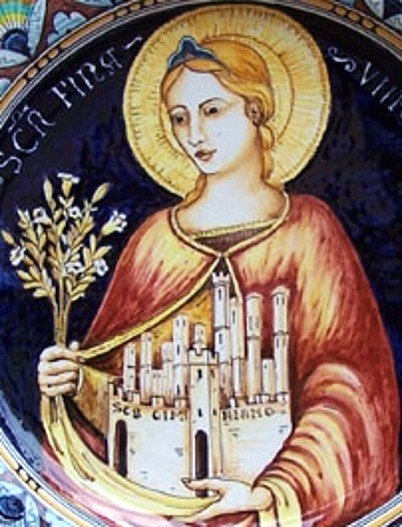
She was a little girl, very pretty, born into a very poor family, whose father died when she was very young. As a little girl she learned to sew and spin, spending most of her time at home.
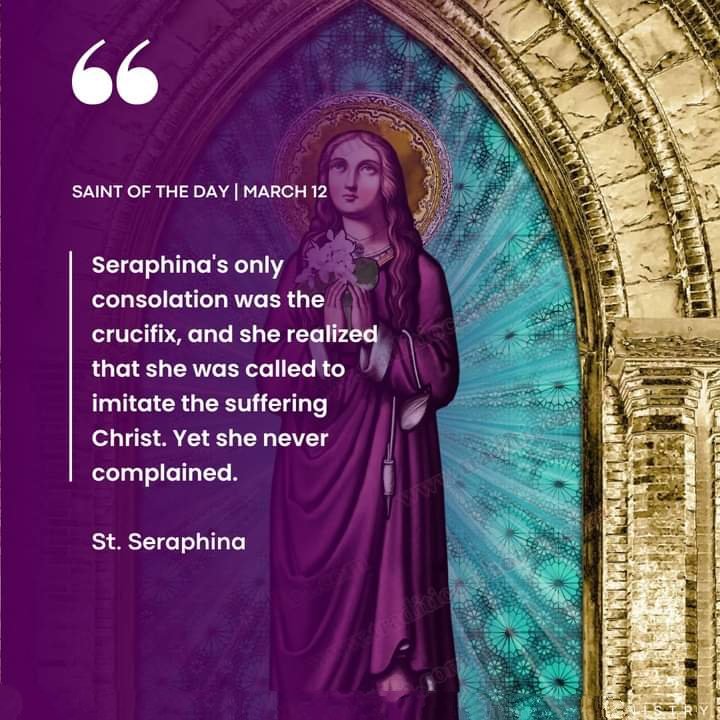
After her father’s death, she was struck with a strange and paralyzing illness. She became misshapen and ugly, in constant pain, unable to get out of bed or even to move. Her mother took care of her but had to leave her for hours at a time to attend to her work. Seraphina’s only consolation was the crucifix, and she realized that she was called to imitate the suffering Christ.
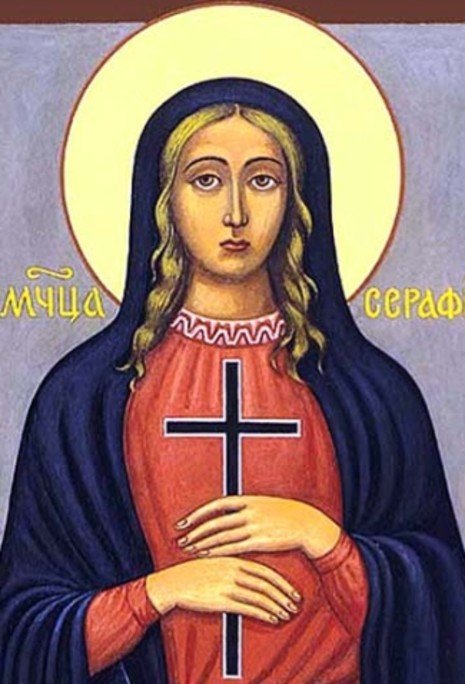
Yet she never complained. She managed to remain serene, and something beautiful shone out of her face. Then she was struck another blow. Her mother died, and she was left completely destitute, her neighbors repelled by her appearance and her sickness, her only friend a girl named Beldia who visited her and brought her food.
In her reading, St. Seraphina had heard of the great sufferings of Pope St. Gregory the Great and he became her special saint. She prayed to him, drew strength from the sufferings that he had to endure, and prayed that he would obtain for her the patience she needed to bear her own sufferings. She was now so weak and helpless that it was clear to everyone she could not live very long.
Eight days before her death, alone and almost completely forsaken, St. Gregory appeared to her and told her: “Dear child, on my feast day, God will give you rest” (in those days his feast day was celebrated on March 12). On that day, she died. The whole city attended her funeral and from that moment everyone began to pray to her. On the place where she had lain, her neighbors found white violets growing, and even today in the village of San Geminiano where she lived, the white violets that bloom in March are called Santa Fina flowers. She died on March 12,1253, at the age of fifteen.
Thought for the Day: Sufferings and pain are difficult for anyone to bear, and in St. Seraphina’s case they were a true martyrdom. Seraphina had to make sense out of it, young as she was. She drew strength from the sufferings of Jesus and found her happiness in God, in spite of her terrible afflictions. We have little reason to complain about ours.
From ‘The Catholic One Year Bible’: . . . “Don’t be so surprised. Aren’t you looking for Jesus, the Nazarene who was crucified? He isn’t here! He has come back to life! Look, that’s where his body was lying. Now go and give this message to his disciples including Peter: ‘Jesus is going ahead of you to Galilee. You will see him there, just as he told you before he died!'”—Mark 16:6-7
Taken from “The One Year Book of Saints” by Rev. Clifford Stevens
PRAYER
Eternal God, you have given us your Glorious Saint Seraphina, who was devoted to Jesus and Mary and who served you with humility and confidence.
She persevered till her very death, towards obtaining the crown of eternal life and gaining the joy of your beatific vision in Heaven.
We pray that through her powerful intercession, we may obtain the infinite goodness of your graces, through Christ our Lord. Amen

Saint Seraphina, pray for us and for all who implore your assistance. Amen
*******************************
ALSO CELEBRATED:
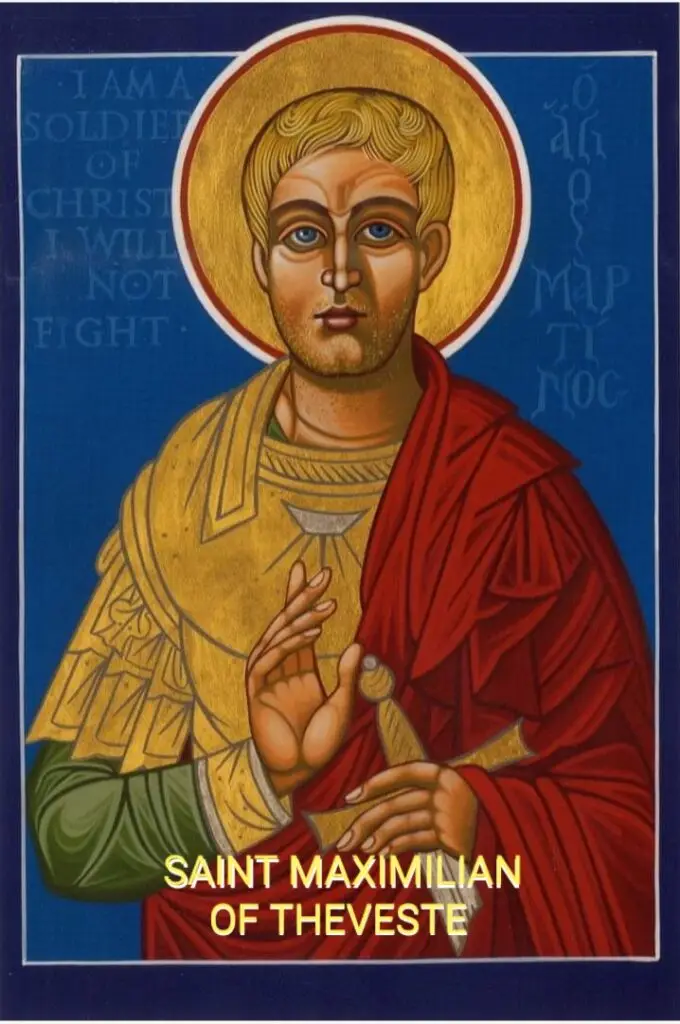
FEAST OF SAINT MAXIMILIAN OF THEVESTE
FEAST DAY – 12th MARCH
Saint Maximilian of Tebessa, (Theveste), also known as Maximilian of Numidia, (AD 274–295), was a Christian saint and martyr, whose feast day is observed on 12 March. Born in AD 274, the son of Fabius Victor, an official connected to the Roman army, Maximilian was obliged to enlist at the age of 21. He is noted as the earliest conscientious objector, although there have been other Christians at the time who refused military service and were executed.
In the African churches of the late Roman Empire, it was not uncommon for liturgies to include readings from the acts and passions of martyrs. The one often included for Saint Maximilian is the authentic record of his trial in Numidia (now Algeria) and execution for refusing to be conscripted into the Roman army. Maximilian resisted because he didn’t want to be tainted by the idolatry of wearing the emperor’s image around his neck.
Maximilian also refused because he was a pacifist, perhaps one of the earliest conscientious objectors. There has long been a debate within the Church concerning the radical pacifism advocated by Our Lord and the less stringent, but more practical, position allowing self-defense and just war.
Prior to the Edict of Milan and the toleration of Christianity, Christians believed that bearing arms contradicted the Gospel. Tertullian, for example, prohibited military service.
Saint Hippolytus said that it was impossible to be a soldier and a catechumen-as contradictory as being a prostitute and catechumen (at least part of his reasoning dealt with the association of soldiers with pagan gods and sacrifices). The Church moderated its position. The Council of Arles (314) said that soldiers who left the army during peace time would be excommunicated.
About 295, the proconsul Dion went to Theveste to recruit soldiers for the third Augustan legion stationed there. At this time the Roman army was mainly volunteers, but sons of veterans were obliged to serve. Maximilian, the 21-year-old son of the Roman army veteran Fabius Victor, was presented to the recruiting agent. The advocatus Pompeianus, seeing that Maximilian would make an excellent recruit, asked for him to be measured. He was 5’10”.
The ensuing dialogue between the proconsul Dion and Maximilian has been preserved to this day. When asked his name, Maximilian replied, “Why do you wish to know my name? I cannot serve because I am a Christian.” Nevertheless, orders were given for him to be given the military seal. He answered, “I cannot do it: I cannot be a soldier.” When told he must serve or die, he said, “You may cut off my head, but I will not serve. My army is the army of God, and I cannot fight for this world”.
It was pointed out to him that there were Christians serving as bodyguards for the emperors Diocletian and Maximian. To this he replied, “That is their business. I am a Christian, too, and I cannot serve.” Dion then told Victor to correct his son. Victor, who had become a Christian like his son, said, “He knows what he believes, and he won’t change his mind.” Dion insisted, but Maximilian would not agree to wear the seal.
He adamantly said, “I will not accept the seal of this world; if you give it to me, I will break it for it is worthless. I cannot wear a piece of lead around my neck after I have received the saving sign of Jesus Christ, my Lord, the son of the living God. You do not know Him; yet He suffered for our salvation: God delivered Him up for our sins. He is the one whom all Christians serve; we follow Him as the Prince of Life and Author of Salvation.”
Again Dion stated that there were other Christians who were soldiers.
Maximilian answered, “They know what is best for them. I am a Christian and I cannot do what is wrong.” Dion continued, “What wrong do those commit who serve in the army?” Maximilian answered, “You know very well what they do.” Threatened with death if he remained obstinate, Maximilian answered, “This is the greatest thing that I desire. Dispatch me quickly. Therein lies my glory.”
Then he added, “I shall not die. When I leave this earth I shall live with Christ my Lord.” He was sentenced accordingly. The verdict read, “Whereas Maximilian has disloyally refused the military oath, he is sentenced to die by the sword.” Just before his execution, Maximilian encouraged his companions to persevere and asked his father to give his new clothes to the executioner.
We are told that Fabius Victor “went home happily, thanking God for having allowed him to send such a gift to heaven.” The day was 12th March, 295. The place of Maximilian’s death is given as Theveste (Tebessa) in Numidia, but it may have been nearer Carthage, where his body was taken for burial by a devout woman named Pompeiana. It was buried close to the relics of Saint Cyprian.
The Order of Maximilian, a group of American clergy opposed to the Vietnam War in the 1970s, took their name from him. Maximilian’s name has been regularly read out, as a representative conscientious objector from the Roman Empire, at the annual ceremony marking International Conscientious Objectors’ Day, 15 May, at the Conscientious Objectors Commemorative Stone, Tavistock Square, Bloomsbury, London.
PRAYER
Grant, O Lord Jesus, that we too may give ourselves entirely, without reserve, to the love and service of our God, not fearing persecution and death, in imitation of your humble servant, Maximilian. Amen
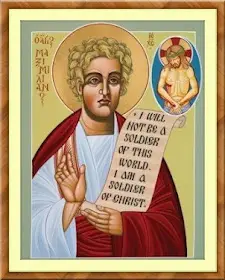
Saint Maximilian of Theveste, pray for us, that we will retain the courage to hold firm to our faith despite the trials. Amen
*********************************
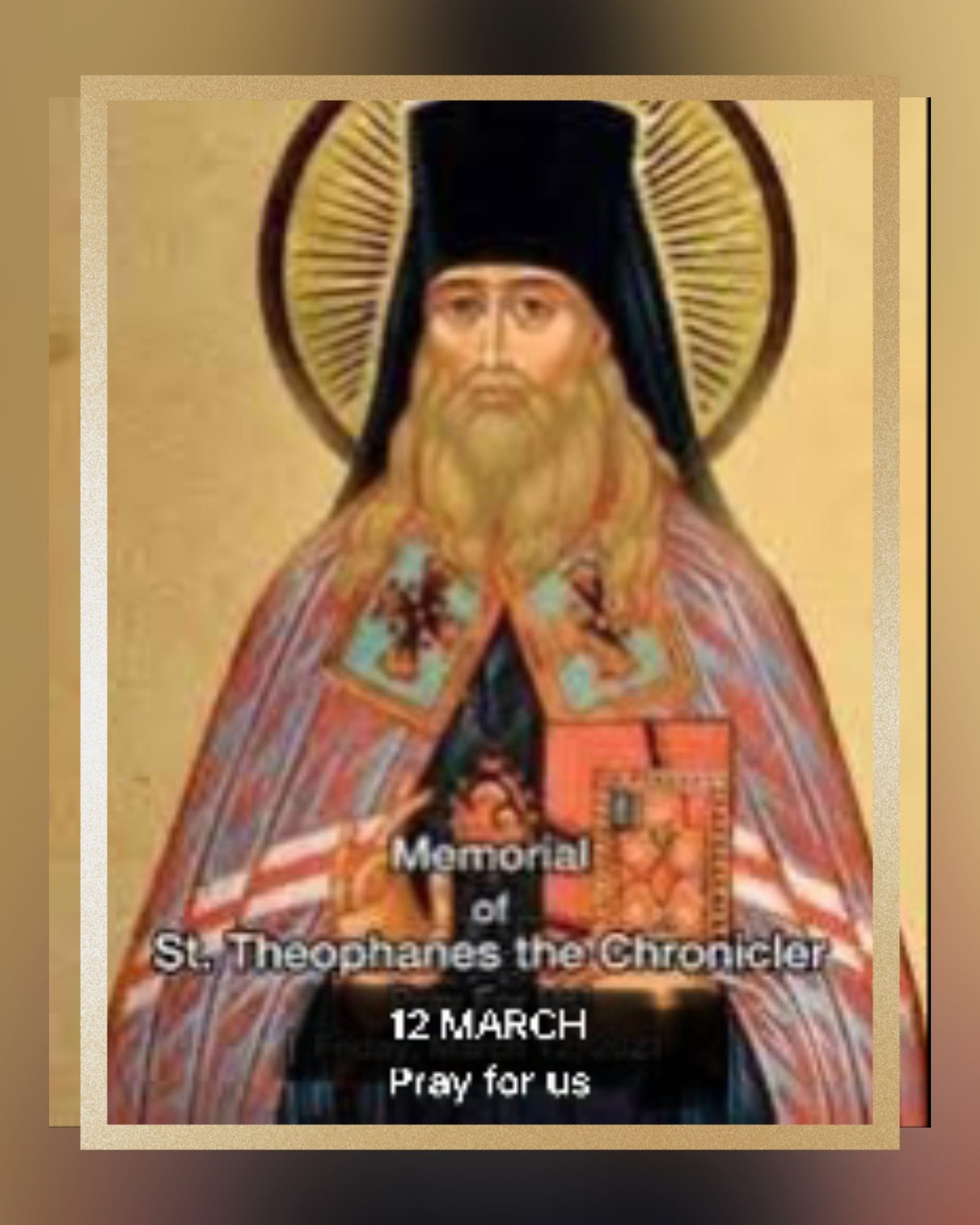
VENERABLE THEOPHANIES THE CONFESSOR OF SIGRIANE
COMMEMORATED ON MARCH 12th:
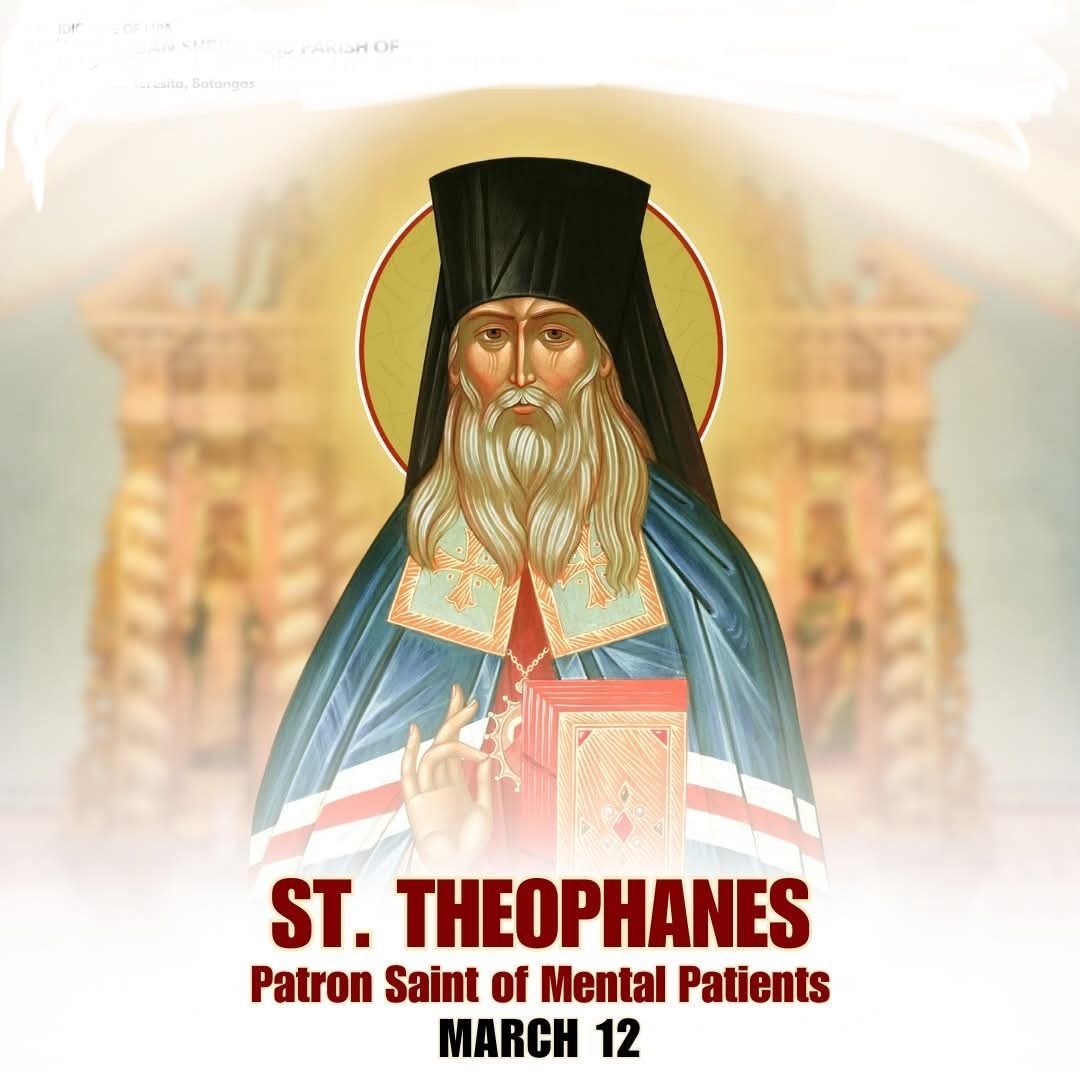
Saint Theophanes the Confessor was born in 759 at Constantinople into a pious and renowned family. His father was a relative of the Byzantine emperor Leo the Isaurian (717-741). Three years after Theophanes was born, his father died, leaving his family under the care of the emperor himself.
Theophanes grew up at the court and became a dignitary under the emperor Leo IV the Khazar (775-780). His position obliged him to enter into marriage, but he persuaded his bride to live with him in virginity.
After the death of his parents, Theophanes and his wife visited monasteries in the Sygrian district (Asia Minor). Theophanes met the Elder Gregory Stratitios, who predicted to Theophanes’ wife that her husband would earn the crown of martyrdom.
Later the wife of Theophanes was tonsured a nun in one of the monasteries in Bithynia, and Theophanes went to a monastery in the Cyzicus region. With the blessing of his Elder, Theophanes founded the Kalonymon monastery on an island in the Sea of Marmara and secluded himself in his cell, transcribing books. Theophanes attained a high degree of skill in this occupation.
Later, Saint Theophanes founded another monastery in Sygria, at a place called the “Big Settlement”, and became its igumen. He participated in all the work of the monastery, and was an example to all in his love for work and ascetical effort. He received from the Lord the gift of wonderworking, healing the sick, and casting out demons.
The Seventh Ecumenical Council met in Nicea in 787, which condemned the heresy of Iconoclasm. Saint Theophanes was also invited to the Council. He arrived dressed in his tattered garments, but he revealed his wisdom in affirming the veneration of the holy icons.
At the age of fifty, Saint Theophanes fell grievously ill and he suffered terribly until the day he died. Even on his deathbed, the saint continued to work. He wrote his CHRONOGRAPHIA, a history of the Christian Church covering the years 285-813. This work has remained an invaluable source for the history of the Church.
During the reign of the emperor Leo the Armenian (813-820), when the saint was advanced in age, the Iconoclast heresy returned. They demanded that Saint Theophanes accept the heresy, but he firmly refused and was locked up in prison. His “Big Settlement” monastery was put to the torch. The holy confessor died in 818 after twenty-three days in prison.
After the death of the impious emperor Leo the Armenian, the “Big Settlement” monastery was restored and the relics of the holy confessor were transferred there.
CONTEMPLATING THE LIFE OF SAINT THEOPHANES THE CONFESSOR (c. 758-817)
Theophanes the Confessor was a Byzantine monk, historian, and defender of the veneration of sacred images (icons) during the period of intense controversy in the Byzantine Empire known as Byzantine Iconoclasm.
He is honored as a “Confessor”, meaning he suffered persecution for the faith but did not die by execution. His courage in defending the use of icons made him one of the important spiritual witnesses of the Eastern Church.
THE MONK WHO DEFIED AN EMPEROR: THE WITNESS OF ST. THEOPHANES THE CONFESSOR.
Background and Early Life
In the great imperial city of Constantinople, power and politics shaped the lives of many.
Palaces glittered with gold. Emperors ruled vast territories stretching across continents. Generals marched armies through distant lands.
Among the noble families of the city was born a boy named Theophanes in 758 AD.
After the death of his father, he was raised under the protection of Constantine V.
His future seemed clear.
With his noble birth and education, he was destined for influence in the imperial court.
But God had planted a different desire in his heart.
A Nobleman Who Chose God
As a young man, Theophanes entered public service in the imperial administration. Yet the life of power and prestige left him restless.
Even his marriage followed the customs of noble families. But something remarkable happened. Both he and his wife shared a longing for a deeper life with God.
After mutual agreement, they chose to live in complete continence and eventually separated to enter religious life. For Theophanes, this meant leaving behind wealth, honor, and influence. He became a monk.
The Monastery of Silence
Far from the noise of the imperial court, Theophanes eventually founded a monastery on the island of Calonymos and later another monastery at Megas Agros in Bithynia (modern-day Turkey).
His life as a monk was marked by:
* strict asceticism
* intense prayer
* generosity to the poor
* hospitality toward travelers and monks.
Travelers and the poor always found a welcome in his monastery. Though he had once lived among nobles, he now embraced simplicity. But his influence did not disappear. His wisdom attracted monks and pilgrims seeking spiritual guidance.
The Historian
In addition to being a monk, Theophanes was also an important historian.
He wrote a major work called the Chronographia, a historical chronicle covering events from the early Christian centuries up to his own time.
This work became one of the most valuable historical sources for Byzantine history.
His writings preserved information about:
* emperors
* wars
* church controversies
* cultural developments.
A Storm in the Empire
During those years the Byzantine world was torn apart by a fierce religious controversy known as Byzantine Iconoclasm. Some emperors believed that sacred images of Christ and the saints should be destroyed.
Others defended the ancient Christian practice of honoring icons. For defenders of icons, the issue was deeply theological.
If Christ truly became human, then His image could be depicted. Theophanes firmly supported the Church’s teaching confirmed by the Second Council of Nicaea. But not all accepted this decision.
The Emperor’s Demand
When Leo V the Armenian came to power, he revived the persecution of those who defended icons. Theophanes’ reputation had spread throughout the empire. The emperor summoned him.
Standing before imperial authority, Theophanes was ordered to reject the veneration of icons. For many people, such pressure would have been overwhelming. But Theophanes remained calm. He refused.
The Price of Fidelity
The emperor reacted with fury. Theophanes was imprisoned. For two years he endured harsh conditions. His monastery was confiscated and destroyed. Eventually he was exiled to the remote island of Samothrace.
His body had grown weak from suffering, but his faith remained unshaken. Shortly after arriving in exile, he died in 817 AD.
Though he was not executed, the Church honored him as a Confessor — one who suffered for defending the faith.
Legacy
St. Theophanes is remembered both as:
* a defender of sacred tradition, and
* one of the most important Byzantine historians.
His life reminds the Church that faithfulness sometimes requires standing against powerful forces.
In summary
St. Theophanes the Confessor stands as a witness of courage, scholarship, and deep faith. Through his defense of sacred icons and his perseverance in suffering, he became a symbol of fidelity to the truth of the Incarnation and the traditions of the Church.
PRAYER
St. Theophanes, steadfast defender of the faith, pray for us as we seek to remain faithful to Christ in the face of challenges. Help us to use our resources for good, stand firm in truth, and trust in God’s will, even in hardship. May we, like you, hold fast to the beauty of the faith and share it with those around us. Amen