
Day Twenty-One of Lent – The Scourging and Mockery
March 13, 2026
Genesis 1:1
March 13, 2026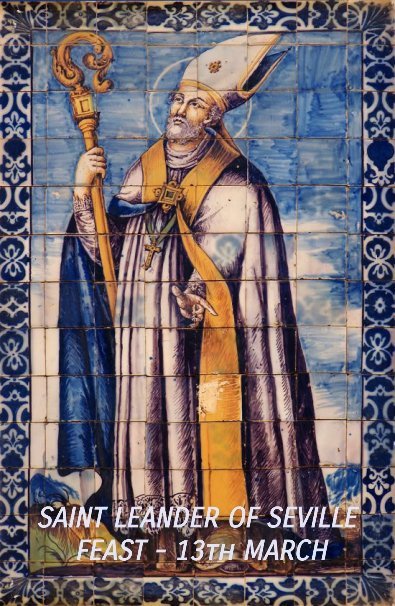
FEAST OF SAINT LEANDER OF SEVILLE
FEAST DAY – 13th MARCH
St Leander of Seville was the son of Severianus and Theodora. He was born in 534 AD at Cartagena, Spain. His family was known for their sanctity. They belonged to an elite family of Hispano-Roman stock of Carthago Nova. Their father is claimed to have been a dux or governor of Cartagena, though this seems more of a fanciful interpretation since Isidore simply states that he was a citizen. The family were staunch Catholics, as were most of the Romanized population. The Visigothic nobles and the kings were Arians.
The family moved to Seville around 554. The children’s subsequent public careers reflect their distinguished origin. Leander and Isidore both became bishops of Seville, and their sister Saint Florentina was an abbess who directed forty convents and one thousand nuns. The third brother, Fulgentius, was appointed Bishop of Écija. All four siblings are considered saints of the Roman Catholic Church.
There was less Visigothic persecution of Catholics than legend and hagiography have painted. From a modern standpoint, the dangers of Catholic Christianity were more political. The Catholic hierarchy were in collusion with the representatives of the Eastern Roman or Byzantine emperor, who had maintained a considerable territory in the far south of Hispania ever since his predecessor had been invited to the peninsula by the former Visigothic king several decades before.
Leander, enjoying an elite position in the secure surroundings of tolerated Catholic culture in Seville, became, around 576, a Benedictine monk, and then in 579 he was appointed bishop of Seville. In the meantime he founded a celebrated school, which soon became a center of Catholic learning. As bishop he had access to the Catholic Merovingian princess Ingunthis, who had come as a bride for the kingdom’s heir, and he assisted her to convert her husband Hermenegild, the eldest son of Liuvigild.
Leander defended the new convert even when he went to war with his father “against his father’s cruel reprisals”. Pierre Suau puts it, “In endeavoring to save his country from Arianism, Leander showed himself an orthodox Christian and a far-sighted patriot.” St Leander converted both Saint Hermengild and Prince Reccared, the sons of the Arian Visigoth King Leovigild, who then exiled Leander to Constantinople from 579 to 582.
When the rebellion failed, he withdrew to Byzantium – perhaps quite hastily – from 579 to 582. It is possible, but not proven, that he sought to rouse the Byzantine Emperor Tiberius II Constantine to take up arms against the Arian king; but in any case the attempt was without result. He profited, however, by his stay at Byzantium to compose works against Arianism, and there became acquainted with the future Pope Gregory the Great, at that time legate of Pope Pelagius II at the Byzantine court.
A close friendship united the two men, and some of their correspondence survives. It was he who recommended that Gregory write his famous commentary (Moralia) on the book of Job. In 585, Liuvigild put to death his intransigent son Hermenegild, who is a martyr and saint of the Catholic Church and also of the Eastern Orthodox Church. Liuvigild himself died in 589. It is not known exactly when Leander returned from exile, but he had a share in the conversion of Reccared the heir of Liuvigild, retaining an influence over him.
When Reccared levitated the throne, St Leander was allowed to go back to Seville. He worked against Arianism and presided over the Third Council of Toledo on 589. Leander revised and unified the Spanish liturgy, and his boundless energy and steady faith led the Visigoths back to orthodox Christianity. He wrote an influential Rule for nuns. Leander introduced the Nicene Creed to Mass in the west. He was honored as a Doctor of the Faith by the Church in Spain.
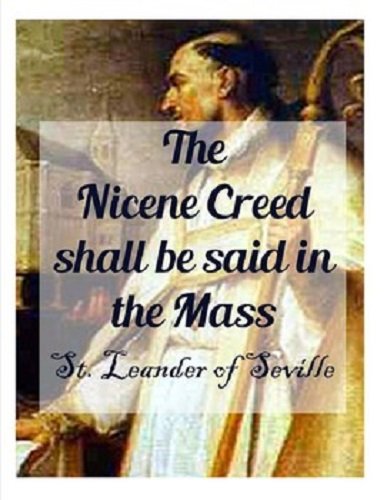 Leander introduced the recitation of the Nicene Creed at Mass, as a way to help reinforce the faith of his people against Arianism.] In 589, he convoked the Third Council of Toledo, where Visigothic Hispania abjured Arianism. Leander delivered the triumphant closing sermon which his brother Isidore entitled Homilia de triumpho ecclesiae ob conversionem Gothorum (“a homily upon the triumph of the Church and the conversion of the Goths”.
On his return from this council, Leander convened a synod in his metropolitan city of Seville (Conc. Hisp., I), and never afterwards ceased his efforts to consolidate the work of extirpating the remains of Arianism, in which his brother and successor St. Isidore was to follow him. The city of San Leandro in the US state of California is named after St. Leander. His feast day is 13 March in the Catholic Church.
PRAYER
Almighty God, we believe that the Father, the Son, and the Holy Spirit are consubstantial, three Person’s in one Essence, one Divinity. This is the one, true faith, which is prophetic, evangelical and apostolic.
Saint Leander of Seville maintained this Creed, introducing it as the Nicene Creed to reinforce the faith of his people, and as an antidote against the heresy of the Arians who denied this Divinity.
Help us to propagate this Truth, just as your saint Leander of Seville did. In Jesus’ Name. Amen
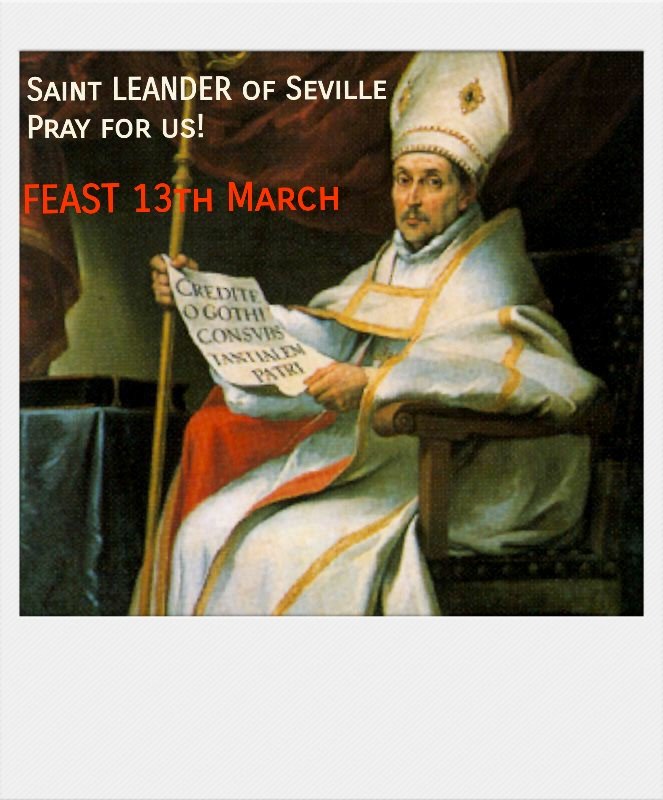
Glorious St Leander, your promotion of the Nicene Creed reminds us of the beauty and importance of this prayer and we thank you for this invaluable contribution to the faith. Saint Leander, pray for us. Amen
**********************************
ALSO CELEBRATED:
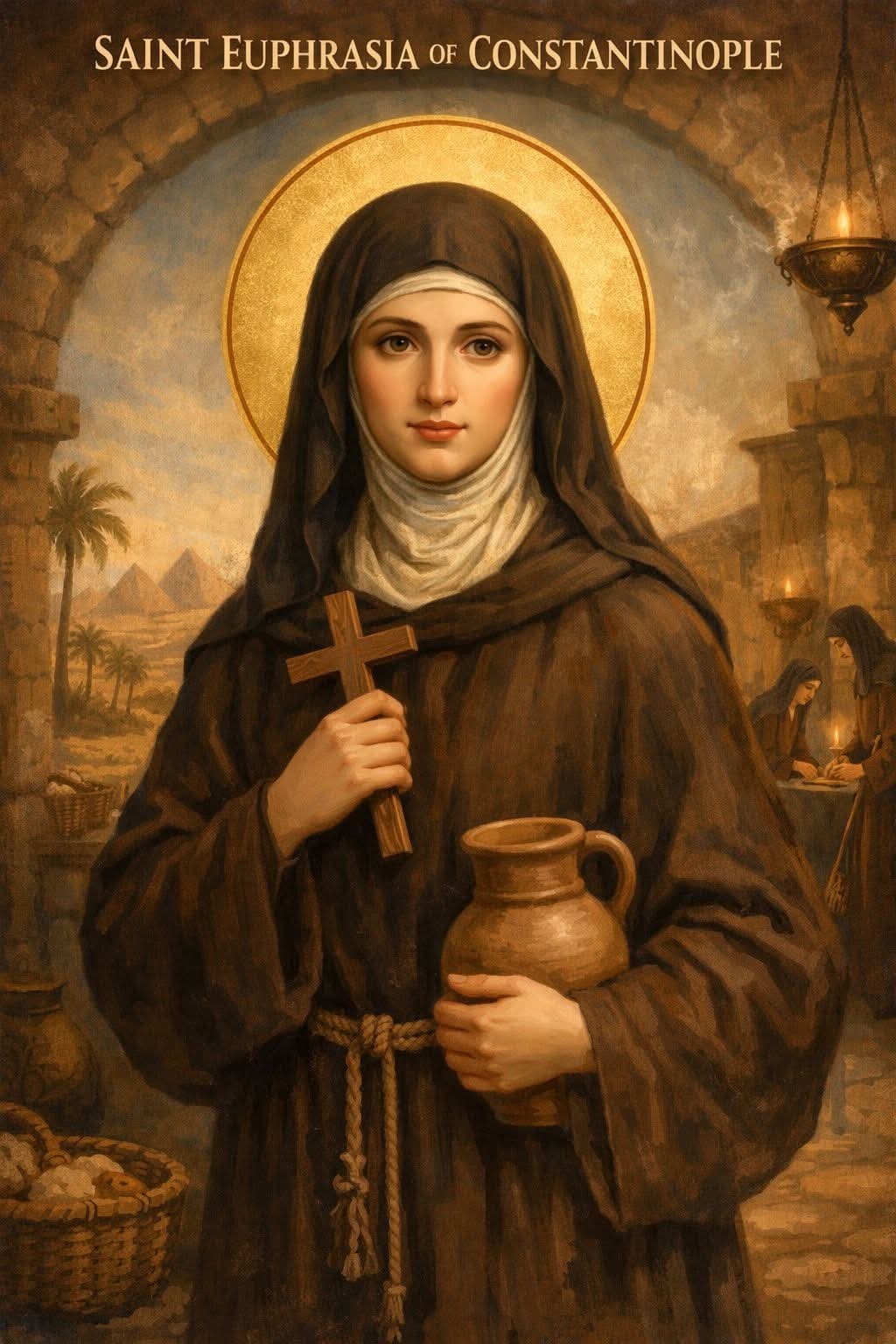
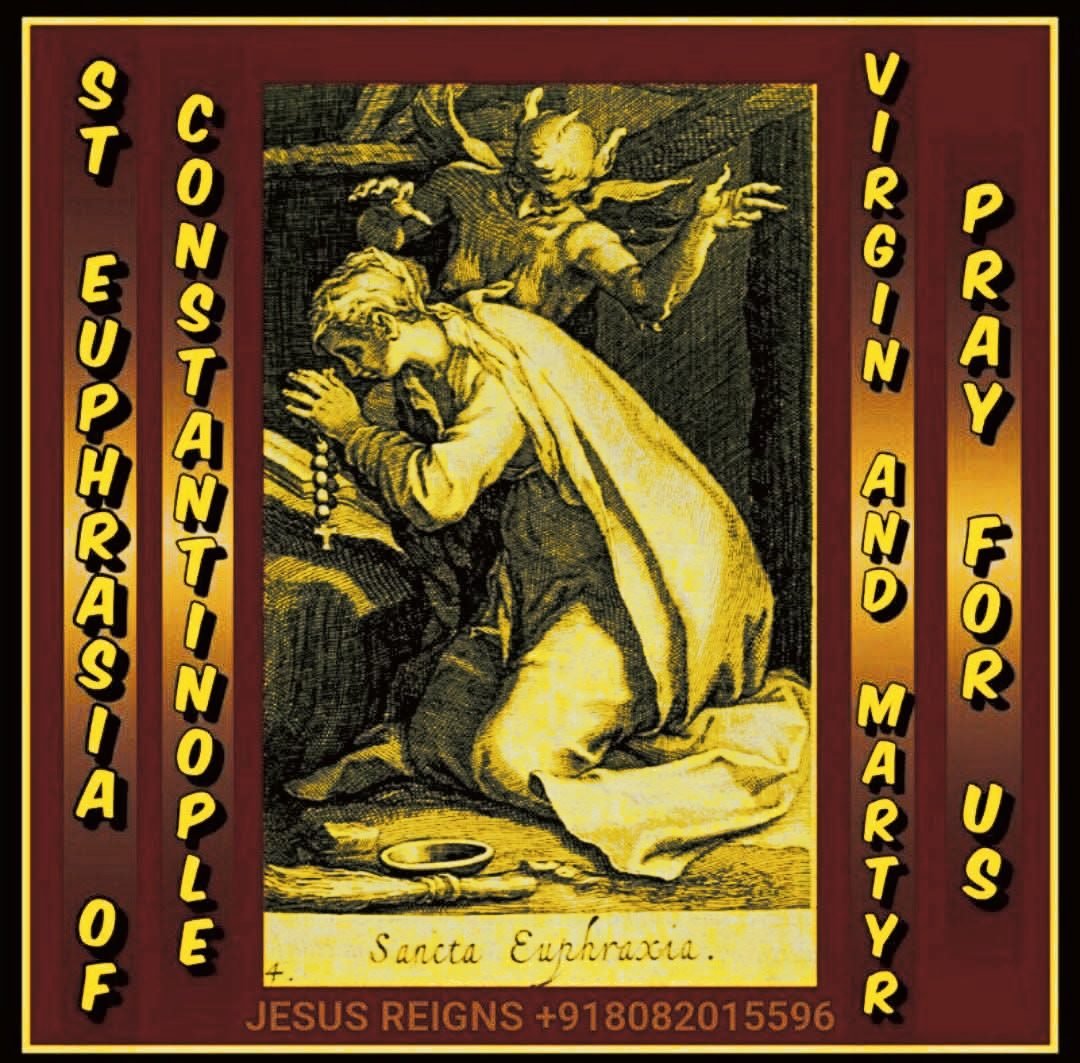
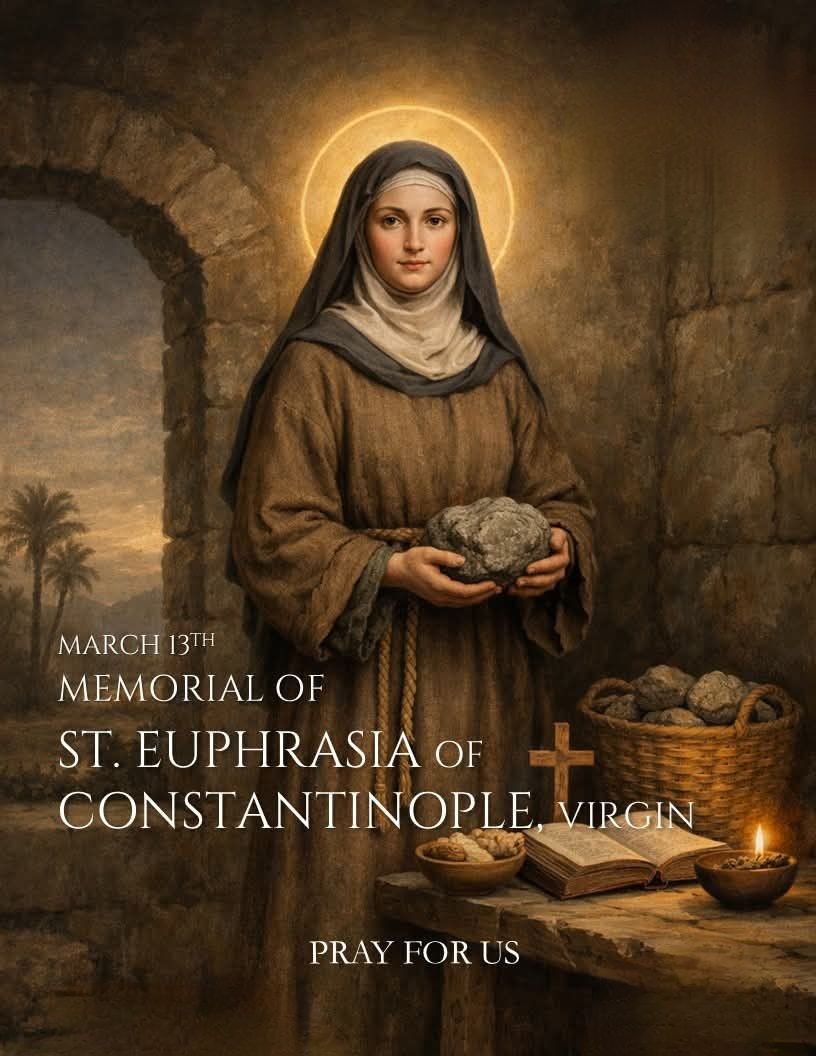
SAINT EUPHRASIA OF CONSTANTINOPLE, VIRGIN AND MARTYR – (380 – 13 March, 410)
Antigonus, the father of this saint, was a nobleman of the first rank and quality in the court of Theodosius the Younger, nearly allied in blood to that emperor, and honoured by him with several great employments in the state. He was married to Euphrasia, a lady no less illustrious for her birth and virtue, by whom he had only one daughter and heiress, called also Euphrasia, the saint of whom we treat.
After her birth, her pious parents, by mutual consent, engaged themselves by vow to pass the remainder of their lives in perpetual continence, that they might more perfectly aspire to the invisible joys of the life to come; and from that time they lived together as brother and sister, in the exercise of devotion, alms-deeds, and penance. Antigonus died within a year, and the holy widow, to shun the importunate addresses of young suitors for marriage, and the distraction of friends, not long after withdrew privately with her little daughter into Egypt, where she was possessed of a very large estate.
In that country she fixed her abode near a holy monastery of one hundred and thirty nuns, who never used any other food than herbs and pulse, which they took only after sunset, and some only once in two or three days: they wore and slept on sackcloth, wrought with their hands, and prayed almost without interruption. When sick, they bore their pains with patience, esteeming them an effect of the divine mercy, and thanking God for the same; nor did they seek relief from physicians, except in cases of absolute necessity, and then only allowed of ordinary general remedies, as the monks of La Trappe do at this day. Delicate and excessive attention to health nourishes self-love and immortification, and often destroys that health which it studies anxiously to preserve. By the example of these holy virgins, the devout mother animated herself to fervour in the exercise of religion and charity, to which she totally dedicated herself. She frequently visited these servants of God, and earnestly entreated them to accept a considerable annual revenue, with an obligation that they should always be bound to pray for the soul of her deceased husband.
But the abbess refused the estate, saying, “We have renounced all the conveniences of the world, in order to purchase heaven. We are poor, and such we desire to remain.” She could only be prevailed upon to accept a small matter to supply the church-lamp with oil, and for incense to be burned on the altar.
The young Euphrasia, at seven years of age, made it her earnest request to her mother that she might be permitted to serve God in this monastery. The pious mother, on hearing this, wept for joy, and not long after presented her to the abbess, who, taking up an image of Christ, gave it into her hands. The tender virgin kissed it, saying, “By vow I consecrate myself to Christ.” Then the mother led her before an image of our Redeemer, and lifting up her hands to heaven, said “Lord Jesus Christ, receive this child under your special protection.” Then turning to her dear daughter, she said, “May God, who laid the foundations of the mountains, strengthen you always in his holy fear.”And leaving her in the hands of the abbess, she went out of the monastery weeping.
Some time after this she fell sick, and being forewarned of her death, gave her last instructions to her daughter in these words: “Fear God, honour your sisters, and serve them with humility. Never think of what you have been, nor say to yourself that you are of royal extraction. Be humble and poor on earth, that you may be rich in heaven.” The good mother soon after slept in peace.Upon the news of her death, the Emperor Theodosius sent for the noble virgin to court, having promised her in marriage to a favourite young senator. But the virgin wrote him with her own hand the following answer: “Invincible emperor, having consecrated myself to Christ in perpetual chastity, I cannot be false to my engagement, and marry a mortal man, who will shortly be the food of worms.
For the sake of my parents, be pleased to distribute their estates among the poor, the orphans, and the church. Set all my slaves at liberty, and discharge my vassals and servants, giving them whatever is their due. Order my father’s stewards to acquit my farmers of all they owe since his death, that I may serve God without let or hindrance, and may stand before him without the solicitude of temporal affairs. Pray for me, you, and your empress, that I may be made worthy to serve Christ.”
The messengers returned with this letter to the emperor, who shed many tears in reading it. The senators who heard it burst also into tears, and said to his majesty, “She is the worthy daughter of Antigonus and Euphrasia, of your royal blood, and the holy offspring of a virtuous stock.” The emperor punctually executed all she desired, a little before his death, in 395.
St. Euphrasia was to her pious sisters a perfect pattern of humility, meekness, and charity. If she found herself assaulted by any temptation, she immediately discovered it to the abbess, to drive away the devil by that humiliation, and to seek a remedy. The discreet superioress often enjoined her, on such occasions, some humbling and painful penitential labour; as sometimes to carry great stones from one place to another; which employment she once, under an obstinate assault, continued thirty days together with wonderful simplicity, till the devil being vanquished by her humble obedience, and chastisement of her body, he left her in peace.
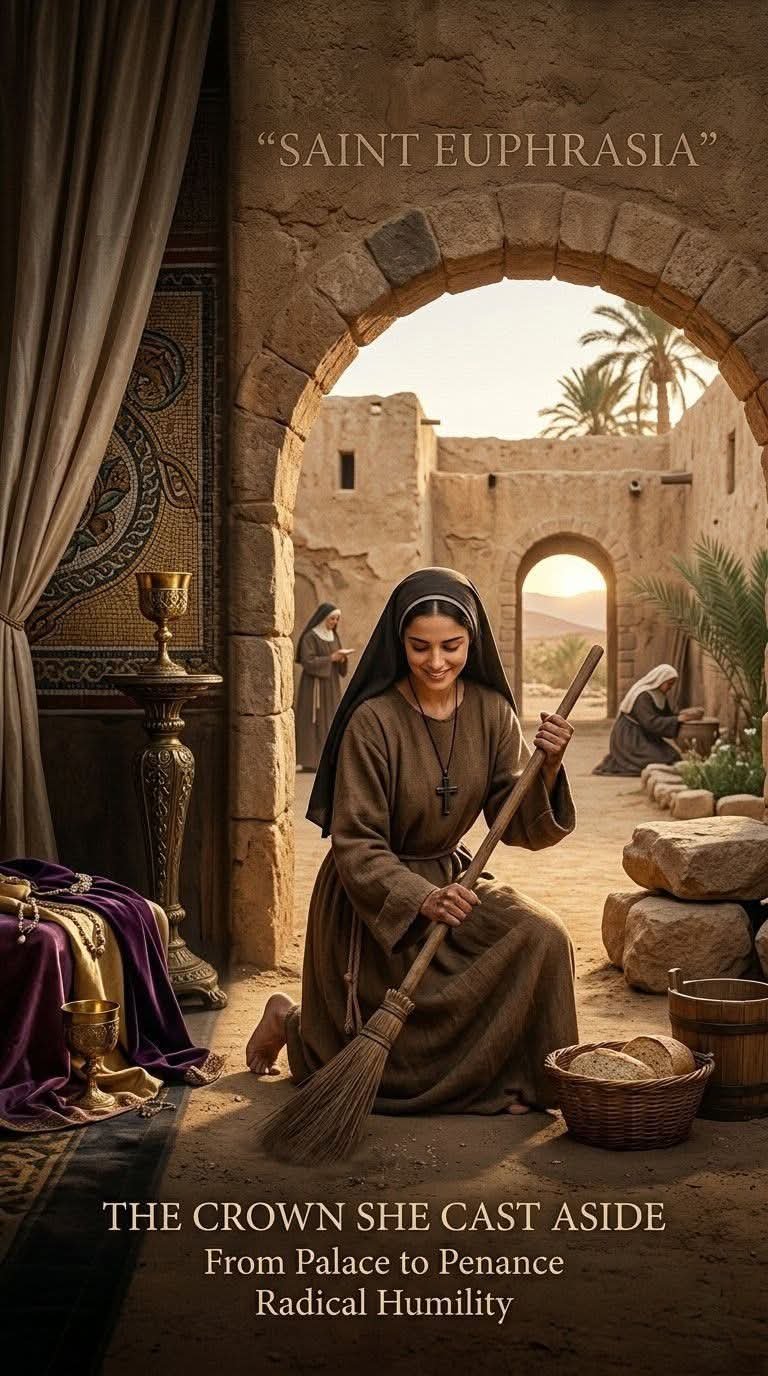
Her diet was only herbs or pulse, which she took after sunset, at first every day, but afterwards only once in two or three, or sometimes seven days. But her abstinence received its chief merit from her humility, without which it would have been a fast of devils. She cleaned out the chambers of the other nuns, carried water to the kitchen, and out of obedience cheerfully employed herself in the meanest drudgery, making painful labour a part of her penance.
To mention one instance of her extraordinary meekness and humility it is related that one day a maid in the kitchen asked her why she fasted whole weeks, which no other attempted to do besides the abbess. Her answer was that the abbess had enjoined her that penance. The other called her an hypocrite. Upon which Euphrasia fell at her feet, begging her to pardon and pray for her. In which action it is hard to say whether we ought more to admire the patience with which she received so unjust a rebuke and slander, or the humility with which she sincerely condemned herself; as if, by her hypocrisy and imperfections, she had been a scandal to others.She was favoured with miracles both before and after her death, which happened in the year 410, and the thirtieth of her age. Her name is recorded on this day in the Roman Martyrology.
– Excerpted from Vol. III of The Lives or the Fathers, Martyrs and Other Principal Saints by the Rev. Alban Butler, the 1864 edition published by D. & J. Sadlier, & Company)
CONTEMPLATING THE LIFE OF SAINT EUPHRASIA OF CONSTANTINOPLE
THE NOBLE CHILD WHO CHOSE THE DESERT: THE HIDDEN HOLINESS OF ST. EUPHRASIA.
Euphrasia of Constantinople (also called Euphrosyne or Eupraxia) was a Byzantine virgin, nun, and ascetic known for her deep humility, obedience, and devotion to God. She lived during the late 4th and early 5th centuries and is remembered as a model of childlike holiness and monastic discipline.
Early Life
In the grand city of Constantinople, marble palaces gleamed under the sun and the halls of power echoed with the voices of senators and courtiers.
Among the noble families of the city was born a little girl named Euphrasia of Constantinople. She inherited wealth, status, and the promise of a comfortable future. But God was preparing a very different path for her.
A Journey Away from Power
When Euphrasia was still young, her father died. Her widowed mother no longer wished to remain in the political world of the imperial court.
Seeking a quieter life devoted to prayer, she traveled with her daughter to Egypt, a land famous for its deserts and monasteries. Egypt in those days was the heartland of early Christian monasticism.
Holy men and women lived in solitude, prayer, and simplicity. Near one of these monasteries of nuns, Euphrasia and her mother found refuge.
The Decision of a Child
The young girl was fascinated by the life of the sisters.
* She watched them pray.
* She listened to their hymns.
* She saw their humility and peace.
When the time came for her mother to return to Constantinople, Euphrasia made a surprising request. She wanted to stay. She was only about seven years old. Yet her desire was sincere.
Seeing the depth of her devotion, her mother entrusted her to the monastery. Shortly afterward, her mother died, leaving Euphrasia completely under the care of the nuns.
The Noble Girl Who Chose Humility
As Euphrasia grew up in the monastery, her noble origins meant nothing to her. She sought the lowest and most difficult tasks.
* She cleaned the floors.
* She carried heavy stones for building work.
* She served in the kitchen.
The sisters often marveled at her willingness to do the hardest work. For Euphrasia, these tasks were acts of love offered to God.
The Renunciation
When she reached adulthood, news came from Constantinople. She had inherited a large fortune. According to the expectations of society, she should return home, marry, and live as a noblewoman.
But Euphrasia had already made her choice.
* She renounced marriage.
* She gave her inheritance to the poor and to the monastery.
* Her life now belonged entirely to God.
A Life Hidden in Prayer
Over time the young nun became known for her holiness. People believed that God had granted her spiritual gifts. Some came asking for prayers for healing. Others sought help for spiritual struggles. Yet she avoided attention.
She preferred the quiet life of prayer, humility, and service. After many years in the monastery, she died peacefully around 410 AD. To the world she had lived a hidden life. But to God she had lived a life of great love.
Legacy
St. Euphrasia is remembered as one of the early examples of women’s monastic holiness in the Eastern Church.
Her life illustrates the ideals of early Christian monasticism:
*.humility
* simplicity
* prayer
* service.
In summary
St. Euphrasia of Constantinople was a noble-born woman who chose the path of radical humility and monastic devotion. Her life demonstrates that true greatness in the Christian life lies not in power or wealth, but in humble love for God expressed through prayer and service.
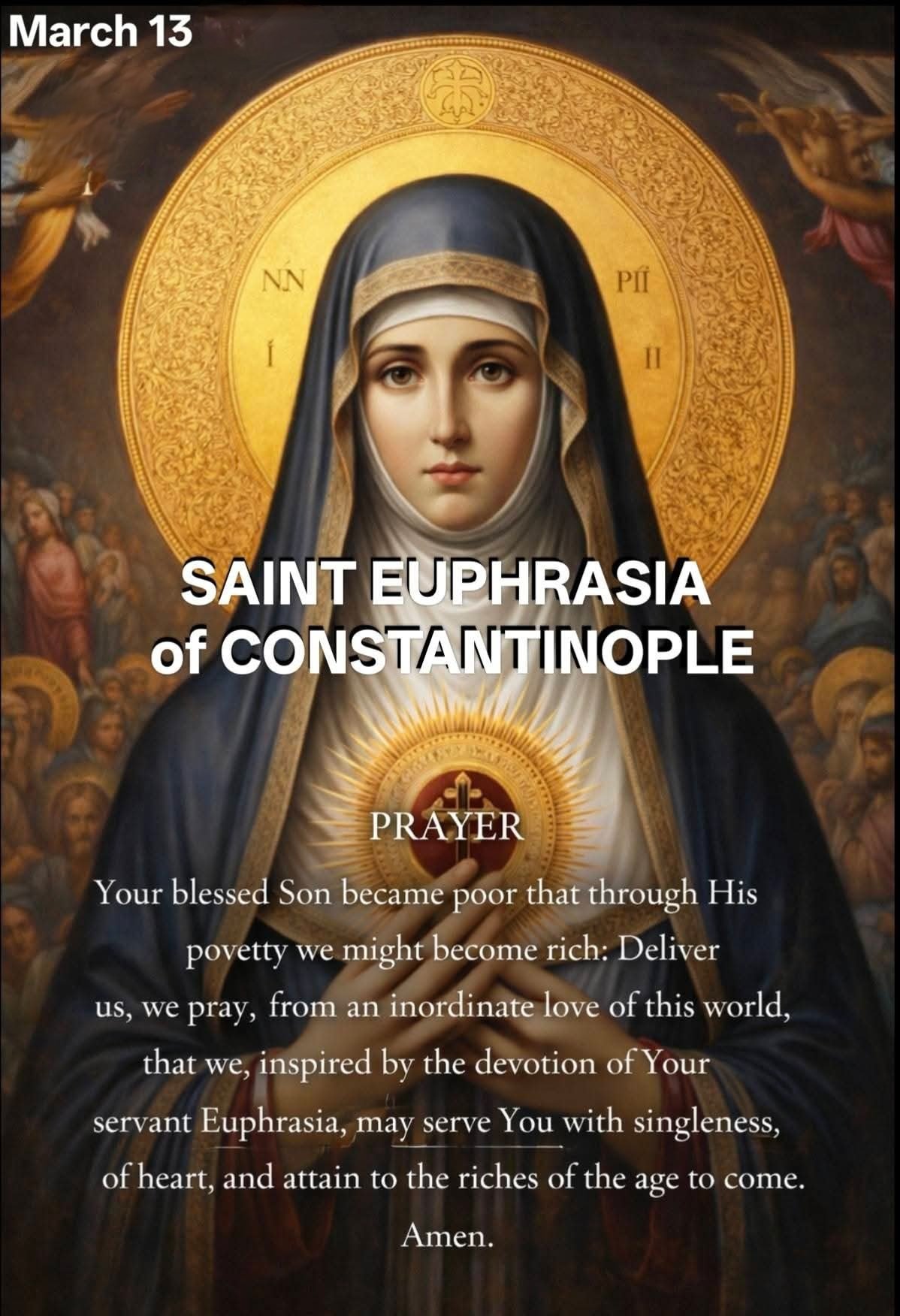
PRAYER
Your blessed Son became poor that through His poverty we might become rich: Deliver us, we pray, from an inordinate love of this world, that we, inspired by the devotion of Your servant Ephrasia, may serve You with singleness of heart, and attain to the riches of the age to come. Amen