
Day Twenty-Eight of Lent – His Hands and Feet
March 21, 2026
Psalm 56:3
March 21, 2026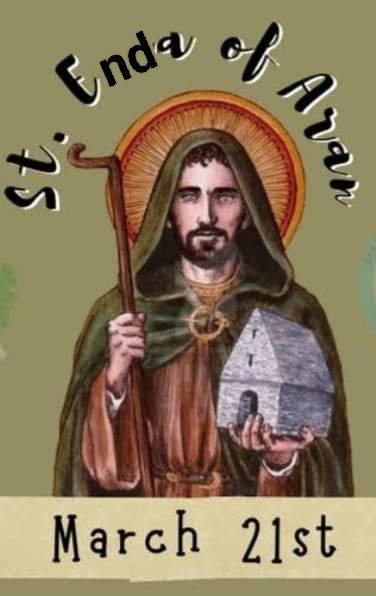
FEAST OF SAINT ENDA OF ARAN, ABBOT
FEAST DAY – 21st MARCH
Saint Enda of Aran (born 430, died 530 AD) is an Irish saint. His feast day is 21 March. According to the Martyrdom of Oengus, Enda was an Irish prince, son of Conall Derg of Oriel (Ergall) in Ulster. Legend has it that when his father died, he succeeded him as king and went off to fight his enemies. The soldier Enda was converted by his sister, Saint Fanchea, an abbess.
He visited Fanchea, who tried to persuade him to lay down his arms. He agreed, if only she would give him a young girl in the convent for a wife. He renounced his dreams of conquest and decided to marry. The girl she promised turned out to have just died, and Fanchea forced him to view the girl’s corpse, to teach him that he, too, would face death and judgment.
Faced with the reality of death, and by his sister’s persuasion, Enda decided to study for the priesthood, and studied first at St Ailbe’s monastery at Emly. Fanchea sent him to Rosnat, a great center of monasticism. There he took monastic vows and was ordained. The stories told of the early life of Saint Enda and his sister are unhistorical. More authentic vitae survive at Tighlaghearny at Inishmore, where he was buried.
Returning to Ireland, Enda built a church at Drogheda. About 484 he was given land in the Aran Islands by his brother-in-law, Aengus, King of Munster. Enda’s monks imitated the asceticism and simplicity of the earliest Egyptian desert hermits. He established the monastery of Enda, which is regarded as the first Irish monastery, at Killeany on Inismór.
He also established a monastery in the Boyne valley, and several others across the island, and along with Finnian of Clonard is known as the father of Irish monasticism. At Killeaney the monks lived a hard life of manual labour, prayer, fasting, and study of the Scriptures. The monks of Aran lived alone in their stone cells, slept on the ground, ate together in silence, and survived by farming and fishing.
Enda divided the island into two parts, one half assigned to the monastery of Killeany, and the western half to such of his disciples as chose “to erect permanent religious houses on the island”. Later he divided the island into 8 parts, in each of which he built a “place of refuge”. The life of Enda and his monks was frugal and austere. They invariably carried out the monastic rule of procuring their own food and clothing by the labour of their hands.
Some fished around the islands; others cultivated patches of oats or barley in sheltered spots between the rocks. Others ground grain or kneaded the meal into bread, and baked it for the use of the brethren. They spun and wove their own garments from the undyed wool of their own sheep. They could grow no fruit in these storm-swept islands; they drank neither wine nor mead, and they had no flesh meat, except perhaps a little for the sick.
Enda’s monastery flourished until Viking times, but much of the stone was ransacked by Cromwell’s men in the 1650s for fortifications, so only scattered ruins remain. Most survive as coastal ruined towers. Cattle, goats, and horses now huddle and shiver in the storm under many of the ruins of old walls where once men lived and prayed.
These structures were the chosen home of a group of poor and devoted men under Saint Enda. He taught them to love the hard rock, the dripping cave, and the barren earth swept by the western gales. They were “men of the caves”, and “also men of the Cross”. One tale tells that Saint Brecan was not happy with Enda’s land division so Enda and Brecan made an agreement.
Each decided to say mass at his own monastery on either end of the island, and when they finished they would begin walking towards the centre. Wherever they met, that’s where they’d divide the land. But Brecan began saying mass earlier than the agreed time. Enda prayed for divine intervention. Brecan’s feet became stuck in the sand at the beach of Kilmurvey, and Enda wound up getting most of the land.
During his own lifetime, Enda’s monastic settlement on the Aran islands became an important pilgrimage destination, as well as a centre for the evangelisation of surrounding areas. At least two dozen canonised individuals had some association with “Aran of the Saints”. Among these were Saint Brendan the Voyager, who was blessed for his voyage there; Jarlath of Tuam, Finnian of Clonard, and Saint Columba of Iona who called it the “Sun of the West”.
Aran became a miniature Mount Athos, with a dozen monasteries scattered over the island, the most famous, Killeany, where Enda himself lived. There, a great tradition of austerity, holiness, and learning was begun. Saint Ciaran of Clonmacnoise came there first as a youth to grind corn, and would have remained there for life but for Enda’s insistence that his true work lay elsewhere, reluctant though he was to part with him.
Saint Finnian left St Enda and founded the monastery of Moville (where Columba spent part of his youth) and who afterwards became bishop of Lucca in Tuscany, Italy. Among those who spent time with Enda was Carthach the Elder. Ciarán is said to have walked to Clonmacnoise with his pet cow, which was a particularly good milker; long after her death in great old age the Book of the Dun Cow was bound in her skin. Saint Enda died around the year 530.
Enda’s holy well is situated on the road to Silver Strand, 5 kilometres from Galway city. It is reputed to have been the resting place of St Enda on his way to the Aran islands. Local tradition has it that St Enda used it to spend the night there on his way to the islands and that one day a well sprung up as he prayed. Pilgrimages were made regularly to the well. Locals still carry out a ceremony called Turas to the Well of Enda. It is said that the well has healing powers and that it never runs dry.
PRAYER
Grant us, O Lord, that amid the uncertainties of this world we may cling with all our heart to the things of heaven, for through the Abbot Blessed Enda, you have given us a model of evangelical perfection.
Through our Lord Jesus Christ, your Son, who lives and reigns with you in the unity of the Holy Spirit, one God, for ever and ever. Amen
(From the Roman Missal.)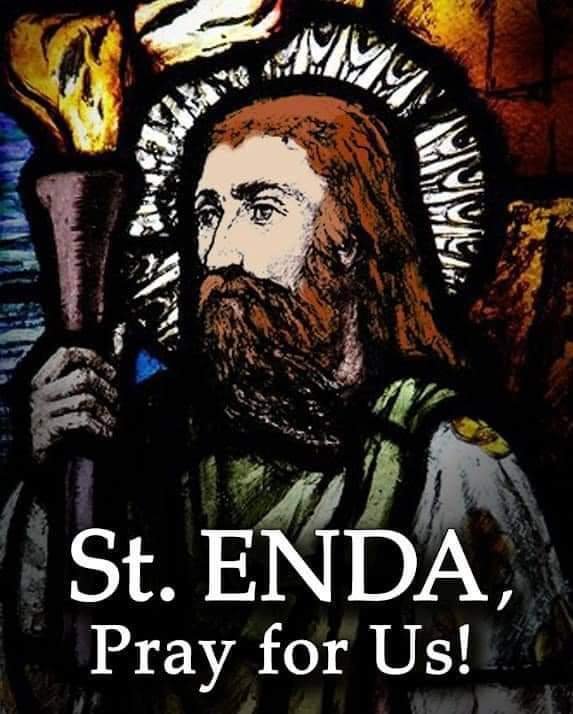
St Enda, pray for us that we will remain humble in our ways towards others.
*********************************
ALSO CELEBRATED:
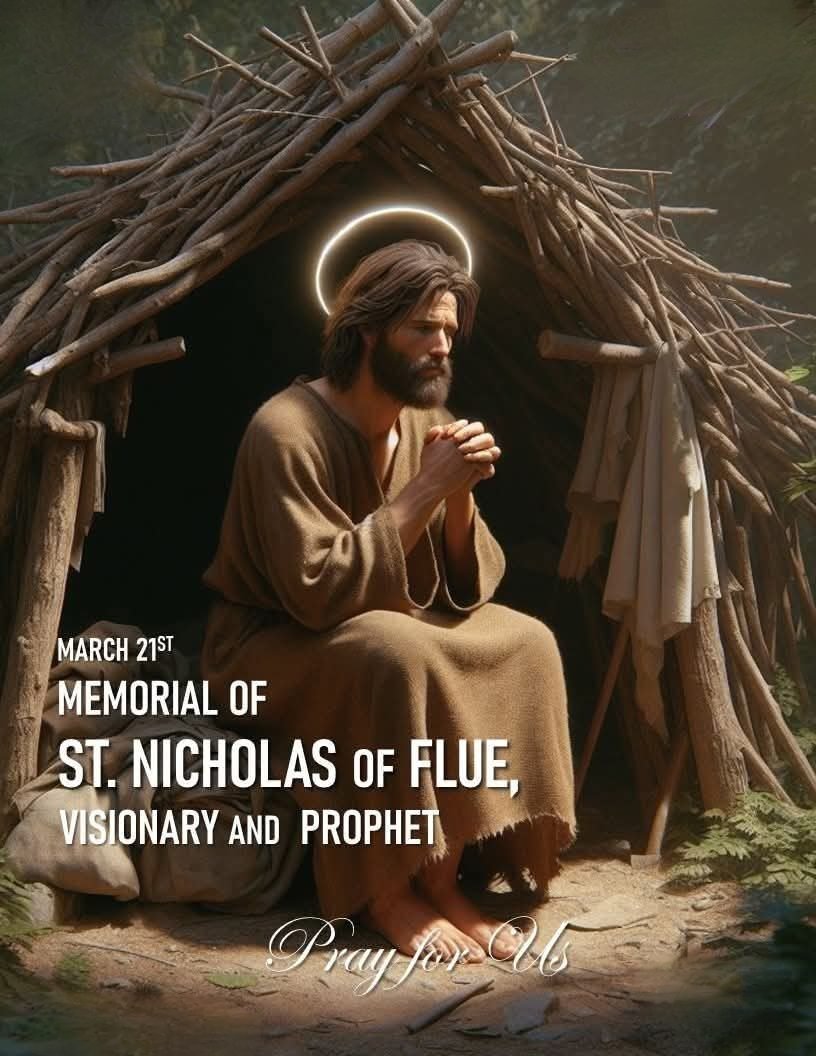
SAINT NICHOLAS OF FLÜE
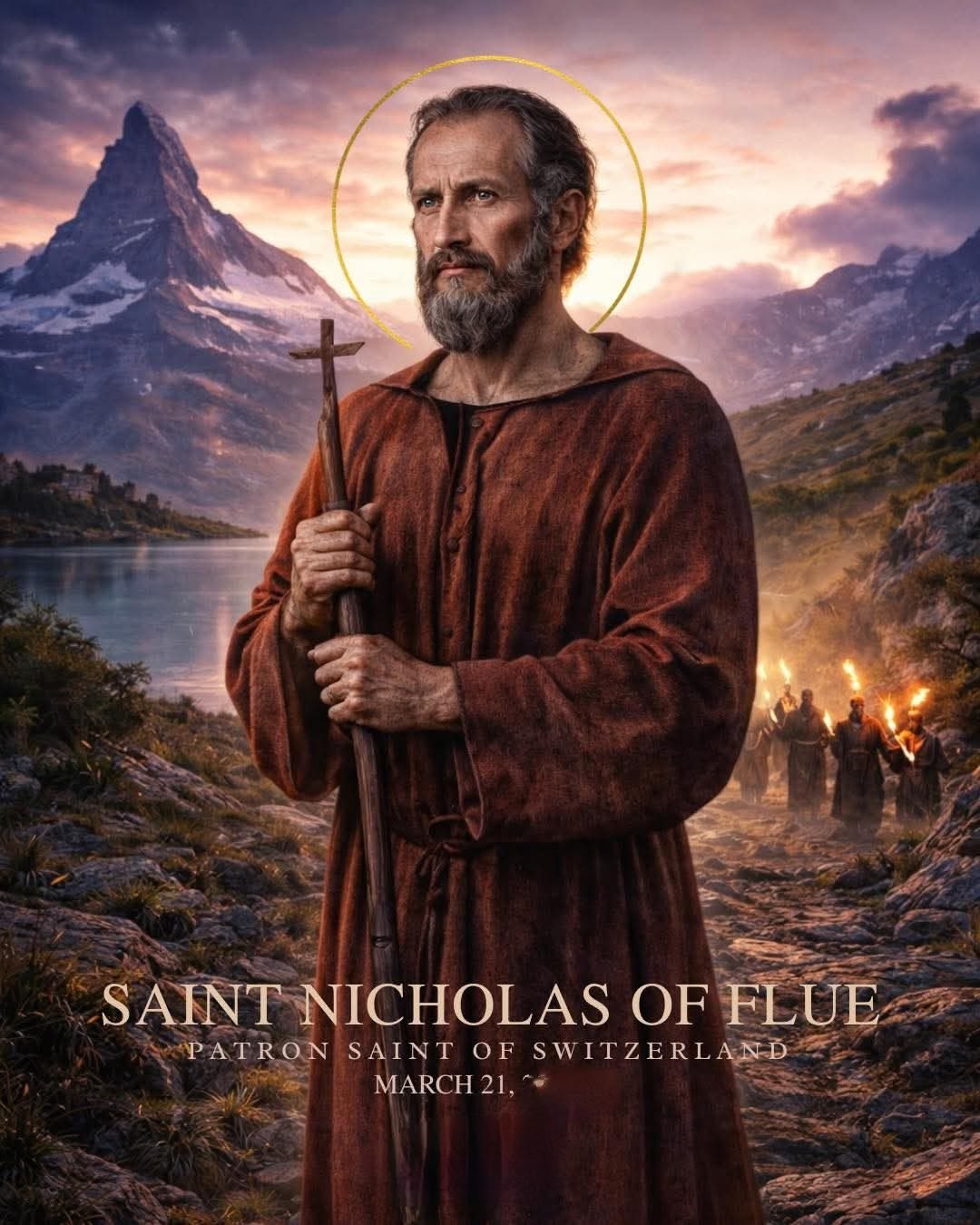
Saint Nicholas of Flüe (1417–1487), also known as Brother Klaus, stands as one of the most revered figures in Swiss history, remembered for his deep spirituality, leadership, and role as a peacemaker. Born into a humble farming family in Unterwalden, he lived a full life as a farmer, soldier, and eventually a captain, while also raising his children with his wife.
Beyond his family life, he actively served his community as a judge and councillor, earning respect for his wisdom and integrity. At the age of fifty, with his wife’s consent, he withdrew from public life to become a hermit in the Ranft Valley, where he lived in prayer and contemplation for two decades, reportedly sustained only by the Holy Eucharist. His influence, however, extended far beyond solitude; in 1481, during a time of political tension among the Swiss cantons, his guidance during the Diet of Stans helped prevent civil war and led to national unity, earning him the title “Father of the Fatherland.”
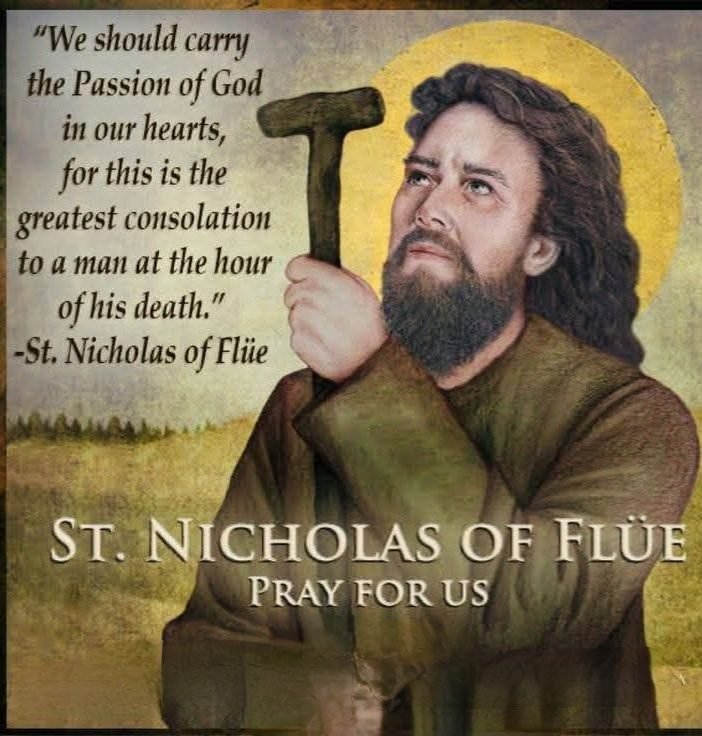
Canonized in 1947 by Pope Pius XII, Saint Nicholas remains the patron saint of Switzerland, the Pontifical Swiss Guards, and large families, with his legacy celebrated for both his spiritual devotion and his enduring contribution to peace. He is celebrated on March 21 (universal) and September 25 in Switzerland and Germany.
CONTEMPLATING THE LIFE OF ST. NICHOLAS OF FLÜE (1417–1487) – HERMIT, MYSTIC, AND PEACEMAKER
Nicholas of Flüe (also known as Niklaus von Flüe or “Brother Klaus”) was a Swiss soldier, husband, father, hermit, and mystic who became one of the most influential spiritual figures in Swiss history.
He is revered as a peacemaker and patron saint of Switzerland, known for his deep contemplative life and his role in preventing civil war.
THE MAN WHO LEFT EVERYTHING – AND SAVED A NATION
In the quiet valleys of Obwalden, surrounded by mountains and fields, there lived a man known for his strength, honesty, and wisdom.
Nicholas of Flüe was not a monk. He was not a priest. He was a farmer, a soldier, a husband, and a father of ten children. To all who knew him, he was a man of integrity. But deep within his heart, there was a longing that nothing in the world could satisfy.
A Life of Responsibility
Nicholas worked the land, defended his country as a soldier, and served his community as a judge and councilman.
People trusted him. They came to him for decisions, for advice, for justice. Yet even in the midst of all this, Nicholas often withdrew into silence. He would spend long hours in prayer.
The Call That Changed Everything
Around the age of fifty, the inner voice that he always heard became impossible to ignore. Nicholas felt called to leave everything behind. Not just his work. Not just his position. But even his family.
For months he struggled.
* How could a husband and father leave?
* How could such a call be from God?
After deep discernment – and with the painful but faithful consent of his wife, Dorothea, Nicholas made a decision that would change history. He left.
The Hermit of Ranft
Nicholas settled in a remote valley called Ranft. There he built a small cell, living in silence, fasting and prayer.
According to tradition, he lived for nearly twenty years sustained only by the Eucharist. People began to hear about the hermit. They came from distant regions seeking advice.
* Farmers.
* Leaders.
* Even political authorities.
What they found was not a man of many words, but a man whose words carried weight.
Mystical Experiences
St. Nicholas was known for profound mystical visions. One of the most famous is the “Vision of the Wheel”, symbolizing the unity of God and creation.
His spirituality emphasized:
* the centrality of God
* detachment from the world
* inner peace through contemplation.
The Man Who Spoke Peace
In 1481, the Swiss Confederation stood on the brink of civil war. Tensions between regions had reached a breaking point. Leaders gathered, unable to find agreement. Violence seemed inevitable.
In desperation, they turned to the hermit of Ranft. A message from Nicholas was brought to them. We do not know his exact words. But we know their effect. The leaders listened. He urged unity, humility, and peace. His counsel broke the deadlock. The Agreement of Stans was reached. War was avoided. A man hidden in a valley helped save a nation.
The Final Years
Nicholas remained in his hermitage until his death on 21st March 1487. He never returned to public life. Yet his influence grew. The farmer who became a hermit became the spiritual father of a nation.
Canonization
He was canonized in 1947 by Pius XII. Today he is one of the most important saints of Switzerland.
Patronage
St. Nicholas of Flüe is the patron saint of Switzerland. He is also invoked for peace, political leaders, families and spiritual discernment.
PRAYER
O Saint Nicholas of Flüe, man of peace and wisdom, Intercede for me before the Lord
Bring peace to my heart and clarity to my mind
Help me choose what is right and walk in God’s will
Guide me in my decisions and lead me away from confusion
May God’s peace remain with me in all that I do
Through Christ our Lord, Amen