
SPIRITUAL INSIGHTS INTO THE LIFE OF SAINT VINCENT FERRER
April 5, 2026
Matthew 28:19
April 6, 2026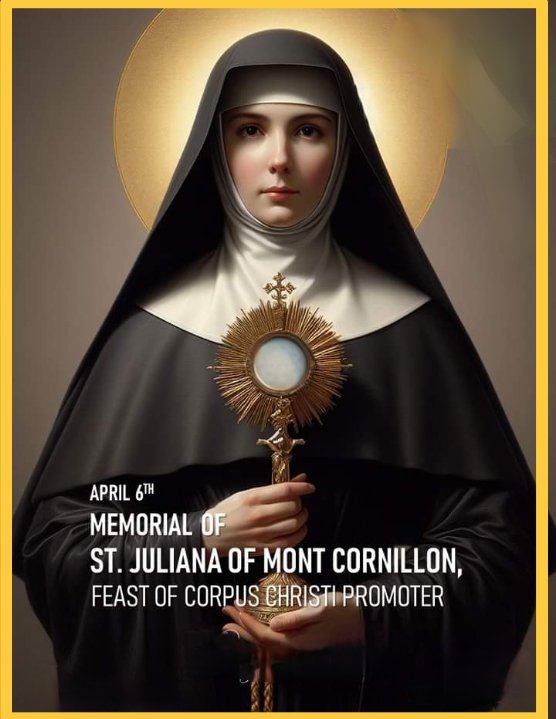
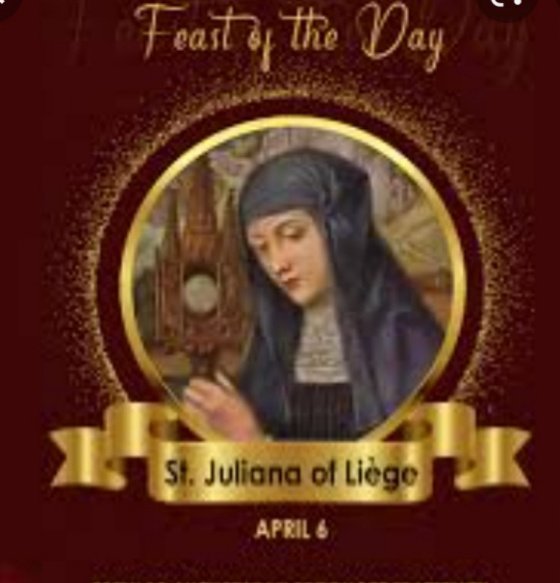
FEAST OF SAINT JULIANA OF CORNILLON
FEAST DAY – 6th APRIL
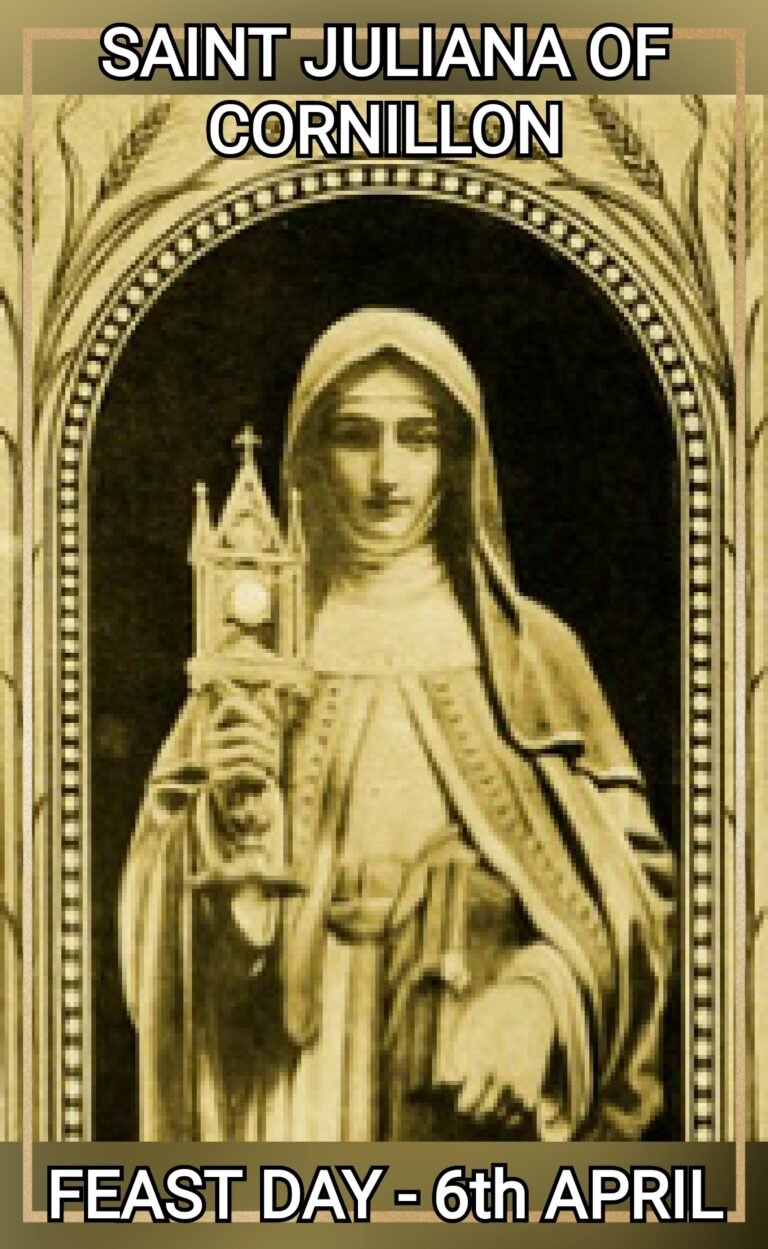
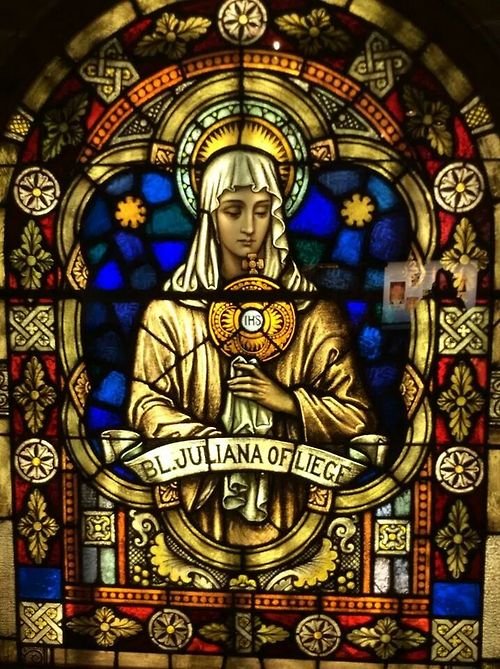
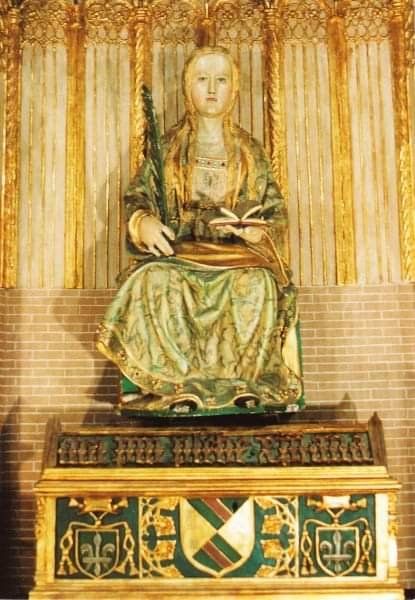
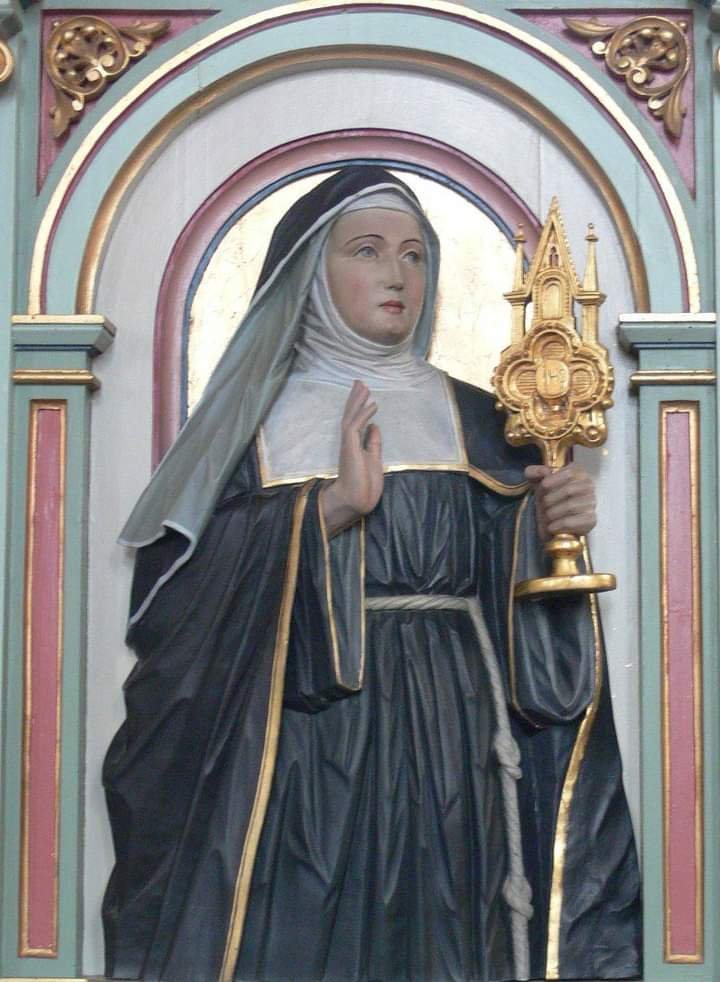
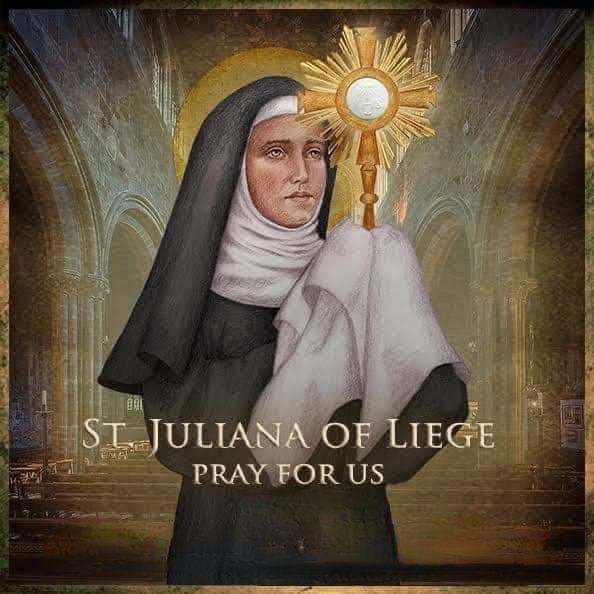
Juliana of Liège, was a medieval Norbertine canoness regular and mystic in what is now Belgium. Traditional scholarly sources have long recognized her as the promoter of the Feast of Corpus Christi, first celebrated in Liège in 1246, and later adopted for the Catholic Church in 1264.
Saint Juliana (1191/1192 – 1258) is little known but the Church is deeply indebted to her, not only because of the holiness of her life but also because, with her great fervour, she contributed to the institution of one of the most important solemn Liturgies of the year, Corpus Christi. St. Juliana de Cornillon, is also known as St. Juliana of Liège. Her biography is a collection of various testimonies of people who were directly acquainted with the Saint.
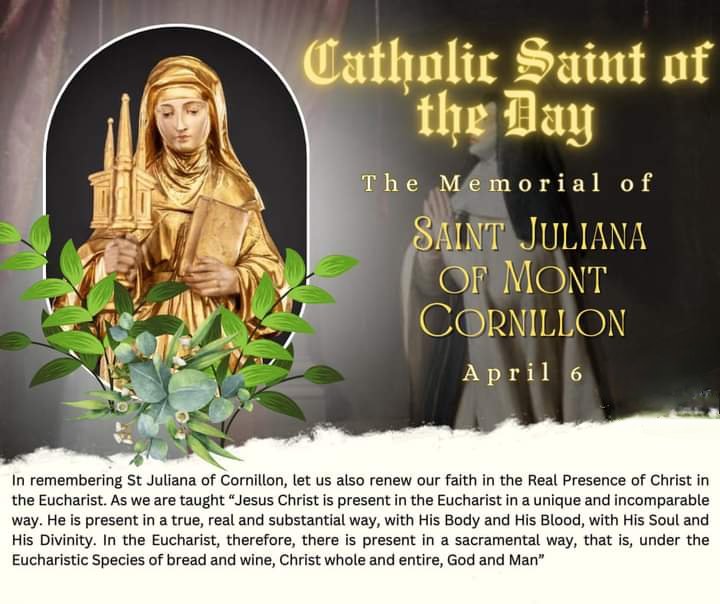 Juliana was born near Liège, Belgium between 1191 and 1192. It is important to emphasize this place because at that time the Diocese of Liège was, so to speak, a true “Eucharistic Upper Room”. Before Juliana, eminent theologians had illustrated the supreme value of the Sacrament of the Eucharist and, again in Liège, there were groups of women generously dedicated to Eucharistic worship and to fervent communion.
Guided by exemplary priests, they lived together, devoting themselves to prayer and to charitable works. Orphaned at the age of five, Juliana, together with her sister Agnes, was entrusted to the care of the Augustinian nuns at the convent and leprosarium of Mont-Cornillon. She was taught mainly by a sister called “Sapienza” [wisdom], who was in charge of her spiritual development to the time Juliana received the religious habit and thus became an Augustinian nun.
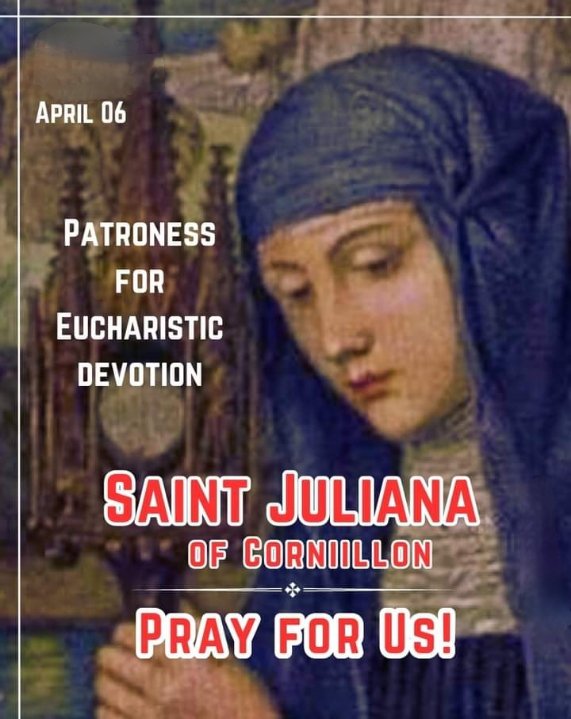
She became so learned that she could read the words of the Church Fathers, of St. Augustine and St. Bernard in particular, in Latin. In addition to a keen intelligence, Juliana showed a special propensity for contemplation from the outset. She had a profound sense of Christ’s presence, which she experienced by living the Sacrament of the Eucharist especially intensely and by pausing frequently to meditate upon Jesus’ words: “And lo, I am with you always, to the close of the age” (Mt 28:20).
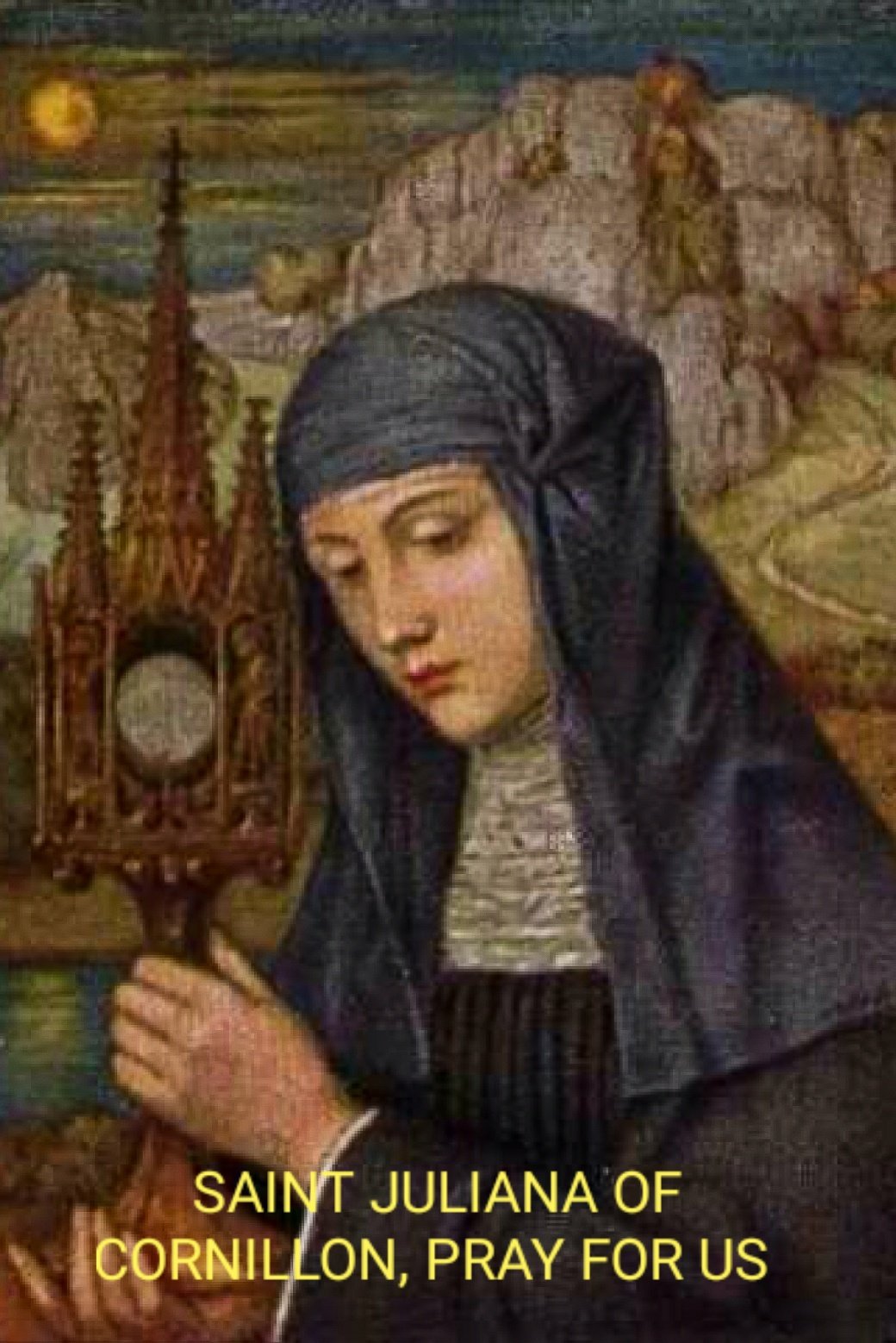
When Juliana was 16 she had her first vision which recurred subsequently several times during her Eucharistic adoration. Her vision presented the moon in its full splendour, crossed diametrically by a dark stripe. The Lord made her understand the meaning of what had appeared to her.
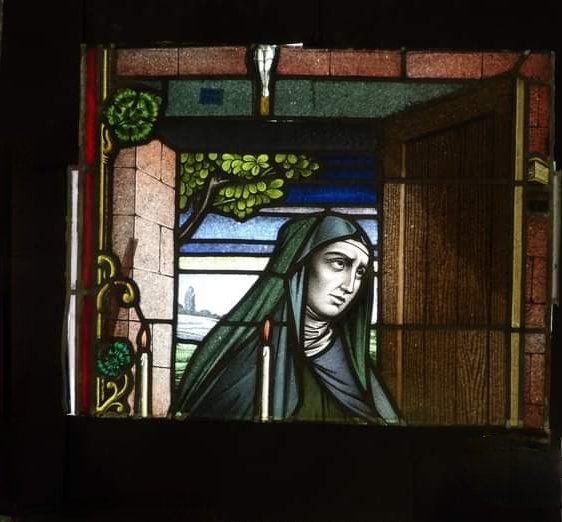
The moon symbolized the life of the Church on earth, the opaque line, on the other hand, represented the absence of a liturgical feast for whose institution Juliana was asked to plead effectively: namely, a feast in which believers would be able to adore the Eucharist so as to increase in faith, to advance in the practice of the virtues and to make reparation for offences to the Most Holy Sacrament.
Juliana, who in the meantime had become Prioress of the convent, kept this revelation that had filled her heart with joy a secret for about 20 years. She then confided it to two other fervent adorers of the Eucharist, Blessed Eva, who lived as a hermit, and Isabella, who had joined her at the Monastery of Mont-Cornillon. The three women established a sort of “spiritual alliance” for the purpose of glorifying the Most Holy Sacrament.
They also chose to involve a highly regarded Priest, John of Lausanne, who was a canon of the Church of St. Martin in Liège. They asked him to consult theologians and clerics on what was important to them. Their affirmative response was encouraging. What happened to Juliana of Cornillon occurs frequently in the lives of Saints.
To have confirmation that an inspiration comes from God it is always necessary to be immersed in prayer to wait patiently, to seek friendship and exchanges with other good souls and to submit all things to the judgement of the Pastors of the Church. It was in fact Bishop Robert Torote, Liège who, after initial hesitation, accepted the proposal of Juliana and her companions and first introduced the Solemnity of Corpus Christi in his diocese.
Later, other Bishops following his example instituted this Feast in the territories entrusted to their pastoral care. However, to increase their faith the Lord often asks Saints to sustain trials. This also happened to Juliana who had to bear the harsh opposition of certain members of the clergy and even of the superior on whom her monastery depended. Of her own free will, therefore, Juliana left the Convent along with her companions.
For ten years, from 1248 to 1258, she stayed as a guest at various monasteries of Cistercian sisters. She edified all with her humility, had no reproach for her adversaries and continued to spread Eucharistic worship zealously. She died at Fosses-La-Ville, Belgium, in 1258. In the cell where she lay the Blessed Sacrament was exposed and Juliana died contemplating with a last effusion to love Jesus in the Eucharist whom she had always loved, honoured and adored.
Jacques Pantaléon of Troyes was also won over to the good cause of the Feast of Corpus Christi during his ministry as Archdeacon in Lièges. It was he who, having become Pope with the name of Urban IV in 1264, instituted the Solemnity of Corpus Christi on the Thursday after Trinity/Pentecost Sunday, as a feast of precept for the Universal Church.
Pope Urban IV issued the papal bull Transiturus in which the Feast of Corpus Christi, i.e., the feast of the Body of Christ was declared a feast throughout the entire Latin Rite. This was the very first papally sanctioned universal feast in the history of the Latin Rite.
In the liturgical reforms of 1969, under Pope Paul VI, the bishops of every nation have the option to transfer it to the following Sunday. Juliana was canonized in 1869 by Pope Pius IX and further celebrated by Pope John Paul II, who wrote a letter mentioning her on the 750th anniversary of the Feast of Corpus Christi. Her feast day is the 6 April. Her patronage is devotion to the Blessed Sacrament.
– Excerpted from Pope Benedict XVI BENEDICT XVI General Audience of November 17, 2010
PRAYER
Glorious St. Juliana, by your deep love for Jesus Christ, our Eucharistic King, you spent countless hours worshiping before the Blessed Sacrament and established a world wide feast to honor this most holy of mysteries, the Feast of Corpus Christi.
By your prayers and example may we too develop a deep appreciation, joy and heartfelt longing to spend time adoring Jesus Christ, our Lord, hidden and veiled in the little form of heavenly bread. Amen
***********************************
ALSO CELEBRATED:
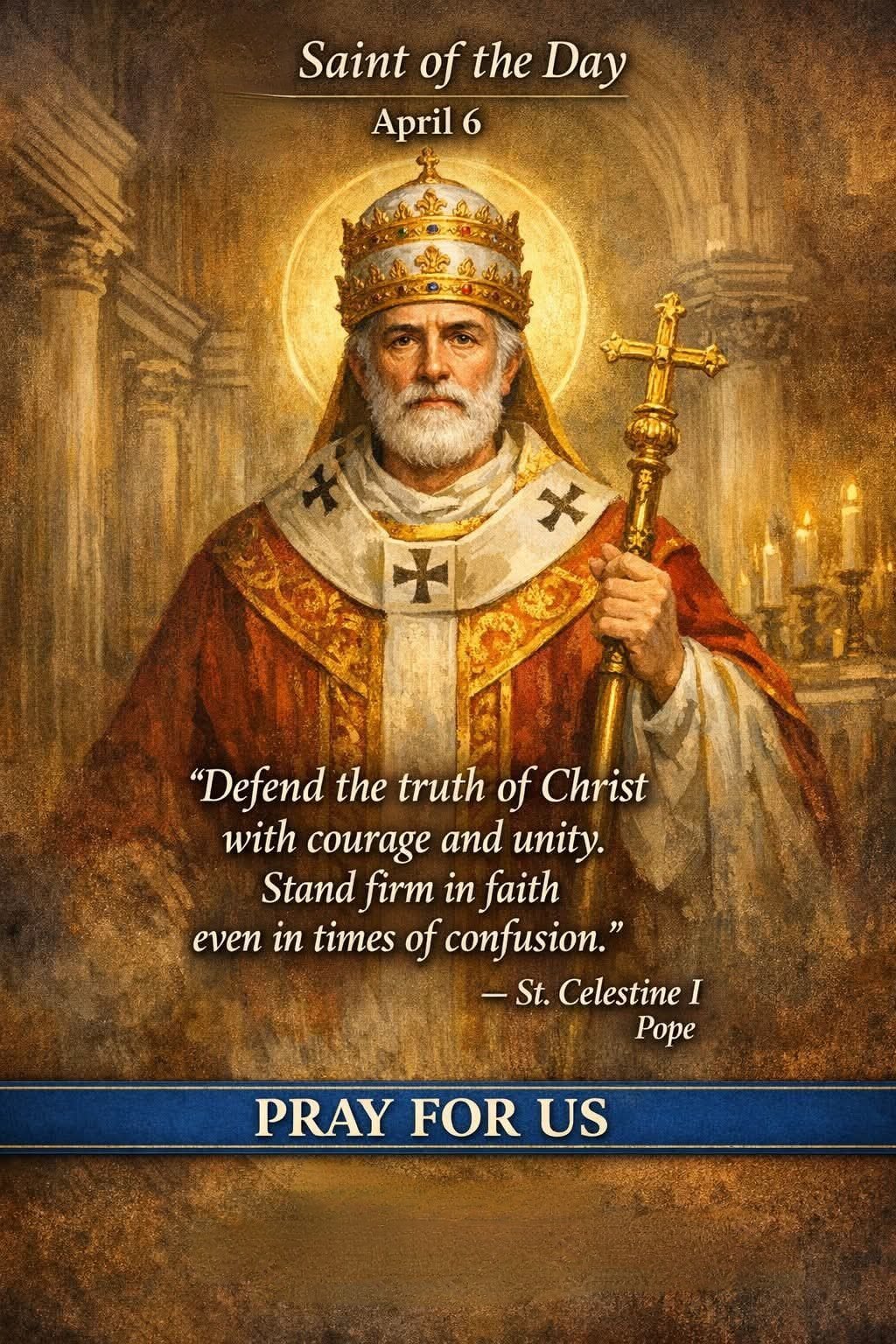
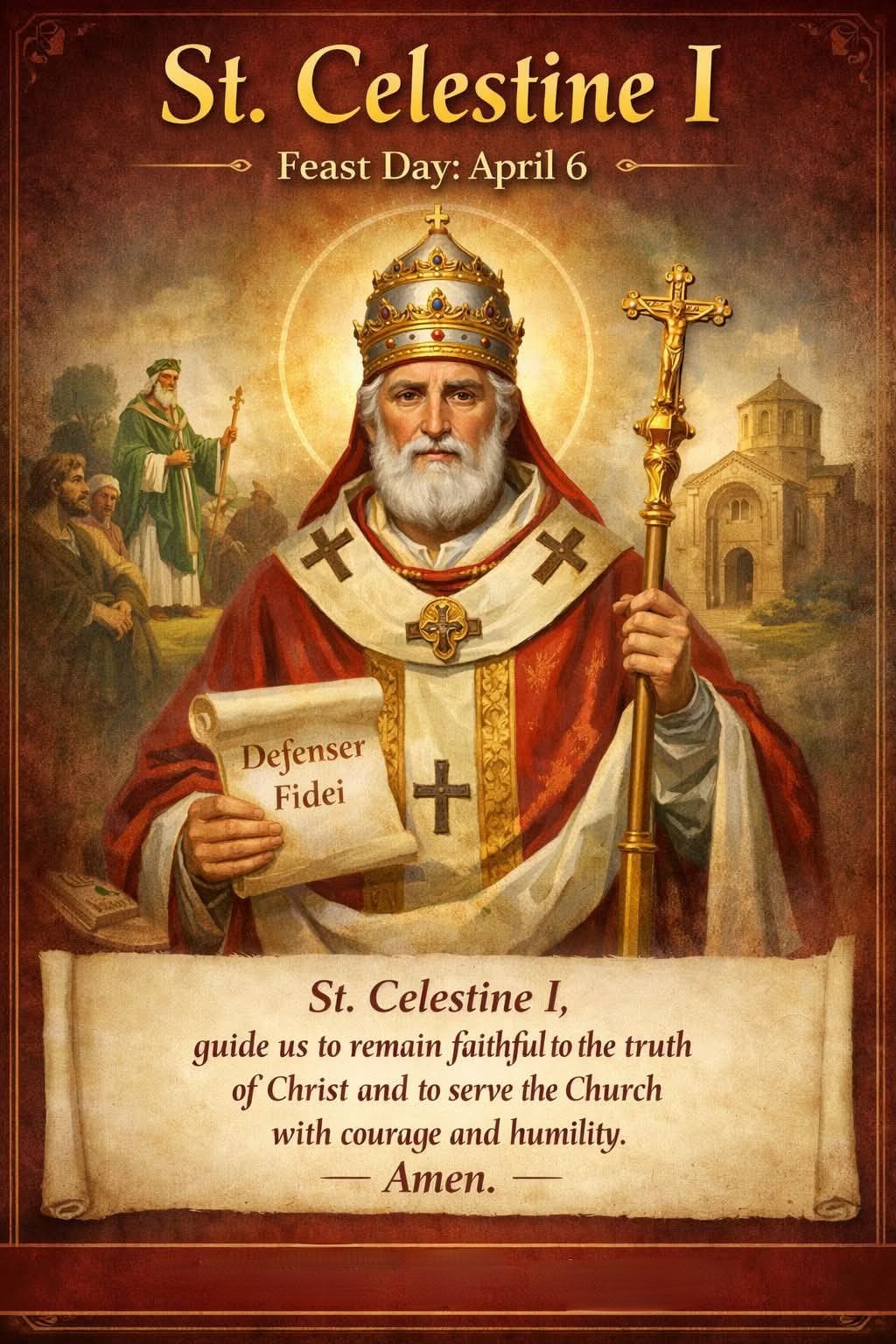
SAINT CELESTINE I, POPE
Nothing is known of his early history except that he was a Roman and that his father’s name was Priscus. He is said to have lived for a time at Milan with St. Ambrose; the first notice, however, concerning him that is known is in a document of St. Innocent I, in the year 416, where he is spoken of as Celestine the Deacon. In 418 St. Augustine wrote to him (Epist., lxii) in very reverential language. He succeeded St. Boniface I as pope, 10 Sept., in 422.
His first official act was to confirm the condemnation of an African bishop who had been convicted of grave crimes. He wrote also to the bishops of the provinces of Vienne and Narbonne in Gaul to correct several abuses which had followed upon errors in doctrine. He stipulated, among other things, that absolution or reconciliation should never be refused to any dying sinner who sincerely asked it; for repentance depends not so much on time as on the heart, which can be changed in a moment when God so wills.
A strong friendship seems to have existed between Celestine and Augustine, and after the death of the latter in 430, Celestine wrote a long letter to the bishops of Gaul on the sanctity, learning and zeal of the holy doctor, and forbade all attacks upon his memory on the part of the Semipelagians, who under the leadership of the famous ascetic, John Cassian, were then beginning to gain influence. Though his lot was cast in stormy times, for the Manichaeans, Donatists, Noviatians, and Pelagians were troubling the peace of the Church, while the barbarian hordes were beginning their inroads into the heart of the empire, Celestine’s firm but gentle character enabled him to meet successfully all the exigencies of his position.
We see him everywhere upholding the rights of the Church and the dignity of his office. In this he was aided by Placidia, who, in the name of her youthful son, Valentinian III, banished from Rome the Manichaeans and other heretics who were disturbing the peace. Celestine not only excluded Coelestius, the companion and chief disciple of Pelagius, from Italy, but procured the further condemnation of the sect from the Council of Ephesus, while through his instrumentality St. Germanus of Auxerre and St. Lupus of Troyes, who had been sent to Britain in 429, the native land of Pelagius, by the Gallic bishops, succeeded in extirpating the error from its native soil.
Saint Celestine assembled a synod at Rome in 430, by which the writings of Nestorius were examined, and the heresiarch’s obstinate errors in maintaining in Christ two persons, a divine and a human, were condemned.
The Pope pronounced sentence of excommunication against Nestorius, and deposed him. Being informed that in Great Britain, the seeds of the Pelagian heresy, denying the necessity of grace, were spreading, Saint Celestine sent there Saint Germanus of Auxerre, whose zeal and ministry happily prevented the threatening danger.
The last official act of Celestine, the sending of St. Patrick to Ireland, perhaps surpasses all the rest in its far-reaching consequences for good. He had already sent (431) Palladius as bishop to the “Scots [i.e. Irish] believing in Christ.” But Palladius soon abandoned Ireland and died the year following in Britain. St. Patrick, who had previously been refused, now received the long-coveted commission only a few days before the death of Celestine, who thus becomes a sharer in the conversion of the race that in the next few centuries was to accomplish such vast works by its countless missionaries and scholars in the conversion and civilization of the barbarian world. In the local affairs of the Roman Church, Celestine manifested great zeal. He restored and embellished the church of Santa Maria in Trastevere, which had suffered from the Gothic pillage of Rome, also the church of St. Sabina, besides decorating the Cemetery of St. Priscilla with paintings of the Council Ephesus. The precise date of his death is uncertain.
His feast is kept in the Latin Church on 6 April, the day on which his body was placed in the Catacombs of St. Priscilla whence it was transferred in 820 by Pope St. Paschal I to the church of Sta Prassede, though the cathedral of Mantua likewise claims his relics. In the Greek Church where he is highly honoured for his condemnation of Nestorius, his feast falls on 8 April. In many of the dioceses, his feast is celebrated on July 27.
CONTEMPLATING THE LIFE OF SAINT CELESTINE I, POPE
GUARDING THE MYSTERY: THE POPE WHO DEFENDED WHO CHRIST IS
St. Celestine I was a 5th-century Pope (422–432 AD), remembered as a strong defender of the true teaching about Christ, a pastor concerned for unity, and a missionary-minded leader. His papacy came at a critical moment when the Church was clarifying who Jesus truly is.
A CHURCH AT THE CROSSROADS
The Church was growing. Across cities and empires, the name of Christ was being proclaimed. But beneath the surface – questions stirred.
Who is Jesus? A teacher? A prophet? A man touched by God? Something more?
Into this moment stepped a quiet but resolute shepherd – Celestine, Bishop of Rome. He understood something others did not yet fully grasp: If the Church loses clarity about Christ, it loses all.
A WHISPER THAT BECAME A STORM
The trouble began as a whisper in Constantinople. A respected patriarch, Nestorius, began to teach: That Mary should not be called “Mother of God.”
That Christ was somehow divided – human here, divine there.
To some, it sounded reasonable. To others, confusing. But to Celestine, it was dangerous. Because if Christ is divided, then salvation is divided. And if Mary is not truly Mother of God, then who is the One she bore?
THE SHEPHERD TAKES A STAND
Celestine did not hesitate. He listened. He discerned. Then he acted. He condemned the teaching. And he entrusted the mission to a strong ally, St. Cyril of Alexandria.
“Stand firm,” he instructed. “Defend the truth.” This was not about winning an argument. This was about protecting a mystery: That Jesus Christ is one Person, fully God and fully man.
THE COUNCIL THAT CLARIFIED CHRIST
The tension reached its peak at the
Council of Ephesus. Bishops gathered. Voices clashed. Truth was tested. Celestine was not physically present –
But his voice was.
Through his representatives.
Through his authority.
Through his unwavering clarity.
And the Church proclaimed: Christ is One. Not divided. Not separated. And Mary – is truly Theotokos, Mother of God. The mystery was safeguarded.
HIS PAPACY (422–432 AD)
Celestine succeeded Pope Boniface I. As Pope, he showed: Firm leadership, Doctrinal clarity, Pastoral concern for unity. He governed the Church not just administratively, but theologically and missionally.
A MISSIONARY POPE
Celestine was not only a theologian – he was also a missionary leader. He sent St. Palladius to Ireland (before St. Patrick), supported evangelization in: Britain, Gaul. He saw the Church not as inward-looking, but outward-moving.
DEFENDER AGAINST OTHER ERRORS
Celestine also opposed:
Pelagianism (denial of the necessity of grace)
Other doctrinal deviations spreading in Western Europe
He worked to:
Preserve orthodoxy
Strengthen unity
PASTORAL LEADERSHIP
Beyond controversies, Celestine:
* Promoted Church discipline
* Supported bishops
* Strengthened ecclesial structures
He was: Firm in doctrine and gentle in pastoral care.
LEGACY
* Defender of Christ’s true identity
* Promoter of unity
* Supporter of missions
SPIRITUAL SIGNIFICANCE
A Pope of Clarity in Confusion
He reminds us: Truth matters – especially when it is challenged.
A Shepherd Who Protected the Faith
He did not avoid conflict when truth was at stake.
A Leader Who Empowered Others
He trusted figures like St. Cyril of Alexandria to act boldly.
DEATH
There was no dramatic ending. No final battle. Just a life that had held the line. In 432, Celestine died. Quietly.
But the truth he defended echoed far beyond his lifetime: Every time the Church professes
who Christ is – His voice is still there.
PRAYER
O God, the light of the faithful, and shepherd of souls, who didst set blessed Saint Celestine I to be a Bishop and Pope in the Church, that he might feed thy sheep by his word and guide them by his example: Grant us, we pray thee, to keep the faith which he taught, and to follow in his footsteps; through Jesus Christ our Lord. Amen