
SPIRITUAL INSIGHTS INTO THE LIFE OF ST. POPE SOTER
April 22, 2026
John 3:17
April 22, 2026FEAST OF SAINT ABDIESUS, DEACON AND MARTYR AND SAINTS SOTER AND CAIUS POPES, MARTYRS – 22nd APRIL
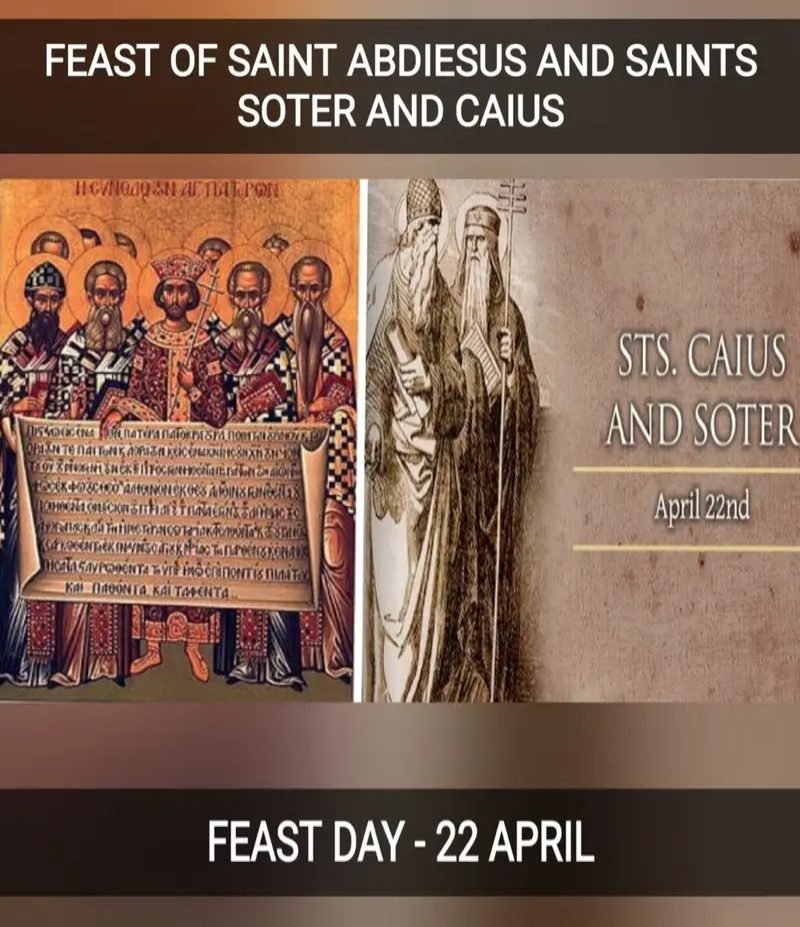
FEAST OF SAINT ABDIESUS, CONFESSOR, DEACON AND MARTYR AND SAINTS SOTER AND CAIUS POPES, MARTYRS
FEAST DAY – 22nd APRIL
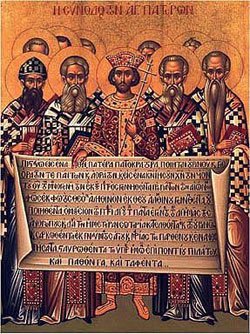
Saint Abdiesus (also known as Saint Abdiesus the Deacon or Hebed Jesus) was one of the Martyrs of Persia under Shapur II. Roman Catholic Tradition states that Saint Abdiesus was a Deacon serving in Persia during the time of the persecutions of Shapur II. He was also accompanied in his martyrdom by Abrosimus, Acepsimus, Azadanes, Azades, Bicor, Mareas, Milles, and a woman named Tarbula.
Also called Hebed Jesus, records indicate that Abdiesus was martyred with some who were Persian courtiers, others priests and bishops. Tarbula was the sister of St. Simeon, and suffered a particularly cruel death by sawing. Saint Abdiesus has been venerated since the pre-Congregational era.
Roman Catholic Martyrology styles Saint Abdiesus as ‘Saint Abdiesus the Deacon’ as not to confuse him with another martyr of the same name ‘Abdiesus’, who served as the Bishop of Cashcar. In Persian – Iranian, Arabic and Latin, the meaning of the name Abdiesus is ‘one who serves Jesus’. Saint Abdiesus was martyred in the year 342, and his feast day is April 22.
PRAYER
Eternal Father, you granted to your Church the light of redemption, by wreathing blessed Abdiesus with the glorious triumph of martyrdom, graciously grant that, as he emulated the Lord’s Passion, so we may, by following his example, be worthy to obtain the grace of eternal salvation.
Through our Lord Jesus Christ, your Son, who lives and reigns with you in the unity of the Holy Spirit, one God, for ever and ever. Amen
**************************************
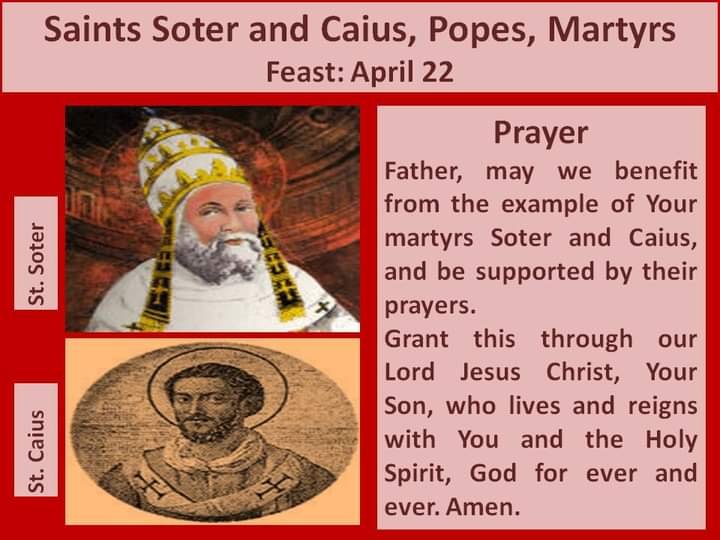
SAINTS SOTER AND CAIUS
POPES AND MARTYRS

St. Soter was born in Fundi, in Italy. The date of his birth is unknown but we know that he was Pope for eight years from 166 until his death in 174. Soter’s papacy was an example of what seems to have been the remarkable tradition of generosity exercised by the bishop of Rome.
This tradition and Soter´s personal charity and paternal love for his universal flock can be evidenced from a letter to Pope Soter by Bishop St. Dionysus of Corinth, quoted in the 4th century “Ecclesiastical History of Eusebius”
“This has been your custom from the beginning, to do good in manifold ways to all Christians, and to send contributions to the many churches in every city, in some places relieving the poverty of the needy and ministering to the Christians in the mines, by the contribution which you have sent from the beginning, preserving the ancestral custom of the Romans, true Romans as you are.
Your blessed bishop Soter has not only carried on the habit but has even increased it, by administering the bounty distributed to the saints and by exhorting with his blessed words the brethren who come to Rome, as a loving father would his children.” (IV, XXIII, 9- 15)
In the same letter of Dionysus we learn that Pope Soter had written a letter to the Corinthians which was read in the Church alongside the epistle of St. Clement and was held in high esteem.
Though his kindness extended to all persons, he was a fierce opponent of heresy, having been said to have written an encyclical against Montanism – the teachings of a heretical sect which believed that a Christian who had sinned gravely could never be redeemed.
CONTEMPLATING THE LIFE OF SAINT POPE SOTER
St Pope Soter was a second century Pope remembered for his charity, pastoral care, and encouragement of Christian communities, especially those facing hardship. Though historical details are limited, his legacy shines through his generosity and his efforts to unite the early Church.
He was likely born in Campania in Italy and died around the year one hundred seventy five. His papacy lasted from around one hundred sixty six to one hundred seventy five. His feast day is celebrated on April twenty two.
He lived during the early development of Church structure, a time of periodic persecution under the Roman Empire, and growing connections between Christian communities.
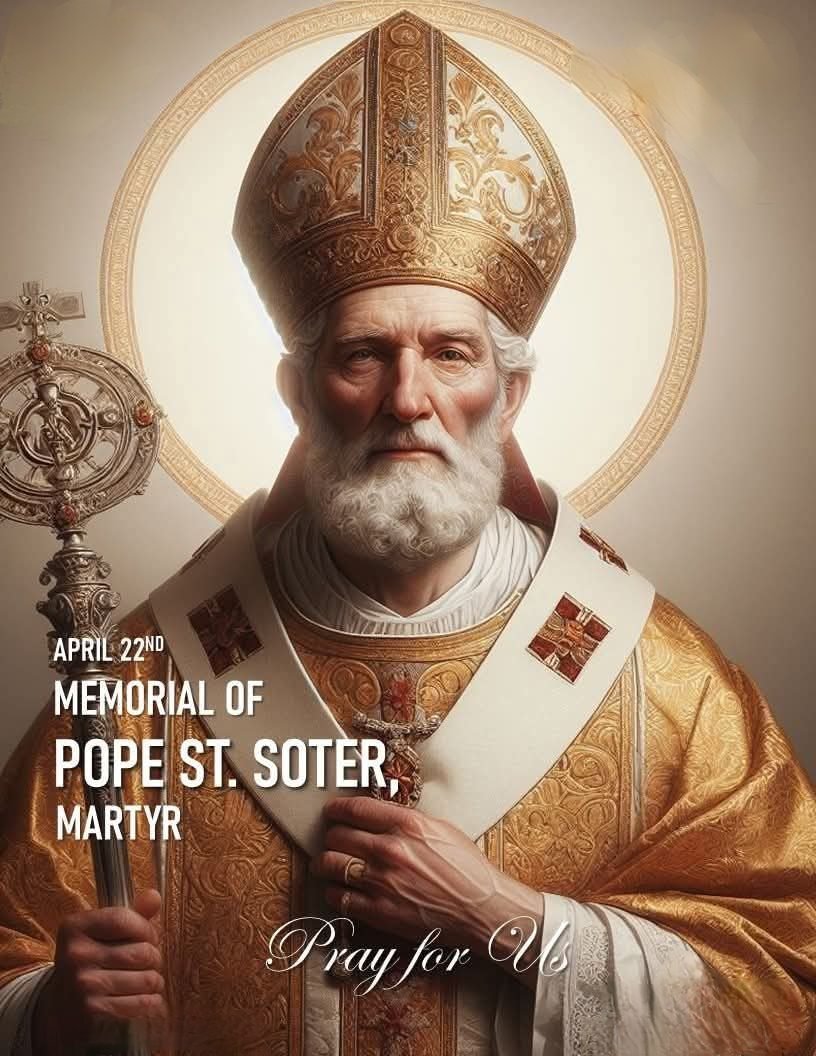
THE SHEPHERD WHO SENT LOVE ACROSS DISTANCES
A CHURCH SCATTERED YET ONE
The early Church was not gathered in one place. It was spread across cities, cultures, and uncertainties. Small communities met quietly in homes and hidden places, often in fear. Though they shared the same faith, many felt alone.
A VOICE FROM ROME
From Rome came a gentle and caring presence. Pope Soter did not lead by authority alone but reached out to distant communities and people he would never meet. Yet he understood that they belonged to him and he to them.
LOVE THAT TRAVELLED FAR
He sent not only messages but also gifts, support, and aid to the poor, the suffering, and those imprisoned. Communities in distant lands received not just help but a powerful reminder that they were not alone.
A LETTER THAT REVEALS HIS HEART
The Church in Corinth remembered him with gratitude, noting that he helped many churches, gave generously, and acted as a father to all. This reflects how the early Church already lived a deep sense of unity.
A CHURCH HELD TOGETHER BY CHARITY
In a time without strong systems or structure, love became the bond that united believers. Soter understood that the Church is sustained not only by structure but by genuine care. Through acts of generosity, a scattered people slowly became one body.
A POPE KNOWN FOR CHARITY
He is especially remembered for his generosity. He sent financial aid to those in need, supported communities facing poverty and persecution, and helped prisoners and the afflicted. His charity extended beyond local boundaries and embraced the universal Church.
THE UNSEEN SUFFERING
He recognized not only visible needs but also hidden pain such as imprisonment, broken families, and lingering fear. Even when he could not be physically present, he shared in their suffering with deep spiritual concern.
A LIFE WITHOUT SPECTACLE
His life was marked not by dramatic events but by steady acts of giving, encouraging, and sustaining others. Tradition suggests he may have suffered martyrdom, but what is certain is that his life was completely offered in service.
PROMOTER OF UNITY
He strengthened communication between churches and encouraged mutual support. His leadership fostered unity in faith and solidarity in action. He led through relationships rather than authority alone.
THE LEGACY OF A QUIET SHEPHERD
He was remembered not for power but for love, not for authority but for generosity. Long after his time, his actions continued to inspire, reminding the Church that it endures through love lived faithfully.
SPIRITUAL CHARACTER
GENEROSITY
He gave freely and widely.
COMPASSION
He cared deeply for those in distress.
UNITY
He strengthened bonds between communities.
PASTORAL LOVE
He led as a father rather than a ruler.
SPIRITUAL SIGNIFICANCE
A POPE OF CHARITY
He shows that love is the foundation of true leadership.
A BUILDER OF COMMUNION
He reminds us that the Church is one body across all distances.
A WITNESS OF PRACTICAL FAITH
His faith was expressed through concrete acts of love.
KEY THEMES FROM HIS LIFE
CHARITY AS LEADERSHIP
To lead is to serve.
SOLIDARITY IN SUFFERING
The Church shares in one another’s struggles.
UNITY ACROSS DISTANCE
Faith connects beyond geography.
QUIET BUT POWERFUL INFLUENCE
Holiness is often revealed through simple and faithful acts of love.
Pope St. Caius reigned for 13 years from 283 until his death in 296 just before the Diocletian persecution. He was a relative of the Emperor Diocletian – instigator of one of the last great persecution of Christians in the early years of the Church.
So that he might live to serve the faithful, he remained in concealment a long time and would not leave Rome. Ordinarily it was in the catacombs that he hid, and there he celebrated the holy mysteries and instructed many pagans. It was Pope Caius who decreed that the following steps must precede consecration to the episcopate: porter, lector, exorcist, acolyte, subdeacon, deacon, and priest.
He died a natural death and was buried in the catacomb of Callistus on April 22. St. Susanna was his niece. Pope Urban VIII revived his memory in Rome by restoring his church, naming him as its patron saint, raising it to the rank of a station, and enriching it with the saint’s relics.
Both St. Soter and St. Caius are buried in the cemetery of St. Calixtus and are venerated on the date of the death of Pope St. Caius.
PRAYER
O God, who to pasture your people filled the Bishops blessed Soter and Caius with a spirit of truth and of love, grant that, as we celebrate their feast day with honor, we may benefit by imitating them and be given relief through their intercession.
Through our Lord Jesus Christ, your Son, who lives and reigns with you in the unity of the Holy Spirit, one God, for ever and ever. Amen
**************************************
ALSO CELEBRATED:
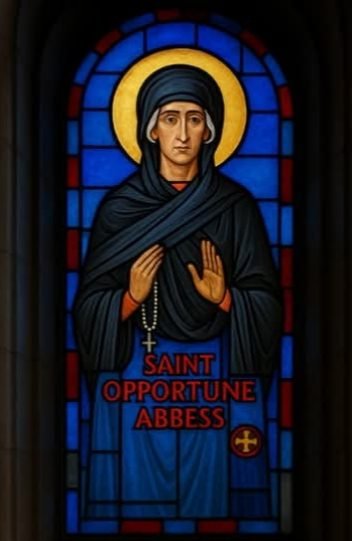
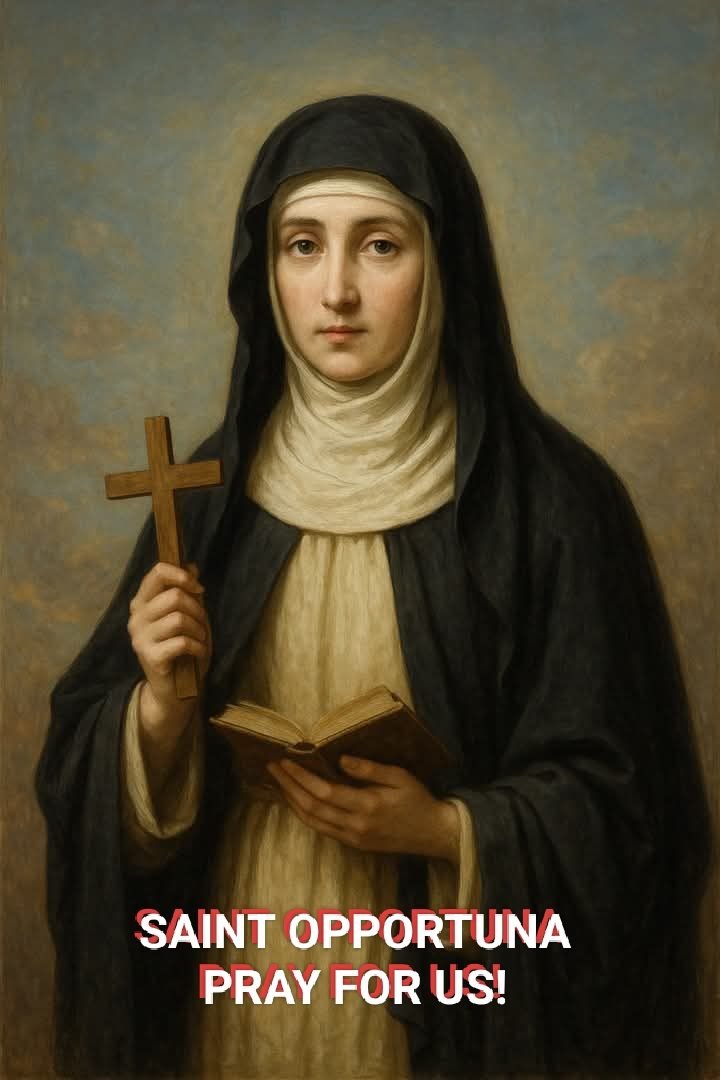
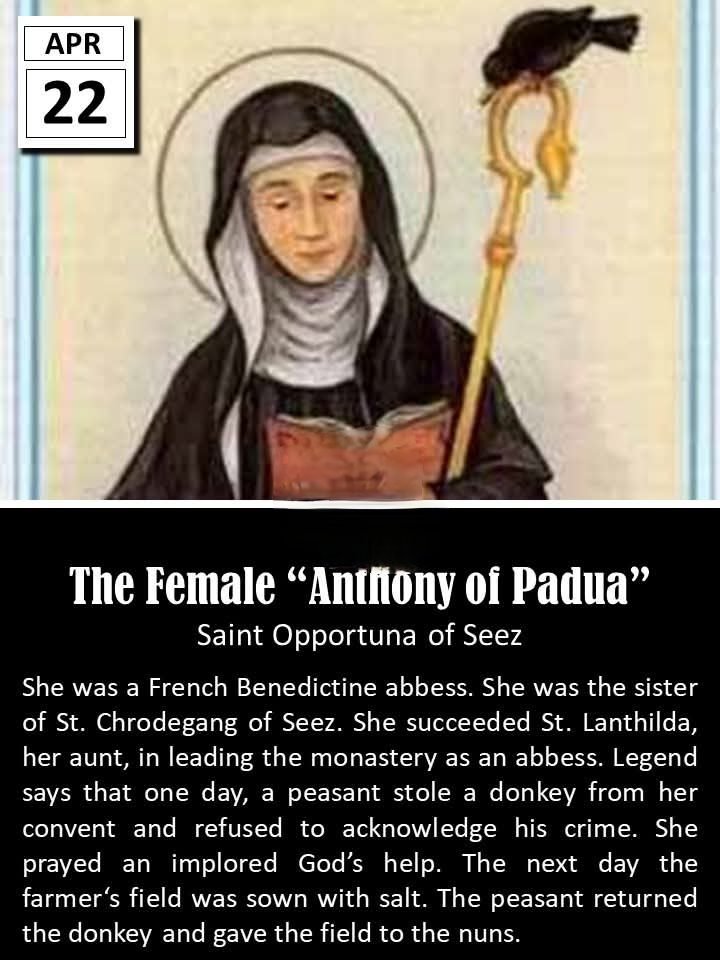
SAINT OPPORTUNA
As far as we know, Saint Opportuna never had any biological children. And yet she left the legacy of being an amazing mother. How is that so?
As abbess of a convent, Opportuna was the spiritual mother of her nuns. She loved and adored them, and they loved and adored her in return. She nurtured the nuns with the tenderness, care, and wisdom that are the best characteristics of loving parents. Even after she passed away, her spiritual children knew how much she loved them, and countless miracles were recorded at her tomb.
Saint Opportuna was an amazing mother. There is little else we know about her. But that is enough, because she teaches us to be amazing parents to our own children.
PRAYER
Saint Opportuna of Montreuil, You who inspired those around her with your devotion, we humbly ask for your prayers today. May your example help us turn to God in prayer so that with his Grace we can instruments of justice, love, and compassion to those in need. Amen