
SPIRITUAL INSIGHTS INTO THE LIFE OF ST. LOUIS-MARIE GRIGNION DE MONTFORT
April 28, 2026
John 1: 12
April 29, 2026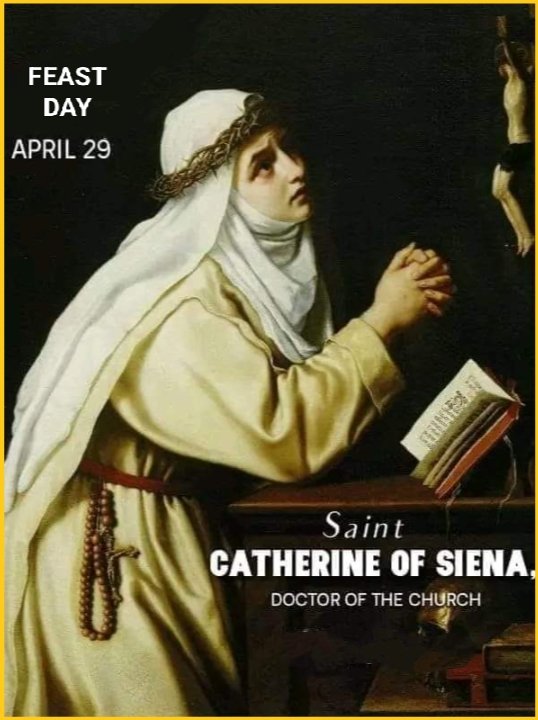
FEAST OF SAINT CATHERINE OF SIENA, MYSTIC AND DOCTOR OF THE CHURCH
FEAST DAY – 29th APRIL
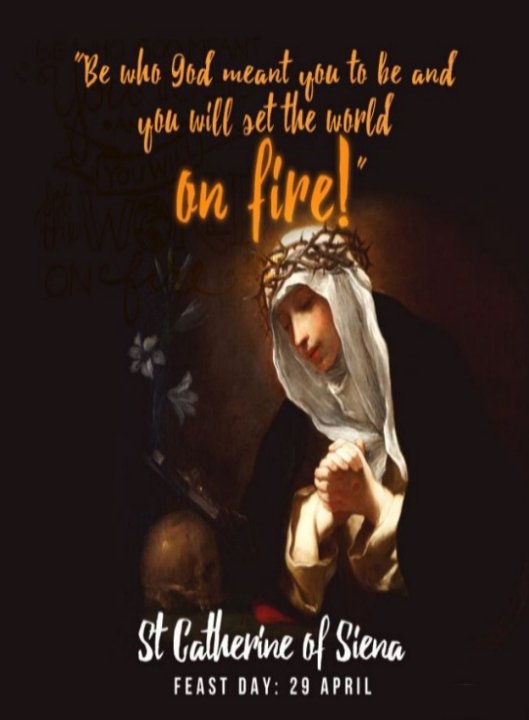
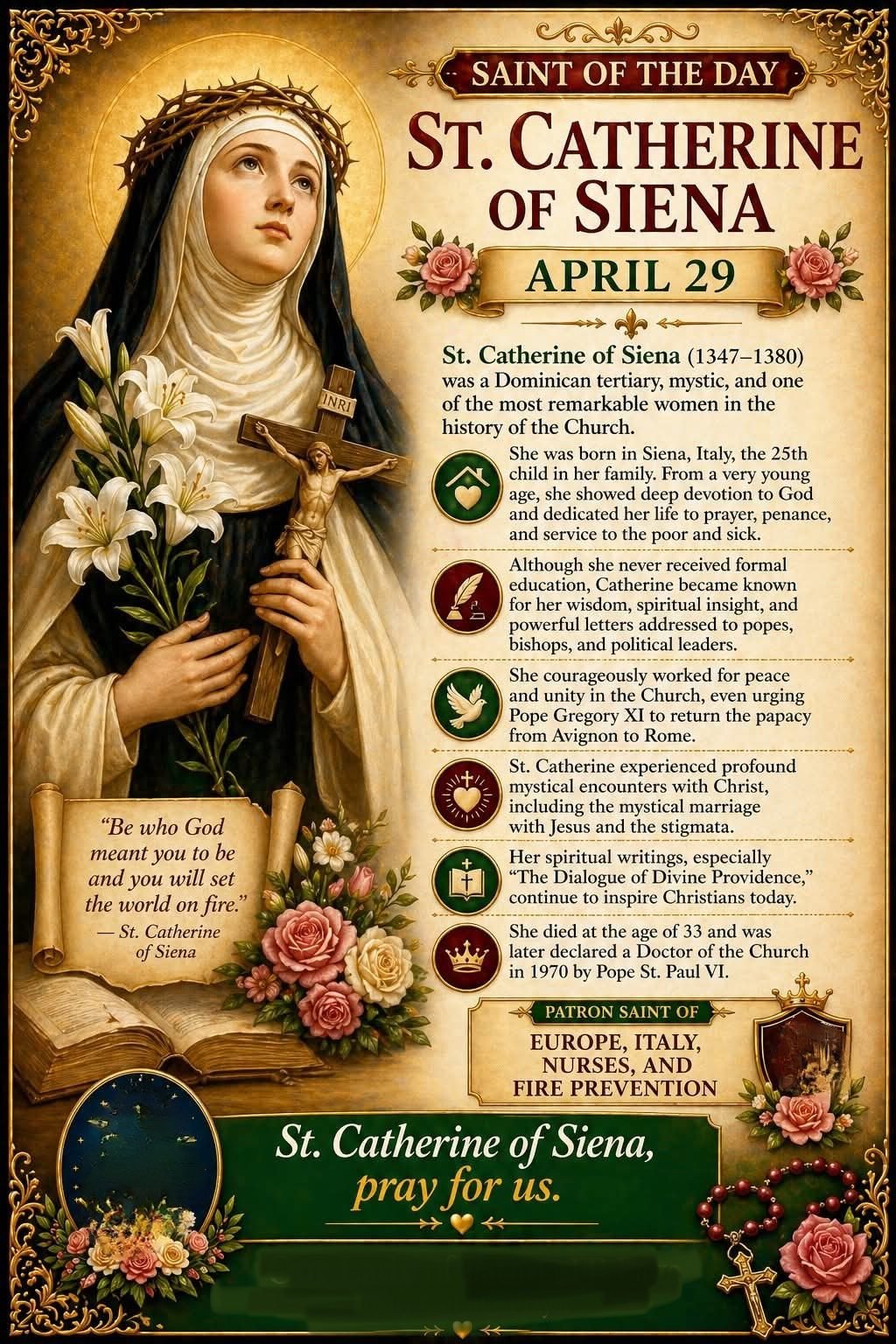
St. Catherine of Siena (25 March 1347 – 29 April 1380) was born during the outbreak of the plague in Siena, Italy, on March 25, 1347. She was the 25th child born to her mother, although half of her brothers and sisters did not survive childhood. Catherine herself was a twin, but her sister did not survive infancy. Her mother was 40 when she was born. Her father was a cloth dyer.
Saint Catherine of Siena was a great philosopher and theologian and is considered a Doctor of the Church. She is the patron saint of fire prevention, illness, miscarriage, Europe and nurses.

At the age of 6, a vision of the Lord came to her and she became very spiritual. She died at the early age of 33 and was canonized in 1461. In 1970, Pope Paul VI granted her the title of Doctor of the Church.
At the age of 16, Catherine’s sister, Bonaventura, died, leaving her husband as a widower. Catherine’s parents proposed that he marry Catherine as a replacement, but Catherine opposed this. She began fasting and cut her hair short to mar her appearance. She was adamant in her choice of life and did not wish to marry at all.
Her parents attempted to resist this move, to avoid marriage, but they were unsuccessful. Her fasting and her devotion to her family, convinced them to relent and allow her to live as she pleased.
Catherine once explained that she regarded her father as a representation of Jesus and her mother as Our Lady, and her brothers as the apostles, which helped her to serve them with humility. Despite Catherine’s religious nature, she did not choose to enter a convent.
Instead, she joined the Third Order of St. Dominic, which allowed her to associate with a religious society while living at home. Fellow Dominican sisters taught St. Catherine how to read. Meanwhile, she lived quietly, isolated within her family home.
St. Catherine developed a habit of giving things away and she continually gave away her family’s food and clothing to people in need. She never asked permission to give these things away, and she quietly put up with their criticisms. The virgin Catherine was espoused to Christ by a precious nuptial ring which, although visible only to her, always remained on her finger.
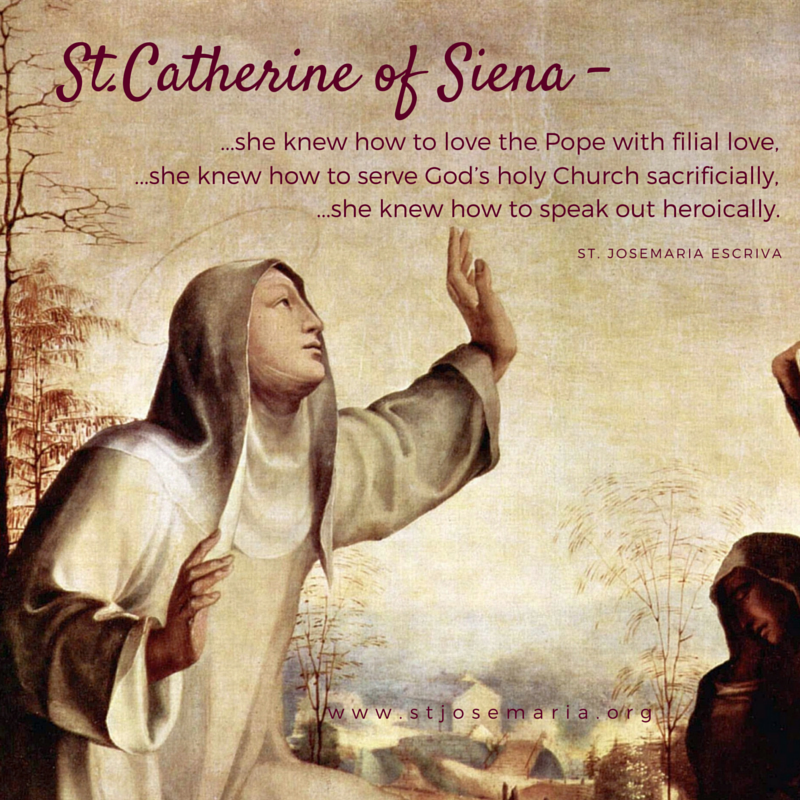
In her vision, she was told to re-enter public life and to help the poor and sick. She immediately rejoined her family and went into public to help people in need. Unbelievable were her austerities, her miracles, her ecstasies. The reputation of her sanctity soon spread abroad; thousands came to see her, to be converted by her.
The priests associated with her, having received extraordinary faculties of absolution, were unable to accommodate the crowds of penitents. She was a helper and a consoler in every need.
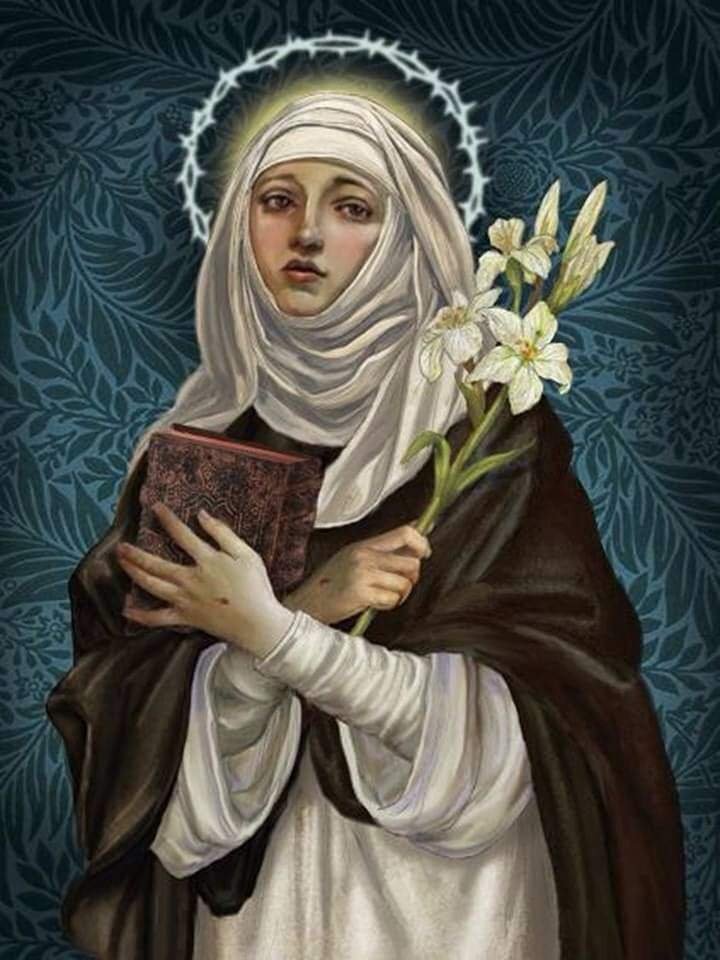
She often visited hospitals and homes where the poor and sick were found. Her activities quickly attracted followers who helped her in her mission to serve the poor and sick.
St. Catherine was drawn further into the world as she worked, and eventually she began to travel, calling for reform of the Church and for people to confess and to love God totally. She became involved in politics, and was key in working to keep city states loyal to the Pope. She was also credited with helping to start a crusade to the Holy Land.

On one occasion, she visited a condemned political prisoner and was credited with saving his soul, which she saw being taken up to heaven at the moment of his death. St. Catherine allegedly was given the stigmata, but like her ring, it was visible only to herself. She took Bl. Raymond of Capua as her confessor and spiritual director.
From 1375 onwards, St. Catherine began dictating letters to scribes. She petitioned for peace and was instrumental in persuading the Pope in Avignon to return to Rome. She became involved in the fractured politics of her time, but was instrumental in restoring the Papacy to Rome and in brokering peace deals during a time of factional conflict among Italian city states.
She also established a monastery for women in 1377 outside of Siena. She is credited with composing over 400 letters, her Dialogue, which is her definitive work, and her prayers. These works are so influential that Saint Catherine would later be declared a Doctor of the Church. She is one of the most influential and popular saints in the Church.
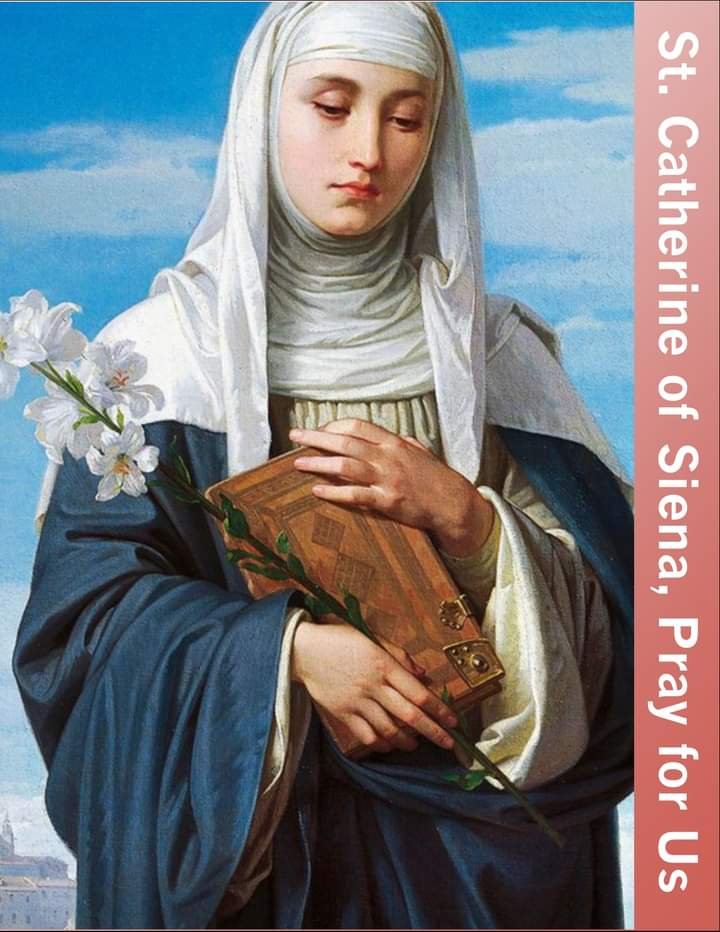
Catherine received private revelations from God the Father, which are recorded in The Dialogues. Some words of the Heavenly Father especially relevant to the Church in today’s world are these: “The sins of the clergy should not lessen your reverence for them” (Dialogue 116).
The Lord also told her: “The reverence you pay to [priests] is not actually paid to them but to me, in virtue of the blood I have entrusted to their ministry. If this were not so, you should pay them as much reverence as to anyone else, and no more. It is this ministry of theirs that dictates that you should reverence them and come to them, not for what they are in themselves but for the power I have entrusted to them, if you would receive the sacraments of the Church….
“So the reverence belongs not to the ministers, but to me and to this glorious blood made one thing with me because of the union of divinity with humanity. And just as the reverence is done to me, so also is the irreverence, for I have already told you that you must not reverence them for themselves, but for the authority I have entrusted to them. Therefore you must not sin against them, because if you do, you are really sinning not against them but against me. This I have forbidden, and I have said that it is my will that no one should touch them” (Dialogue 116).
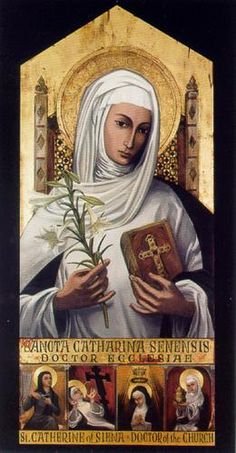
To encourage them to follow God’s will, this humble saint sent letters to many of her contemporaries, including popes and secular rulers. In fact, she was able to persuade Pope Gregory XI to return to Rome after the popes had resided at Avignon instead of Rome for almost 70 years.
This holy saint was a great lover of the Holy Eucharist; Pope Benedict XVI makes mention of this in his Apostolic Exhortation Sacramentum Caritatis. She loved to receive Jesus in Holy Communion. “O You who are mad about Your creature! True God and true Man, You have left Yourself wholly to us, as food, so that we will not fall through weariness during our pilgrimage in this life, but will be fortified by You, and by Your celestial nourishment.”
By 1380, the 33-year-old mystic had become ill, possibly because of her habit of extreme fasting. Her confessor, Raymond, ordered her to eat, but she replied that she found it difficult to do so, and that possibly she was ill. In January of 1380, her illness accelerated her inability to eat and drink. Within weeks, she was unable to use her legs. She died on April 29, following a stroke just a week prior.
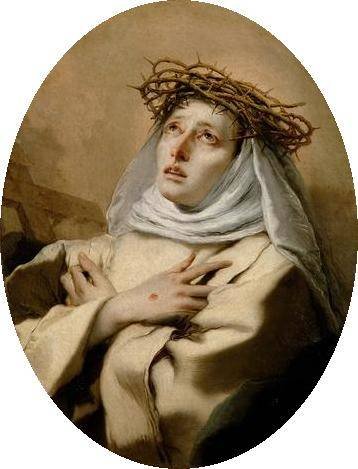
What can we learn from St. Catherine? In Pope Benedict XVI’s General Audience where he spoke about St. Catherine, he stated: “Like the Sienese saint, every believer feels the need to be conformed with the sentiments of the heart of Christ to love God and his neighbor as Christ himself loves.
And we can all let our hearts be transformed and learn to love like Christ in a familiarity with him that is nourished by prayer, by meditation on the Word of God and by the sacraments, above all by receiving Holy Communion frequently and with devotion.”
St. Catherine’s feast day is April 29. She is the patroness against fire, illness, the United States, Italy, miscarriages, people ridiculed for their faith, sexual temptation, and nurses, bodily ills, Europe, fire prevention, fire-fighters, Siena, Italy and temptations.
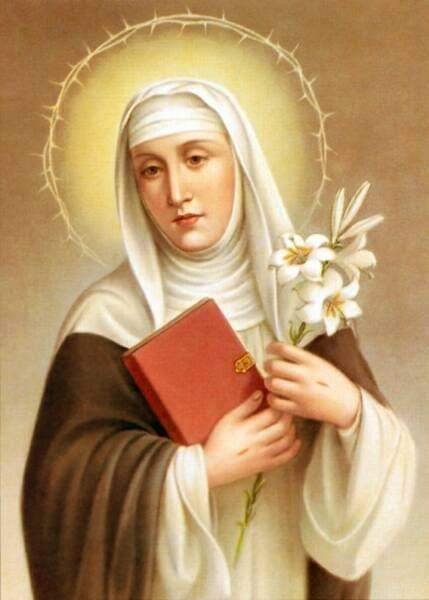
CONTEMPLATING THE LIFE OF SAINT CATHERINE OF SIENA
St. Catherine of Siena stands among the most remarkable saints in Church history. A mystic, reformer, peacemaker, and Doctor of the Church, she lived a life deeply rooted in prayer while courageously addressing the crises of her time. She united contemplation with fearless action.
Born in 1347 in Siena, Italy, she lived as a lay Dominican and died in Rome in 1380 at the age of thirty-three. Her feast is celebrated on April 29, and she was declared a Doctor of the Church in 1970.
A FIRE IN THE CHURCH THE WOMAN WHO SPOKE TO A POPE
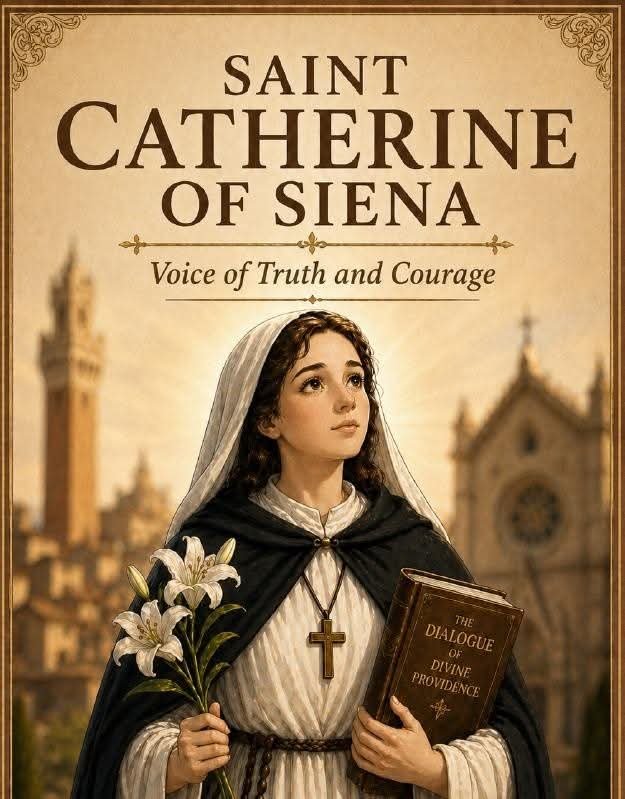
THE CHILD WHO SAW WHAT OTHERS DID NOT
Amid the busy and noisy life of Siena, Catherine stood apart. Born into a large family, she experienced a profound vision of Christ at a young age and felt called to give her life entirely to God. She resisted pressure to marry and the expectations of society, choosing instead a path that belonged wholly to God.
THE YEARS HIDDEN FROM THE WORLD
While others sought recognition, Catherine withdrew into silence, prayer, fasting, and deep interior struggle. Unknown to the world, she learned to listen to God in stillness, and in that hidden life her spiritual understanding grew.
ENTRY INTO DOMINICAN LIFE
She joined the Dominican Third Order, living in the world while dedicating herself completely to God. Her vocation was not confined to a convent but expressed in a life of devotion amidst ordinary surroundings.
MYSTICAL EXPERIENCES
Her life was marked by visions, intimate spiritual dialogue with God, and a profound mystical union with Christ, including what is known as her mystical marriage. Her spiritual insights were later recorded in her work The Dialogue of Divine Providence.
THE VOICE THAT CALLED HER FORTH
Her deep prayer did not keep her withdrawn. She was called to serve the poor, the sick, and the suffering. With clarity and purpose, she entered the world, and people were drawn not to her position but to her truth.
A CHURCH WOUNDED FROM WITHIN
In her time, Italy was divided by political conflict, and the Church itself was entangled in instability. Corruption, weakened discipline, and political influence had diminished its credibility. The papacy resided in Avignon instead of Rome, weakening the unity and authority of the Church. Catherine saw these wounds clearly and carried their burden in her heart.
THE DIALOGUE THAT SHAPED HER MISSION
Through prayer, she came to understand God’s immense love, the dignity of the human soul, the reality of sin, and Christ as the bridge to God. She realized that the Church, though wounded, remained beloved and must be renewed rather than abandoned.
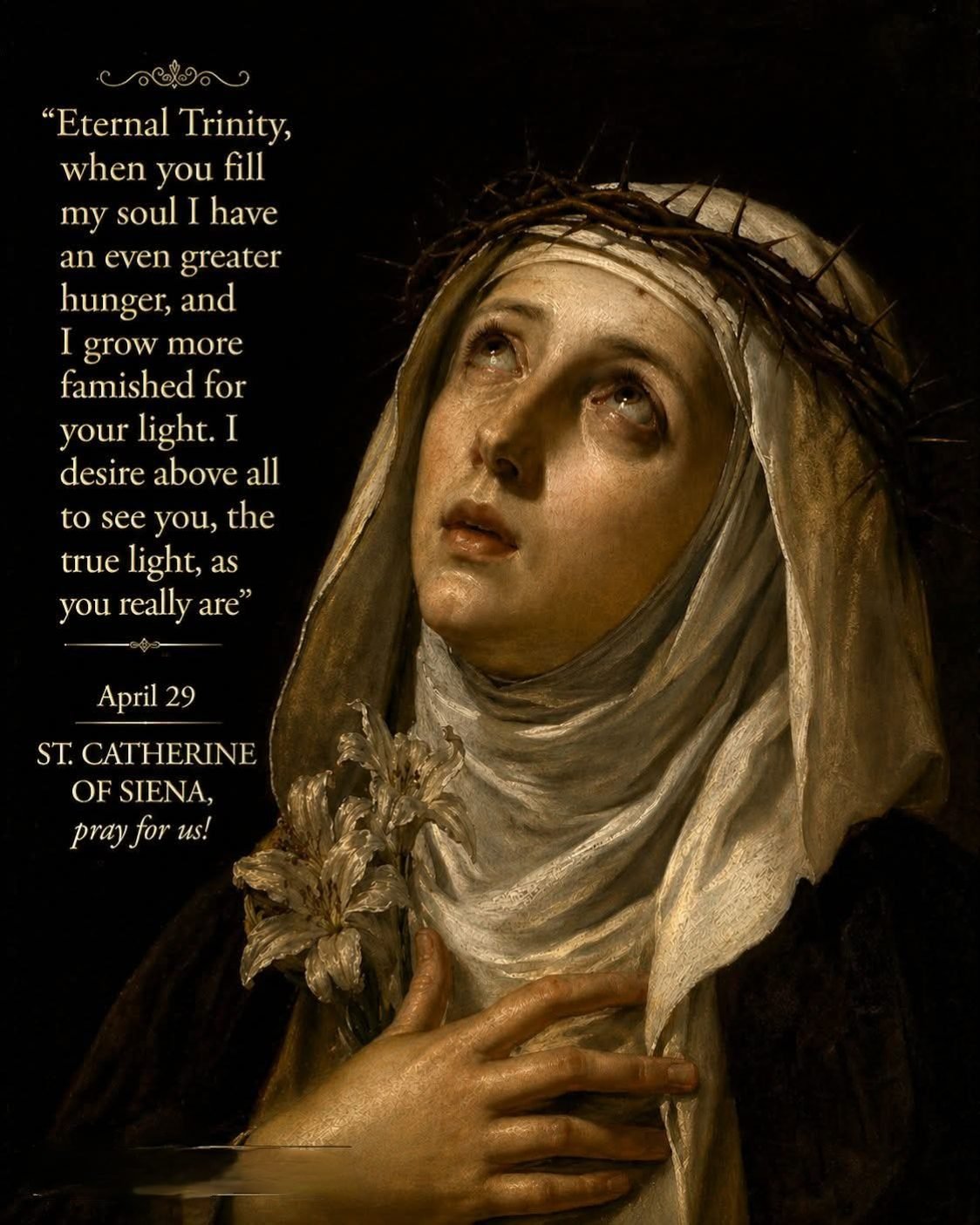
A VOICE THAT REACHED BEYOND ITS PLACE
Catherine began writing to leaders and rulers with clarity and boldness. Her words were direct and often challenging. She even addressed the Pope, urging spiritual courage and reform.
THE COURAGE TO ADDRESS A POPE
To Pope Gregory XI, she spoke as a witness, calling him to return to Rome, to reform the Church, and to act without fear. Her message was deeply spiritual, urging him to be a true shepherd and to live his calling faithfully.
THE JOURNEY INTO POWER
She traveled to Avignon herself, entering the center of authority without status or power. Speaking with conviction born of prayer, she addressed the Pope directly, not with force but with truth.
THE TURNING OF A DECISION
The Pope had long hesitated due to political pressures and uncertainty. Catherine reframed the situation as a matter of obedience to God rather than strategy. Gradually, her words helped inspire change.
THE RETURN
In 1377, the Pope returned to Rome, ending the Avignon Papacy. While not her work alone, Catherine played a vital role in encouraging this decisive step.
A LIFE POURED OUT
Her physical strength declined, but her voice remained strong until the end. She died at thirty-three, having given herself completely, not solving every problem but holding nothing back.
SPIRITUAL CHARACTER
Catherine is remembered for her intense love for Christ, her courage in speaking truth, her deep wisdom, and her complete self-sacrifice for God and the Church.
SPIRITUAL SIGNIFICANCE
Her life reveals that true contemplation leads to action, that truth must be spoken even to those in power, and that the Church must be loved and renewed even in its brokenness.
KEY THEMES FROM HER LIFE
Union with God leads to mission. Love for the Church calls for service and renewal. Truth requires courage. Total surrender leaves nothing withheld.
THE FIRE THAT REMAINED
Catherine left behind no institution or worldly power, only her words, her witness, and her union with God. Yet her life continues to challenge us with a question: what happens when a person listens so deeply to God that fear no longer holds them back from speaking the truth?
COLLECT PRAYER
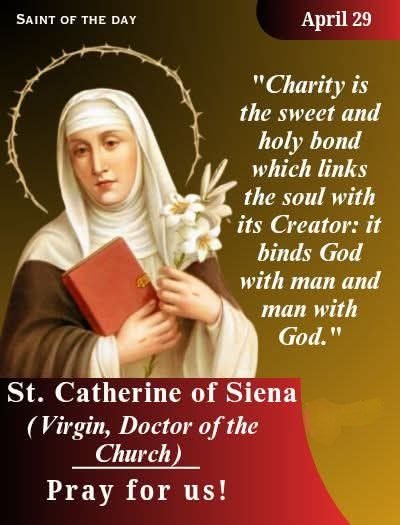
O God, You set Saint Catherine of Siena on fire with divine love in her contemplation of the Lord’s Passion and her service of your Church with the utmost humility of spirit.
Grant, through her intercession, that your people, participating in the mystery of Christ, may ever exult in the revelation of his glory. Who lives and reigns with you in the unity of the Holy Spirit, one God, forever and ever. Amen

Saint Catherine of Siena, humble virgin and Doctor of the Church, in thirty-three years you achieved great perfection and became the counselor of Popes. Saint Catherine of Siena, intercede and pray for us.