
SPIRITUAL INSIGHTS INTO THE LIFE OF Saint Augustine of Canterbury
May 27, 2026
Proverbs 9:10
May 28, 2026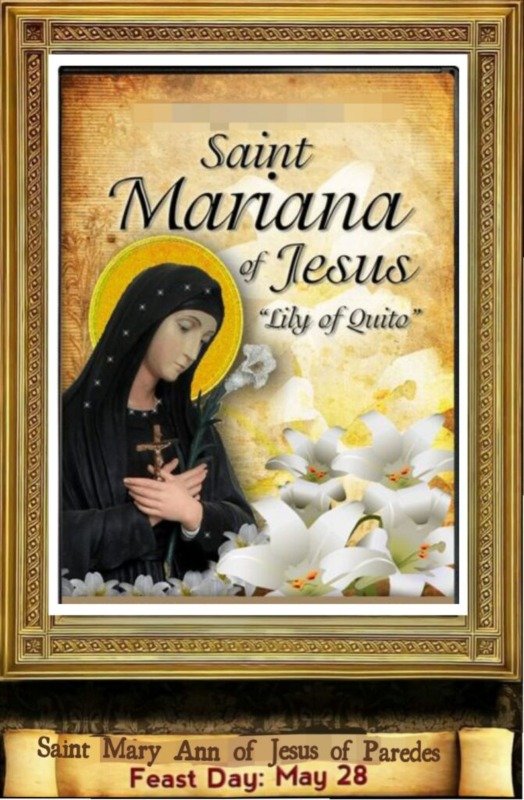
FEAST OF SAINT MARIANA OF JESUS DE PAREDES
FEAST DAY – 28th MAY
Mariana of Jesus de Paredes (Spanish: Mariana or María Ana de Jesús de Paredes; October 31, 1618 – May 26, 1645), is a Catholic saint and was the first person to be canonized from what is now Ecuador. She was a recluse who is said to have sacrificed herself for the salvation of her city. She was beatified by Pope Pius IX in 1853 and canonized by Pope Pius XII in 1950.
She is the patron saint of Ecuador and venerated at the Church of the Society of Jesus in Quito. Her feast day is celebrated on May 26 by the nation and on May 28 by the Franciscan Order. She was born Maríana de Paredes Flores y Granobles y Jaramillo in the city of Quito, then part of the Viceroyalty of Peru, on October 31, 1618. She was born of aristocratic parents.
Her father was Jerónimo de Paredes Flores y Granobles, a nobleman of Toledo, and her mother was Mariana Jaramillo, a descendant of one of the leading conquistadors. Mariana was the youngest of eight children, and it is claimed her birth was accompanied by most unusual phenomena in the heavens, clearly connected with the child and juridically attested at the time of the process of her beatification.
Orphaned at the age of four, she was taken in and raised by her older sister, Jerónima de Paredes, and the latter’s husband, Cosme de Caso. Drawn to a spiritual life, her sister and brother-in-law allowed her to live in seclusion in their house, leading an ascetical lifestyle, similar to Rose of Lima to whom she is often compared.
She was refused entry into a monastery, despite urging from her brother-in-law and guardian Cosme de Caso. She subjected herself to bodily mortification, with the aid of her Indian servant. She did not live in total seclusion, but rather centered her spiritual life on the nearby Jesuit church, where she participated in the Sodality of Our Lady, established by the Society in their various churches around the world to help the laity in their desire to deepen their spiritual lives.
It is reported that the fast which Paredes kept was so strict that she took scarcely an ounce of dry bread every eight or ten days. The food which miraculously sustained her life, as in the case of Catherine of Siena and Rose of Lima, was, according to the sworn testimony of many witnesses, the Eucharist alone, which she received every morning at Mass.
Paredes’ spiritual life was closely connected to the Jesuits, but, at the suggestion of her spiritual director, she became a member of the Third Order of St. Francis. This was likely advised to her as enrolling in that Order gave her an official status reflective of her penitential way of life in Spanish society, for which the Jesuits had no equivalent.
The religious name she assumed at that time, Mariana of Jesus, was no doubt indicative as to where her spiritual heart lay. According to her Jesuit hagiographer, she did not go to the Franciscan church to receive the scapular and rope cincture proclaiming membership in that life, but sent someone else.
Following Paredes’ death in 1645, her funeral and burial were held in the Jesuit church. The funeral sermon that the priest Alonso de Rojas preached emphasized her bodily mortification and renunciation of the flesh, and put her forward as a model for females in Quito to emulate. “Learn girls of Quito, from your fellow countrywoman, [to prefer] holiness over beauty, virtues over ostentation.”
The sermon became a key document in the long process to establish her saintliness, beatification (1853), and final canonization (1950). The Friars Minor claimed Paredes as a saint of the Franciscan Order. She did wear the Franciscan scapular and cord, but her 17th-century Jesuit hagiographer, Jacinto Morán de Butrón, claims that the Jesuits nurtured her spiritual life.
Soon after her death, the Franciscan Province of Peru, based in Lima, included a biography of Mariana in the history of the province, citing the Jesuit funeral sermon as a source. Paredes possessed an ecstatic gift of prayer and is said to have been able to predict the future, see distant events as if they were passing before her, read the secrets of hearts, cure diseases by a mere sign of the Cross or by sprinkling the sufferer with holy water, and at least once restored a dead person to life.

During the 1645 earthquakes and subsequent epidemics in Quito, she publicly offered herself as a victim for the city and died shortly thereafter. It is also reported that, on the day she died, her sanctity was revealed in a wonderful manner: Immediately after her death, a pure white lily sprang up from her blood, blossomed and bloomed, a prodigy which has given her the title of “The Lily of Quito”. The Republic of Ecuador has declared her a national heroine.
Soon after Paredes’ death, at the urging of the Jesuit Fathers, the Bishop of Quito, Alfonso de la Peña y Montenegro, initiated the first preliminary steps towards the canonization of Paredes as well as her niece, Sebastiana de Caso, and instituted the process of inquiring into and collecting evidence for the sanctity of her life, her virtues and her miracles.
King Charles II of Spain took up the cause of their canonization, in an effort to promote the connection of native-born colonists in the Americas with the Spanish nation, as well as proving the faith of the colonial population. The Sacred Congregation of Rites, having discussed and approved of this process, decided in favor of the formal introduction of the cause, and Pope Benedict XIV signed the commission for introducing the cause on December 17, 1757.
After the Suppression of the Society of Jesus throughout the Spanish Empire in 1767, the cause for Paredes’ canonization was taken over by the Spanish Crown, which appointed a Chilean priest as Postulator of the cause to the Holy See. Her veneration was encouraged in the various Spanish colonies of South America.
The Apostolic process concerning the virtues of Mariana de Paredes was drawn up and examined in due form by the two Preparatory Congregations and by the General Congregation of Rites, and orders were given by Pope Pius VI for the publication of the decree attesting the heroic character of her virtues. The process concerning the two miracles wrought through the intercession of this servant of God was subsequently prepared and was examined and accepted by the three congregations, and formally approved on January 11, 1817, by Pope Pius IX.
The General Congregation having decided in favor of proceeding to the beatification, Pope Pius IX commanded the Brief of beatification to be prepared. Peter Jan Beckx, Superior General of the Society of Jesus, petitioned the cardinal Costantino Patrizi Naro to order the publication of the Brief, and his request was granted.
The Brief was read and the solemn beatification took place in the Basilica of St Peter in Rome on November 10, 1853. Many miracles have been claimed to have been the reward of those who have invoked her intercession, especially in America. An additional miracle having been confirmed by the General Congregation, her canonization was approved by Pope Pius XII and celebrated in 1950.
Since Parades was beatified, many parishes and educational facilities have been placed under her patronage throughout Latin America. A congregation of teaching Religious Sisters named for her was founded in 1873 by Mercedes de Jesús Molina.
After the death of Saint Mariana of Jesus de Paredes, a beautiful lily sprouted forth from her blood, and so she has been styled the Lily of Quito. But in far greater measure did Saint Mariana of Jesus deserve the name because of the innocence of her life. She preserved it unsullied in the midst of a wicked world, carefully protecting it by the practice of rare austerities.
From her earliest childhood Mariana felt altogether drawn to God and to heavenly things. Meanwhile she attached herself to the Immaculate Virgin with unbounded confidence and tender devotion. She received the habit of the Third Order from the Franciscans in her native town of Quito, Ecuador, and in consideration of her great virtue, she was permitted to take the three vows of religion. Then she repaired to her home where she led a life hidden in God and devoted to prayer and penance.
PRAYER
Almighty God of Infinite Goodness, Triune Godhead of three persons, One in Being, we thank you for the perpetual graces bestowed upon your most devoted servant, St. Mariana de Jesus, demonstrated through the exemplary holiness of her life.
Lord, continue to benefit us all, who appeal to you, and grant us singular graces, especially in times of natural calamity and epidemics, through St Mariana’s intercession, especially the assistance of gaining eternal salvation in Jesus’ Name. Amen
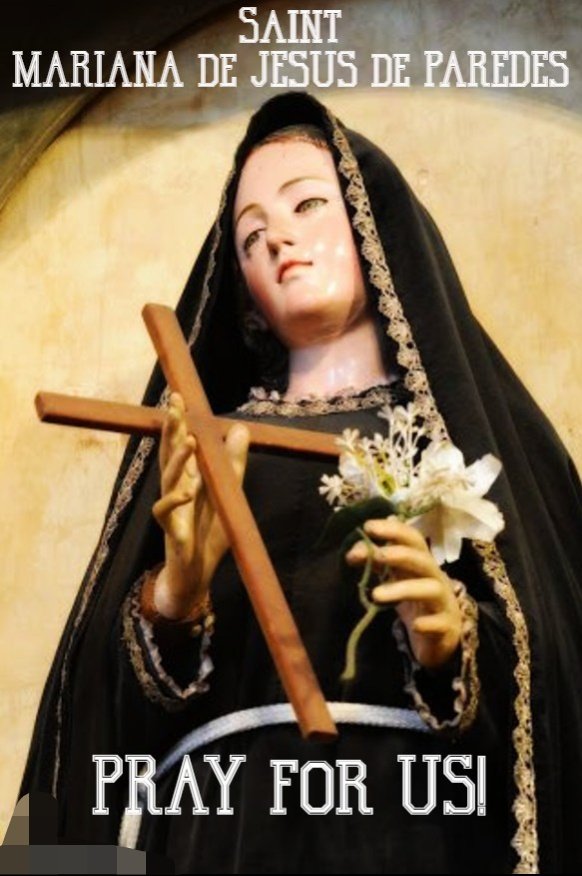
Saint Mariana of Jesus de Paredes, pray for us.
*********************************
ALSO CELEBRATED:
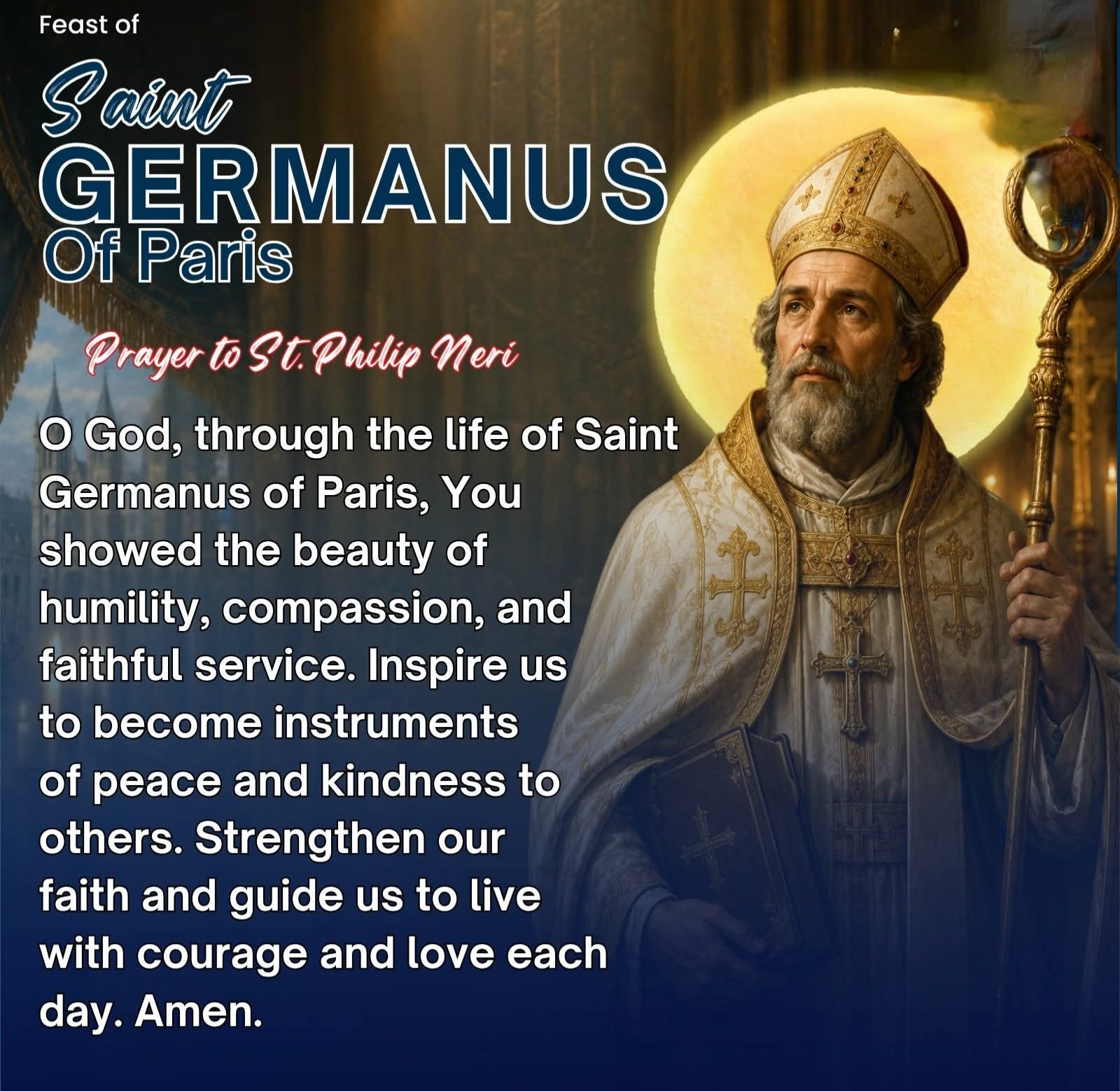
SAINT GERMANUS OF PARIS
FEAST DAY – 28 MAY
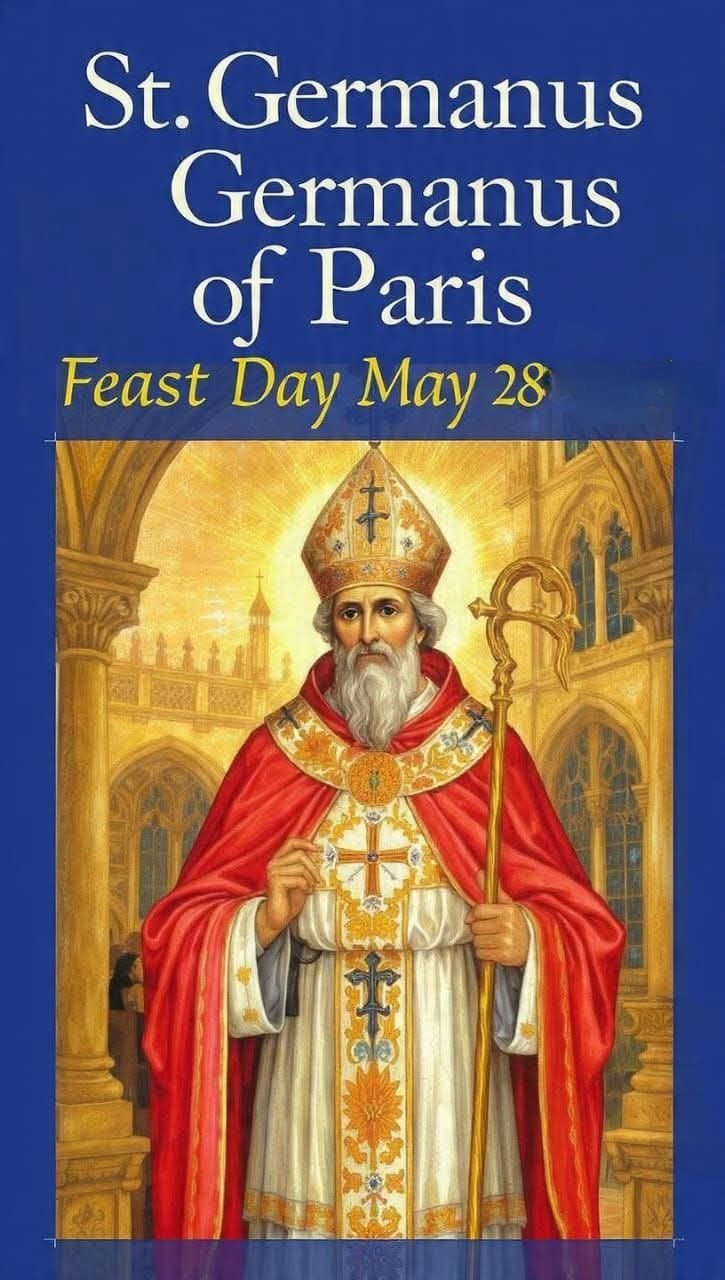
Saint Germanus of Paris was a holy bishop and one of the great spiritual leaders of sixth-century France. Born around 469 near Autun, he was known from his youth for deep piety, prayer, and discipline. After becoming a priest and later abbot of St. Symphorian’s monastery, he gained a reputation for miracles and prophecy.
In 554, he became Bishop of Paris despite his reluctance. As bishop, he lived a life of strict simplicity, fasting, prayer, and extraordinary charity to the poor. His home was always open to beggars and the suffering, and his preaching transformed Paris by encouraging repentance, ending public immorality, and restoring peace among the people.
He had a strong spiritual influence over King Childebert, helping convert the king from worldly ambition to a life of piety and generosity. Through St. Germanus’ guidance, many churches and monasteries were founded, including the famous church later known as St. Germain-des-Prés.
St. Germanus was also known for healing miracles, including curing King Childebert and later King Clotaire through prayer. He courageously confronted immoral rulers, even excommunicating King Charibert for adultery and scandalous behavior. During political conflicts among the Frankish kings, he worked tirelessly to preserve peace and warned rulers against violence and ambition.
He played a major role in eliminating pagan practices in France and helped draft church laws at the Third Council of Paris in 557. By his advice, idols were destroyed and immoral entertainments on Sundays and feast days were forbidden.
St. Germanus died on May 28, 576, at about eighty years old. After his death, many miracles were reported at his tomb, increasing devotion to him throughout France. He is remembered especially for his holiness, zeal for souls, and boundless charity to the poor.
Source: ewtn
CONTEMPLATING THE LIFE OF SAINT GERMANUS OF PARIS

THE BISHOP WHO WALKED AMONG KINGS YET BELONGED TO THE POOR
St. Germanus of Paris was a sixth-century bishop, monk, reformer, miracle-worker, and peacemaker who became one of the most beloved saints of early medieval France. He was known for his charity toward the poor, deep prayer life, courage before rulers, compassion for prisoners, and efforts to bring peace during violent times. Though he advised kings and lived among royalty, he remained simple, humble, and devoted to God. He became known as the “Father of the Poor.”
HISTORICAL BACKGROUND
Germanus lived during the Merovingian era in present-day France, a period marked by political instability, violence, poverty, and warfare following the collapse of the Western Roman Empire. In this difficult age, bishops often acted as spiritual guides, protectors of the poor, and mediators of conflict. Germanus emerged as one of the great spiritual leaders of his time.
A CHILD BORN INTO A TROUBLED WORLD
Born around the year 496 near Autun into a noble family, Germanus grew up in a world shaped by conflict and insecurity. Despite his background, he showed little interest in power or status and was drawn instead toward prayer, silence, and God.
THE YOUNG MONK
Germanus entered the monastery of Saint Symphorien, embracing a life of prayer, fasting, obedience, and simplicity. He became known for his tenderness toward the poor, often giving away food, clothing, and possessions to those in need. His compassion distinguished him even within monastic life.
THE ABBOT WHO CHOSE MERCY
Eventually becoming abbot, Germanus led with discipline and kindness. His life remained centered on prayer and service. Although respected for his holiness, he preferred a hidden monastic life rather than public recognition.
THE RELUCTANT BISHOP OF PARIS
King Childebert I called Germanus to become Bishop of Paris. Though reluctant to leave the peace of monastic life for a city filled with political struggles and inequality, he accepted the role in obedience.
THE BISHOP OF THE POOR
As bishop, Germanus devoted himself to the needy. He visited widows, prisoners, the sick, and the abandoned. He freely distributed food and church resources, believing wealth existed to serve suffering people. The poor lovingly called him “Father.”
MINISTRY TO PRISONERS
Germanus regularly visited prisons, bringing comfort and mercy to forgotten people. He prayed with prisoners, sought clemency for the condemned, and became associated with miracles and stories of liberation.
COURAGE BEFORE KINGS
Although close to rulers, Germanus fearlessly challenged injustice, violence, and corruption. He valued faithfulness to God above royal approval and spoke truth even when it was risky.
A PEACEMAKER IN A VIOLENT AGE
Living amid political conflict and bloodshed, Germanus repeatedly worked to reconcile enemies and restore peace. Though not always successful, he never abandoned the pursuit of mercy and unity.
THE HIDDEN MYSTIC
Despite his many responsibilities, Germanus remained deeply contemplative. He fasted, kept vigils, and sought silence. Stories of healings and miracles surrounded him, yet he always remained inwardly a monk.
THE ABBEY THAT BORE HIS NAME
With King Childebert, Germanus helped establish a monastery and church in Paris that later became known as Saint-Germain-des-Prés. It became one of the spiritual centers associated with his legacy.
THE FINAL DAYS
By old age, Germanus was widely regarded as a living saint. Loved by the poor and respected by rulers, he died on May 28, 576. Paris mourned the loss of a bishop whose life had been devoted to the suffering and forgotten.
CANONIZATION AND DEVOTION
Like many early saints, Germanus was recognized through popular devotion before formal canonization processes existed. His veneration spread widely throughout France, especially in Paris.
SPIRITUAL THEMES IN HIS LIFE
CHARITY AS THE HEART OF CHRISTIANITY
Germanus believed love for God could never be separated from love for the poor and suffering.
HOLINESS IN PUBLIC RESPONSIBILITY
Though contemplative by nature, he accepted leadership when obedience required it.
COURAGE BEFORE POWER
He remained spiritually free enough to challenge rulers with truth and justice.
MERCY TOWARD THE FORGOTTEN
His ministry showed special care for prisoners, the poor, and those neglected by society.
PATRONAGE
Saint Germanus of Paris is especially associated with Paris, prisoners, the poor, peacemaking, and compassionate pastoral ministry.
ARTISTIC REPRESENTATION
He is often shown as a bishop distributing alms, freeing prisoners, surrounded by the poor, or depicted with chains symbolizing his ministry to captives.
WHY HE STILL MATTERS
Modern society continues to struggle with inequality, corruption, violence, neglect, and spiritual emptiness. Germanus reminds believers that authentic holiness is not separation from human suffering but deeper compassion through closeness to God.
His life poses an enduring question: Can spiritual life remain authentic if it ignores the suffering of others?
For Germanus, the answer was clear: the closer one grows to God, the closer one must move toward the wounded.
PRAYER
Saint Germanus , Bishop of Paris, remembered as a humble shepherd of the people and a defender of Christian faith and charity, pray for us all.