
SPIRITUAL INSIGHTS INTO THE LIFE OF SAINT GERMANUS OF PARIS
May 28, 2026
John 15:2
May 29, 2026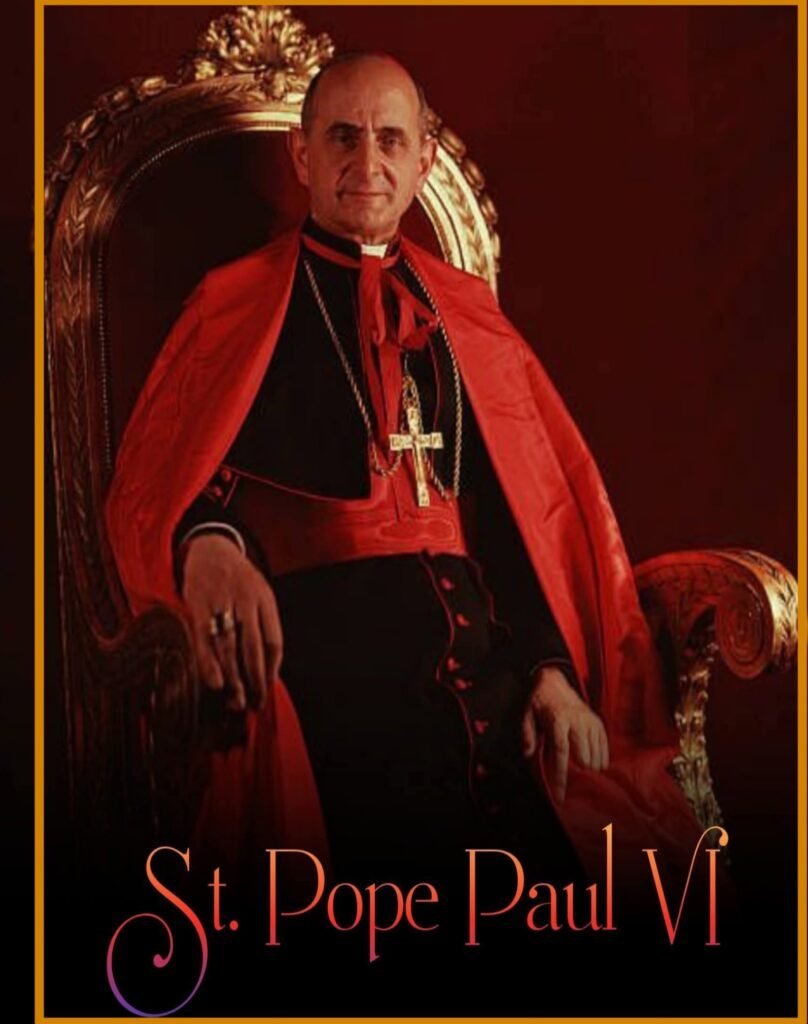
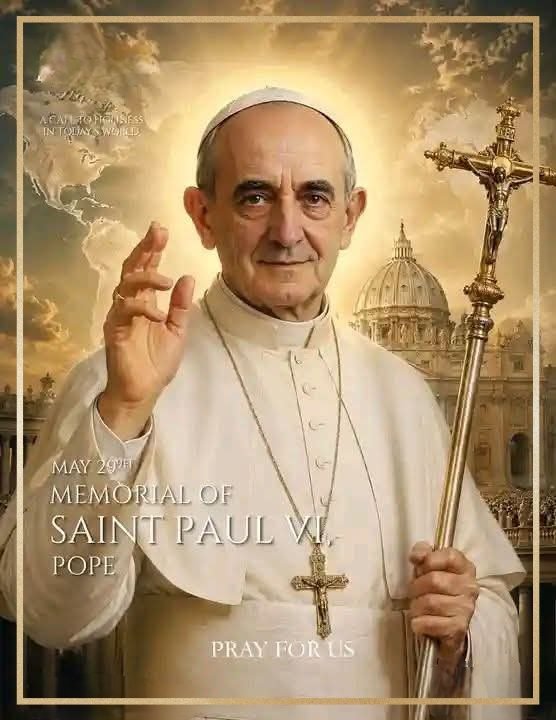
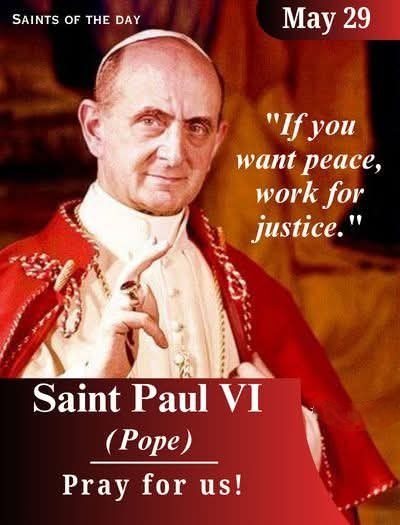
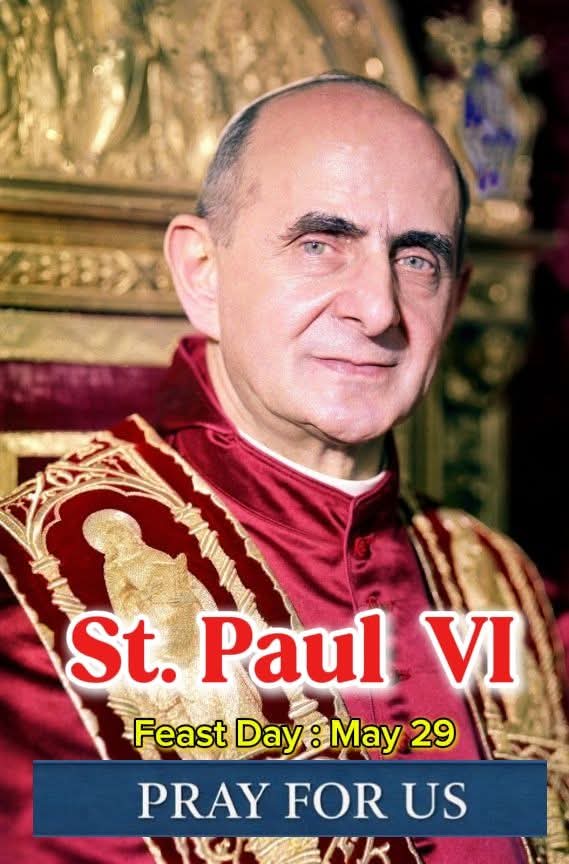
FEAST OF SAINT PAUL VI, POPE
FEAST DAY – 29th MAY
Pope Paul VI (Latin: Paulus VI; Italian: Paolo VI; born Giovanni Battista Enrico Antonio Maria Montini, 26 September 1897 – 6 August 1978) was head of the Catholic Church and sovereign of the Vatican City State from 21 June 1963 to his death in 1978. Succeeding John XXIII, he continued the Second Vatican Council, which he closed in 1965, implementing its numerous reforms.
He fostered improved ecumenical relations with Eastern Orthodox and Protestant churches, which resulted in many historic meetings and agreements. Pope Paul VI was born in the last years of the nineteenth century in Northern Italy to an educated and dignified family that was deeply committed to the Church.
Giovanni was ordained a priest at the tender age of twenty-two and entered the service of the Vatican a few years later. He spent approximately thirty years serving in the central administration of the Holy See in roles placing him in close contact with three popes. He was appointed Archbishop of Milan in 1954 and a Cardinal in 1958.
“Habemus Papam” could have been announced before the Cardinals ever mustered in the Sistine Chapel for the papal conclave of 1963, as few doubted whose experience best prepared him to be pope or who Pope John XXIII wanted to succeed him. Cardinal Baptista took the name Paul, the first Pope of that name in over three hundred years.
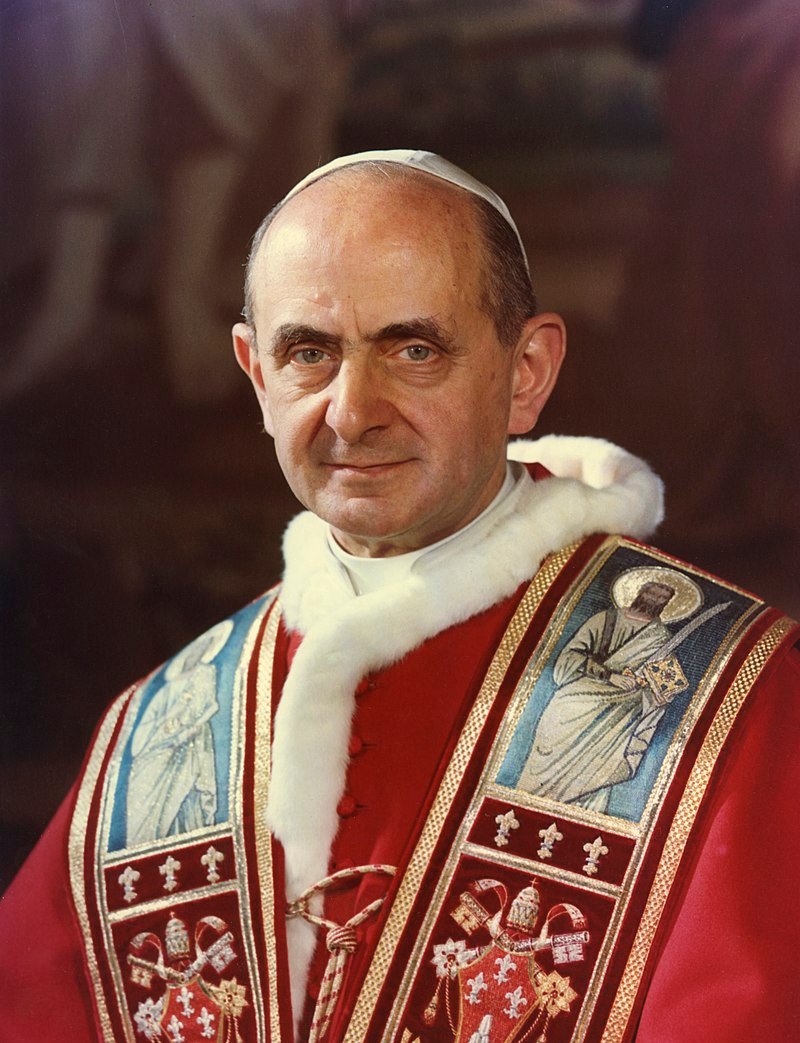
The new Pope very consciously united the stability and authority represented by Saint Peter with the zealous evangelical outreach represented by Saint Paul. Paul VI became the first pope ever to travel to other continents, going on apostolic pilgrimages to the Holy Land, India, Colombia, the United States, Portugal, and Uganda. Paul also continued the Second Vatican Council and shepherded it to its conclusion in 1965.
After the Council, Paul VI promulgated a new liturgical calendar, missal, breviary, and simplified rites for all the sacraments, thus impacting the lives of Catholics the world over in a personal way that few popes had ever done before. Paul VI was also deeply immersed in the theological and moral deliberations over the Church’s response to new technologies making artificial means of contraception accessible and affordable to the masses.
Paul’s 1968 encyclical, Humanae Vitae, heroically restated the Church’s perennial teaching on the immorality of using artificial means of contraception. Although Humana Vitae was not as compelling and humanistic a presentation of the Church’s rich teachings on married love as would later be advanced by Pope Saint John Paul II, it was replete with prophecies.
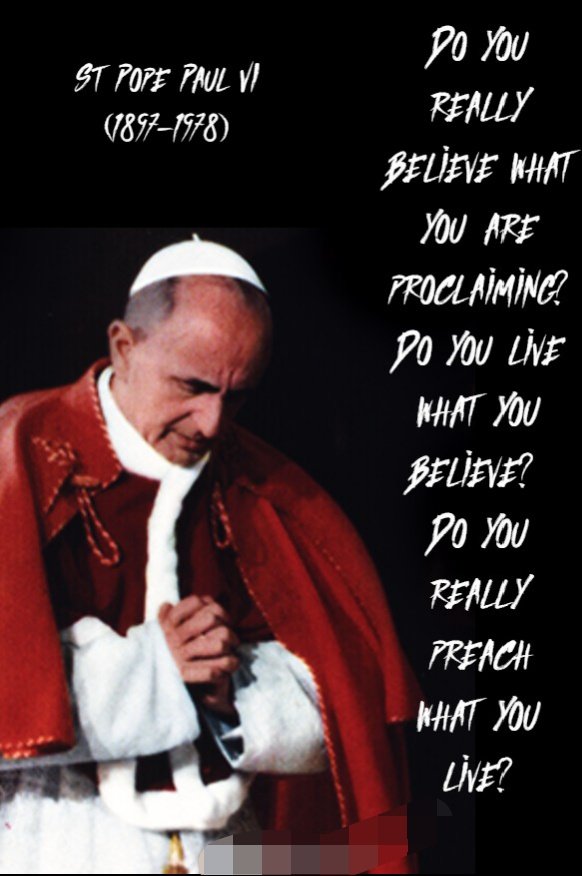
Paul VI’s predictions about the far-reaching and negative repercussions of the widespread use of contraceptives have all come true! No other individual or institution at the time foresaw, or anticipated in any way, even one of the ticking time bombs whose cultural shrapnel Paul inventoried with such accuracy. The intense storms that blew over Humanae Vitae in Northern Europe and North America lashed the aging Pope, and he never issued another encyclical.
At times in the late 1960s and 1970s, it seemed as if chunks of Catholicism, Christianity’s mighty rock of Gibraltar, might fall away and drop into the sea. But Paul VI’s steady, if undynamic, hand avoided fissures in the Church’s facade. Though no schisms surfaced during his pontificate, the Pope did publicly warn about the smoke of satan entering the temple of God.
Our saint was in many ways a tragic figure, tasked with leading a huge, complex Church in a confusing time. Paul’s confessor, a holy and faithful Jesuit, said, after the Pope’s death, that “if Paul VI was not a saint when he was elected Pope, he became one during his pontificate.” The Church was Paul VI’s perennial love and undying concern.
He died on the Feast of the Transfiguration, August 6, and was buried, per his request, in a simple casket placed directly in the earth in the grottoes under St. Peter’s Basilica, near so many of his predecessors who sat on the same Chair of Peter.
CONTEMPLATING THE LIFE OF SAINT PAUL VI
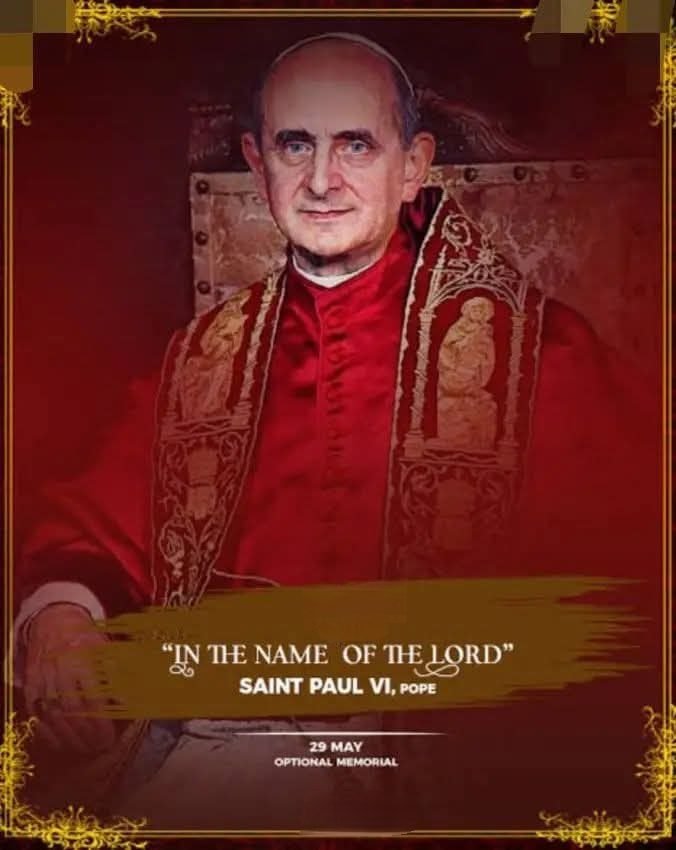
THE POPE WHO GUIDED THE CHURCH THROUGH A TIME OF UPHEAVAL
Saint Paul VI was one of the most influential popes of the modern era, leading the Church during a period of major cultural, social, and spiritual change. He is remembered for completing the Second Vatican Council, guiding the Church through post-conciliar challenges, promoting peace and dialogue, defending human dignity, and authoring Humanae Vitae. Though reserved and deeply reflective, he carried the struggles and hopes of the modern Church with remarkable faithfulness and is often regarded as one of the most misunderstood popes of recent history.
THE POPE WHO CARRIED THE WEIGHT OF A CHANGING CHURCH
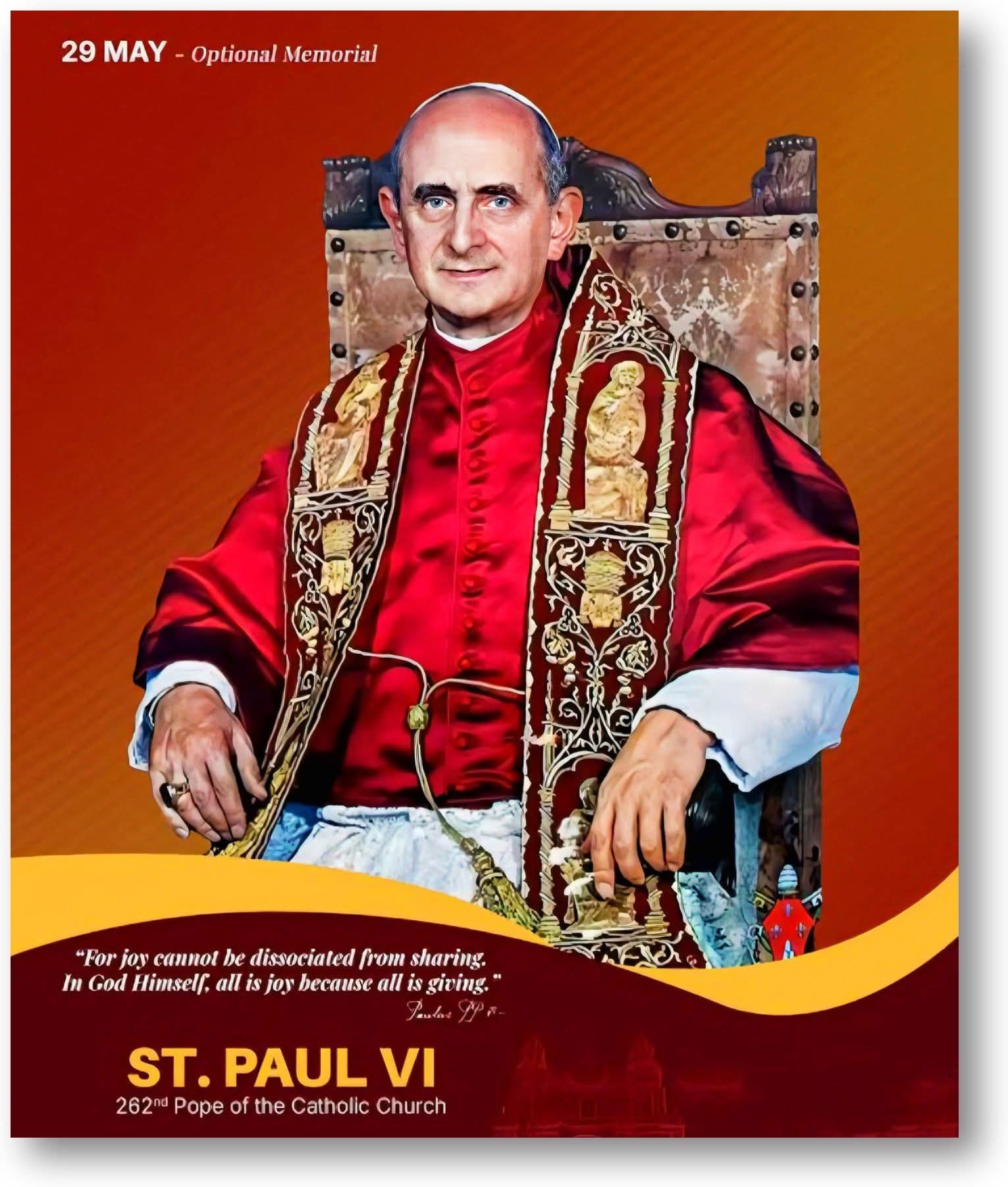
A QUIET BOY IN NORTHERN ITALY
Born Giovanni Battista Montini in 1897 in Concesio near Brescia, Italy, he grew up in a home shaped by faith, public service, and concern for society. Quiet, thoughtful, and physically frail, he preferred reading and prayer to noisy activities. His early years formed the reflective character that would later guide the Church through turbulent times.
THE YOUNG PRIEST WITH A DIFFERENT MISSION
Ordained a priest in 1920, Giovanni’s fragile health led him away from parish ministry and toward service within the Vatican. He worked closely with Popes Pius XI and Pius XII and became involved in diplomacy, administration, and humanitarian work. During World War II, he helped organize aid for refugees and victims of conflict, developing a deep concern for human suffering.
THE ARCHBISHOP OF THE MODERN CITY
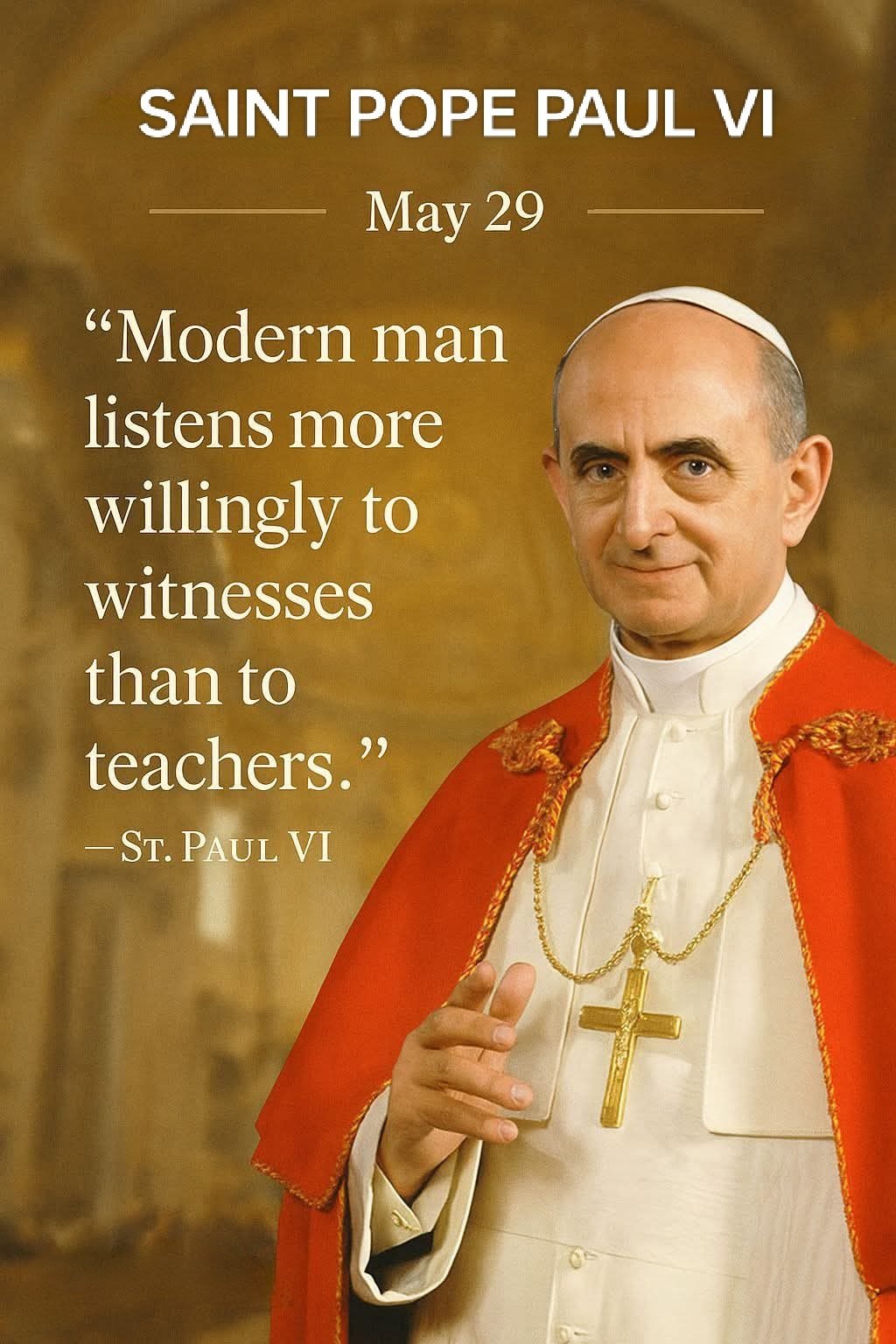
In 1954, he became Archbishop of Milan, where he encountered the realities of industrial life, urban poverty, and growing secularism. He visited factories, met workers, and listened to ordinary people, believing the Church had to engage the modern world while remaining faithful to its mission.
THE UNEXPECTED POPE
Following the death of Pope John XXIII in 1963, Cardinal Montini was elected pope and chose the name Paul VI, inspired by Saint Paul the Apostle and his missionary spirit. He inherited the immense responsibility of leading the Church during the ongoing Second Vatican Council.
THE POPE IN THE STORM
The 1960s brought cultural upheaval, rapid social change, and internal Church tensions. Paul VI completed the Second Vatican Council and worked to balance renewal with fidelity to tradition. Criticized by both progressives and conservatives, he often stood isolated while trying to preserve unity amid confusion.
THE LONELY DECISION
In 1968, Paul VI issued Humanae Vitae, reaffirming Church teaching on marriage, human life, and artificial contraception despite intense pressure to change. The reaction was immediate and widespread criticism followed. Yet he remained firm, believing truth could not be sacrificed for popularity, even when it brought loneliness and misunderstanding.
THE PILGRIM POPE
Paul VI transformed the papacy through international travel, becoming the first modern pope to visit many parts of the world. He traveled to the Holy Land, India, Africa, the Americas, and addressed the United Nations, where he famously pleaded for peace and called for an end to war.
A MEETING AFTER CENTURIES
One of the most historic moments of his papacy was his meeting with Patriarch Athenagoras I. Their embrace symbolized renewed efforts toward reconciliation between Catholics and Orthodox Christians after centuries of separation.
THE SUFFERING POPE
As years passed, Paul VI became increasingly burdened by division within the Church, declining faith in some regions, and global unrest. He spoke of “the smoke of Satan entering the Church,” expressing concern over spiritual confusion. Despite personal suffering, he remained steadfast in prayer and perseverance.
THE FINAL YEARS
By the end of his life, Paul VI appeared physically worn but spiritually strong. He died in 1978 after years of carrying enormous responsibilities. Over time, greater appreciation emerged for the sacrifices and burdens he had endured.
THE POPE WHO STAYED AT HIS POST
Paul VI lived at the intersection of tradition and modernity, crisis and renewal. He was not naturally charismatic or universally admired, but he remained faithful during difficult times. His witness showed that holiness often means carrying responsibility, misunderstanding, suffering, and loneliness without abandoning truth or love.
SPIRITUALITY AND PERSONALITY
Paul VI was intellectually gifted, contemplative, humble, sensitive, and deeply prayerful. His spirituality centered on Christ, the Cross, obedience, and perseverance. Many see his sanctity especially in his endurance through suffering.
RELATIONSHIP WITH OTHER SAINTS AND CHURCH LEADERS
Paul VI strongly supported missionary work, social justice, evangelization, and dialogue with the modern world. Figures such as Saint Teresa of Calcutta and Saint Oscar Romero deeply respected him and benefited from his encouragement.
DEATH
Paul VI died in 1978 after years marked by physical exhaustion and spiritual perseverance. Those close to him remembered his humility and unwavering fidelity to the Church.
CANONIZATION
He was canonized in 2018 by Pope Francis. The Church recognized not only his achievements but also his heroic faithfulness, perseverance, and holiness amid extraordinary pressure.
SPIRITUAL THEMES IN HIS LIFE
FIDELITY AMID CONFUSION
Paul VI remained faithful during one of the most challenging periods in modern Church history.
COURAGE TO STAND ALONE
He defended difficult truths even when facing intense criticism and isolation.
THE CHURCH ENGAGING THE MODERN WORLD
He believed the Church must remain in dialogue with society while preserving its identity and mission.
SUFFERING AS PART OF LEADERSHIP
His life demonstrated that leadership often carries loneliness, sacrifice, and spiritual burdens.
PATRONAGE AND LEGACY
Paul VI remains significant for modern Catholicism, interpretation of Vatican II, evangelization, moral theology, and dialogue between faith and culture. His influence continues to shape the modern papacy.
WHY HE STILL MATTERS
Many challenges Paul VI faced remain relevant today, including secularization, polarization, moral confusion, and Church reform. His life reminds believers that holiness sometimes means quietly carrying heavy burdens with faithfulness and courage.
Paul VI was not universally admired during his lifetime, yet history increasingly recognizes him as a pope who stood in the center of great storms without abandoning truth or charity.
His life continues to ask an important question: Can fidelity endure even when misunderstood? For Paul VI, the answer was yes.
PRAYER
Pope Saint Paul VI, you were dynamic, dedicated and devoted and you resisted a swell of voices to uphold the Church’s teachings on authentic human love.
May all bishops and popes be as courageous as you in their fidelity to the Church’s undying tradition.

Pope Saint Paul VI, pray for us.
(Source: mycatholic.life)
*************************************
ALSO CELEBRATED
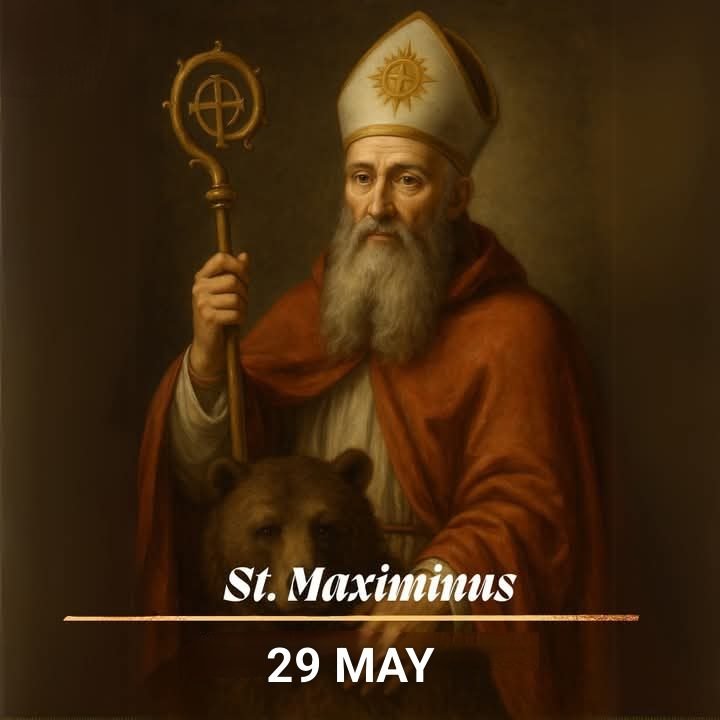
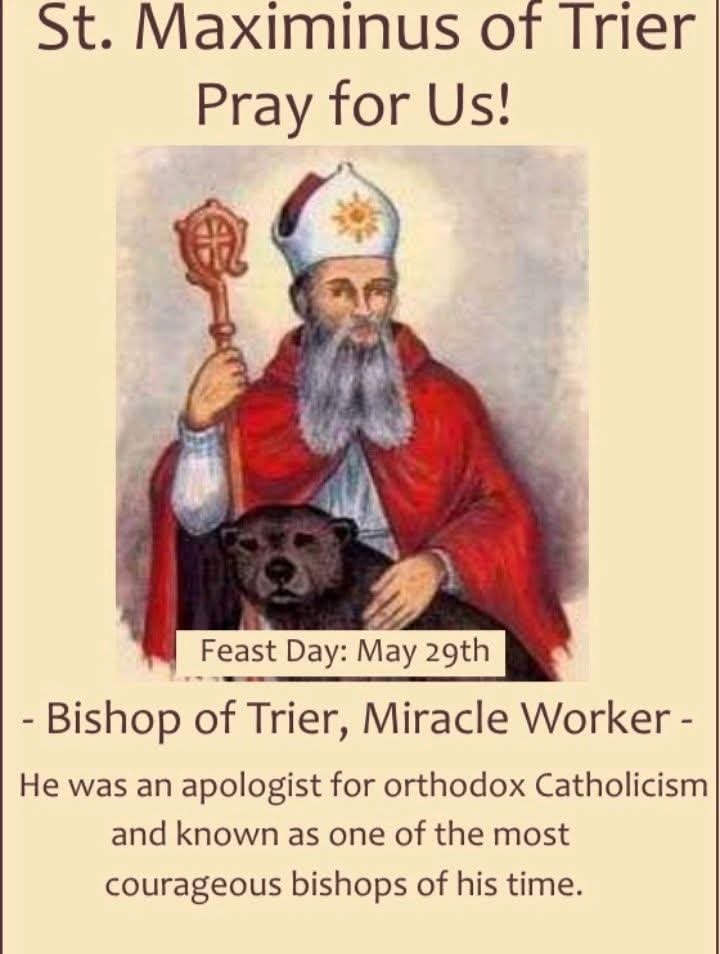
SAINT MAXIMINUS OF TRIER – FEAST DAY: MAY 29
Saint Maximinus was born around 286 AD in Silly-en-Gouffern, Normandy (modern-day France). He came from a pious Christian family and had a brother, St. Maxentius, who was also canonized. Maximinus was sent to Trier, one of the most important Roman cities in the Western Empire, where he was educated in Christian doctrine and eventually entered the clergy. He was consecrated Bishop around c. 329 AD, succeeding St. Agritius.
Trier, at that time, was a key center for both political and ecclesiastical activity in the Roman West. He became a leading defender of the Nicene faith, especially in opposing Arianism, the heresy that denied the divinity of Christ.
St. Maximinus was a staunch ally of St. Athanasius of Alexandria, the great defender of Nicene Christianity. In 336 AD, he offered refuge and support to Athanasius, who had been exiled from Alexandria by the Arian-friendly Emperor Constantius II.
His hospitality to Athanasius and other exiled bishops made Trier a haven for persecuted defenders of orthodoxy. Maximinus was known to confront imperial authorities and was fearless in defending the true faith even at great personal cost. His firmness in doctrine and pastoral courage earned him respect throughout the Church.
St. Maximinus died around 346 AD. He was buried near Trier, and his tomb soon became a place of pilgrimage. The Abbey of St. Maximin in Trier was later built over his tomb and became one of the oldest and most significant Benedictine monasteries in Germany. His reputation for holiness, courage, and orthodoxy spread across Europe.
St. Maximinus is a model of episcopal courage—a bishop who did not seek favor with emperors but remained faithful to the truth of Christ even when it meant risking exile or death. His hospitality to Athanasius reminds us of the importance of standing in solidarity with those who are persecuted for righteousness. In our time—where truth and orthodoxy are often compromised in favor of comfort or worldly favor—St. Maximinus remains a model of bold fidelity to the faith.
PRAYER
Heavenly Father, through the example of St. Maximinus, You have shown us how to be steadfast in truth, bold in charity, and firm in faith. Grant that we, inspired by his witness, may defend the teachings of Christ with courage, shelter the oppressed, and remain always faithful to the Church You established. May St. Maximinus intercede for us in our trials and help us walk in the light of Your truth. Through Christ our Lord. Amen