
SPIRITUAL INSIGHTS INTO THE LIFE OF SAINT BONIFACE
June 5, 2026
Matthew 5:7
June 6, 2026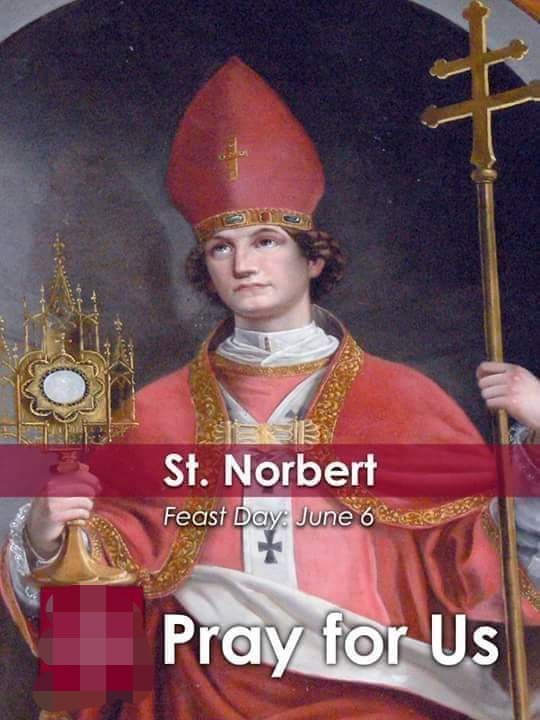
FEAST OF SAINT NORBERT OF XANTEN, BISHOP
FEAST DAY – 6 JUNE
Saint Norbert of Xanten (1080-1134), a worldly noble converted much like Saint Paul, who became a zealous preacher and bishop. The life of Saint Norbert reminds us that it is never too late to repent, turn our broken selves to the Lord, and become whole in His ministry.
Norbert was born in Xanten (now Germany), and grew up in the royal court of Emperor Henry V. Norbert took the robes of a secular monastic order(refusing the priesthood, due to the restrictions it would place on his lifestyle), serving as the court’s chief alms gatherer. However, he embraced his position not out of obedience and love for the Lord, but rather as a career move and occupation which allowed him access to the emperor.
He, like most of the court, was governed by the principles of pleasure, and thought little of the implications of his lifestyle on his soul. One afternoon, when Norbert was about the age 35, he was out riding across the countryside for sport when a fierce thunderstorm arose. A lightning bolt opened up the ground, causing his horse to toss him to the ground, rendering him unconscious.
He lay in the heavy rain, on the ground, soiling his fancy clothes and well-coifed hair for hours, neither the rain nor the thunder reviving him. When he awoke, Norbert gazed at the stormy sky and asked, “Lord, what do you want me to do?” (the same words Saint Paul spoke on the road to Damascus.) In response to his question, Norbert heard, “Turn from evil and do good. Seek peace, pursue it.”
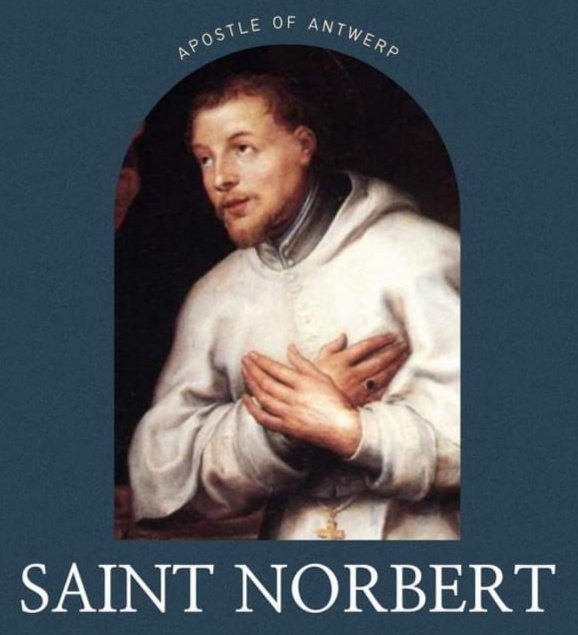
From that moment on, Norbert converted his life, and bore witness to those around him of the power of the Lord. He returned home, and committed himself to studying for the priesthood, a vocation he had previously avoided. He spent his days in prayer, fasting, and mortification—reparation for his lifetime of sinfulness. Labeled a hypocrite by many, Norbert gave away all of his worldly possessions to the poor, and for the remainder of his life, strove to own nothing.
He traveled to Rome, seeking an audience with the pope, begging permission to preach. The pope gladly commissioned Saint Norbert, who traveled throughout Europe, preaching to all who would listen. During his travels, Norbert—in penance for his sins—chose the most difficult paths and roads to take, walking barefoot, even during the harsh European winters.
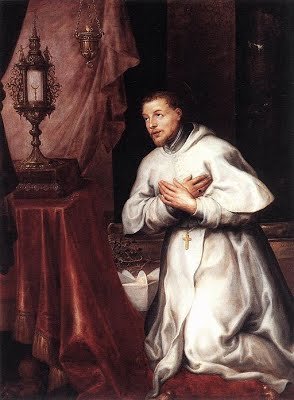
Those who traveled with him oftentimes died from exposure to the elements, and while Norbert himself suffered, he maintained his health. Over time, he regained the respect of those who had labeled him hypocrite, and they, in turn, looked to him for guidance, preaching, and reform. Wholly devoted to the Holy Eucharist, Saint Norbert tirelessly defended the sanctity of the Blessed Sacrament.
He is credited for driving a heretic (Tanchelin) from Antwerp who repeatedly renounced the reality of the priesthood and blasphemed the Blessed Sacrament, removing it from the cathedral and hiding it. Saint Norbert, led by the Holy Spirit, rescued the monstrance, returning it unharmed to the cathedral, rekindling the people’s love and adoration of the Eucharist.
Norbert had garnered a reputation for orthodoxy, strict adherence to Church guidelines (not always the case at that time), and strict observance of the Dominican Rule. His model and life attracted many followers, and following a gift of land, Norbert began a small monastic community. This Augustinian community, eventually known as Norbertines (or Premonstratensians) grew to eight monasteries and two convents.
The order eventually swept through Europe, bringing with it a return to orthodoxy and reform. Norbert was eventually selected as bishop (and later archbishop) of Madgebourg. Legend tells us that upon arrival to his new bishop’s residence, the porter refused to let Norbert inside, believing him to be a beggar. The crowd who had accompanied the new bishop reprimanded the porter, but Norbert, such was his humility, gently told him, “You were right the first time.”
Upon Saint Norbert’s death, his remains were interred at Madgebourg, but many centuries later, moved to a Norbertine abbey of Stahov in Prague. At that time, his body was found to be incorrupt. When Norbert died in Magdeburg on 6 June 1134, both the canons at the cathedral and the canons at St. Mary’s Abbey claimed the body.
The two parties resorted to Lothair III who decreed the body should be buried in the Norbertine Abbey. In 1524, Martin Luther preached in the city and, as a result, Magdeburg became a Protestant city. Numerous attempts were made over the centuries by the Abbey of Strahov in Prague to retrieve Norbert’s body. Only after several military defeats at the hand of Emperor Ferdinand II was the abbot of Strahov able to claim the body.
On 2 May 1627 the body was finally brought to Prague where it remains to this day, displayed as an auto-icon in a glass-fronted tomb. Norbert was canonized by Pope Gregory XIII in the year 1582, and his statue appears above the Piazza colonnade of St. Peter’s Basilica in Rome.
Saint Norbert followed the rules of Saint Augustine, who undertook Church reform centuries earlier. His works led to true conversion of others, following the miraculous Godly conversion of himself. His life reminds us each to strive for our own true conversion, deep within ourselves, every day… remembering that it is never too late to turn to the Lord!
CONTEMPLATING THE LIFE OF SAINT NORBERT OF XANTEN – THE NOBLEMAN WHO WAS THROWN FROM HIS HORSE, ROSE AS A SAINT AND CHANGED THE CHURCH
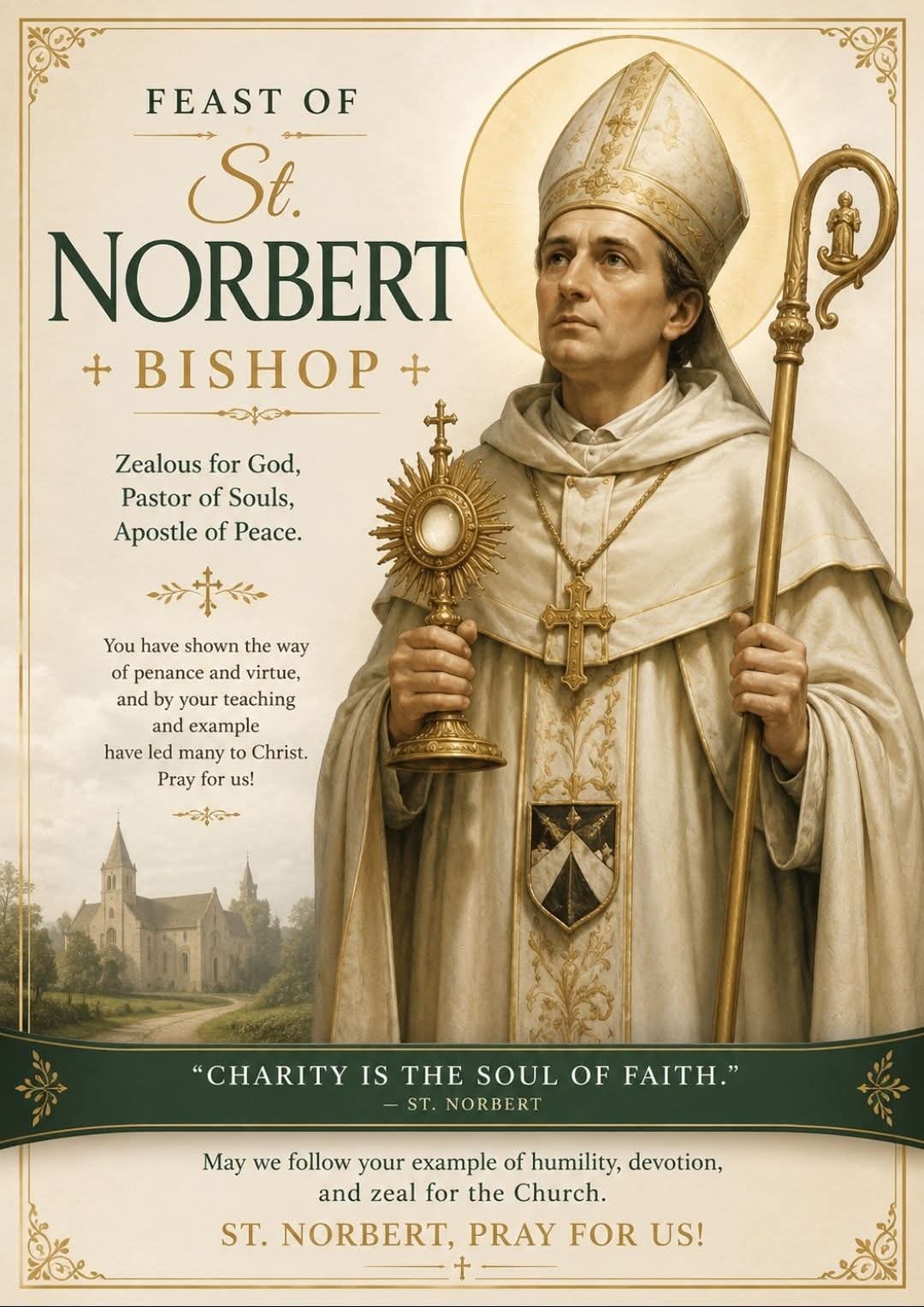
Saint Norbert was one of the great reforming saints of the twelfth century. He was a preacher, founder, bishop, reformer, peacemaker, and spiritual leader whose dramatic conversion transformed him from a worldly noble cleric into one of medieval Europe’s most influential churchmen.
He is remembered for his powerful conversion, radical embrace of poverty, reform of clergy and religious life, founding of the Premonstratensian Order, deep Eucharistic devotion, defense of Church unity, and pastoral leadership.
His life is often compared to other dramatic conversion stories because God transformed his worldly ambitions into a life of holiness and service.
HISTORICAL BACKGROUND
Norbert lived during a period marked by Church reform, political conflict between Church and state, moral decline among sections of the clergy, and the need for ecclesiastical renewal. The Church needed leaders who combined holiness, courage, pastoral care, and reform. Norbert became one of those leaders.
THE NOBLEMAN WHO FELL FROM HIS HORSE AND ROSE AS A SAINT
Born into a noble family in Xanten in present-day Germany, Norbert received an excellent education and moved among influential circles. He entered clerical life and eventually served in the court of Emperor Henry V, enjoying wealth, prestige, and comfort. Yet beneath his successful life, God was preparing a deeper calling.
THE STORM THAT CHANGED EVERYTHING
Around the year 1115, while riding near Vreden, Norbert was caught in a violent storm. Lightning struck nearby, throwing him from his horse. Deeply shaken, he questioned the direction of his life and is traditionally remembered for praying, “Lord, what do You want me to do?”
The storm passed, but the experience transformed him forever.
A NEW LIFE BEGINS
After this experience, Norbert abandoned his comfortable lifestyle and embraced prayer, penance, simplicity, and spiritual discipline. Many were surprised by his radical change, but he had discovered something greater than worldly success.
THE WANDERING PREACHER
Norbert traveled widely preaching repentance, renewal, and deeper faith. Because he preached from personal experience, his words carried conviction. While many welcomed his message, others resisted, especially those challenged by his call to reform.
THE VALLEY OF PRÉMONTRÉ
Seeking God’s guidance, Norbert settled in the valley of Prémontré in France, where he founded a religious community in 1120. This community later became known as the Premonstratensians or Norbertines.
He envisioned a life centered on prayer, community, preaching, service, and poverty. What began quietly soon spread across Europe.
EUCHARISTIC DEVOTION
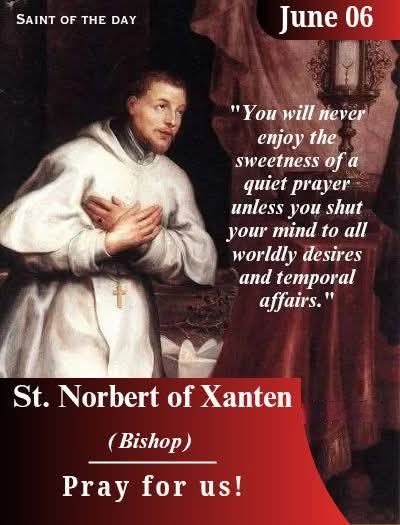
At the center of Norbert’s spirituality was deep love for Christ in the Eucharist. He spent long hours in prayer before the Blessed Sacrament and defended belief in the Real Presence during times of controversy.
His preaching, reforms, and strength flowed from this Eucharistic foundation.
ARCHBISHOP OF MAGDEBURG
In 1126, Norbert became Archbishop of Magdeburg. The archdiocese faced corruption and needed reform. Despite opposition, he accepted the responsibility and worked courageously for renewal.
REFORM THROUGH COURAGE
As archbishop, Norbert focused on clergy formation, pastoral care, moral renewal, and ecclesiastical discipline. Though resistance was strong, he remained committed to the mission, understanding that authentic reform requires sacrifice and perseverance.
THE PEACEMAKER
Norbert worked to preserve unity during times of political and religious conflict. He acted as a peacemaker and defender of the Church, earning trust through humility and love for God rather than personal ambition.
FINAL YEARS
As his religious community continued to grow across Europe, Norbert’s health weakened but his zeal remained strong. The conversion that began during the storm continued shaping his life until the end.
THE SAINT WHO LEARNED TO FALL
When Norbert died in 1134, he left behind a thriving religious order, a renewed archdiocese, and a lasting legacy of reform.
His life teaches that holiness often begins when human strength fails. What seemed like a fall became the beginning of sainthood. God used interruption, suffering, and surrender to transform a nobleman into a saint.
CANONIZATION
Norbert was canonized in 1582 by Pope Gregory XIII in recognition of his holiness and lasting contribution to the Church.
SPIRITUAL THEMES IN HIS LIFE
CONVERSION
One moment of grace changed the course of his life and led him toward holiness.
DETACHMENT
He left behind privilege and comfort to follow Christ more completely.
REFORM
He sought renewal both personally and within the Church.
EUCHARISTIC LOVE
The Eucharist remained the center of his spirituality and mission.
PATRONAGE
Saint Norbert is considered patron of the Premonstratensian Order, peace and reconciliation in certain traditions, and those devoted to Eucharistic spirituality.
ARTISTIC REPRESENTATION
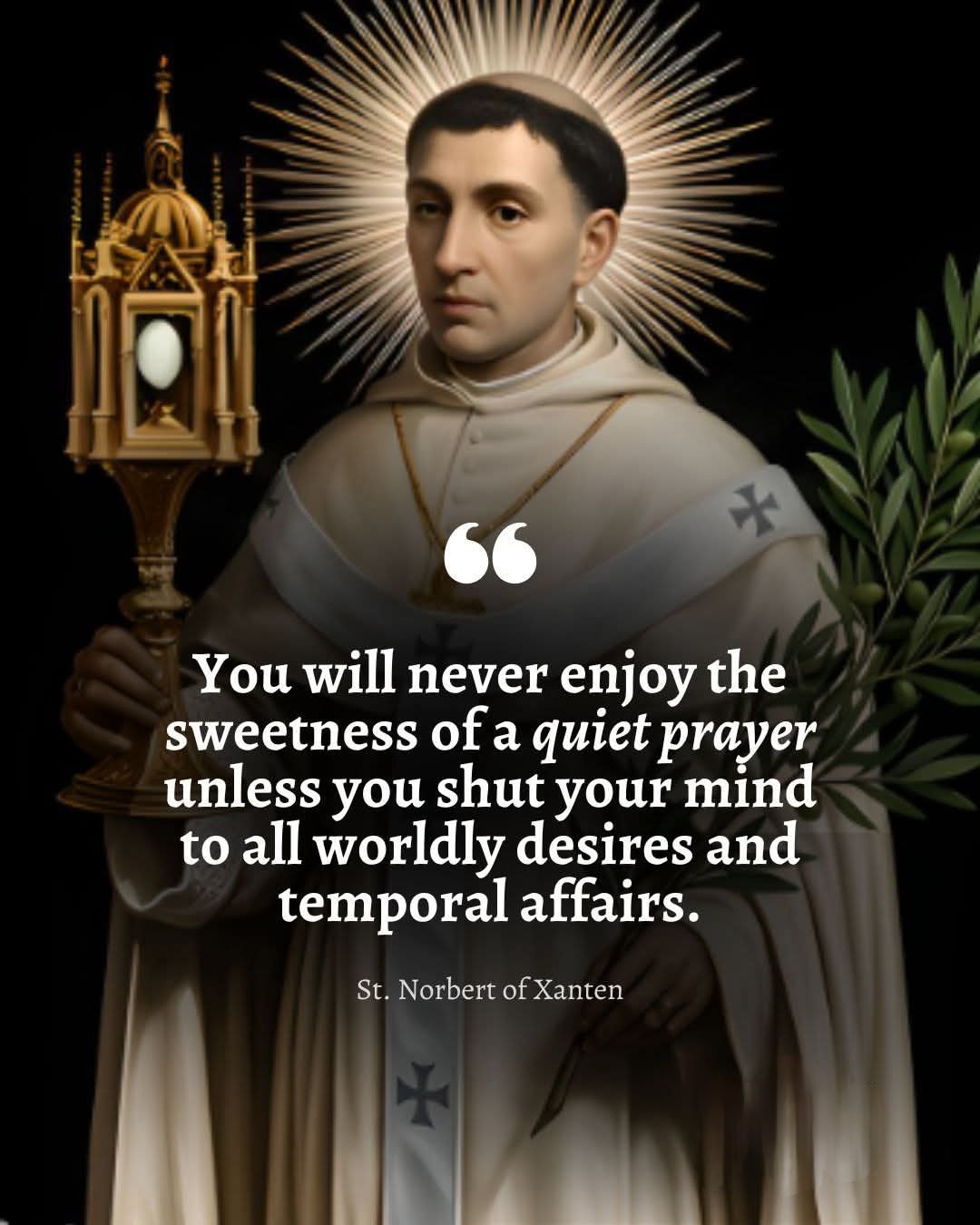
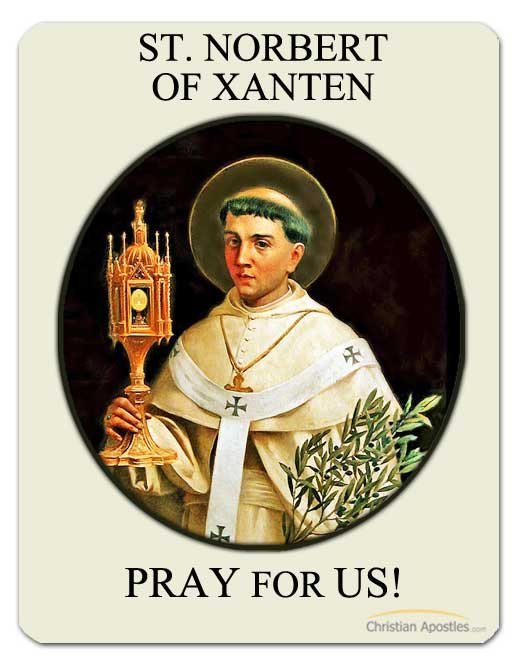
He is commonly portrayed as a bishop carrying a monstrance or pastoral staff, often dressed in the white habit of the Norbertines. These symbols reflect his strong Eucharistic devotion and commitment to truth.
WHY HE STILL MATTERS
Modern believers often struggle with distraction, comfort, and spiritual complacency. Norbert’s life reminds us that conversion is not a single moment but a lifelong response to God.
His witness teaches that grace can transform lives, holiness is the beginning of reform, prayer must lead to action, and courageous leadership requires sacrifice.
His story begins with a fall from a horse, but its deeper message is timeless: God sometimes interrupts comfortable lives to lead people toward the vocation they were truly created to live.
PRAYER
Heavenly Father, you gave us as a role model your appointed bishop Norbert, a zealous minister of your Church, well known for his preaching and pastoral ardor. Bless your Church with faithful shepherds to lead your chosen ones to eternal salvation.
Through our Lord Jesus Christ, your Son, who lives and reigns with you in the unity of the Holy Spirit, God for ever and ever. Amen
Saint Norbert, pray for us.