
SPIRITUAL INSIGHTS INTO THE LIFE OF SAINT GERMAINE COUSIN
June 15, 2026
1 Peter 4:8
June 15, 2026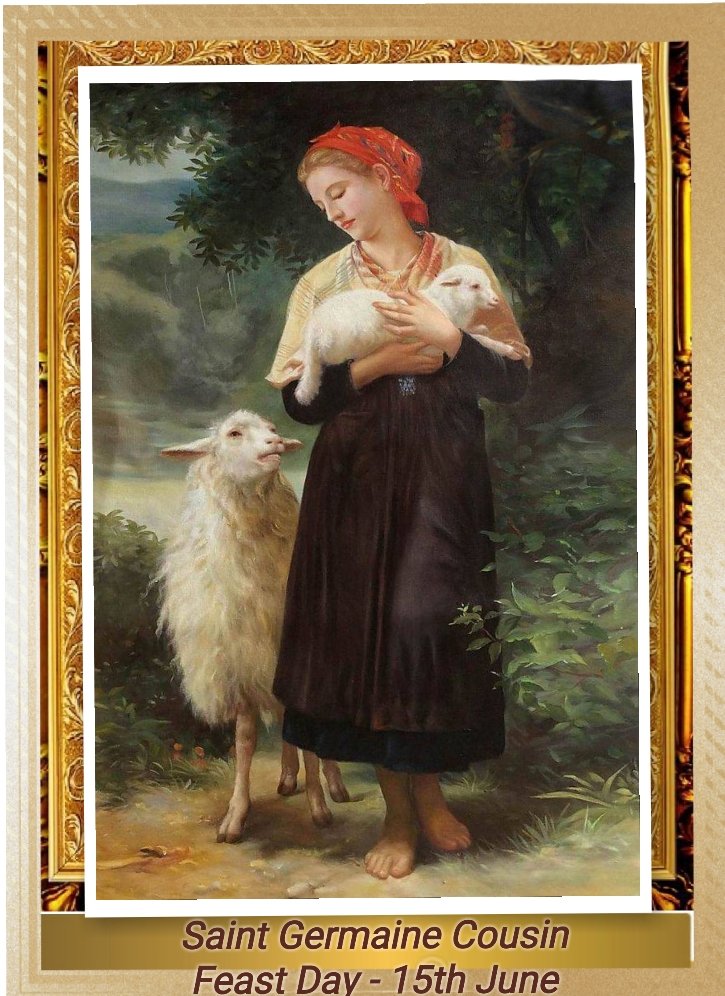
FEAST OF SAINT GERMAINE COUSIN
FEAST DAY – 15th JUNE
Germaine Cousin, (1579–1601) is a French saint. She was born in 1579 to humble parents at Pibrac, a village 15 km from Toulouse. She is the patron saint of abandoned people, abuse victims, against poverty, disabled people, girls from rural areas, illness, impoverishment, loss of parents, shepherdesses, sick people, unkind people, physical therapists.
From her birth she seemed marked out for suffering. She came into the world with a deformed hand and the disease of scrofula, and, while yet an infant, lost her mother. Her father soon married again, but his second wife treated Germaine with much cruelty. Under pretence of saving the other children from the contagion of scrofula she persuaded the father to keep Germaine away from the homestead.
Thus the child was employed almost from infancy as a shepherdess. When she returned at night, her bed was in the stable or on a litter of vine branches in a garret. In this hard school Germaine learned early to practise humility and patience. She was gifted with a marvellous sense of the presence of God and of spiritual things, so that her lonely life became to her a source of light and blessing.

Her love for Jesus in the Blessed Sacrament and for His Virgin Mother presaged the saint. She assisted daily at the Holy Sacrifice; when the bell rang, she fixed her sheep-hook or distaff in the ground, and left her flocks to the care of Providence while she heard Mass. Although the pasture was on the border of a forest infested with wolves, no harm ever came to her flocks.
She is said to have practised many austerities as reparation for the sacrileges perpetrated by heretics in the neighbouring churches. She frequented the Sacraments of Penance and the Holy Eucharist, and it was observed that her piety increased on the approach of every feast of the Virgin Mary. The villagers are said to have inclined at first to treat her piety with mild derision, until certain signs of God’s signal favour made her an object of reverence and awe.
The ford in winter, after heavy rains or the melting of snow, was at times impassable. On several occasions the swollen waters were seen to open and afford her a passage without wetting her garments. Notwithstanding her poverty, she found means to help the poor by sharing with them her allowance of bread.
According to one story, one day in winter, when she was being chased by her stepmother who accused her of stealing bread, she opened her apron and fresh summer flowers fell out. She offered the flowers to her stepmother as a sign of forgiveness. Her father at last came to a sense of his duty, forbade her stepmother henceforth to treat her harshly, and wished to give her a place in the home with his other children.

Germaine begged to be allowed to remain in the humbler position. At this point, when men were beginning to realize the beauty of her life, she died. One morning in the early summer of 1601, her father found that she had not risen at the usual hour and went to call her, finding her dead on her pallet of vine-twigs. She was 22 years old at the time.
Her remains were buried in the parish church of Pibrac in front of the pulpit. In 1644, when the grave was opened to receive one of her relatives, the body of Germaine was discovered fresh and perfectly preserved. It was exposed for public view near the pulpit, until a noble lady, the wife of François de Beauregard, presented as a thanks-offering a casket of lead to hold the remains.
Her infant son whose life was despaired of was restored to health on her seeking the intercession of Germaine. This was the first of a long series of wonderful cures wrought at her relics. The leaden casket was placed in the sacristy, and in 1661 and 1700 the remains were viewed and found fresh and intact by the vicars-general of Toulouse, who have left testamentary depositions of the fact.
Expert medical evidence deposed that the body had not been embalmed, and experimental tests showed that the preservation was not due to any property inherent in the soil. In 1700 a movement was begun to procure the beatification of Germaine, but it fell through owing to accidental causes. In 1793 the casket was desecrated by a revolutionary tinsmith, named Toulza, who with three accomplices took out the remains and buried them in the sacristy, throwing quick-lime and water on them.

After the Revolution, her body was found to be still intact save where the quick-lime had done its work. The private veneration of Germaine had continued from the original finding of the body in 1644, supported and encouraged by numerous cures and miracles. The cause of beatification was resumed in 1850. The documents attested more than 400 miracles or extraordinary graces, and thirty postulatory letters from archbishops and bishops in France besought the beatification from the Holy See.
The miracles attested were cures of every kind (of blindness, congenital and resulting from disease, of hip and spinal disease), besides the multiplication of food for the distressed community of the Good Shepherd at Bourges in 1845. On 7 May 1854, Pius IX proclaimed her beatification. He proclaimed her a saint on 29 June 1867, the day on which a vast assembly of prelates gathered in Rome to mark the 18th centenary of the martyrdom of Peter the Apostle.
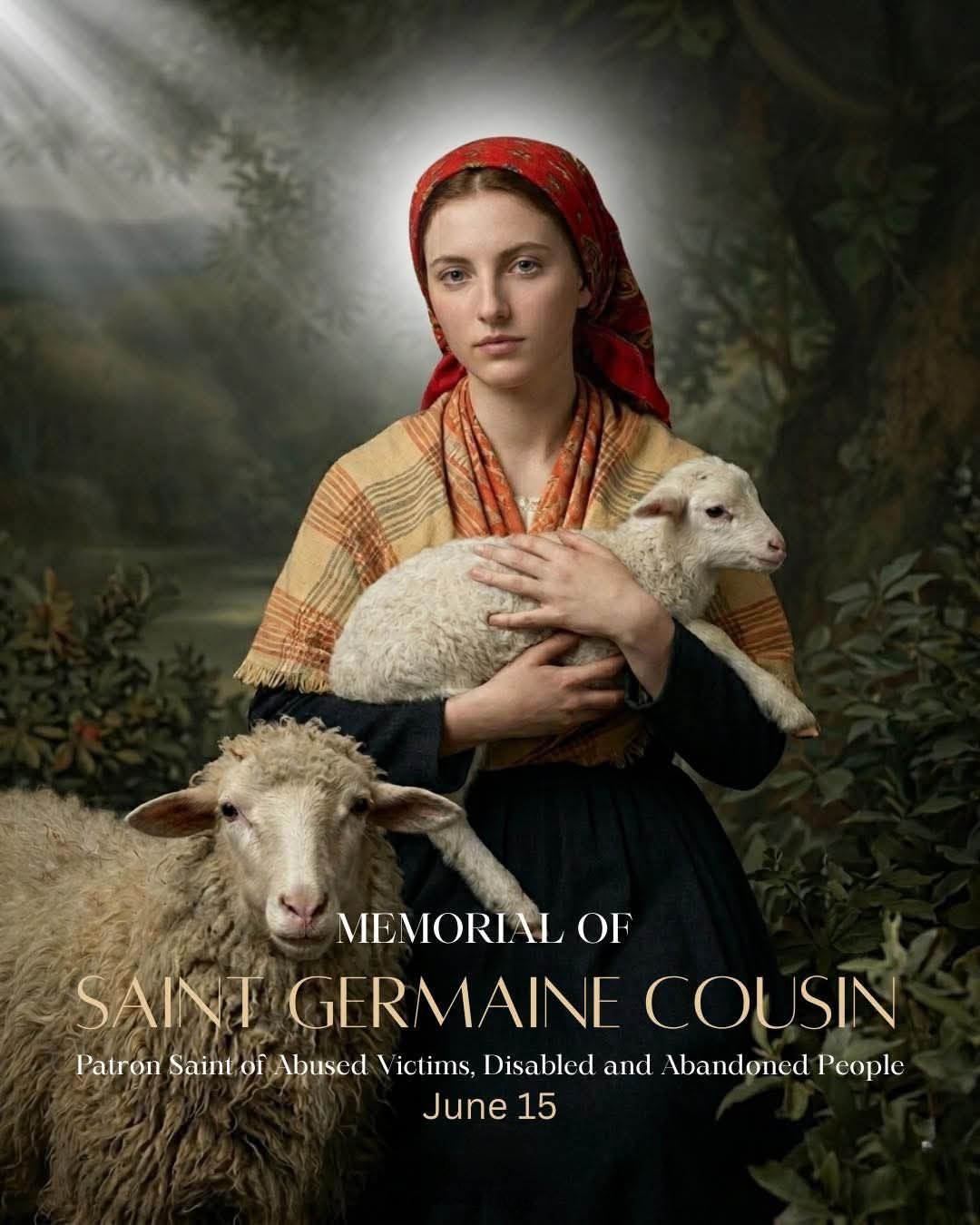
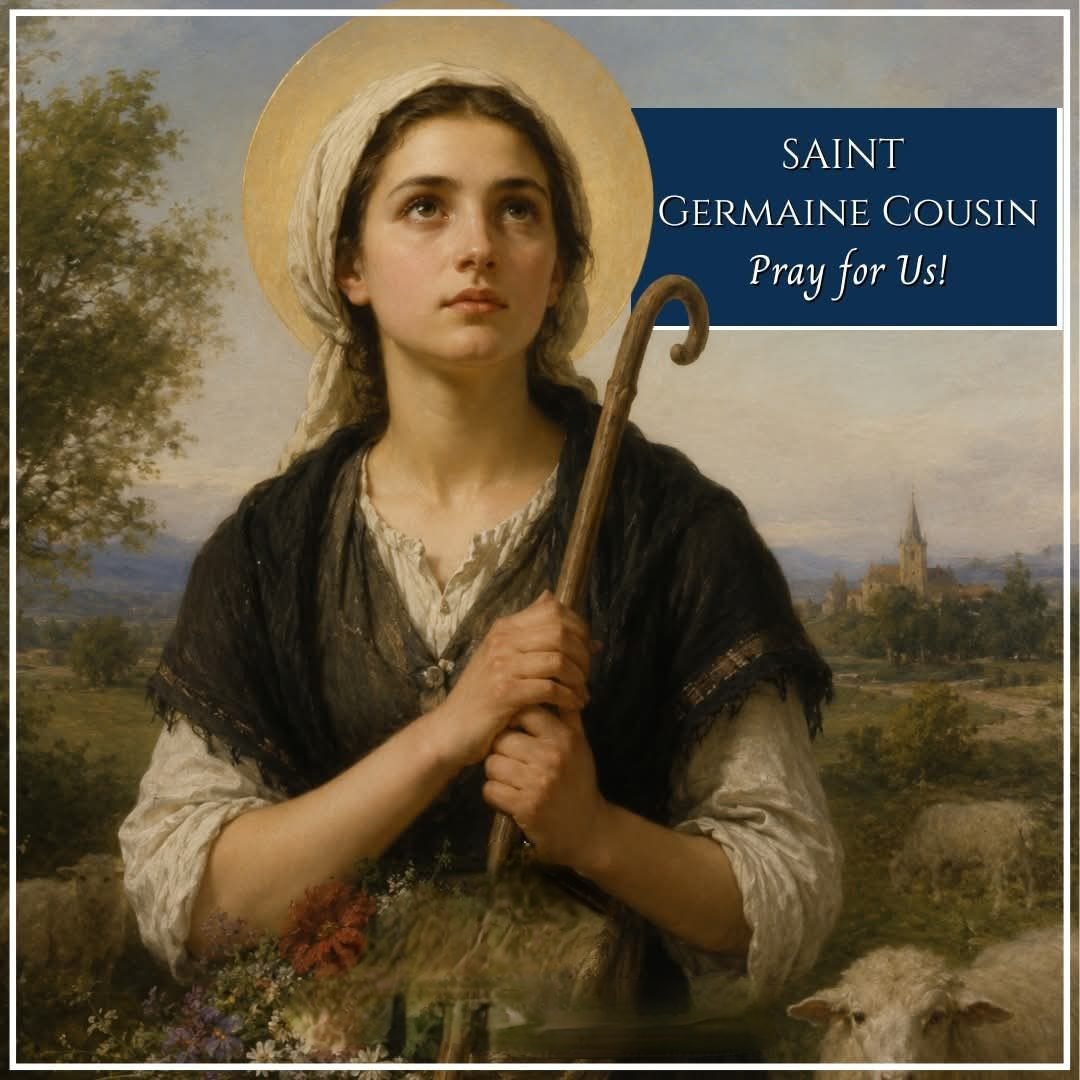
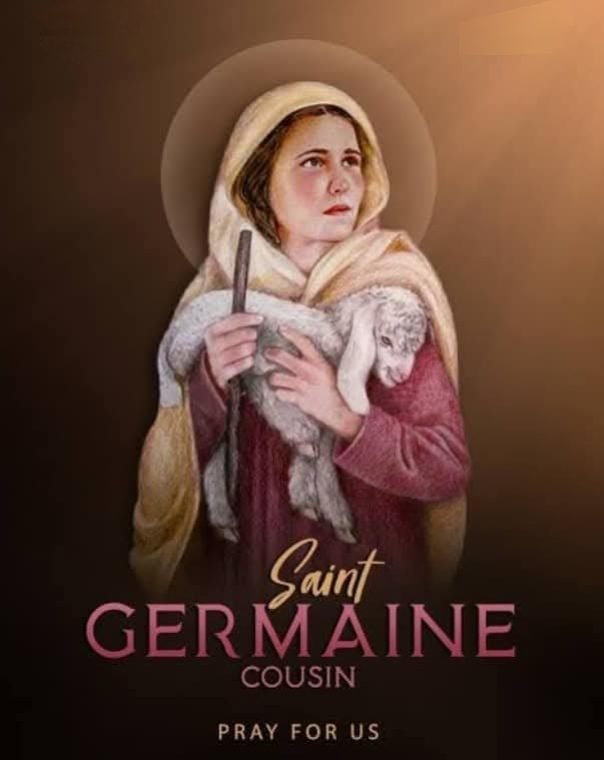
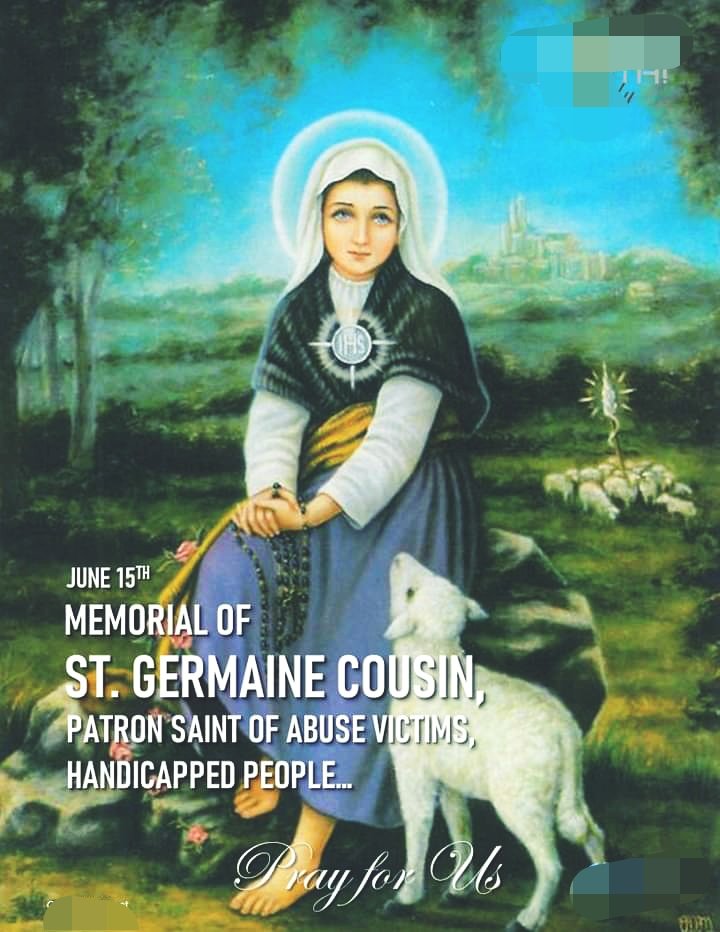
He congratulated the archbishop of Toulouse, Florian Desprez, and his diocese for giving the church a saint “so powerful, so kind, and so dear to its heart”. Her feast is kept in the Diocese of Toulouse on 15 June. She is represented in art with a shepherd’s crook or with a distaff; with a watchdog, or a sheep; or with flowers in her apron.
CONTEMPLATING THE LIFE OF SAINT GERMAINE COUSIN

THE SHEPHERDESS WHOM THE WORLD OVERLOOKED
St. Germaine Cousin is one of the most inspiring saints in Christian history because she possessed none of the qualities the world usually admires. She was poor, physically disabled, neglected, uneducated, and socially insignificant, yet she became rich in holiness.
Her life teaches that sanctity does not depend on beauty, status, education, wealth, or influence, but on love for God and faithfulness in suffering. Often called “The Saint of the Forgotten,” she represents all who feel unwanted, rejected, overlooked, or lonely. Her life shows that God’s grace can flourish even in the most hidden and difficult circumstances.
THE SHEPHERDESS WHOM GOD NEVER FORGOT – THE CHILD NOBODY WANTED
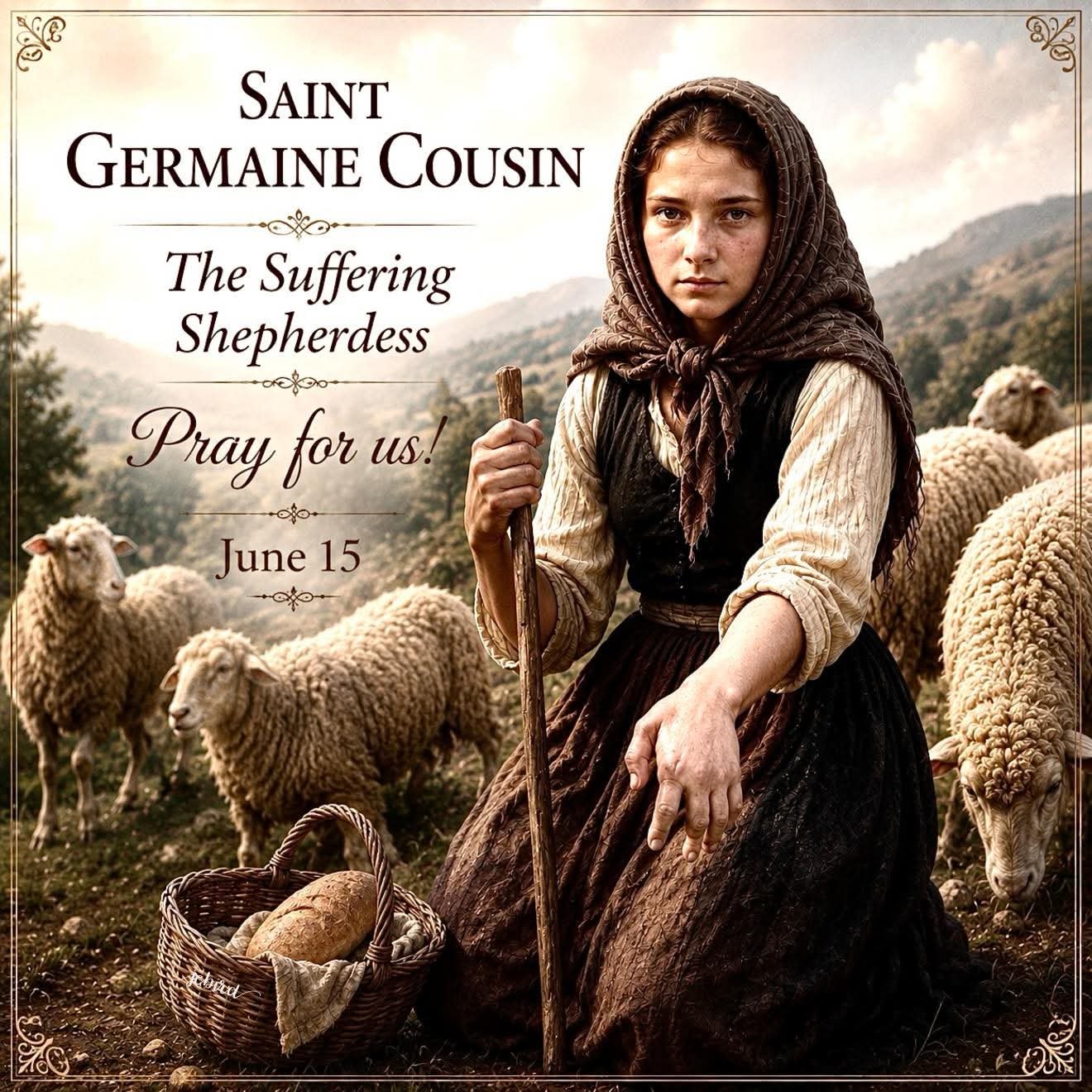
Born in the village of Pibrac near Toulouse in sixteenth-century France, Germaine entered a life marked by hardship. She was born with a disability affecting one of her hands and arms and lost her mother at a young age. After her father remarried, she often experienced rejection and neglect instead of affection.
Though she appeared insignificant to the world, she was precious in God’s sight.
THE SHEPHERDESS OF THE FIELDS
As she grew older, Germaine was assigned the task of tending sheep. While other children enjoyed companionship, she spent much of her life in solitude. Her clothing was simple, her meals meager, and her possessions few.
Yet in the quiet fields, God was forming a saint. What others saw as loneliness, Germaine transformed into prayer.
A FRIEND OF GOD
The village church became the center of her life. She loved the Mass, the Eucharist, and spending time with God. Even while caring for her sheep, her heart remained fixed on heaven.
The fields became her chapel, the silence her sanctuary, and God her closest companion.
THE RIVER AND THE CHURCH

A local tradition tells of a stream that Germaine had to cross to attend Mass. During floods, the crossing became dangerous, yet her desire to be with Christ in the Eucharist was stronger than her fear. Many believed that God protected her journey, showing His care for the humble shepherdess.
THE SHEEP LEFT IN GOD’S CARE
Another tradition relates that Germaine sometimes left her flock while attending Mass. Although people expected the sheep to wander away, they always remained safe. Her childlike trust in God’s providence amazed the villagers.
THE POOR GIRL WHO GAVE AWAY BREAD
Despite her own poverty, Germaine generously shared what little she had with those in need. Though she received little, she continued giving. Though she suffered, she became a source of comfort to others.
THE MIRACLE OF THE ROSES
One day, her stepmother accused her of taking bread from the household and demanded to see what she carried in her apron. When Germaine opened it, the bread had become beautiful roses.
The miracle became well known, but an even greater miracle was the transformation of her suffering into love.
THE SAINT WHO REFUSED BITTERNESS
Years of rejection and hardship could have filled Germaine with resentment, but she chose forgiveness, prayer, trust, and love. She continually placed her wounds in God’s hands, and He transformed them into holiness.
HIDDEN FROM THE WORLD
Germaine never became famous, preached sermons, or held positions of influence. Her life unfolded quietly among sheep, prayer, and acts of charity. Though unknown to most people, she was fully known by God.
THE YOUNG SAINT’S DEATH
Around the age of twenty-two, Germaine died quietly. No public honors marked her passing, and few could have imagined that future generations would remember her.
THE SECRET REVEALED
Years after her death, her body was reportedly found incorrupt. News spread, pilgrims arrived, and reports of favors and healings increased. The shepherdess once overlooked by society became known throughout the Church.
Eventually, Pope Pius IX canonized her. The child who had felt unwanted became honored by millions of believers.
THE SAINT OF THE FORGOTTEN
Germaine left behind no famous writings, leadership roles, or worldly achievements. Yet she became a saint because holiness is measured not by recognition but by love.
She loved God in loneliness, loved others in poverty, and remained faithful through suffering. Her life offers hope to every neglected soul: you may be forgotten by people, but you are never forgotten by God.
SPIRITUAL THEMES IN HER LIFE
HIDDEN HOLINESS
Her sanctity grew in obscurity rather than public recognition.
PRAYER
She transformed loneliness into deep communion with God.
CHARITY
She gave generously despite her own poverty.
FORGIVENESS
She refused to allow suffering to produce bitterness.
TRUST
She relied completely on God’s providence.
PATRONAGE
St. Germaine is invoked as the patron of shepherds, abused children, neglected persons, people with disabilities, the poor, and those who suffer rejection within their families. Many who feel forgotten find comfort in her example.
ARTISTIC REPRESENTATION
She is often depicted as a shepherdess carrying sheep, holding roses or flowers, dressed in simple peasant clothing, and accompanied by symbols of prayer. The roses recall the miracle associated with her charity.
WHY SHE STILL MATTERS
Modern society often measures people by appearance, success, wealth, popularity, and achievement. Germaine possessed none of these advantages, yet she became a saint.
Her life reminds us that dignity comes from God, suffering can become a path to holiness, prayer transforms loneliness, and hidden virtue has great value in God’s eyes.
HER ENDURING MESSAGE
Germaine never preached to crowds, founded a religious order, wrote books, or held positions of influence. She simply loved God where she was—in the fields, in poverty, in rejection, and in obscurity.
Her life proclaims a powerful truth: those most overlooked by the world are often seen most clearly by God.
PRAYER
Saint Germaine, God’s favored one, help us to see the virtues we lack, our problems, and weaknesses and aid the sufferings of others in the light of the presence, help, and healing mercy of Jesus Christ.
Help us to know the gift and support of our guardian angels and to treasure our times of being alone as moments of solitude with the Holy Trinity. St. Germaine, pray for us to see others as our Heavenly Father sees them.
St. Germaine, pray for us. Amen