
NOVENA TO OUR LADY OF PERPETUAL HELP
June 18, 2026
1 John 2:6
June 18, 2026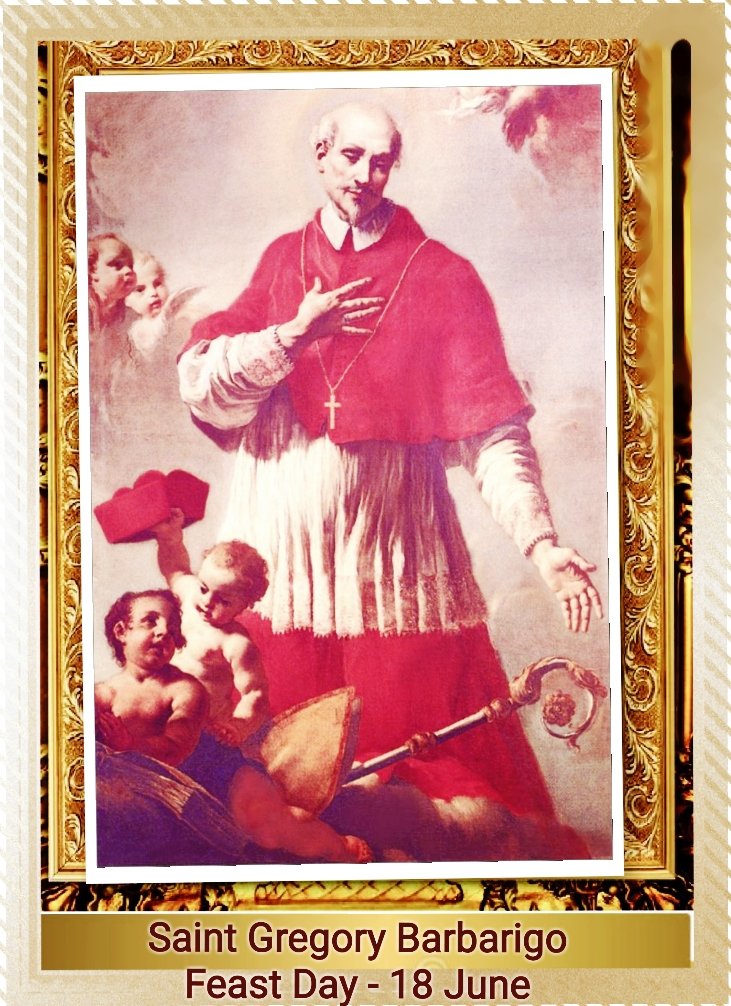
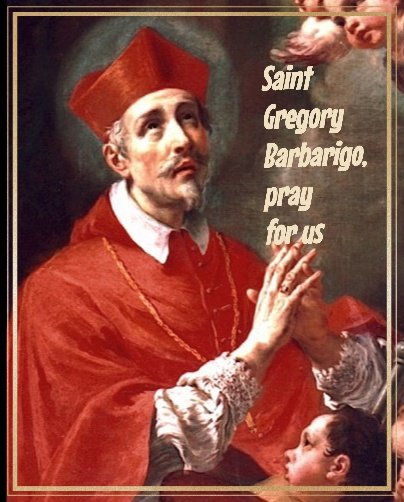
FEAST OF SAINT GREGORY BARBARIGO, BISHOP OF PADUA AND CARDINAL
FEAST DAY – 18th JUNE
Gregorio Giovanni Gaspare Barbarigo (16 September 1625 – 18 June 1697) was an Italian Roman Catholic cardinal who served as the Bishop of Bergamo and later as the Bishop of Padua. He was a frontrunner in both the 1689 and 1691 papal conclaves as he had distinguished himself for his diplomatic and scholastic service. He became noted as a scholar for his distinguished learning and as an able pastor for his careful attention to pastoral initiatives and frequent parish visitations.
St. Gregory was born on September 16, 1625, and he died in 1697. His family lived in Venice and were held in high repute by the people there. He was the fourth son. He excelled in his studies at an early age and became interested in diplomacy and statesmanship. He knew Contarine, the Venetian ambassador, and went with him on at least one ambassadorial mission.
His parents were the nobles Giovanni Francesco Barbarigo (a senator) and Lucrezia Leoni (d. 19 March 1631 – plague). His father brought a cousin – Franchesina Lippomani – to look after the children after the death of his wife. His sister was Elena and his two brothers were Pietro and Antonio. He was a relative of the cardinal Marcantonio Barbarigo and the uncle of Cardinal Giovanni Francesco Barbarigo.
He was also a relation of Cardinal Angelo Barbarigo. His ancestors included the two Venetian doges Marco Barbarigo and Agostino Barbarigo. His father instructed him in philosophical studies and in mathematics while preceptors taught him Latin and Greek. He acquired the rudiments of music.
In 1643 he accompanied as secretary the Venetian ambassador Aloise Contarini to Münster for the negotiations to prepare for the Peace of Westphalia which was signed on 24 October 1648. There he became acquainted with Archbishop Fabio Chigi (the future Pope Alexander VII) – the nuncio to Cologne and a participant in the negotiations. He went to Holland, Flanders and then to Paris. In July 1648 he returned to Venice, continuing his studies in Padua.
In 1650 he was elected as a member of the Collegio dei Savi and initiated his political career which he did not find to be good for him. In the winter in 1653 he went to Rome to ask the advise of Cardinal Chigi who recommended that he not retire as a hermit but follow the ecclesiastical career and begin obtaining a doctorate in law.
Barbarigo obtained a doctorate in “utroque iure” both canon law and civil law on 25 September 1655 and received his ordination to the priesthood on 21 December 1655 from the Cardinal Patriarch of Venice Gianfrancesco Morosini. He left for Rome in late February 1656 for Chigi – now Pope Alexander VII – initiated him into the papal service.
He was named a domestic prelate of His Holiness and on 21 April 1656 was appointed as the Referendary of the Tribunals of the Apostolic Signature of Justice and of Grace. On 9 June 1665 he was given a canonicate in the cathedral chapter of Padua without the requirement of residence and in 1656 – at the request of the pope – he organized the assistance to the Romans in the Trastevere area who had been stricken with the plague.
He oversaw the care of the mothers and their children and the funerals of the deceased in this work. He nursed the sick, buried to dead, and comforted those frightened and in mourning. On 9 July 1657 the pope appointed him as Bishop of Bergamo and he received his episcopal consecration as such on 29 July 1657 from Marcantonio Bragadin.
But before he accepted the post he decided to celebrate a Mass to discern the will of God when he felt the concrete call to take on the see during the Mass. Barbarigo took possession of his new episcopal see on 2 September through his procurators Rodolfo Roncalli the archdeacon and the vice-capitular Giovanni Battista Lavezzali while he himself arrived there on 27 March 1658. He inspected each of the 279 parishes of the diocese.
He was a successful bishop and his fame spread through the ranks so much to the point that his old friend Alexander VII elevated him to the cardinalate on 5 April 1660 at the Quirinale Palace. He was made the Cardinal-Priest of San Tommaso in Parione on 21 June 1660 but later opted to become the Cardinal-Priest of San Marco on 13 September 1677.
In 1664 he was made Bishop of Padua and upon entrance into his new diocese he strove to model himself upon the example of Charles Borromeo. His procurator the Archpriest Galeazzo Mussato took possession of the see on Barbarigo’s behalf on 24 April before the cardinal entered the see on 22 June. He was a strong supporter of the work of the Council of Trent.
 He made the seminaries of Padua and of Bergamo larger and added an archive and printing press in Padua. He celebrated a diocesan synod from 1–3 September 1683 and wrote the “Regulae Studiorum” in 1690 for ecclesial studies. He also visited all 320 parishes in his diocese. The cardinal learned in 1678 that Elena Piscopia was pursuing a theological course and he refused this on the basis that she was a woman.
But he allowed for her to obtain a philosophical degree which she did. In his role as a cardinal he participated in his first papal conclave in 1667 and also attended those in 1676 and that of 1689 when he emerged as a potential contender though falling short of the votes needed to become pope. The same was in 1691 when he emerged as a greater threat to other contenders.
He did not attend the 1669-70 conclave. The election of Pope Innocent XI in 1676 saw the pope ask Barbarigo to remain in Rome until 1679 as his counselor and entrusted Rome’s education to him and the reunification of the Eastern Churches. One of his episcopal acts was to consecrate as a bishop Niels Stensen on 19 September 1677. He ordained the convert Thomas Nicholson a priest.
The 1691 conclave shifted Barbarigo’s status as a potential contender for he gained greater ground and almost succeeded in becoming pope. Cardinal d’Estrées included him in his list of potential candidates in light of the impending death of Alexander VIII while Cardinal Leandro Colloredo decided to throw his support behind Barbarigo.
Even Chigi – who had blocked his candidature back in 1689 – thought well to advocate Barbarigo’s name. But the French were not all that enthralled with Barbarigo since he was considered a leading ‘creature’ of Alexander VII who had not been too lenient with the French. Cardinals Pietro Ottoboni and Paluzzo Paluzzi Altieri were opposed to his candidature and in the end was elected Antonio Pignatelli as Pope Innocent XII.
Cardinal Barbarigo fostered catechetical instruction and he travelled to each village in his diocese in order to teach and to preach to the people. His compassion to the poor was well known for he gave his household goods and his clothes to the poor for their comfort. He even sold his bed on one occasion to help them. Barbarigo died after a brief illness on 18 June 1697 in Padua where he was interred in the diocesan cathedral.
Bishop Barbarigo was distinguished by his piety and heroic patience and miracles quickly bore witness to his sanctity. His holiness was observed in his life enough to the point that the faithful started to press the competent ecclesial authorities to launch the process for sainthood with the informative phase of the investigation ending on 11 July 1716; the formal introduction to the cause came under Pope Innocent XIII on 3 July 1723.
His remains were exhumed on 25 May 1725 and allegedly found to be incorrupt with his nephew Bishop Giovanni Francesco Barbarigo leading the exhumation initiative. However, the report of the examining physicians was actually equivocal. While medical professionalism prevented them form saying the body was incorrupt, popular opinion and ecclesiastical expectations were otherwise.
The report stated that the condition of the body was “wondrous” which fell short of miraculous, a distinction largely lost upon those interested. Pope Clement XIII beatified Barbarigo in 1761 while Pope John XXIII canonized Barbarigo in mid-1960. The beatification seemed all the more fitting for Clement XIII since his mother – Vittoria Barbarigo, was a distant relative of the late cardinal.
That latter pope, while he was a simple priest, signed a petition in 1911 addressed to Pope Pius X requesting Barbarigo’s cause to be taken forward, for the late cardinal to become a saint. Pope Pius X did so on 28 February 1912 when he issued the decree to resume the cause. John XXIII is said to have felt a close kinship with the late cardinal.
Pope John XXIII, who canonised him in 1960, held Barbarigo as a great role model and fostered a great devotion to him, since the pope had hailed from Bergamo. His liturgical feast is on 17 June in the General Roman Calendar of 1960. On the General Roman Calendar of 1969, it is observed on 18 June.
CONTEMPLATING THE LIFE OF SAINT GREGORY BARBARIGO
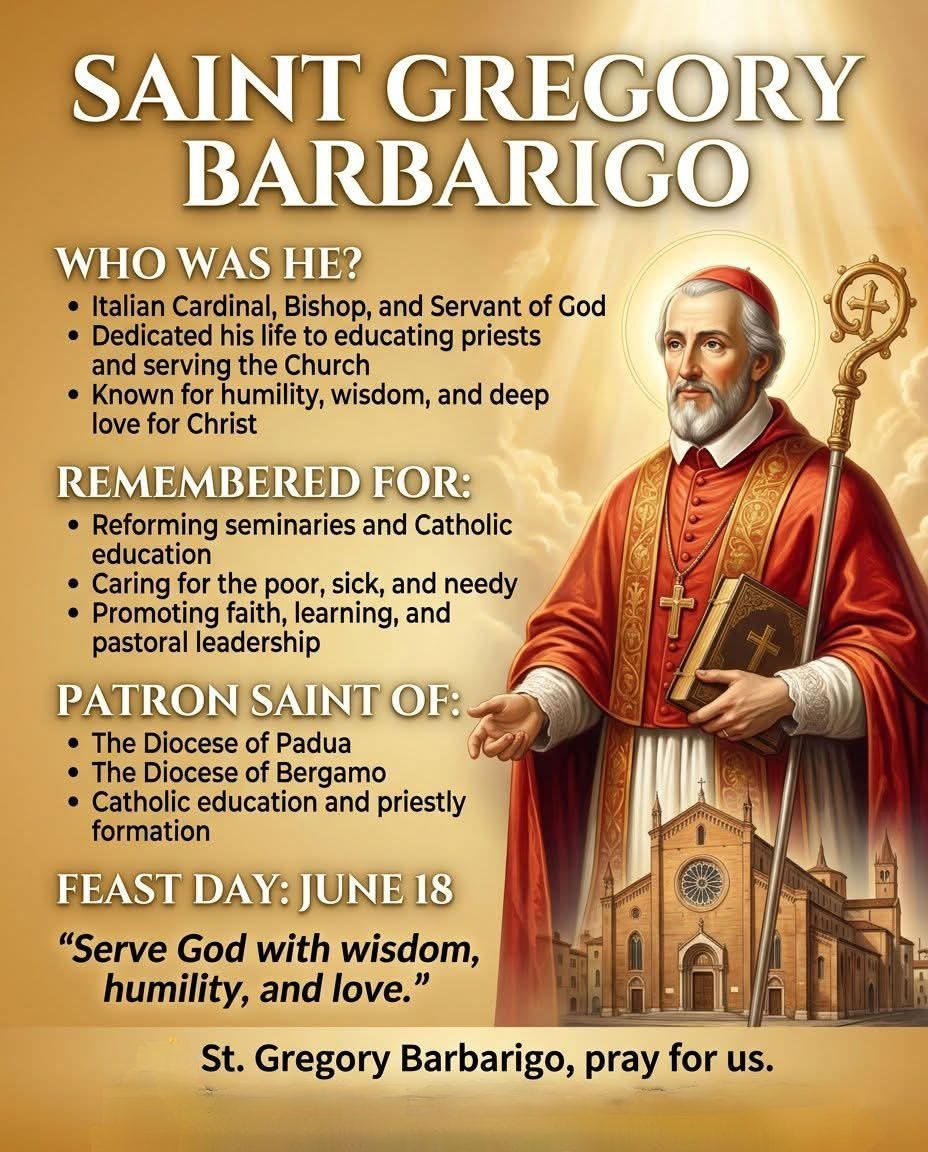
THE SCHOLAR-BISHOP WHO REFORMED THROUGH WISDOM AND CHARITY
St. Gregory Barbarigo was one of the great bishop-saints of the post-Reformation Church. He united deep prayer, intellectual excellence, pastoral charity, wise administration, and personal holiness. Rather than becoming known through dramatic miracles or extraordinary adventures, he renewed the Church through faithful leadership, education, reform, and loving care for souls. He is remembered as a bishop, cardinal, educator, reformer, patron of seminarians, servant of the poor, and promoter of Catholic renewal. His life shows that holiness can flourish in the responsibilities of leadership as much as in monasteries or mission fields.
HISTORICAL BACKGROUND
Gregory lived during the seventeenth century, after the Council of Trent, when the Church was implementing reforms to strengthen priestly formation, pastoral care, education, and discipline. He became one of the finest examples of a bishop who faithfully carried these reforms into practice.
THE CARDINAL WHO BUILT SOULS MORE THAN INSTITUTIONS
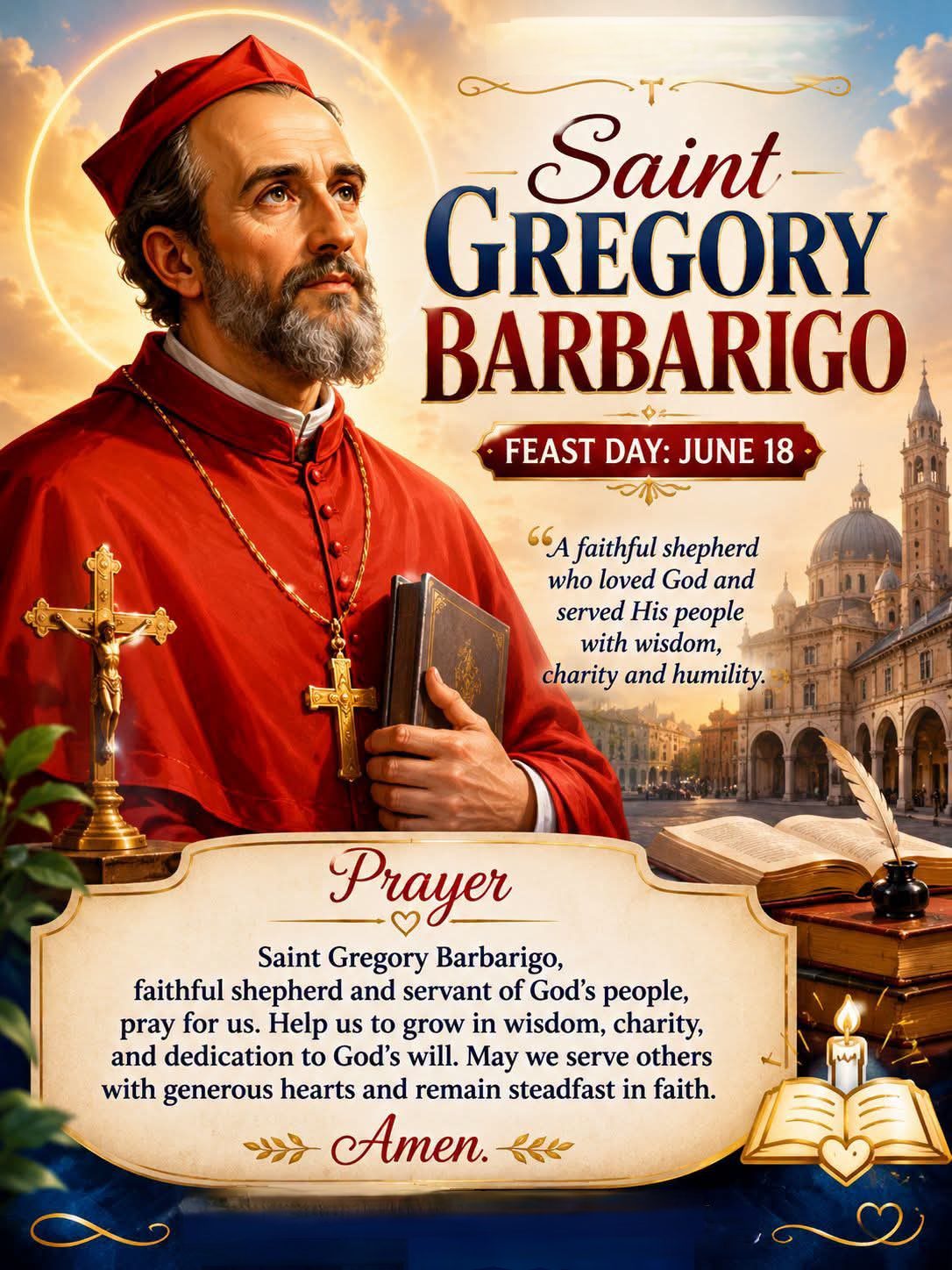
A NOBLE CHILD IN VENICE
Born in Venice in 1625, Gregory came from a distinguished family and received an excellent education. Surrounded by opportunities for influence and public honor, he appeared destined for a successful worldly career. Yet God was preparing him for a higher calling.
THE MEETING THAT CHANGED HIS LIFE
As a young man, Gregory accompanied his father on diplomatic missions and became familiar with the affairs of nations. During events connected with the conclusion of the Thirty Years’ War, he met Cardinal Fabio Chigi, who later became Pope Alexander VII. This encounter profoundly influenced him and helped him recognize God’s call to a life of service in the Church.
CHOOSING THE GREATER SERVICE
Although many expected him to pursue a distinguished political career, Gregory chose the priesthood. He willingly left behind worldly ambition, convinced that serving Christ offered a greater and more lasting nobility than any earthly honor.
THE SHEPHERD EMERGES
After his ordination, Gregory quickly gained a reputation for wisdom, diligence, and humility. When appointed Bishop of Bergamo, he devoted himself to knowing his people personally. He visited parishes, met priests, listened to families, and remained close to those entrusted to his care.
THE BISHOP WHO REMAINED CLOSE TO HIS PEOPLE
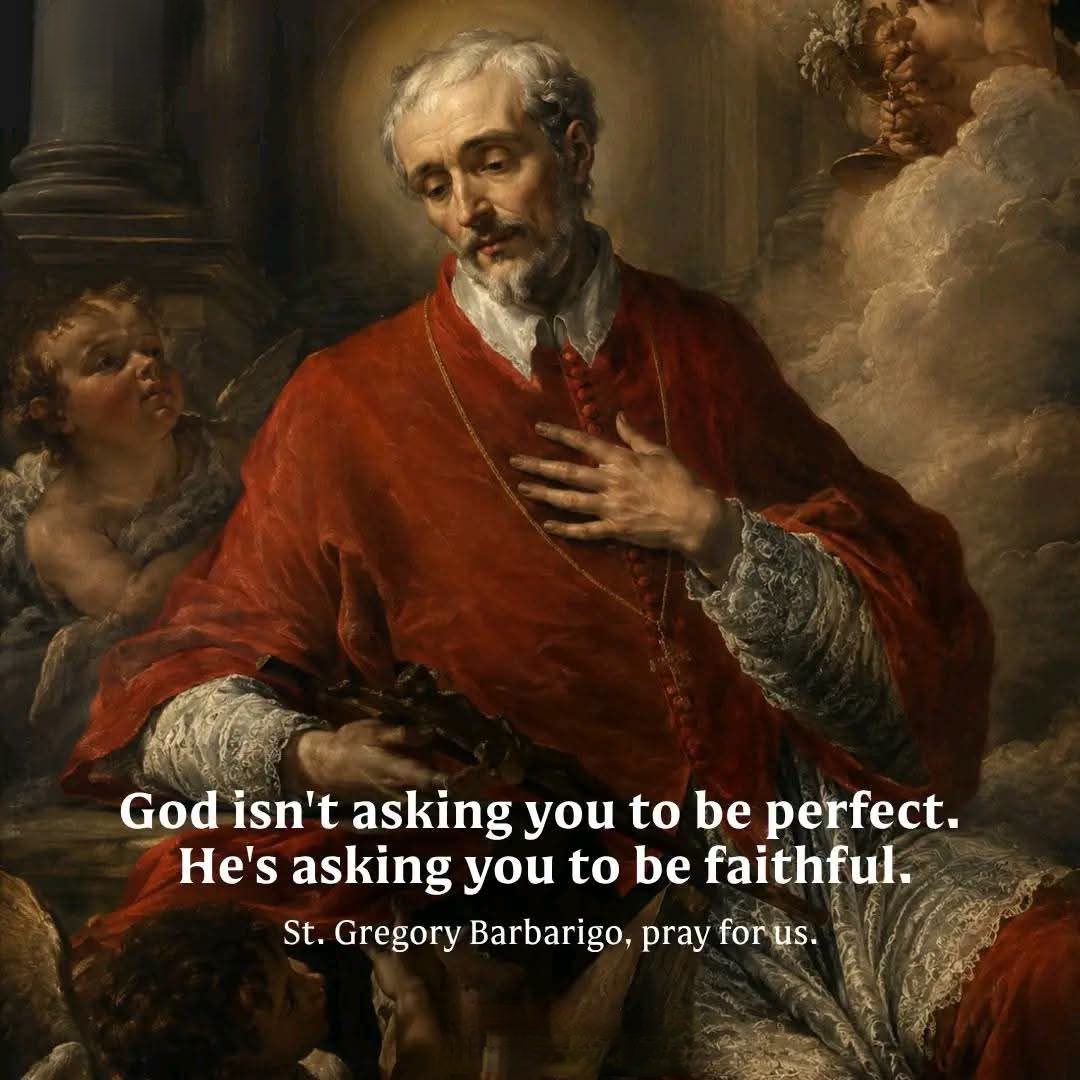
Gregory traveled extensively throughout his diocese, encouraging the faithful, supporting clergy, and correcting problems where necessary. His reforms were rooted in pastoral concern and genuine love for the people he served.
PADUA AND HIS LIFE’S WORK
Later appointed Bishop of Padua, Gregory spent many years renewing the Church through steady and faithful labor. His patient efforts strengthened the spiritual life of the diocese and created lasting foundations for future generations.
THE BUILDER OF FUTURE PRIESTS
Gregory understood the importance of well-formed clergy. He devoted great energy to seminaries, improving education, strengthening spiritual formation, and fostering holiness among future priests. Through this work, he helped shape the future of the Church.
THE LOVER OF LEARNING
A gifted scholar, Gregory valued knowledge as a means of serving truth and guiding souls. He established libraries, expanded educational opportunities, and preserved resources for future generations. His learning was always directed toward the good of the Church and the salvation of souls.
WISDOM AND CHARITY UNITED
Gregory’s love for learning was matched by his love for the poor. He cared for the sick, supported those in need, and responded generously during times of hardship. His scholarship never separated him from the suffering of others but inspired greater compassion.
THE CARDINAL WHO REMAINED A SHEPHERD
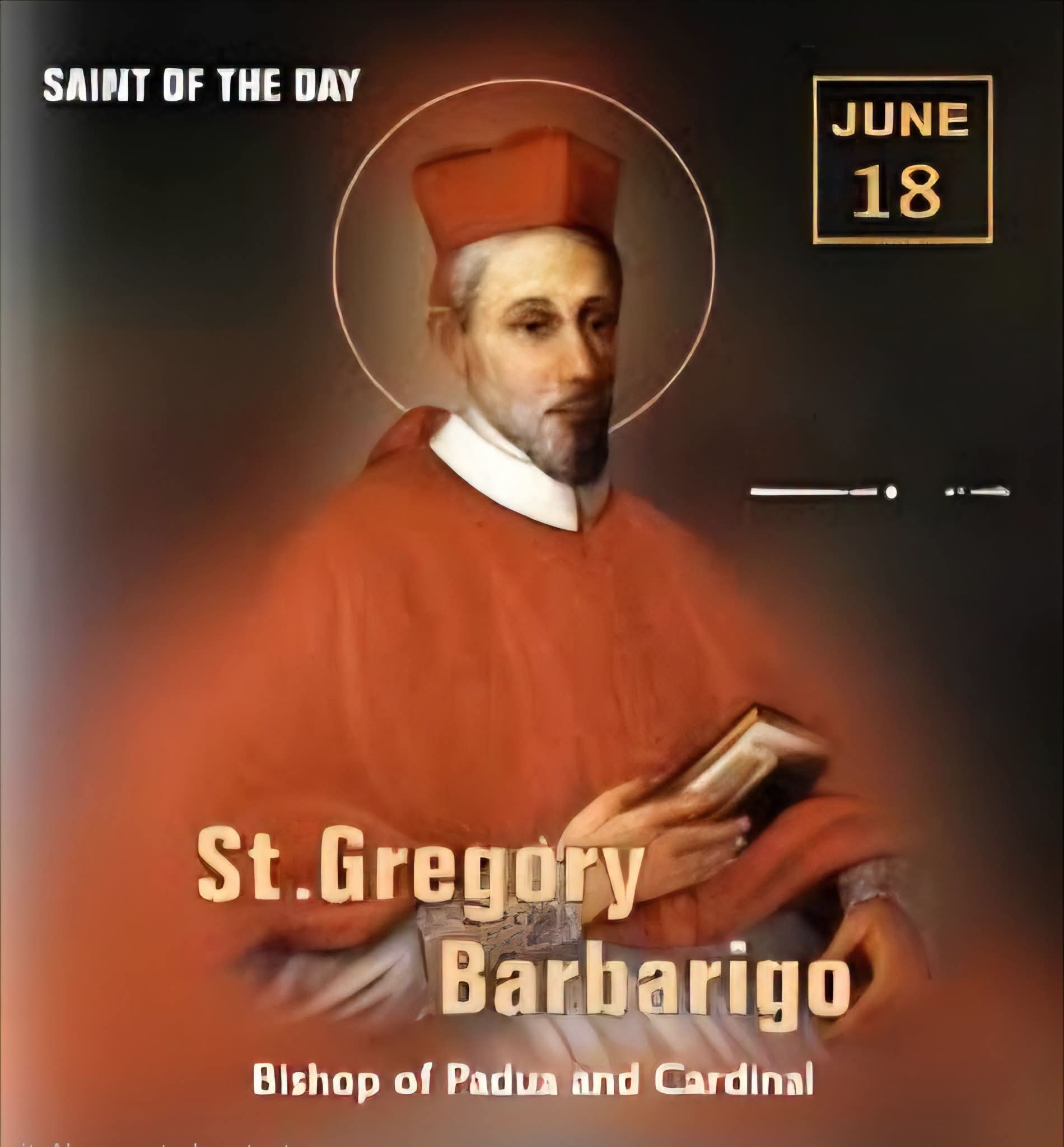
When Gregory was elevated to the College of Cardinals, he continued to serve with the same humility and dedication. Despite increased influence and honor, he remained focused on priests, seminarians, students, and the poor, seeing himself first and foremost as a servant of God’s people.
THE FINAL YEARS
Even as age weakened his body, Gregory’s zeal remained strong. He continued his pastoral work faithfully until the end of his life, never ceasing to care for the flock entrusted to him.
THE QUIET TRIUMPH
When Gregory died in 1697, he left behind a legacy of well-formed priests, renewed parishes, educated minds, and strengthened souls. His greatness was not built on dramatic achievements but on decades of steady fidelity and faithful service.
THE SAINT WHO BUILT WHAT LASTS
Gregory understood that earthly honors and achievements pass away, but souls endure forever. He dedicated his life to forming priests, educating minds, caring for the poor, and renewing hearts. His example reminds us that true holiness is often found in faithful service carried out quietly and consistently.
CANONIZATION
In 1960, Pope John XXIII canonized Saint Gregory Barbarigo, presenting him to the Church as a model bishop, shepherd, and reformer.
SPIRITUAL THEMES IN HIS LIFE
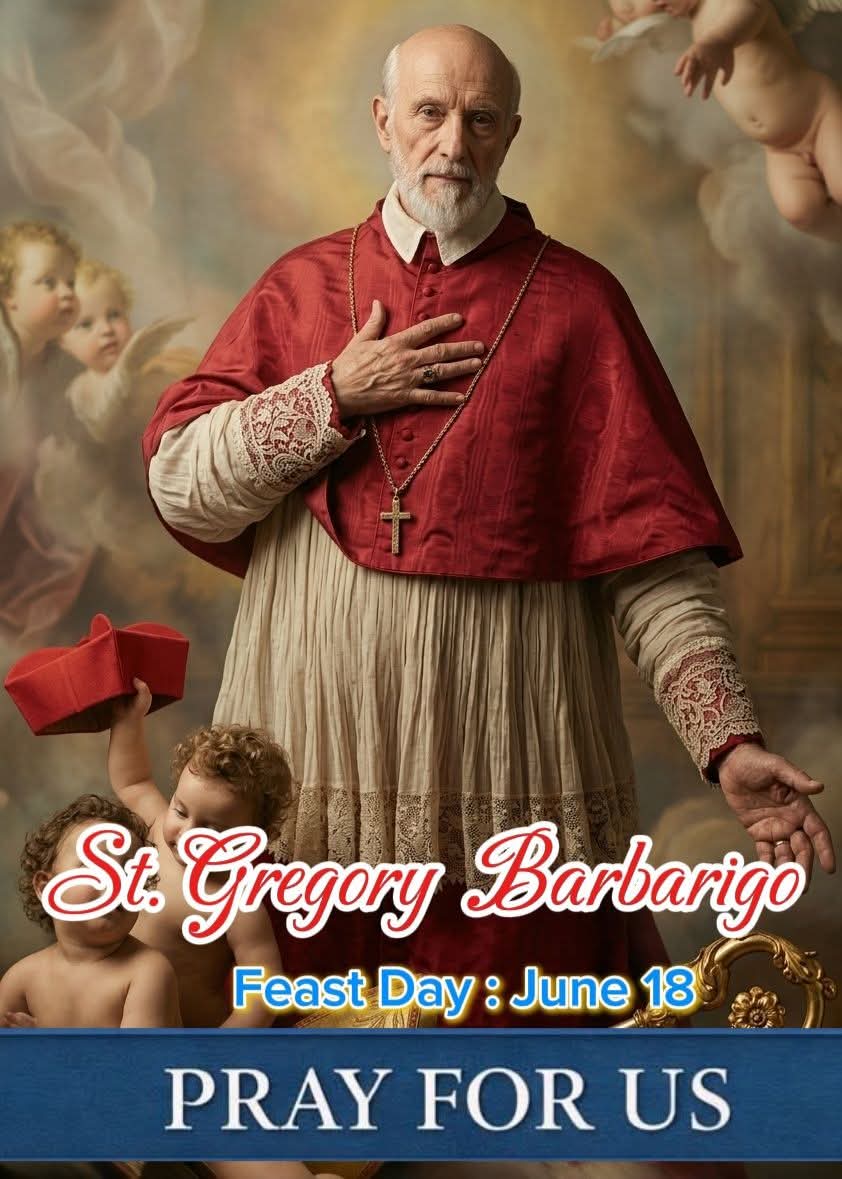
LEADERSHIP AS SERVICE
Gregory viewed authority as a responsibility to serve others rather than a privilege to be enjoyed.
EDUCATION
He recognized the power of learning to strengthen faith and transform lives.
REFORM
He promoted renewal through patience, personal involvement, and perseverance.
CHARITY
His concern for the poor remained inseparable from his intellectual pursuits.
PASTORAL PRESENCE
He stayed close to the people entrusted to his care and guided them with fatherly concern.
PATRONAGE
Saint Gregory Barbarigo is regarded as a patron of seminarians, students, educators, bishops, and diocesan leaders.
ARTISTIC REPRESENTATION
He is often depicted wearing episcopal vestments, holding books, teaching students, caring for the poor, or surrounded by symbols of learning. These images reflect the harmony of wisdom and charity that marked his life.
WHY HE STILL MATTERS
In a world that often separates knowledge from wisdom, leadership from service, and authority from compassion, Gregory offers a powerful example of their unity. He teaches that education should lead to holiness, leadership should serve people, reform requires patience, and learning should inspire charity.
HIS ENDURING MESSAGE
Saint Gregory Barbarigo transformed the Church through faithful leadership, wise decisions, patient reform, and compassionate service. His life reminds us that lasting renewal is usually accomplished through steady fidelity to God’s call and that a shepherd who truly loves his people can help shape the future of the Church.
PRAYER
Saint Gregory Barbarigo, you always had great prudence and love, which you said impels us to run to God. You taught your flock that though the impulse to rush toward God is blind and at times we would stumble, the prudence we develop would always guide us.
May we walk in holiness as you did, and always work with integrity, for the greater glory of God. Saint Gregory, pray for us.
*********************************
ALSO CELEBRATED:
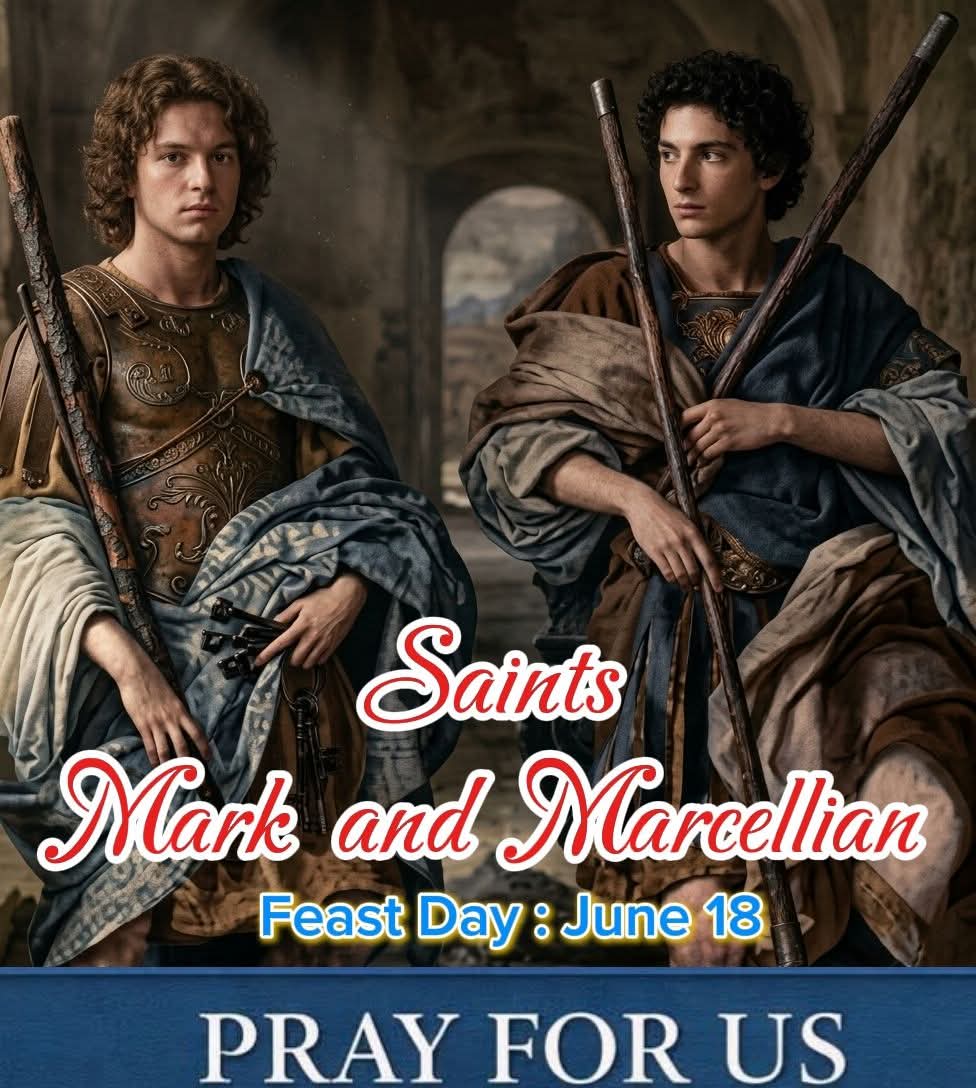
SAINTS MARK AND MARCELLIAN
TWIN BROTHERS AND MARTYRS OF THE EARLY CHURCH
Mark and Marcellian were identical twin brothers born into a noble, prominent family in Rome during the 3rd century AD. Raised in a pagan household, they secretly came to know the Christian faith through a faithful tutor, and as they grew, they embraced Christianity with deep devotion. Both were ordained as deacons, serving the early Christian community with humility, charity, and dedication to prayer and service.
During the fierce persecution under Emperor Diocletian (around the year 286 AD), Christians were forbidden and punished for refusing to worship the Roman gods and honor the emperor as divine. The brothers were arrested because of their faith and brought before the authorities. They firmly refused to offer sacrifices to pagan idols or renounce their belief in Jesus Christ, even when threatened with death.
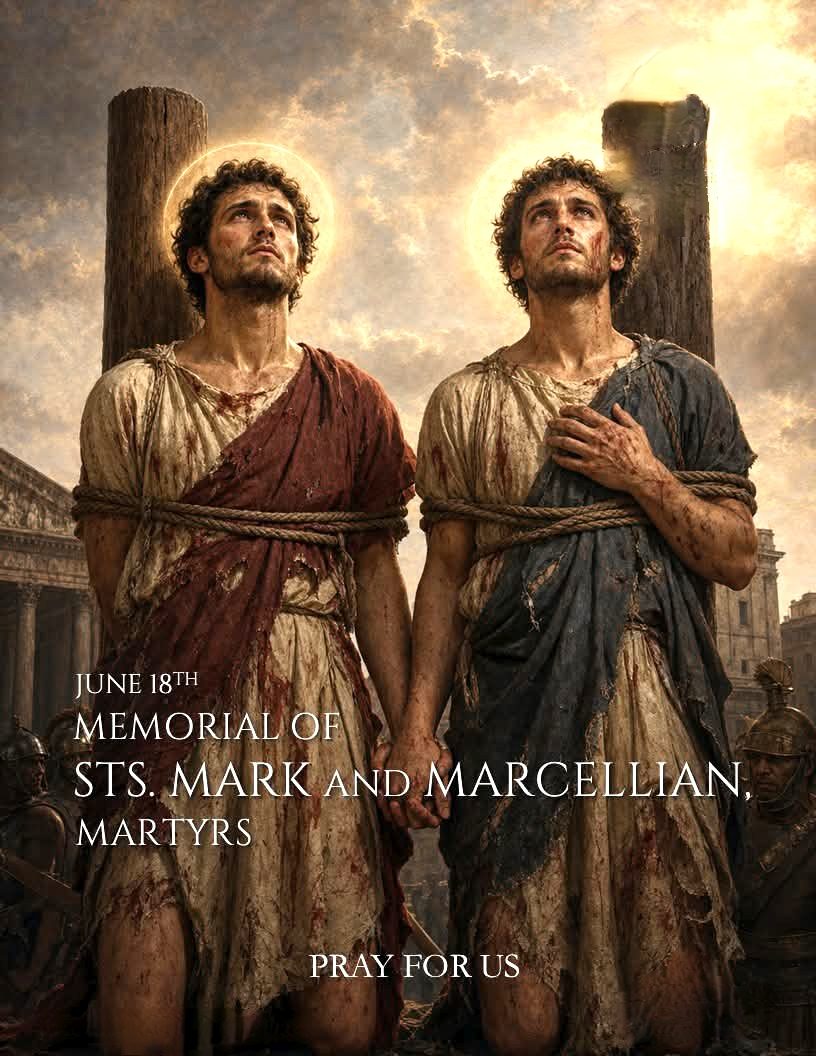
Their parents, Tranquillinus and Martia, visited them in prison, begging them to abandon their faith to save their lives. At first, the brothers remained steadfast, but their families’ sorrow and pleas weighed heavily on them. It was through the encouragement and teaching of Saint Sebastian, a brave Christian officer who ministered to imprisoned believers, that Mark and Marcellian found the strength to stand firm.
Sebastian also helped bring about the conversion of their parents, as well as other officials and their families—including the judge who had sentenced them and his household. Many people came to faith through the witness of the brothers and the work of those who encouraged them.
For a time, the brothers were freed, but they did not stop living and serving as Christians. Later, they were betrayed by a person who had once been a believer but turned away from the faith. They were arrested again and brought before new authorities, who condemned them to cruel death.
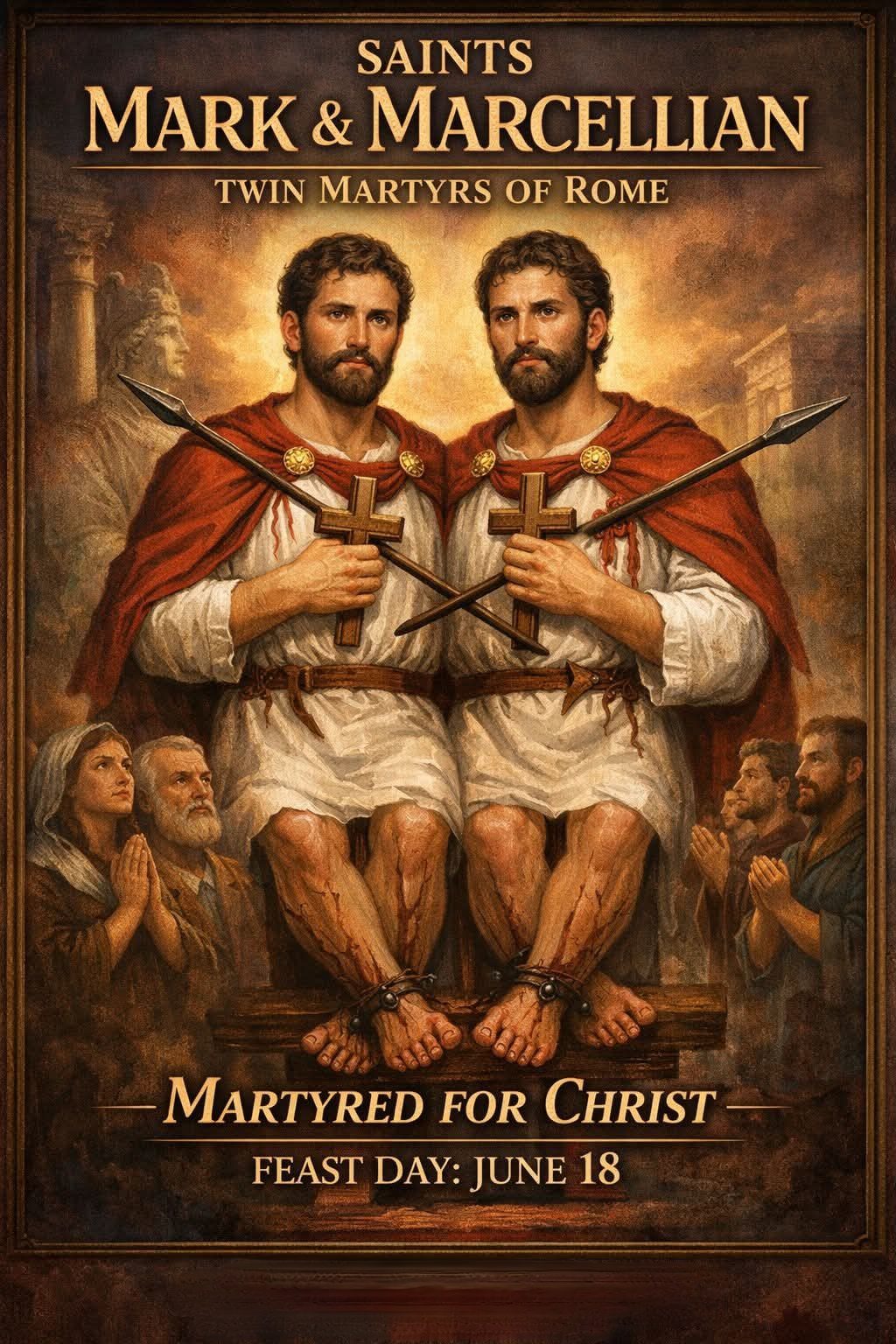
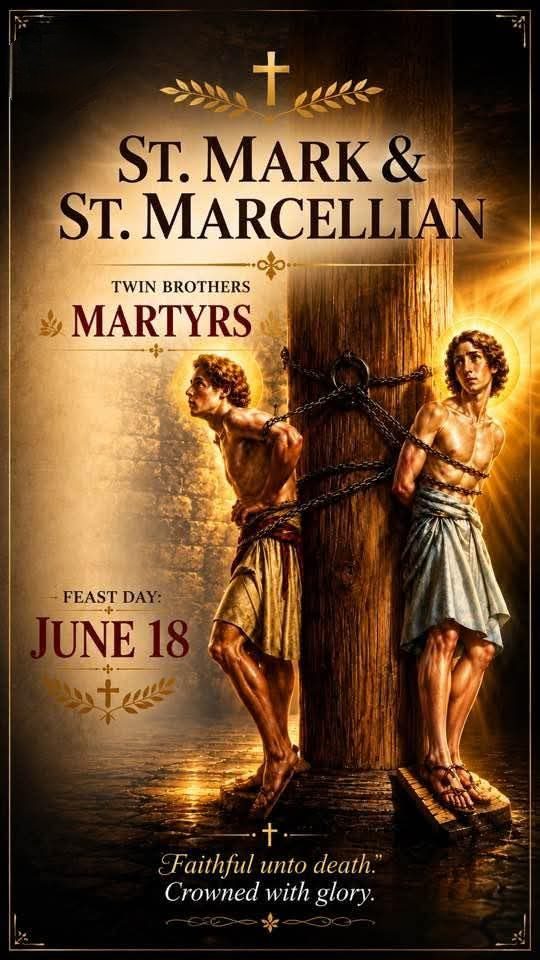
They were bound head-down to two pillars, with their feet nailed to the wood. They remained in this painful position for a full day and night, yet they did not complain or deny Christ. At last, they were put to death with lances.
They were buried on June 18 in the cemetery of Saint Balbina along the Via Ardeatina in Rome. Their relics are honored in churches in Rome and elsewhere, and they have been venerated as saints from the earliest days of the Church.
Mark and Marcellian are remembered as examples of unshakable faith, showing that even when faced with suffering and death, the hope of eternal life in Christ gives strength to remain true to God.
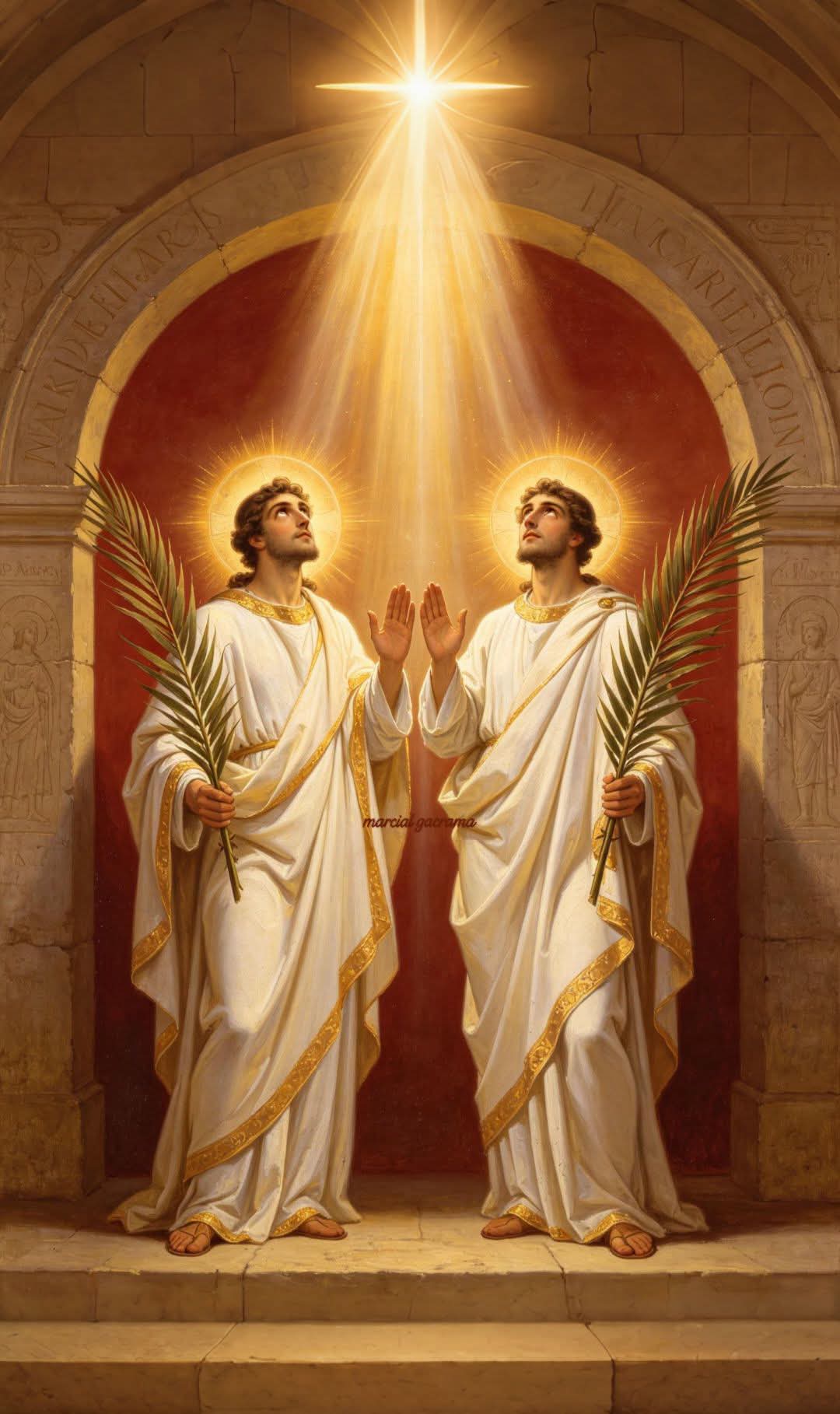
CONTEMPLATING THE LIVES OF SAINT MARK AND SAINT MARCELLIAN – THE TWIN BROTHERS WHO CHOSE CHRIST OVER LIFE ITSELF
Saints Mark and Marcellian were twin brothers and early Christian martyrs of Rome who are honored for their unwavering faith in Christ. Though not as widely known as some other martyrs, they were greatly venerated in the early Church and remain shining examples of courage, perseverance, and fidelity. Their feast is celebrated on June 18.
HISTORICAL BACKGROUND
Mark and Marcellian lived during a time of severe persecution of Christians in the Roman Empire, most likely during the late third century. Tradition associates their martyrdom with the persecution under Emperor Diocletian or a similar period of hostility toward Christianity.
TWO BROTHERS, ONE FAITH
Born into a Christian family in Rome, Mark and Marcellian shared the same faith and devotion to Christ. As adults, they became husbands and fathers and lived quietly within the Christian community. Yet God was preparing them for a greater witness that would inspire generations.
THE DAY EVERYTHING CHANGED
Their peaceful lives were interrupted when they were arrested for being Christians. Brought before Roman authorities, they were ordered to renounce Christ and offer sacrifice to pagan gods. In return, they would be spared. Despite the temptation to save their lives, both brothers firmly refused.
THE EMOTIONAL TRIAL
Rather than executing them immediately, the authorities allowed their relatives to visit them in prison. Their parents, wives, children, and friends pleaded with them to give in and save themselves. The brothers endured deep emotional suffering as they listened to the tears and fears of those they loved.
THE STRUGGLE OF THE HEART
Mark and Marcellian loved their families deeply. Their sorrow and concern caused moments of hesitation and inner struggle. Their temptation came not from fear of death but from love for those closest to them. They experienced the painful conflict between earthly attachments and fidelity to Christ.
THE ENCOURAGEMENT OF SAINT SEBASTIAN
At this crucial moment, Saint Sebastian, who was also suffering for the faith, encouraged them. He reminded them of Christ’s sacrifice and the promise of eternal life. His words strengthened their resolve and renewed their courage to remain faithful.
COURAGE RESTORED
The brothers overcame their doubts and stood united once again. Neither threats from the authorities nor emotional appeals from loved ones could separate them from Christ. They chose faithfulness over compromise.
A WITNESS THAT INSPIRED OTHERS
Their steadfast faith deeply impressed those around them. Tradition holds that their example inspired conversions among relatives, guards, and others who witnessed their courage. Even in prison, they became powerful witnesses to the Gospel.
THE FINAL TEST
The authorities gave them additional opportunities to renounce Christ and save their lives. Each time they refused. They valued their relationship with Christ above earthly security and remained firm in their decision.
THE MARTYRDOM OF THE BROTHERS
Ancient traditions differ in some details of their execution, but all agree on the essential fact: they suffered and died for Christ. Bound, tortured, and eventually executed, they entered eternity together, united in faith as they had been united in life.
BURIAL AND VENERATION
The early Christians buried them in the Roman catacombs and honored them as martyrs. Their tomb became a place of devotion, and their names were preserved in ancient martyrologies and liturgical commemorations.
THE VICTORY OF FAITH
The Roman authorities believed that death would silence them, but their witness endured. The empire that condemned them eventually passed away, while the faith for which they died spread throughout the world. Their courage continues to inspire Christians today.
SPIRITUAL THEMES IN THEIR LIVES
FIDELITY
Mark and Marcellian remained loyal to Christ despite intense pressure and temptation.
FAMILY AND FAITH
Their story illustrates the challenge of balancing love for family with complete commitment to God.
PERSEVERANCE
They overcame moments of weakness through God’s grace and remained steadfast to the end.
WITNESS
Their courage led others to embrace the Christian faith.
BROTHERHOOD
Their shared journey highlights the strength that comes from supporting one another in faith.
PATRONAGE
They are often regarded as examples and intercessors for siblings, families, Christians facing persecution, and those struggling to remain faithful under pressure.
ARTISTIC REPRESENTATION
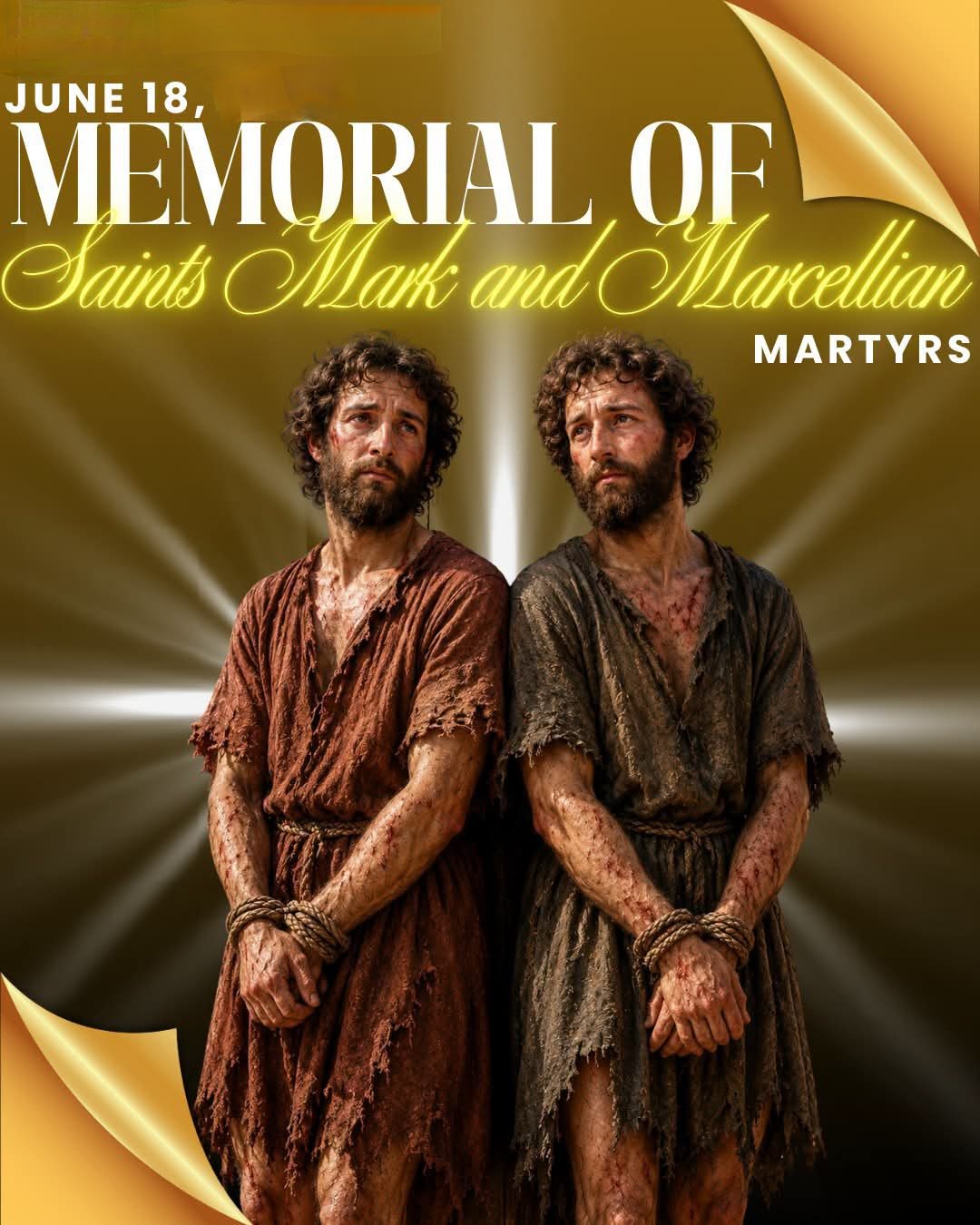
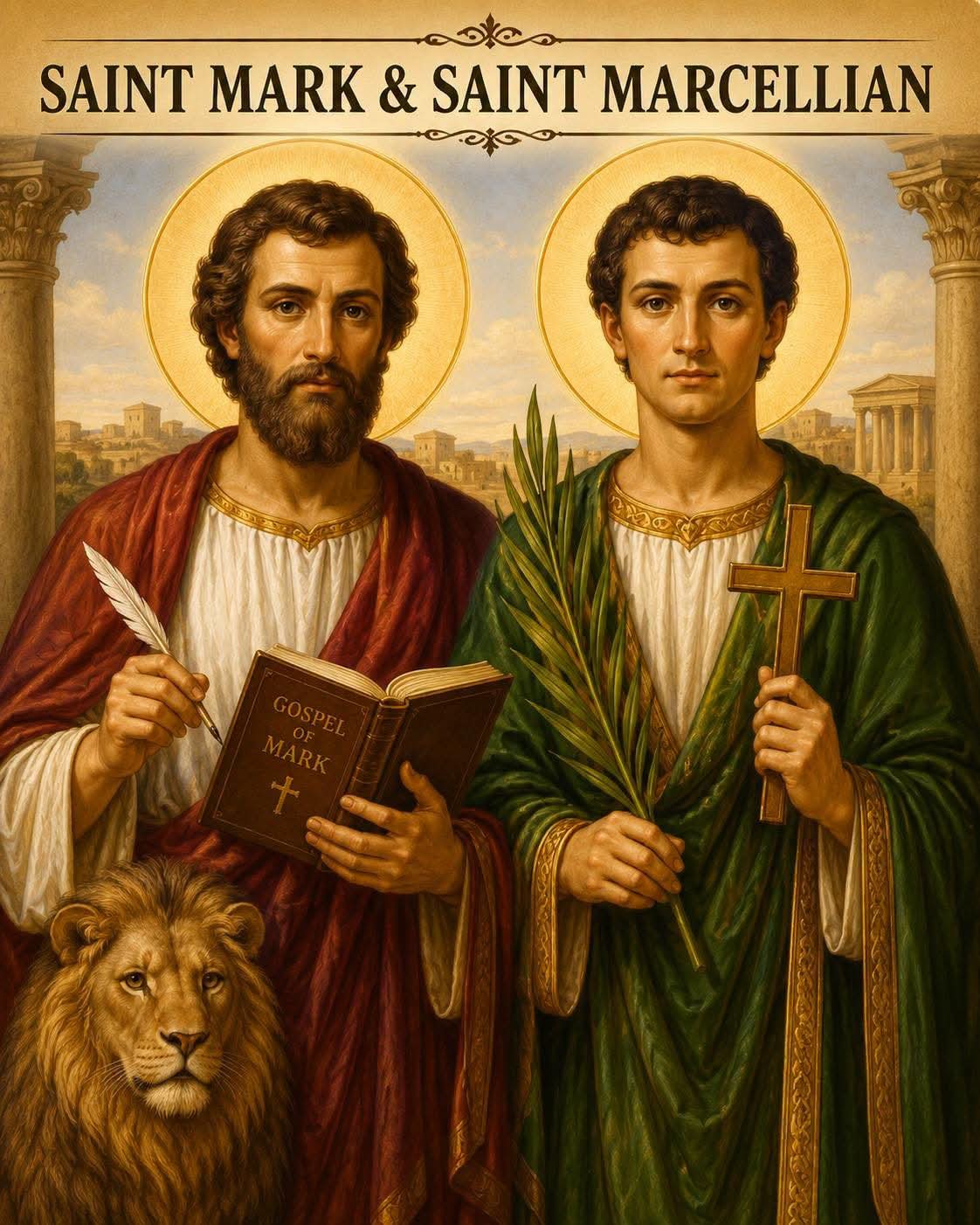
They are commonly depicted together as twin brothers, holding the palm branches of martyrdom, bearing symbols of their execution, or standing alongside Saint Sebastian. These images emphasize their unity in faith and sacrifice.
WHY THEY STILL MATTER
Most Christians today do not face martyrdom, but many encounter social pressure, opposition, fear, or the temptation to compromise their beliefs. Mark and Marcellian remind us that true courage is not the absence of struggle but faithfulness through struggle.
THEIR ENDURING MESSAGE
The greatness of Mark and Marcellian lies not only in their martyrdom but also in the struggle they overcame before it. They deeply loved their parents, spouses, children, and relatives, yet they placed Christ above all else. Their lives teach that the strongest faith is not a faith that never struggles, but a faith that remains faithful after the struggle has been won.
PRAYER
O God, our Father,
You gave to Your holy martyrs Mark and Marcellian
the grace to remain faithful to You even in the face of suffering and death.
We honor their courage and their love for You,
which led them to reject idolatry and stand firm in the truth of the Gospel.
They did not fear torture or danger,
because their hope was fixed on the eternal reward You promised to those who love You.
Holy Brothers, Mark and Marcellian,
pray for us!
In a world where faith is often tested and values are challenged,
obtain for us the grace to be steadfast in our beliefs.
Give us the strength to stand for what is right,
even when it is difficult or unpopular.
Help us to follow your example:
to live with integrity, to witness to Christ in all we do,
and to lead others closer to You by our words and deeds.
Protect us from evil, from doubt, and from temptation.
Grant us peace of heart, courage in trial, and the joy of true faith.
May we, like you, holy Saints Mark and Marcellian, live and die faithful to Jesus Christ, and one day share in the glory of Your heavenly kingdom. Through Christ our Lord. Amen