
SPIRITUAL INSIGHTS INTO THE LIVES OF SAINT DENIS AND COMPANIONS
October 9, 2026
Philippians 4:9
October 9, 2026
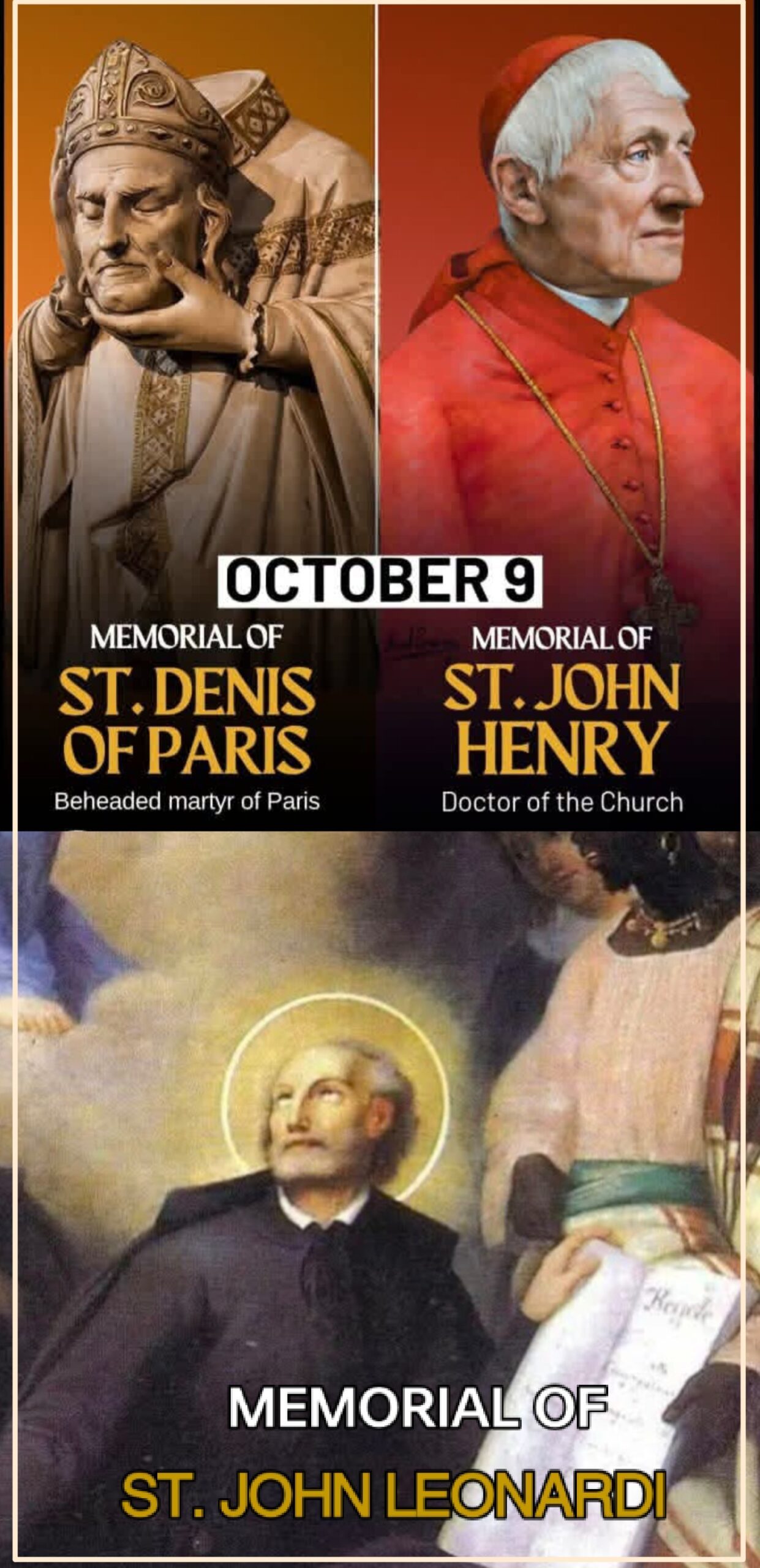
FEAST OF SAINT JOHN LEONARDI – FEAST DAY – 9th OCTOBER
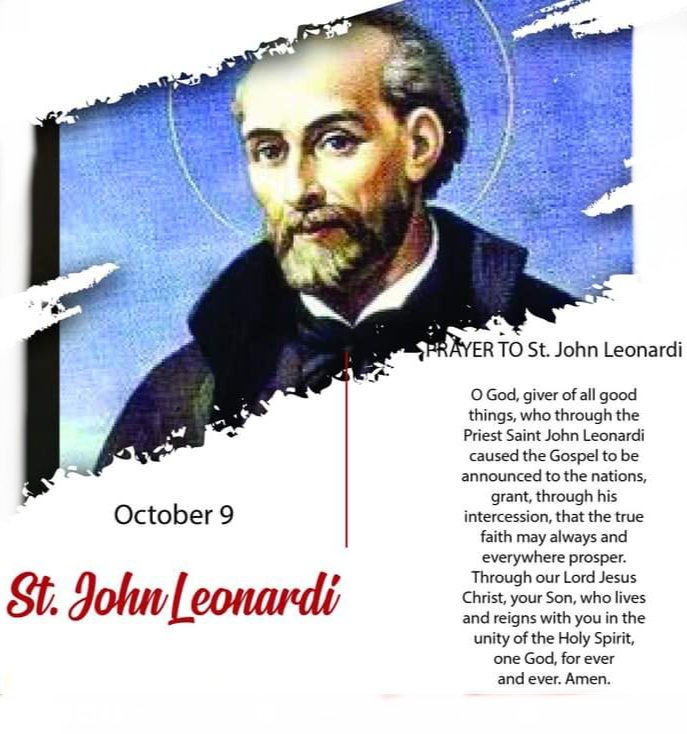
Today’s saint was among that first wave of post Council of Trent priests and founders whose purification of the Church started with themselves. Saint John Leonardi was a man ardently in love with Christ and Mary and the sacred field of the Catholic Church, where theological truths grow tall and dense in the richest soil. Because that sacred field was so in need of clearing, pruning, and weeding in his era, Saint John stripped from himself every single personal interest, desire, or goal and merged his life totally with that of Christ.
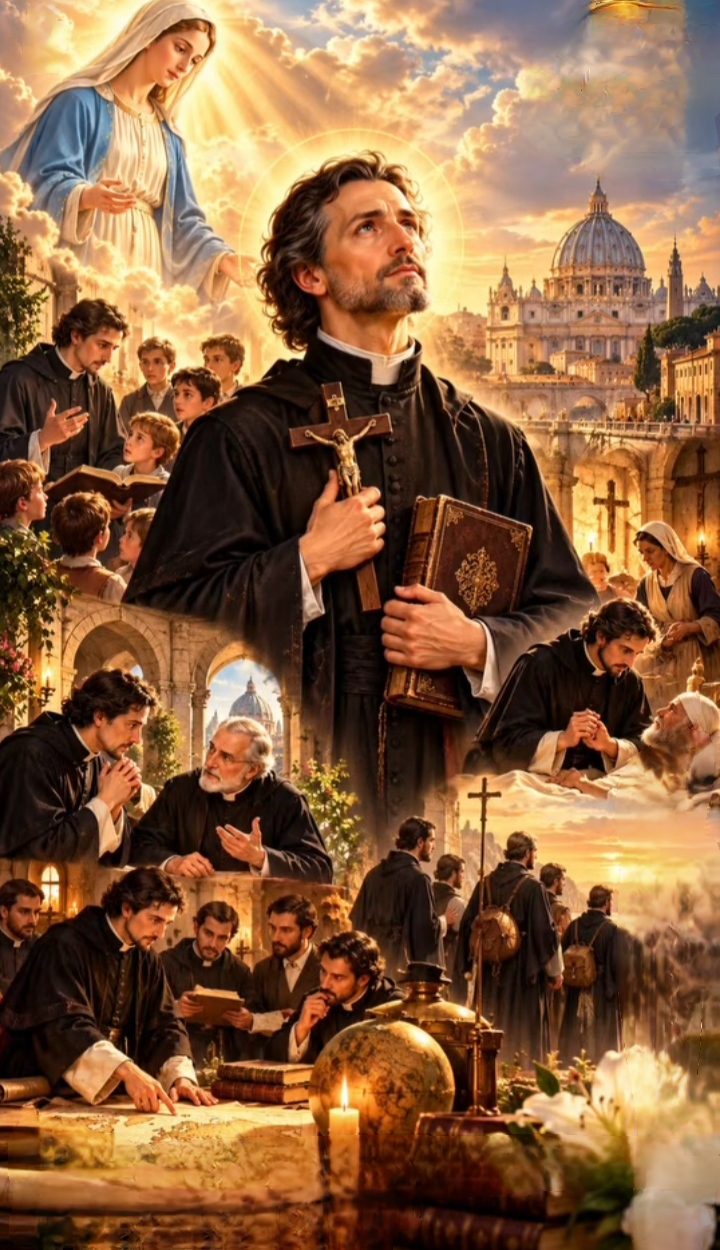
John was like a small twig grafted onto the verdant root-stem of Christ. John, Christ, and the Church all grew and thrived together as one living thing. Like so many saints, John Leonardi was born into a large family. The hum and whistle of daily life, work, meals, conversation and prayer in large families is a small school where children learn generosity in a natural atmosphere. The large family’s numerous siblings serve as proxies for the diverse personalities found in the broader culture, better preparing the children for life outside the home.
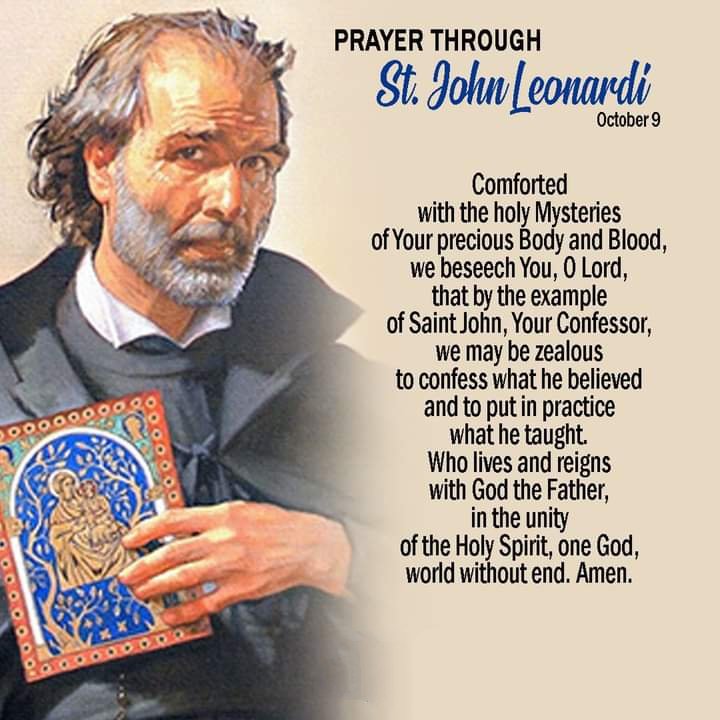
John’s parents won the battle for his soul early. He was a religiously inclined boy from the start. As a teenager, John studied to be a pharmacist under a local mentor for many years and later maintained a life-long interest in medicine. But mature reflection eventually took him down another path. He would not apply essences, compounds, or poultices to patients’ bodies but rather feed the sacraments to people’s souls.
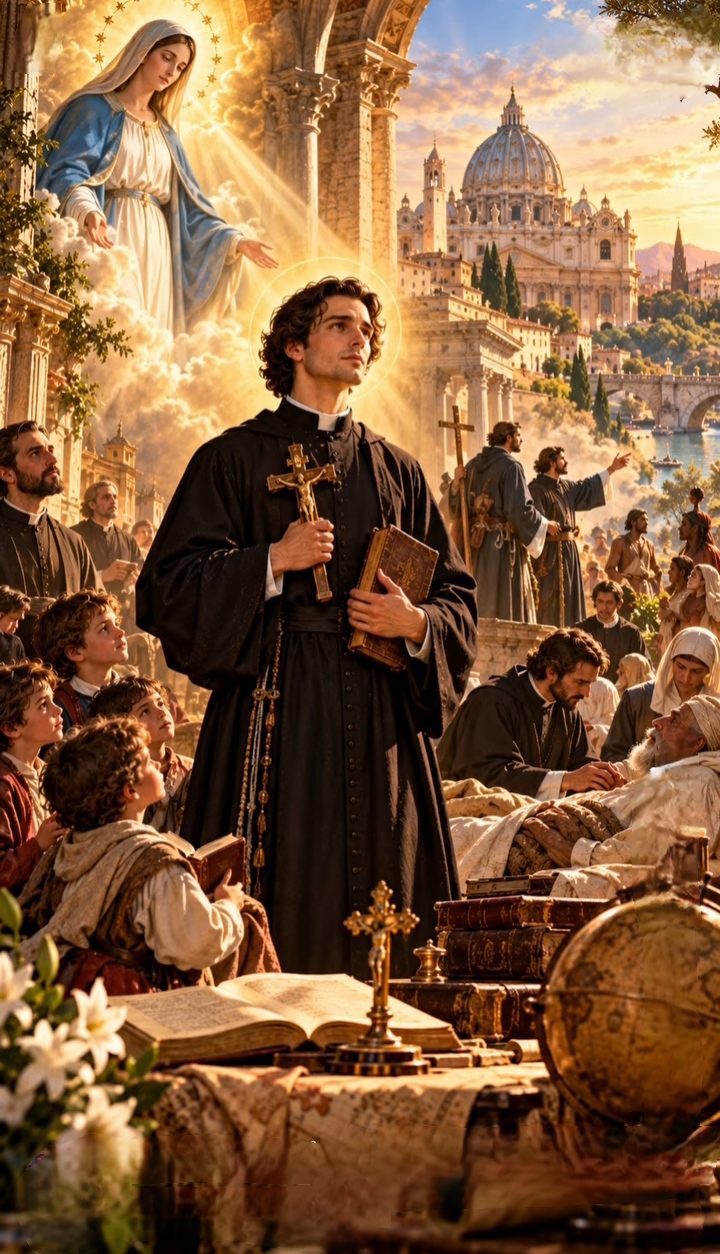
John studied for the priesthood and was ordained in 1572. Father John served among the youth at parishes in his native city of Lucca, Italy, and was active in visiting hospitals and prisons. His ardour attracted a loyal following of laymen with whom he lived and worked and prayed. John’s life and priesthood flowed effortlessly into the great river of reforms that gushed from the Council of Trent, which had concluded just a few years before John was ordained.
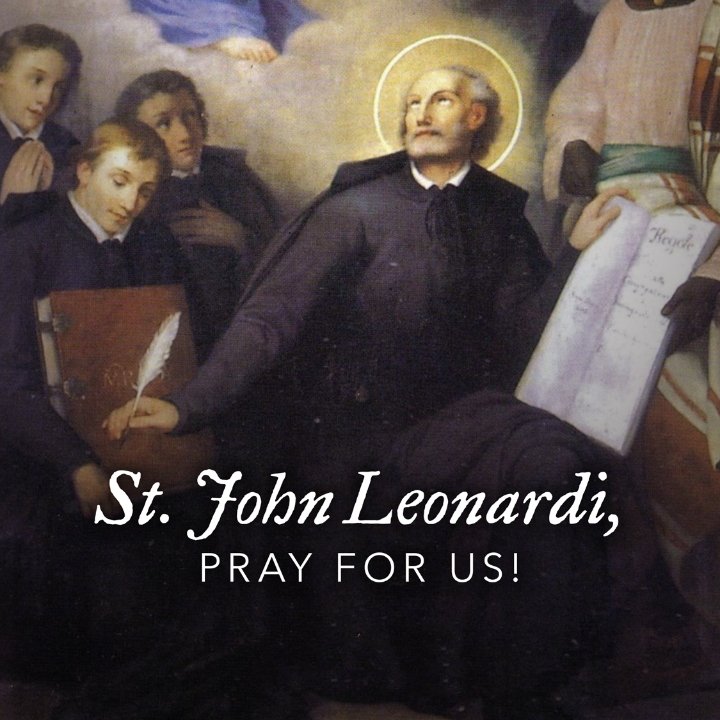
John was intensely focused on implementing the Council’s teachings. His local bishop tasked John with preaching in all of Lucca’s churches to straighten the crooked lines sketched by some theologically confused priests. Father John’s experience of orthodox preaching, and of the fierce resistance it generated, convinced him that only an impeccable moral and spiritual life could draw people to self reform and conversion.
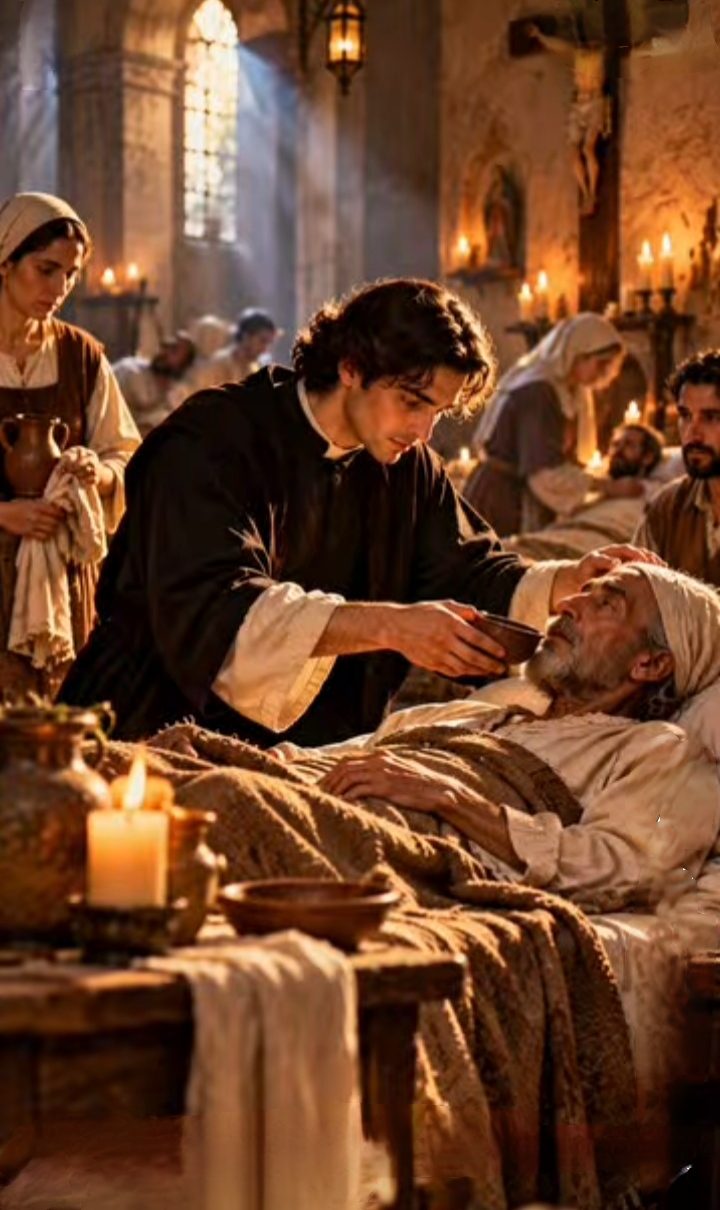
John thus sought to mirror every virtue, to be a lighthouse on the rugged cliff, drawing all people safely into the harbor of Christ. John’s small band of brothers were eventually recognized as a Congregation by successive popes, but due to local resistance, John had to move his work to Rome.
He befriended Saint Philip Neri, was entrusted with reforming several monasteries, and was instrumental in founding the seminary for the future Congregation for the Propagation of the Faith, a successful Vatican entity which formed priests for service in the foreign missions. John advocated the Forty Hours Devotion, frequent reception of Holy Communion, and the Christian formation of children at as early an age as possible.
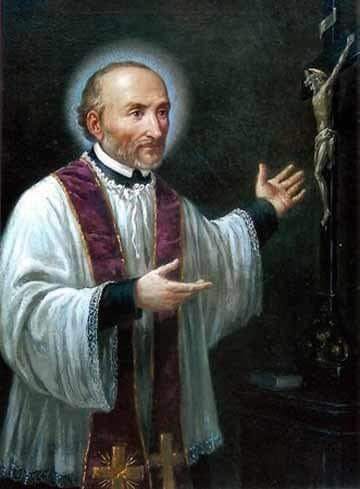
By 1600 Father John Leonardi was a well-known Counter-Reformation force in Italy not due to his books, new ideas, or charisma, but due to his virtue and zeal for the house of the Lord. In 1609 our saint died well but too soon. He was infected with the plague while visiting the sick.
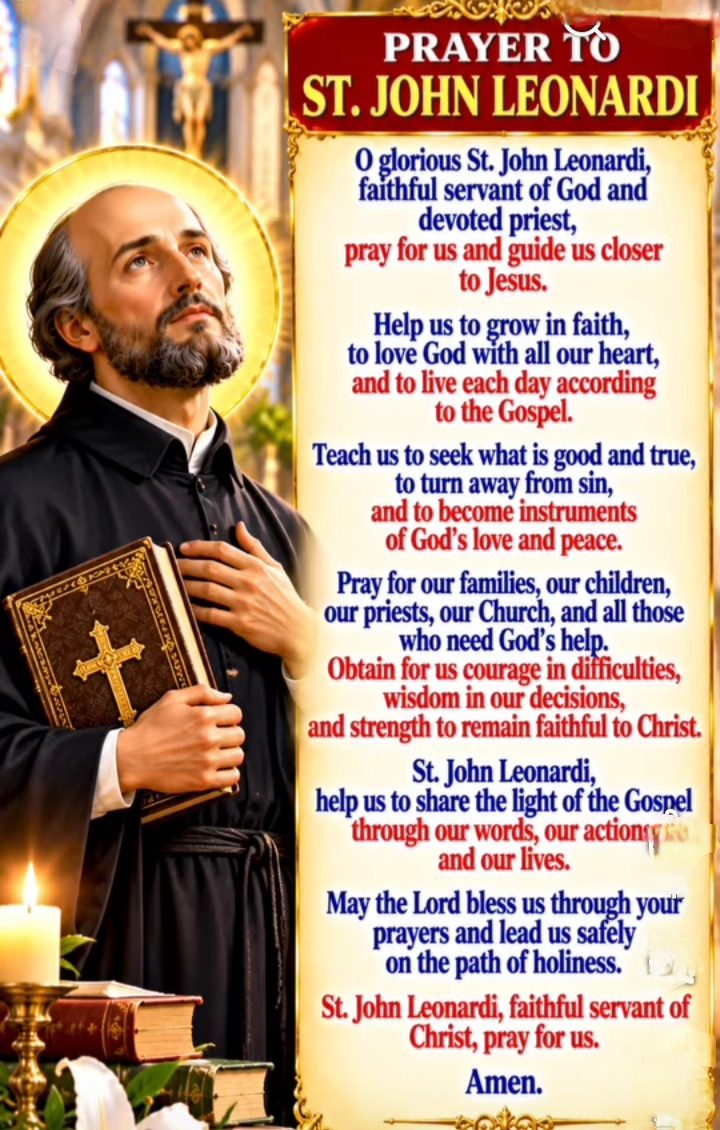
The small Congregation he founded, the Clerks Regular of the Mother of God of Lucca, continues until today, purposely small and focused on their important work. Father John Leonardo was canonized in 1938 and is buried in a handsome baroque church near the Roman Forum.
PRAYER
Saint John Leonardi, you were faithful to your ministry, consumed with the love of Christ and burning with the holy desire to serve Jesus and Mary in the very heart of the Church.
May your generous example of priestly service inspire zeal among priests so that they too may serve the Church with holy passion, zealous faith and humble generosity, through Christ our Lord. Amen
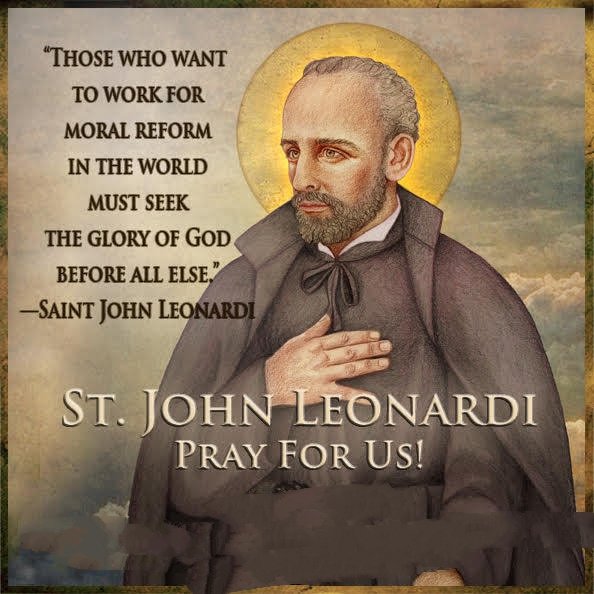
+++++++++++++++++++++++++++++++++++++++++++++++++++++++++++++++++++++
ALSO CELEBRATED:
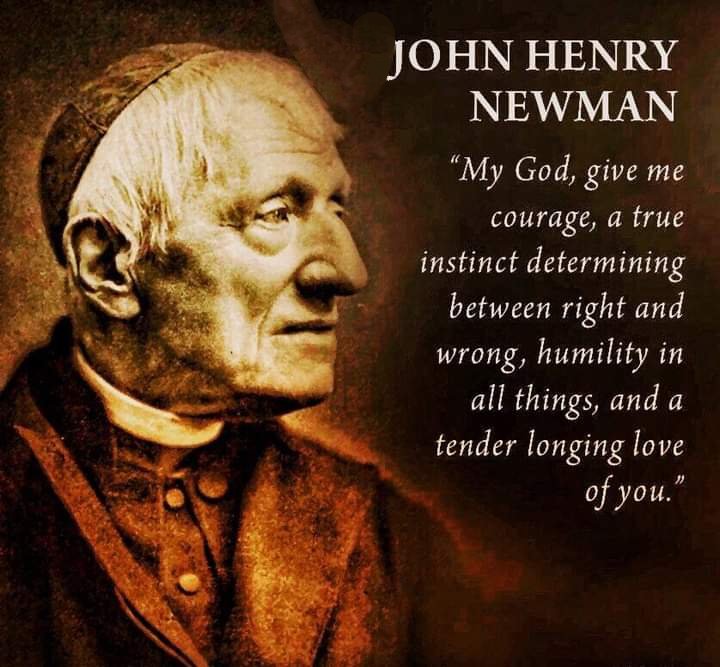
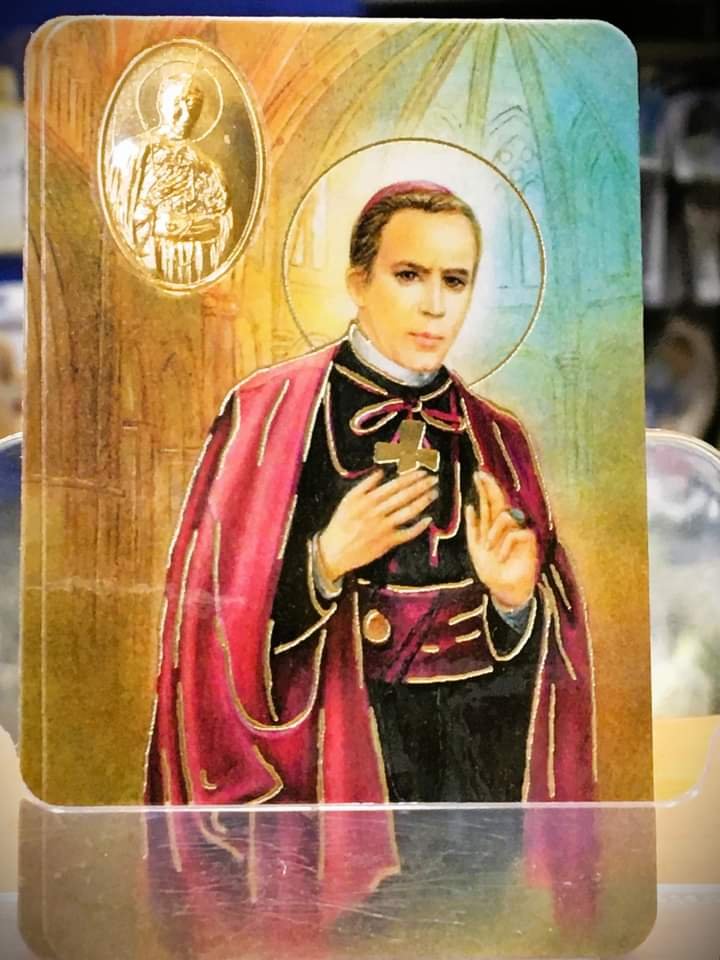
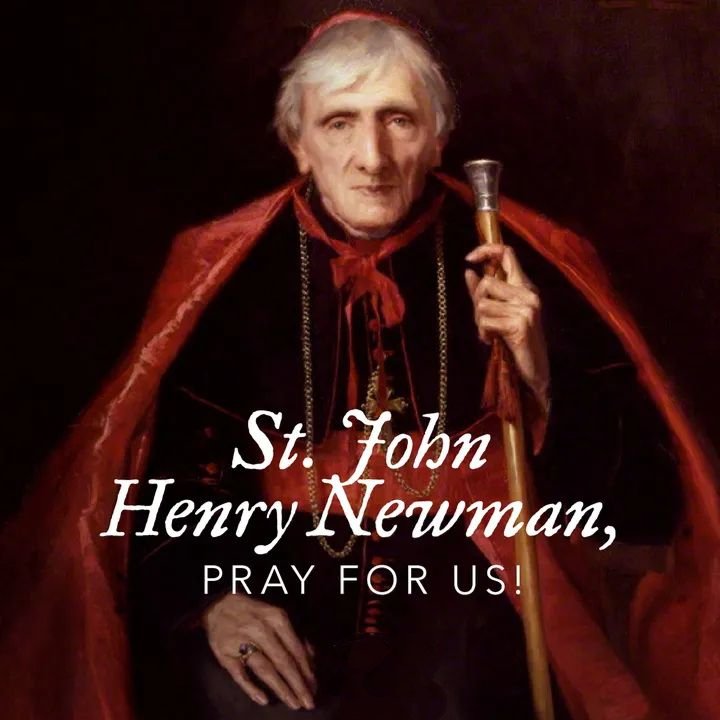
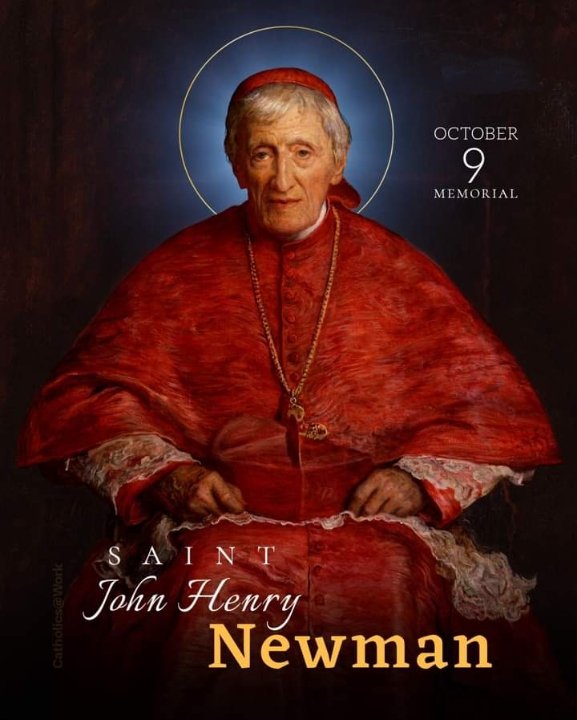 MEMORIAL OF SAINT JOHN HENRY NEWMAN– 9 OCTOBER
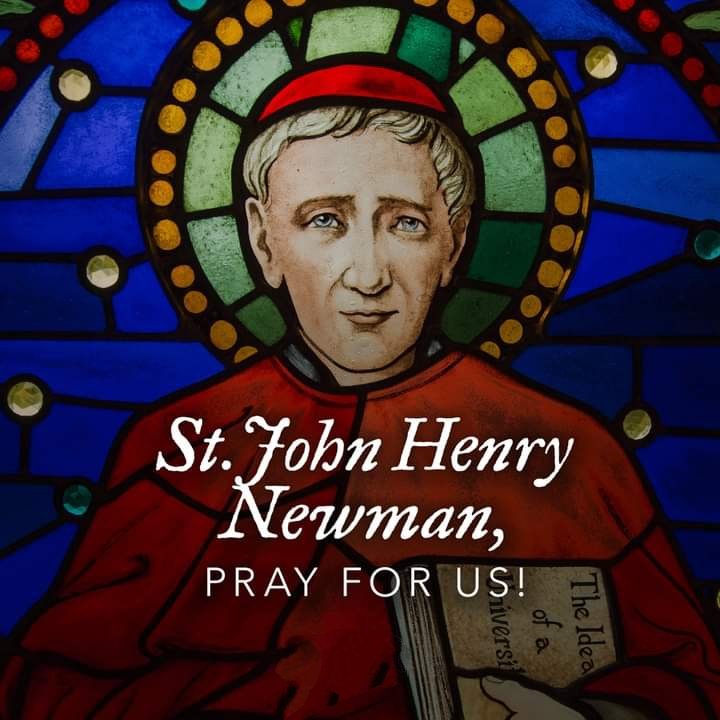
“God has created me to do Him some definite service. He has committed some work to me which He has not committed to another. I have my mission. I may never know it in this life, but I shall be told it in the next. I am a link in a chain, a bond of connection between persons. He has not created me for naught. I shall do good; I shall do His work. I shall be an angel of peace, a preacher of truth in my own place, while not intending it if I do but keep His commandments.
Therefore, I will trust Him, whatever I am, I can never be thrown away. If I am in sickness, my sickness may serve Him, in perplexity, my perplexity may serve Him. If I am in sorrow, my sorrow may serve Him. He does nothing in vain. He knows what He is about. He may take away my friends. He may throw me among strangers. He may make me feel desolate, make my spirits sink, hide my future from me. Still, He knows what He is about.” ~Saint John Henry Newman
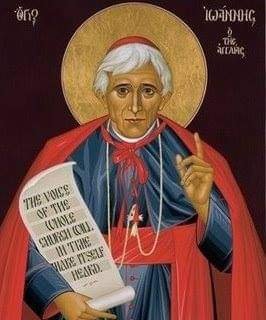
John Henry Newman, born in London, England, was the eldest of three sons and had three sisters. His father was a banker, and his mother’s family were engravers and papermakers. His early education was given by his Anglican mother who was descended from French Calvinist Huguenots. As a child, he became well-versed in the Bible, although his religious convictions were not definitive. At the age of seven, he was sent to Great Ealing School, a boarding school considered to be the best private school in England at that time. John was a serious student who loved to read, devouring everything from Arabian tales to philosophical and theological works. He especially loved stories that sparked his imagination.
When John Henry was fifteen, during his final year at Ealing, he went through a profound conversion. Of that conversion, he later wrote, “I fell under the influences of a definite creed, and received into my intellect impressions of dogma, which, through God’s mercy, have never been effaced or obscured” (Apologia #3).
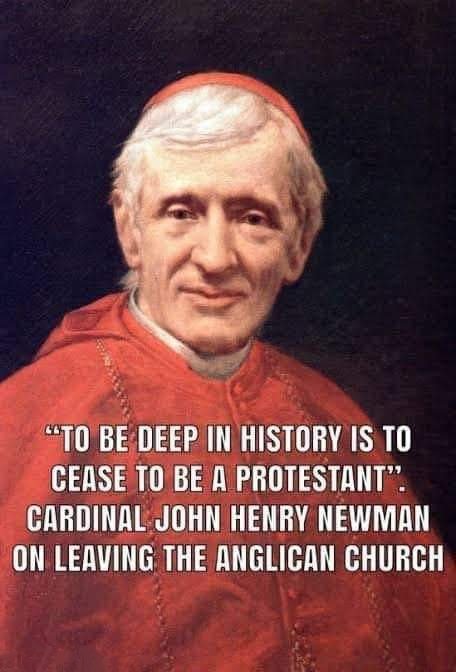
His conversion came through reading Evangelical books in which he came to a personal conviction about eternal glory. That year he continued to read and was introduced to Saint Augustine and other Church Fathers, though most of his reading was in Evangelical theology. His reading even led him to conclude that the “Pope was the Antichrist predicted by Daniel, St. Paul, and St. John.” Finally, he sensed that his life mission would require him to remain celibate, perhaps so he could be a missionary or for some other reason.
After his personal conversion, John Henry continued his studies at Trinity College, Oxford. Because he struggled, he graduated without distinctions. Desiring to continue with his intellectual pursuits, he began working as a private tutor and preparing for a fellowship at Oriel College, Oxford, which he received in 1822 at the age of twenty-one. In 1824, he was ordained an Anglican deacon and became a priest in 1825.
After his Anglican ordination, he became curate of Saint Clement’s Church, Oxford. As curate, he assisted the parish priest with various pastoral duties, which gave him time to reflect upon his theological concepts within the context of real life with real people. His time as a curate won him much respect, and in 1828, he was appointed Vicar of the University Church of Saint Mary the Virgin, Oxford. He remained in this position until 1843.
In the early 1830s, some leaders within the Church of England were growing increasingly concerned about what appeared to be a laxity of faith among the Anglican community, as well as state interference in the Anglican Church. On July 14, 1833, an Anglican priest named John Keble preached a sermon at the University of Oxford that caught the interest of a number of Anglican leaders, including John Henry Newman. This sermon sparked what became known as the Oxford Movement.
Over the next several years, John Henry and others began to write and publish “Tracts for the Times.” These tracts were a series of pamphlets that defended Anglican apostolic succession and argued for a return to the liturgical traditions with a renewed interest in the Church Fathers. Little by little, however, his writings appeared to sound more like Catholic teaching than Anglican. Though this caused controversy, John Henry continued to develop his doctrinal convictions.
It was Newman’s study and articulation of the teachings of the Church Fathers that had the biggest impact upon him. In 1842, he retired from his positions at Oxford and retreated to Littlemore, where he spent the next few years living a quasi-monastic life of prayer, study, and writing. After a thorough study of the Church Fathers and the development of the doctrines he deeply believed in, he was convinced that the Roman Catholic Church was the Church instituted by Christ.
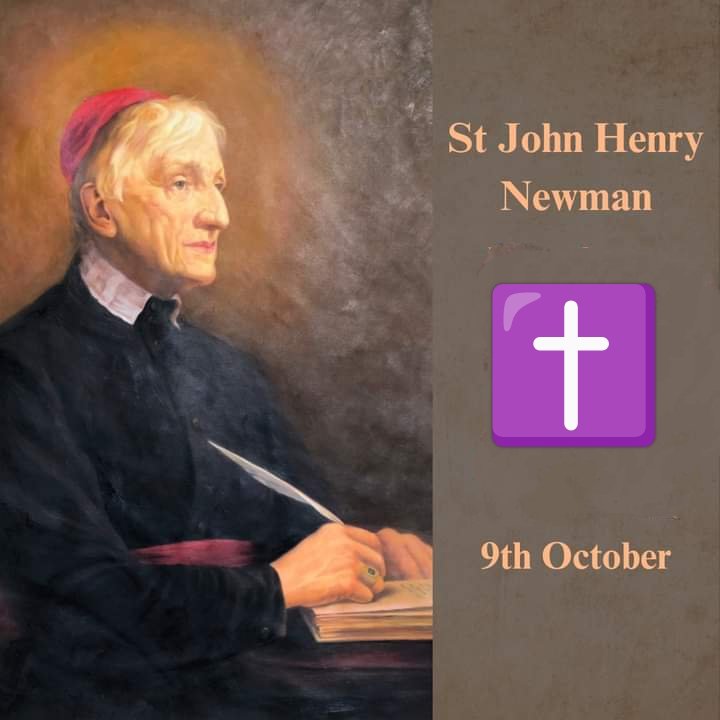
Despite the shock and disapproval of those close to him, on October 9, 1845, he was received into the Catholic Church in a small ceremony at Littlemore by Blessed Dominic Barberi. He then traveled to Rome for further studies, was ordained a Catholic priest in 1847, and returned to Birmingham, England, to form the Birmingham Oratory of St. Philip Neri in 1848.
In the years that followed, Father Newman helped found the Catholic University of Ireland and published the Apologia Pro Vita Sua, a theological defense of his personal conversion. He also published several other works, including The Idea of a University, in which he especially articulates the purpose of a university. He argued that a university was not just to teach useful knowledge but to cultivate the mind in its pursuit of knowledge, ultimately arriving at “a great and firm belief in the sovereignty of Truth.” It is for this reason that Catholic chaplaincies at colleges are called Newman Centers.

Before his death, Father Newman received two important honors. In 1877, he was given an honorary fellowship at Trinity College as a way of reconciling him with Oxford and his former colleagues. An even greater honor came in 1879 when Pope Leo XIII made him a cardinal, despite the fact that he was not a bishop.
Saint John Henry Newman could have lived a comfortable life as an Anglican priest and scholar. However, he chose to follow the convictions of faith that God planted in his mind and heart. As we honor Saint John Henry Newman, ponder his process of personal discovery and conversion. We all need ongoing conversion and transformation. Allow Saint John Henry Newman’s courage to inspire you to always seek out the fullness of the truth and go wherever it leads you.
PRAYER
Saint John Henry Newman, you first went through a conversion when you were young, but that conversion was only a stepping stone to your later conversion. Please pray for me, and especially for college students, that we will never shy away from the Truth but will always seek it out and courageously follow where God leads us. Saint John Henry Newman, pray for me. Jesus, I trust in You.
Source: mycatholiclife
*******************************************************************
SAINT DENIS AND COMPANIONS
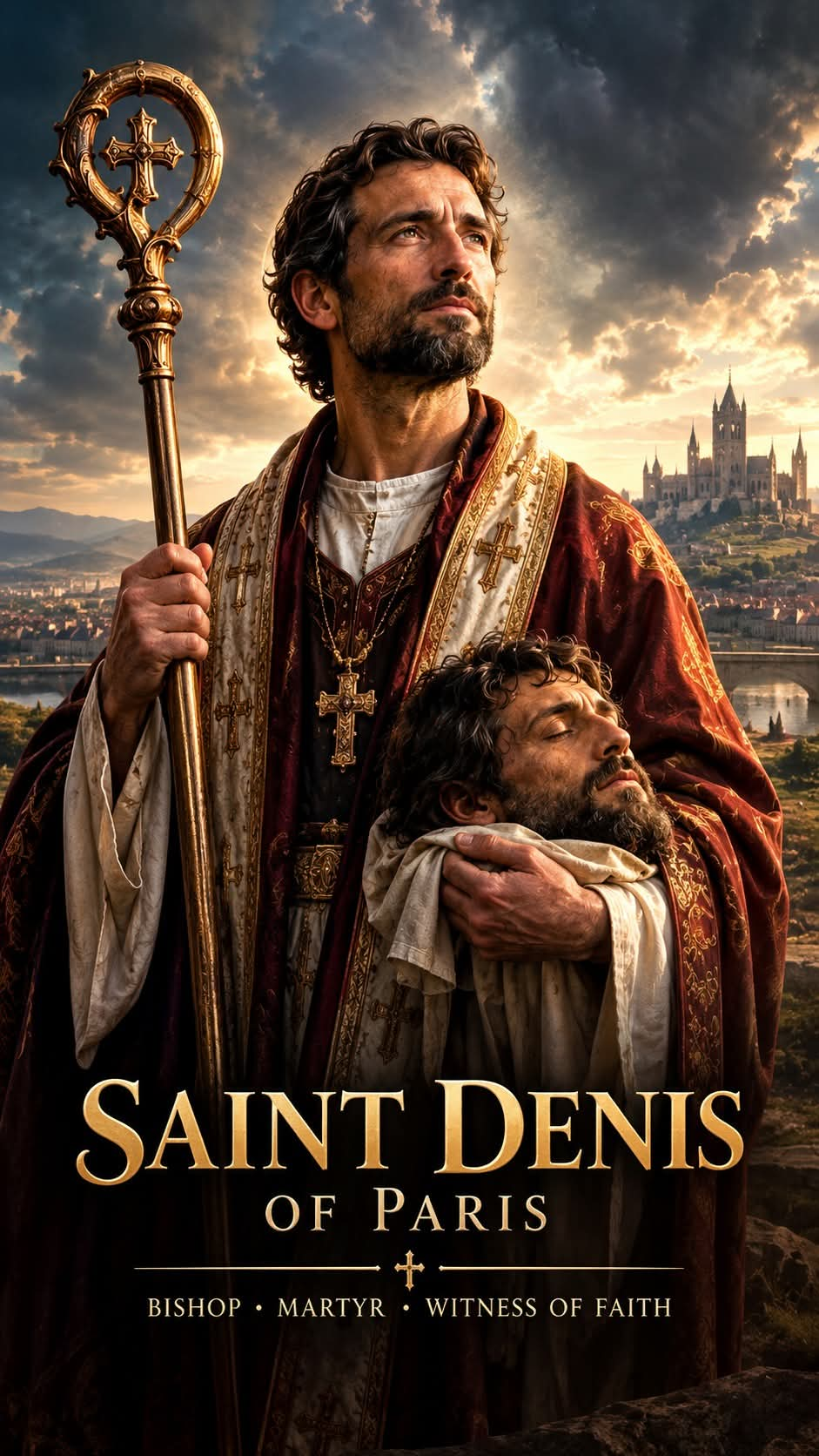
The story of Saint Denis, first bishop of Paris and patron of France, is written not only in history but also in legend. Alongside his faithful companions, Rusticus the priest and Eleutherius the deacon, he came to Gaul in the Third Century, sent from Rome with the fire of the Gospel. In a land where pagan temples still held sway, Denis built the first Christian community in what was then Lutetia, and with patience, courage, and a heart aflame with Christ, became its shepherd.
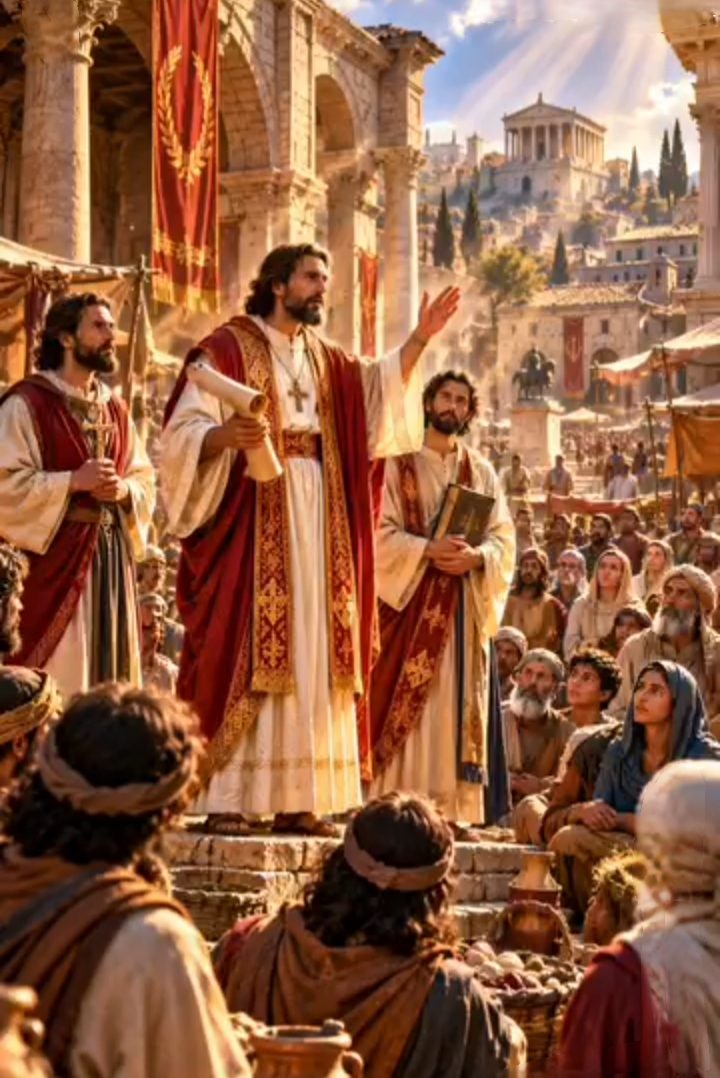
With Rusticus and Eleutherius, he walked the streets of Paris before it was Paris, proclaiming a truth both ancient and ever new: that Christ had conquered death, and that no empire could silence His voice. They preached in marketplaces and homes, gathering converts, sowing seeds that would one day take root in the heart of France. Denis’s mission was not simply to instruct minds but to awaken souls, to draw people from shadows into the radiant light of Faith.
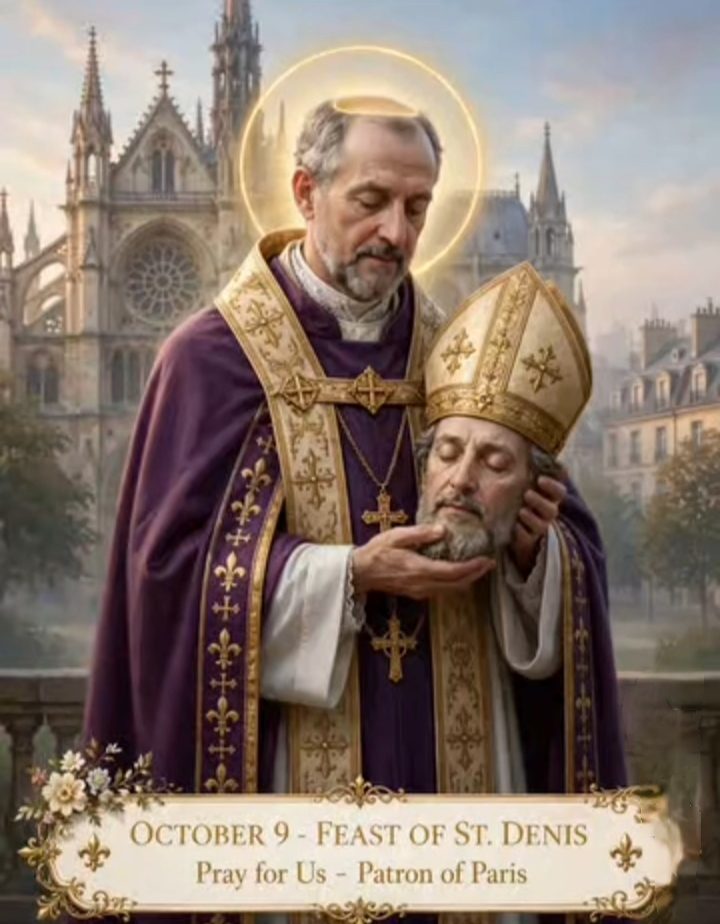
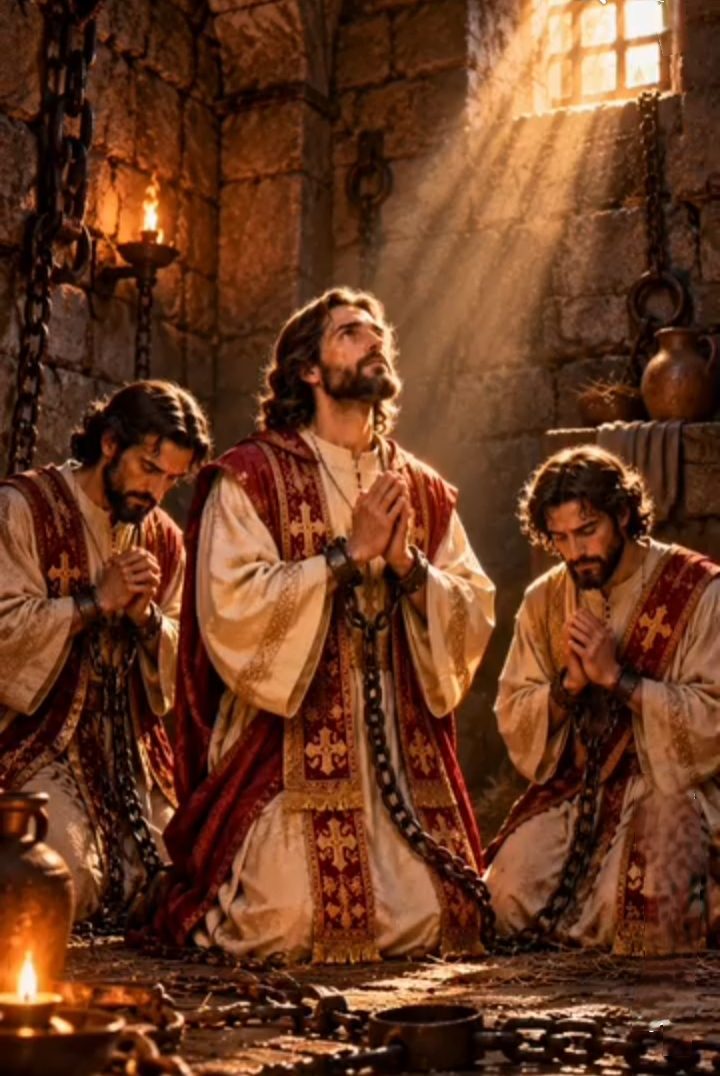
But truth rarely goes unchallenged. Their work drew the suspicion of local rulers, who feared the growing Christian presence. Arrested and condemned, Denis and his companions were led to Montmartre, the “mountain of martyrs”, and there, around the year 258 AD, were beheaded.
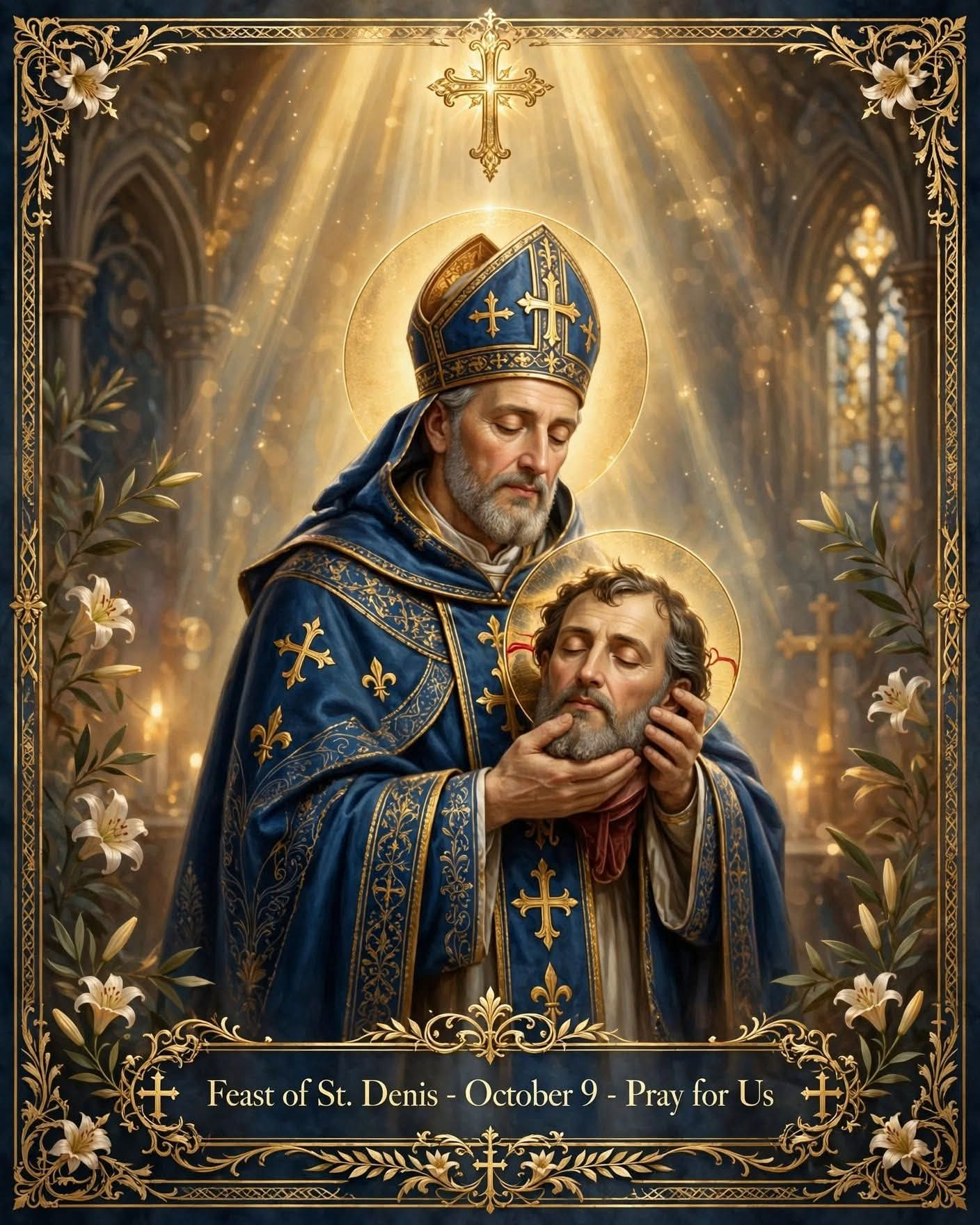
Legends tell us that Denis did not fall silent even in death. Rising, he took his head into his hands and walked miles, preaching as he went, his lips proclaiming forgiveness, his steps a sermon in motion. At last, he laid himself down in the place where he wished to be buried. To the modern mind, such a tale strains belief, yet within it shines a truth deeper than history – faith does not end with the sword, and the witness of a martyr carries farther than the grave.
Another story speaks of their bodies cast into the Seine, only to be lovingly recovered by a woman named Catalla, who laid them to rest with reverence. Soon the faithful began to visit the tombs, praying where these martyrs slept, and from that soil of sacrifice rose the first chapels.
In 469 AD, through the devotion of Saint Genevieve, a larger chapel was raised over the martyrs’ resting place. Across centuries it grew, until it became the Basilica of Saint-Denis, a jewel of faith and architecture. More than a shrine, it became the royal necropolis of France, where kings and queens chose to be laid to rest in the shadow of the saint who first planted the Gospel in Paris. Almost every monarch from the sixth to the nineteenth centuries found their tomb there, as if to anchor the destiny of a nation to the faith of its first bishop.
The basilica today still speaks – its stones echoing with prayers of countless pilgrims, its silence reminding visitors that the roots of France are entwined with the blood of martyrs.
Saint Denis is honored as the patron of France, and counted among the Fourteen Holy Helpers, intercessors for every need. Rusticus and Eleutherius share in his crown, remembered for their steadfast courage and loyalty. Their feast day is more than a date on the calendar; it is a summons to all believers to examine the depth of their own fidelity.
The legends surrounding Denis – the cephalophore carrying his head, the pious woman rescuing their bodies – are not empty tales but vessels of meaning. They tell us of forgiveness stronger than hatred, of perseverance stronger than death, of grace working through frail humanity. Whether miracle or metaphor, the stories lift our gaze to the God who turns weakness into strength, death into life.
To honor Saint Denis and his companions is to hear their challenge echoing through the ages: will we remain faithful when trials come? Will we choose holiness over compromise, mercy over resentment, love over fear? Their witness does not merely tell us what happened long ago – It shows us what is possible even now.
CONTEMPLATING THE LIFE OF SAINT DENIS, BISHOP, AND HIS COMPANIONS, MARTYRS
A LAND OF SHADOWS
In the third century, Christianity was spreading across the Roman Empire, but Gaul, present-day France, remained largely pagan. The people worshipped Roman and Celtic gods, relied on superstitions and sacrifices, and were expected to honour the Roman Emperor as divine.
Into this world, Pope Fabian sent missionaries led by Denis, accompanied by Rusticus the priest and Eleutherius the deacon, to proclaim the Gospel of Jesus Christ.
THE LIGHT COMES TO LUTETIA
When Denis and his companions arrived in Lutetia, now Paris, there were temples and shrines but few Christians. Denis courageously preached about the one true God and Jesus Christ, who died and rose again to offer salvation.
The missionaries visited homes, comforted the sick, reconciled enemies and taught people to live in faith and love. Their message gradually touched many hearts, bringing hope to those who turned away from pagan worship.
THE WRATH OF THE EMPIRE
The pagan priests grew hostile and accused Denis of turning people away from the traditional gods and the Emperor. During the persecution under Emperor Valerian, Denis, Rusticus and Eleutherius were arrested and ordered to sacrifice to the pagan gods.
Denis firmly refused to abandon his faith. According to tradition, the three missionaries endured severe torture but remained steadfast in their devotion to Christ. They were eventually condemned to death for their Christian witness.
THE MOUNT OF MARTYRS
The three companions were taken to a hill north of the city, where they were executed. Before his death, Denis prayed for the people of Paris, hoping that the land once devoted to idols would embrace the Christian faith.
Their martyrdom became a powerful testimony to the unity of the Church and the courage of those who remain faithful to Christ even in the face of death. The hill became known as Montmartre, meaning the Mount of Martyrs.
THE SILENT SERMON
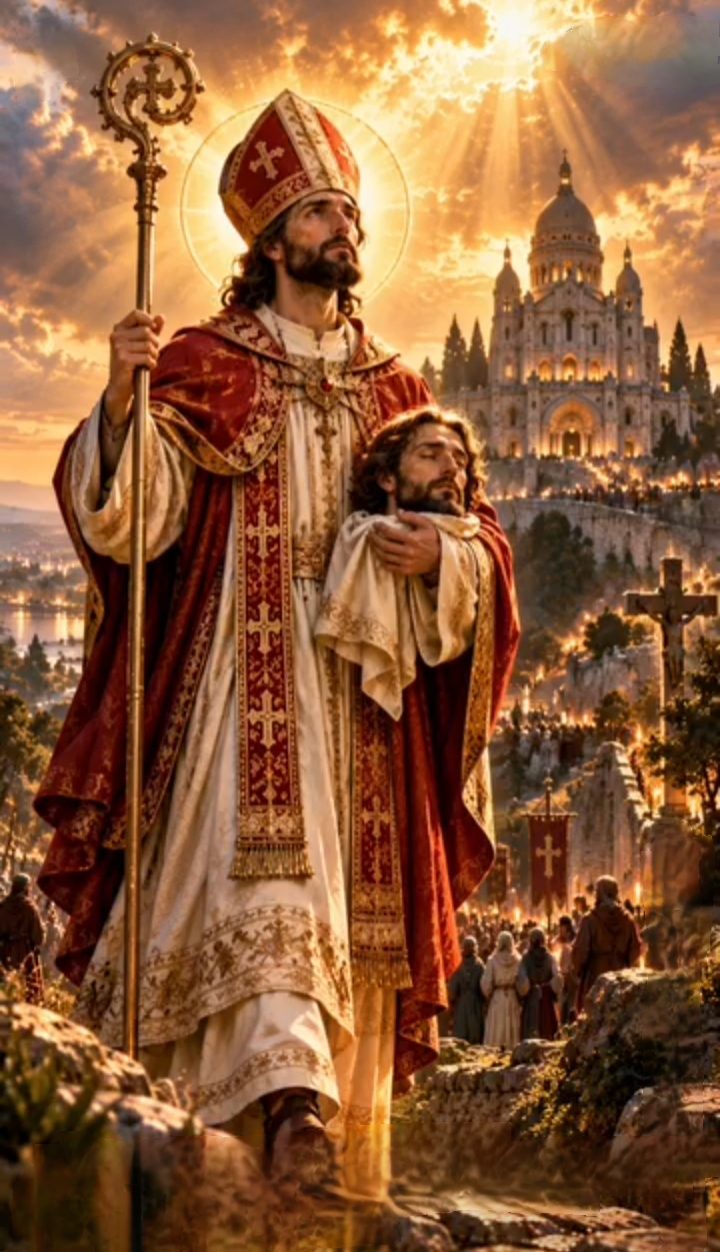
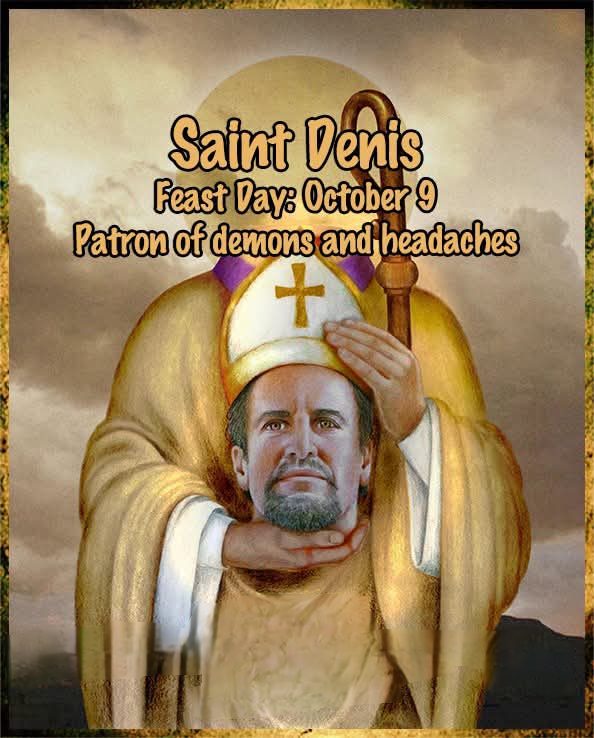
According to ancient tradition, after being beheaded, Denis picked up his head and walked several miles while proclaiming the name of Christ, before finally collapsing at the place where he was to be buried.
Whether understood as a miracle or a symbol of enduring faith, this story conveys a profound message: even when a martyr’s voice is silenced, his witness continues to speak. Denis became an enduring symbol of courage and unwavering devotion to the Gospel.
THE BIRTH OF A NATION’S FAITH
Christians buried the martyrs, and a chapel was eventually built at the burial place of Denis. Over the centuries, it developed into the famous Abbey of Saint-Denis, which became one of France’s most important religious centres and a burial place for French kings and queens.
The memory of Denis and his companions remained deeply rooted in French Christian tradition, reminding generations of believers of the faith planted through their sacrifice.
THE LEGACY OF COURAGE
Saint Denis and his companions conquered hearts not through violence but through faith, love and perseverance. Their willingness to suffer rather than renounce Christ helped strengthen the early Church in Gaul.
Their lives remind us that the Gospel can overcome darkness, truth cannot be permanently silenced, and faithful love can transform lives. Their example encourages us to remain steadfast in our beliefs and bear witness to Christ through courage, compassion and service.
PRAYER TO SAINT DENIS, RUSTICUS AND ELEUTHERIUS
Lord God, You sent Saint Denis and his companions to bring the light of the Gospel into a world of unbelief. Through their fearless witness, the Christian faith took root where pagan worship once prevailed.
Kindle in us the same flame of faith, that we may bring Your light into the darkness of our world. When our words are silenced, let our lives speak; when we are wounded, let Your mercy flow through us; and when the world refuses to hear the truth, let love remain our answer.
Through the intercession of Your holy martyrs, purify our hearts, strengthen our faith and make us courageous witnesses of Your eternal Kingdom, where light is never extinguished and truth reigns forever. Amen.
PRAYER
Heavenly Father, like Denis, may we be fearless in carrying Christ into the world. Like Rusticus and Eleutherius, may we walk faithfully beside our shepherds, and bear the weight of the cross with dignity. And when forgiveness seems impossible, may we remember the legend of the head-carrier bishop preaching peace even in death, and find strength to forgive as he forgave.
The memory of these martyrs still lives in the heart of Paris, in the stones of the basilica, and in the prayers of those who invoke their intercession. May their courage inspire our own, that in our lives, Christ our Savior, may be proclaimed – boldly, faithfully, and without end. Amen
Saints John Leonardi, John Henry Newman and Saint Denis and companions, pray for us!