
SPIRITUAL INSIGHTS INTO THE LIFE OF SAINT AGNES OF MONTEPULCIANO
April 21, 2026
Novena to Saint Joseph the Worker
April 22, 2026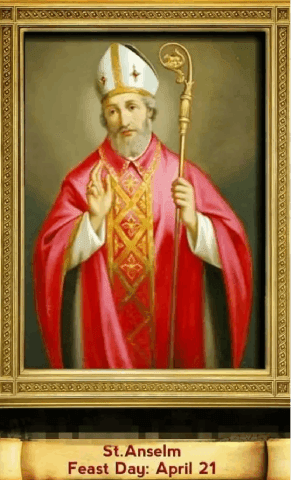
A RESTLESS AND SEARCHING YOUTH
“You have made us for Yourself, O Lord, and our heart is restless until it rests in You.”
— Augustine of Hippo
As a young man, Anselm experienced a deep inner restlessness and a longing for truth. Dissatisfied with worldly pursuits and strained in his relationship with his father, he left home in search of meaning. This inner hunger eventually led him toward God.
Restlessness can become the beginning of vocation when it draws the soul toward its true home.
ENCOUNTER WITH LANFRANC
“Remember your leaders, those who spoke to you the word of God; consider the outcome of their way of life, and imitate their faith.”
— Hebrews 13:7
Anselm’s life changed when he encountered Lanfranc at the Abbey of Bec. Under his guidance, Anselm grew in wisdom and discipline, discovering both his intellectual gifts and his spiritual calling.
God often guides the soul through wise and holy relationships.
ENTERING MONASTIC LIFE
“Be still, and know that I am God.”
— Psalm 46:10
Anselm chose the quiet life of a monk at Bec, embracing prayer, study, and community. In the silence of the monastery, his mind and heart were formed for deeper communion with God.
Silence and withdrawal from noise create space for truth and divine encounter.
FAITH SEEKING UNDERSTANDING
“Trust in the Lord with all your heart, and do not rely on your own insight.”
— Proverbs 3:5
Anselm is known for expressing that faith naturally seeks understanding. His writings, including the famous *Proslogion*, reveal a mind that loved God and desired to understand Him more deeply.
Faith is not the end of thought but its beginning, drawing the mind toward deeper truth.
THEOLOGICAL REFLECTION AS PRAYER
“Love the Lord your God with all your heart, and with all your soul, and with all your mind.”
— Matthew 22:37
Anselm approached theology not as mere study but as prayerful reflection. His works were written in a spirit of devotion, often beginning and ending in prayer.
When rooted in humility, thinking becomes an act of worship.
RELUCTANT LEADERSHIP
“Whoever wishes to be great among you must be your servant.”
— Matthew 20:26
Though he preferred the quiet of monastic life, Anselm was called to serve as Archbishop of Canterbury after Lanfranc. He accepted this role with humility, seeking to shepherd God’s people faithfully.
True authority is rooted in service, not ambition.
CONFLICT WITH William II of England AND Henry I of England
“We must obey God rather than men.”
— Luke 14:11
Anselm stood firm against royal interference in Church matters, refusing to compromise the freedom of the Church. His courage led to tension and opposition from the kings he served under.
Truth must remain free and cannot be shaped by power.
EXILE AND SUFFERING
“Blessed are those who are persecuted for righteousness’ sake, for theirs is the kingdom of heaven.”
— Matthew 5:10
Because of his fidelity, Anselm was forced into exile more than once. Despite hardship and separation from his people, he remained steadfast in his commitment to God and truth.
Faithfulness often leads through suffering, but it deepens trust in God.
A LIFE UNITED IN MIND AND HEART
“You shall love the Lord your God with all your heart, and with all your soul, and with all your mind.”
— Matthew 22:37
Anselm’s life beautifully united intellect and devotion. He showed that deep thinking and deep love of God are not opposed but belong together in the journey toward holiness.
Holiness integrates both understanding and love.
PRAYER THROUGH THE INTERCESSION OF SAINT ANSELM OF CANTERBURY
Lord God,
who gave Saint Anselm of Canterbury
a mind that sought understanding
and a heart that trusted You,
grant us the grace
to seek You with all we are.
Teach us to believe deeply,
to think honestly,
and to remain faithful in all circumstances.
Through Christ our Lord.
Amen.