
FEAST OF SAINT STEPHEN OF HUNGARY, KING – 16th AUGUST
August 16, 2026
Psalm 126:5
August 16, 2026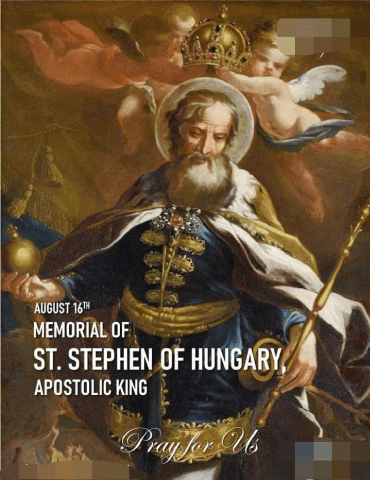
A LIFE SURRENDERED TO GOD’S PURPOSE
“Here I am, Lord; I have come to do your will.”
— Hebrews 10:7
Saint Stephen was born into a people who were still largely attached to pagan traditions, yet God prepared him to become the first Christian King of Hungary. Baptized in his youth, he embraced the Christian faith wholeheartedly and eventually devoted his kingship to establishing Christianity throughout his kingdom. His life reminds us that God can call one person to become an instrument of transformation for an entire nation.
A KING WHO SAW AUTHORITY AS SERVICE
“Whoever wishes to become great among you must be your servant.”
— Matthew 20:26
Stephen did not regard the crown merely as a symbol of power and prestige. He understood kingship as a responsibility entrusted to him by God. Pope John Paul II later described Stephen’s attitude by emphasizing that he accepted the crown as a service and consistently sought the good of the community entrusted to him. Stephen established laws, organized the kingdom and promoted both its human and spiritual development.
A BUILDER OF THE KINGDOM OF GOD
“Unless the Lord builds the house, those who build it labour in vain.”
— Psalm 127:1
Saint Stephen worked tirelessly to establish the Church in Hungary. He founded dioceses, supported monasteries, built churches and invited priests and religious to teach the Gospel. He understood that a nation could not be transformed merely by political structures; its people needed the light of faith. His efforts helped give Christianity deep and lasting roots in Hungary.
A HEART OPEN TO THE POOR
“Whatever you did for one of the least of these brothers and sisters of mine, you did for me.”
— Matthew 25:40
Although he was a powerful king, Stephen remained attentive to those who were suffering. He made himself accessible to the poor, protected widows and orphans and provided support for those in need. One tradition recounts that he even disguised himself so that he could personally distribute assistance to the poor. His compassion teaches us that greatness before God is measured not by what we possess, but by how generously we serve others.
FAITH THAT TRANSFORMS SOCIETY
“You are the light of the world.”
— Matthew 5:14
Stephen knew that faith could not remain merely a private devotion. He sought to bring Christian values into the life of his nation by establishing churches, supportg clergy and encouraging Christian customs. He created structures that would enable the Gospel to be taught and liveind from one generation to another. His life challenges us to allow our own faith to influence our families, communities and society through truth, justice and charity.
PERSEVERANCE THROUGH TRIALS
“We are afflicted in every way, but not crushed; perplexed, but not driven to despair.”
— 2 Corinthians 4:8
Stephen’s mission was not easy. He faced resistance from pagan forces, political opposition and struggles over succession. His greatest personal sorrow came when his only son, Emeric, died in a hunting accident in 1031. Yet Stephen continued to serve God and his people despite his grief and difficulties. His life shows us that holiness does not mean freedom from suffering; it means remaining faithful to God in the midst of suffering.
A FATHER WHO FORMED HIS SON IN FAITH
“Train children in the right way, and when old, they will not stray.”
— Proverbs 22:6
Stephen took great care in forming his son Emeric in Christian wisdom and virtue. He wanted his son to understand that leadership was not about privilege but about responsibility before God. He prepared teachings and guidance for Emeric so that he might become a Christian ruler who would serve his people faithfully. Stephen reminds parents that one of their greatest responsibilities is to hand on faith not merely through words, but through example.
A DEVOTION TO THE BLESSED VIRGIN MARY
“Behold, from now on all generations will call me blessed.”
— Luke 1:48
At the end of his life, Stephen entrusted Hungary and his own soul to the Blessed Virgin Mary. Tradition especially remembers his entrustment of the kingdom to Mary, whom he honoured as its heavenly Queen. Even after years of political responsibility, Stephen ultimately recognized that his deepest security was not in earthly power but in placing everything into God’s hands through Mary.
A LEGACY THAT LIVES BEYOND DEATH
“Well done, good and faithful servant.”
— Matthew 25:21
Saint Stephen died in 1038 after a life marked by faith, service and sacrifice. He was canonized in 1083 and became the patron saint of Hungary. His legacy was not simply the kingdom he governed, but the Christian foundations he established and the example of a ruler who sought to place his authority at the service of God and his people.
A DEVOTION TO THE BLESSED VIRGIN MARY
“Behold, from now on all generations will call me blessed.”
— Luke 1:48
At the end of his life, Stephen entrusted Hungary and his own soul to the Blessed Virgin Mary. Tradition especially remembers his entrustment of the kingdom to Mary, whom he honoured as its heavenly Queen. Even after years of political responsibility, Stephen ultimately recognized that his deepest security was not in earthly power but in placing everything into God’s hands through Mary.
LEARNING FROM SAINT STEPHEN TODAY
“Let your light shine before others, so that they may see your good works and give glory to your Father in heaven.”
— Matthew 5:16
Saint Stephen invites us to ask ourselves whether our faith is visible in the way we live, serve, forgive and care for others. We may not possess royal authority, but each of us has influence within our family, workplace, parish and community. Like Stephen, we are called to use whatever gifts and responsibilities God has entrusted to us for the good of others and the glory of God.
PRAYER
Heavenly Father, through the intercession of Saint Stephen of Hungary, teach us to place our lives, our responsibilities and our talents at Your service. Give us the wisdom to lead with humility, the courage to stand firm in faith, the compassion to care for the poor and suffering, and the perseverance to remain faithful during times of trial.
Like Saint Stephen, may we build Your Kingdom through our words, our actions and our example. Help us to entrust our families and our future into Your loving hands and, like him, to place our trust in the Blessed Virgin Mary.
Saint Stephen of Hungary, pray for us, that our lives may become instruments of faith, hope, love and service. May we one day hear the words: “Well done, good and faithful servant.” Amen.