
FEAST OF THE INFANT JESUS OF PRAGUE – 14 JANUARY
January 14, 2026
Proverbs 22:4
January 14, 2026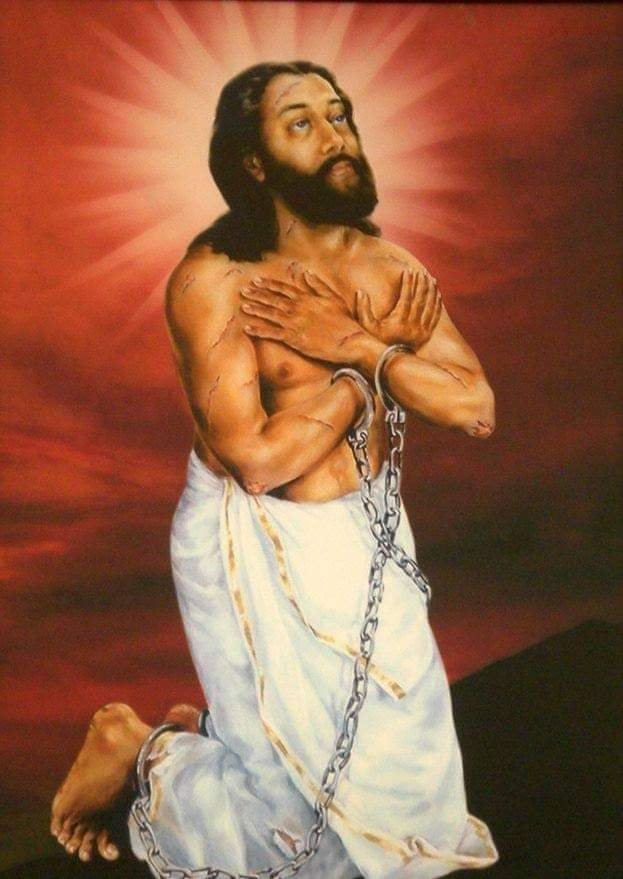
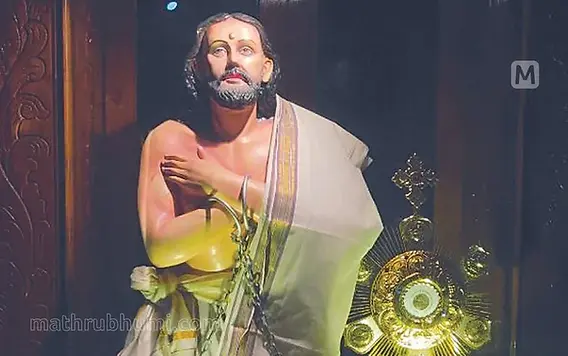
FEAST OF SAINT DEVASHAYAM PILLAI
Devashayam Pillai, an official in the court of the King of Travancore, had embraced Christianity in the 18th century, and was eventually martyred. In 2012, Pope Benedict XVI had paved the way for a decree to be promulgated regarding Pillai’s martyrdom and he was granted the title ‘Venerable’.
At the Vatican, Pope Francis declared Devasahayam Pillai a saint during a Canonization Mass in St. Peter’s Basilica – the first time that such an announcement had been made about an Indian lay person.
Lazarus or Devasahayam (which means ‘God is my help’ in the local language), was among seven Blessed who were canonised according to the announcement made by the Congregation for the Causes of Saints in the Vatican.
Born in what is today Tamil Nadu’s Kanyakumari district, he had been converted to Catholicism by a Jesuit priest in 1745. His father was a Brahmin and his mother reportedly belonged to the Nair caste.

He was an official in Travancore ruler Maharaja Marthanda Varma’s court when he came under the influence of Dutch naval commander, Captain Eustachius De Lannoy. Reports suggest that he was killed for upholding the Christian faith in 1752, being buried in front of the main altar at the St Francis Xavier cathedral in Kottar.
In 2012, Devasahayam Pillai became the first Indian layman not connected to any religious institute to be beatified. Ten years later he was canonized in Rome. His liturgical feast is celebrated on January 14.
PRAYER
Almighty and merciful God, you empowered St.Devasahayam Pillai to overcome the torments of his passion. Grant that through his intercession, we may remain invincible under your protection against the snares of the enemy. In Jesus’ Name. Amen
*******************************
ALSO CELEBRATED
FEAST OF SAINT FELIX OF NOLA
FEAST DAY – 14th JANUARY
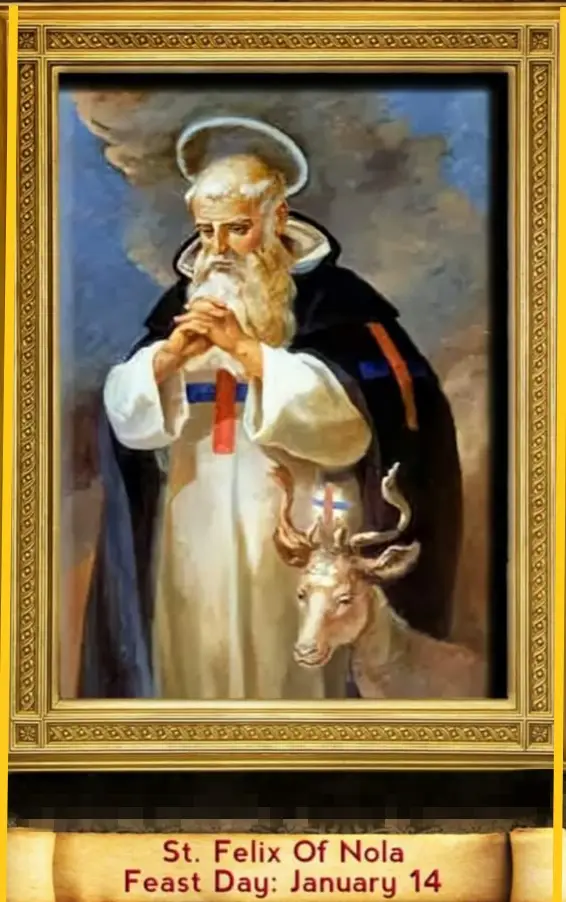
Saint Felix of Nola was a Christian presbyter at Nola near Naples in Italy. He sold off his possessions in order to give to the poor, but was arrested and tortured for his Christian faith during the persecution of the Roman emperor Decius (r. 249–51). He was believed to have died a martyr’s death during the persecution of Decius or Valerian, but is now listed in the General Roman Calendar as a confessor of the faith, who survived his tortures.
Felix was the elder son of Hermias, a Syrian centurion who had retired to Nola, Italy. After his father’s death Felix sold off most of his property and possessions, gave the proceeds to the poor, and pursued a clerical vocation. Felix was ordained by, and worked with, Saint Maximus of Nola. When bishop Maximus fled to the mountains to escape the persecution of the Roman emperor Decius, Felix was arrested and beaten for his faith instead. He escaped prison, according to legend being freed by an angel, to help bishop Maximus.
Felix found Maximus alone, ill, and helpless, and hid him from soldiers in a vacant building. When the two were safely inside, a spider quickly spun a web over the door, fooling the imperial forces into thinking it was long abandoned, and they left without finding the Christians. A subsequent attempt to arrest Felix followed, which he avoided by hiding in a ruined building where again a spider web, spun across the entrance, convinced the soldiers the building was abandoned. The two managed to hide from authorities until the persecution ended with the death of Emperor Decius in 251.
After Maximus’s death, the people wanted Felix to be the next bishop of Nola, but he declined, favoring Quintus, a “senior” priest who had seven days more experience than Felix. Felix himself continued as a priest. He also continued to farm his remaining land, and gave most of the proceeds to people even poorer than himself. Legend assigns to Felix a martyr’s death either in the year 255 under Emperor Valerian (253–260) or, in another version, in the general persecution instigated by the Emperor Decius (249-251). According to Butler, Felix died in a good old age, on the fourteenth of January.
Much of the little information we have about Felix comes from the letters and poetry of Saint Paulinus of Nola. When at length peace was obtained, Felix returned home and in poverty lived a withdrawn life until old age, an unconquered confessor of the faith. Five churches have been built at, or near the place, where he was first interred, which was without the precincts of the city of Nola.
His precious remains are kept in the cathedral; but certain portions are at Rome, Benevento, and some other places. In time a new church in Nola was dedicated in the name of St Felix. People travelled from far away to see the burial place of this revered saint. He should not be confused with another Saint Felix of Nola, of about a century later, whose feast is on 15 November. Saint Felix is the Patron of Nola, Italy, spiders and keepers of spiders.
PRAYER
Heavenly Father, your devoted servant, St. Felix of Nola, is regarded as a martyr even though he was not put to death, because he endured everything for love of Jesus, especially much torture.
Animals were close to Saint Felix’s heart and his intercession, through our Lord Jesus Christ is often sought by those who have lost animals of their stock, or pets. He is venerated for helping the poor and as the saint who finds and restores lost animals. May we have the same compassion which he showed to the lowly, in Jesus’ Name. Amen
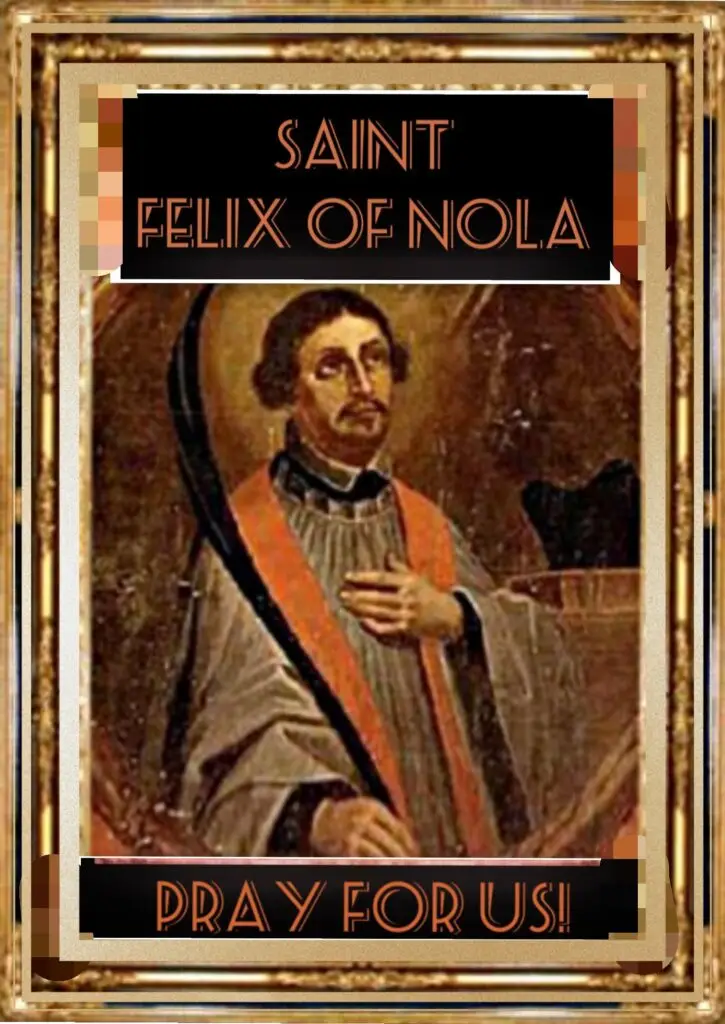
Saint Felix of Nola, pray for us.
*******************************
ALSO CELEBRATED:
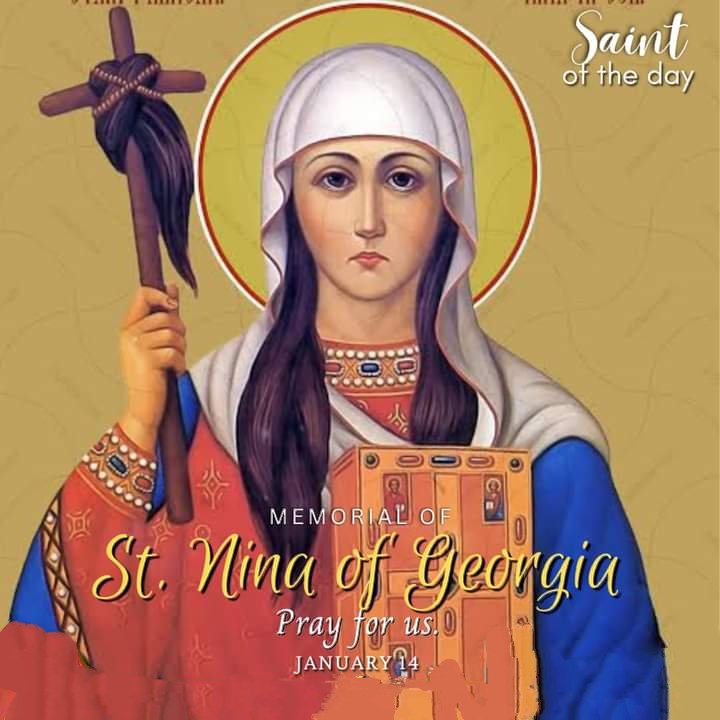
FEAST OF SAINT NINA/NINO OF GEORGIA
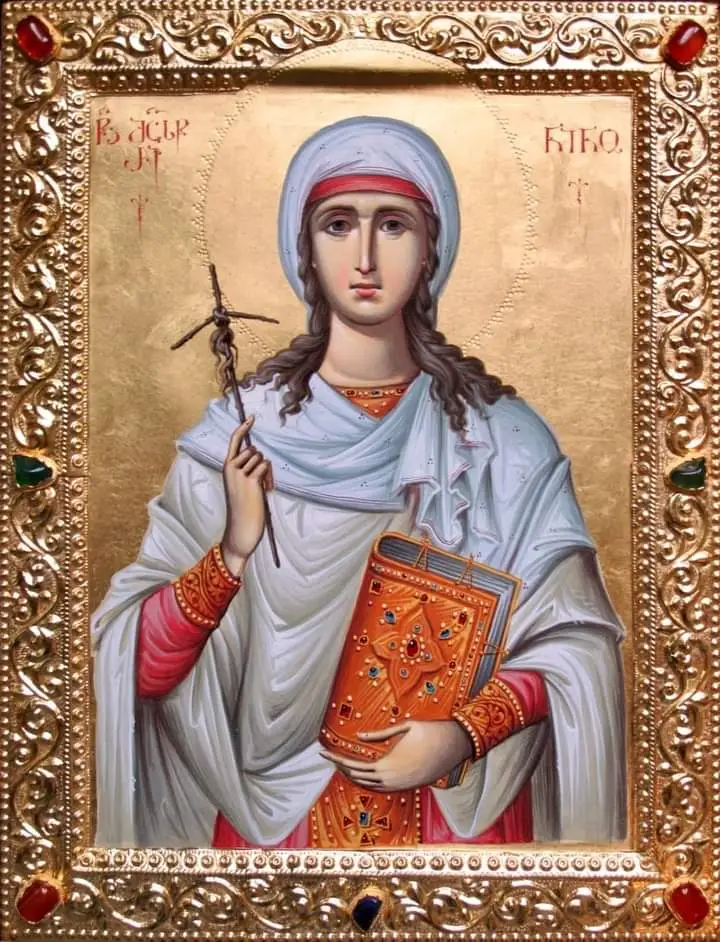
St. Nina was born in Cappadocia, what is now modern day Turkey. She was the only daughter of a Roman General. When Nina was twelve, her family traveled to Jerusalem, where her father became a monk, her mother became a Church worker, and Nina became the foster child of a pious elderly woman. Under her foster mother, Nina quickly learned the rules of faith and piety.
At the age of fourteen, Nina questioned her mentor about the location of Christ’s robe. She was convinced that such an important relic could not have been lost. Her foster mother told her that it was in Iberia, now modern day Georgia, and a land not yet completely developed. When the Apostles had drawn lots to determine who was to preach where, the Mother of God had received the lot of Iberia, but she had been held back from going and was assured that someone would later preach there.
In a dream the Mother of God came to Nina and urged her to preach the Gospel in Georgia. The Mother of God assured Nina that she would protect her and as a pledge, left a cross with her, a cross made of grape vines. The Patriarch, her uncle, was delighted with the news of her vision. He eagerly gave Nina his blessing to go.
When the time arrived for her departure, Nina was led into the Church and was prayed over by the Patriarch these words, “Lord God, Our Savior! As I let this young girl depart to preach Thy Divinity, I commit her into Thy hands. Condescend, O Christ God, to be her Companion and Teacher everywhere that she proclaims Thy Good Tidings, and give her words with such force and wisdom that no one will be able to oppose or refute them.
And Thou, most Holy Virgin Mother of God, Helper and Intercessor for all Christians, clothe with Thy strength against all enemies, visible and invisible, this girl whom Thou Thyself hast chosen to preach the Gospel of Thy Son and our God among the pagan nations. Be always for her a shield and an invincible protection, and do not deprive her of Thy favor until she has fulfilled Thy holy will”.
Nina joined the party of Princess Ripsimia, because they were traveling toGeorgia to escape the persecution of Diocletian. All but Nina were martyred in Armenia after Ripsimia declined to marry the King. Living as a pilgrim, Nina became weary, and wondered briefly where she was going, and what she was doing. She had continued visions to encourage her on her way. She witnessed the worship of the local gods, and prayed that they might be destroyed. She witnessed a downpour that washed the idols into the river and out of sight.
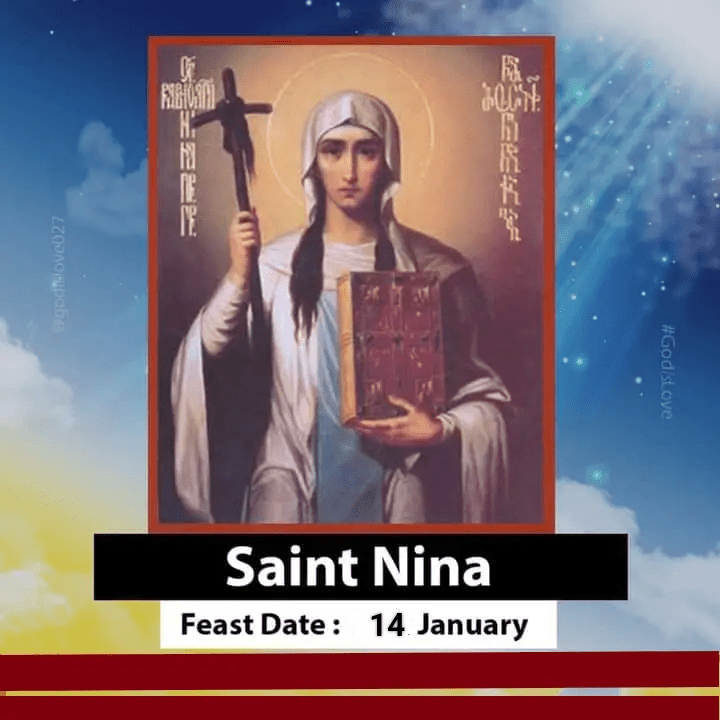
She settled in the capital where she lived in a hut near the royal garden. She gained a reputation for holiness because of her daily piety and her miraculous healings. She cured Queen Nana of a disease no doctor had been able to relieve. Even the King was converted.
After preaching to and converting many Jews and pagans, Nina learned the story of Christ’s robe. A local Jew, Elioz, had obtained the robe from the soldier to whose lot it had fallen and had carried it home to Georgia. His sister, Sidonia, had clasped the robe to her breast and had died. No one could take the robe from her, and it had been buried with her.
A cedar, now part of the royal garden, was said to have grown from her grave. Nina had doubts about the identification of the particular tree, but she knew from her visions that the ground of the royal gardens was holy. Without knowing that was the location of Christ’s robe, it is where she settled in a hut – in the royal gardens, only to find out later that she was living on the spot where Christ’s robe was buried.
Nina died in the early fourth century, after she had seen Christianity spread throughout Georgia, and had through her preaching, converted a neighboring Queen and her kingdom. Nina was buried near the place where she had died, in Bodbi. The Church built by her grave was dedicated to St. George.
Nina was a pious child who was fostered by another mother, other than her own. She dedicated her life to learning about Christ. She was intrigued as to the whereabouts of Christ’s robe, knowing it was too holy to have been lost. The Mother of God appeared to her and told her it was taken to Georgia, and was asked to go there and convert that nation. She did as she was told, and converted that region.
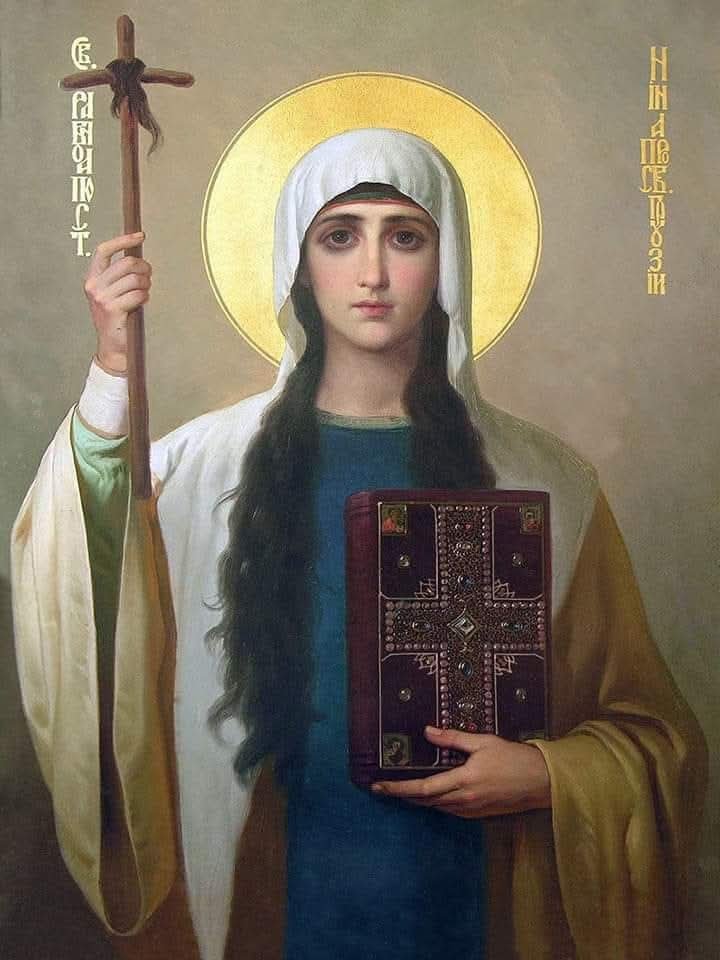
Once there, she learned that a soldier had brought it back to Georgia after the crucifixion, and had given it to his sister to safe guard. While clutching it to her breast – she died, and no one was able to take it from her. The robe of Christ was buried with her. This very spot was the place that St. Nina had settle as a pilgrim in a hut, without knowing the importance of where she settled. It is said that a cedar grew from the grave of the girl that was buried with Christ’s robe.
KEY FACTS ABOUT SAINT NINA:
Saint Nina is considered the enlightener of Georgia (ancient Iberia), credited with bringing Christianity to the region after a divine vision from the Virgin Mary, leading to the conversion of the Georgian people, including the royal family, and famously carrying a grapevine cross as her emblem.
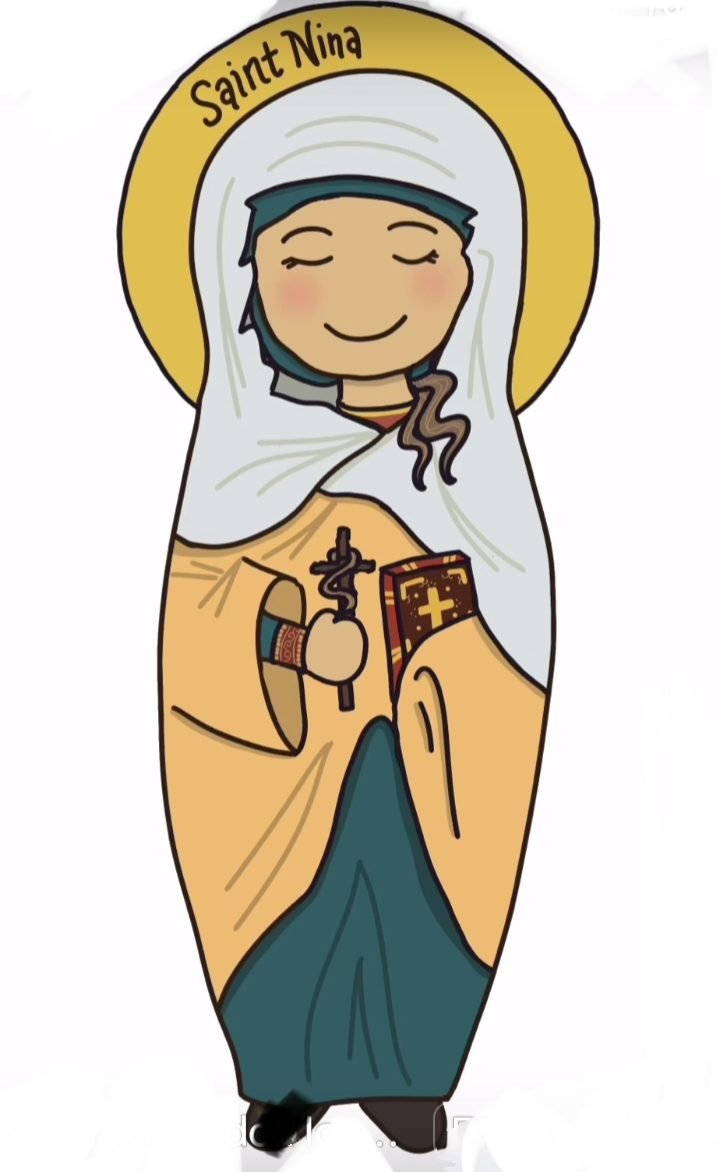
Origin: Born in Cappadocia (modern-day Turkey) to a Roman general and his wife around 296 AD.
Mission: At age 14, she was told by the Theotokos (Virgin Mary) in a dream to preach the Gospel in Iberia (Georgia).
Miracles & Conversion: She healed the sick, including Queen Nana, and through her preaching and miracles, converted many, leading to the Christianization of the Kingdom of Iberia.
Symbol: She carried a simple cross made of intertwined grapevine branches, a symbol of her mission.
Legacy: She is revered as “Equal to the Apostles” and the “Enlightener of Georgia” in Eastern Orthodoxy and other Eastern Churches.
Feast Days: January 14 (New Calendar) or January 27 (Old Calendar) for her death, and May 19 (New Calendar) or June 1 (Old Calendar) for her entry into Kartli (Georgia).
Shrine: Her major shrine is at the Bodbe Monastery in Georgia (Bodbe Monastery).
Why the name variations (Nina/Nino/Nune)?
Nino: The Georgian form, commonly used in Georgia.
Nina: A Latinized or broader variation.
Nune: The Armenian form
PRAYER
O handmaiden of the Word of God, who equaled the first-called Apostle Andrew in preaching, and emulated the other Apostles; Enlightener of Iberia and lyre of the Holy Spirit, Holy equal of the Apostles Nina, pray to Christ God for the salvation of our souls. Amen
*************************************
ALSO CELEBRATED:
SAINT SAVA ARCHBISHOP of SERBIA … FEAST DAY 14th JANUARY
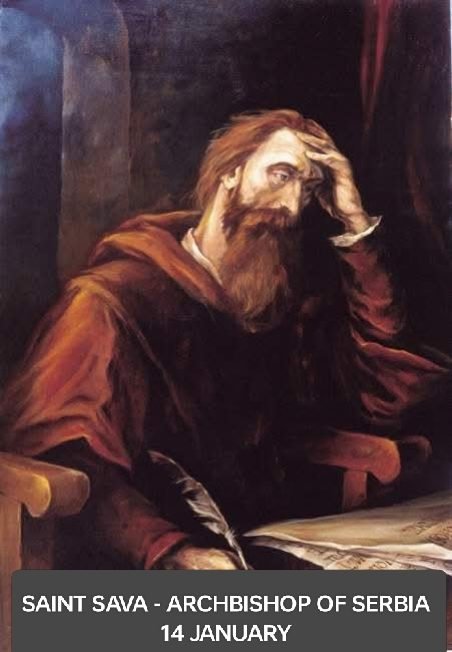
Originally Prince Rastko Nemanjic, he was the first Patriarch of Serbia (1219-1233) and is an important Saint in the Serbian Orthodox Church.
In his youth (around 1192) St. Sava escaped from home to join the Orthodox monastic colony on Mount Athos and was given the name Sava. He first traveled to a Russian monastery and then moved to a Greek monastery, Vatoped. At the end of 1197 his father, King Stefan Nemanja, joined him.
In 1198 the former prince and king restored the abandoned monastery Hilandar, which was at that time the center of Serbian Christian monastic life.
St. Sava’s father took the monastic vows under the name Simeon, and died in Hilandar on February 13, 1200. He is also canonized, as Saint Simeon.
After his father’s death, Sava retreated to an ascetic monastery in Kareya which he built himself in 1199. He also wrote the Kareya typicon both for Hilandar and for the monastery of ascetism.
St. Sava managed to persuade the Patriarch of the Greek/Byzantine Orthodox Church to elevate him to the position of the first Serbian archbishop, thereby establishing the independence of the archbishopic of the serbian church in the year of 1219.
Saint Sava is celebrated as the founder of the independent Serbian Orthodox Church and as the patron saint of education and medicine among Serbs. Since the 1830s, Saint Sava has become the patron Saint of Serbian schools and students.
After participating in a ceremony called “blessing of the waters” he developed a cough that progressed into pneumonia. He died from pneumonia in the evening between Saturday and Sunday, January 14, 1235. He was buried at the Cathedral of the Holy Forty Martyrs in Trnovo. He remained in Trnovo until May 6, 1237, when his sacred bones were moved to the monastery Mileseva in southern Serbia. Three-hundred and sixy years later the Ottoman Turks dug out his bones and burnt them on the main square in Belgrade.
The temple of Saint Sava in Belgrade, whose construction was planned in 1939 and began in 1985 is built on the place where his holy bones were burned.
– (Catholic News Agency)
PRAYER
Saint Sava, you remind us to place God first in all things. As a shepherd of souls, you chose humility, prayer, and wisdom over power, guiding your people toward a faith rooted in truth and peace.
Your life echoes the words of the Gospel.
When we seek the Kingdom of God above all else, everything we truly need is given in grace.
May you teach us to order our lives toward God, trusting that He will provide, in Jesus’ Name. Amen
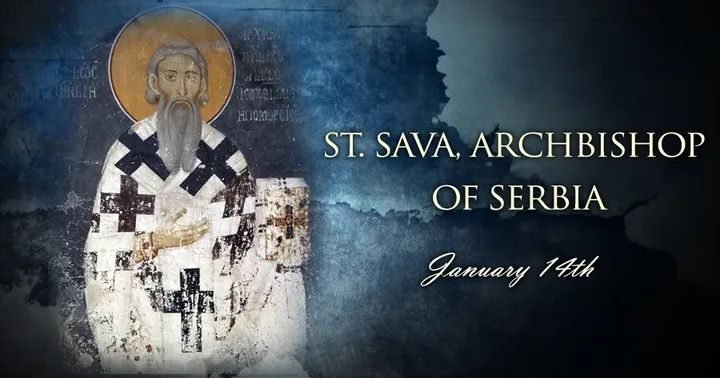
Saint Sava, pray for us!