

Day Twenty-Two of Lent – “Behold, Your King!”
March 14, 2026
Esther 4:14
March 14, 2026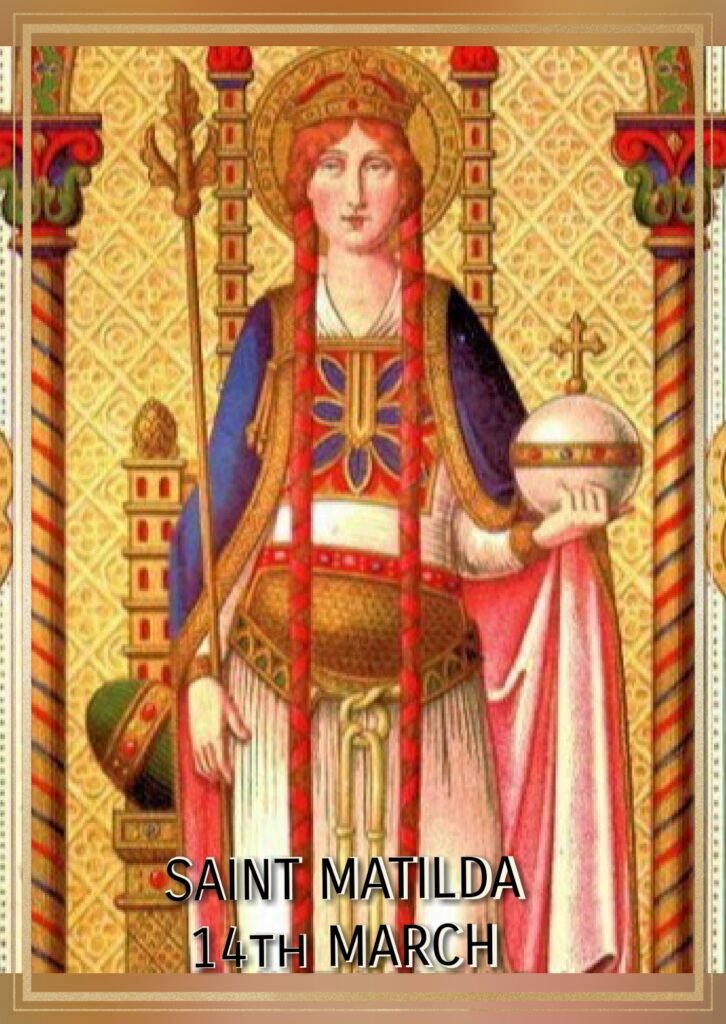
FEAST OF SAINT MATILDA, QUEEN OF GERMANY
FEAST DAY – 14th MARCH
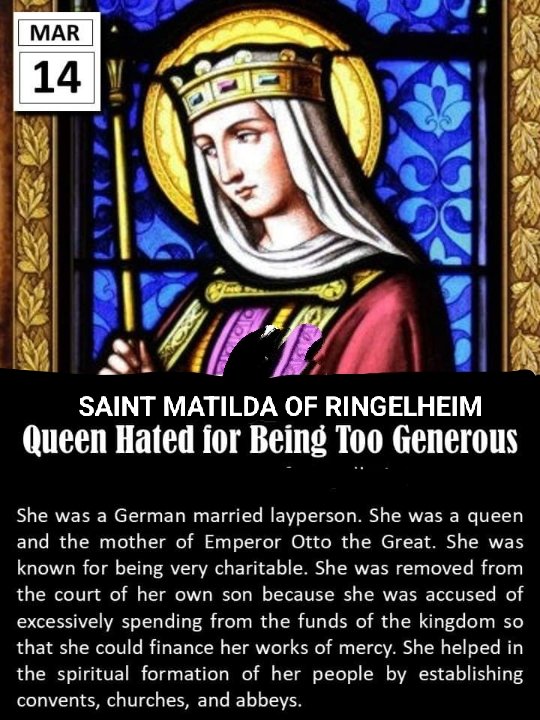
Matilda, of Ringelheim, 892 – 14 March 968, also known as Saint Matilda, was a Saxon noblewoman. Due to her marriage to Henry I in 909, she became the first Ottonian queen. Her eldest son, Otto I, restored the Holy Roman Empire in 962. Mathilde founded several spiritual institutions and women’s convents, as the Queen of Germany, wife of Henry I. She was born in Engern, Westphalia, Germany in 895 to Count Detrich and his wife, Reinhild. Raised by her grandmother, an abbess, she had an arranged marriage with King Henry the Fowler of Saxony in 1913.
She had three sisters; Amalrada, Bia, and Fridarun, who married Charles III of West Francia, king of West Francia; and a brother Beuve II, the Bishop of Châlons-sur-Marne. Due to Fridarun’s marriage to Count Wichmann the Elder, there was an alliance between the House of Billung and the Ottonian family, which expanded their possessions to the west.
Matilda became the mother of: Otto I, Emperor of Germany; Henry, Duke of Bavaria; St. Bruno, Archbishop of Cologne; Gerberga, who married Louis IV of France; Hedwig, the mother of Hugh Capet. As queen, Matilda was humble, holy, and very generous — always ready to help the poor and the down-trodden.
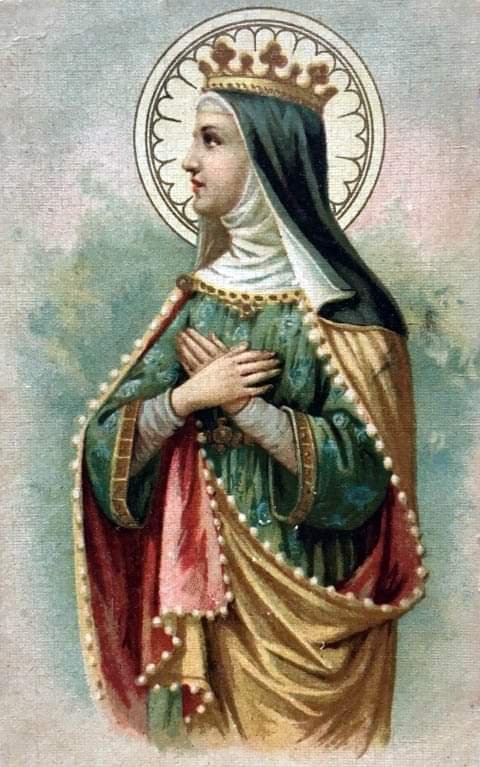 After Henry’s death 936 in Memleben, he was buried in Quedlinburg, where Queen Mathilde founded a convent the same year. She lived there during the following years and took care of the family’s memorialization. Thus Quedlinburg Abbey became the most important center of prayer and commemoration of the dead in the East-Franconian Empire.
Like in other convents, daughters of noble families were raised in Quedlinburg, to later become Abbesses in order to secure the families influence. One of them was her own granddaughter Matilda, daughter of Otto I and Adelheid of Burgundy, to whom she passed on the conducting of the convent in 966, after 30 years of leadership. The younger Mathilde therefore became the first abbess of the convent in Quedlinburg.
With her other goods, Queen Mathilde founded further convents, one of them in 947 in Enger. Her last foundation was the convent of Nordhausen in 961. Mathilde’s handling of her dowry, which she had received from King Henry I previous to his death, was subject to a dispute between her and Otto I during the years 936–946. Otto made a claim on his mother’s possessions, which eventually led to her fleeing into exile. Otto’s wife, Queen Eadgyth, is said to have brought about the reconciliation in which Mathilde left her goods and Otto was forgiven for his actions.
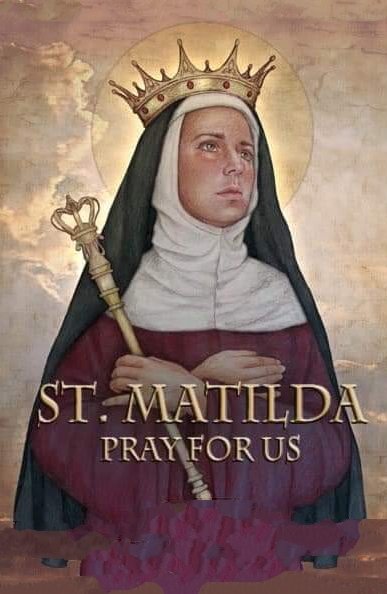 The exact circumstances of this feud are still controversial to this day, but in order to protect her goods, Mathilde acquired papal privileges for all monasteries in eastern Saxony in the period before her death in early 968. However, these efforts were ignored when Theophanu, the wife of Otto II, received Mathilde’s dowry after she died.
Following her husband’s death, Matilda had made an unsuccessful attempt to secure the throne for her favorite son Henry, but his elder brother was elected and crowned in 936. Later, when the two brothers joined in persecuting their mother, whom they accused of having impoverished the crown by her lavish almsgiving, she renounced the possessions the deceased king had left her, and retired to her villa at Engern in Westphalia.
When she suffered financial difficulties, Matilda was called back to the palace, and both Otto and Henry asked for her forgiveness. She built many churches and founded and supported numerous monasteries; she was known for her great charity. She died of natural causes in 968 and was buried in the monastery at Quedlinburg, Germany. Matilda was venerated as a saint immediately after her death. She is often pictured with a purse, and alms and is celebrated for her devotion to Prayer and Almsgiving.
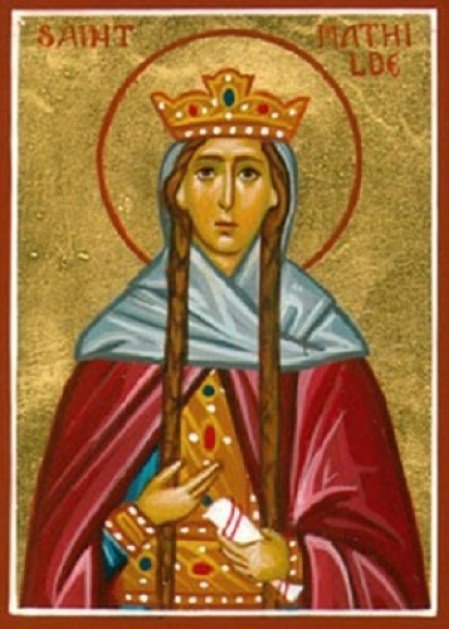
After Henry died Matilda gave her worldly jewels and possessions to a priest. Since she was persecuted by the emperor (her eldest son) as well as her youngest son, she escaped the country. She later returned as her eldest child (the emperor) was ill and he was seeking her forgiveness. She forgave, as Christ forgives and continued her missionary work by caring for the poor and constructing convents. She is Patroness of Large Families, and Patron for girls.
CONTEMPLATING THE LIFE OF SAINT MATILDA OF RINGELHEIM (c. 895–968)
Matilda of Ringelheim, also known as Matilda of Saxony, was a 10th-century queen, wife, mother, benefactor of the poor, and founder of monasteries. She was the wife of Henry the Fowler and the mother of Otto I.
Despite living in royal power and wealth, she became famous for her deep charity, prayer, and generosity toward the poor, eventually being remembered as one of the great royal saints of medieval Europe.
THE QUEEN WHO RULED WITH MERCY: THE STORY OF ST. MATILDA
Early Life
In the rugged lands of Saxony, long before Germany became a unified nation, a noble child was born into a powerful family.
Her name was Matilda.
From an early age, Matilda’s life was shaped not by royal courts but by the quiet discipline of a convent school at Herford Abbey.
* There she learned to pray.
* There she learned to read the Scriptures.
But perhaps the most important lesson she learned was this:
* _True greatness is measured by how we care for the poor._
The Queen of a Kingdom
Her beauty and virtue soon became widely known. A young Saxon duke named Henry the Fowler heard about her and wished to meet her. Their meeting led to marriage.
Soon Henry became king, and Matilda became queen of East Francia, the kingdom that would later form the foundation of medieval Germany.
Life in the royal court was filled with political struggles, military campaigns, and royal responsibilities.
But Matilda carried the spirit of the convent into the palace.
* The poor were welcomed at the gates of the royal residence.
* The hungry were fed.
* Prisoners were freed when possible.
The queen believed she was not only ruler of a kingdom – she was a servant of Christ in the poor.
A Mother of Kings
Matilda became the mother of several children who would shape the history of Europe.
Her children included:
* Otto I the Great – Holy Roman Emperor
* Henry I, Duke of Bavaria
* Bruno – Archbishop of Cologne
* Gerberga – Queen of France
* Hedwig – Duchess of the West Franks.
Otto I, would later become one of the most powerful emperors of the Middle Ages. Through her children, Matilda became the matriarch of one of the most influential dynasties in medieval Europe.
Her children grew up watching their mother pray daily and care for the needy. In many ways, Matilda ruled the kingdom not through authority but through example.
A Queen Who Loved the Poor
Matilda became famous for her generosity. She often used royal resources to help:
*.the poor
* widows and orphans
* prisoners
* the sick.
She frequently gave away money, food, and clothing. Sometimes her generosity worried the royal treasury. But Matilda believed that serving the poor was serving Christ.
A Queen Who Built Houses for God
Matilda believed that the kingdom needed places where prayer and charity could flourish.
So she founded monasteries including:
* Quedlinburg Abbey
* Nordhausen Abbey
* Pöhlde Abbey.
The most famous was Quedlinburg Abbey, which became a center of prayer, learning, and charity. To Matilda, monasteries were not just buildings, but beacons of light in a troubled world.
Trials After the Crown
When King Henry died in 936, Matilda’s life changed dramatically. Without her husband’s protection, she faced criticism and suspicion.
Some of her own sons accused her of giving away too much royal wealth to the poor and to monasteries.
For a time she experienced humiliation and conflict within her own family.
But Matilda did not respond with anger.
* She remained calm.
* She continued praying.
Eventually her son Otto recognized her wisdom and restored her honor.
The Queen Who Chose Simplicity
In her later years, Matilda spent much of her time at Quedlinburg Abbey. Though she had once lived in palaces, she now preferred the quiet rhythm of prayer. She visited the poor, encouraged the monks and nuns, and spent long hours in devotion.
Death
St. Matilda died on 14 March 968 at Quedlinburg, the monastery she loved most. She was buried beside her husband King Henry. Her reputation for holiness spread quickly, and she was venerated as a saint soon after her death. She had worn a crown during her life. But her true crown was mercy.
Patronage
St. Matilda is remembered as a patron of:
* large families
* widows
* rulers and political leaders.
She is often invoked as a model of Christian leadership and generosity.
In summary
St. Matilda of Ringelheim was a queen who transformed royal power into a tool for charity and faith. Through her generosity to the poor, her support of monastic life, and her perseverance through family difficulties, she became one of the great Christian queens of medieval Europe.
PRAYER
Almighty God, happy is she who, like Saint Matilda, despises the transitory glories and pleasures of this life for your kingdom, O God. Truly happy is she who sets the right value on the fallacious joys of this world, and tramples on them all, for purity of heart, charity, love of penance, and good works, which makes a diadem for a Christian’s head.
May we, like Saint Matilda, have no value for hoarding things of the earth, but instead, gather up treasures to store in the Heavenly Kingdom, in Jesus’ Name. Amen

Saint Matilda, pray for us all!






0 Prayers
/T