
SPIRITUAL INSIGHTS INTO THE LIFE OF ST. NICHOLAS OF FLÜE
March 21, 2026
FEAST OF SAINT LEA OF ROME – 22nd MARCH
March 22, 2026

PASSIONTIDE BEGINS THIS SUNDAY
Passiontide marks a more intense and solemn phase within the season of Lent.
Traditionally, Passiontide starts on the Fifth Sunday of Lent, also known as Passion Sunday. From this point onward, the Church’s focus turns more directly to the suffering and impending death of our Lord, Jesus Christ.
During Passiontide, several notable changes occur in the liturgy and devotional life:
Images and statues are veiled in violet cloth, symbolizing the hidden glory of Christ and inviting deeper reflection.
The readings at Mass emphasize the growing tension between Jesus and His opponents, leading toward His Passion.
The faithful are encouraged to enter more deeply into prayer, penance, and meditation on Christ’s sacrifice.
This period prepares us more intensely for the events of Holy Week, which begins the following Sunday with Palm Sunday.
Spiritually, Passiontide invites us to “walk with Christ” in His suffering—pondering His love, His obedience to the Father, and the mystery of the Cross. It is a time to quiet distractions, deepen repentance, and renew our commitment to live according to the Gospel.
As Passiontide begins, it may help to ask: How can I accompany Christ more closely in His Passion?
The Readings on the Fifth Sunday of Kent/Passiontide, take us to the Good News of Easter and the Resurrection of the Dead.
In Ezekiel 37:12-14, we see the future resurrection.
“Thus says the Lord God: O my people, I will open your graves and have you rise from them. I will put my spirit in you so that you may live.” In the Gospel, St. John 11:1-45 Jesus actually raised Lazarus from the dead. The Gospel shows the faith of Lazarus and his sisters Martha and Mary, all recognized as Saints in the Church.
In Romans 8: 8-11 St. Paul tells us what we must do to be risen from the dead to live in heaven.
“Brothers and sisters: Those who are in the flesh cannot please God.” “You are not in the flesh; on the contrary, you are in the Spirit.”
St. Paul encourages living according to the Holy Spirit rather than yielding to the “deeds of the body.”
What is more important to you: feeding your body or feeding your soul? Do you follow Jesus’ command to love God and love your neighbor, or do you listen to the devil who says you don’t have to do either to get to heaven? How does Jesus help you do what is good and avoid what is not?
In another place. St. Paul Philippians 2: 12, says “Work with anxious concern in achieving your salvation.”
FIFTH SUNDAY IN LENT: WEEPING
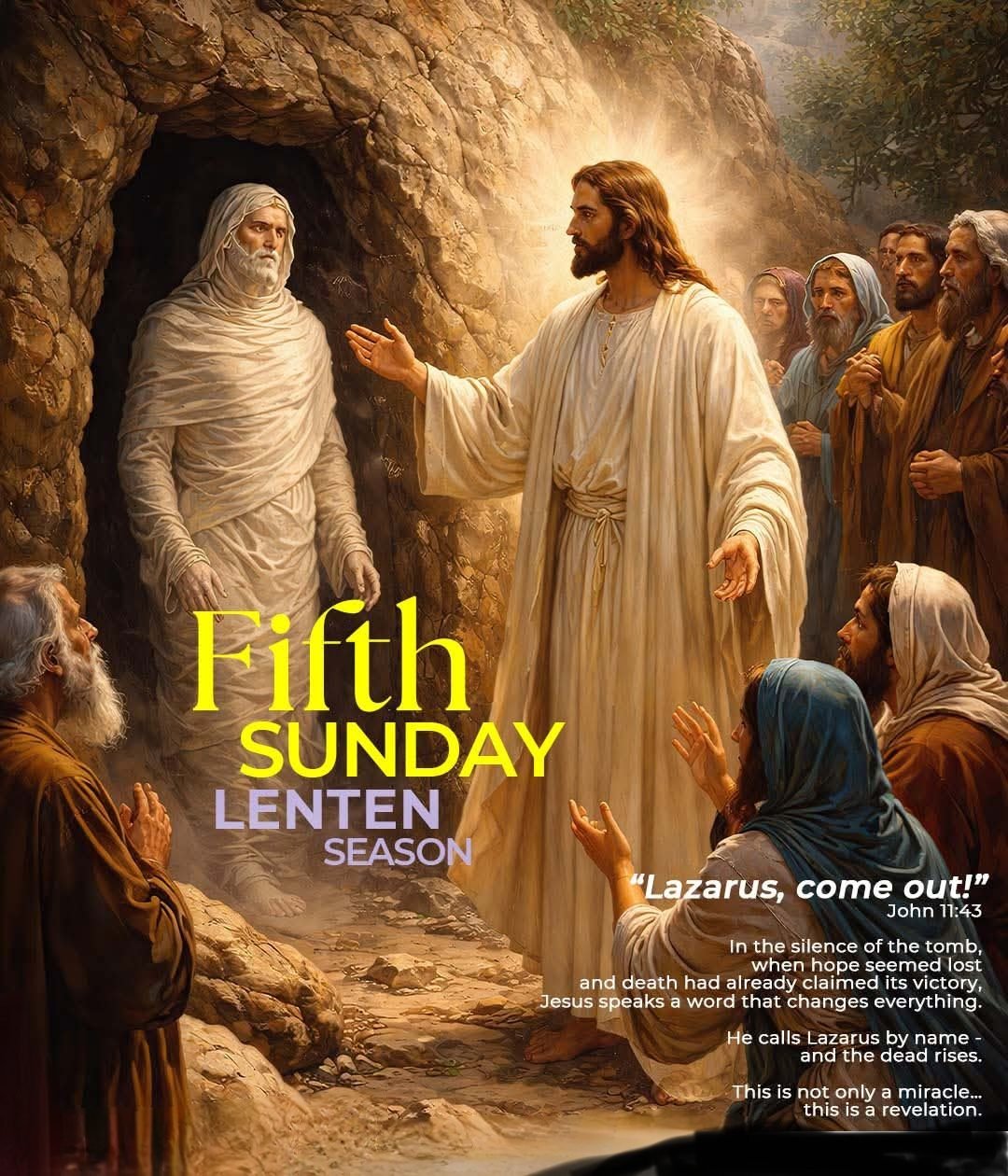
Today’s Gospel (from Year A, which is also optional for Years B and C) presents us with the intimate story of Jesus raising His close friend Lazarus from the dead. Lazarus was the brother of Mary and Martha of Bethany. Martha is best known for serving Jesus dinner while Mary sat at His feet, listening to Him. Mary is also “the one who had anointed the Lord with perfumed oil and dried his feet with her hair” (John 11:2). John’s Gospel says, “Now Jesus loved Martha and her sister and Lazarus” (John 11:5).
Today, illness does not often result in death, but, given the limited medical knowledge in Jesus’ time, death from illness was far more common. There was grave concern when someone became sick with a fever. Martha and Mary, out of their concern, sent word to Jesus about Lazarus’ illness, “Master, the one you love is ill” (John 11:3). When Jesus heard this, He said to the apostles, “This illness is not to end in death, but is for the glory of God, that the Son of God may be glorified through it” (John 11:4)
Jesus, however, remained for two days where He was staying before traveling to Bethany. By divine intuition, Jesus knew that Lazarus would die before His arrival. When He arrived, Martha greeted Him, expressing her deep sorrow. Mary also came to Him, despairing and sorrowful. When Jesus saw her, He became “perturbed and deeply troubled” and He wept.
Why would the Son of God weep? He knew what He was going to do. He knew that everyone’s sorrow would soon turn to joy. So why weep? As soon as Jesus wept, some of those present said, “See how he loved him.” (John 11:36).

Jesus’ tears reveal the depth of compassion within His human heart. He is not only the All-Powerful Second Person of the Holy Trinity, He is also fully human, and His Sacred Heart is truly a human heart, perfectly united with His divinity. Jesus expressed the perfection of His divine love in this intimate moment when He encountered such grief, confusion, faith, a lack of faith, pain, loss, and even despair. He experienced all of these emotions from the people present and was moved with the holiest and purest compassion that a human heart has ever felt.
As we continue to journey toward the end of Lent and continue to ponder our sin and our need to repent, use this story as a reminder that it is the same Jesus Whose heart is exploding with compassion for you and Who calls you out of sin. Continue to examine your conscience honestly, humbly, and thoroughly. Jesus loves you as He loved Mary, Martha, and Lazarus. As you experience your own sin, pain, confusion, or even despair at times, Jesus responds with holy sorrow, with weeping, and with compassion. At the end of time, He will be the Judge of all. For now, He is pure mercy and compassion, longing to say to you what He said to Lazarus, “Lazarus, come out!” and “Untie him and let him go” (John 11:43–44). Come out of your sin. Be set free from all that burdens you. Rise to the new life of grace.
Ponder this compassion today. Ponder Jesus’ tears for you, for all you struggle with, for all you suffer. Know that the joy experienced by those who saw Lazarus walk out of the tomb awaits you, if you only allow Jesus to call you forth from the tomb of your sin and guilt to the newness of life.
PRAYER
My compassionate Lord, Your mercy is endless and inexhaustible. It is pure and perfect in every way. Please lavish that mercy upon me so that I will not fear facing my sin and confessing it to You. Untie me from these bonds that hold me down and call me forth to the newness of life. Jesus, I trust in You.
Source: mycatholiclife