
SPIRITUAL INSIGHTS INTO THE LIFE OF SAINT PHILIP NERI
May 26, 2026
2 Corinthians 9:7
May 27, 2026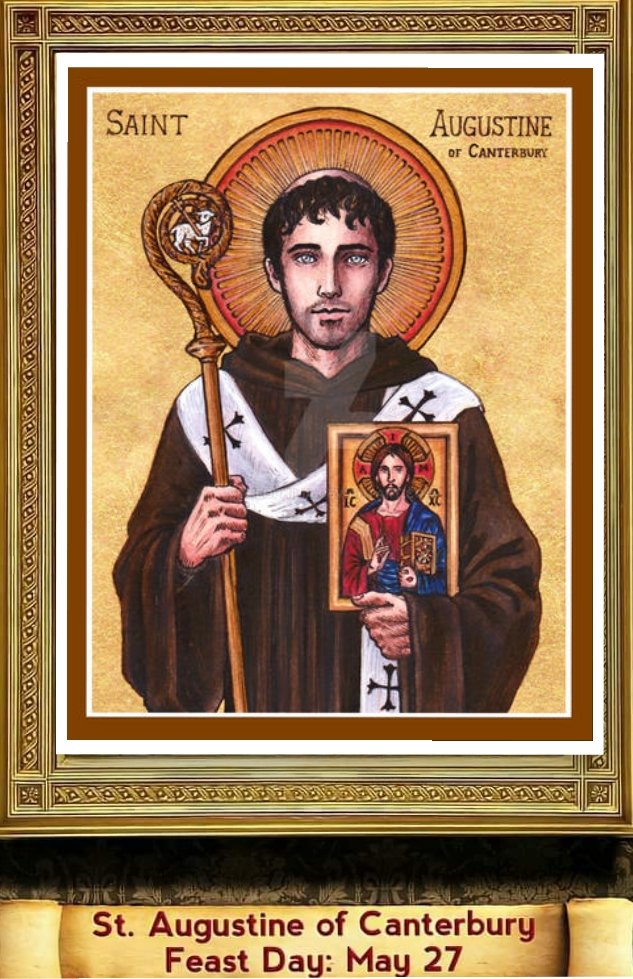
FEAST OF SAINT AUGUSTINE OF CANTERBURY, BISHOP
FEAST DAY – 27th MAY
Augustine of Canterbury (early 6th century – probably 26 May 604) was a monk who became the first Archbishop of Canterbury in the year 597. He is considered the “Apostle to the English” and a founder of the English Church.
Augustine was the prior of a monastery in Rome when Pope Gregory the Great chose him in 595 to lead a mission, usually known as the Gregorian mission, to Britain to Christianize King Æthelberht and his Kingdom of Kent from Anglo-Saxon paganism. Kent was probably chosen because Æthelberht had married a Christian princess, Bertha, daughter of Charibert I the King of Paris.
Before reaching Kent, the missionaries had considered turning back, but Gregory urged them on, and in 597, Augustine landed on the Isle of Thanet and proceeded to Æthelberht’s main town of Canterbury. King Æthelberht converted to Christianity and allowed the missionaries to preach freely, giving them land to found a monastery outside the city walls.
Augustine was consecrated as a bishop and converted many of the king’s subjects, including thousands during a mass baptism on Christmas Day in 597. Pope Gregory sent more missionaries in 601, along with encouraging letters and gifts for the churches, although attempts to persuade the native British bishops to submit to Augustine’s authority failed.
Roman bishops were established at London, and Rochester in 604, and a school was founded to train Anglo-Saxon priests and missionaries. Augustine also arranged the consecration of his successor, Laurence of Canterbury. The archbishop probably died in 604 and was soon revered as a saint.
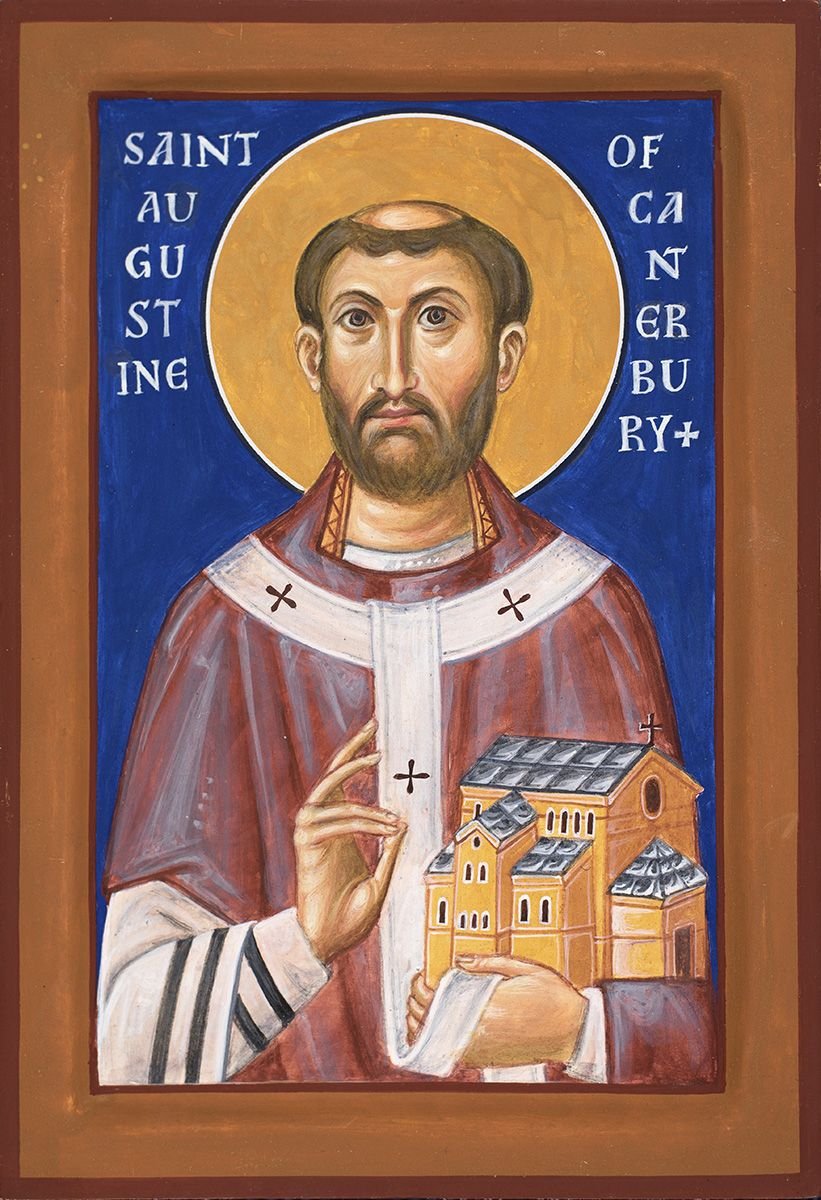
Saint Augustine of Canterbury was born in an unknown year about a century after his Christian namesake’s death in 430 A.D. in North Africa. He also conquered a king, like his secular namesake, but not for his own glory. Saint Augustine of Canterbury is called the Apostle to the English (not to the British.) The history is complex. Christianity was deeply rooted in Roman Britain.
British bishops attended Church Councils in France in the fourth century, and two famous Roman British Catholics well known to history lived centuries before Saint Augustine—Pelagius and Saint Patrick. But after the Romans abandoned Britain around 410 A.D., invasions of the pagan Saxons from Northern Europe mixed with native tribes to alter the cultural and religious landscape. Old Roman Britain faded as Anglo-Saxon England dawned.
Christianity was relegated to the margins of the British Isles, surviving in remote regions and in an extensive network of monasteries, not parishes or dioceses, under the wise tutelage of Irish monks. This two hundred year British-Irish hibernation of Catholicism was aroused from its sleep when, in 595 A.D., Pope Saint Gregory the Great had a plan. The goal? Convert King Ethelbert. Why? Because he was an Anglo-Saxon pagan. The hope? His wife was Catholic. The means? A large missionary train. The man for the job? Saint Augustine.
Our saint, an educated Benedictine monk from Rome, headed a large team that struggled through France on horseback, crossed the English Channel in simple boats, and finally walked to Ethelbert’s seat of power in Canterbury. The King of all Kent heard the missionaries and…converted to Catholicism! And then all his subjects converted as well in mass baptisms. The plan worked. Mission accomplished!
More missionaries followed. Schools were established. Monasteries were founded. Bishops were appointed. Priests were ordained. Parishes were opened. Rough Anglo-Saxon England put on the yoke of Christ and the lovely, rolling, deep green countryside of England became Mary’s dowry. Nothing is known of the life of Saint Augustine before 595 A.D. He is famous because he was a missionary monk and later bishop.
His life and his mission are indistinguishable. He accepted a dare from the Pope and did the impossible. He was himself the foundation stone upon which a Catholic nation built its house of faith for almost a millennium.
CONTEMPLATING THE LIFE OF SAINT AUGUSTINE OF CANTERBURY
Saint Augustine of Canterbury was a Benedictine monk and missionary chosen by Pope Gregory I to evangelize the Anglo-Saxons in England during the late sixth century. He became the first Archbishop of Canterbury and one of the foundational figures of English Christianity. Through his quiet perseverance and faithful mission, organized Christianity was re-established in parts of England after the fall of Roman rule.
HISTORICAL BACKGROUND — ENGLAND AFTER ROME
After the Roman Empire withdrew from Britain in the fifth century, the land became politically divided and unstable. Anglo-Saxon pagan tribes settled across much of England, and many Christian communities weakened or disappeared, especially in the eastern regions. Christianity survived more strongly in Ireland, Wales, and parts of Scotland, while much of Anglo-Saxon England remained pagan by the late sixth century.
A LAND FORGOTTEN BY ROME
The Roman roads and cities of Britain slowly declined after the empire collapsed. Pagan kingdoms arose across the land, and many believed the Christian faith in England was fading. Yet far away in Rome, a new mission was beginning.
THE POPE WHO SAW “ANGELS”
According to tradition, Pope Gregory I once saw fair-haired slaves in a Roman marketplace and was told they were “Angles.” He replied, “Not Angles, but angels.” Whether legend or history, the story reflects Gregory’s deep desire to bring Christianity to the English people. For this mission, he chose Augustine.
THE QUIET MONK
Augustine was not known as a great preacher or adventurer. He lived quietly as a Benedictine monk devoted to prayer, silence, liturgy, and monastic life. Yet Gregory entrusted him with the enormous task of traveling to pagan England to preach the Gospel, and Augustine obediently accepted the mission.
FEAR ON THE JOURNEY
As Augustine and the missionaries traveled northward, fear began to overwhelm them. Stories about violent tribes, foreign customs, and possible death discouraged the group. Some accounts say they even turned back temporarily. Augustine himself was not naturally fearless, but Gregory encouraged him firmly and urged him to continue. Augustine obeyed, and that decision would change history.
CROSSING INTO ENGLAND
In the year 597, Augustine and his companions arrived in the Kingdom of Kent. Tradition says they entered carrying a cross, sacred images, and chanting prayers. Augustine met King Æthelberht of Kent, whose Christian wife, Queen Bertha, had already prepared the way through her faith. Although the king did not immediately convert, he allowed the missionaries to remain and preach openly.
THE BEGINNING AT CANTERBURY
Augustine settled in Canterbury, where the monks prayed, preached, served the people, and lived visibly Christian lives. Gradually conversions increased. People were drawn by the monks’ peace, charity, and faith in Christ. Eventually King Æthelberht himself accepted baptism, and Christianity began spreading more widely throughout the kingdom.
THE FIRST ARCHBISHOP
Augustine was consecrated bishop and became the first Archbishop of Canterbury. Although England remained divided and paganism was still strong, he continued working patiently. He also faced challenges in relating to older Celtic Christian communities whose customs differed from Roman practices. Despite difficulties and setbacks, Augustine quietly persevered.
THE MONK WHO BUILT SLOWLY
Augustine did not rely on force or dramatic preaching. Instead, he patiently built churches, formed Christian communities, instructed converts, and guided people step by step in the faith. His missionary strength came from prayer, humility, and steady faithfulness rooted in monastic spirituality.
LETTERS FROM ROME
Pope Gregory I continued encouraging Augustine through letters filled with wisdom and pastoral guidance. Gregory advised him not to destroy local customs immediately, but to purify and gradually transform what could be transformed. This patient approach helped Christianity spread peacefully and effectively.
THE FINAL YEARS
Very little is known about Augustine’s final years. He did not die a martyr or leave behind dramatic final words. He simply continued serving faithfully. By the time of his death around 604 or 605, the foundations of Christian England had been firmly laid, and Canterbury had become an important Christian center.
THE LEGACY BEYOND HIS LIFETIME
Augustine did not complete the conversion of England alone, but he began a mission whose fruits continued for generations. Because of his obedience and perseverance, Christianity once again took deep root in English soil. He is remembered as “The Apostle to the English,” and his influence shaped English Christianity, medieval culture, and the future Church in Britain for centuries.
SPIRITUAL THEMES IN HIS LIFE
OBEDIENCE DESPITE FEAR
Augustine teaches that courage does not mean the absence of fear, but faithfulness despite fear.
EVANGELIZATION THROUGH PATIENCE
His mission succeeded gradually through prayer, witness, kindness, and perseverance.
MONASTIC SPIRITUALITY AS MISSIONARY STRENGTH
His contemplative life sustained him during the hardships of missionary work.
PLANTING SEEDS FOR FUTURE GENERATIONS
Augustine planted seeds whose full fruits appeared long after his death.
PATRONAGE
Saint Augustine of Canterbury is associated with England, missionaries, evangelization, and the English Church.
ARTISTIC REPRESENTATION
He is often portrayed as a bishop carrying a crozier, baptizing converts, arriving in England with monks, or standing near Canterbury Cathedral.
WHY HE STILL MATTERS
The life of Augustine reminds Christians that great transformations often begin with small acts of obedience. His story teaches that mission requires patience, conversion takes time, and fear does not prevent God from working through a person. A quiet monk obeyed God, crossed the sea, and changed the spiritual history of England forever.
PRAYER
Saint Augustine, your long years of prayer, asceticism, and reading as a monk prepared you for greater things. May all who seek your intercession prepare themselves in times of quiet for future challenges. May all missionaries be as daring as you in fulfilling what is asked of them.
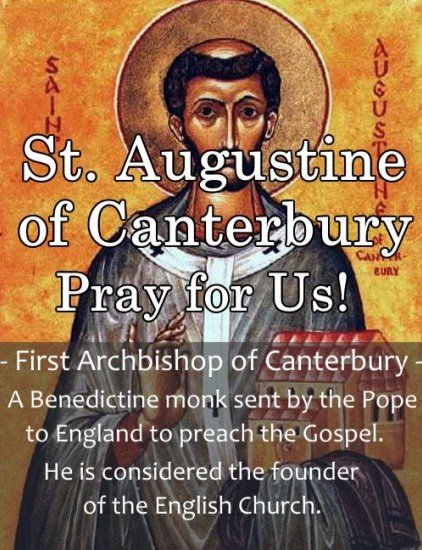
Saint Augustine of Canterbury, pray for us.