
TODAY’S GOSPEL READING – 26 MAY
May 26, 2026
FEAST OF SAINT AUGUSTINE OF CANTERBURY, BISHOP – 27th MAY
May 27, 2026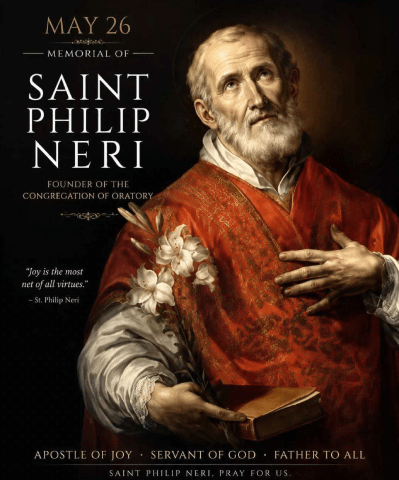
CHEERFUL CHILDHOOD
Even as a child, Saint Philip Neri radiated joy, gentleness, and kindness toward everyone around him. His cheerful nature earned him the nickname “Good Pippo” among the people of Florence.
“Rejoice in the Lord always. Again I will say, rejoice!”
— Philippians 4:4
As a young boy, Philip was known for helping the poor, comforting others, and bringing peace wherever he went. His joyful spirit reflected the presence of God within him from an early age.
True joy often becomes one of the earliest signs of a soul deeply touched by God’s grace.
ABANDONMENT OF WEALTH AND SECURITY
Philip left behind opportunities for wealth and business success in order to dedicate his life completely to God. Though he had prospects for a comfortable future, he chose spiritual riches instead of worldly ambition.
“What profit is it to a man if he gains the whole world and loses his own soul?”
— Mark 8:36
While staying with a wealthy relative who hoped Philip would inherit and manage the family business, he discerned a deeper calling from God and quietly left for Rome to live a life of prayer and simplicity.
The soul discovers deeper freedom when it chooses God above comfort, security, and ambition.
HIDDEN YEARS OF PRAYER
Before becoming widely known, Philip spent many quiet years in prayer, study, and spiritual preparation in Rome. He often prayed through the night in churches and catacombs.
“But when you pray, go into your room, close the door and pray to your Father who is unseen.”
— Matthew 6:6
Philip lived humbly, teaching children and caring for the sick while deepening his relationship with God in hiddenness. These silent years became the foundation of his future ministry.
God often forms souls deeply in hiddenness before using them publicly for others.
MYSTICAL EXPERIENCE OF THE HOLY SPIRIT
While praying in the Catacombs of Saint Sebastian, Philip experienced a powerful outpouring of the Holy Spirit that filled his heart with divine love.
“The love of God has been poured into our hearts through the Holy Spirit.”
— Romans 5:5
Witnesses later testified that his heart had physically enlarged from this mystical experience. Philip himself would often tremble or enter deep ecstasy while praying or celebrating Mass.
When the Holy Spirit truly fills the soul, love expands beyond human limits and transforms the entire person.
JOYFUL MINISTRY AMONG ORDINARY PEOPLE
Philip approached people with warmth, humor, compassion, and understanding rather than fear or harshness. People from every background were drawn to him.
“A joyful heart is good medicine.”
— Proverbs 17:22
He walked through the streets of Rome speaking kindly with workers, children, beggars, and nobles alike. Many returned to God simply because they experienced genuine love and acceptance through him.
Holiness rooted in love naturally attracts souls toward God instead of pushing them away.
MINISTRY IN THE CONFESSIONAL
Saint Philip spent long hours hearing confessions and guiding souls gently toward repentance and healing.
“Be merciful, just as your Father is merciful.”
— Luke 6:36
Many sinners who were afraid of condemnation found peace in Philip’s patience and kindness. He often used gentle humor and wise counsel to lead people back to God’s mercy.
Mercy opens hearts to conversion more deeply than condemnation ever can.
HUMOR AND HUMILITY
Philip deliberately avoided praise and attention. He sometimes acted in amusing or unexpected ways so that people would not admire him excessively.
“God opposes the proud but gives grace to the humble.”
— James 4:6
On one occasion, he shaved off half his beard before attending gatherings, simply to prevent others from treating him with too much honor. He desired only that God be glorified.
Humility grows when the soul no longer depends upon admiration or human approval.
FRIENDSHIP WITH YOUNG PEOPLE
Philip loved guiding young people through friendship, prayer, music, recreation, and joyful companionship.
“Let no one despise your youth, but be an example to the believers”
— 1 Timothy 4:12
He gathered youth for walks, conversations, prayer meetings, and pilgrimages, helping them grow closer to Christ in a joyful and natural way. His love transformed many young lives.
Authentic spiritual fatherhood leads souls toward God through love, trust, and joyful witness.
HIDDEN MYSTICAL LIFE
Though outwardly cheerful and ordinary, Philip possessed a profound interior union with God that remained largely hidden from others.
“Your life is hidden with Christ in God.”
— Colossians 3:3
During Mass or prayer, he would sometimes enter ecstasy and lose awareness of the world around him. Yet afterward, he returned to ordinary life with simplicity and humor.
The deepest spiritual lives are often hidden beneath humility, simplicity, and ordinary human warmth.
&nsp;
LASTING JOY
The joy of the Lord is your strength
“The joy of the Lord is your strength”
— Nehemiah 8:10
Shortly before his death, despite physical weakness, he continued encouraging others with serenity and hope. His joy came not from circumstances but from his deep union with God.
The closer the soul grows to God, the more deeply it discovers lasting joy beyond circumstances.
PRAYER THROUGH THE INTERCESSION OF SAINT PHILIP NERI
O joyful Saint Philip Neri,
lover of God and faithful friend of souls,
pray for us that we may grow in holiness with humility, joy, and love.
Teach us to bring peace to others through kindness,
to resist pride through simplicity,
and to trust completely in the Holy Spirit.
Help us to remember that true holiness
does not make the heart cold or fearful,
but fills it with freedom, laughter, compassion, and divine love.
May we learn from your example
to serve God joyfully and lead others gently toward Christ.
Amen.