
NOVENA PRAYERS FOR THE NATIVITY OF THE BLESSED VIRGIN MARY
August 30, 2026
Proverbs 16:9
August 30, 2026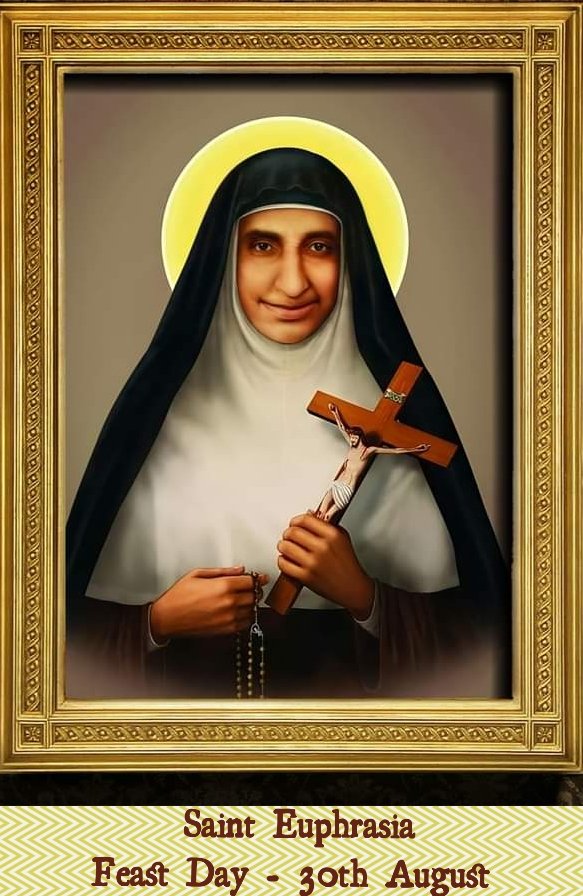
FEAST OF SAINT EUPHRASIA ELUVATHINGAL
FEAST DAY – 30th AUGUST
The daughter of Anthony and Kunjethy of Eluvathingal Cherpukaran, Rose Eluvathingal was born on 17 October 1877 in the village of Kattoor, in the Diocese of Trichur, India. Her mother’s deep piety and great devotion to the Virgin Mary, the Mother of God, had a strong influence on little Rose from her childhood.
From the stories that her mother told her, especially about St Rose of Lima, she grew with a strong desire to practice the virtues, to suffer for Jesus and to be holy, and to do all this in a quiet, hidden manner. During her developing years Rose began to detach herself from earthly possessions and pleasure and took a great interest in spiritual matters.
This was all the more rooted in her at the age of 9 by means of an apparition of the Blessed Mother, after which the young girl offered herself totally to the Lord. Notwithstanding the strong opposition of her father, who wanted Rose to marry into a rich family, she wanted to become a religious Sister.
Her intense prayer life, which included the rosary, fasting and abstinence, as well as the rather sudden death of her younger sister, brought about a change of heart in her father, Anthony, who granted Rose permission to enter the convent. In fact, her father accompanied her personally to the convent of the Congregation of the Mother of Carmel at Koonammavu, the first indigenous congregation of Syro-Malabars.
But even with her desire to be a Religious, Rose was often afflicted with various illnesses which caused her intense suffering. Once, during a particularly painful attack, the Sisters were resolved to send her away for ever, but through an apparition of the Holy Family she received a miraculous healing that permitted her to continue following God’s call.
On 10 May 1897 Rose became a postulant and took the name Sr Euphrasia of the Sacred Heart of Jesus, and on 10 January 1898 she received the holy habit of Carmel. She practised the virtues of humility, charity and renunciation and grew in holiness with the help of the Blessed Virgin Mary. For the periods of grave illness and the trials of the powers of darkness that she endured, she was rewarded by intense spiritual joys.
On 24 May 1900 St Mary’s Convent was founded in the current Archdiocese of Trichur, and on the same day Sr Euphrasia made her perpetual vows to God, a day of unspeakable joy, since now she belonged for ever to her Heavenly Spouse. From 1904 to 1913 Sr Euphrasia was entrusted with the duty of novice mistress and, sustained by the gifts and power of the Holy Spirit, she formed the future members of her Congregation.
In their Mother Mistress the novices saw the heroic virtues of humility, poverty, penance, obedience and abandonment to God’s will. Although Sr Euphrasia wanted to live a hidden life, she was chosen as Superior of the Convent of St Mary at Ollur. Due to her profound humility she found it difficult to accept this new duty.
But after an interior inspiration she acquired a statue of the Sacred Heart of Jesus, placed it in the centre of the convent and entrusted the duty of Mother Superior to his Sacred Heart. She held the post from 1913 to 1916. For almost 48 years the convent of St Mary was home to Mother Euphrasia.
Observing her life of prayer and holiness, the local people called her “Praying Mother”, and her Sisters in community referred to her as the “Mobile Tabernacle”, because the divine presence she kept within her radiated to all she encountered. From the first years of her Religious life, Mother Euphrasia had the blessing of the spiritual guidance of Bishop John Menacherry.
He ordered her to reveal to him every aspect of her spiritual life, and he wisely kept all of her letters. When his successor, Mar George Alappatt, retired, he entrusted the letters to the Superior of the Congregation of the Carmelites of Trichur with the prophetic words: “You will need them”. In fact, they are a precious treasure and an authentic mirror of the spiritual life of this holy, humble Religious.
Loving Church and neighbour
Mother Euphrasia spent much of her day in the convent chapel before the Blessed Sacrament and she also nourished a great love and devotion for the Blessed Virgin Mary; as a result, she was naturally an apostle of the Eucharist and of the Rosary.
She was totally dedicated to love and was continually consoled by the Crucified Lord. She was the first to humble herself and to accept suffering, misunderstandings and rejection for love of Christ. Her strength came from Jesus, who had become her betrothed in spiritual matrimony as her letters testify.
From her profound union with the Lord Jesus, came her capacity to give of herself to others, and so she fully incarnated the motto of her Congregation: “Remain united to me in contemplation and consecrated to me in action” (cf. Jn 15: 5).
Thus, with a pure heart Mother Euphrasia gave her maternal love and tenderness to those who sought her help. She gave them the comforting words of Jesus’ Gospel and interceded for them. For each little kindness bestowed upon her she would reply, “I will not forget it, not even after death”.
Mother Euphrasia had a profound sense of Church and she personally felt the sorrows and problems of the Church of her day. She offered her mortifications and penances for the conversion of schismatics and asked the novices and children to pray for them. She prayed ardently before the Blessed Sacrament for the Holy Father, for Bishops, priests and Religious.
Mother Euphrasia offered her life in sacrifice for love of God. She abandoned herself to his will and finally joined him in the heavenly embrace with her holy death on 29 August 1952. After Mother Euphrasia’s death many of those who had obtained her help during her lifetime now continued to beseech her help at her tomb. In 1990 her tomb was opened, and her mortal remains were moved to the convent chapel.
Pope John Paul II approved the Decree of the heroic virtues of the Servant of God in 2002, proclaiming her Venerable. She was beatified on 3 December 2006 in St. Anthony’s Forane Church, Ollur, with the declaration of the Major Archbishop, Varkey Vithayathil, on behalf of Pope Benedict XVI. She was canonised as a saint by Pope Francis on 23 November 2014.
PRAYER
Saint Euphrasia, you dedicated your life in service to the Sacred Heart of Jesus, becoming a model of prayer and penance for love of our Lord. You are a source of deep inspiration for all those aspiring to holiness and perfect devotion to the Sacred Heart of Jesus and Mary.
Help us to emulate your exemplary way of life, to live for the edification of Christ’s Body, the Church and to offer endless praise and glorify his Holy Name. May we strive to obtain God’s grace and protection from every evil, especially sin, through your holy intercession for us. Amen
******************************
ALSO CELEBRATED
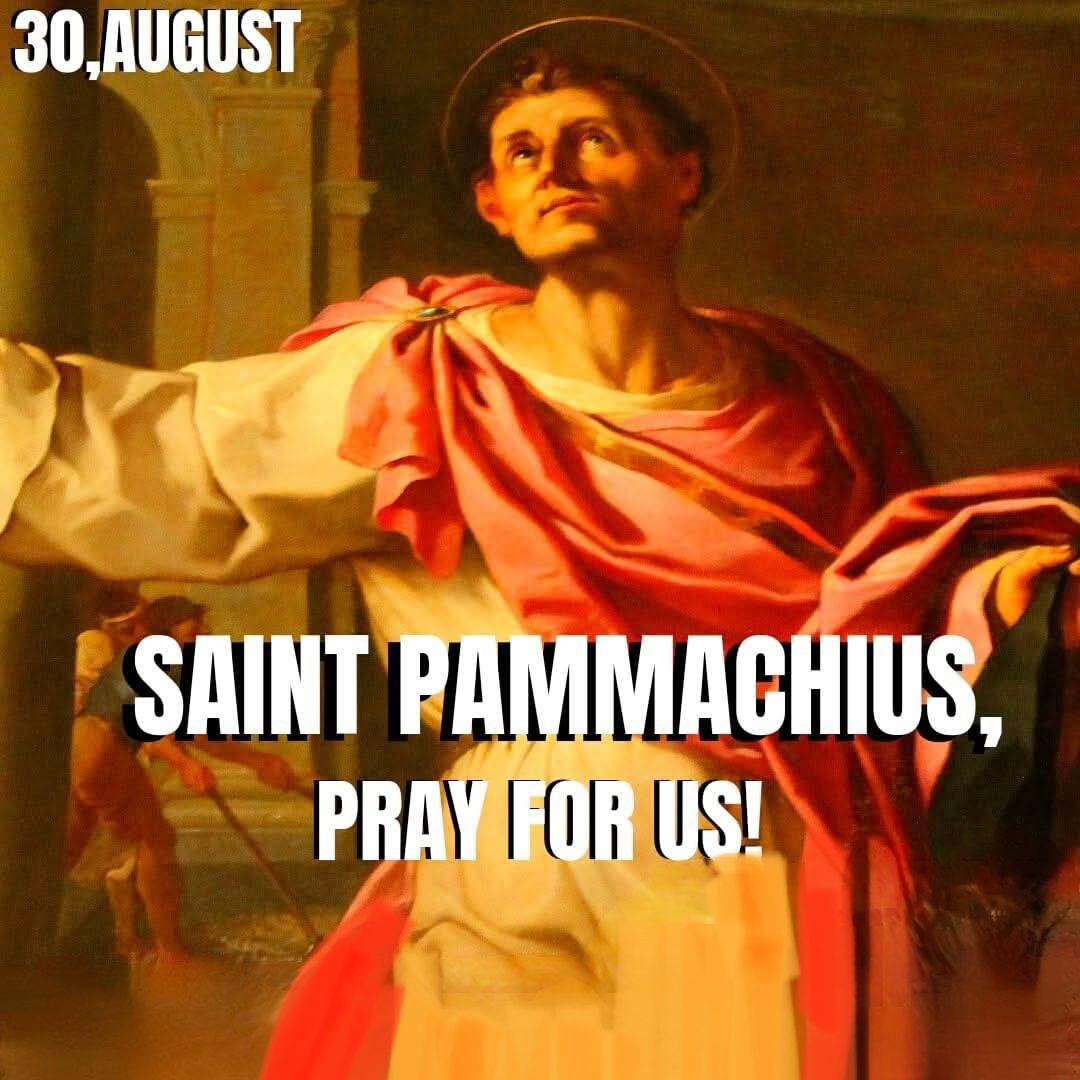
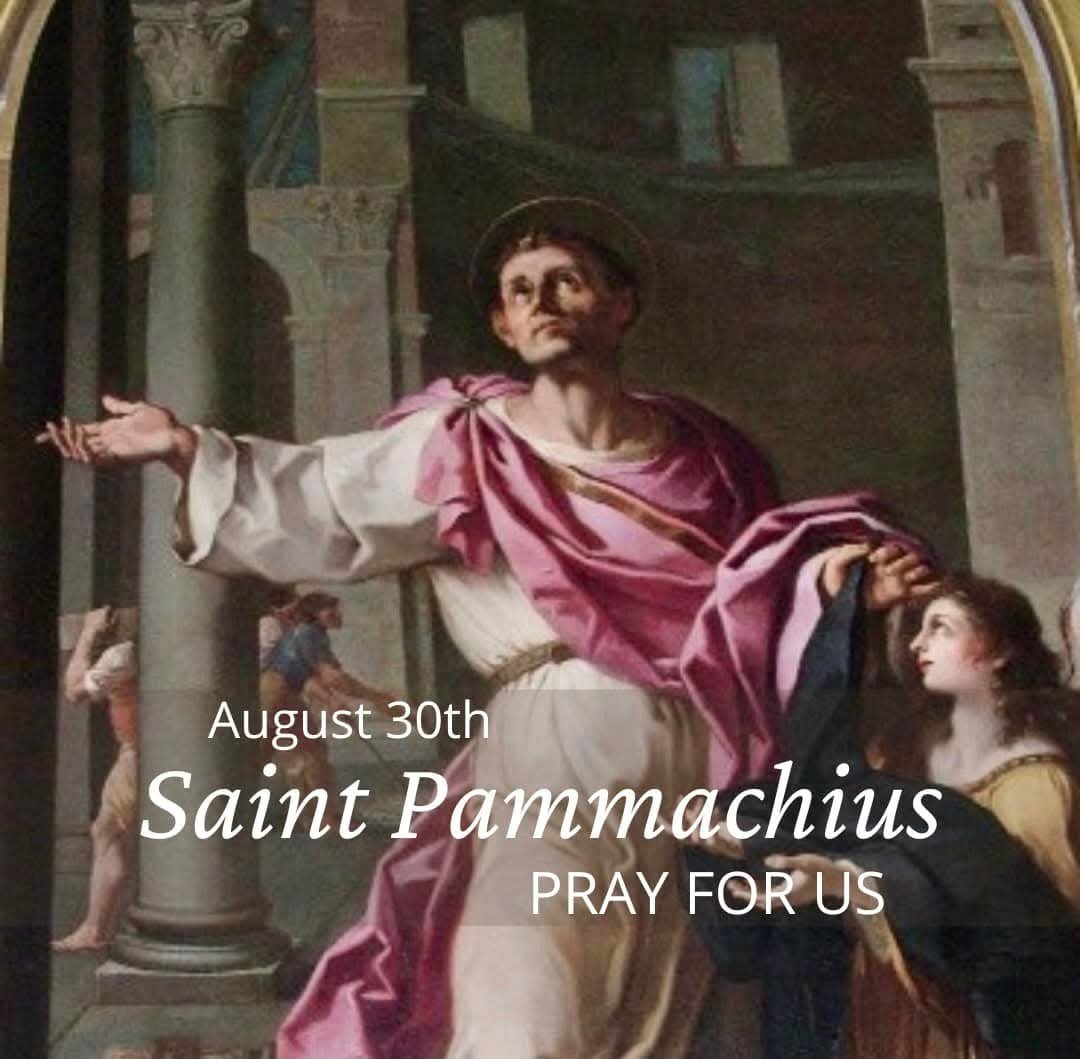
SAINT PAMMACHIUS, MONK –FEAST DAY AUGUST 30
Pammachius was a distinguished Christian layman who lived in the fourth century. As a young student, he had become friends with St. Jerome. They remained friends all their lives and kept an ongoing correspondence. His wife was Paulina, the second daughter of St. Paula, another good friend of Saint Jerome. When Paulina died in 397, Saint Jerome and Saint Paulinus of Nola wrote deeply moving letters filled with sympathy, support and the promise of prayers.
Pammachius was heart-broken about his wife’s death. He spent the rest of his life serving in the hospice he and St. Fabiola built. There pilgrims coming to Rome were welcomed and made comfortable. Pammachius and Fabiola willingly accepted and even preferred the poor, the sick and the handicapped. Pammachius felt that his deceased wife was with him as he performed his works of mercy. Paulina had been known for her love for the poor and suffering. Her husband now believed that by caring for them, he was paying the best possible tribute to her memory.
Saint Pammachius was much more gentle with his words and ways than the fiery Saint Jerome. He often suggested to Jerome that he soften or reword his letters, but Jerome usually did not. For example, a man named Jovinian was teaching serious errors. Jerome wrote a harsh essay exposing Jovinian’s errors.
Saint Pammachius read the essay and made some good suggestions about rewording the overpowering expressions. Saint Jerome thanked his friend for his concern, but did not make the corrections. Pammachius also tried to heal a quarrel between his friend Saint Jerome and a man named Rufinus. But it does not seem that he could move Jerome to become more mild in his handling of the person or issues.
Saint Pammachius had a church in his house. Today it is the Passionist church of Saints John and Paul. Saint Pammachius died in 410 as the Goths were taking over Rome.
Saint Pammachius knew how to be a good friend. He was supportive and honest. We can ask him to help us be true to our friends as he was.
CONTEMPLATING THE LIFE OF SAINT PAMMACHIUS, MONK
A LIFE TRANSFORMED BY CHRIST
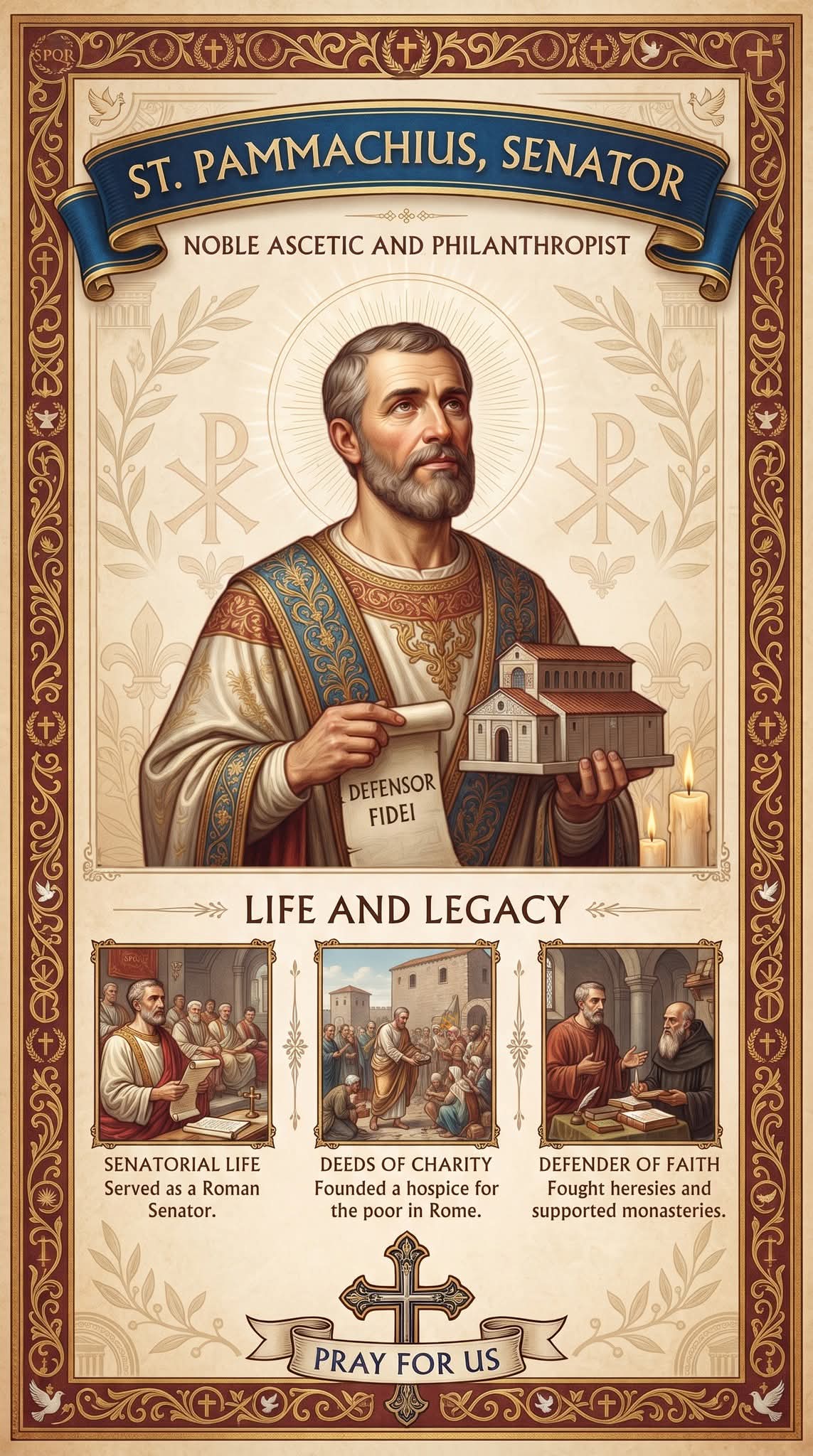
Saint Pammachius was a Roman senator who experienced a profound transformation after the death of his wife, Paulina. Instead of continuing to live for worldly honour and wealth, he chose to dedicate himself more completely to Christ. His life reminds us that conversion is not merely a change of habits but a surrender of the whole heart to God.
FROM WORLDLY HONOUR TO HUMBLE SERVICE
Pammachius belonged to a distinguished and wealthy Roman family and enjoyed a position of influence. Yet, after embracing a life of Christian dedication, he increasingly turned away from worldly prestige and towards humility and service. He understood that true greatness is measured not by status or possessions but by love and service to others.
CHARITY AS A WAY OF LIFE
One of the most beautiful aspects of Pammachius’s life was his extraordinary concern for the poor. He used his wealth to care for those who were hungry, sick and neglected. He founded a hospice at Porto, near Rome, where travellers and the needy could receive assistance. His generosity showed that authentic Christian faith must become visible through compassionate action.
A FRIEND OF SAINT JEROME
Pammachius was also closely associated with Saint Jerome, with whom he corresponded about faith, Scripture and Christian living. Jerome respected his intelligence, sincerity and commitment to the faith. Their friendship demonstrates the importance of surrounding ourselves with people who encourage us to grow spiritually and remain faithful to God.
FAITHFULNESS THROUGH SUFFERING
Pammachius did not choose an easy path. He experienced personal loss and lived during a period of considerable political and social turmoil. Yet these difficulties did not turn him away from God. Instead, they strengthened his desire to live faithfully and to place his trust in Divine Providence.
A HEART THAT BELONGED TO THE POOR
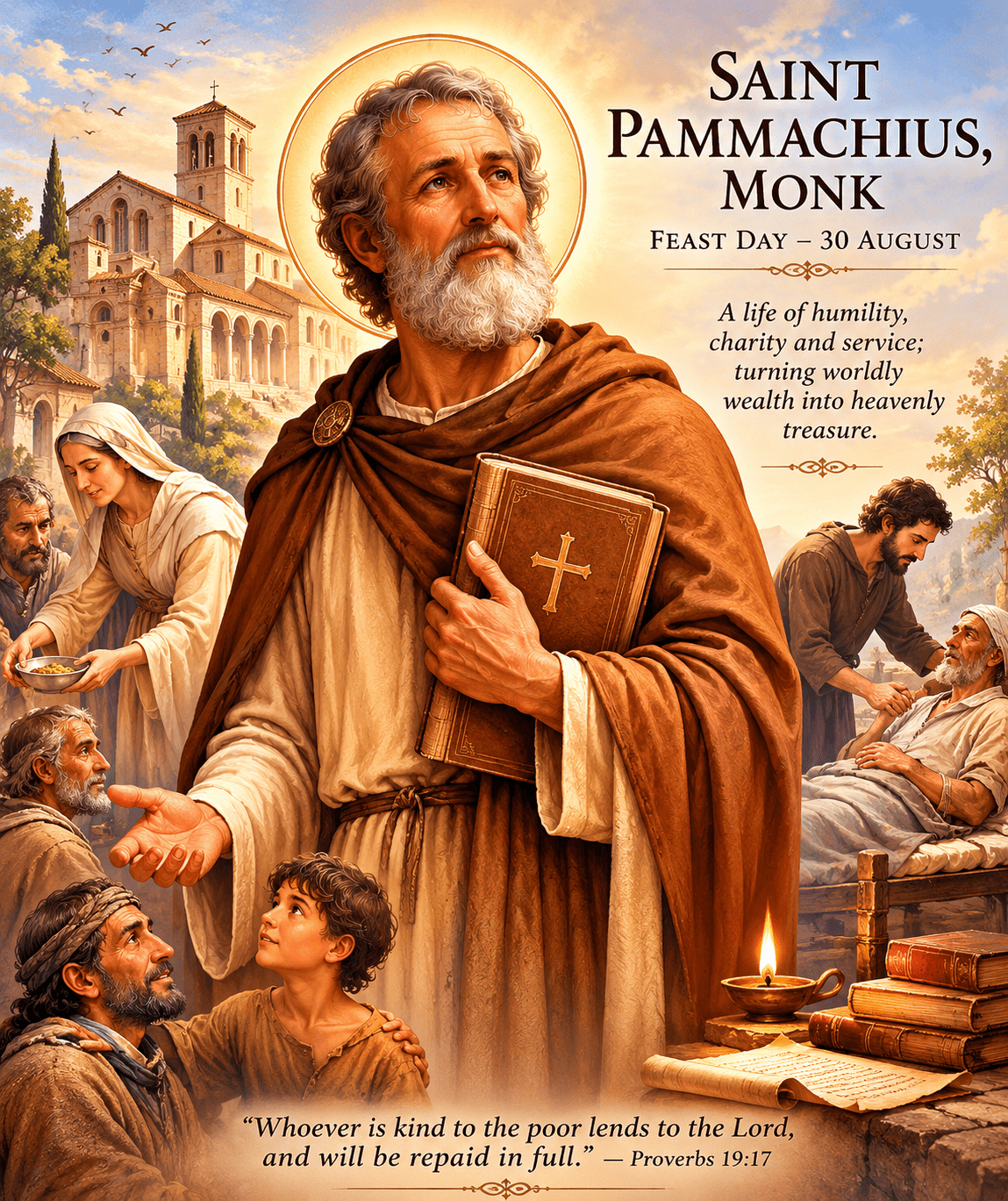
Although Pammachius had access to wealth and influence, he increasingly identified himself with those who had little. His concern for the poor was not merely an occasional act of generosity; it became an expression of his Christian identity. He teaches us to look beyond our own needs and recognise those who may be silently suffering around us.
HOLINESS IN ORDINARY RESPONSIBILITY
Pammachius’s life shows that holiness is possible even for someone who has lived in the world of public responsibility and influence. His vocation was not simply an escape from society but a transformation of how he used his position, possessions and relationships. He teaches us that our daily responsibilities can become occasions for holiness when they are carried out with integrity, humility and love.
LETTING GO OF WHAT DOES NOT LAST
Pammachius understood that wealth, reputation and social position cannot give the soul lasting security. He chose instead to seek the riches that endure beyond this earthly life. His example encourages us to examine our own priorities and ask whether we are investing more in temporary possessions or in lasting values such as love, generosity, compassion and faith.
A LIFE OF QUIET GENEROSITY
The holiness of Pammachius was expressed less through dramatic achievements and more through consistent generosity. His life demonstrates that simple acts of kindness can reveal God’s love. A meal given to the hungry, care offered to the sick, hospitality extended to a stranger and encouragement given to someone discouraged can all become powerful expressions of Christian witness.
CONTEMPLATING HIS WITNESS TODAY
Saint Pammachius invites us to examine our relationship with wealth, influence and comfort. Do we possess our possessions, or do they possess us? Do we notice the needs of others? Are we willing to use what God has given us for His glory and the good of His people? His example reminds us that Christian discipleship becomes credible when faith is translated into generosity and service.
A HEART GIVEN COMPLETELY TO GOD
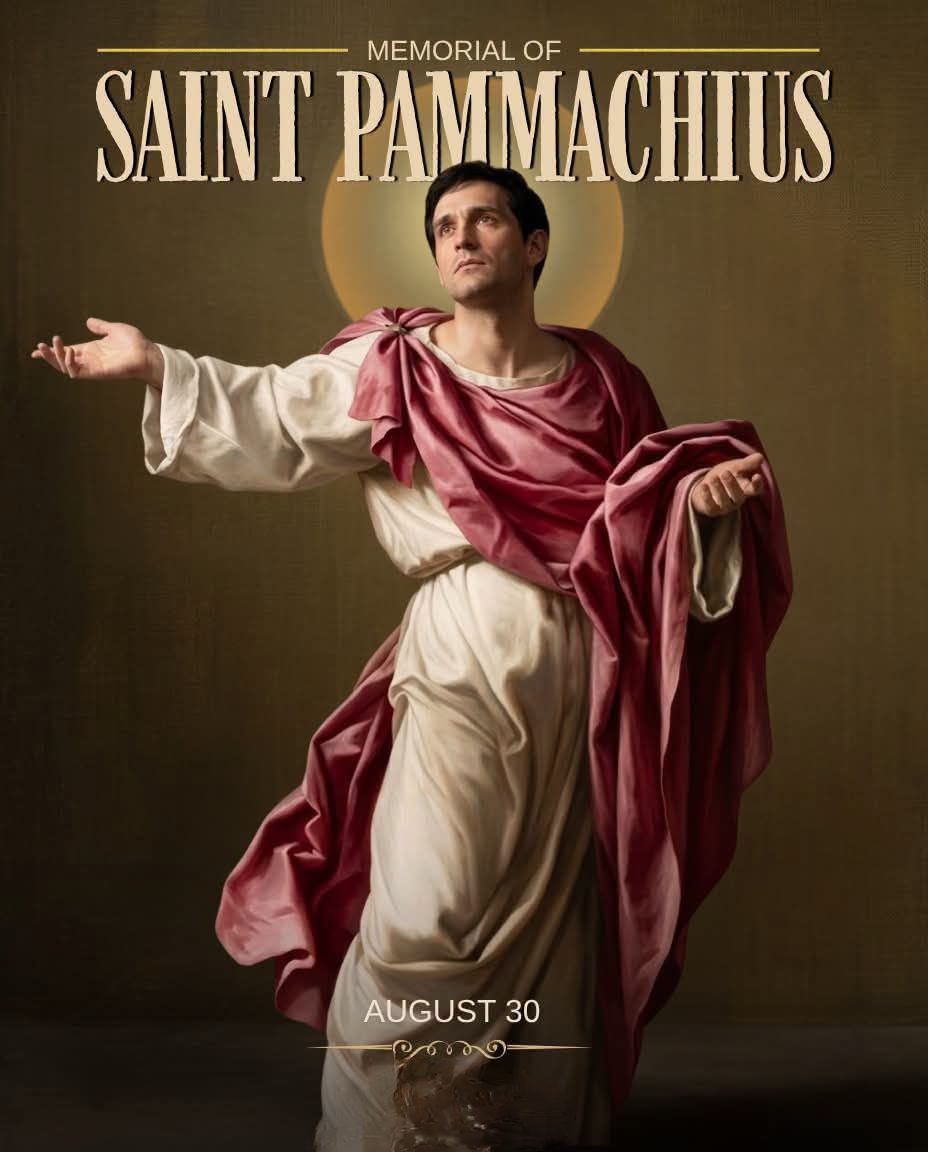
The deepest lesson of Pammachius’s life is that nothing is truly lost when it is surrendered to God. His grief became compassion, his wealth became service, his influence became responsibility and his faith became charity. He discovered that the greatest treasure is not what we keep for ourselves but what we give in love.
PRAYER
O God, you inspired St. Pammachius to leave behind wealth and honor, and to embrace the service of the poor in charity and humility.
Through his example and intercession, grant us the grace to see Christ in the suffering and forgotten, to serve with generous hearts, and to seek treasures not of this world but of heaven.
May his prayers strengthen us to walk in faith, persevere in hope, and abound in love. Through Christ our Lord. Amen