
SPIRITUAL INSIGHTS INTO THE FEAST OF THE ROSARY
October 7, 2026
James 5:16
October 8, 2026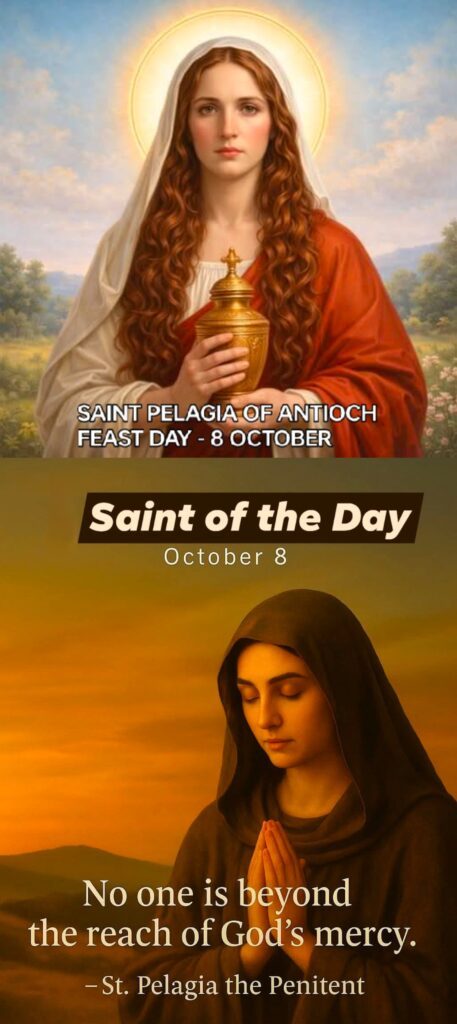
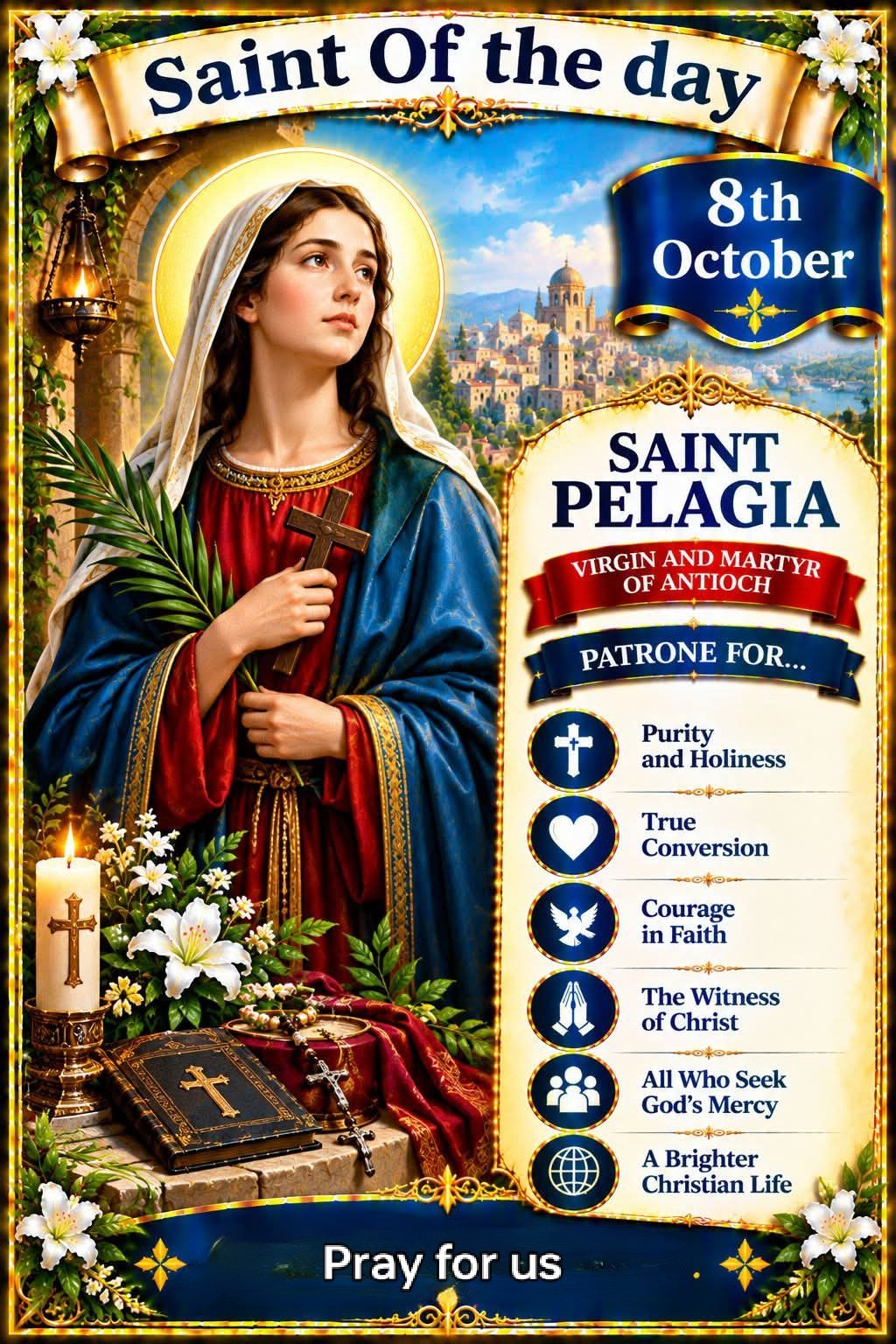
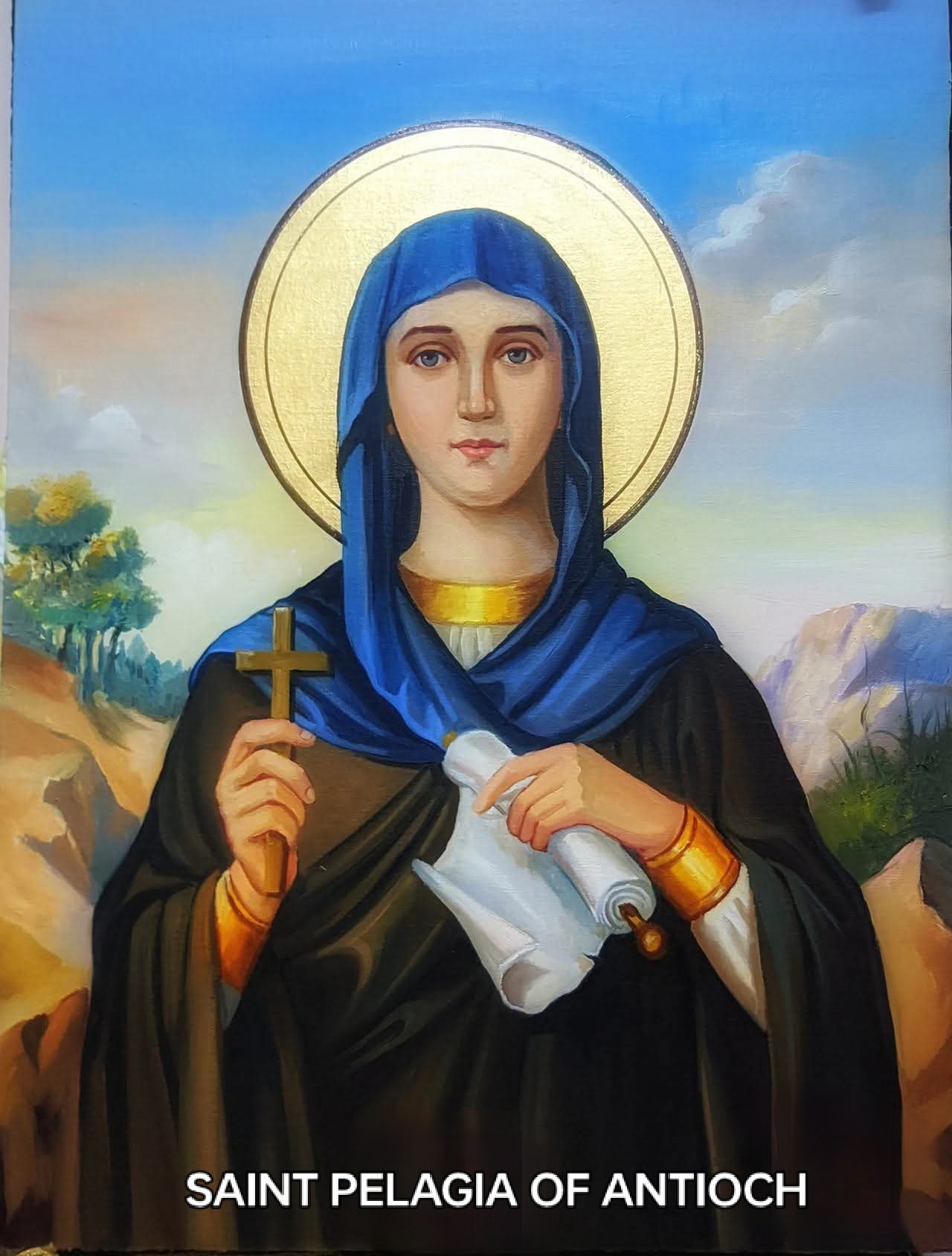
SAINT PELAGIA THE VIRGIN MARTYR OF ANTIOCH AND SAINT PELAGIA THE PENITENT – 8th OCTOBER
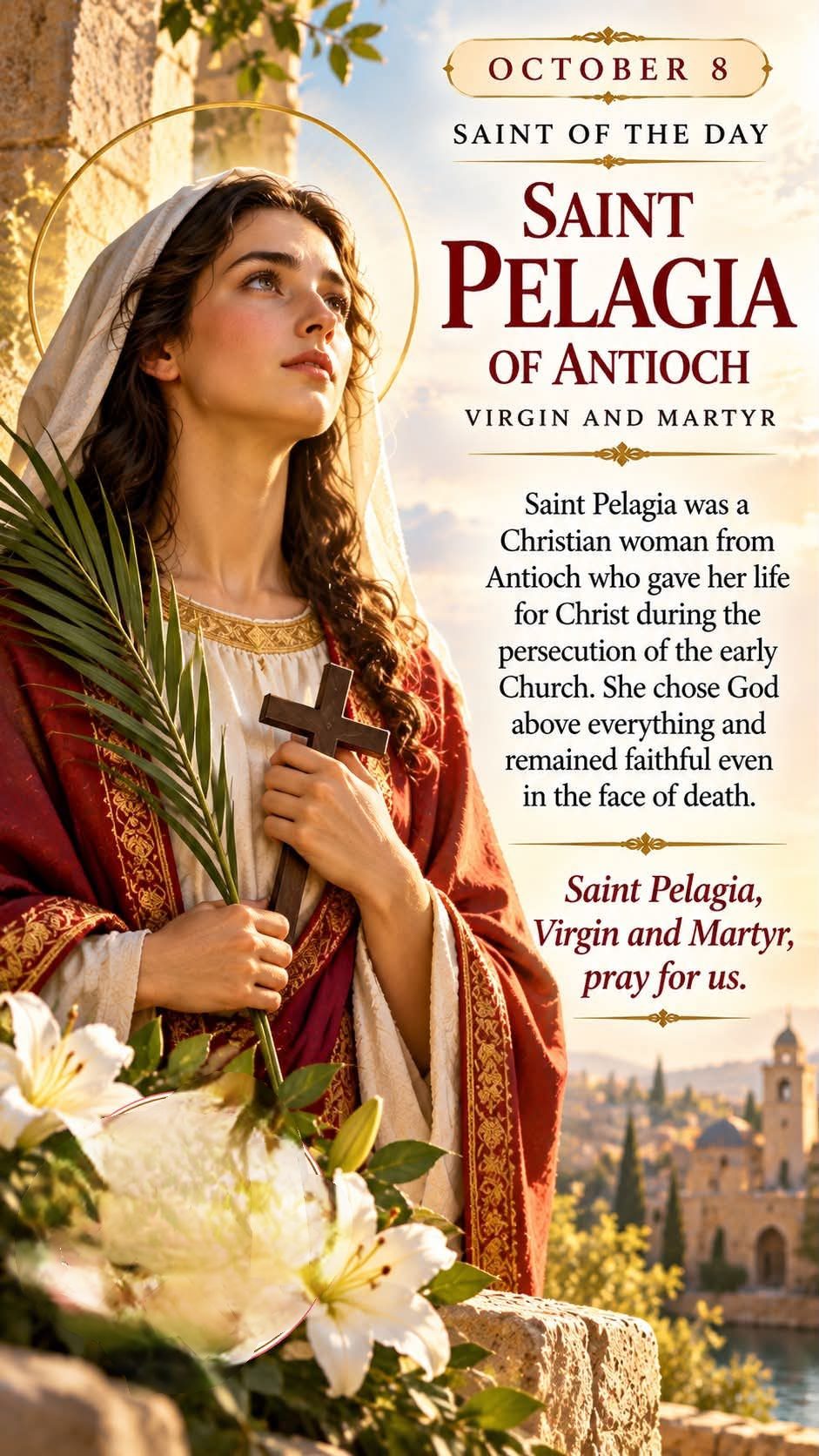
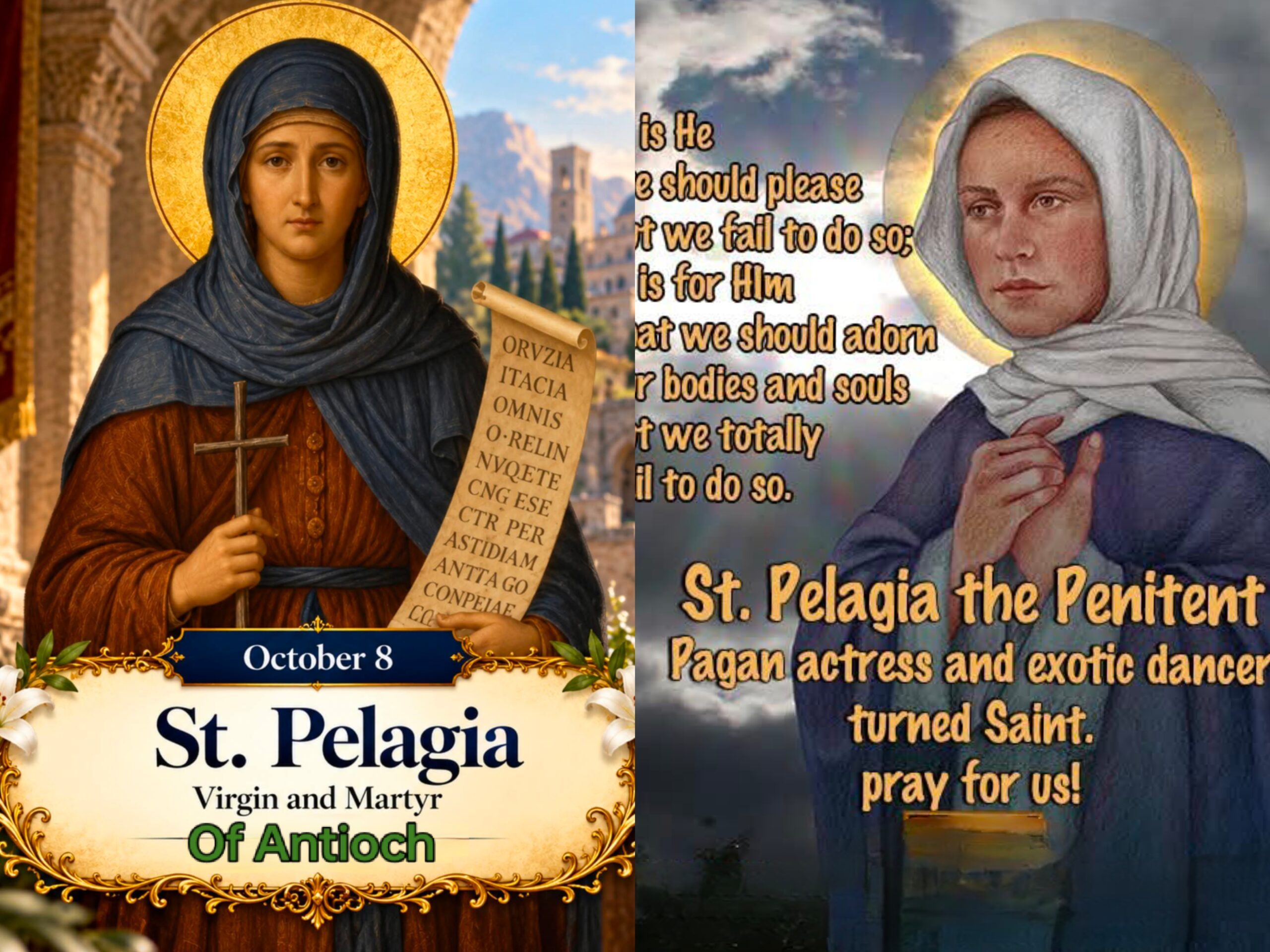
Today, October 8, the Church marks the feast day of two Saint Pelagias: Pelagia the Virgin Martyr of Antioch and Pelagia the Penitent. Over the years, the lives of these Pelagias have become entwined and confused by oral tradition. There were at least two Pelagias, both from Antioch, Syria. Today, we take lessons from both their lives.

The first Pelagia was a young virgin martyr in the fourth century. Committed to maintaining her virginity for Christ, Saint Pelagia was prepared for the Diocletian persecution when it reached Antioch. At fifteen years of age, soldiers came in search of her, in order to force her to publicly offer a sacrifice to the pagan gods.

She was alone in the house, and unable to defend herself. She politely asked the soldiers what was to become of her, and upon hearing that she was sentenced to execution, begged permission to return inside her home to put on more modest clothing. Overcome by her resolute courage, the solders allowed her the privilege.

Knowing what was ahead of her, including her defilement at the hands of the soldiers, the holy virgin was not willing to expose herself to danger of being dishonored.
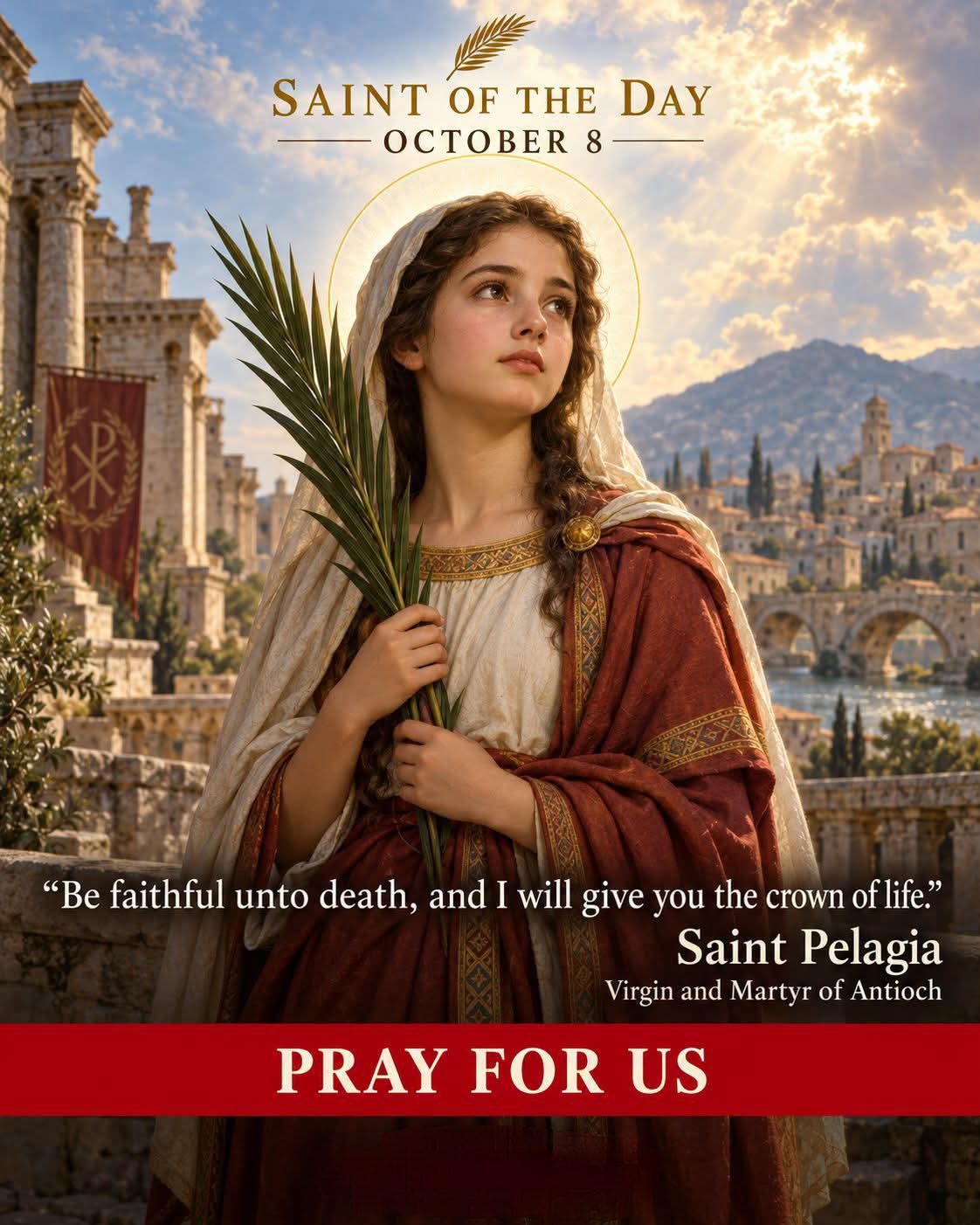
Both St. John Chrysostom and St. Ambrose refer to her example of faithfulness. They tell of her leaping to her death from the roof of the house rather than be taken by soldiers.
SAINT PELAGIA THE PENITENT

The second Pelagia, known later as Pelagius (also sometimes known as Margaret of Antioch) the Penitent, lived about a century later. This Pelagia was a dancer and “immoral actress” in Antioch. Very beautiful, she is reported to have had many lovers, desired expensive jewels, and was renowned for her dissolute and decadent lifestyle.
She would, however, undergo radical conversion and come to live for the Lord alone. At the height of her popularity, she and some friends were passing by the Basilica of Saint Julian in Antioch where Bishop Nonnus was preaching. Pelagia was reclining in a litter and was provocatively dressed; her head and shoulders were uncovered at a time when women were to be veiled in public.
The group of bishops who were gathered outside were shocked by the sight of her and turned away, except for Bishop Nonnus who looked at her for a long time. Bishop Nonnus then turned to the other bishops and asked, “Did not the sight of her great beauty delight you?” When Bishop Nonnus spoke in the basilica the next day, Pelagia was there.
The people were surprised to see her because she was not a catechumen. Apparently the bishop’s words had stirred Pelagia to reconsider how she was living her life. She met with the bishop soon after and asked to be baptized, saying: “Holy father, be merciful to me, a sinner; baptize me, and teach me repentance. I am a sea of iniquity, an abyss of destruction, a net and weapon of the devil.”

Upon questioning, Pelagia explained that her father and mother named her Pelagia, but that the people of Antioch called her Margarita, (which means pearl) for she was the “devil’s jewel.” Bishop Nonnus found a woman to act as her godmother and then exorcised and baptized her. A few days later Pelagia arranged to give all her wealth and possessions to the bishop.
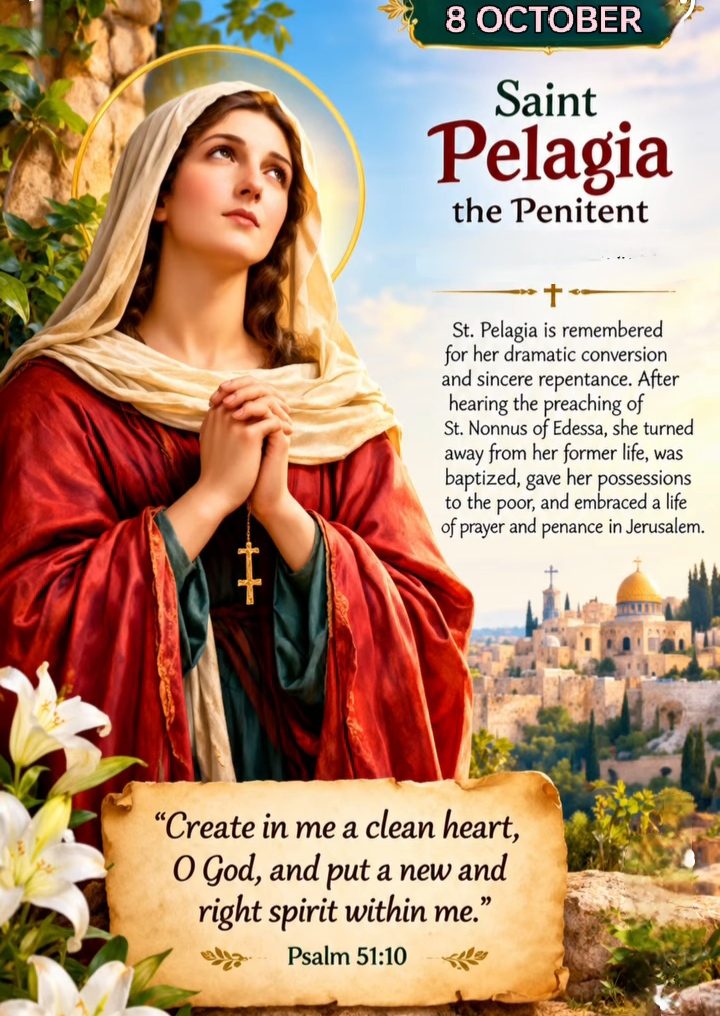
He handed all the wealth over to the treasurer of the church in Antioch, telling him to use it for widows and orphans, not for the church, because it was tainted money. Soon after Pelagia’s conversion and baptism she left Antioch, never to return. She withdrew to a cave in Jerusalem near the Mount of Olives where she dressed in men’s clothing and lived an austere life as a hermit, praying, fasting, and engaging in penance for her earlier sins.
She became known as Pelagius, “the beardless monk.” Bishop Nonnus kept in touch with Pelagia, sending emissaries to bring “Brother Pelagius” messages of encouragement from time to time. One such emissary, James the Deacon, found her dead during one visit. It was not until the anointing of her body that they discovered that she was a woman.
By repentance and striving, the former sinner received the mercy of God, the forgiveness of her sins and sanctification, and her purified and sanctified soul was made worthy of the Kingdom of God.
The lives of the two Saint Pelagias remind us of the different paths our own lives can take. Few of us are sin-free, engaging in “extreme” measures to avoid defilement like Saint Pelagia the virgin martyr.
It is far more likely that we are better able to identify with Saint Pelagia the Penitent, living sinful lives, but called to the repent by the Lord. Both women—from very different backgrounds—found their salvation in the Gospel, and washed clean, joined their Creator in Heaven. We are inspired to true conversion, full repentance, and lives of sanctity by their stories.
CONTEMPLATING THE LIFE OF SAINT PELAGIA THE PENITENT
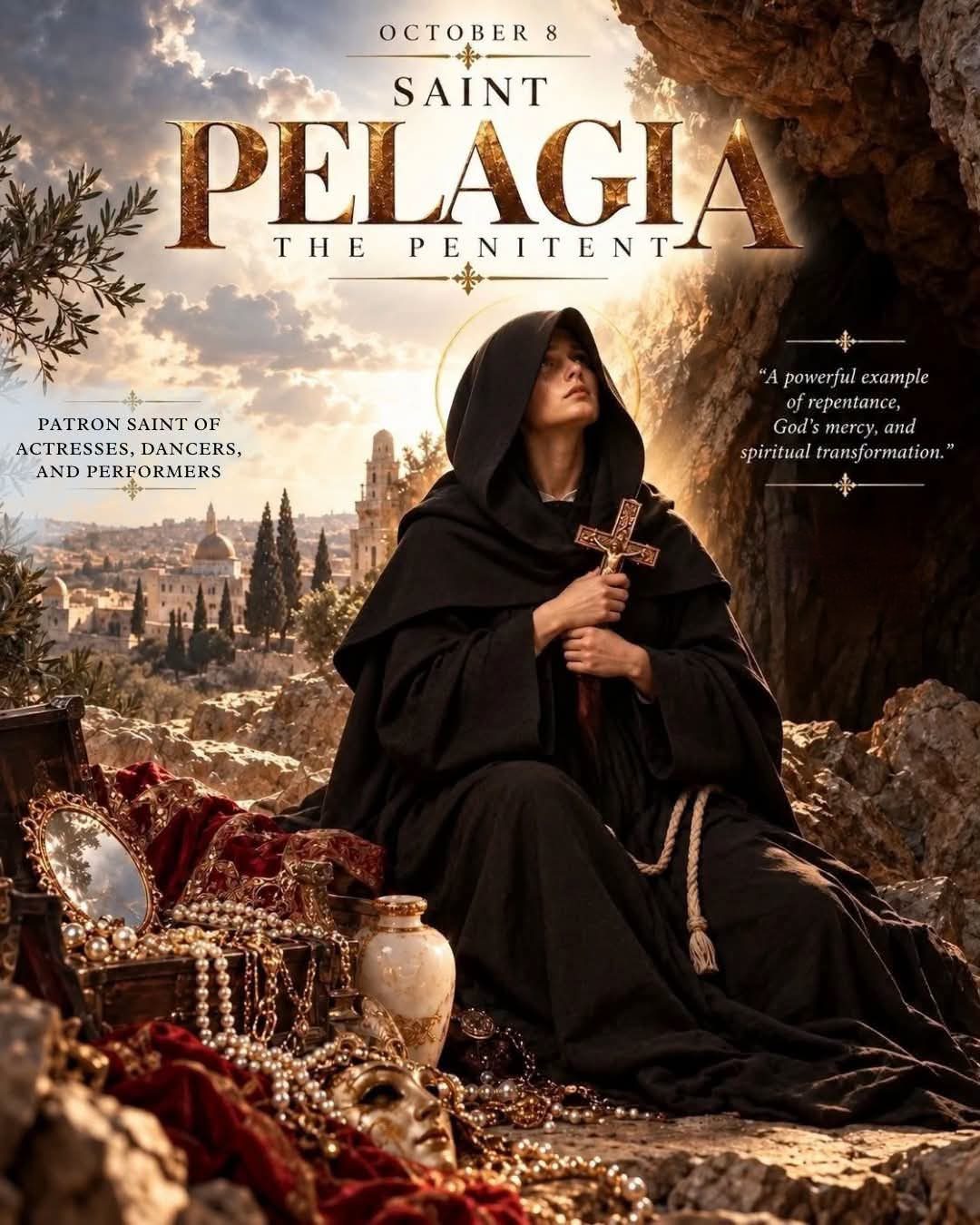
THE WOMAN KNOWN AS MARGARITA
Saint Pelagia the Penitent lived in the fifth century and is traditionally identified as a celebrated actress and dancer in Antioch. Because of the pearls and rich ornaments she wore, she was also known as Margarita, meaning “Pearl.” Her life was filled with luxury and worldly pleasures, but beneath that outward splendour God was preparing her heart for a profound conversion.
THE ENCOUNTER WITH SAINT NONNUS
During a gathering of bishops in Antioch, Saint Nonnus, Bishop of Edessa, was preaching in the church of Saint Julian. Pelagia passed by dressed magnificently, attracting attention because of her beauty. Unlike those who simply turned away from her, Nonnus looked beyond her outward appearance and recognized a soul capable of holiness. He prayed fervently for her conversion.
THE SERMON THAT AWAKENED HER SOUL
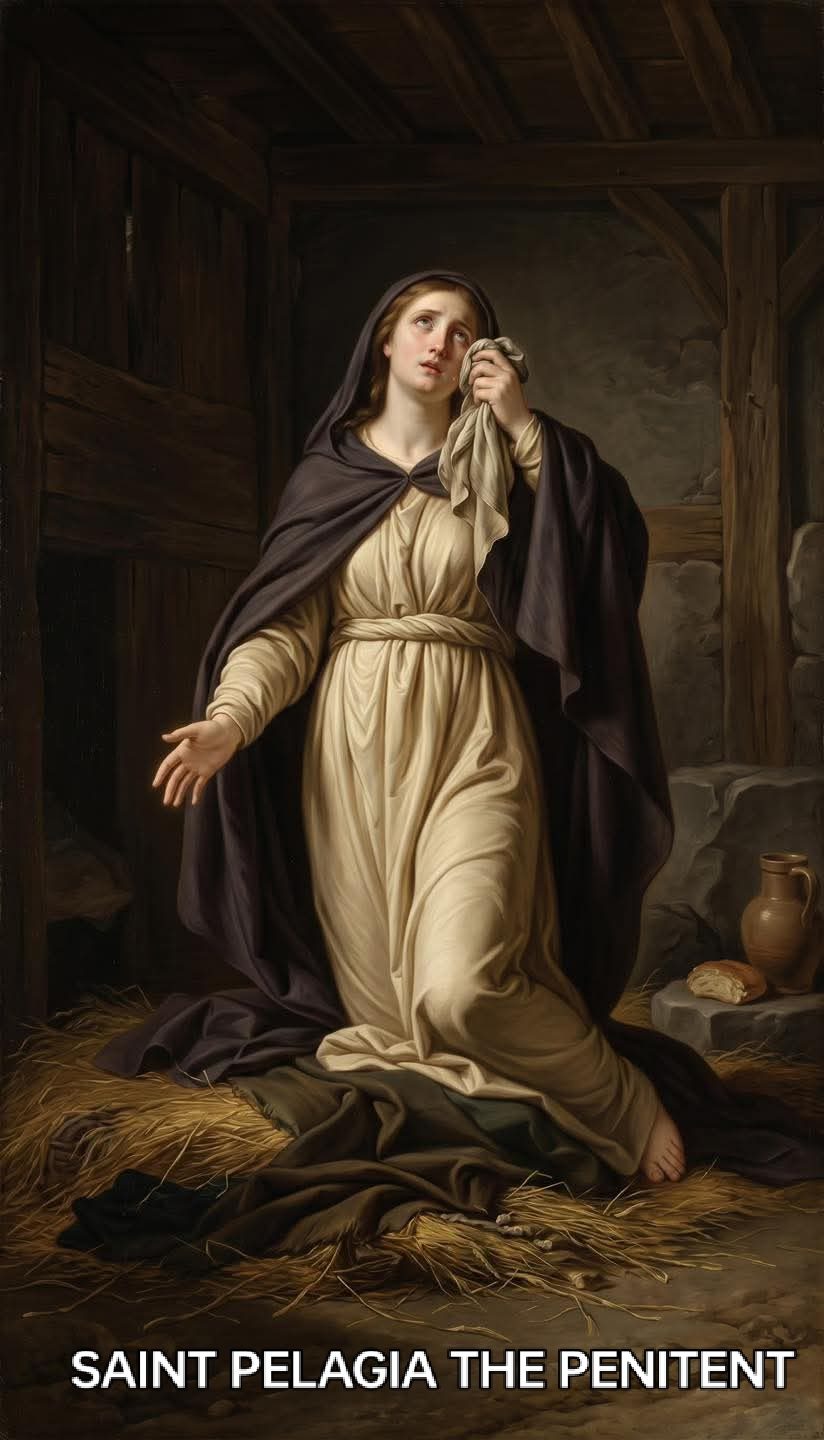
Pelagia later returned to hear Nonnus preach about the Last Judgment. His words struck her with such force that she was overcome with sorrow for her past life. She approached him in tears and asked to be instructed in the Christian faith and prepared for Baptism. Her response shows how a single moment of grace can awaken a heart that has been far from God.
THE COURAGE TO BEGIN AGAIN
Pelagia received Baptism and embraced a completely new way of life. She did not treat repentance as a passing emotion. She made a decisive break with her former existence and placed herself entirely in God’s hands. Her conversion reminds us that God’s mercy does not merely forgive the past; it opens the way to a new future.
THE WEALTH THAT BECAME A BLESSING
Three days after her Baptism, Pelagia gathered her valuable possessions and brought them to Nonnus. He ordered that her wealth be distributed among the poor. What had once been connected with her former life was transformed into an instrument of charity. Her action teaches us that genuine repentance seeks not only forgiveness but also the healing of the harm caused by our former choices.
LEAVING ANTIOCH BEHIND
Pelagia then left Antioch and journeyed to Jerusalem. Antioch was the place of her former life and conversion, while Jerusalem became the place of her life of solitude and penance. She went to the Mount of Olives, where she lived in a small cell in profound asceticism.
THE HIDDEN LIFE OF PELAGIUS
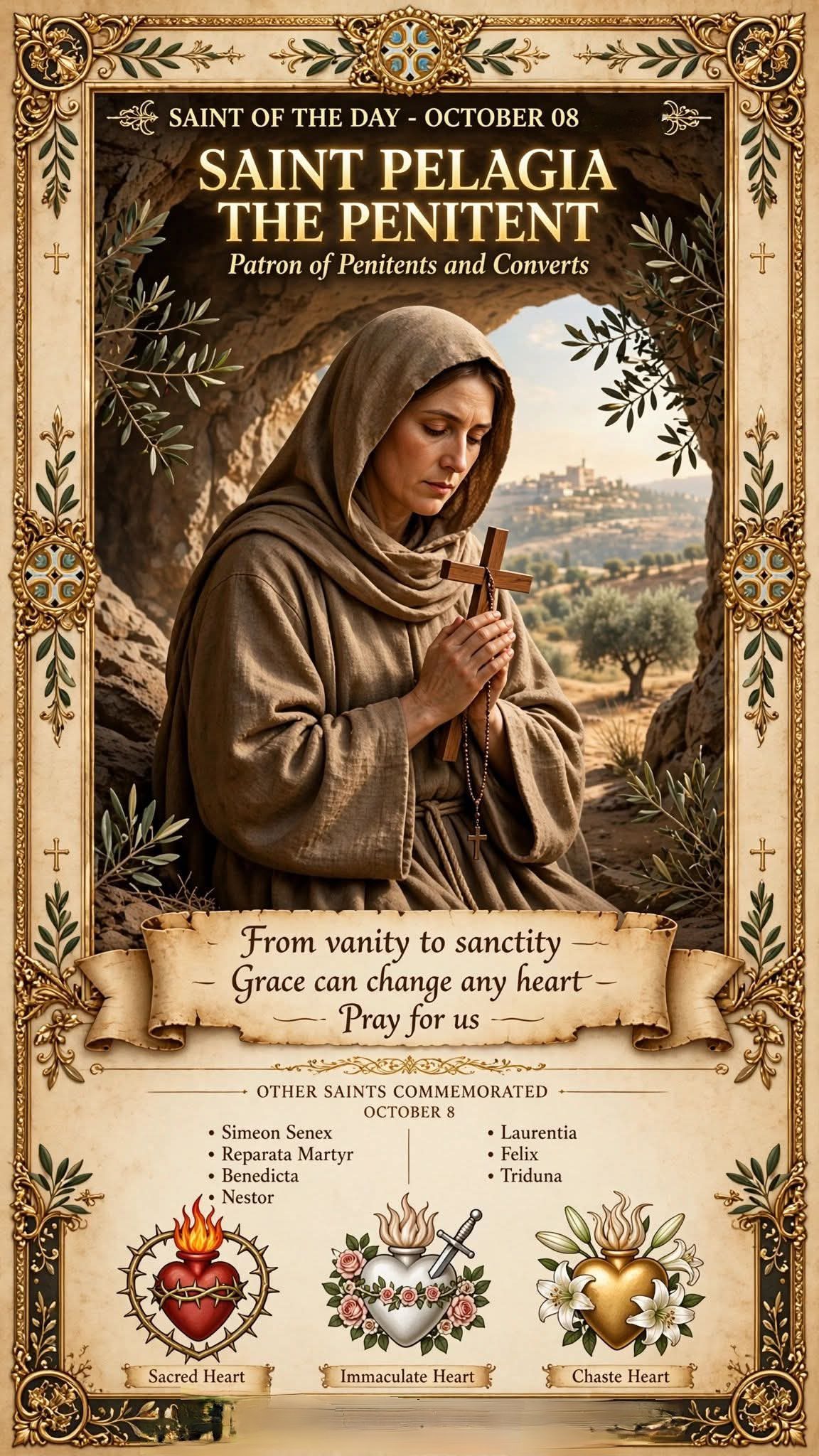
On the Mount of Olives, Pelagia lived in seclusion under the name Pelagius. She withdrew from the attention that had once surrounded her and devoted herself to prayer, fasting and penance. The woman who had once been admired for her outward beauty now sought the hidden beauty of a soul surrendered to God.
THE VISIT OF JAMES THE DEACON
According to the traditional account, James the Deacon later visited the hermit Pelagius in Jerusalem without recognizing that the ascetic was actually Pelagia. Her identity remained hidden, and she continued her solitary life of prayer and penance. The story emphasizes the complete transformation from public celebrity to hidden servant of God.
A LIFE HIDDEN IN GOD
Pelagia eventually died in her cell on the Mount of Olives. Only after her death was her true identity revealed. The woman once known for her beauty, wealth and public reputation had chosen to become almost completely unknown to the world. Her hidden life became a testimony that holiness does not depend upon recognition but upon fidelity to God.
THE PEARL THAT GOD REVEALED
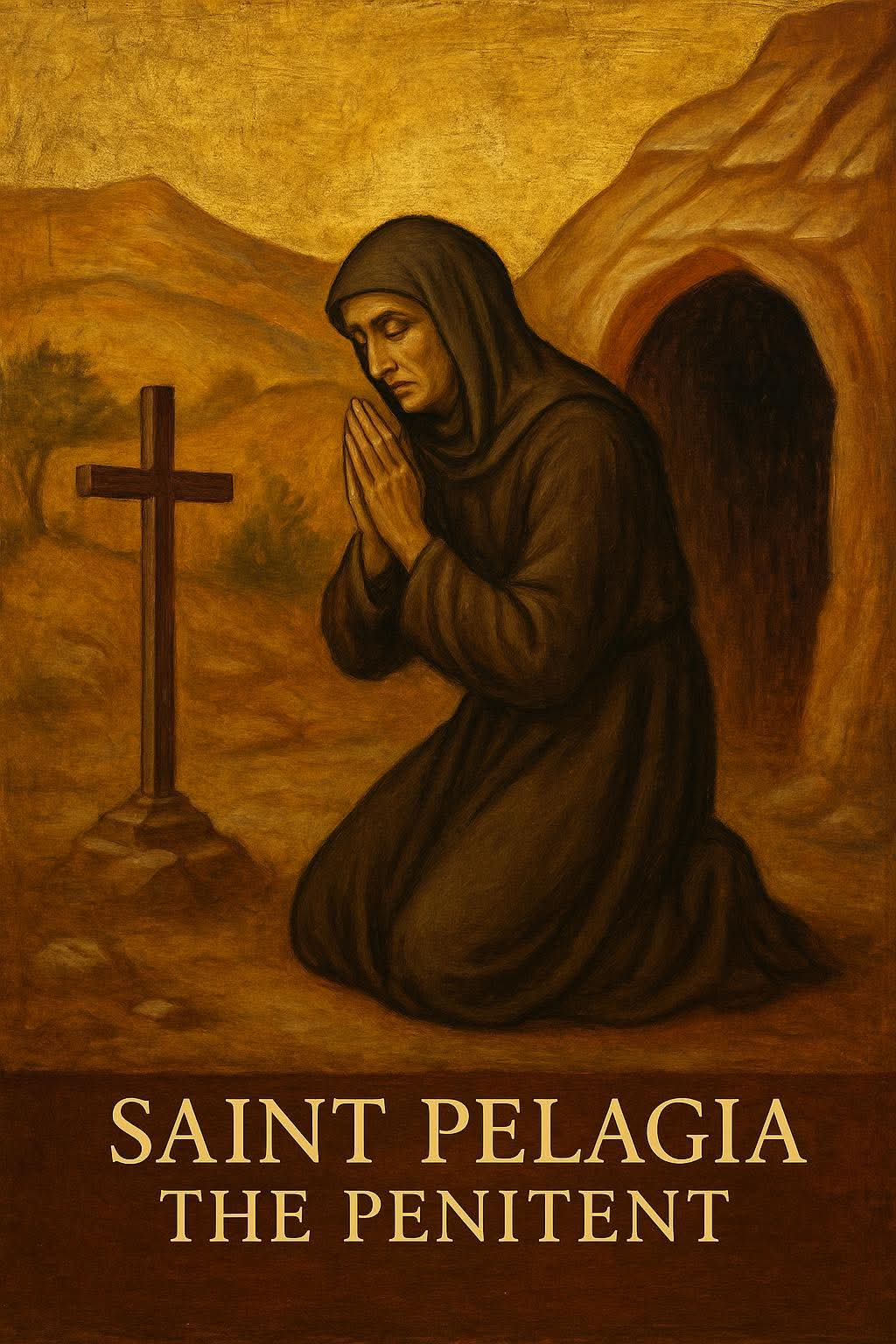
Pelagia’s story is a profound meditation on repentance. The woman once called Margarita, the Pearl, discovered a treasure far greater than worldly beauty or wealth. Through God’s grace, she became a different kind of pearl: a soul purified through repentance and devoted entirely to Christ.
THE INVITATION TO CONVERSION
Saint Pelagia the Penitent reminds us that no one should ever despair of God’s mercy. Her story calls us to examine whatever keeps us attached to the past and to have the courage to begin again. She teaches us that when the heart truly turns towards God, even a life that seems lost can become a beautiful witness to His transforming grace.

PRAYER
Almighty God, by whose grace and power two Saint Pelagias witnessed and found their salvation: Grant that we, who now remember them before thee, may likewise remain faithful and witness unto thee in this world, that we may receive with them the crown of glory that fadeth not away.
Through Jesus Christ our Lord, who with thee and the Holy Spirit liveth and reigneth, God, for ever and ever. Amen.