
TODAY’S GOSPEL READING – 25 APRIL
April 25, 2026
SOLEMNITY OF THE MEMORIAL OF OUR LADY OF GOOD COUNSEL – 26th APRIL
April 26, 2026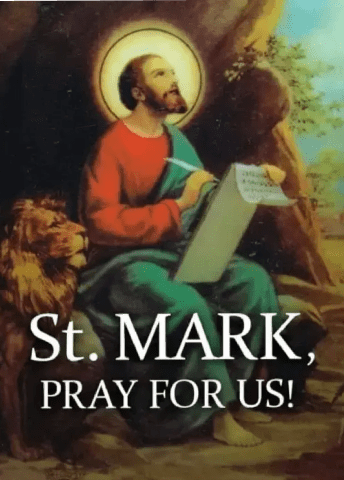
GROWING UP IN AN EARLY CHRISTIAN HOUSEHOLD
Before public mission, there is quiet formation. What we absorb early shapes what we later become. Faith is often formed in hidden environments.
“Train up a child in the way he should go; even when he is old he will not depart from it.”
— Proverbs 22:6
St. Mark, also known as John Mark, was raised in a home that welcomed the early Church. His mother Mary’s house in Jerusalem became a place of prayer and gathering for believers, even during times of persecution. It is believed that this environment nurtured his early faith and prepared him for his future mission.
THE NIGHT HE FLED
Moments of weakness are not the end of vocation. They are part of the journey toward deeper courage. Fear does not disqualify, it reveals humanity.
“Do not be conformed to this world, but be transformed by the renewal of your mind. ”
— Romans 12:2
Awareness is the beginning of conversion.
MISSION WITH ST. PAUL THE APOSTLE AND ST. BARNABAS
Not every step in vocation is successful. God forms us even through missteps. Growth includes failure and correction.
“We know that in everything God works for good for those who love him.”
— Romans 8:28
Mark accompanied Paul and Barnabas on their missionary journey but left them midway in Pamphylia. This caused disagreement later between Paul and Barnabas. Despite this setback, Mark continued to grow, showing that God’s plan unfolds even through imperfect choices.
RECONCILIATION AND FORMATION WITH ST. PETER THE APOSTLE
Healing often comes through new connections. Spiritual maturity is shaped in community. God restores through relationship.
“Clothe yourselves, all of you, with humility toward one another. ”
— 1 Peter 5:5
Mark became a close companion of Peter, who referred to him affectionately as his “son.” Under Peter’s guidance, Mark matured in faith and understanding. This relationship helped restore his confidence and deepen his calling.
WRITING THE GOSPEL
What God does within us is meant to be given to others. Our story becomes part of a greater story. Personal transformation becomes shared witness.
“Go into all the world and preach the gospel to the whole creation. ”
— Mark 16:15
Mark is traditionally recognized as the author of the earliest Gospel, drawing from the preaching and memories of Peter. His Gospel captures the life and mission of Jesus with clarity and urgency, preserving the Good News for generations.
THE URGENCY OF HIS GOSPEL
Mark’s Gospel moves quickly because discipleship requires decision. Following Christ is immediate. Faith calls for response, not delay.
“Today, if you hear his voice, do not harden your hearts.”
— Hebrews 3:15
The Gospel of Mark frequently uses the word “immediately,” reflecting the dynamic and urgent call of Christ. Through this style, Mark emphasizes that responding to Jesus is not something to postpone but to embrace at once.
MISSION TO NEW LANDS
Faith cannot remain contained. It seeks to reach beyond familiar boundaries. The Gospel is meant to go outward.
“You will be my witnesses… to the ends of the earth.”
— Acts 1:8
Tradition holds that Mark carried the Gospel to Alexandria in Egypt, where he established the Church and served as its first bishop. His missionary zeal extended the reach of Christianity beyond its early centers.
MARTYRDOM AFTER A LIFE OF GROWTH
The one who once fled became one who remained. Holiness is a journey, not a single moment. Courage is formed over time.
“Be faithful unto death, and I will give you the crown of life.”
— Revelation 2:10
Mark’s life ended in martyrdom in Alexandria, where he was persecuted for his faith. The one who had once run away in fear now stood firm, offering his life as a witness to Christ.
A LIFE THAT POINTS BEYOND ITSELF
Mark did not seek recognition. His purpose was to reveal Jesus, not himself. The true witness directs attention to Christ.
“He must increase, but I must decrease.”
— John 3:30
Mark’s Gospel is simple and direct, focusing entirely on Jesus rather than on the author. His life and work reflect humility, drawing others not to himself but to the Savior.
PRAYER THROUGH THE INTERCESSION OF ST. MARK
Lord God,
who formed St. Mark the Evangelist
through weakness into faithful witness,
grant us the grace
to grow through our failures
and to follow You with courage.
Help us to proclaim Your Gospel
not only in words,
but in the way we live.
Through Christ our Lord.
Amen.