
TODAY’S GOSPEL READING – 23 MAY
May 23, 2026
PENTECOST SUNDAY
May 24, 2026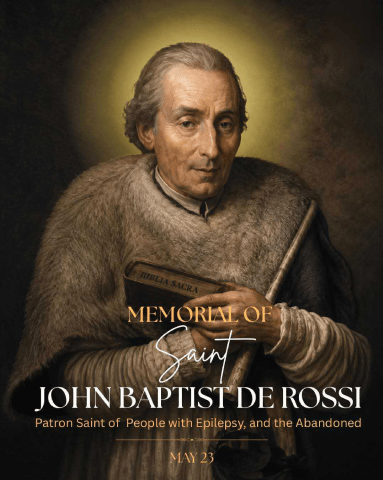
COMPASSIONATE LOVE FROM CHILDHOOD
Even as a child, Saint John Baptist de Rossi showed deep kindness toward the poor, the sick, and those who suffered. His heart was naturally drawn toward those whom others ignored. This early compassion became the foundation of his future ministry of mercy.
“Be kind and compassionate to one another, forgiving each other, just as in Christ God forgave you.”
— Ephesians 4:32
As a young boy, he was known for helping struggling people in simple and quiet ways. God was already shaping him into a shepherd for wounded souls.
God often plants deep compassion within souls He calls to become instruments of mercy.
HIS ARRIVAL IN ROME
When John Baptist came to Rome for studies, he saw not only the beauty of the city but also the hidden misery of the poor, prisoners, and abandoned people living in suffering. While many overlooked them, his heart was moved with pity.
“Whatever you did for one of the least of these brothers and sisters of mine, you did for me.”
— Matthew 25:40
Walking through the streets of Rome, he often stopped to speak with beggars and neglected people. He began dedicating his life to serving those forgotten by society.
A soul awakened by God begins to see invisible suffering that the world overlooks.
HIS PERSONAL SUFFERINGS
Throughout his life, Saint John Baptist suffered from physical weakness, exhaustion, and illness. He also experienced periods of emotional and mental struggle, yet he continued serving others with patience and gentleness.
“My grace is sufficient for you, for my power is made perfect in weakness.”
— 2 Corinthians 12:9
Even during times of sickness, he continued hearing confessions and caring for the suffering. His own pain made him more understanding toward the burdens of others.
Personal suffering can deepen the heart’s capacity for tenderness toward others.
HIS MINISTRY AMONG THE POOR
Saint John Baptist spent much of his priesthood walking through poor neighborhoods searching for the hungry, homeless, and abandoned. He personally brought food, comfort, and spiritual support to those in need.
“Blessed are the merciful, for they will be shown mercy.”
— Matthew 5:7
He often gave away his own possessions to help the poor. Many people in Rome saw him as a living sign of Christ’s compassion.
When love becomes selfless, the soul begins recognizing Christ in the wounded and abandoned.
People were drawn to him because they felt safe, understood, and forgiven in his presence. Many experienced deep conversion through his kindness.
Mercy has the power to heal souls more deeply than fear or harsh judgment.
HIS VISITS TO PRISONERS
Saint John Baptist regularly visited prisons to comfort prisoners and encourage them to trust in God’s mercy. He treated even the most rejected people with dignity and hope.
“Remember those in prison as if you were together with them in prison.”
— Hebrews 13:3
He prayed with prisoners, listened to their sorrows, and prepared many for repentance and reconciliation with God.
No soul is ever beyond the reach of God’s grace and redemption.
HIS CARE FOR THE MENTALLY ILL
At a time when the mentally suffering were often feared or abandoned, Saint John Baptist treated them with patience, tenderness, and respect. He visited hospitals and cared personally for many who were neglected.
“Carry each other’s burdens, and in this way you will fulfill the law of Christ.”
— Galatians 6:2
He saw every suffering person as precious in the eyes of God, regardless of their condition or weakness.
Every human person carries sacred dignity, even when the world fails to recognize it.
HIS HIDDEN AND HUMBLE LIFE
Saint John Baptist never sought honor, fame, or important positions within the Church. He preferred a quiet life of service among ordinary people.
“Whoever wants to become great among you must be your servant.”
— Matthew 20:26
Though respected throughout Rome, he remained simple, humble, and detached from worldly recognition.
Holiness often grows silently through small acts of love repeated faithfully every day.
HIS EXHAUSTION IN SERVICE
Years of constant ministry slowly weakened his body. He sacrificed his comfort and strength in order to continue helping souls in need.
“Greater love has no one than this: to lay down one’s life for one’s friends.”
— John 15:13
Even when tired and ill, he continued serving in confessionals, hospitals, prisons, and among the poor until the end of his life.
A life poured out in charity becomes a living reflection of Christ’s self-giving love.
HIS LEGACY AMONG THE FORGOTTEN
When Saint John Baptist de Rossi died, the poor, prisoners, and abandoned people of Rome mourned deeply because they had experienced God’s compassion through him.
“Well done, good and faithful servant.”
— Matthew 25:23
His life remains a powerful witness that true holiness is found in mercy, humility, and love for the forgotten.
The souls closest to God often become signs of hope for those who feel unseen and unloved.
PRAYER THROUGH THE INTERCESSION OF Saint John Baptist de Rossi
O gentle Saint John Baptist de Rossi,
friend of the poor and forgotten,
pray for us that we may grow in mercy, compassion, and patience.
Teach us to recognize Christ
in the suffering, lonely, and abandoned.
Help us to listen with kindness,
forgive with humility,
and serve others with generous love.
May we never ignore those whom the world overlooks,
but become instruments of God’s tenderness and peace.
Amen.