
SPIRITUAL INSIGHTS INTO THE LIFE OF SAINT RITA OF CASCIA
May 22, 2026
Acts 1:8
May 23, 2026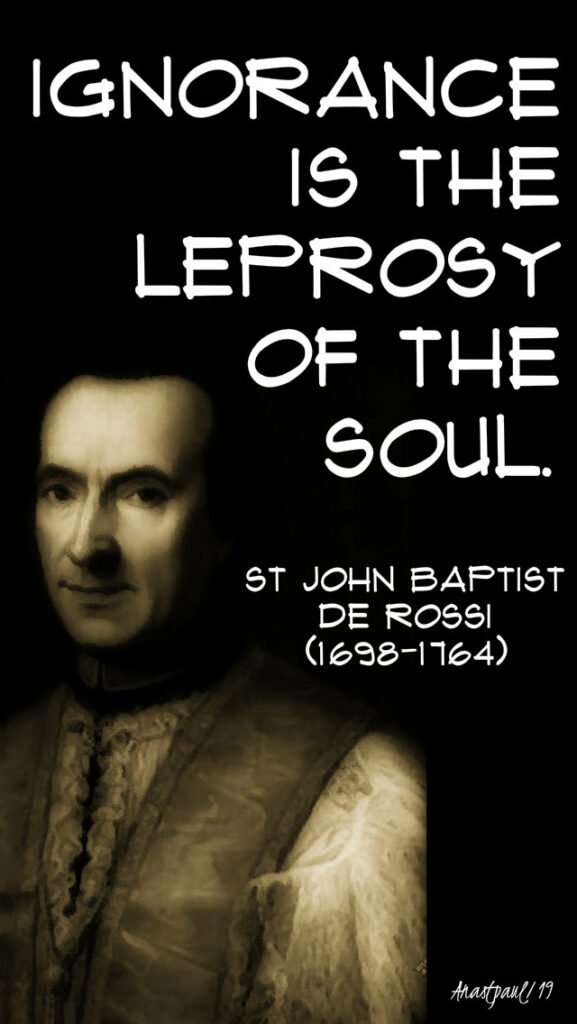

FEAST OF SAINT GIOVANNI BATTISTA DÉ ROSSI/JOHN THE BAPTIST DE ROSSI, ROMAN PRIEST
FEAST DAY – 23rd MAY
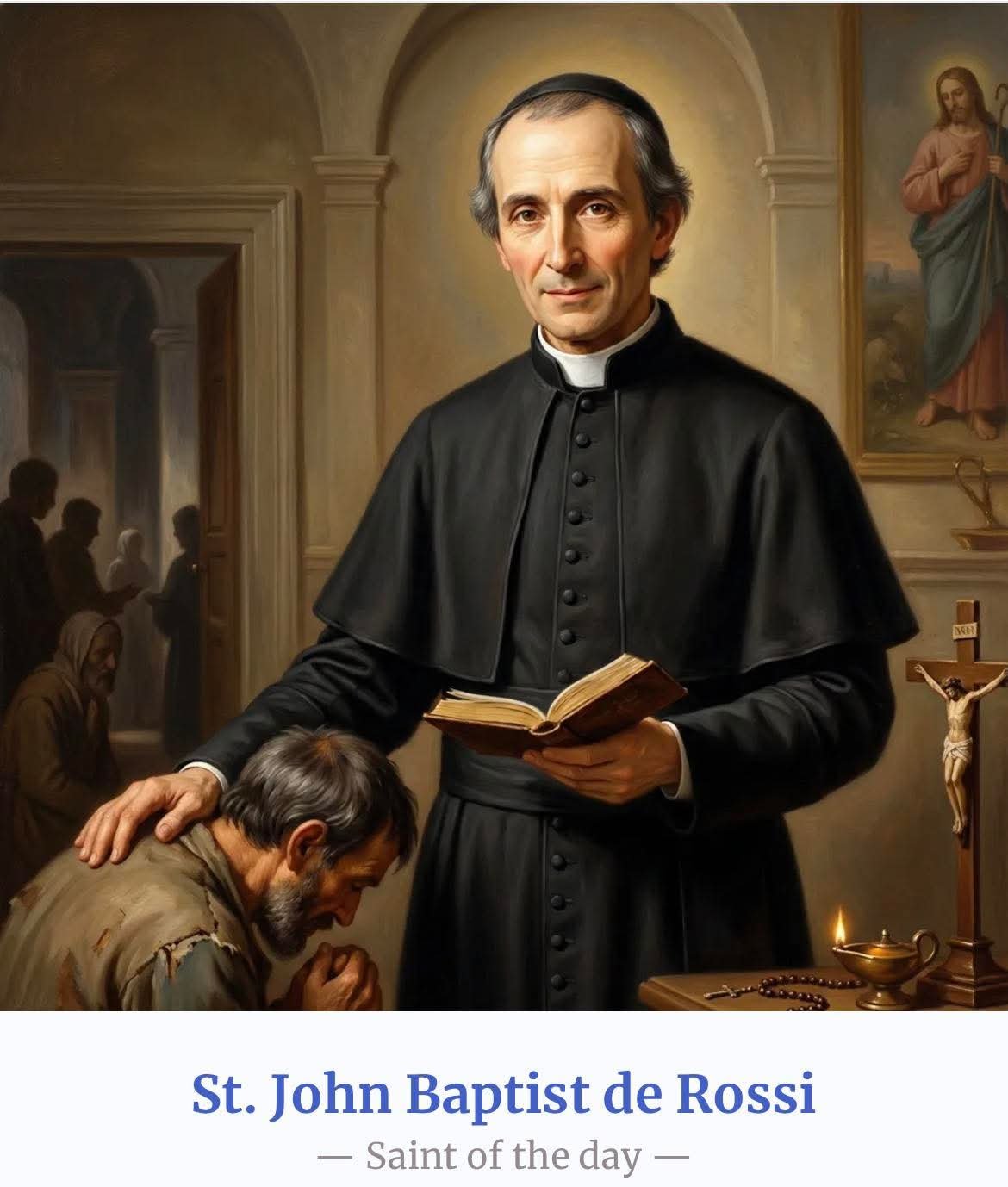
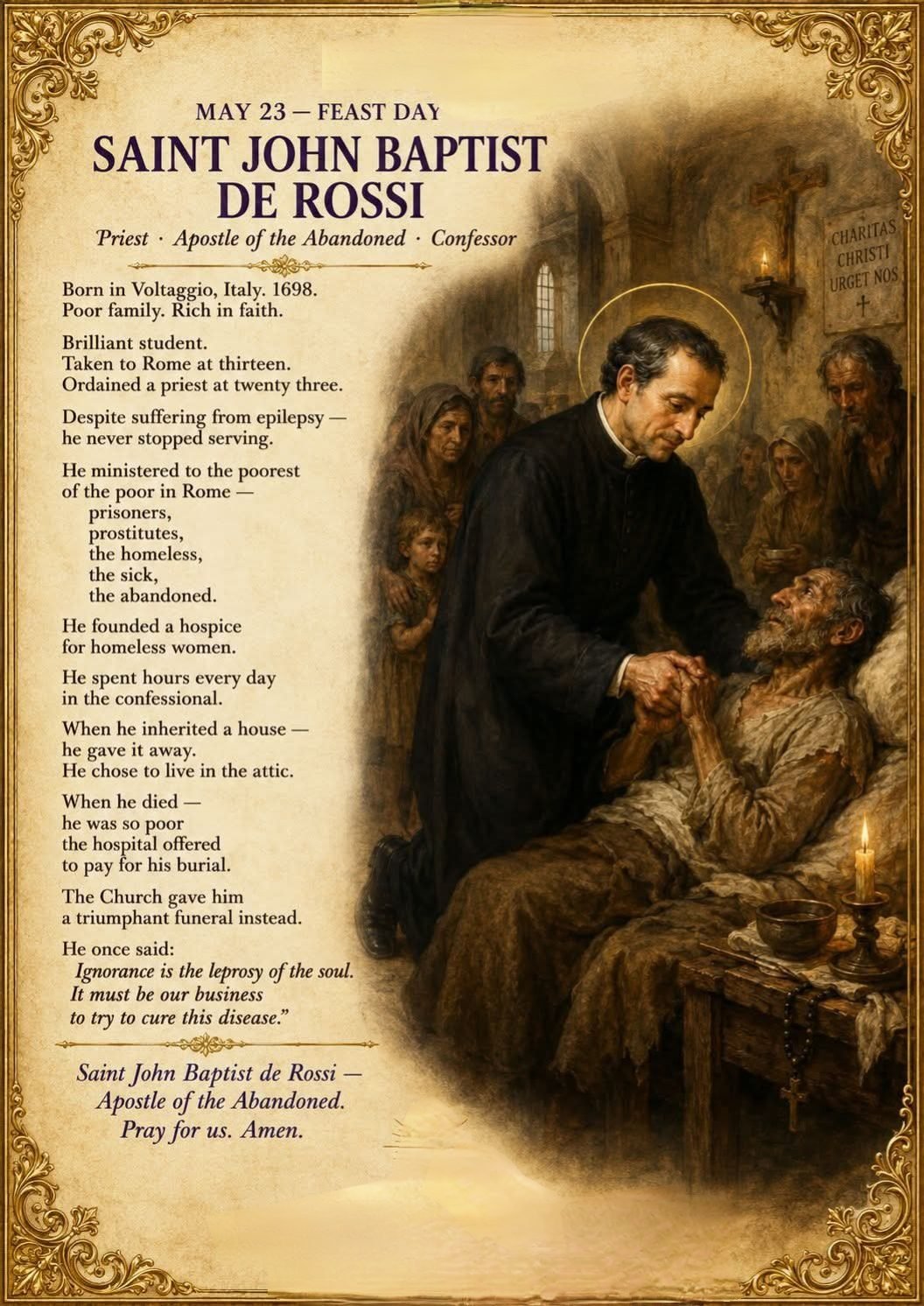
Giovanni Battista de’ Rossi (22 February 1698 – 23 May 1764) was an Italian Roman Catholic priest. He served as the canon of Santa Maria in Cosmedin after his cousin, who was a priest serving there, died. He was a popular confessor despite his initial fears that his epileptic seizures could manifest in the Confessional. Rossi opened a hospice for homeless women not long after his ordination, and was known for his work with prisoners and ill people, to whom he dedicated his entire ecclesial mission.
Giovanni was born on February 22, 1698 in Voltaggio, Italy. He was the fourth child of Charles de Rossi and Frances Anfossi, known to be a holy and faith filled couple. Though John’s family was not financially wealthy, they were rich in faith. Through their guidance and a wonderful education, John learned to excel in his living faith, piety and gentleness.
A pair of priests, Scipio Gaetano and Giuseppe Repetto, saw great potential within John and took his early education and faith formation as a part of their apostolate, taking him under their spiritual care. When he was 10-years-old, John met with a wealthy, noble couple from Genoa after Mass. They, too, noted his gifts and potential. So, they took him in as a page, after receiving his father’s approval. John was taken to Genoa to attend school until 1711.
In 1710, John’s father suddenly passed away. His mother pleaded for him to return home, but John was convinced that the Lord wanted him to finish his education in Genoa. In 1711, John was called to Rome by his cousin, the canon of St. Mary in Cosmedin, Lorenzo de Rossi. Lorenzo suggested John complete his studies there at the Collegium Romanum under the guidance of the Jesuits.
John continued to thrive in his studies. His natural talents, spiritual gifts, Christian virtue and willingness to apply himself to his studies made him the model student. He studied philosophy and theology under the Dominicans at the Dominican College of Saint Thomas.
During this time, John joined the Sodality of the Blessed Virgin and the Ristretto of the Twelve Apostles. Both groups were comprised of lay Christian faithful especially dedicated to Christian prayer and service. He led the members of the groups in meetings, group prayer and outreach to the poor, including visits to the hospitals.
John’s desire to grow in holiness sometimes led him to going overboard in his practices of voluntary mortification and his austerity nearly ruined his health. He also began to have fits of epilepsy. He struggled with these for the rest of his life. John wanted dearly to become a priest. Under normal circumstances, his epileptic fits would have excluded him from the priesthood.
However, he was granted a special dispensation. After ordination as a deacon, he was ordained to the priesthood on March 8, 1721. John believed he had reached his goal and was deeply grateful to the Lord for the vocation of priesthood. So, as an expression of gratitude, he vowed to not accept any ecclesiastical benefits unless commanded to do so out of obedience to his religious superiors.
He devoted himself to serving Rome’s sick, homeless and prostitutes. He would visit the sick and poor in the hospitals by day, and by night he ministered to the street people. He reached out to assist homeless women and helped to found a hospice for them near Saint Galla. He also aided prisoners and workers.
John spoke to the dying about Jesus Christ, leading them to salvation. He desperately wanted to relieve them of their suffering. None of the sick repulsed him, no matter how bad their illness or symptoms because he saw Jesus in them.
In one instance, a young man who was ill and dying from syphilis turned away from John’s attention, out of shame. However, as John showed his selfless heart and helped him with his bedpan, the man finally took the time to listen to John’s words and was able to make a good confession before his death.
Other priests were in awe of John’s holiness and manner of life. They saw that with only a few kind words he could turn people’s lives around. During one of his sermons, John stated to his fellow priests:
“Ignorance is the leprosy of the soul. How many such lepers exist in the church here in Rome, where many people don’t even know what’s necessary for their salvation? It must be our business to try to cure this disease. The souls of our neighbors are in our hands, and yet how many are lost through our fault? The sick die without being properly prepared because we have not given time or care enough to each particular case. Yet with a little more patience, a little more perseverance, a little more love, we could have led these poor souls to heaven.”
The poor come to church tired and distracted by their daily troubles. If you preach a long sermon they can’t follow you. Give them one idea that they can take home, not half a dozen, or one will drive out the other, and they will remember none.”
In 1735, John became titular canon at St. Mary in Cosmedin. Following the death of his cousin in 1737, obedience forced John to accept the canonry. However, John refused the house belonging with the title, and used funds from selling the home toward his cause with the poor.
John’s illness continued to impact his life, as he was afraid of entering the confessional because the possibility of having a seizure during the session. He became accustomed to sending the sinners he found to other priests.
In 1738, John became dangerously ill and was sent to Civita Castellana to regain his health. While there, the bishop residing in that location pushed him to hear confessions. After reviewing his moral theology, John received the special faculty of hearing confessions in any of Rome’s churches.
From then on, John spent countless hours hearing confessions from the poor and illiterate whom he sought from hospitals and their homes. John became the “apostle of the abandoned,” and became known as a second Philip Neri, a hunter of souls. He preached five to six times a day in all kinds of places, including churches, hospitals and prisons. He was also known for his strong devotion to St. Aloysius Gonzaga.

In August 1762, the state of his health became worse. John became worn out and his strength began to deteriorate. His companions begged him to go to Lake Nemi to recover. While there, he started having worse epileptic fits. Two months later, he returned to Rome. John rarely left his room, but in September 1763, he celebrated Mass at Santa Maria in Cosmedin, telling those present that he would be dying soon.
In December, he was found in his room unconscious, after suffering a violent seizure. He remained unconscious for a day. He was given Viaticum, the special prayers and reception of the Holy Eucharist given to the gravely ill and dying. He was also given the Anointing of the Sick, also called Last Rites when it is administered before death.
However, John recovered from his illness and went on to celebrate several more Masses. Soon later, his health once again declined and he was confined to his bed. John Baptist de Rossi passed to the Lord whom he loved with such true devotion on May 23, 1764 in his bedroom in Trinita de Pellegrini.
His body was buried in that church under a marble slab at the altar of the Blessed Virgin. His remains were relocated in 1965 to a new church named in his honor. Pope Pius VI began the cause of canonization for John Baptist de Rossi in 1781, but both the French Revolution and the Napoleonic Wars created setbacks.
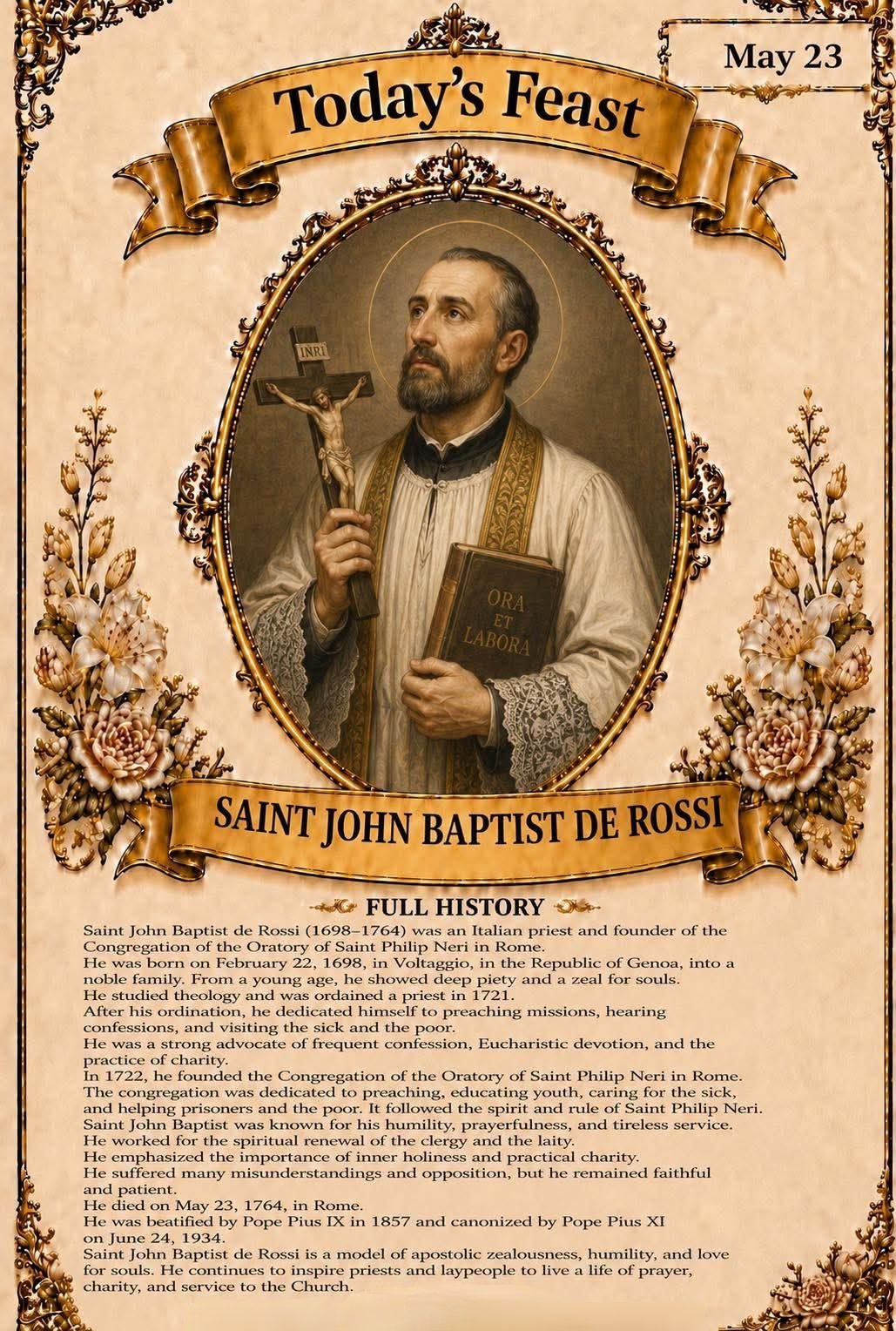
Years later in 1859, Pope Pius IX resumed his cause and attributed two miracles to John’s intercession. St. John Baptist de Rossi was beatified on May 13, 1860 by Pope Pius IX and canonized on December 8, 1881 by Pope Leo XIII. He is the patron saint of Voltaggio and his feast day is celebrated on May 23.
(Source: catholiconline)
CONTEMPLATING THE LIFE OF SAINT JOHN BAPTIST DE ROSSI
THE GENTLE APOSTLE OF ROME’S FORGOTTEN PEOPLE
St. John Baptist de Rossi was an 18th-century Italian priest known for his deep compassion toward the poor, prisoners, the homeless, the mentally ill, abandoned women, and those spiritually neglected. Though he was not a famous missionary or founder of a religious order, his holiness shone through humble service in the streets, hospitals, prisons, and confessionals of Rome.
He became known for tireless charity, patience in confession, humility, and loving care for society’s forgotten people. He is often remembered as “The Apostle of the Abandoned of Rome.”
HISTORICAL BACKGROUND
John Baptist de Rossi lived during a time when Rome was crowded with poverty, inequality, beggars, and suffering people. Many prisoners, laborers, sick people, and children were neglected and abandoned. Into this difficult world came a priest whose heart was open to the forgotten.
A BOY WITH A GENTLE HEART
Born near Genoa in Italy, John Baptist grew up in a poor but deeply religious family. From childhood he showed unusual kindness and sensitivity toward the weak and needy. He listened patiently, spoke gently, and loved prayer deeply.
ARRIVAL IN ROME
As a young student, he traveled to Rome for his studies. While many admired the beauty and grandeur of the city, John Baptist noticed the suffering hidden beneath it. He saw homeless people near churches, prisoners forgotten in dark cells, sick beggars abandoned on the streets, and mentally ill people treated without dignity. These experiences awakened within him a desire to serve the forgotten.

A BODY MARKED BY WEAKNESS
John Baptist suffered throughout his life from epilepsy, exhaustion, and recurring illness. At times his health became so poor that others feared he would never complete his studies. Yet his suffering made him more compassionate and understanding toward those who were weak and afflicted.
A PRIEST FOR THE FORGOTTEN
Ordained in 1721, John Baptist did not seek honor or prestige. Instead, he quietly dedicated himself to the wounded corners of Rome. He entered poor neighborhoods, searched for abandoned souls, and made the streets his mission field.
THE APOSTLE OF THE POOR
Each day he walked through the streets carrying food, encouragement, prayer, and assistance to beggars, laborers, homeless children, and the elderly poor. More than material help, he gave people dignity and kindness. Those who felt rejected by society began to feel remembered by God.
THE CONFESSIONAL OF MERCY
John Baptist became widely known for his patience in the confessional. Long lines formed as sinners came seeking guidance and forgiveness. He corrected gently, listened patiently, and revealed the mercy of God without harshness or humiliation. Many left his confessional with renewed peace and hope.
MINISTRY TO PRISONERS
He regularly visited prisons, comforting prisoners and hearing their confessions. He prayed with condemned men and reminded even criminals that no soul was beyond God’s mercy. In places filled with despair, he brought hope.
COMPASSION FOR THE MENTALLY ILL
At a time when mentally ill people were often neglected or feared, John Baptist treated them with tenderness and dignity. He visited hospitals and shelters frequently, seeing in every suffering person the face of Christ.
HIDDEN HOLINESS
John Baptist never became famous or powerful. He founded no religious order and sought no recognition. His holiness was revealed through ordinary acts of charity, forgiveness, listening, and service repeated daily with great love.
A LIFE WORN OUT BY MERCY
Years of labor gradually weakened his fragile body, yet he continued serving tirelessly until his death in Rome in 1764. Those who mourned him most deeply were the poor, prisoners, and forgotten people who had experienced his genuine love and compassion.
CANONIZATION
He was canonized in 1881 by Pope Leo XIII. The Church honors him as a model of pastoral charity, mercy, priestly compassion, and humble service.
SPIRITUAL THEMES IN HIS LIFE
John Baptist de Rossi teaches the importance of seeing Christ in the forgotten and rejected. His life revealed God’s mercy especially through the confessional and through compassionate service. His own sufferings made him patient and understanding toward others, and his holiness grew quietly through hidden acts of love.
PATRONAGE AND LEGACY
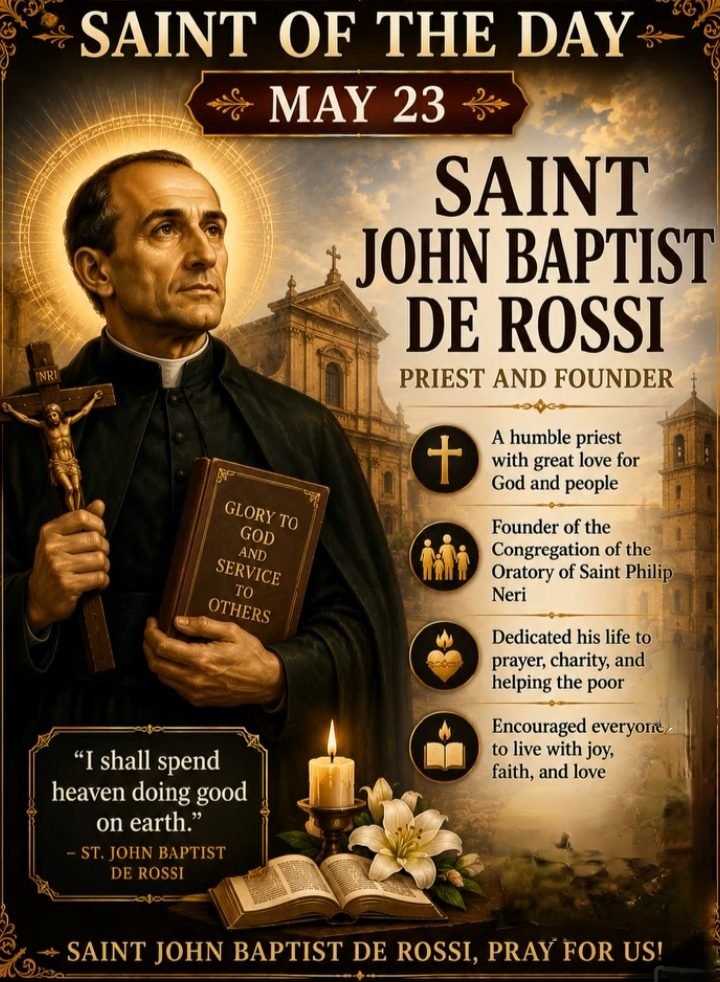
He remains a powerful example for priests, confessors, caregivers, social workers, and all who serve marginalized people. His life shows that holiness often grows through simple acts of kindness and faithful daily service.
ARTISTIC REPRESENTATION
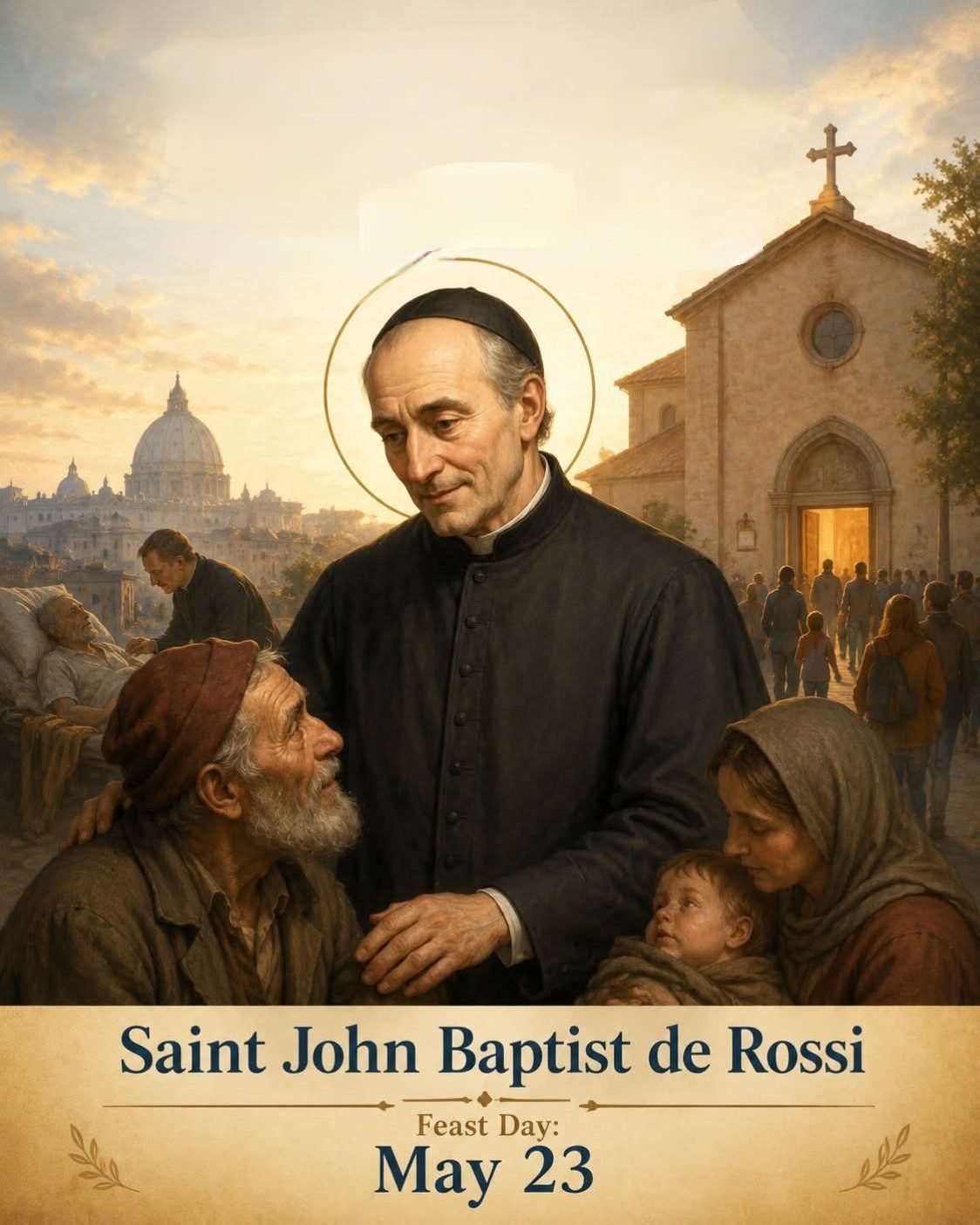
He is commonly shown wearing a priest’s cassock, hearing confessions, helping the poor, or comforting prisoners and the sick. Sacred art often highlights his tenderness toward suffering humanity.
WHY HE STILL MATTERS TODAY
Modern society continues to struggle with loneliness, homelessness, mental illness, and spiritual despair. St. John Baptist de Rossi reminds the Church that true Christianity must care for those on the margins of society.
His life teaches that mercy is strength, listening can heal wounded souls, and holiness often appears quietly through patient compassion. Above all, he made abandoned people feel remembered and loved by God.
PRAYER
O God, light of the faithful and shepherd of souls,
who set blessed John Baptist Rossi in the Church
to feed your sheep by his words and form them by his example,
grant that through his intercession
we may keep the faith he taught by his words
and follow the way he showed by his example.
Through our Lord Jesus Christ, your Son,
who lives and reigns with you in the unity of the Holy Spirit,
one God, for ever and ever. Amen
(from The Roman Missal: Common of Pastors—For One Pastor)