
TODAY’S GOSPEL READING – 8 OCTOBER
October 8, 2026
SPIRITUAL INSIGHTS INTO THE LIVES OF SAINT DENIS AND COMPANIONS
October 9, 2026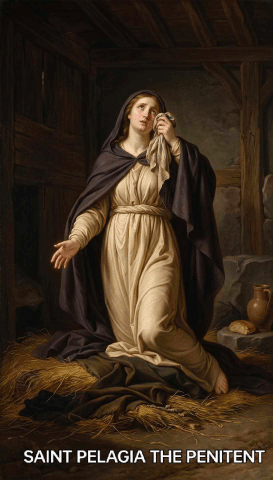
THE GRACE OF A NEW BEGINNING
“Therefore, if anyone is in Christ, there is a new creation; everything old has passed away; see, everything has become new.”
— 2 Corinthians 5:17
Saint Pelagia’s life reminds us that no past is beyond the reach of God’s mercy. After hearing Saint Nonnus preach about the Last Judgment, she was deeply moved, wept over her former life, sought Baptism and began an entirely new life. Her conversion teaches us that God does not define us by our past but calls us towards the person we can become through His grace.
THE COURAGE TO FACE THE TRUTH
“For godly grief produces a repentance that leads to salvation.”
— 2 Corinthians 7:10
Pelagia did not excuse or hide her former way of life when the word of God touched her heart. She acknowledged her sin and sought the path of repentance. Her tears became an expression of genuine conversion. Her example teaches us that spiritual healing begins when we honestly face our sins and allow God to transform our hearts.
RESPONDING WHEN GOD CALLS
“Today, if you hear his voice, do not harden your hearts.”
— Hebrews 3:15
Pelagia did not postpone her response to God. After hearing the preaching of Saint Nonnus, she immediately sought Baptism and asked to be taught the way of repentance. Her decisive response reminds us that grace often comes through a moment of awakening, and we should not allow fear, shame or delay to prevent us from answering God.
LEAVING THE OLD LIFE BEHIND
“Put away your former way of life, your old self, corrupt and deluded by its lusts.”
— Ephesians 4:22
After her Baptism, Pelagia gave up the life she had previously known. She surrendered her possessions and former attachments, and chose a life of prayer and penance. Her radical change teaches us that true conversion is more than feeling sorry for the past; it means turning away from whatever separates us from God.
TURNING EARTHLY TREASURES INTO TREASURES FOR GOD
“Do not store up for yourselves treasures on earth… but store up for yourselves treasures in heaven.”
— Matthew 6:19–20
Pelagia gathered her valuable possessions and entrusted them to Saint Nonnus so that they could be distributed to the poor. What had once been connected with her former life was transformed into an opportunity for charity. Her example teaches us to place our possessions at the service of God and those in need.
THE POWER OF THE CROSS OVER TEMPTATION
“Resist the devil, and he will flee from you.”
— James 4:7
After her Baptism, Pelagia was tempted by the devil to return to her former life. She prayed and made the Sign of the Cross, and the temptation disappeared. Her experience reminds us that conversion does not mean the end of temptation. When temptation comes, prayer, trust in God and the power of the Cross give us strength to remain faithful.
THE BEAUTY OF A HIDDEN LIFE WITH GOD
“Your life is hidden with Christ in God.”
— Colossians 3:3
Pelagia eventually withdrew from the world and lived a solitary life of prayer and penance. She chose to be known not for her former beauty, wealth or reputation, but for her devotion to God. Her hidden life teaches us that holiness does not depend upon recognition. God sees the goodness that the world may never notice.
PERSEVERING IN PENANCE
“Bear fruits worthy of repentance.”
— Matthew 3:8
Pelagia did not treat her conversion as a passing emotion. She embraced prayer, fasting, solitude and penance with perseverance. Her life demonstrates that genuine repentance gradually transforms the whole person. It is a lifelong journey of allowing God to purify the heart and strengthen the will.
FROM WORLDLY PRAISE TO GOD’S APPROVAL
“How can you believe when you accept glory from one another and do not seek the glory that comes from the one who alone is God?”
— John 5:44
Pelagia had once been admired for her beauty, accomplishments and worldly life. After her conversion, she deliberately chose a hidden existence in which human applause no longer mattered. Her transformation teaches us to seek God’s approval rather than the praise of people.
GOD CAN BRING GREAT GOOD FROM A WOUNDED PAST
“Where sin increased, grace abounded all the more.”
— Romans 5:20
The story of Pelagia is a powerful testimony to the abundance of divine grace. Her former life could have become a source of despair, but through repentance it became part of a testimony to God’s mercy. She teaches us never to believe that our failures are greater than God’s power to redeem.
HOLINESS IS POSSIBLE FOR EVERYONE
“Be holy, for I am holy.”
— 1 Peter 1:16
Pelagia’s life shows that sanctity is not reserved for those who have never fallen. God can call a sinner to extraordinary holiness when that person responds wholeheartedly to His grace. Her journey from a life of sin to a life of prayer reminds us that every person is capable of beginning again with God.
A LIFE COMPLETELY GIVEN TO CHRIST
“I have been crucified with Christ; and it is no longer I who live, but it is Christ who lives in me.”
— Galatians 2:20
Pelagia surrendered her former identity, possessions, ambitions and comforts in order to belong completely to Christ. Her life of solitude became an offering of love. She teaches us that conversion reaches its fullness when we stop living merely for ourselves and allow Christ to become the centre of our existence.
THE MERCY OF GOD IS GREATER THAN OUR PAST
“The Lord is merciful and gracious, slow to anger and abounding in steadfast love.”
— Psalm 103:8
The life of Saint Pelagia the Penitent is ultimately a witness to mercy. She discovered that God does not reject the repentant sinner but welcomes the one who returns to Him with a sincere heart. Her life encourages us to approach God confidently whenever we have fallen, trusting not in our worthiness but in His compassion.
PRAYER
Merciful Father, through the intercession of Saint Pelagia the Penitent, give me the grace of true repentance and a sincere conversion of heart. Help me to leave behind whatever separates me from You. Give me courage to resist temptation, humility to acknowledge my sins, generosity to share what I possess, and perseverance in prayer. Teach me to seek Your approval rather than the praise of the world. May the life of Saint Pelagia remind me that Your mercy is greater than every failure and that no heart is beyond Your transforming grace. Through Christ our Lord. Amen.