
SPIRITUAL INSIGHTS INTO THE LIFE OF SAINT BERNADETTE SOUBIROUS
April 16, 2026
1 Peter 5: 8-9
April 17, 2026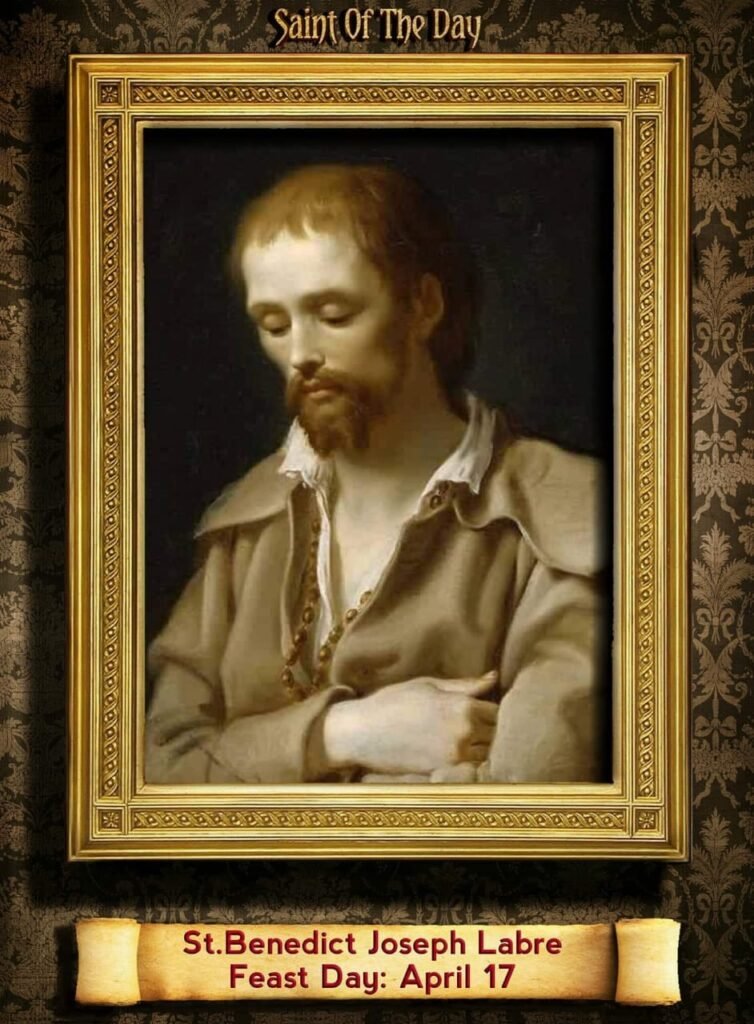
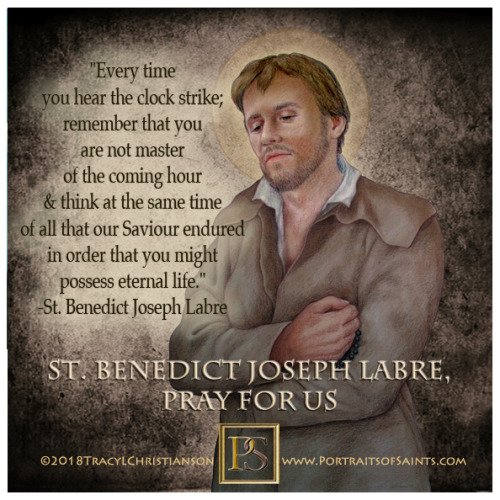
FEAST OF SAINT BENEDICT JOSEPH LABRE
FEAST DAY – 17th APRIL
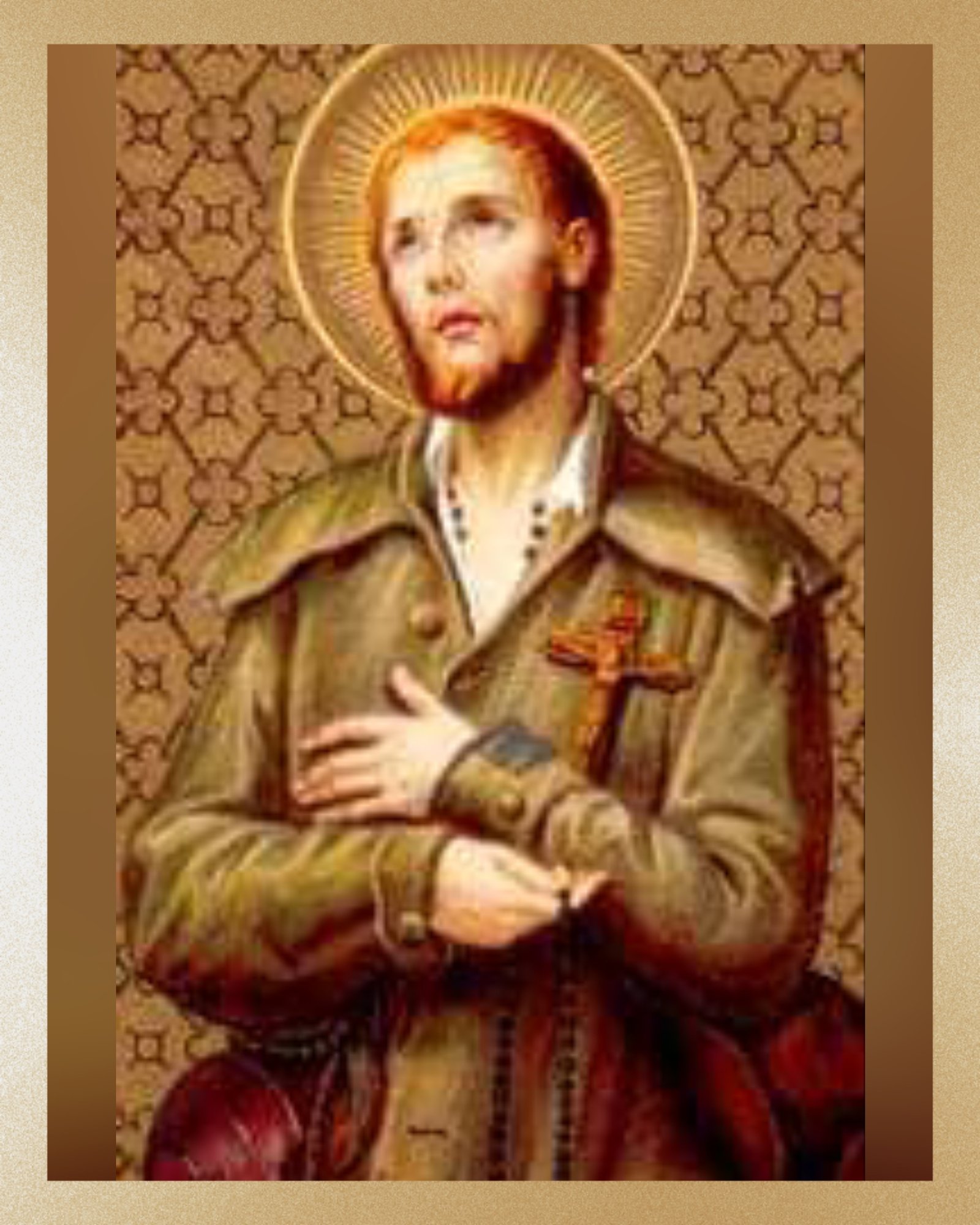
Benedict Joseph Labre (French: Benoît-Joseph Labre, 25 March 1748 – 16 April 1783) was a French mendicant, Franciscan tertiary, and Catholic saint. Labre was from a well to do family near Arras, France. After attempting a monastic lifestyle, he opted instead for the life of a pilgrim. He traveled to most of the major shrines of Europe, subsisting by begging.
Labre is patron saint of the homeless. Labre was born in 1748 in the village of Amettes, near Arras, in the former Province of Artois in the north of France. He was the eldest of fifteen children of a prosperous shopkeeper, Jean-Baptiste Labre, and his wife, Anne Grandsire. Labre had an uncle, a parish priest, living some distance from his family home.
This uncle gladly received him, and undertook his early education for the priesthood. At the age of sixteen, he approached his uncle about becoming a Trappist monk, but his parents told him he would have to wait until he grew older. When Benedict was about eighteen, an epidemic struck the city, and uncle and nephew busied themselves in the service of the sick.
While the uncle took care of the souls and bodies of the people, Benedict went to and fro caring for the cattle. Among the last victims of the epidemic was Labre’s uncle. Labre set off for La Trappe Abbey to apply to the Order, but did not come up to their requirements. He was under age, he was too delicate; he had no special recommendations.
He later attempted to join the Carthusians and Cistercians, but each order rejected him as unsuitable for communal life. He was, for about six weeks, a postulant with the Carthusians at Neuville. In November 1769 he obtained admission to the Cistercian Abbey of Sept-Fonts. After a short stay at Sept-Fonts his health gave way, and it was felt that his vocation lay elsewhere.
Labre, according to Catholic tradition, experienced a desire, which he considered was given to him by God and inspired by the example of Alexius of Rome and that of the Franciscan tertiary pilgrim, Saint Roch, to “abandon his country, his parents, and whatever is flattering in the world to lead a new sort of life, a life most painful, most penitential, not in a wilderness nor in a cloister, but in the midst of the world, devoutly visiting as a pilgrim the famous places of Christian devotion.”
Labre joined the Third Order of Saint Francis and settled on a life of poverty and pilgrimage. He first traveled to Rome on foot, subsisting on what he could get by begging. He then traveled to most of the major shrines of Europe, often several times each. He visited the various shrines in Loreto, Assisi, Naples, and Bari in Italy, Einsiedeln in Switzerland, Paray-le-Monial in France, and Santiago de Compostela in Spain.
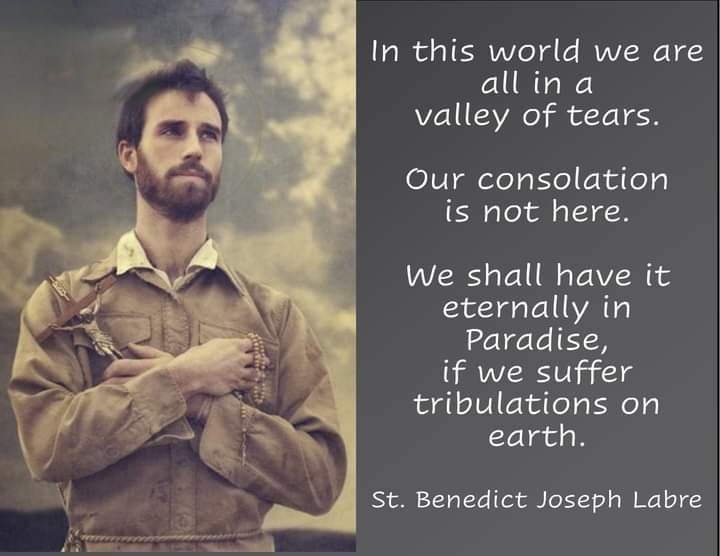
During these trips he would always travel on foot, sleeping in the open or in a corner of a room, with his clothes muddy and ragged. On one occasion he stopped at the farmhouse of Matthieu and Marie Vianney, who would later become the parents of Curé d’Ars. He lived on what little he was given, and often shared the little he did receive with others. He is reported to have talked rarely, prayed often, and accepted quietly the abuse he received.
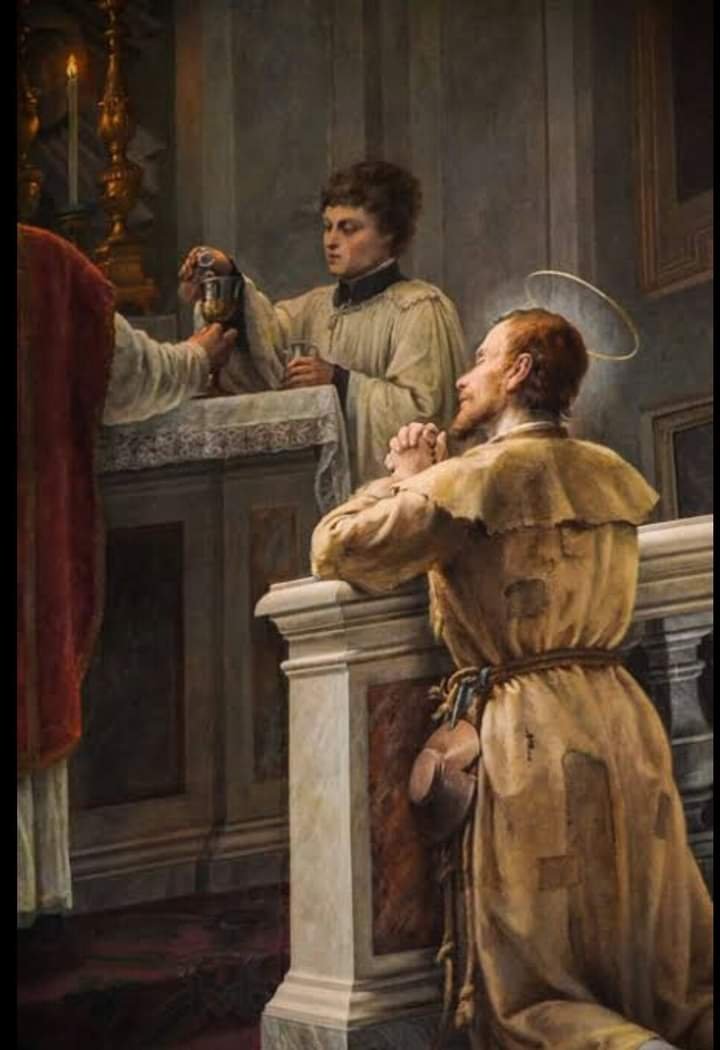
In so doing, Labre was following in the role of the mendicant, The “Fool-for-Christ,” found more often in the Eastern Church. He spent many hours in adoration of the Blessed Sacrament. He would often swoon when contemplating the crown of thorns, in particular, and, during these states, it is said he would levitate or bilocate. He was also said to have cured some of the other homeless he met and to have multiplied bread for them.
In the last years of his life (his thirties), he lived in Rome, for a time living in the ruins of the Colosseum, and would leave only to make a yearly pilgrimage to the shrine of Our Lady of Loreto. He was a familiar figure in the city and known as the “saint of the Forty Hours” (or Quarant’ Ore) for his dedication to Eucharistic adoration.
The day before he died, Labre collapsed on the steps of the church of Santa Maria ai Monti, blocks from the Colosseum, and despite his protestations was charitably taken to a house behind the church at Via dei Serpenti. He died there of malnutrition and exhaustion on 16 April 1783, during Holy Week, and was buried in the Church of Santa Maria ai Monti.
Labre’s confessor, Marconi, wrote his biography and attributed 136 separate cures to his intercession within three months of his death. Those miracles were instrumental in the conversion of the Reverend John Thayer, the first American Protestant clergyman to convert to Catholicism, who was resident in Rome at the time of St. Benedict’s death.
A cult grew up around him very soon after his death; he was declared Blessed by Blessed Pius IX in 1860, and canonized by Pope Leo XIII in 1881. Benedict is patron saint of Unmarried men (bachelors), rejects, mental illness, mentally ill people, insanity, beggars, hobos, the homeless.
PRAYER
Saint Benedict Joseph Labre, you gave up honor, money, and home for love of Jesus. Help us to set our hearts on Jesus and not on the things of this world. You lived in obscurity among the poor in the streets. Enable us to see Jesus in our poor brothers and sisters and not judge by appearances. Amen
*******************************
ALSO CELEBRATED:
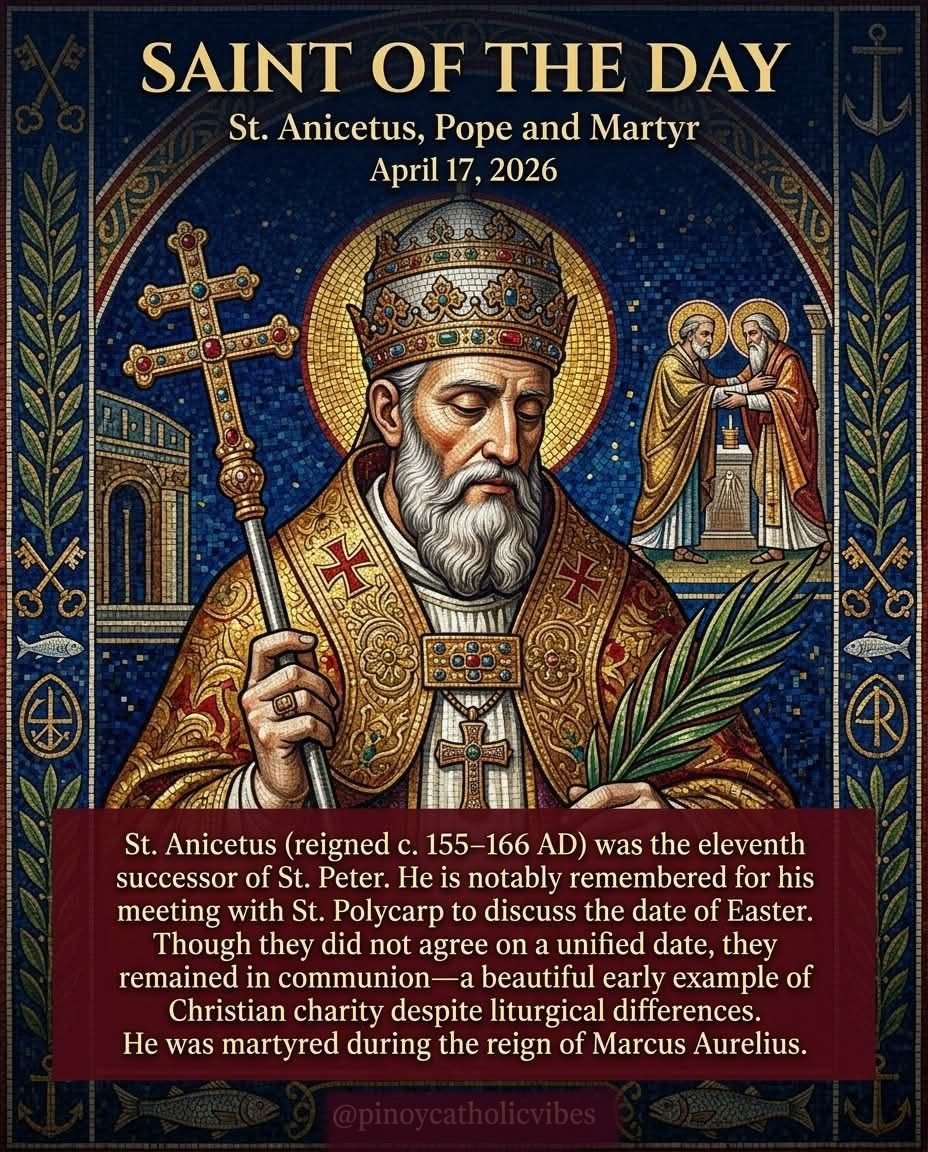
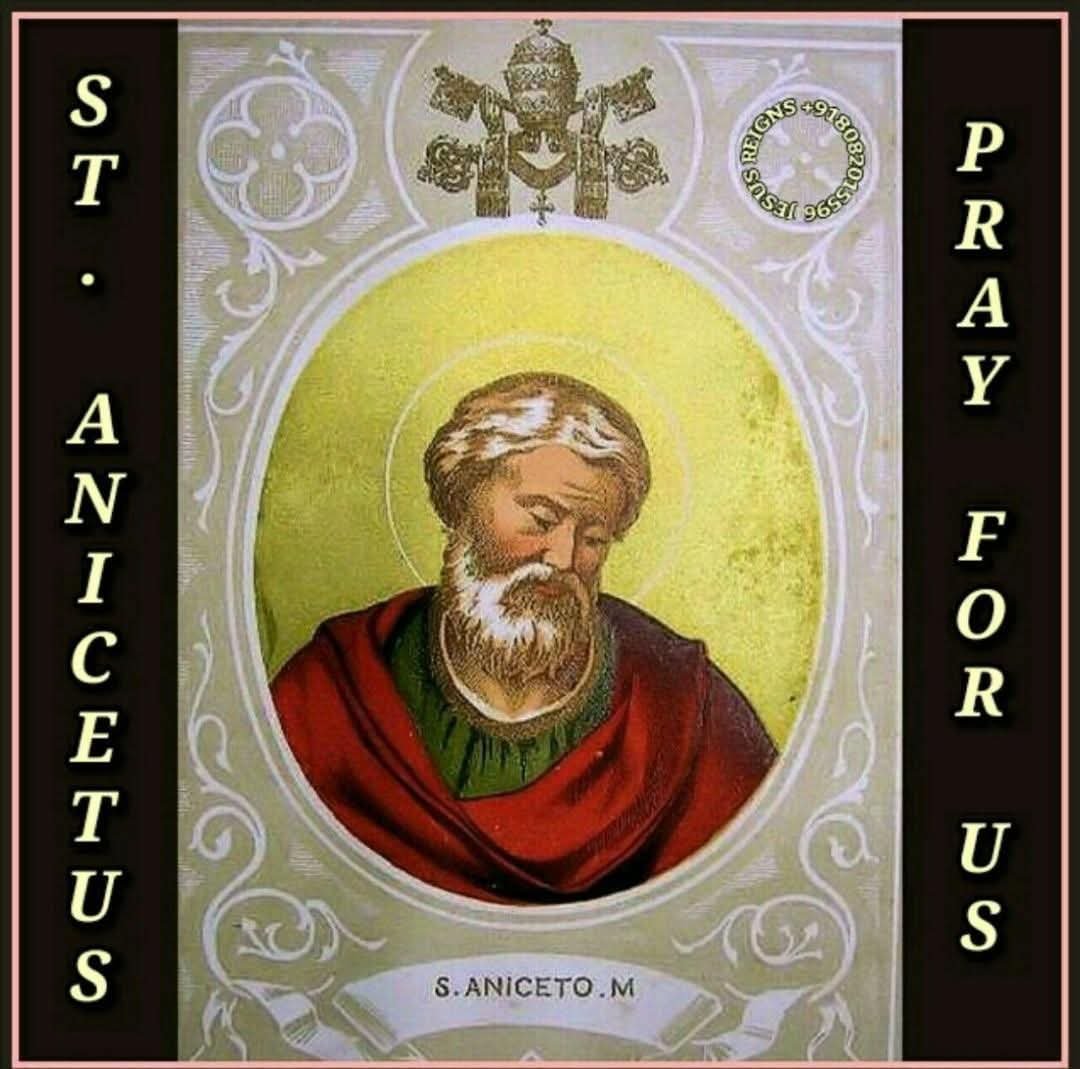
SAINT ANICETUS – POPE
Saint Anicetus, the twelfth Pope after St. Peter, first saw the light of day in Syria, toward the end of the first century. He was carefully educated by his parents, and was gifted by God with great natural abilities, especially with a clear, penetrating mind. He made, by his untiring perseverance, such progress in all sciences that he was accounted among the best scholars of his time.
In addition to this, the life he led was so blameless, that he was a model to every one of Christian perfection. The most shining of all his virtues was his truly apostolic zeal in protecting and disseminating the true faith.
Therefore, when Pius I. had ended his life by a glorious martyrdom, Anicetus was unanimously elected his successor amid great rejoicing. And in truth, the Church needed at that period, a Pope as learned, zealous and holy as himself, as she was assailed and persecuted in all possible ways by divers heretics.
Valentinus and Marcion, two Heresiarchs, had already commenced to sow the poison of their corruption in Rome, and even a wicked woman named Marcellina, who had adopted the teachings of Carpocrates, had already many followers. The saddest fact of all, however, was that the Catholics, themselves, became very indolent in the practice of their faith, and their conduct was not such as their religion required.
This inspired the heretics with hope of being able to instill their spurious doctrines into their minds, as we know by experience that the surest road to apostasy from the true faith, is indifference and debased morals.
St. Anicetus, although he perceived all this with great pain, did not become disheartened. Calling on God for aid, he began earnestly to work. By daily sermons, by teaching and exhortation, he endeavored to move the Catholics to more fervency in their religion, as well as to a reformation of their lives. The example of his own holy life gave the greatest force to his words. He lived like a Saint, and all his thoughts were directed to lead his flock to salvation.
He was an enemy to even the most innocent amusement, and found his only pleasure in prayer and in working for the honor of God and the salvation of souls. He employed the greater part of the night in devotional exercises, and during the day he was only found in Church, in the dwellings of the sick, or poor, or at home occupied in study or prayer. He chastised his body by fasting and other penances.
To his enemies he was kind and charitable; to the poor, liberal; while in danger and persecution he was fearless and strong. This beautiful example of their shepherd was soon followed by the Catholics residing at Rome with such zeal, that, according to the testimony of Hegesippus, the historian, the whole city became a habitation of sanctity. This change in the morals of the people was the most efficacious means of preserving them in the true faith, as the best safeguard of faith is a pious and blameless life. As far as the heretics were concerned, who endeavored to implant in the hearts of the Romans the seeds of their false doctrines, the holy father had the greatest compassion on them on account of their lost souls.
He left nothing untried to bring them to the knowledge of their error, but he thought it prudent to banish those who remained inflexible from the city. Polycarp, a disciple of St. John, came to Rome at the time of Anicetus, to discuss several points with him, which were to be settled for the welfare of the faithful. All was happily concluded and Polycarp paid the greatest honors to the holy Pope, everywhere praising his saintly conduct.
For eight years, Anicetus governed the Church with wonderful wisdom and power, when during the persecution of Marcus Aurelius he was seized, and being inflexible in the confession of his faith, he was decapitated.
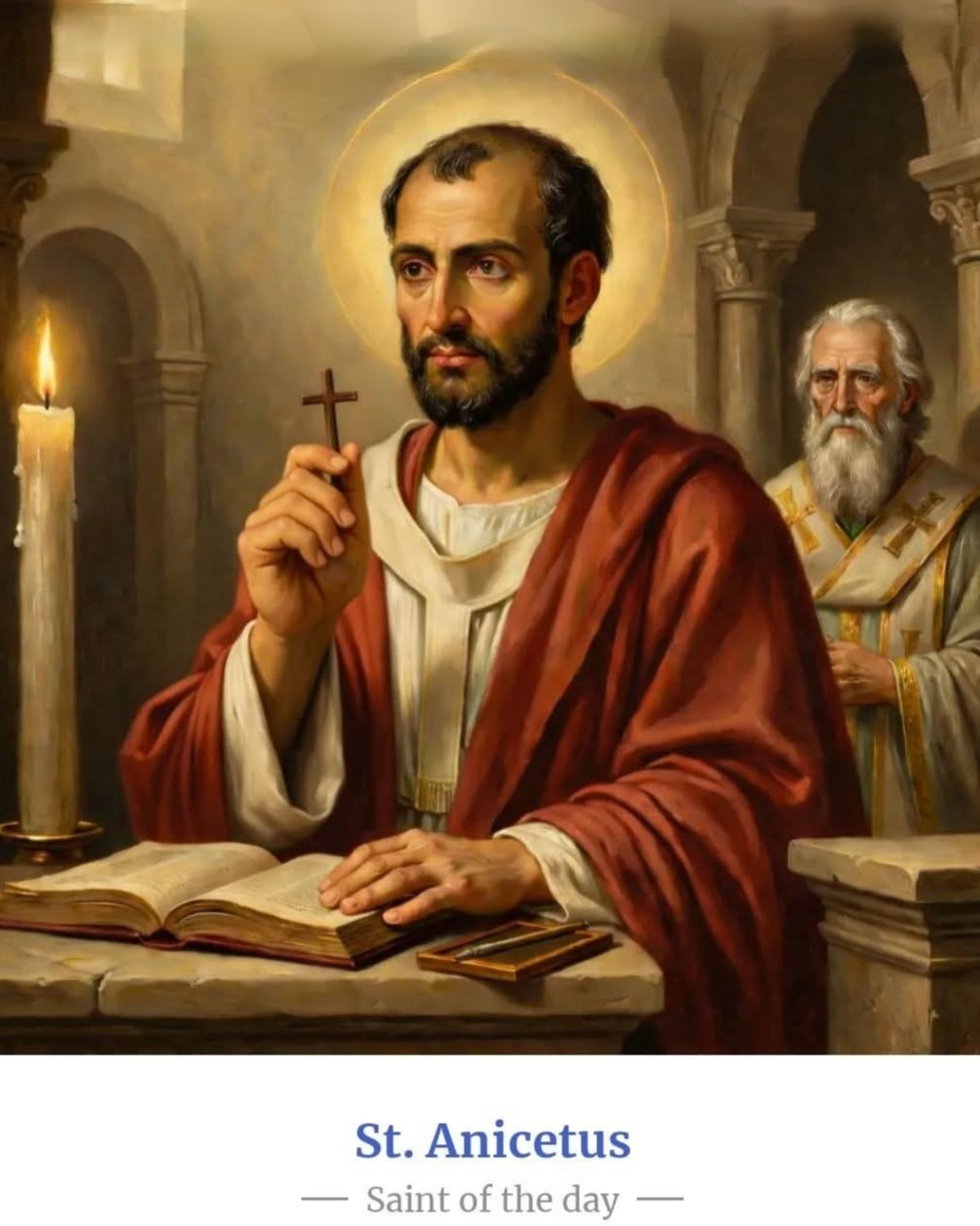
CONTEMPLATING THE LIFE OF SAINT POPE ANICETUS
A LIFE ROOTED IN THE EARLY CHURCH
Saint Anicetus stands among the early successors of the Apostles, guiding the Church during a time when its identity, teachings, and unity were still taking shape. Though little is known in detail, his quiet leadership helped preserve the faith handed down from the Apostles.
He was likely born in Syria, possibly in Emesa, and served as Pope in the mid-second century. His life unfolded during a period marked by the influence of the early Church Fathers, occasional Roman persecution, and the gradual development of doctrine and liturgical practices.
HOLDING THE CENTER THE QUIET STRENGTH OF UNITY
The Apostles had passed on, leaving behind communities spread across vast regions. These communities carried the Gospel through memory, teaching, and shared faith.
As the Church grew, it expanded across cultures and languages. With this growth came challenges, not only from external pressures but also from internal differences and tensions.
THE WHISPER OF OTHER TRUTHS
New ideas began to emerge within philosophical and religious circles. Among them were teachings later known as Gnosticism. These ideas suggested that salvation came through secret knowledge, that the material world was inferior, and that Christ only appeared to be human.
Such beliefs, though appealing to some, struck at the core of Christian truth. If Christ had not truly become human, then humanity itself could not be fully redeemed.
DISTORTIONS THAT DIVIDED
Other confusions also arose regarding the identity of Christ, the meaning of salvation, and the interpretation of apostolic teaching.
These were not always outright denials of truth but subtle shifts that gradually risked dividing the Church and weakening its unity.
A SHEPHERD WHO DID NOT PANIC
In the midst of these challenges stood Pope Anicetus. He was not known for dramatic actions or forceful measures. Instead, he led with clarity, patience, and fidelity.
He remained firmly rooted in the teachings received from the Apostles, safeguarding them without alteration or innovation.
TRUTH WITHOUT HARSHNESS
When faced with error and confusion, Anicetus did not engage in endless disputes. Rather, he strengthened the Church by upholding authentic teaching and ensuring continuity with apostolic tradition.
He understood that truth is best preserved not through noise or conflict, but through steady clarity and faithful witness.
A DIFFERENCE THAT DID NOT DIVIDE
A notable challenge during his papacy concerned the celebration of Easter. Different regions followed different traditions. To address this, Saint Polycarp of Smyrna visited Rome.
Though they disagreed on the practice, they remained united in faith. Anicetus did not impose uniformity but allowed diversity while preserving unity. He even welcomed Polycarp to celebrate the Eucharist in Rome, a powerful sign of communion.
HOLDING THE CENTRE
The Church remained united not because every issue was resolved, but because truth and charity were both upheld. Anicetus stood not as a ruler enforcing control, but as a shepherd holding the Church together with wisdom and humility.
SPIRITUAL SIGNIFICANCE – A SAINT OF UNITY IN DIVERSITY
His life shows that differences need not lead to division when rooted in truth and charity.
A GUARDIAN OF TRADITION
He faithfully preserved what was handed down, ensuring the continuity of apostolic teaching. He maintained unity in a time of diversity, fostering communion rather than conflict.
KEY THEMES FROM HIS LIFE – UNITY WITHOUT UNIFORMITY
The Church can remain one even amid differing practices.
DIALOGUE OVER DIVISION
Charitable disagreement strengthens rather than weakens the body of Christ.
FIDELITY TO APOSTOLIC TRADITION
The faith of the past continues to guide the present.
QUIET LEADERSHIP
True leadership is often steady, faithful, and without spectacle.
A LEGACY WITHOUT NOISE
Saint Anicetus did not leave behind dramatic accounts or grand displays. Instead, he left something far more enduring. By holding firmly to truth, he helped preserve the clarity of the Gospel. By choosing unity, he helped the Church endure.
PRAYER
Lord God,
You guided Your Church through the faithful leadership of Saint Pope Anicetus.
Grant us the grace to remain rooted in truth, patient in times of confusion,
and united in love despite our differences.
Help us to be instruments of peace and guardians of Your truth.
Amen