
FEAST OF THE IMMACULATE HEART OF MARY
June 13, 2026
Isaiah 43:2
June 13, 2026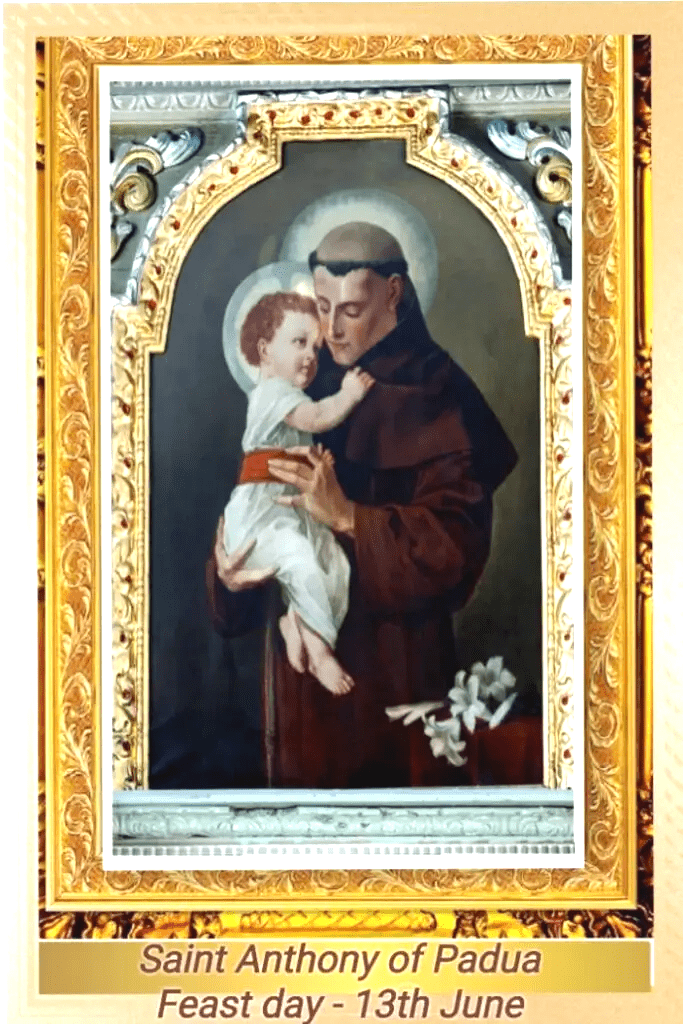
FEAST OF SAINT ANTHONY OF PADUA, PRIEST AND DOCTOR OF THE CHURCH
FEAST DAY – 13th JUNE
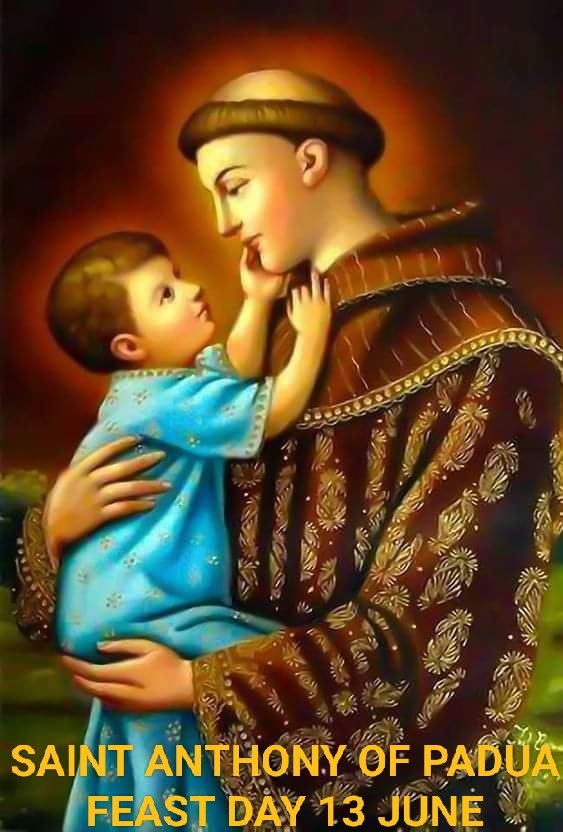
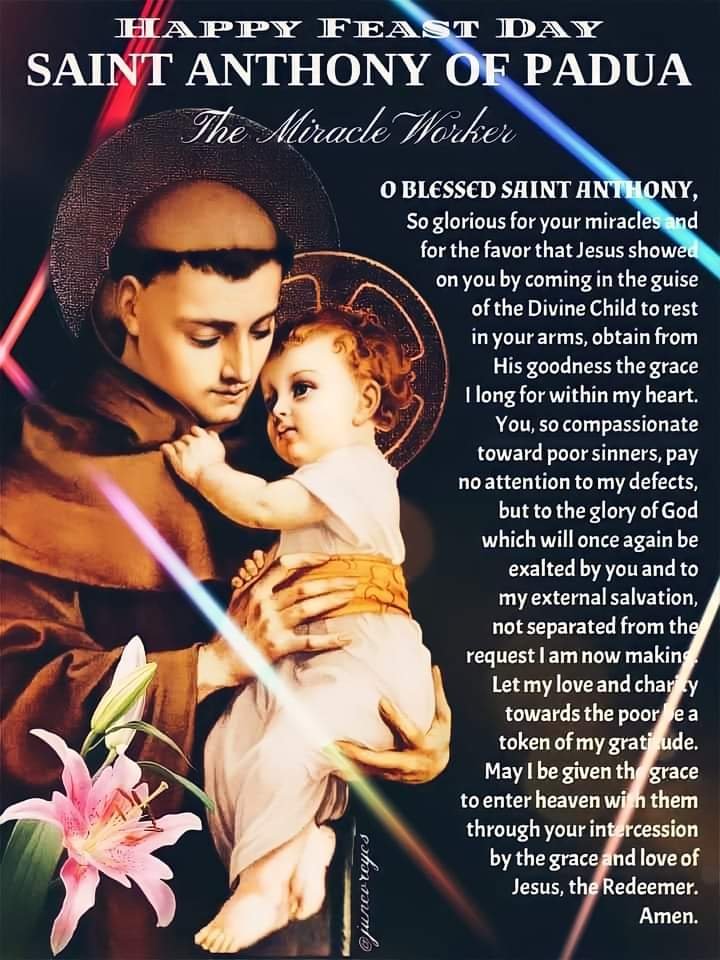
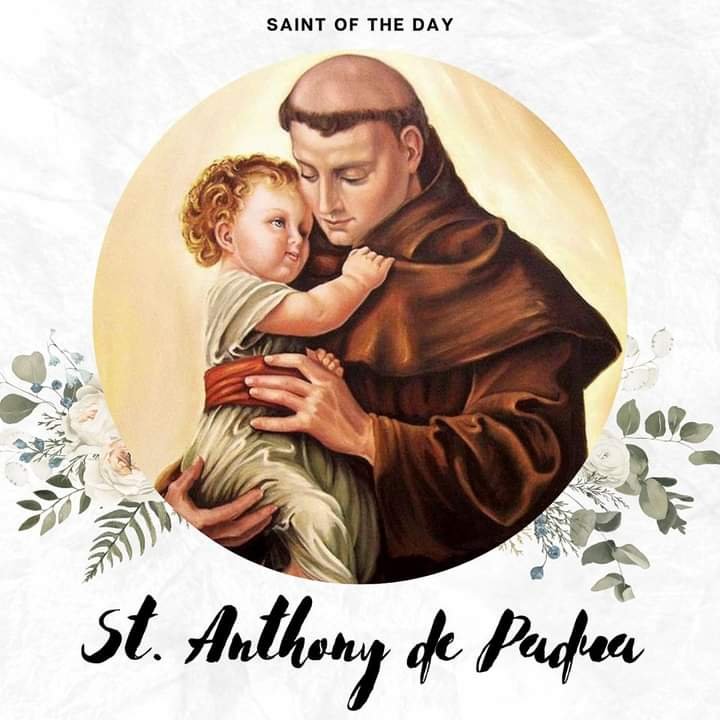
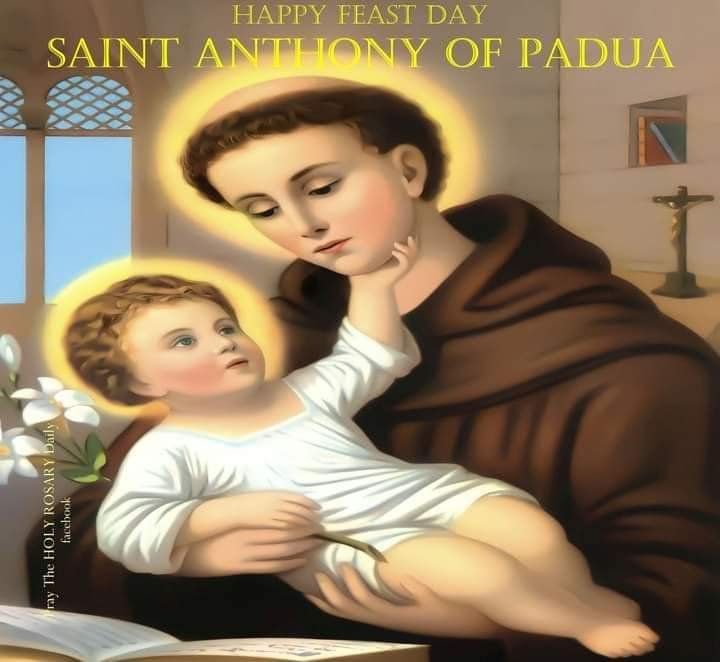
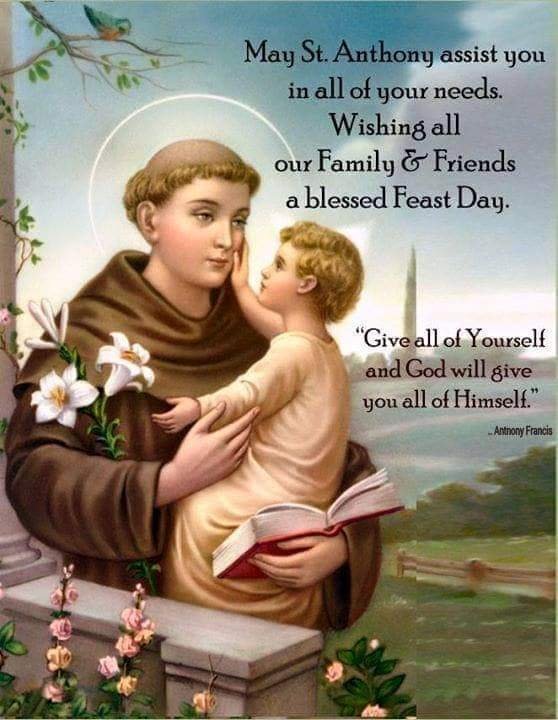
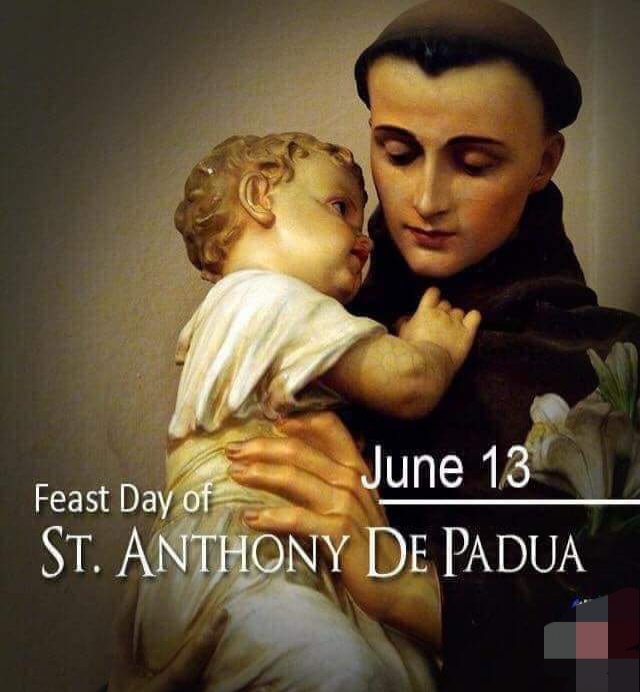
St. Anthony of Padua is one of the Catholic Church’s most popular saints. Saint Anthony of Padua, patron saint of lost and stolen articles, was a powerful Franciscan preacher and teacher. He’s typically portrayed holding the child Jesus—or a lily—or a book—or all three—in his arms. Many people give alms to St. Anthony Bread in thanksgiving to God for blessings received through the prayers of St. Anthony.
St. Anthony of Padua’s life is what every Christian’s life is meant to be; a steady courage to face the ups and downs of life, the call to love and forgive, to be concerned for the needs of others, to deal with crisis great and small, and to have our feet solidly on the ground of total trusting love and dependence on our Everlasting Father God.

St Anthony is beloved throughout the world and is responsive to all people and all needs. His intercessory powers before our God are awesome. Known as the patron saint of the poor, of sailors and fishermen, of priests and travelers, a protector and guardian of the mails, and wonder-worker, the story of St. Anthony of Padua is very special.
Legends about Saint Anthony abound. Anthony was born in 1195 (13 years after St. Francis) in Lisbon, Portugal and given the name of Fernando at Baptism. His parents, Martin and Mary Bulhom, apparently belonged to one of the prominent families of the city. At the age of 15 he entered the religious order of St. Augustine. Monastery life was hardly peaceful for young Fernando, nor conducive to prayer and study.

His old friends came to visit frequently and engaged in vehement political discussions. After two years he was sent to Coimbra. There he began nine years of intense study, learning the Augustinian theology that he would later combine with the Franciscan vision. Fernando was probably ordained a priest during this time.
The life of the young priest took a crucial turn when the bodies of the first five Franciscan martyrs were returned from Morocco. They had preached in the mosque in Seville, almost being martyred at the outset, but the sultan allowed them to pass on to Morocco, where, after continuing to preach Christ despite repeated warnings, they were tortured and beheaded.
Now, in the presence of the queen and a huge crowd, their remains were carried in solemn procession to Fernando’s monastery. He was overjoyed and inspired to a momentous decision.
He went to the little friary in Coimbra and said, “Brother, I would gladly put on the habit of your Order if you would promise to send me as soon as possible to the land of the Saracens, that I may gain the crown of the holy martyrs.”
After some challenges from the prior of the Augustinians, he was allowed to leave that priory and receive the Franciscan habit, taking the name Anthony. True to their promise, the Franciscans allowed Anthony to go to Morocco, to be a witness for Christ, and a martyr as well. But, as often happens, the gift he wanted to give was not the gift that was to be asked of him.
He became seriously ill, and after several months realized he had to go home. He never arrived. His ship ran into storms and high winds and was blown east across the Mediterranean. Months later he arrived on the east coast of Sicily. The friars at nearby Messina, though they didn’t know him, welcomed him and began nursing him back to health.

Still ailing, he wanted to attend the great Pentecost Chapter of Mats (so called because the 3,000 friars could not be housed and slept on mats). Francis was there, also sick. History does not reveal any meeting between Francis and Anthony. Since the young man was from “out of town,” he received no assignment at the meeting, so he asked to go with a provincial superior from northern Italy.
“Instruct me in the Franciscan life,” he asked, not mentioning his prior theological training. Now, like Francis, he had his first choice—a life of seclusion and contemplation in a hermitage near Montepaolo. Perhaps we would never have heard of Anthony if he hadn’t gone to an ordination of Dominicans and Franciscans in 1222.

As they gathered for a meal afterward, the provincial suggested that one of the friars give a short sermon. Quite typically, everybody ducked. So Anthony was asked to give “just something simple,” since he presumably had no education. Anthony too demurred, but finally began to speak in a simple, artless way. The fire within him became evident. His knowledge was unmistakable, but his holiness was what really impressed everyone there.
Now he was exposed. His quiet life of prayer and penance at the hermitage was exchanged for that of a public preacher. Francis heard of Anthony’s previously hidden gifts, and Anthony was assigned to preach in northern Italy. The problem with many preachers in Anthony’s day was that their life-style contrasted sharply with that of the poor people to whom they preached.

In our experience, it could be compared to an evangelist arriving in a slum driving a Mercedes, delivering a homily from his car and speeding off to a vacation resort.
Anthony saw that words were obviously not enough. He had to show gospel poverty. People wanted more than self-disciplined, even penitent priests. They wanted genuineness of gospel living.
And in Anthony they found it. They were moved by who he was, more than by what he said. Despite his efforts, not everyone listened. Legend has it that one day, faced with deaf ears, Anthony went to the river and preached to the fishes. That, reads the traditional tale, got everyone’s attention.
Anthony traveled tirelessly in both northern Italy and southern France—perhaps 400 trips—choosing to enter the cities where the heretics were strongest. Yet the sermons he has left behind rarely show him taking direct issue with the heretics. As the historian Clasen interprets it, Anthony preferred to present the grandeur of Christianity in positive ways.
It was no good to prove people wrong. Anthony wanted to win them to the right, the healthiness of real sorrow and conversion, the wonder of reconciliation with a loving Father. Anthony’s superior, St. Francis, was cautious about education such as his protégé possessed. He had seen too many theologians taking pride in their sophisticated knowledge.
Still, if the friars had to hit the roads and preach to all sorts of people, they needed a firm grounding in Scripture and theology. So, when he heard the glowing report of Anthony’s debut at the ordinations, Francis wrote in 1224, “It pleases me that you should teach the friars sacred theology, provided that in such studies they do not destroy the spirit of holy prayer and devotedness, as contained in the Rule.”
Anthony first taught in a friary in Bologna, which became a famous school. The theology book of the time was the Bible. In one extant sermon by the saint, there are at least 183 passages from Scripture. While none of his theological conferences and discussions were written down, we do have two volumes of his sermons: Sunday and Feast-day Sermons.
His method included the use of allegory and symbolic explanation of Scripture. Anthony continued to preach as he taught the friars and assumed more responsibility within the Order. In 1226 he was appointed provincial superior of northern Italy, but still found time for contemplative prayer in a small hermitage. Around Easter in 1228 (he was only 33 years old), while in Rome, he met Pope Gregory IX, who had been a faithful friend and adviser of St. Francis.
Naturally, the famous preacher was invited to speak. He did it humbly, as always. The response was so great that people later said that it seemed the miracle of Pentecost was repeated.
Padua, Italy, is a short distance west of Venice. At the time of Anthony, it was one of the most important cities in the country, with an important university for the study of civil and canon law.
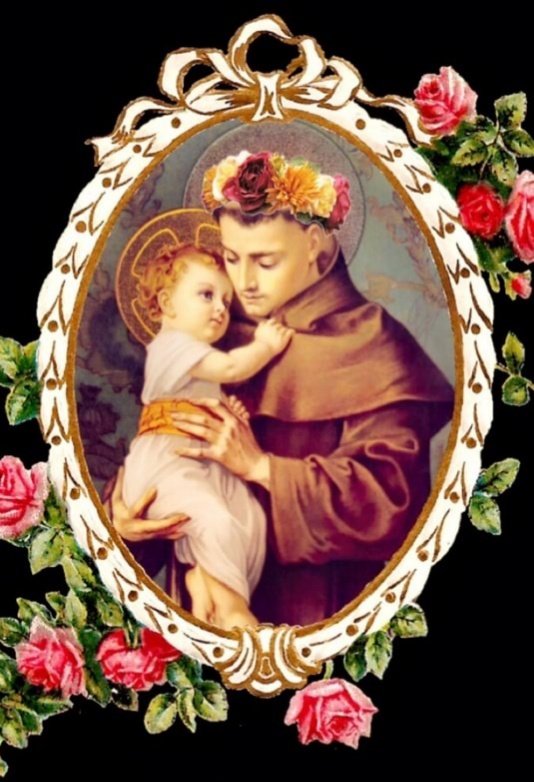
Sometimes Anthony left Padua for greater solitude. He went to a place loved by Francis—LaVerna, where Francis received the wounds of Jesus. He also found a grotto near the friary where he could pray in solitude. In poor health, and still provincial superior of northern Italy, he went to the General Chapter in Rome and asked to be relieved of his duties.
But he was later recalled as part of a special commission to discuss certain matters of the Franciscan Rule with the pope. Back in Padua, he preached his last and most famous Lenten sermons. The crowds were so great—sometimes 30,000—that the churches could not hold them, so he went into the piazzas or the open fields. People waited all night to hear him.
He needed a bodyguard to protect him from the people armed with scissors who wanted to snip off a piece of his habit as a relic. After his morning Mass and sermon, he would hear confessions. This sometimes lasted all day—as did his fasting. The great energy he had expended during the Lent of 1231 left him exhausted.
He went to a little town near Padua, but seeing death coming close, he wanted to return to the city that he loved. The journey in a wagon weakened him so much, however, that he had to stop at Arcella. He had to bless Padua from a distance, as Francis had blessed Assisi.
At Arcella, he received the last sacraments, sang and prayed with the friars there.
When one of them asked Anthony what he was staring at so intently, he answered, “I see my Lord!” He died in peace a short time after that. He was only 36 and had been a Franciscan but 10 years. The following year, his friend, Pope Gregory IX, moved by the many miracles that occurred at Anthony’s tomb, declared him a saint.
Anthony was a simple and humble friar who preached the Good News lovingly and with fearless courage. The youth whom his fellow friars thought was uneducated became one of the great preachers and theologians of his day. He was a man of great penance and apostolic zeal. But he was primarily a saint of the people.
The reason for invoking St. Anthony’s help in finding lost or stolen things is traced back to an incident in his own life. As the story goes, Anthony had a book of psalms that was very important to him.
Besides the value of any book before the invention of printing, the psalter had the notes and comments he had made to use in teaching students in his Franciscan Order.
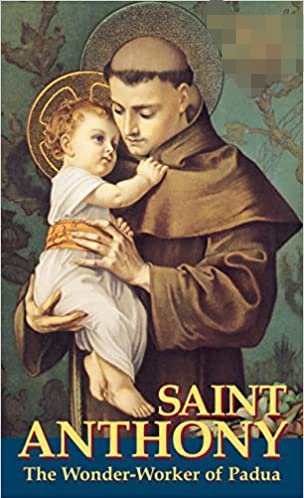
A novice who had already grown tired of living religious life decided to depart the community and he took Anthony’s psalter with him. Upon realizing his psalter was missing, Anthony prayed it would be found or returned to him. And after his prayer the thieving novice was moved to return the psalter to Anthony and to return to the Order, which accepted him back.
Legend has embroidered this story a bit. It has the novice stopped in his flight by a horrible devil, brandishing an ax and threatening to trample him underfoot if he did not immediately return the book. Obviously a devil would hardly command anyone to do something good. But the core of the story would seem to be true. And the stolen book is said to be preserved in the Franciscan friary in Bologna.
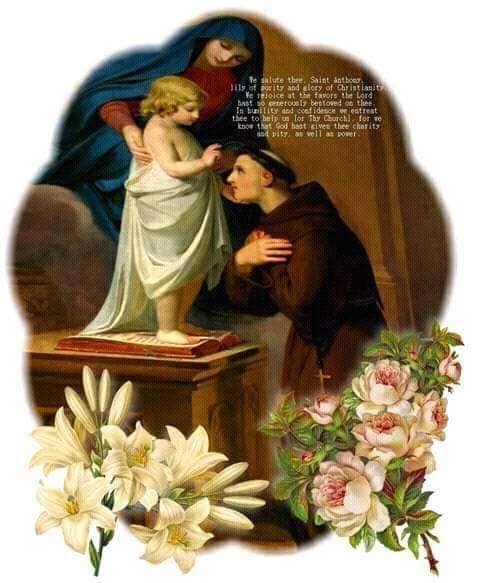
In any event, shortly after his death people began praying through Anthony to find or recover lost and stolen articles. And the Responsory of St. Anthony composed by his contemporary, Julian of Spires, O.F.M., proclaims
“The sea obeys and fetters break
And lifeless limbs thou dost restore
While treasures lost are found again
When young or old thine aid implore.”
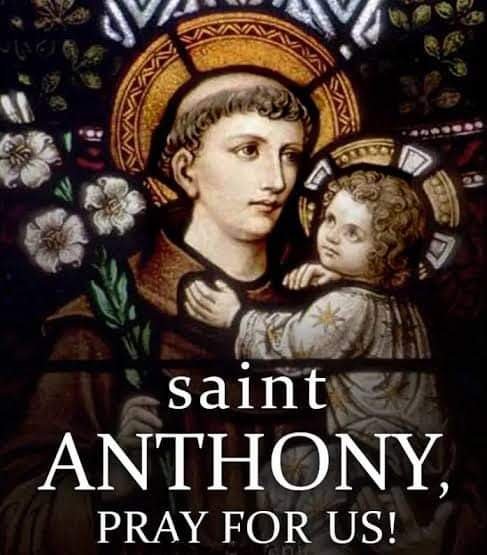
St. Anthony Bread is a term used for offerings made in thanksgiving to God for blessings received through the prayers of St. Anthony. Sometimes the alms are given for the education of priests. In some places parents also make a gift for the poor after placing a newborn child under the protection of St. Anthony. It is a practice in some churches to bless small loaves of bread on the feast of St. Anthony and give them to those who want them.
Different legends or stories account for the donation of what is called St. Anthony Bread. By at least one account it goes back to 1263, when it is said a child drowned near the Basilica of St. Anthony which was still being built. His mother promised that if the child was restored to her she would give for the poor an amount of corn equal to the child’s weight. Her prayer and promise were rewarded with the boy’s return to life.
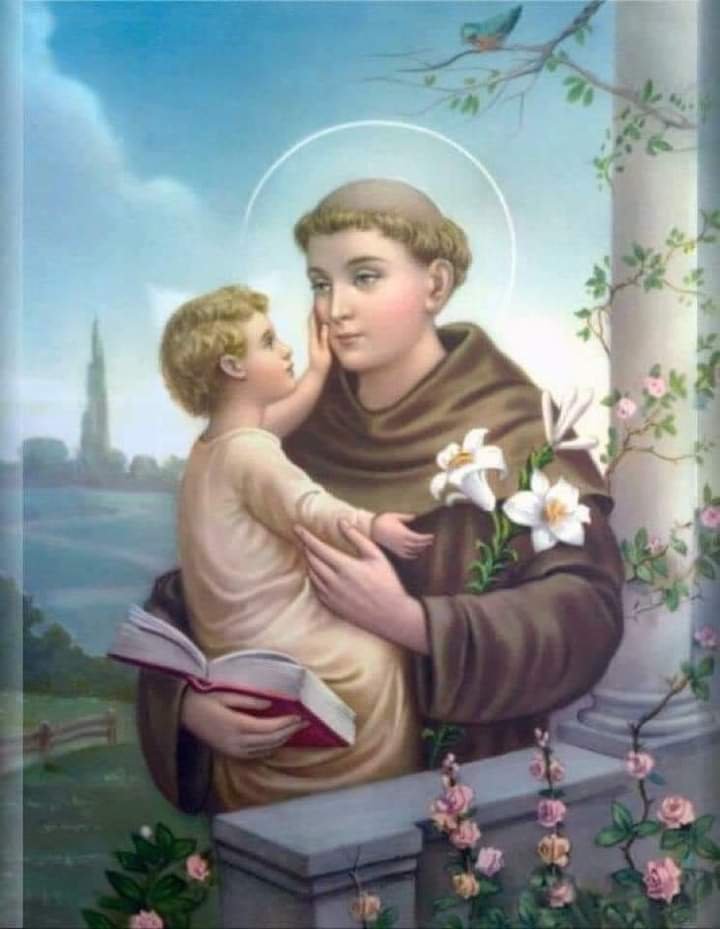
Another reason for the practice is traced back to Louise Bouffier, a shopkeeper in Toulon, France. A locksmith was prepared to break open her shop door after no key would open it. Bouffier asked the locksmith to try his keys one more time after she prayed and promised to give bread to the poor in honor of St. Anthony. The door then opened. After others received favors, they joined Louise Bouffier in founding the charity of St. Anthony Bread.
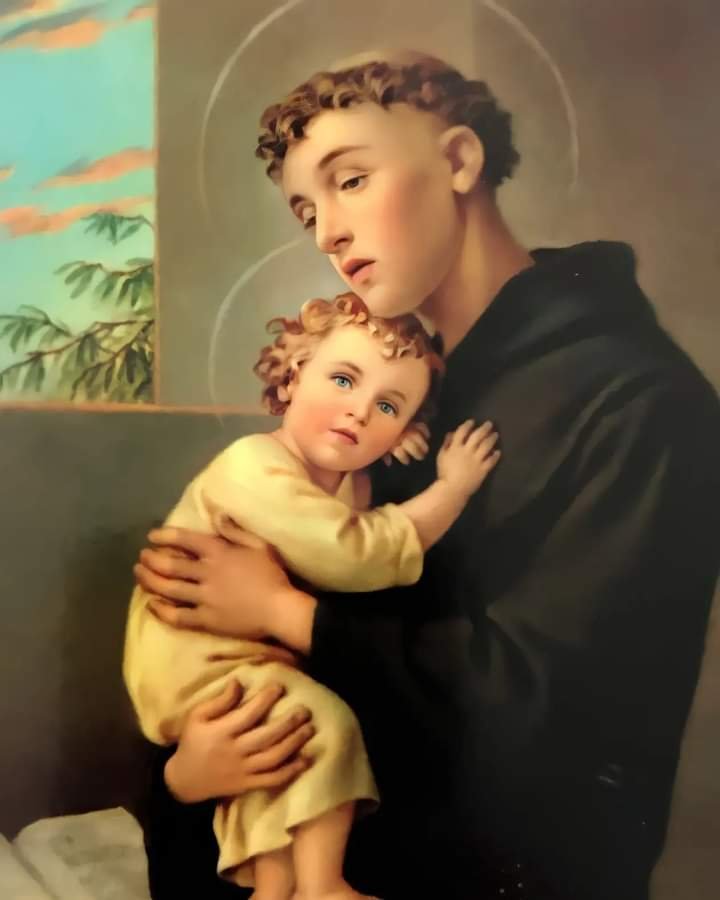
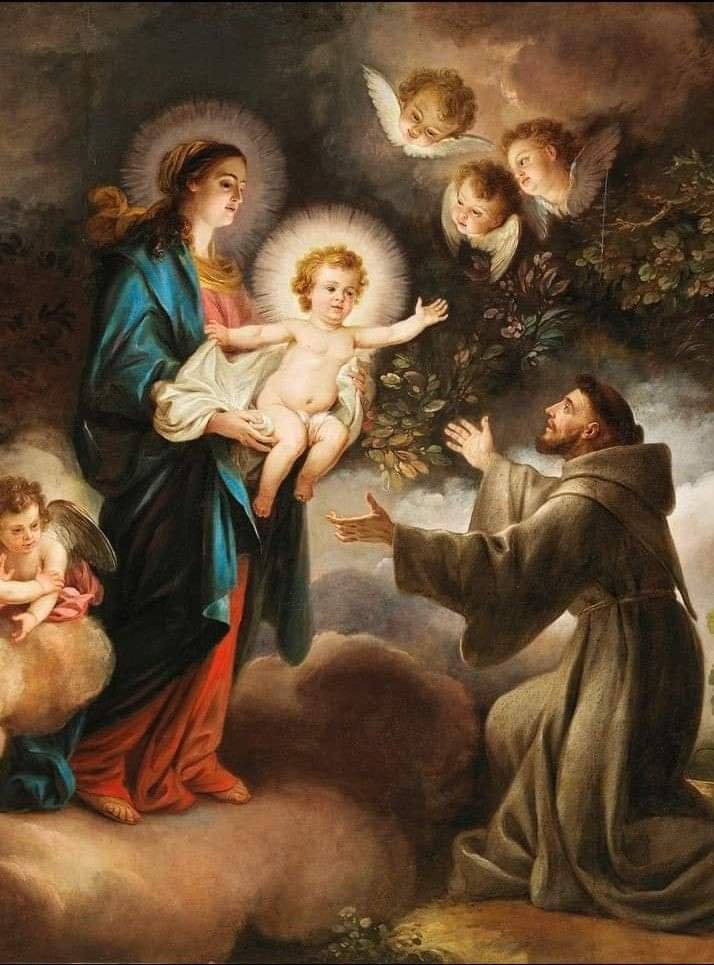
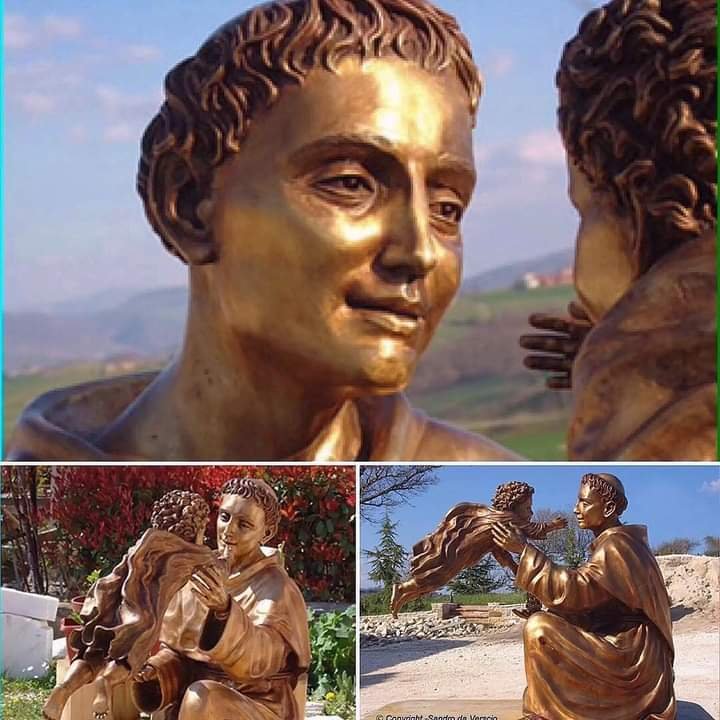
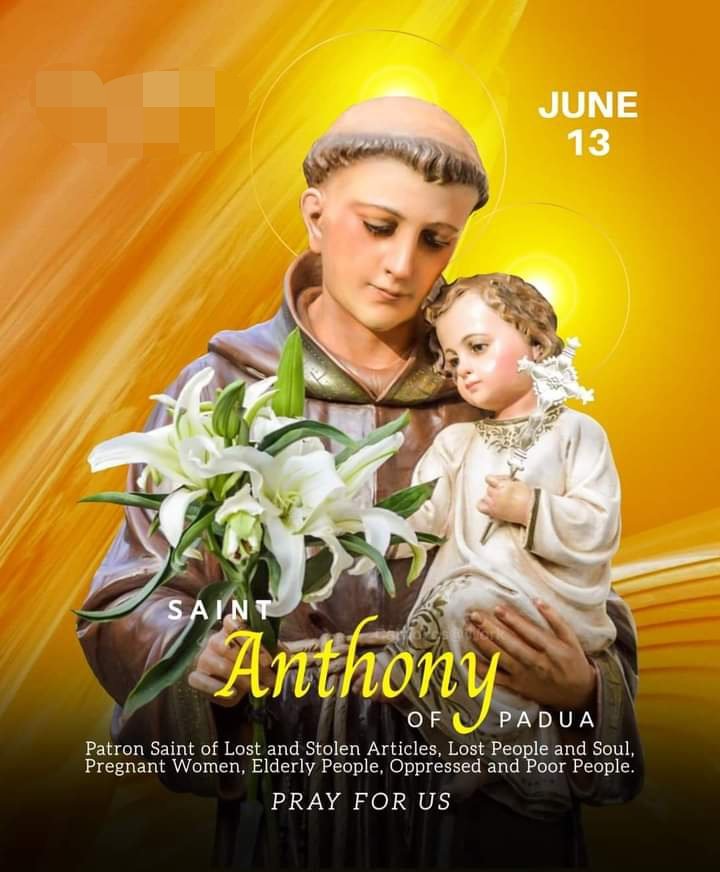
St. Anthony has been pictured by artists and sculptors in all kinds of ways. He is depicted with a book in his hands, with a lily or torch. He has been painted preaching to fish, holding a monstrance with the Blessed Sacrament in front of a mule or preaching in the public square or from a nut tree.
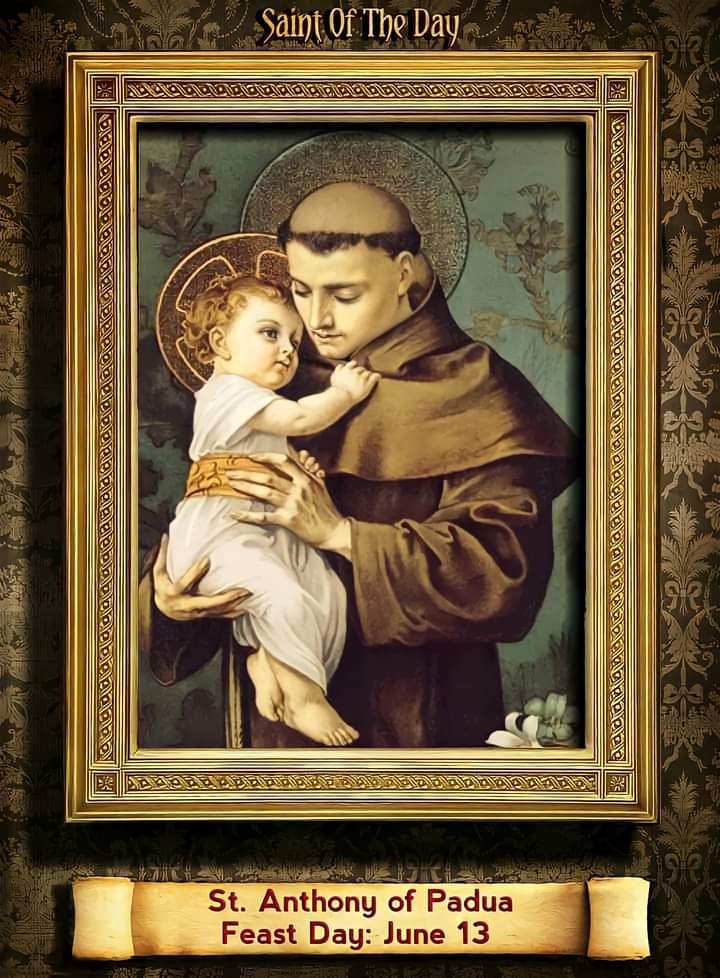
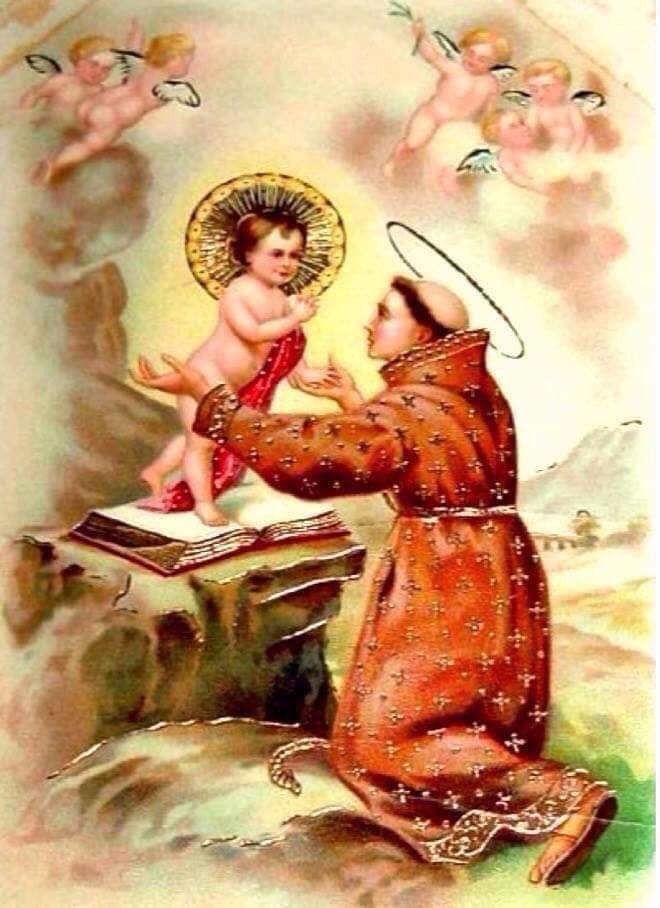
But since the 17th century we most often find the saint shown with the child Jesus in his arm or even with the child standing on a book the saint holds. A story about St. Anthony projects back into the past a visit of Anthony to the Lord of Chatenauneuf. Anthony was praying far into the night when suddenly the room was filled with light more brilliant than the sun.
Jesus then appeared to St. Anthony under the form of a little child. Chatenauneuf, attracted by the brilliant light that filled his house, was drawn to witness the vision but promised to tell no one of it until after St. Anthony’s death. Some may see a similarity and connection between this story and the story in the life of St. Francis when he reenacted at Greccio the story of Jesus, and the Christ Child became alive in his arms.
There are other accounts of appearances of the child Jesus to Francis and some companions. These stories link Anthony with Francis in a sense of wonder and awe concerning the mystery of Christ’s incarnation. They speak of a fascination with the humility and vulnerability of Christ who emptied himself to become one like us in all things except sin.
For Anthony, like Francis, poverty was a way of imitating Jesus who was born in a stable and would have no place to lay his head. In Portugal, Italy, France and Spain, St. Anthony is the patron saint of sailors and fishermen. According to some biographers his statue is sometimes placed in a shrine on the ship’s mast. And the sailors sometimes scold him if he doesn’t respond quickly enough to their prayers.
Not only those who travel the seas but also other travelers and vacationers pray that they may be kept safe because of Anthony’s intercession. Several stories and legends may account for associating the saint with travelers and sailors. First, there is the very real fact of Anthony’s own travels in preaching the gospel, particularly his journey and mission to preach the gospel in Morocco, a mission cut short by severe illness.
But after his recovery and return to Europe, he was a man always on the go, heralding the Good News. There is also a story of two Franciscan sisters who wished to make a pilgrimage to a shrine of our Lady but did not know the way. A young man is supposed to have volunteered to guide them. Upon their return from the pilgrimage one of the sisters announced that it was her patron saint, Anthony, who had guided them.
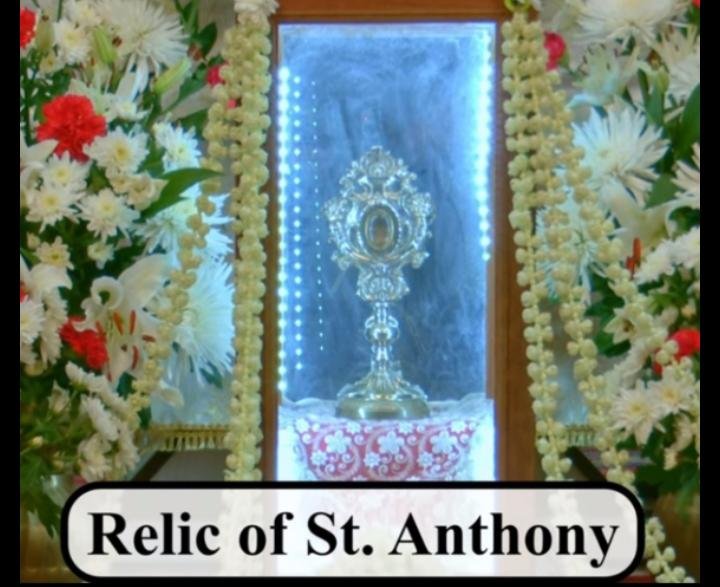
Still another story says that in 1647 Father Erastius Villani of Padua was returning by ship to Italy from Amsterdam. The ship with its crew and passengers was caught in a violent storm. All seemed doomed. Father Erastius encouraged everyone to pray to St. Anthony. Then he threw some pieces of cloth that had touched a relic of St. Anthony into the heaving seas. At once, the storm ended, the winds stopped and the sea became calm.
Among the Franciscans themselves and in the liturgy of his feast, St. Anthony is celebrated as a teacher and preacher extraordinaire. He was the first teacher in the Franciscan Order, given the special approval and blessing of St. Francis to instruct his brother Franciscans. His effectiveness as a preacher resulted in the title “Hammer of Heretics.” Just as important were his peacemaking and calls for justice.
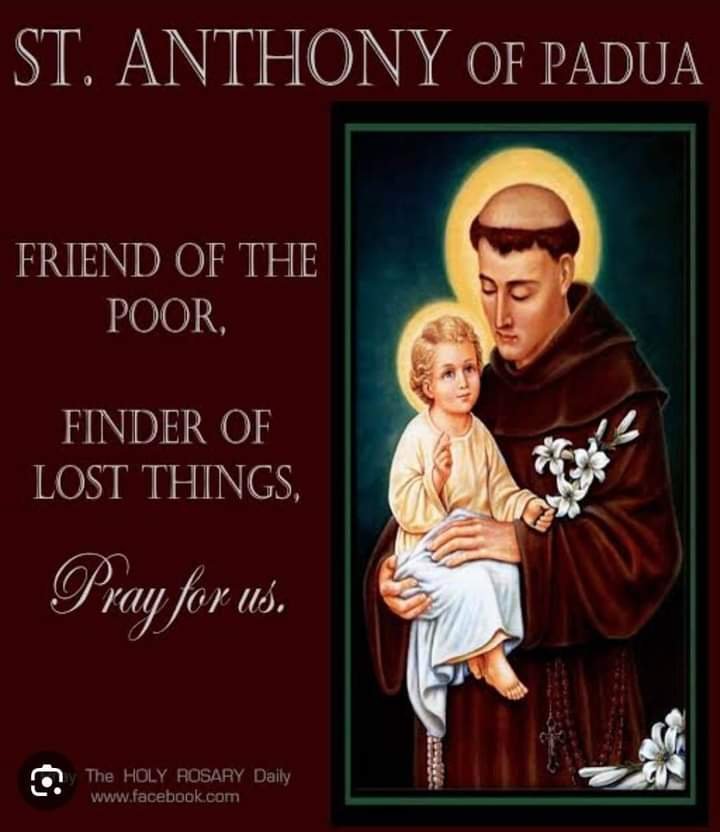
In canonizing Anthony in 1232, Pope Gregory IX spoke of him as the “Ark of the Testament” and the “Repository of Holy Scripture.” That explains why St. Anthony is frequently pictured with a burning light or a book of the Scriptures in his hands. In 1946 Pope Pius XII officially declared Anthony a Doctor of the Universal Church.
It is in Anthony’s love of the word of God and his prayerful efforts to understand and apply it to the situations of everyday life that the Church especially wants us to imitate St. Anthony. While noting in the prayer of his feast Anthony’s effectiveness as an intercessor, the Church wants us to learn from Anthony, the teacher, the meaning of true wisdom and what it means to become like Jesus, who humbled and emptied himself for our sakes and went about doing good.
(Source: stanthony.org)
UNFAILING PRAYER TO SAINT ANTHONY
O Holy St. Anthony, gentlest of Saints, your love for God and Charity for His creatures, made you worthy, when on earth, to possess miraculous powers. Encouraged by this thought, I implore you to obtain for me (request).
O gentle and loving St. Anthony, whose heart was ever full of human sympathy, whisper my petition into the ears of the sweet Infant Jesus, who loved to be folded in your arms; and the gratitude of my heart will ever be yours. Amen
(Source: catholic.org)

CONTEMPLATING THE LIFE OF SAINT ANTHONY OF PADUA – THE WONDER-WORKER, PREACHER, AND LOVER OF THE WORD OF GOD
Saint Anthony of Padua, known in his homeland as Anthony of Lisbon, is one of the most beloved saints of the Catholic Church. He is remembered as a gifted preacher, theologian, Franciscan friar, miracle worker, Doctor of the Church, defender of the poor, and zealous evangelist. For centuries, Christians have sought his intercession, especially when searching for lost things, lost opportunities, or a renewed relationship with God. Yet his greatest gift was leading people back to Christ through his holiness and love for Scripture.
THE SAINT WHO WANTED TO DIE A MARTYR BUT LIVED TO SAVE SOULS
Born in Lisbon, Portugal, in 1195, Anthony was originally named Fernando. Though he came from a noble family and had many opportunities for success, he felt called to serve God from an early age. He entered religious life, seeking holiness above worldly honors.
THE SCHOLAR IN SEARCH OF GOD
Fernando joined the Canons Regular of Saint Augustine, where he devoted himself to prayer, theology, and the study of Sacred Scripture. His knowledge and wisdom grew, but God was preparing him for a mission far greater than academic learning.
THE MARTYRS WHO CHANGED HIS HEART
The return of the bodies of five Franciscan missionaries martyred in Morocco deeply moved Fernando. Inspired by their sacrifice, he desired to become a missionary and give his life for Christ.
A NEW NAME AND A NEW DREAM
Leaving the Augustinians, he joined the Franciscan Order and took the name Anthony in honor of Saint Anthony the Great. Filled with missionary zeal, he set out for Morocco, hoping to preach the Gospel and, if God willed, die as a martyr.
THE PROVIDENCE OF GOD
Shortly after arriving in Morocco, Anthony became seriously ill and was forced to return home. During the voyage, a storm diverted his ship to Italy. What seemed like failure was actually God’s plan leading him toward his true vocation.
THE HIDDEN FRIAR
In Italy, Anthony lived quietly, performing simple duties while remaining largely unnoticed. He prayed, worked, and waited patiently, trusting God’s timing.
THE SERMON THAT CHANGED EVERYTHING
At an ordination ceremony, when the scheduled preacher failed to appear, Anthony was asked to speak. His remarkable knowledge of Scripture and ability to explain the Gospel amazed everyone present. His hidden talents were finally revealed.
THE FRIEND OF SAINT FRANCIS
News of Anthony’s preaching reached Saint Francis of Assisi, who recognized his wisdom and holiness. Francis encouraged him to teach theology and preach throughout the Franciscan community.
THE APOSTLE OF THE CROWDS
Anthony became one of the greatest preachers of his age. Vast crowds gathered to hear him. Through his words, many people returned to God, found hope, and renewed their faith. He preached with conviction, charity, and truth.
THE DEFENDER OF THE POOR
Anthony boldly challenged greed, injustice, and dishonesty. He defended the poor and spoke against the misuse of power, teaching that true holiness includes concern for those who suffer.
THE WONDER-WORKER
Many miracles were attributed to Anthony. Tradition tells of fish listening to his preaching when people refused and of a mule kneeling before the Blessed Sacrament in testimony to Christ’s presence in the Eucharist. Numerous healings, conversions, and answered prayers were associated with his ministry.
THE VISION OF THE CHILD JESUS
One of the most cherished traditions recounts that Anthony received a vision of the Child Jesus while deep in prayer. This image of the saint holding the Christ Child has become one of the most beloved representations of him and reflects his deep intimacy with Christ.
THE FINAL JOURNEY
Years of preaching and ministry weakened Anthony’s health. He died on June 13, 1231, at the age of thirty-six in Padua. The people already regarded him as a saint, and great sorrow filled the city at his passing.
THE SAINT OF LOST THINGS
Although Anthony is widely known as the patron saint of lost items, his greatest mission was helping people rediscover their relationship with God. He dedicated his life to bringing lost souls back to Christ.
CANONIZATION
Anthony’s canonization was among the fastest in Church history. About a year after his death, Pope Gregory IX declared him a saint in recognition of his extraordinary holiness.
DOCTOR OF THE CHURCH
In 1946, Pope Pius XII proclaimed Anthony a Doctor of the Church, honoring the depth of his theological wisdom and biblical teaching.
PATRONAGE
Saint Anthony is the patron of lost items, lost persons, travelers, the poor, pregnant women, fishermen, and all who seek spiritual assistance. His patronage reflects both his concern for human needs and his mission of leading souls to God.
ARTISTIC REPRESENTATION
Anthony is commonly depicted holding the Child Jesus, carrying a lily, and holding a Bible while dressed in the Franciscan habit. These symbols represent his purity, love for Scripture, and close union with Christ.
WHY HE STILL MATTERS
Saint Anthony remains relevant today because he reminds believers that holiness and learning belong together, that God’s plans are often different from our own, and that apparent failures can become pathways to greater blessings. His life shows that Scripture transforms lives and that Christ continually seeks what is lost.
HIS ENDURING MESSAGE
Anthony dreamed of becoming a martyr in Morocco, but God called him to become a preacher in Italy. What appeared to be disappointment became his true vocation. Through obedience to God’s plan, he touched countless lives and became one of the most beloved saints in Christian history. His life teaches that God’s plans are often greater than our own dreams, and that what seems like failure may be the beginning of a greater purpose.
REFLECTIONS FROM THE LIFE OF SAINT ANTHONY OF PADUA
HIS EARLY DESIRE FOR GOD
From childhood, Anthony was drawn to prayer and the religious life despite the attractions of worldly success.
God often places holy desires within the heart long before revealing the mission they are meant to accomplish.
HIS YEARS OF STUDY
Anthony dedicated himself to Scripture, theology, and spiritual growth.
Knowledge becomes true wisdom when it leads to a deeper love of God and service to others.
THE INSPIRATION OF THE MARTYRS
The witness of the Franciscan martyrs inspired him to give his life completely to Christ.
The courage and faith of holy people often inspire others to respond generously to God’s call.
HIS DECISION TO BECOME A FRANCISCAN
Anthony left behind comfort and security to follow God’s invitation.
Every genuine vocation requires trust and surrender to God’s plan.
HIS FAILED MISSION TO MOROCCO
Illness prevented him from fulfilling his dream of missionary work.
What appears to be failure may become God’s way of leading us to a greater purpose.
THE STORM THAT CHANGED HIS COURSE
A violent storm redirected his journey and changed the direction of his life.
God’s providence often works through unexpected events and interruptions.
HIS HIDDEN YEARS OF HUMBLE SERVICE
Before becoming widely known, Anthony served quietly and faithfully.
God often prepares His servants in hidden ways before entrusting them with greater responsibilities.
HIS GIFT OF PREACHING
Anthony used his deep knowledge of Scripture to bring many people closer to Christ.
When God’s Word fills the heart, it naturally touches and transforms the lives of others.
HIS LOVE FOR THE POOR AND FORGOTTEN
He defended the suffering and spoke against injustice wherever he encountered it.
True love for Christ is always expressed through compassion for those in need.
HIS VISION OF THE CHILD JESUS
Tradition recalls that Anthony held the Child Jesus in his arms during prayer.
Those who sincerely seek Christ eventually discover that Christ has been seeking them even more.
PRAYER THROUGH THE INTERCESSION OF SAINT ANTHONY OF PADUA
O beloved Saint Anthony of Padua, faithful preacher of the Gospel and friend of all who seek God’s help, pray for us that we may grow in faith, humility, and love for Christ. Teach us to trust in God’s providence when our plans fail, to cherish His Word in our hearts, and to serve others with compassion and generosity. Help us recover whatever has been lost in our spiritual lives, whether faith, hope, courage, or peace. May your prayers lead us ever closer to Jesus, whom you loved so deeply and proclaimed so faithfully. Amen
PRAYER
Eternal Father, your dearly beloved Saint Anthony revelled in every moment of the life you gave him, and seized every minute as an opportunity to enrich his relationship with You. His absolute trust and palpable love for You was evident in every fibre of his being.
He dedicated his entire life towards edification of Your Holy Name and that of Your Church. May we emulate Saint Anthony by transforming our lives to living in Christ in a tangible manner, setting an example for others to draw nearer to You. In Jesus’ Name. Amen
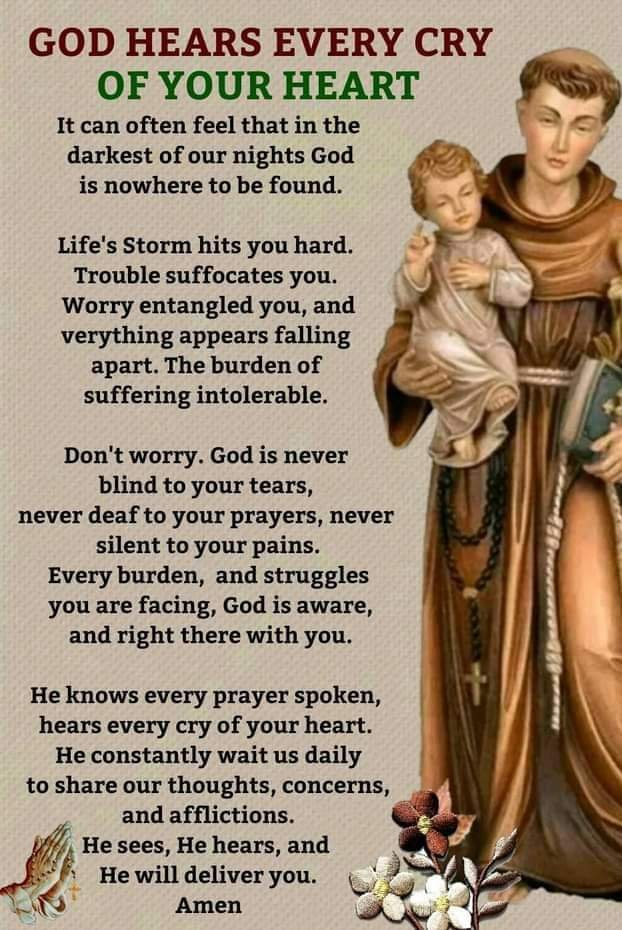
Saint Anthony, Saint Anthony, do come around
Something has been lost, and has got to be found!
Saint Anthony of Padua, pray for us.