
DEVOTION OF THE MONTH OF APRIL TO THE HOLY SPIRIT AND THE HOLY EUCHARIST
April 1, 2026
Hebrews 12: 1 – 2
April 1, 2026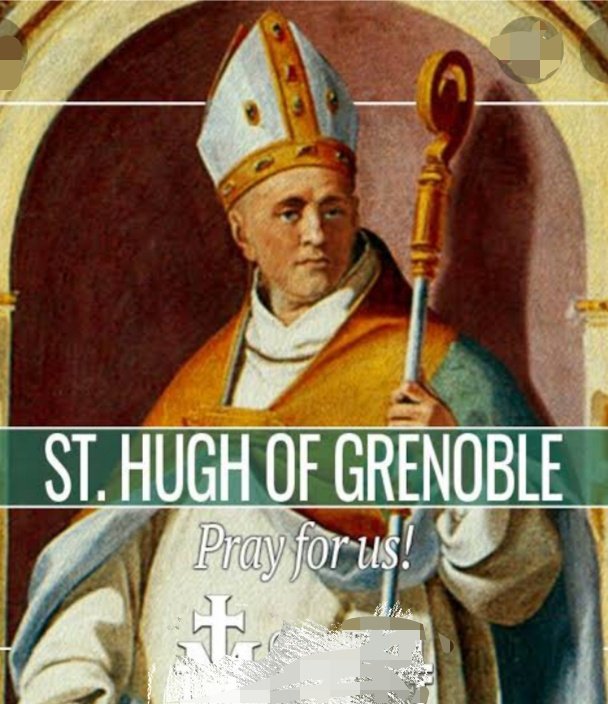
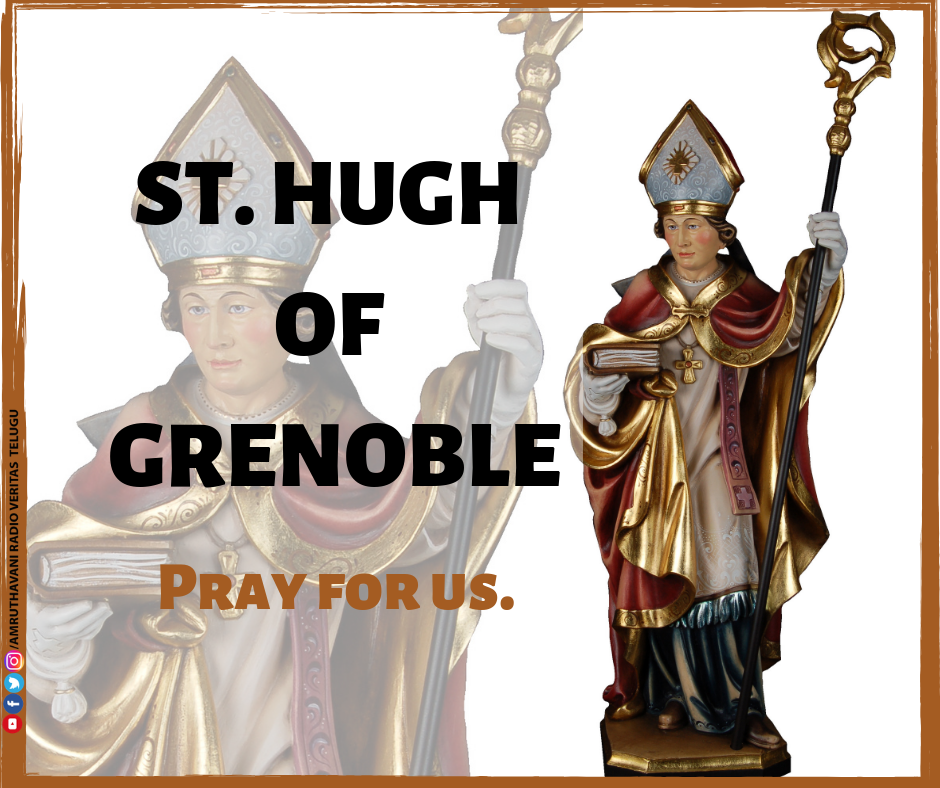
FEAST OF SAINT HUGH OF GRENOBLE
FEAST DAY – 1st APRIL
Hugh of Châteauneuf (French: Hugues de Châteauneuf, 1053 – 1 April 1132), also called Hugh of Grenoble, was the Bishop of Grenoble from 1080 to his death. A partisan of the Gregorian reform, he was opposed to the Archbishop of Vienne, who later became Pope Callixtus II. Hugh was born at Châteauneuf-sur-Isère, County of Albon, and showed piety and theological facility from a young age.
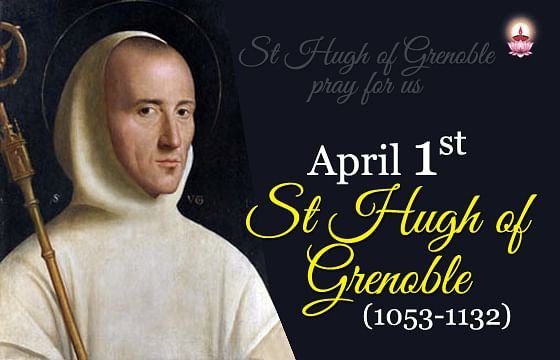
While still a layman, Hugh was made a canon of Valence. His piety was such that it was said of him that he only knew one woman by sight. Hugh had received, from his cradle, strong impressions of piety through the example and solicitude of his illustrious and holy parents. His father, Odilo, who served in an honorable post in the army, labored by all means in his power to make his soldiers faithful servants of their Creator, and by severe punishments, to restrain vice.
By the advice of his son, Saint Hugh, in his later years he became a Carthusian monk, and died at the age of one hundred, having received Extreme Unction and Viaticum from the hands of his son. Under his direction, his mother had served God in her own house for many years by prayer, fasting, and abundant almsgiving; and Saint Hugh also assisted her in her last hours.
Hugh, from the cradle, was a child of benediction; he was recognized as such through his exceptional success in his studies. Having chosen to serve God in the ecclesiastical state, he accepted a canonry in the cathedral of Valence. His sanctity and learning rendered him an ornament of that church, and at age twenty-seven he was chosen to be the Bishop of Grenoble. At the Council of Avignon in 1080, he was elected bishop, though he was not yet ordained.
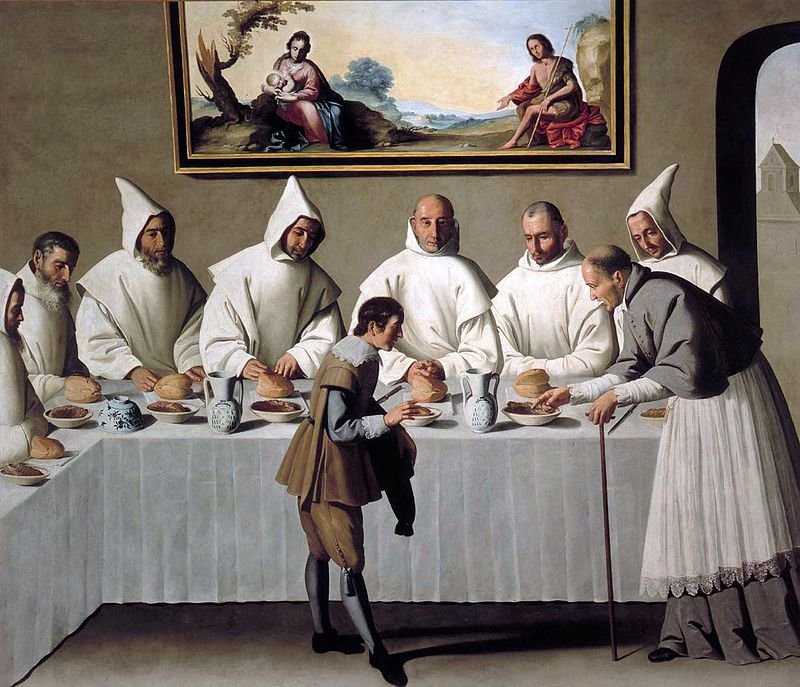
His forceful preaching moved crowds and touched hearts; in the confessional he wept with his penitents, and aroused in them a deeper contrition. Pope Gregory VII consecrated him in Rome, and inspired in him an ardent zeal for the Church’s liberty and the sanctification of the clergy.The See of Grenoble had fallen into a very poor state and Hugh was selected to be its Gregorian renovator. Conducted by a papal legate to Rome, Hugh was ordained by Pope Gregory VII himself.
He at once undertook to reprove vice and reform abuses, at that time rampant in his diocese, but found his efforts without fruit. When he had succeeded in countering abuse and fostering devotion after two years, he tried to resign his bishopric and enter the Benedictine monastery at Cluny. However, the Pope ordered him to continue his episcopal work. Pope Gregory commanded him, in the name of holy obedience, to resume his pastoral charge, saying: “Go to your flock; they need you.” This time his sanctity effected great good in souls.
After a few years the face of his diocese had changed. His charity for the poor led him to sell even his episcopal ring and his chalice to assist them. During his episcopate the young Saint Bruno came to him for counsel, and it was Saint Hugh who assisted him in the foundation of the Carthusian Monastery in the mountains of the diocese of Grenoble, whose renown after a thousand years has not diminished.
Always filled with a profound sense of his own unworthiness, he earnestly solicited three Popes for leave to resign his bishopric, that he might die in solitude, but was never able to obtain his request. For the rest of the 11th century, his episcopate was marked by strife with Count Guigues III of Albon over the possession of ecclesiastic lands in the Grésivaudan, a valley in the French Alps. Hugh alleged that the Count had usurped the lands from the bishopric of Grenoble with the help of Bishop Mallen of Grenoble.
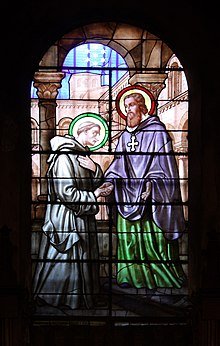
An accord was finally reached between Hugh and Count Guigues only in 1099. The Count agreed to cede the disputed territories while Hugh admitted to the Count’s temporal authority within the vicinity of Grenoble. It was then that Hugh became instrumental in founding the Carthusian Order. He received Bruno of Cologne, perhaps his own teacher, and six of his companions in 1084, after seeing them under a banner of seven stars in a dream.
Hugh installed the seven in a snowy and rocky Alpine location called Chartreuse. They founded a monastery and devoted their lives to prayer and study, being often visited by Hugh, who was reported to have adopted much of their way of life. Hugh also founded the nearby Monastère de Chalais, which grew into an independent order. God was pleased to purify his soul by a lingering illness before He called him to Himself.
He closed his penitential course on the 1st of April in 1132, two months before completing his eightieth year. Miracles attested the sanctity of his death, and he was canonized on 22 April 1134, only two years afterwards, by Pope Innocent II. His patronage is against headache and for Grenoble, France. His feast day is on 1 April in the Catholic Church. During the French Wars of religion, the Huguenots burned his body. Sant’Ugo, a Roman titular church, was dedicated to him in 1991. He also gives his name to a church in Greenbelt, Maryland, US.
CONTEMPLATING THE LIFE OF SAINT HUGH OF GRENOBLE
THE SHEPHERD WHO COULD NOT RUN AWAY
St. Hugh of Grenoble is one of the great reforming bishops of the 11th-12th century Church, remembered for his personal holiness, pastoral courage, and crucial role in founding the Carthusian Order. His life is a striking example of a shepherd who transformed both himself and his diocese.
A YOUNG MAN IN A FRACTURED CHURCH
Hugh was born into a noble and devout family and educated in Valence. He was known early for intelligence, integrity and deep piety. The Church was wounded. Not in its doctrine – but in its life. Positions were bought. Discipline was weak. Many who should have been shepherds had become caretakers of comfort. Into this world, this young man named Hugh was formed – quiet, intelligent, deeply sincere.
At just twenty-seven, the unimaginable happened:bHe was made Bishop of Grenoble. Not into honor – but into chaos.
THE WEIGHT OF A CROZIER
Hugh walked into his diocese and saw it clearly. Every attempt to reform met opposition. At night, he knelt alone. The burden was too heavy. So he did what many secretly wish to do. He ran. He left his post. Sought refuge in a monastery. Chose silence over struggle.
THE CALL HE COULD NOT ESCAPE
But God followed him into the silence. Through the voice of Pope Gregory VII, the message came: “Return.” Not suggestion. Not invitation. A command.
Hugh stood at a crossroads of choosing
Peace… or obedience. Silence… or responsibility. He chose obedience. And walked back into the storm.
THE GREAT REFORM OF GRENOBLE
Over the next decades, Hugh reformed the clergy, restored discipline, removed corruption and strengthened spiritual life.bHe governed with firmness, compassion and personal example.
HIS SECRET?
He lived what he preached:
Simplicity, Prayer, Austerity. His authority came not from position – but from holiness.
THE VISION AND ST. BRUNO
One of the most beautiful episodes in his life is that Hugh had a dream or vision of seven stars descending into a remote valley; A sign of something divine to come. Soon after, St. Bruno of Cologne arrived with six companions. Hugh immediately recognized:
“These are the stars I saw.”
He gave them land in the wilderness of Chartreuse. This became the birthplace of the Carthusian Order – one of the most austere contemplative orders in the Church.
A HEART DIVIDED – YET UNITED
Hugh remained a bishop. But his heart was drawn to the silence of the mountains. He visited the Carthusians often. Sat with them. Prayed with them. Listened.
He lived between two worlds:
The noise of responsibility and the silence of God. And somehow, he held them together.
THE LONG FAITHFULNESS
Despite being a bishop, Hugh lived very simply, practiced austerity and was deeply prayerful. Years passed. Decades. Hugh grew older. Weaker. Headaches tormented him. His body failed.
But he did not leave. He remained faithful, gentle and tireless in service. He stayed – In the place he once tried to escape – Until the end.
HIS STRUGGLES – NOT A “PERFECT” SAINT
Hugh’s sanctity was not effortless. He struggled with: Discouragement, Desire to withdraw, The weight of responsibility. This makes him deeply relatable. He became holy not by ease – but by perseverance.
FINAL YEARS AND DEATH
After decades of service, he gradually withdrew due to age and illness. When he finally laid down his life in 1132 – It was not dramatic – But it was complete. A life not of brilliance – but of perseverance. He was quickly venerated as a saint and canonized in 1134, just two years after his death.
SPIRITUAL SIGNIFICANCE
A Bishop Who Became a Saint Through Responsibility
He shows:
Holiness is possible in leadership
Administration can be sanctified
A Bridge Between Action and Contemplation
Like many great saints:
He governed actively
Yet longed for silence and union with God.
A Reformer with a Gentle Heart
He did not reform through harshness alone – but through: Example, Patience
and Integrity.
PRAYER TO ST. HUGH
O Heavenly Patron, Saint Hugh, in whose name I glory, pray ever to Christ for me. Strengthen me in my faith; establish me in virtue; guard me in the conflict; that I may vanquish the malignant foe and attain to glory everlasting. Amen