
NOVENA TO THE HOLY SPIRIT
May 15, 2026
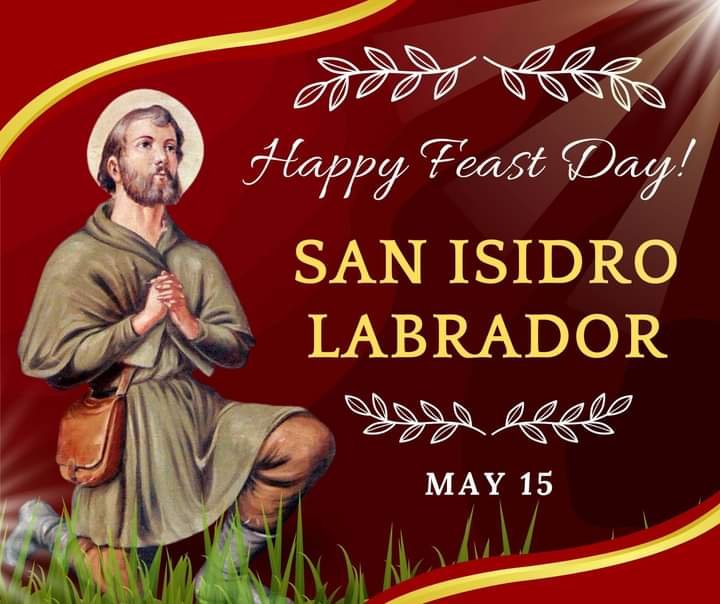
SPIRITUAL INSIGHTS INTO THE LIFE OF Saint Isidore the Farmer
May 15, 2026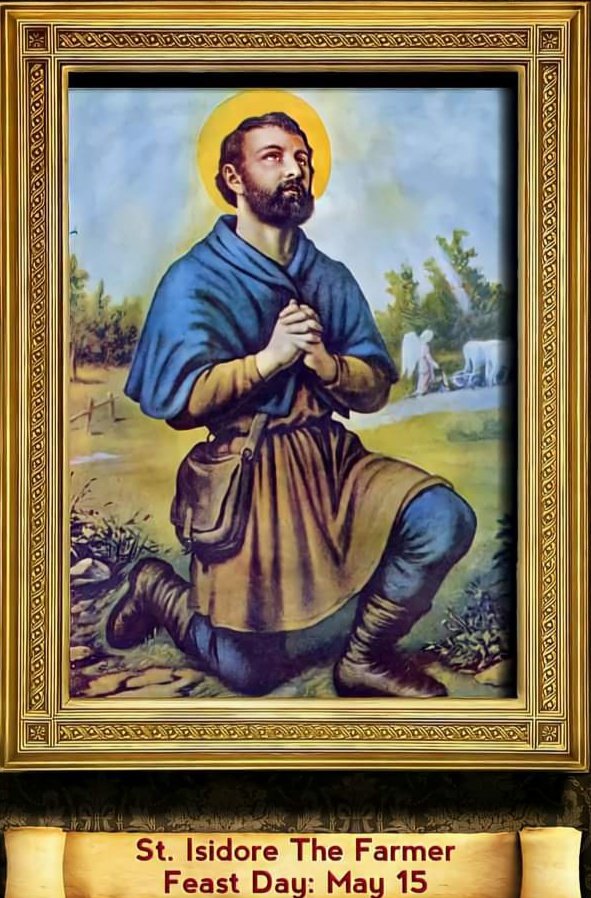
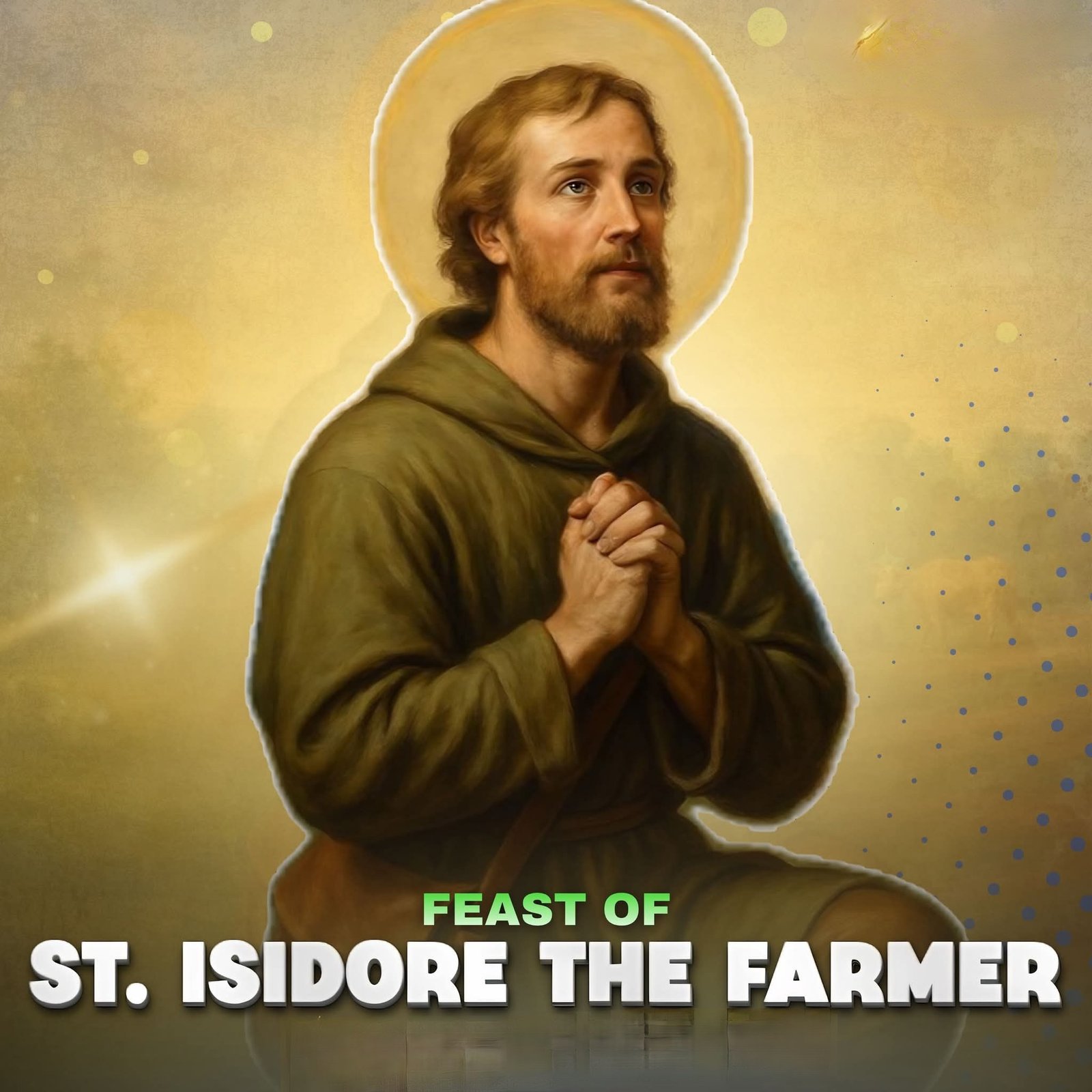
FEAST OF SAINT ISIDORE THE FARMER
FEAST DAY – 15th MAY
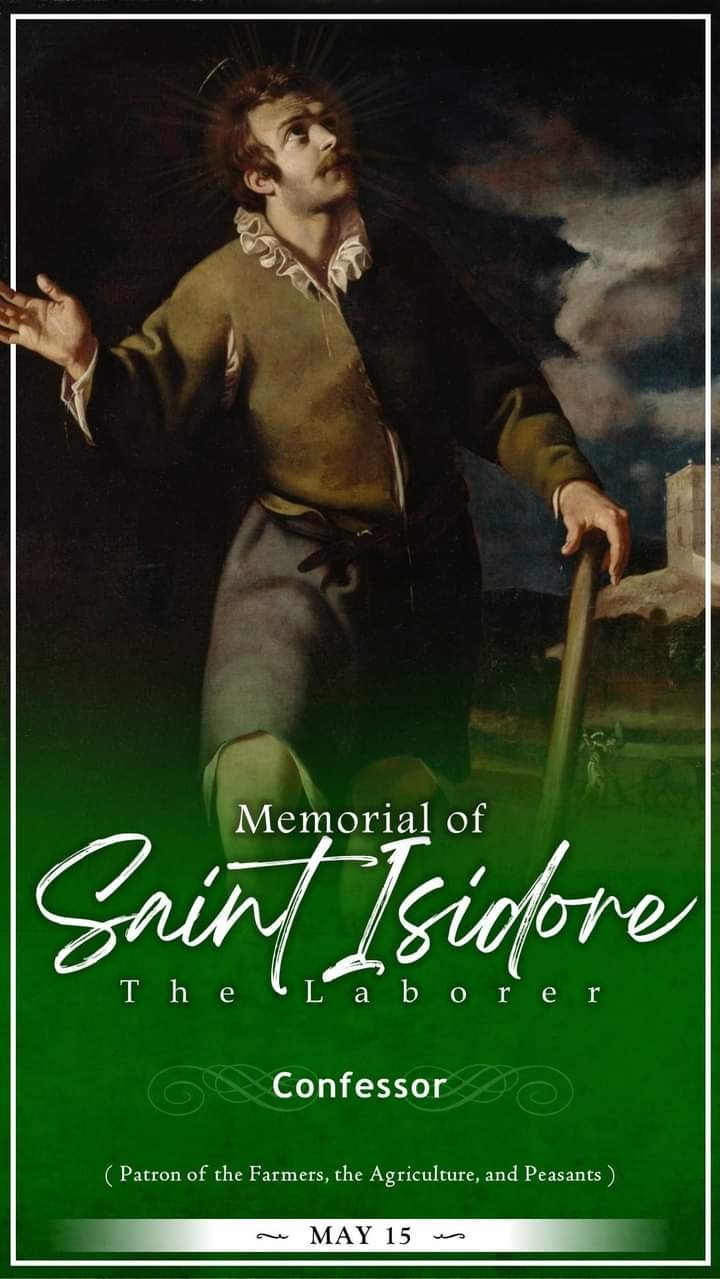
Isidore the Farm Labourer, also known as Isidore the Farmer (c. 1070 – May 15, 1130), was a Spanish farmworker known for his piety toward the poor and animals. He is the Catholic patron saint of farmers and of Madrid, El Gobernador, Jalisco and of La Ceiba, Honduras. His feast day is May 15. His real name was Isidro de Merlo y Quintana.
Isidore was born in Madrid, in about the year 1070, of poor but very devout parents, and was christened Isidore from the name of their patron, St. Isidore of Seville. Isidore spent his life as a hired hand in the service of the wealthy Madrilenian landowner Juan de Vargas on a farm in the city’s vicinity. He shared what he had, even his meals, with the poor. Juan de Vargas would later make him bailiff of his entire estate of Lower Caramanca.
Isidore married Maria Torribia, known as Santa María de la Cabeza in Spain; she has never been canonized, pending confirmation by Pope Francis. Isidore and Maria had one son. On one occasion, their son fell into a deep well and, at the prayers of his parents, the water of the well is said to have risen miraculously to the level of the ground, bringing the child with it. In thanksgiving Isidore and Maria then vowed sexual abstinence and lived in separate houses. Their son later died in his youth.
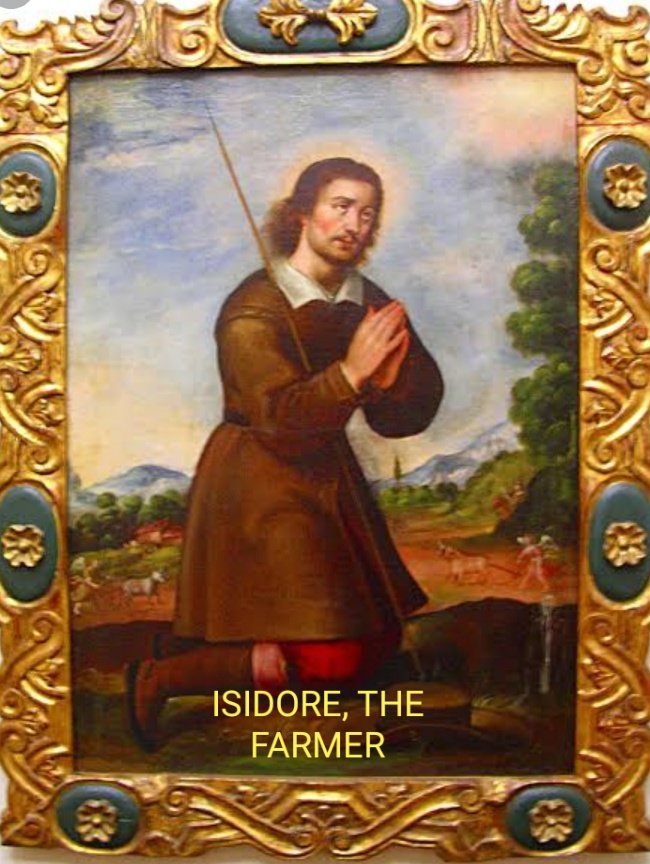
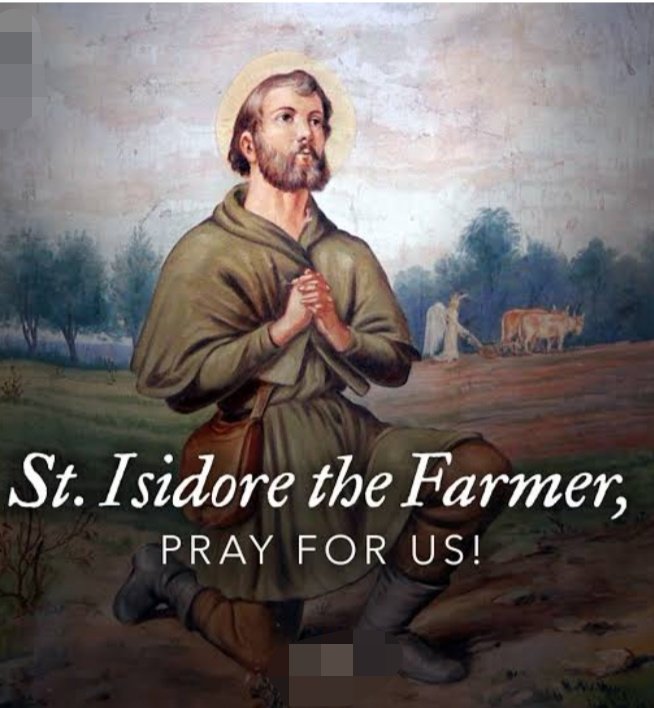
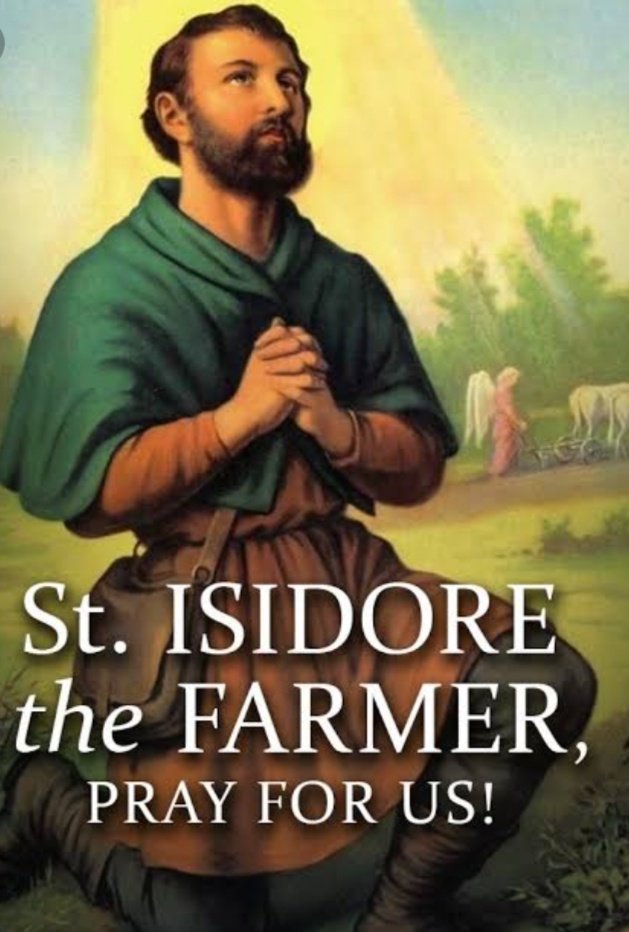
Isidore died on May 15, 1130, at his birthplace close to Madrid, although the only official source places his death in the year 1172. In the morning before going to work, Isidore would usually attend Mass at one of the churches in Madrid. One day, his fellow farm workers complained to their master that Isidore was always late for work in the morning. Upon investigation the master found Isidore at prayer while an angel was doing the ploughing for him.
On another occasion, his master saw an angel ploughing on either side of him, so that Isidore’s work was equal to that of three of his fellow field workers. Isidore is also said to have brought back to life his master’s deceased daughter, and to have caused a fountain of fresh water to burst from the dry earth to quench his master’s thirst.
One snowy day, when going to the mill with wheat to be ground, he passed a flock of wood-pigeons scratching vainly for food on the hard surface of the frosty ground. Taking pity on the poor animals, he poured half of his sack of precious wheat upon the ground for the birds, despite the mocking of witnesses. When he reached the mill, however, the bag was full, and the wheat, when it was ground, produced double the flour.
Isidore’s wife, Maria, always kept a pot of stew on the fireplace in their humble home as Isidore would often bring home anyone who was hungry. One day he brought home more hungry people than usual. After she served many of them, Maria told him that there simply was no more stew in the pot. He insisted that she check the pot again, and she was able to spoon out stew to feed them all.
On April 2, 1212, after torrential rains had exhumed cadavers from cemeteries in Madrid, his body was discovered in an apparent state of incorruptibility. He is said to have appeared to Alfonso VIII of Castile, and to have shown him the hidden path by which he surprised the Moors and gained the victory of Las Navas de Tolosa, in 1212.
When King Philip III of Spain was cured of a deadly disease after touching the relics of the saint, the king replaced the old reliquary with a costly silver one and instigated the process of his beatification. Throughout history, other members of the royal family would seek curative powers from the saint.
The number of miracles attributed to him has been counted as 438. The only original source of hagiography on him is a fourteenth century codex called Códice de Juan Diácono which relates five of his miracles:
The pigeons and the grain.
The angels ploughing.
The saving of his donkey, through prayer, from a wolf attack.
The account of his wife’s pot of food.
A similar account of his feeding the brotherhood.
The codex also attests to the incorruptible state of his body, stating it was exhumed 40 years after his death. Isidore was beatified in Rome on May 2, 1619, by Pope Paul V. He was canonized nearly three years later by Pope Gregory XV, along with Saints Ignatius of Loyola, Francis Xavier, Teresa of Ávila and Philip Neri, on March 12, 1622.
In 1696, his relics were moved to the Royal Alcazar of Madrid to intervene on behalf of the health of Charles II of Spain. The King’s locksmith pulled a tooth from the body and gave it to the monarch, who slept with it under his pillow until his death. This was not the first, nor the last time his body was mutilated out of religious fervour. For example, it was reported one of the ladies in the court of Isabella I of Castile bit off one of his toes.
In 1760, his body was brought to the Royal Palace of Madrid during the illness of Maria Amalia of Saxony. In 1769, Charles III of Spain had the remains of Saint Isidore and his wife Maria relocated to the San Isidro Church, Madrid. The sepulcher has nine locks and only the King of Spain has the master key.
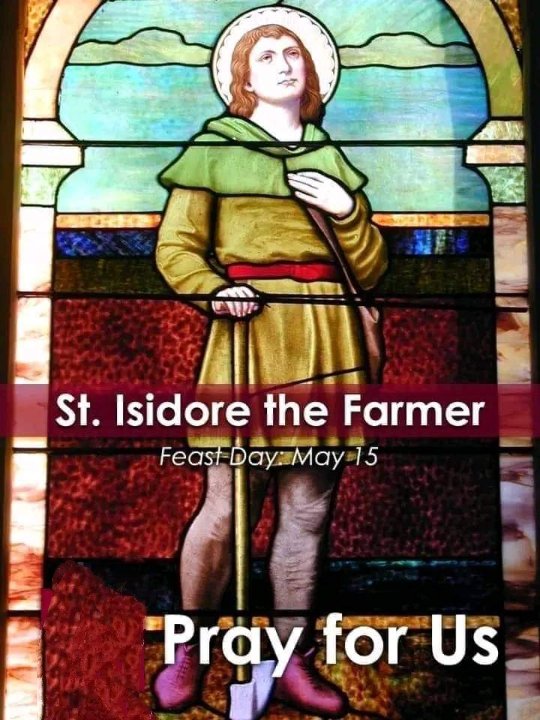
The opening of the sepulcher must be performed by the Archbishop of Madrid and authorized by the King himself. Consequently, it has not been opened since 1985. His feast day is celebrated on May 15 in the Catholic Church, and in the Philippine Independent Church. Saint Isidore is widely venerated as the patron saint of farmers, peasants, day laborers and agriculture in general, as well as brick layers.
His hometown of Madrid, the Spanish cities of Leon, Zaragoza, and Seville, and various locales in the former Spanish Empire honour him as their patron saint. The US National Catholic Rural Life Conference claims him as its patron. San Ysidro, California, and San Ysidro, New Mexico, were named after him
The story of St. Isidore is a reminder of the dignity of work, and that ordinary life can lead to holiness. Legends about angel helpers and mysterious oxen indicate that his work was not neglected and his duties did not go unfulfilled. St. Isidore’s life demonstrates that if you have your spiritual self in order, your earthly commitments will fall into order also.
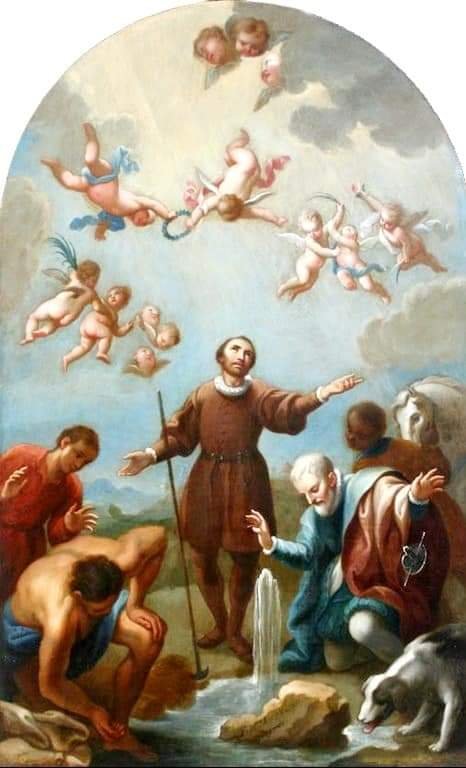
The house of his master, Juan de Vargas, in Madrid is now a museum, popularly known as the “Casa de San Isidro”. It houses temporary exhibitions on the history of Madrid, as well as on the life of the saint. It is not to be confused with the aforementioned San Isidro Church. Not only does this museum contain a chapel built upon the place where Isidore lived and died, but also the well where his son fell and was saved.
CONTEMPLATING THE LIFE OF SAINT ISIDORE THE FARMER
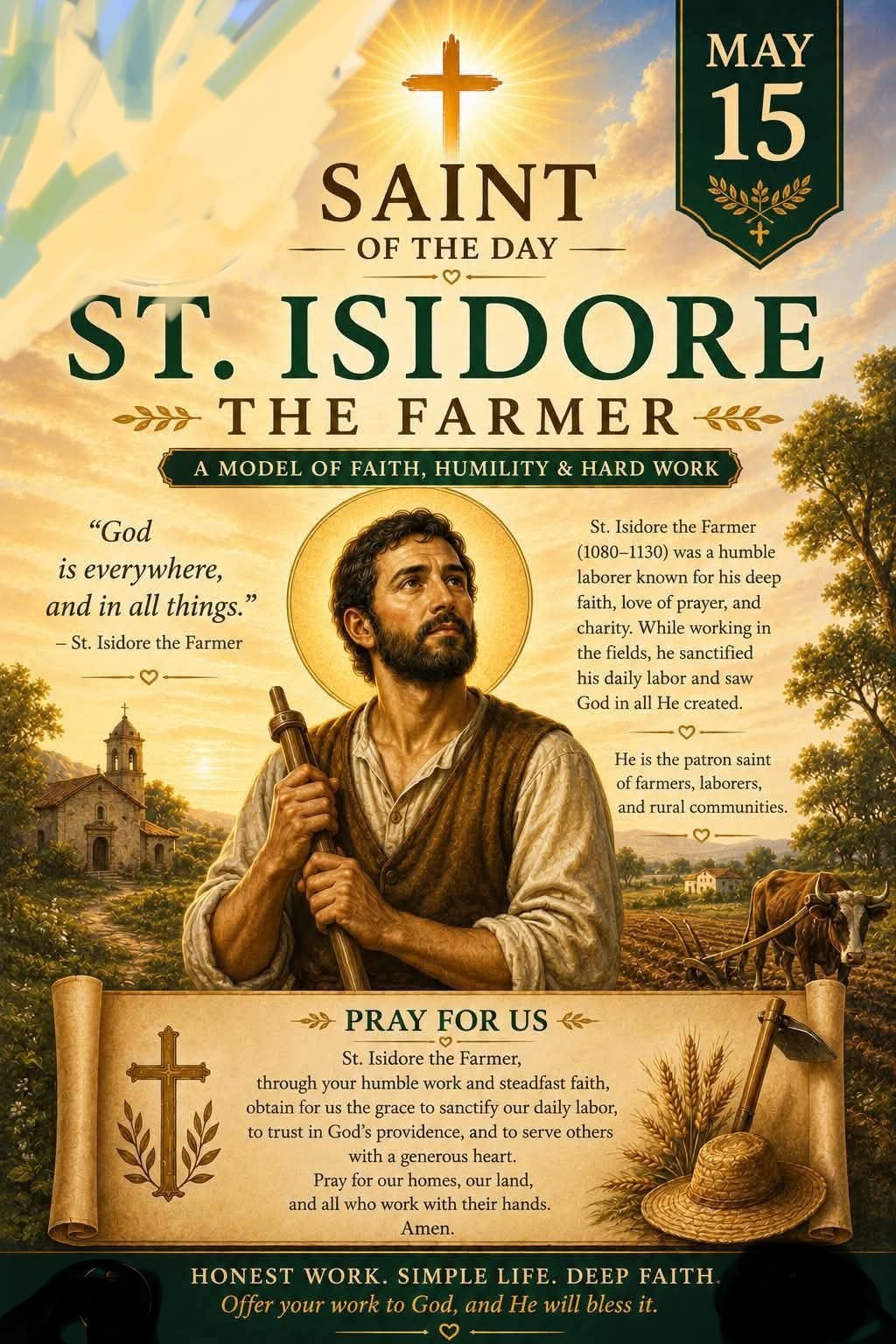
HISTORICAL IDENTITY AND BACKGROUND
Saint Isidore the Farmer, also known as Isidore the Laborer, is remembered as a saint of ordinary working life. He became holy not through preaching, scholarship, or martyrdom, but through humble labor, prayer, honesty, and trust in God.
He was born around 1070 in Madrid, Spain, and lived during the medieval period. As a poor farm laborer, he experienced the hardships of rural life, depending on weather, harvests, and daily physical work for survival. Yet through this simple life, he became a powerful example of holiness in everyday duties.
ISIDORE THE FARMER: THE SAINT WHO FOUND GOD IN THE FIELDS
Isidore spent his life working in the fields around Madrid under difficult conditions of heat, cold, and hard labor. He owned no wealth, held no position of power, and lived a very simple life. Still, those around him recognized a deep closeness to God.
THE BOY RAISED BY SOIL AND PRAYER
Born into poverty, Isidore learned endurance, patience, and dependence on God from an early age. Farming life taught him that human effort alone could not guarantee survival. Good harvests depended on providence as much as labor, and this shaped his strong life of prayer and faith.
THE QUIET RHYTHM OF HIS DAYS
His daily routine was simple and steady. He rose early, prayed, worked long hours in the fields, returned home, and repeated the same pattern each day. Though ordinary in appearance, Isidore understood that daily work offered to God could become holy. The fields themselves became a place of prayer and communion with God.
A MARRIAGE ROOTED IN FAITH
Isidore married Maria Torribia, who was also known for her holiness. Their home was poor but filled with prayer, charity, and trust in God. Despite hardship and uncertainty, they lived with peace and faithfulness, inspiring those around them.
THE ANGELS IN THE FIELD
Some fellow workers complained that Isidore spent too much time praying and attending Mass before work. His employer investigated and, according to tradition, saw angels plowing the fields while Isidore prayed.
Whether understood literally or spiritually, the story teaches that prayer does not take us away from work but sanctifies it. Isidore united labor and prayer in a beautiful way.
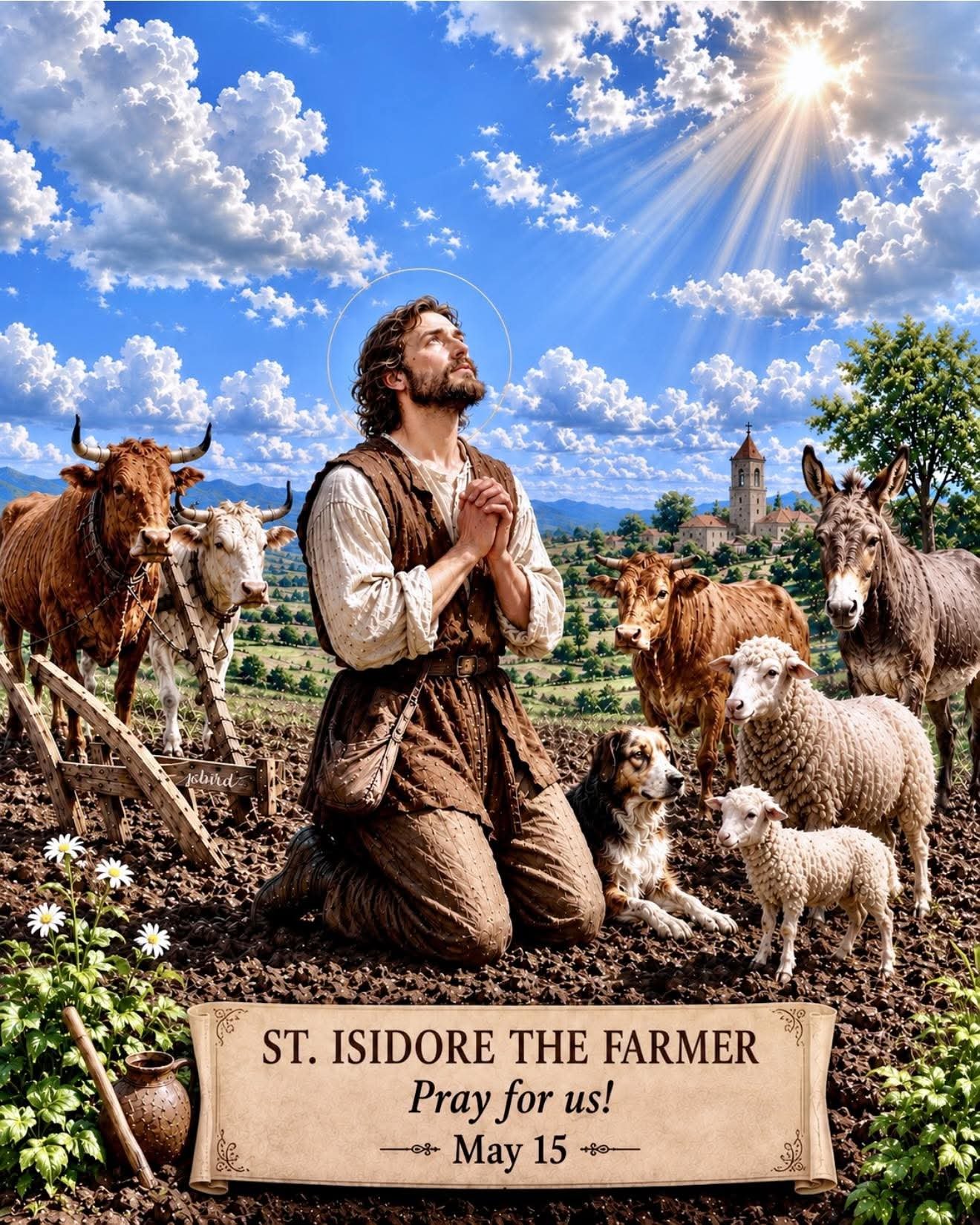
THE POOR MAN WHO SHARED WITH OTHERS
Although he himself had little, Isidore generously shared food and supplies with the poor. Stories spread of food multiplying and provisions lasting beyond expectation after he gave to those in need. His generosity showed that poverty had not hardened his heart.
A SAINT CLOSE TO THE EARTH
Unlike saints who lived in monasteries or universities, Isidore lived among fields, animals, tools, and crops. Ordinary workers and struggling families easily related to him because he proved that holiness is possible in simple daily life.
THE HIDDEN GREATNESS OF AN ORDINARY LIFE
Isidore did not found religious orders, influence rulers, or gain worldly fame. He simply prayed, worked, loved, trusted God, and remained faithful throughout his life. Through years of quiet consistency, his ordinary life became radiant with holiness.
THE DEATH OF THE FARMER AND GROWING DEVOTION
When Isidore died around 1130, he left behind no worldly achievements. Yet people remembered his kindness, prayerfulness, and generosity. Devotion to him spread throughout Spain because people saw hope in his life: if holiness could grow in a field, it could grow anywhere.
His tomb became associated with miracles and prayers related to farming, weather, drought, and rural life.
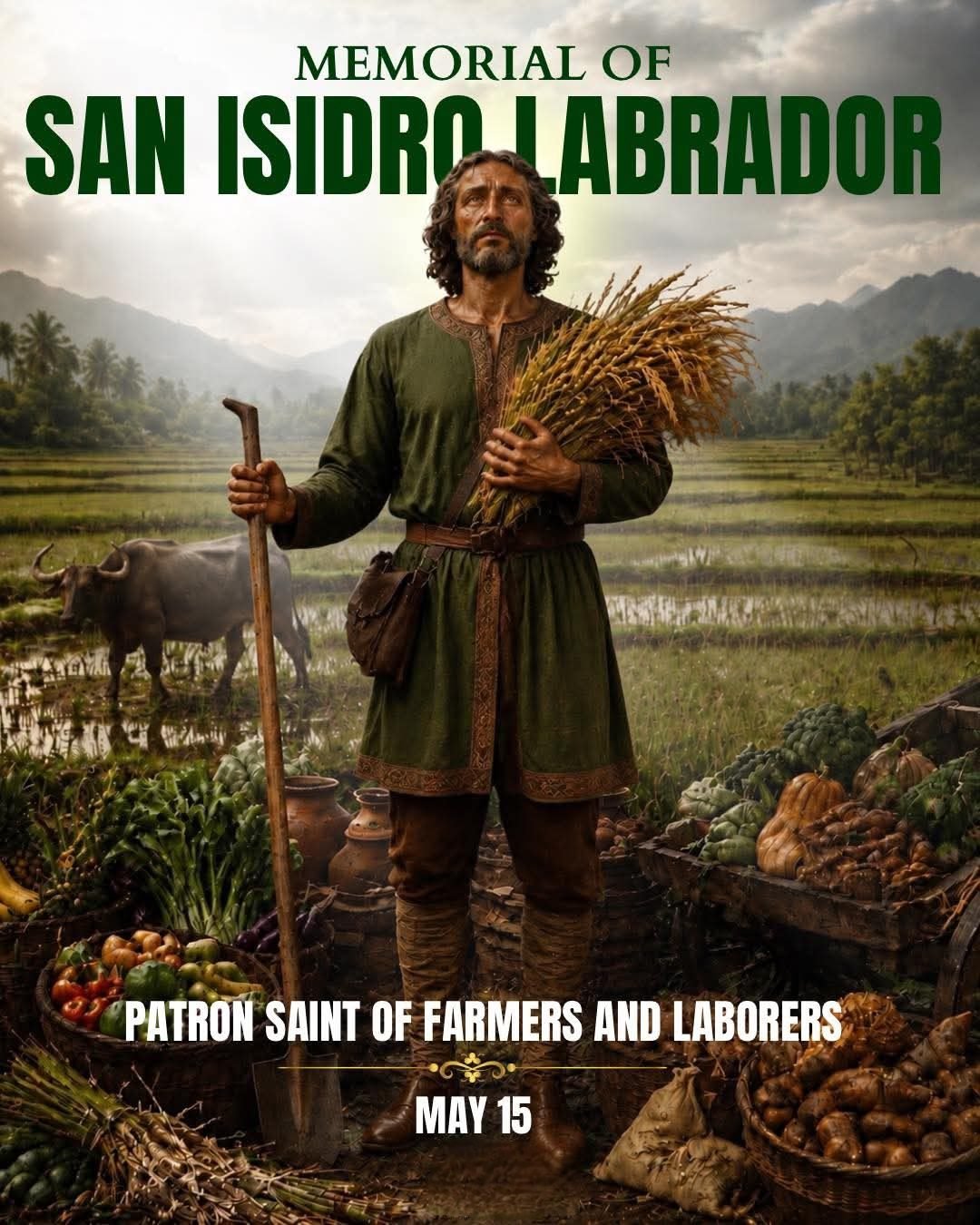
CANONIZATION AND RECOGNITION
Saint Isidore was canonized in 1622 by Pope Gregory XV. He was canonized during the same period as great saints such as Ignatius of Loyola, Francis Xavier, Teresa of Ávila, and Philip Neri. Among theologians and missionaries stood a humble farmer, showing the Church’s recognition of holiness in ordinary labor.
PATRONAGE AND LEGACY
Saint Isidore became the patron saint of farmers, agricultural workers, rural communities, laborers, and the city of Madrid. His life continues to inspire workers, families, and ordinary people seeking holiness in daily responsibilities.
SPIRITUAL THEMES IN HIS LIFE
Holiness can be found in ordinary work when it is offered to God.
Prayer and daily responsibilities can exist together in harmony.
Trust in God’s providence brings peace and generosity.
Quiet and hidden lives can reflect great holiness.
A BRIEF NARRATIVE REFLECTION
Isidore spent most of his life doing simple work that the world rarely notices. He plowed fields, carried burdens, watched the seasons, and labored each day under the sun.
Yet through prayer and faithfulness, his soul became deeply united with God. His life reminds us that holiness is not limited to monasteries or great public works. Sometimes it grows quietly in ordinary places, where humble hands work faithfully while the heart remains lifted toward heaven.
PRAYER
Merciful Father, we humbly beseech you, through the intercession of Blessed Isidore, farmer and confessor, not to let us be vain with the wisdom of the world, but by his merits and example, let us in all humility always do what is pleasing to you. Through Christ our Lord. Amen
Good Saint Isidore, bless us and our labors, that we may some day reap the reward of good works with you in heaven. Amen