
TODAY’S GOSPEL READING – 25 NOVEMBER
November 25, 2025
Psalm 68:19
November 26, 2025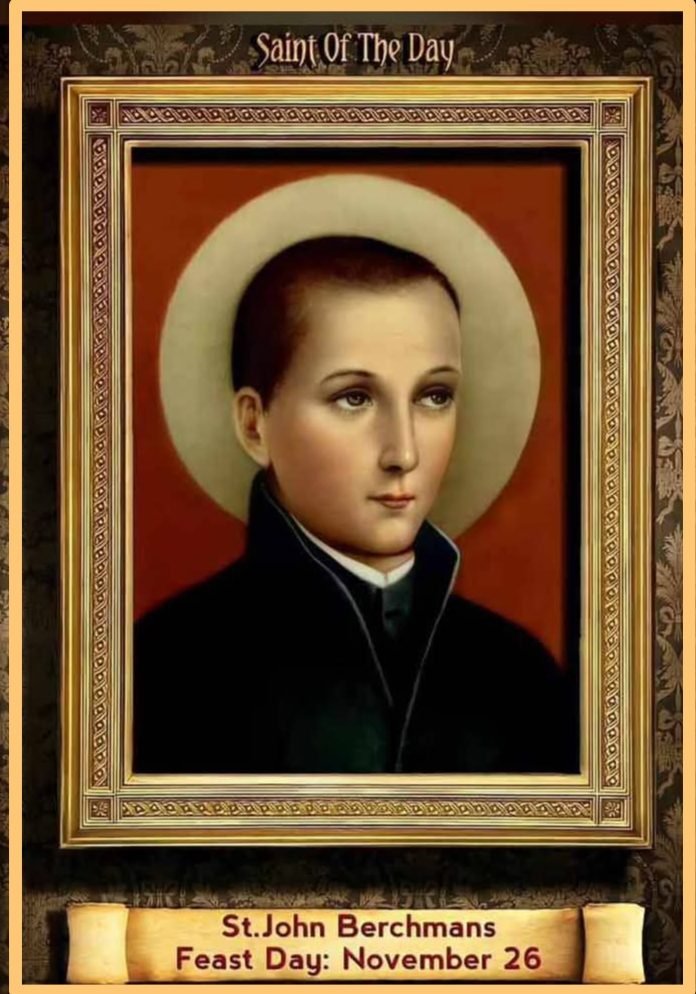
FEAST OF SAINT JOHN BERCHMANS
FEAST DAY – 26th NOVEMBER
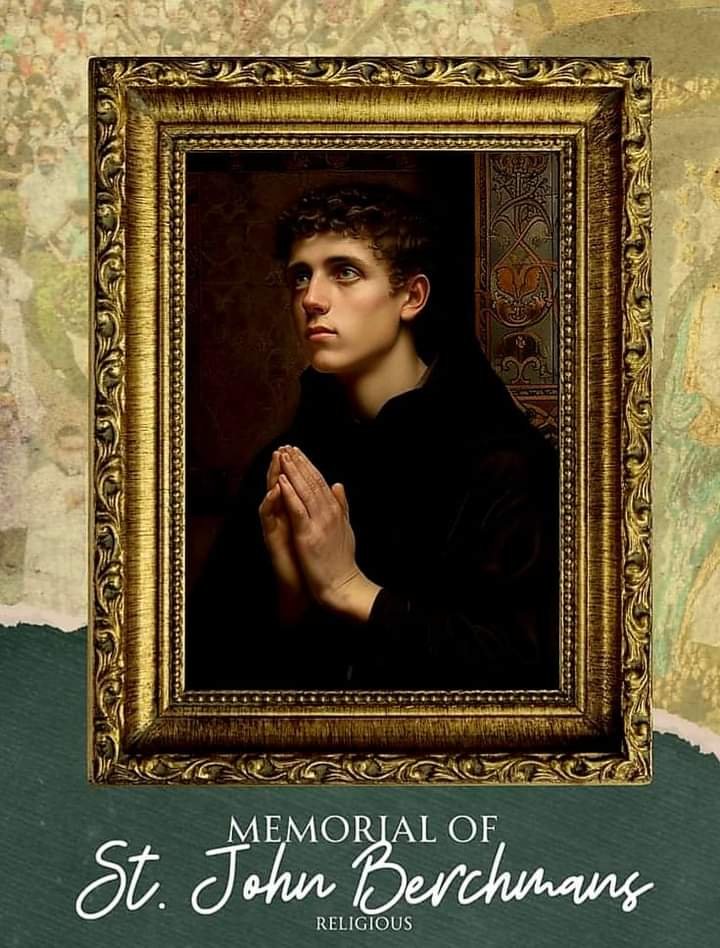
John was born at Diest, Brabant, the eldest son of a shoemaker. His parents were John Charles and Elizabeth Berchmans. At baptism he was named John, in honor of John the Baptist. He grew up in an atmosphere of political unrest because of a religious war between the Catholic and Protestants. At nine years of age, his mother was bedridden by a very serious illness. John would pass several hours by her side and studied at a Gymnasium in Diest.
He wished to be a priest, and when he turned thirteen, served in the household of one of the Cathedral canons at Malines, John Froymont. He was given entrance in the Jesuit College at Malines in 1615, and became a Jesuit novice.
Immediately upon entering, he enrolled in the Sodality of the Blessed Virgin. He had a special devotion to Mary, mother of Jesus; and to him is owed the Little Rosary of the Immaculate Conception.
When Berchmans told his parents that he would like to join the Society of Jesus, his father traveled to Mechelen to dissuade him and sent him to the Franciscan convent in Mechelen, where a friar also tried to change his mind.
His father threatened to end all financial aid if he failed to change his plan. On 24 January 1618, he took his first vows and went to Antwerp to study philosophy.
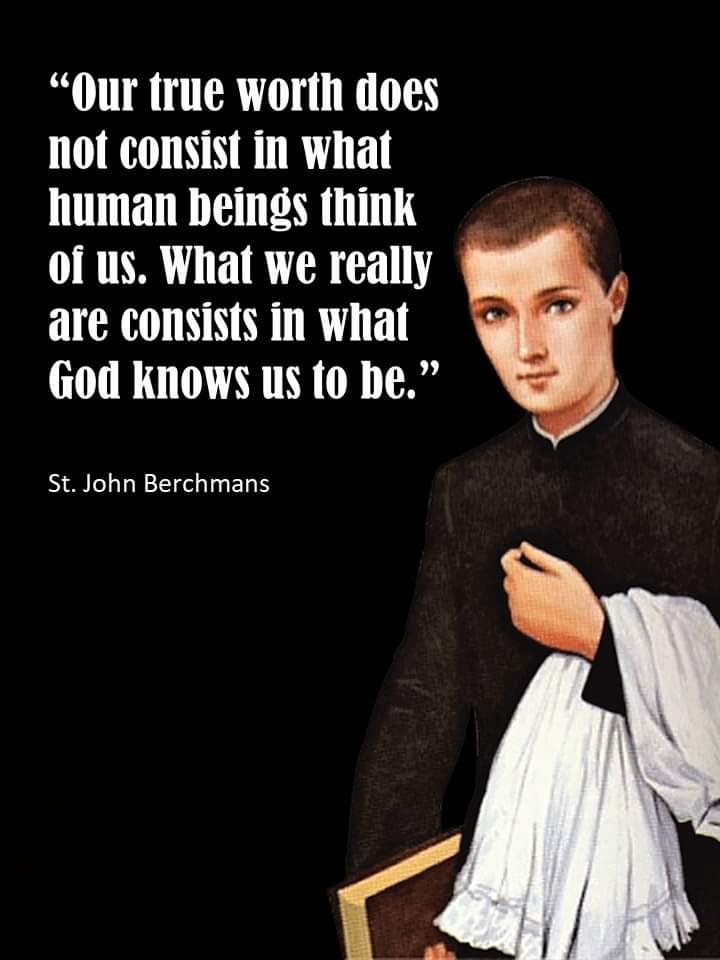
He then went to Rome in the latter part of 1618 to continue his studies, and impressed everyone with his diligence, holiness,, piety and perfection in all things. He adopted a spiritual model, a Jesuit named Aloysius Gonzaga, and he was struck deeply by the example of English Jesuit martyrs.
John was affable and endowed with a genial personality that endeared him to all. He hoped that after ordination as a priest he could become a chaplain in the army, and be martyred on the battlefield.
Later, in August 1621, the prefect of studies selected Berchmans to be a part of a debate of philosophy at the Greek College, which at the time was managed by Dominicans.
Berchmans started the discussion with great lucidity and profoundness, but after returning to his own quarters, was struck down with the Roman fever. His lungs became severely inflamed and his condition deteriorated rapidly.

He succumbed to dysentery on 13th August 1621, at the age of twenty-two years and five months. When he died, a large crowd assembled to view his remains and to invoke his intercession.
That same year, Phillip-Charles, Duke of Aarschot, sent a petition to the Pope
Gregory XV with a view to beginning the process leading to the beatification of Berchmans, whose remains were eventually buried in Sant’Ignazio Church.
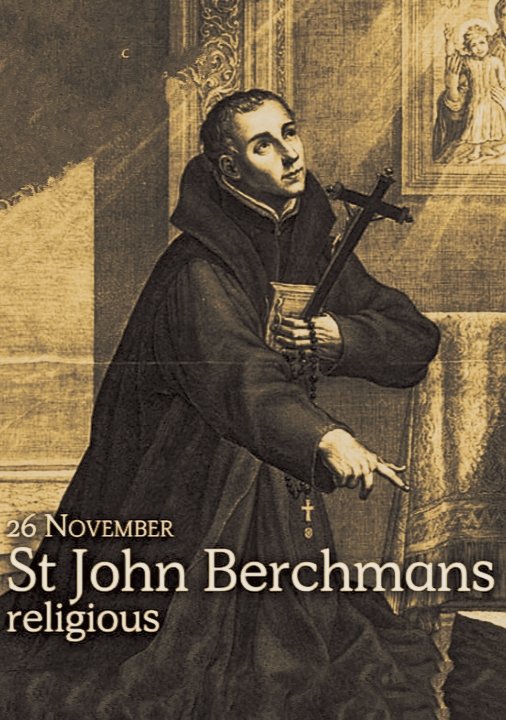
His heart was returned to his homeland in Belgium where it is kept in a silver reliquary on a side altar in the church at Leuven. Berchmans was declared Blessed in 1865. Statues frequently depict him with hands clasped, holding his crucifix, his book of rules, and his rosary.
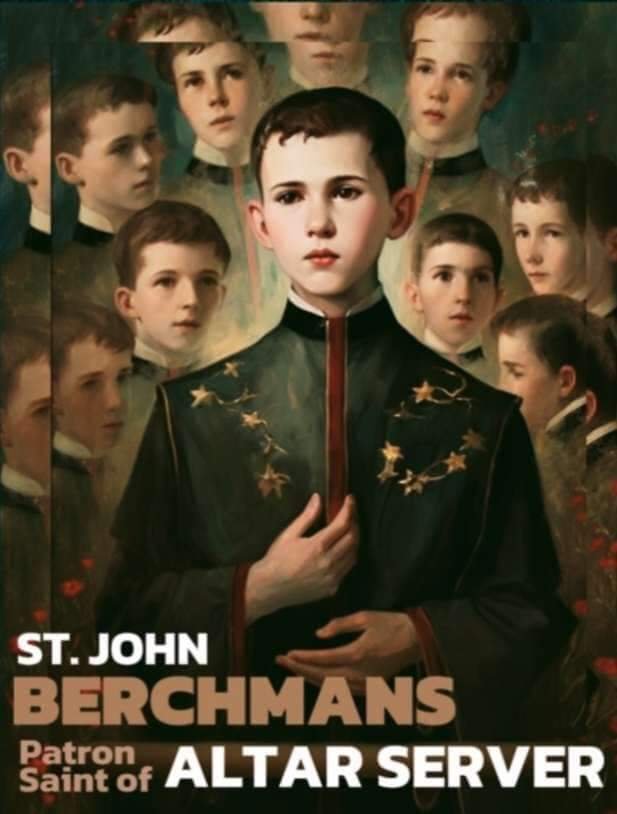
Many miracles were attributed to him after his death, and he was canonized in 1888. He is the patron saint of altar servers, Jesuit scholastics, and students. His feast day is November 26.
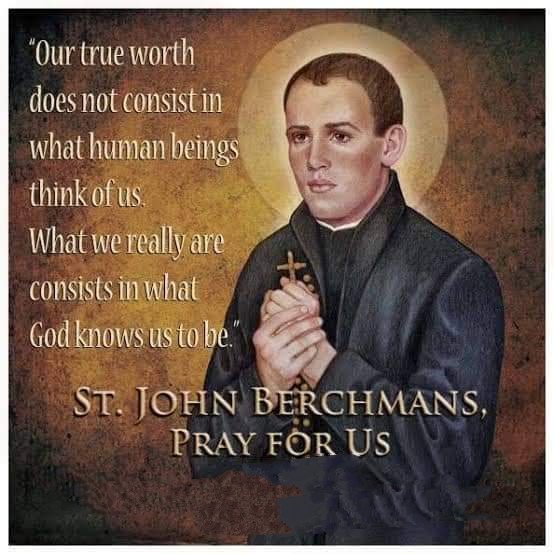
PRAYER
Eternal God, you invite us always to give you our love and are pleased with a cheerful giver. Give us a youthful spirit, to be like St. John, always eager to seek you and to do your will. Help us to be patient, devout, pleasing by our nature and aiding everyone by our inclination.
We ask you Lord, through the good offices of Saint John Berchmans, to have a dedicated spirit and revere Mary our Mother, achieving perfection, through our Lord Jesus Christ, your Son, who lives and reigns with you and the Holy Spirit, one God, for ever and ever.
Amen
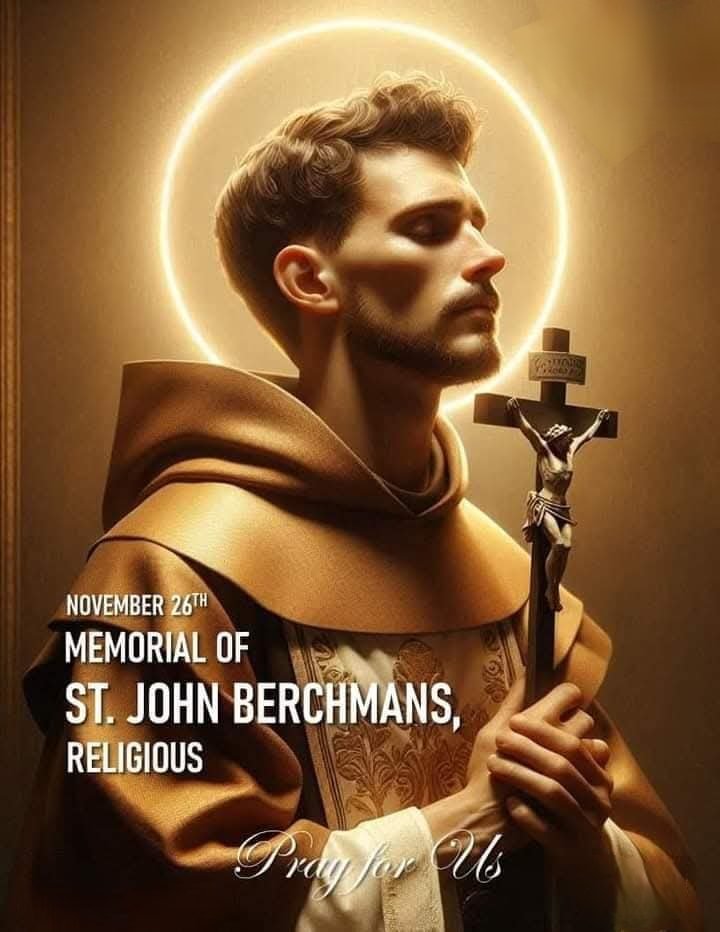
St John Berchmans, pray for us.
================================
ALSO CELEBRATED

SAINT LEONARD OF PORT MAURICE
Saint Leonard of Port Maurice, was an Italian Franciscan preacher and ascetic writer.
Paul Jerome Casanova was born on December 20, 1676, in Porto Maurizio (today’s Imperia), then part of the Republic of Genoa. His father, a ship captain, was a man of faith; five of his six children went on to become religious. When the boy who would become St. Leonard was 13 he went to study at the Roman College in Rome, the city where his uncle lived. He thought of entering the medical profession but God had other plans for him, wanting to make him a doctor of souls.
One day he happened to visit the church connected with the Franciscan convent of St. Bonaventure on the Palatine hill just as the friars were chanting Compline. At the words “converte nos Deus, salutaris noster” (convert us, oh God, our salvation) the young man was converted from his worldly aspirations to supernatural ones. Listening to God’s call, he entered the reform branch of the Franciscan Order.
He took his habit in 1697, taking the name of Leonard. After making his novitiate at Ponticelli he completed his studies at the principal house of the reform branch at San Bonaventura al Palatino in Rome. After his ordination (1703) he remained there as a professor. Leonard longed to go to China as a missionary, for it was his great desire to convert souls for Christ and to shed his blood for the Faith. However, he was soon seized with severe gastric haemorrhage, becoming so ill that he was sent to his native Porto Maurizio in the hope that he might recover his health.
St. Leonard did indeed recover, and he attributed his restoration to health to Our Lady’s intercession. During his illness, he had promised that, should his prayers for recovery be granted, he would devote his life to the conversion of sinners. And he kept his promise, spending 44 years preaching popular missions, covering every section of Italy and the island of Corsica.
Leonard at one time felt certain distaste for mission work but, after his superiors laid this duty upon him, he understood it to be the Will of God, and he consecrated himself whole-heartedly to it, becoming one of the greatest missionaries and apostles in the history of the Church. He chose as the patron of his missions the great Dominican saint, preacher and miracle worker St. Vincent Ferrer (whose picture he also used to bless the sick).
Around the age of 30, he began to preach in Port Maurice and its vicinity. Leonard’s preaching was marked by many extraordinary conversions. The power of his words coupled with his holiness and extraordinarily austere and penitential life made a deep impression on even the most hardened sinners.
St. Leonard used to preach to many thousands in open squares in every town where he went; the churches were too small to contain the multitudes. Entire towns flocked to hear his sermons so that it was not uncommon to see crowds of 15 to 20 thousand gatherings listen to the saint. Miraculous conversions followed his preaching everywhere.
St. Leonard preached several times a day, heard confessions for countless hours, gave advice, established peace between warring factions – all without neglecting his prayers (including three hours of mental prayer each day), celebrating daily Mass with great devotion and precision, and saying the Divine Office on his knees.
The saint stressed the importance of the practice of maintaining oneself in the presence of God at all times. He recommended people to exclaim many times throughout the day, and especially at the beginning of every action, “my Jesus, mercy.” That way they can pray always, even amidst their daily occupations, and do everything with pure intention, looking to God alone in every action they perform.
In 1716 he founded the Solitude of St. Mary of Incontro near Florence, a House of Retreat where the friars could retire from time to time to renew their spiritual strength, applying themselves seriously, in silence and great austerities, to the work of their own sanctification. The religious would withdraw there in turn, to then return to their convents and missionary labours filled with renewed zeal to work for the glory of God and salvation of souls.
Leonard was superior in Florence and Prato for over 20 years before returning to Rome in 1736 to become Guardian of the convent of St. Bonaventure. He was an austere, reserved and silent man, but also kind and patient in his treatment of others.
The devotion to the Blessed Virgin Mary (and in particular the Immaculate Conception), perpetual adoration of the Blessed Sacrament, and devotion to the Sacred Heart of Jesus were some of the topics he promoted. It was St. Leonard who composed, especially as a reparation for the sin of blasphemy, the Divine Praises we say at the end of every Benediction (“blessed be God, blessed be His Holy Name…”).
It is to St. Leonard we owe the devotion of the Stations of the Cross. Wherever he went he promoted the Via Crucis. Not a mission went by without him leading the people in this pious meditation on the Passion of our Lord. St. Leonard erected 571 Stations of the Cross throughout Italy, including the famous Stations at the Colosseum in Rome.
While St. Leonard’s great life-work was the mission, he also preached many retreats both to religious and laypeople. The theme was most often the Passion of Christ. He wrote that one of the cures for the ills of men and of society was a daily meditation on the Passion. It would bring people back in touch with reality, rearrange their priorities, and put everything into proper perspective, causing them to grow in love for Christ.
St. Leonard’s love for Our Lady led him to ardently desire to see – and do his utmost to procure – the dogmatic definition of her Immaculate Conception. He called this the most important cause in the world because every other good depended on it: peace, happiness, triumph over heresies, the triumph of the Church. He urged prelates to petition Rome for this.
The strains of his missionary labours and severe mortifications completely exhausted St. Leonard’s body. After his missions in Lucca and Bologna, he was stricken by fever but nevertheless journeyed back to Rome in obedience to the wishes of Pope Benedict XIV who made him promise he would not die in any other city but Rome. Even in his last days, half-dead, the saint insisted on saying Mass, though with the greatest difficulty, for, “a single Mass is worth more than all the wealth of the world.”
On Nov 26, 1751, St. Leonard arrived at his beloved monastery of St. Bonaventure in Rome, dying that same evening at 11 pm, at the age of 75. Great crowds came to see and venerate his body. God glorified him in life but still more after his death by numerous miracles. His (still partially incorrupt) body was kept at the high altar of the church of San Bonaventura at Palatino until 1997 when it was transferred to his native town. There it can be seen, in a glass urn, at the cathedral of Imperia Porto Maurizio. Only a relic of one of his ribs remains at the church of St. Bonaventure in Rome. At the adjacent convent, one can visit the saint’s former cell (transformed into a little museum).
St. Leonard was beatified by Pius VI in 1796. Blessed Pius IX, a Franciscan tertiary, canonized him in 1867. He was named the patron saint of parish missionaries by Pius XI.
St. Leonard left us many writings, the most well known of which is his beautiful book about “the most precious treasure we have on earth” – the Mass (“The Hidden Treasure”). His sermons, letters, ascetic and devotional writings have been preserved but only a small part has been translated to English. His most famous sermon, “The Little Number of Those Who Are Saved”, was the one he relied on for the conversion of great sinners.
His feast day is November 26.
PRAYER
Saint Leonard of Port Maurice, you are known for your fiery preaching, deep love for the Sacred Heart, and your mission of bringing souls back to God, through repentance and devotion. Your life reminds us that holiness is found in faithfulness, one day at a time.
St. Leonard, guide our hearts to love Jesus more deeply and to walk the path of humility and repentance. Pray for us!