
TODAY’S GOSPEL READING – 12 APRIL
April 12, 2026
John 3:16
April 13, 2026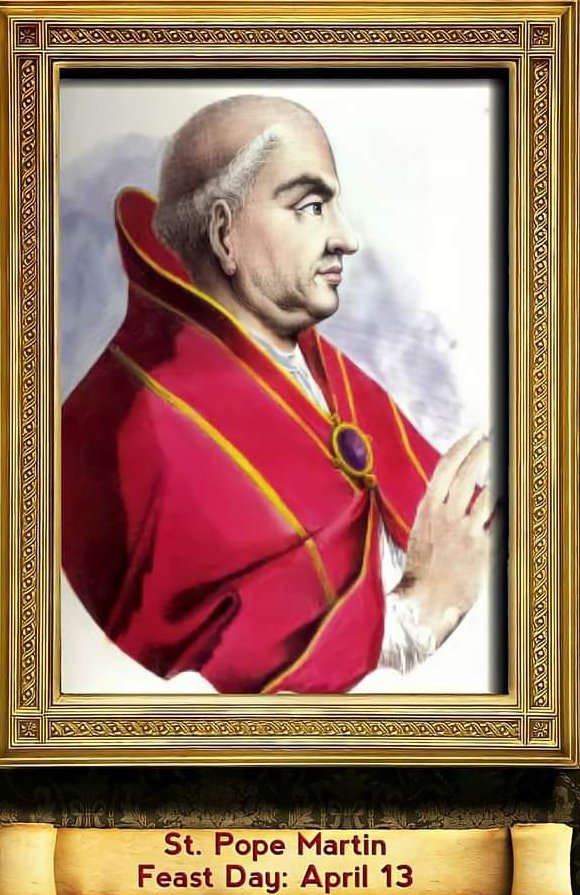
FEAST OF SAINT MARTIN I, THE CONFESSOR, POPE AND MARTYR
FEAST DAY – 13th APRIL
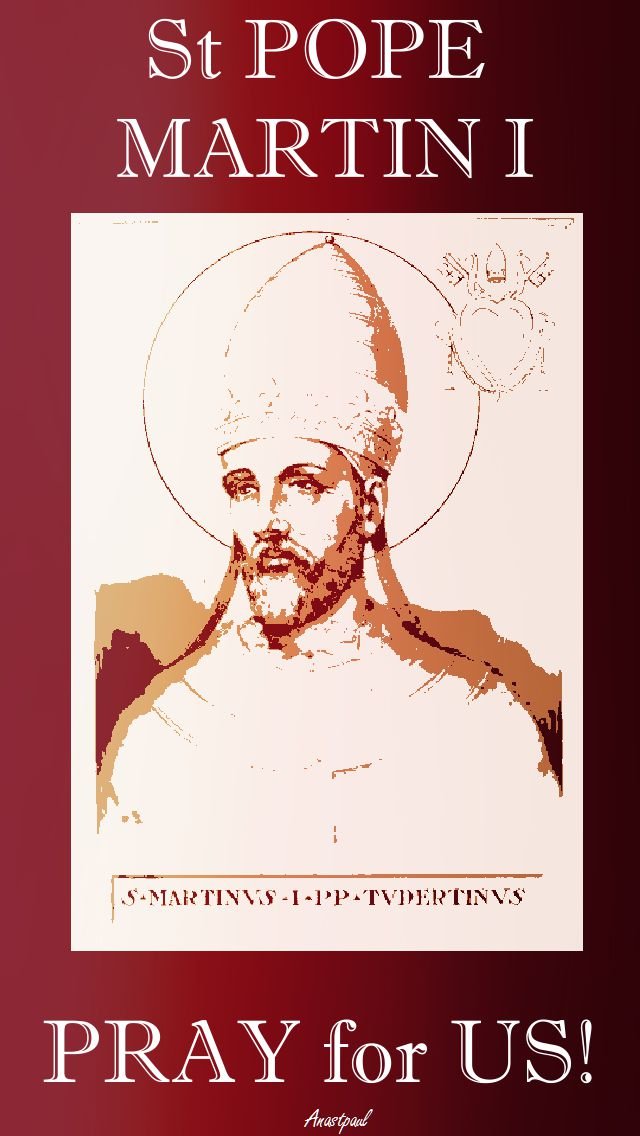
Pope Martin I, (between 590 and 600 – 16 September 655), also known as Martin the Confessor, was the bishop of Rome from 21 July 649 to his death on 16 September 655. He served as Pope Theodore I’s ambassador to Constantinople and was elected to succeed him as pope.
He was the only pope during the Eastern Roman domination of the papacy whose election was not approved by an imperial mandate from Constantinople. For his strong opposition to Monothelitism, Pope Martin I was arrested by Emperor Constans II, carried off to Constantinople, and ultimately banished to Cherson. He is considered a saint and martyr by the Catholic Church and the Eastern Orthodox Church.
Martin was born near Todi, Umbria, in the place now named after him (Pian di San Martino). According to his biographer Theodore, Martin was of noble birth, of commanding intelligence, and of great charity to the poor. Piazza states that he belonged to the order of St. Basil.
In 641, Pope John IV sent the abbot Martin into Dalmatia and Istria with large sums of money to alleviate the distress of the inhabitants, and redeem captives seized during the invasion of the Slavs. As the ruined churches could not be rebuilt, the relics of some of the more important Dalmatian saints were brought to Rome, where John then erected an oratory in their honour.
Martin acted as apocrisiarius or legate at Constantinople in the early years of the pontificate of Theodore I (642–49), and was a deacon at the time of his election in 649. When Martin I became pope in 649, Constantinople was the capital of the Byzantine empire and the patriarch of Constantinople was the most influential Church leader in the eastern Christian world.
The struggles that existed within the Church at that time were magnified by the close cooperation of emperor and patriarch. A teaching, strongly supported in the East, held that Christ had no human will. Twice emperors had officially favored this position, Heraclius by publishing a formula of faith and Constans II by silencing the issue of one or two wills in Christ.
Shortly after assuming the office of the papacy (which he did without first being confirmed by the emperor), Martin held a council at the Lateran in which the imperial documents were censured, and in which the patriarch of Constantinople and two of his predecessors were condemned. Constans II, in response, tried first to turn bishops and people against the pope.
Failing in this and in an attempt to kill the pope, the emperor sent troops to Rome to seize Martin and to bring him back to Constantinople. Already in poor health, Martin offered no resistance, returned with the exarch Calliopas and was then submitted to various imprisonments, tortures and hardships. On 17 June 653, Martin was arrested in the Lateran along with Maximus the Confessor.
He was hurried out of Rome and conveyed first to Naxos, Greece, and subsequently to Constantinople, where he arrived on 17 September 653. He was saved from execution by the pleas of Patriarch Paul II of Constantinople, who was himself gravely ill. Martin hoped that a new pope would not be elected while he lived but the imperial Byzantine government forced the Romans to find a successor.
Eugene I was elected on 10 August 654, and Martin apparently acquiesced. After suffering an exhausting imprisonment and reportedly many public indignities, Martin was banished to Cherson, where he arrived on 15 May 655. He died there on 16 September, tortures and cruel treatment having taken their toll. He is the last of the early popes to be venerated as a martyr.
QUOTE: The breviary of the Orthodox Church pays tribute to Martin: “Glorious definer of the Orthodox Faith…sacred chief of divine dogmas, unstained by error…true reprover of heresy…foundation of bishops, pillar of the Orthodox faith, teacher of religion…. Thou didst adorn the divine see of Peter, and since from this divine Rock, thou didst immovably defend the Church, so now thou art glorified with him.”
CONTEMPLATING THE LIFE OF SAINT MARTIN I, POPE, MARTYR
FEAST DAY – 13 APRIL
St. Martin I stands as one of the last popes honored as a martyr, remembered for his unyielding defense of the truth about Christ, even in the face of imperial persecution. His life is a powerful witness to courage, suffering, and fidelity under pressure.
Born around 590, likely in central Italy, he later became Pope and served from 649 to 653. He died in 655 in exile at Cherson, in modern-day Crimea. He is honored with the title Pope and Martyr, and his feast day is celebrated on April 13.
He lived during a time when the Church was deeply entangled with imperial politics, and doctrinal controversies about Christ continued even after earlier councils had addressed key issues.
THE POPE WHO CHOSE TRUTH OVER POWER
A CHURCH CAUGHT BETWEEN TRUTH AND PEACE
The Church had already endured persecutions, defined doctrines, and stood firm through many trials. Yet another crisis emerged, not from outside but from within. A teaching arose that seemed harmless and even helpful, offering a compromise and a way to maintain peace.
This teaching was called Monothelitism, which claimed that Christ had only one will, divine, and not both human and divine wills. To many, it appeared to promote unity. To Martin, however, it posed a serious danger.
Monothelitism undermined the fullness of Christ’s humanity. If Christ is not fully human, then humanity is not fully saved.
A POPE WHO REFUSED TO BE SILENT
When Martin became Pope, he clearly recognized the tension. The emperor supported silence on the controversy and desired unity without doctrinal clarity. What was sought was not truth, but quiet—no debates, no definitions, no divisions, only peace.
Martin understood that peace without truth is not peace at all. For him, truth could not be sacrificed for political harmony. So he chose to act.
THE COUNCIL THAT SPOKE CLEARLY
He gathered bishops, listened carefully, prayed deeply, and discerned wisely. At the Lateran Council of 649, which he convened, the Church proclaimed clearly that Christ has two wills, fully divine and fully human, united in one Person.
This was not merely a theological statement but a declaration about the reality of salvation. The truth was clarified, but the cost of that clarity was soon to follow.
THE WRATH OF AN EMPEROR
Far away, Emperor Constans II observed these developments. He did not want conflict; he wanted control. Martin’s actions disrupted both aims. An order was issued for his arrest.
THE NIGHT OF CAPTURE
In the year 653, the arrest came suddenly, without public debate or warning. Soldiers entered Rome and took the Pope, not as a shepherd but as a criminal. He was carried across the sea, far from his people and his city, to stand trial.
A TRIAL WITHOUT JUSTICE
In Constantinople, Martin was accused not of heresy, but of defiance. False charges were brought against him, including treason, disobedience, and causing disorder.
He was publicly humiliated, stripped of dignity, and mocked. Yet he remained unbroken. He did not defend himself but stood firmly for the truth.
EXILE – THE LONG MARTYRDOM
Death did not come quickly. Instead, he was sent into exile in the harsh and distant land of Cherson. There he endured cold, hunger, illness, and isolation.
There were no crowds, no recognition—only suffering and endurance. His letters from exile reveal deep physical pain and loneliness, yet also unwavering faith. They speak not of anger, but of quiet trust in God.
THE FINAL WITNESS – DEATH AS A MARTYR
In 655, his body finally gave way, worn down by suffering yet steadfast in faith. He is honored as a martyr because his death resulted from his defense of the faith. He was not executed swiftly but died slowly through prolonged hardship.
SPIRITUAL CHARACTER
St. Martin I is remembered for his courage in standing against imperial pressure, his fidelity to truth without compromise, his endurance in suffering, and his pastoral leadership as both a theologian and a shepherd.
SPIRITUAL SIGNIFICANCE
He stands as a martyr for truth, showing that truth is worth suffering for. He is a witness against compromise, reminding us that unity without truth is fragile. He is also a model of perseverance, demonstrating that holiness is often tested through endurance.
KEY THEMES FROM HIS LIFE
Truth cannot be negotiated, and doctrinal clarity matters. Courage under pressure is essential, as faithfulness often brings opposition. Suffering itself can become a powerful witness. Above all, his life centered on the question of who Christ is.
CONCLUDING THOUGHT
Pope Martin I died far from Rome and far from honor, yet closer than ever to the truth he defended. He did not lose; he bore witness, showing that truth is not preserved by power, but by those willing to suffer for it.
PRAYER
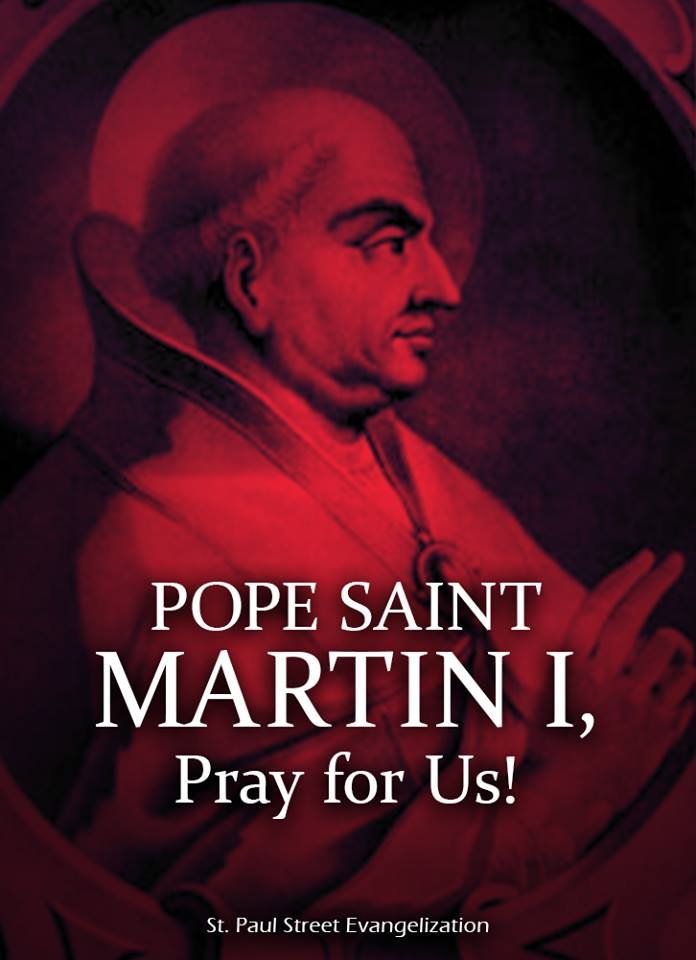
Pope Saint Martin I, through your intercession through Jesus Christ, before the Father in Heaven, fortify all teachers and leaders of the Church to remain steadfast in the truth, to advocate for the truth, and to suffer for the truth, no matter the personal cost. Amen