

SPIRITUAL INSIGHTS INTO THE LIFE OF SAINT TERESA EUSTOCHIO VERZERI
October 27, 2026
Ephesians 6:18
October 28, 2026

FEAST OF SAINTS SIMON AND JUDE, APOSTLES, MARTYRS – 28 OCTOBER

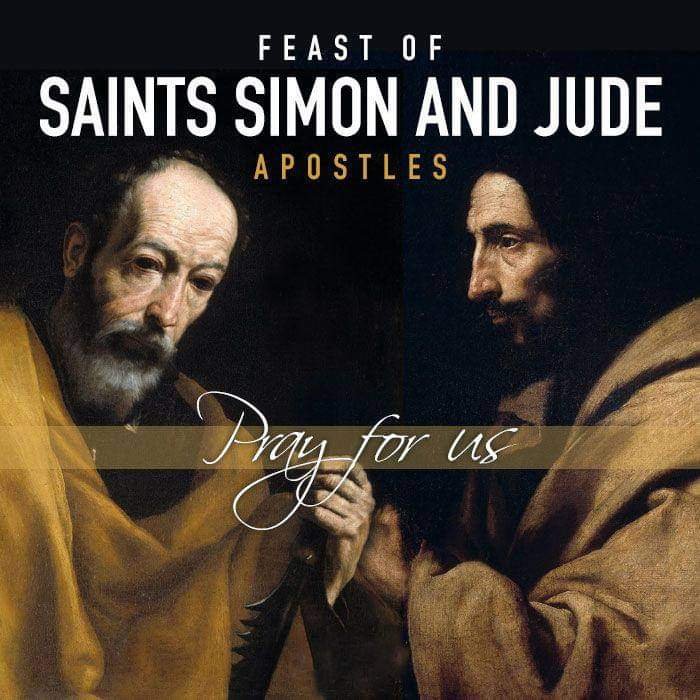
St. Jude Thaddeus and St. Simon, two of the least known Apostles, are paradoxically, among the closest to Jesus their Master, two of his cousins. Jude Thaddeus’ father, Alpheus, is mentioned in Scripture as the brother of St. Joseph, while his mother, Mary Cleophas, was a cousin of the Virgin.
The Gospel names St. Simon as the tenth apostle, just before Jude Thaddeus. Many identify in Simon the cousin of Christ, brother of James the Younger. The Byzantines identify in him Nathanael of Cana and the canteen director at the wedding of Cana, while St. Fortunatus of Poitiers states that Simon and Jude Thaddeus were buried in Suanir, a city in Persia, where they suffered martyrdom.
It is almost certainly in this part of the world that Simon, known as the Zealot or the Canaanite, as the evangelists Matthew and Mark call him, crossed paths with Jude Thaddeus, who would be his companion in mission until the end.
When the Eleven dispersed from Jerusalem to proclaim the Kingdom of God in other lands, Jude Thaddeus departed from Galilee and Samaria to go into Syria, Armenia and ancient Persia. In this area, sources claim, he met Simon, and their missionary partnership won tens of thousands of Babylonians and people from other cities for Christ. As always, the Gospel earned for itself both followers and enemies: for the two Apostles, the hour of supreme witness eventually arrived.

The courage to be called Christians.
Arrested and taken to the Temple of the Sun, the sentence imposed on both was to worship the goddess Diana, and so to deny Christ. In refusing, it is said that Jude Thaddeus declared pagan idols false, and that at the same time two horrible demons came out of the temple, destroying him.
Frightened, the people watching the scene are said to have pounced ferociously on the two Apostles, who were brutally killed. Their relics are kept in the Basilica of Saint Peter. The Apostles laid the foundation for a later generation’s roots of faith.
Saint Jude (or Judas) was often confused with his evil contemporary, Judas Iscariot, who was despised and ignored, and since he shared a name with the good Jude, a tradition gathered over the centuries of petitioning today’s saint only when all other saints had failed to answer one’s prayers.
Saint Jude became the Patron Saint of Hopeless Causes, because of the faithful’s reluctance to seek the intercession of one whose misfortune it was to share a name with Christ’s betrayer. Out of confusion or an abundance of caution, Saint Jude thus became a saint of last resort.
Saint Simon the Apostle is called the “Zealot” in Saint Luke’s Gospel. Nothing is known of either of them with any certainty, not even where they evangelized or where they met death. As Apostles, however, we know with certainty that they were key actors in laying the deep foundations of the Church in the rock-solid substrata of the Middle Eastern culture in which they lived. They thus founded a universal family living in one universal household we call the Church. They are Patron Saints of hopeless causes (Jude) and tanners (Simon).
CONTEMPLATING THE LIVES OF SAINTS SIMON AND JUDE, APOSTLES, MARTYRS
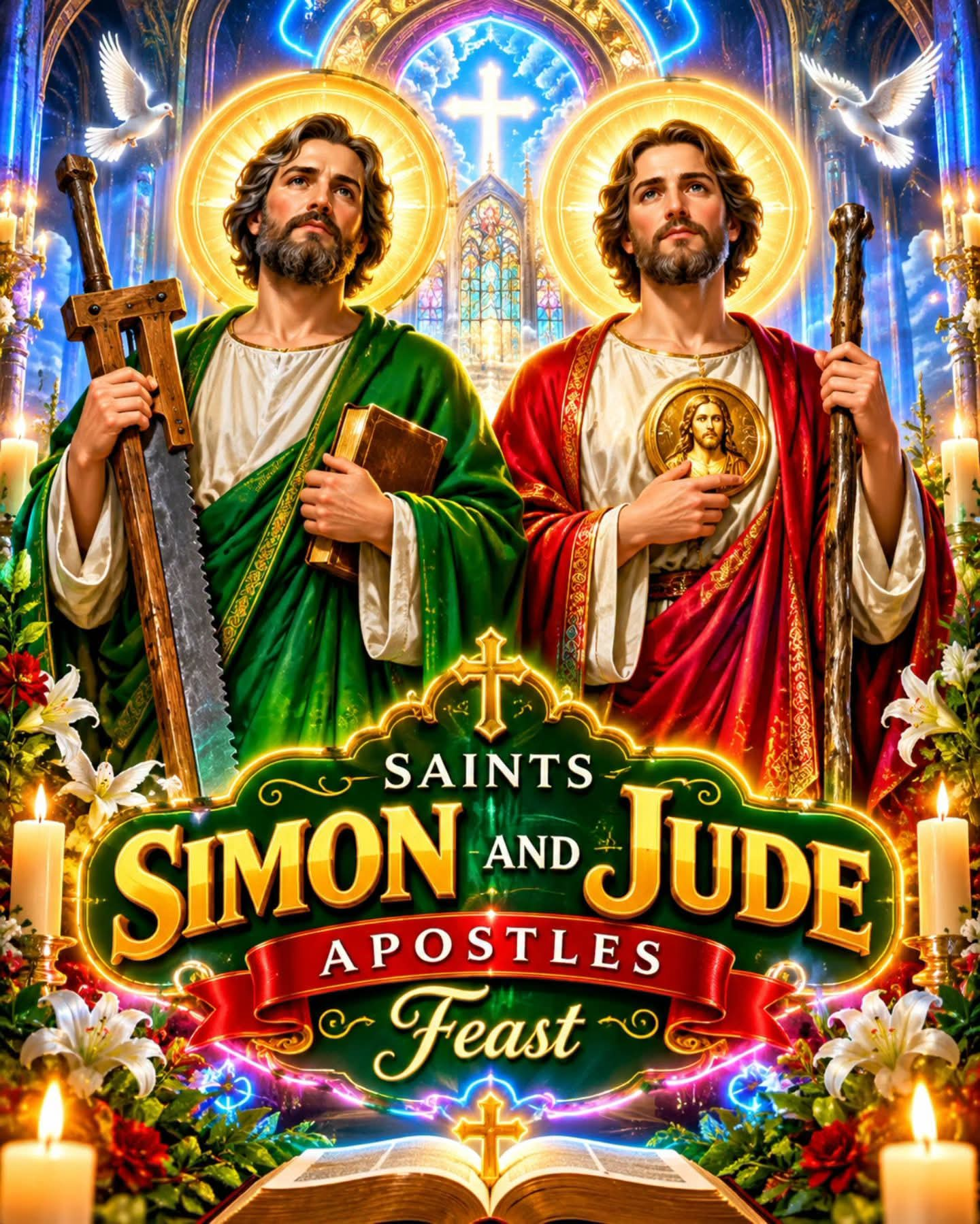
“BROTHERS OF THE LAST FRONTIER ” – THE STORY OF SAINTS SIMON AND JUDE
The sun burned over Galilee, glinting on the waves where fishermen mended their nets. Among them, a man with fiery eyes and restless steps paced along the shore – Simon the Zealot, they called him. He had once burned with patriotic rage, part of that fierce band of men who dreamt of driving the Romans out. His heart longed for freedom – for Israel, for God’s people.
Then one day he heard a voice on the wind, quiet yet commanding:
“Follow Me.”
It was not the voice of a general calling to arms, but of a man whose strength lay not in the sword but in mercy.
Simon followed – and the old fire within him found a new purpose. He may once have sympathized with nationalist ideals, longing to free Israel from Roman domination – but then, in encountering Christ, discovered the true liberation of the soul.
The Gentle Questioner
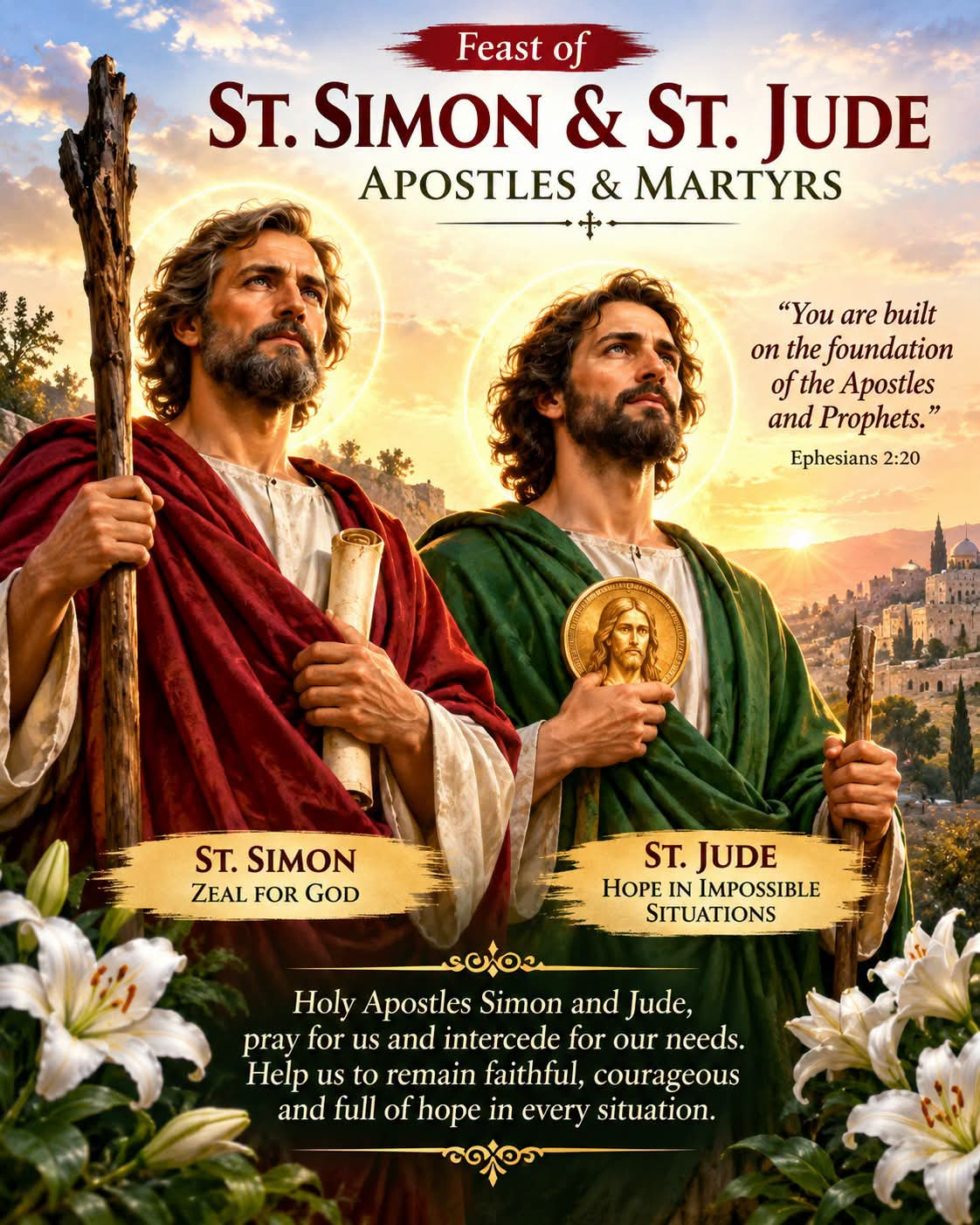
Among the twelve there was another who spoke little, his heart tuned to quiet questions. He was Jude, called Thaddeus, “the gentle-hearted.” (Not to be confused with Judas Iscariot who betrayed Jesus, but is also identified as Judas son of James – Luke 6:16).
He had once been content to live in the shadows of faith – not the kind that doubted, but the kind that pondered deeply.
At the Last Supper, as Jesus spoke of revealing Himself to His friends, Jude could not hold back:
“Lord, how is it that You will reveal Yourself to us, and not to the world?”
The Master smiled.
“If anyone loves Me, he will keep My word, and My Father will love him.”
From that night on, Jude understood that revelation was not thunder from the sky but the quiet rising of love in a faithful heart.
Brothers in the Spirit
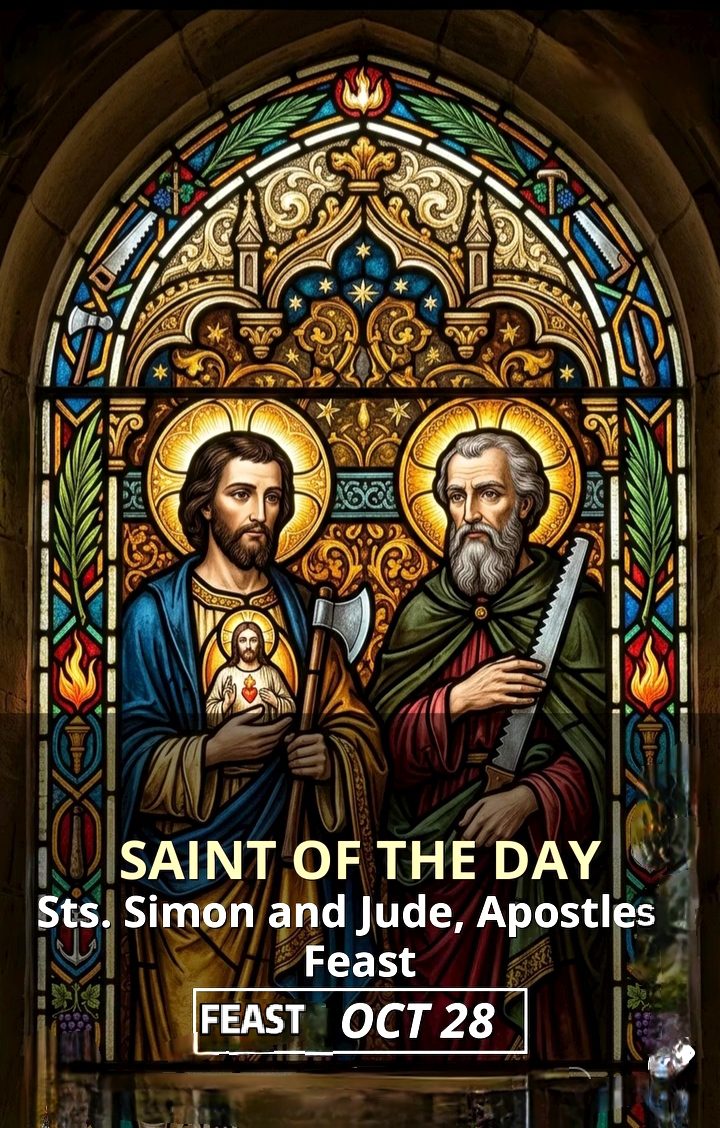
After Pentecost, when the tongues of fire had settled upon them, Simon and Jude found themselves drawn together – the zealous and the tender, the fire and the balm. They became brothers in the Spirit, walking shoulder to shoulder through lands where Christ’s name had never been spoken.
They journeyed first through Syria and Mesopotamia, healing the sick, teaching the poor, baptizing pagans at the edge of desert wells. Then, their road led eastward – to Persia, a land of strange tongues and many gods.
In each city they entered, Simon would preach with fiery conviction – his words cutting through the clamor of idols like a sword. And Jude, beside him, would speak softly to the wounded and forgotten, the ones hiding in the corners of the crowd.
Together they were a flame that both burned and warmed.
Miracles in a Pagan Land
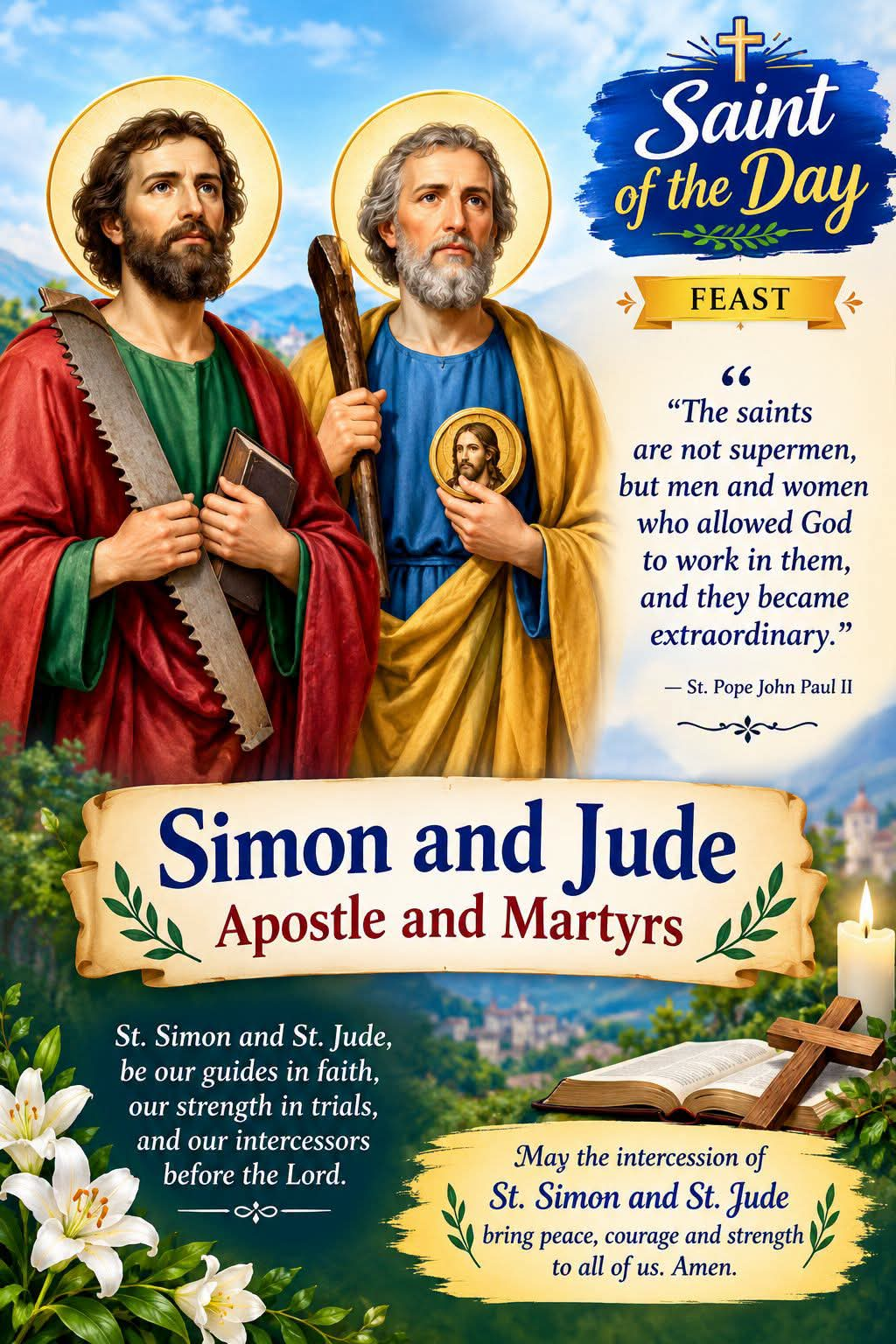
One story tells that in a Persian temple, magicians had bound the people in fear. They mocked the Apostles and demanded a sign.
Simon raised his hands toward heaven – and the idols fell to dust before their eyes. Cries rose from the crowd, and hundreds believed.
But where grace worked, hatred followed. The temple priests, humiliated and furious, stirred the rulers against them.
Martyrs of Persia
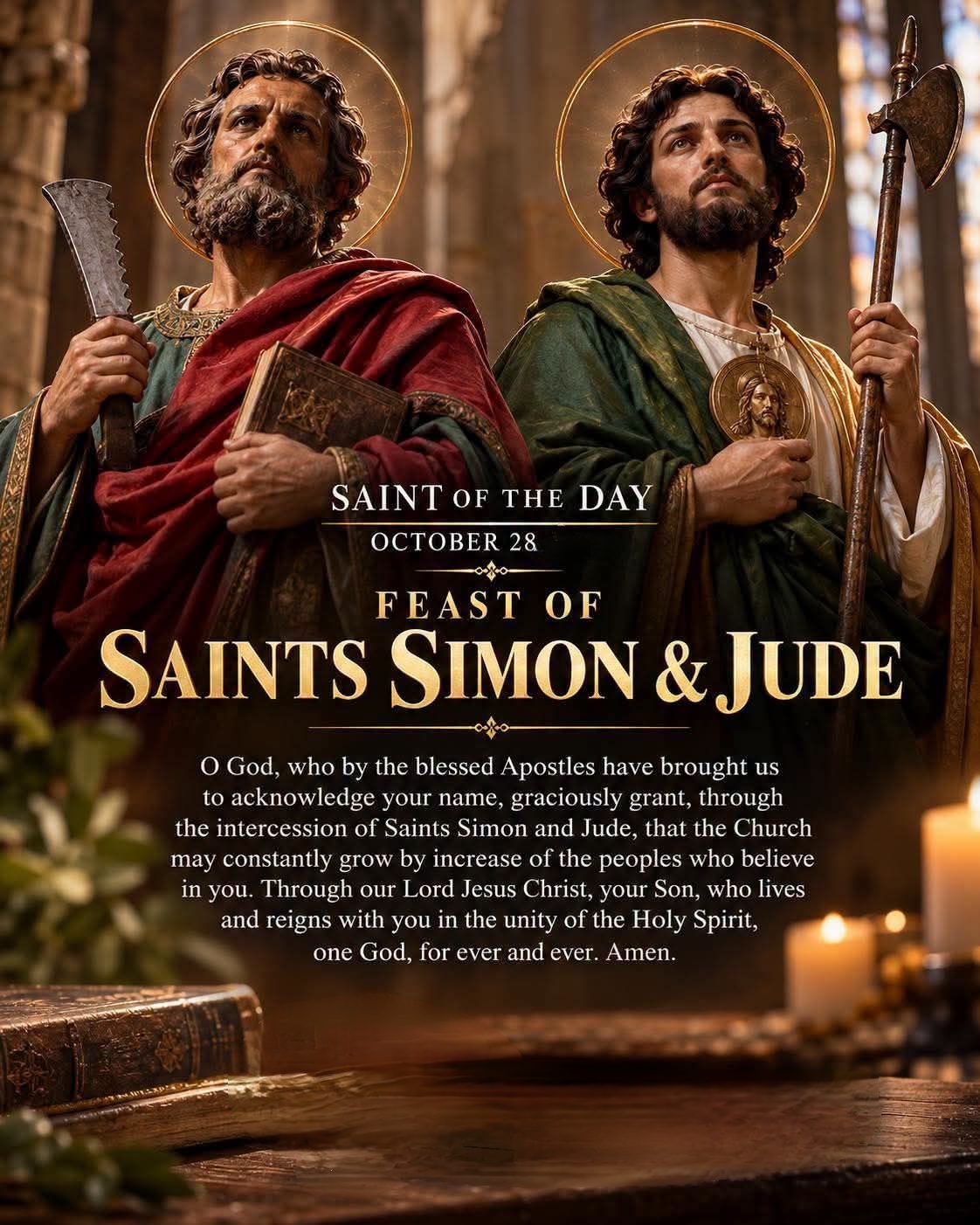
It was in the city of Suânîr (or Sufian) in Persia (modern-day Iran), near the banks of a dry plain, that their road ended.
The two friends were seized – scourged, chained, and ordered to renounce the Crucified.
Simon’s answer was calm, his eyes aflame:
“I served kings once who ruled with fear. I will not forsake the King who rules with love.”
And Jude added, with that quiet courage that had always marked him:
“We have seen His face. We cannot deny Him.”
The crowd fell upon them with clubs and axes. And as their blood mingled in the dust, witnesses said they heard them praying – their last words lost in the cry, “Come, Lord Jesus.”
Their bodies were buried together – two friends who in life had shared one mission, one love, one death.
Accounts differ on how they died – some say they were beaten with clubs or axes, others that they were sawed or speared to death, together proclaiming Christ until their last breath.
Their relics are believed to have been brought later to St. Peter’s Basilica in Rome, where they rest side by side – still inseparable in death as in life.
The Hidden Apostle Revealed
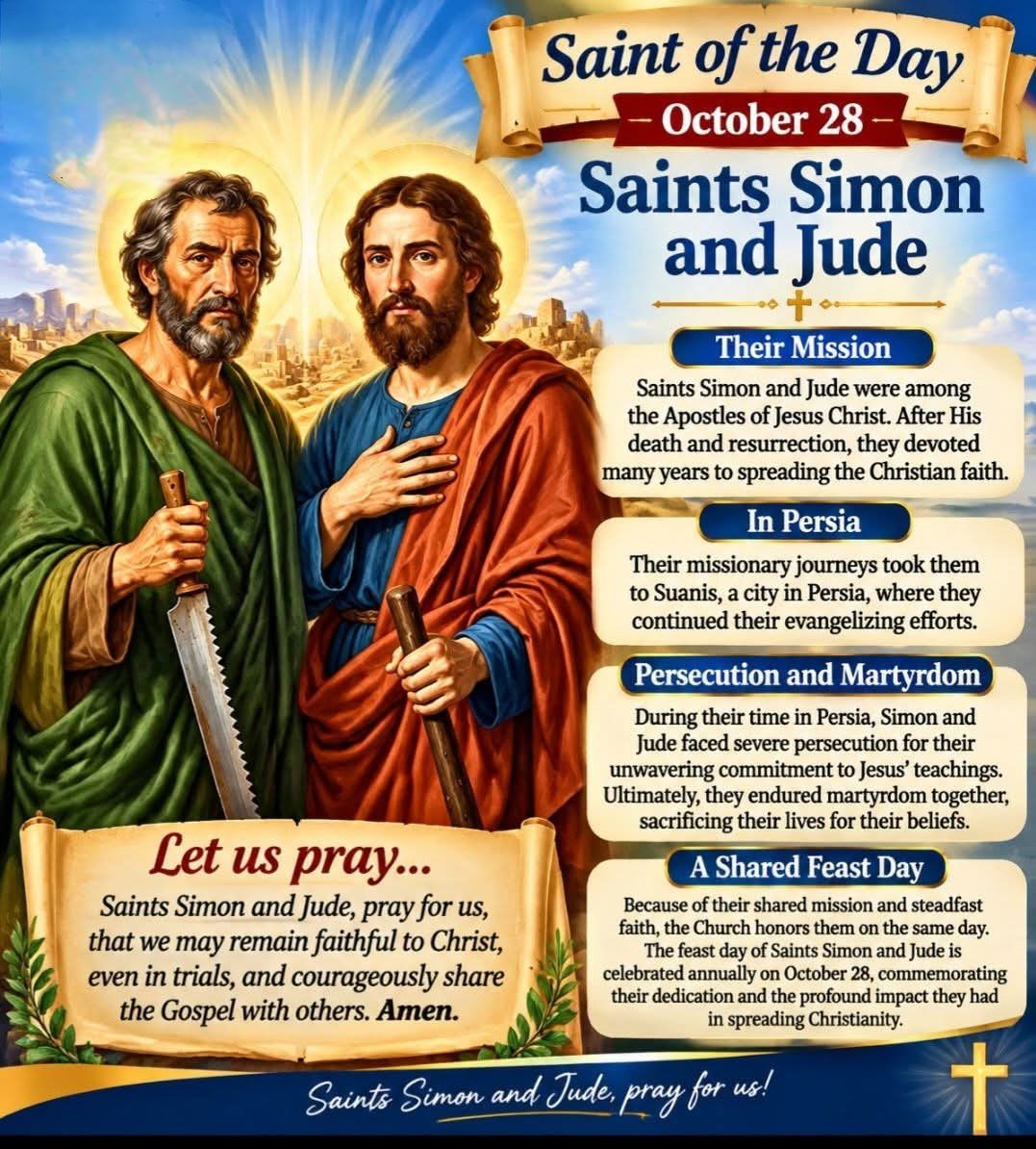
Among the two, St. Jude gained particular devotion in later centuries. Because his name, Judas, was so close to that of the betrayer, early Christians were hesitant to invoke him. Yet his intercession, it was said, brought powerful results in desperate situations.
Over time, he became known as the Patron Saint of Hopeless or Impossible Causes – the friend to those who feel forgotten, misunderstood, or beyond rescue.
His small New Testament letter (the Epistle of Jude) warns against corruption and false teachers, yet ends with hope:
“Keep yourselves in the love of God… and wait for the mercy of our Lord Jesus Christ unto eternal life.” (Jude 21)
Simon and Jude in the Early Church
In the early centuries, their missionary zeal became a model for evangelization beyond cultural and national boundaries.
Their joint feast reminds the Church that the Gospel first spread not through powerful institutions, but through pairs of faithful hearts who walked into strange lands armed only with love and courage.
In these two apostles, the Spirit wed zeal and tenderness – the two wings of the Gospel.
Simon shows the soul that passion, when purified by grace, becomes mission.
Jude shows that quiet fidelity can shake mountains.
Their friendship is the image of the Church herself – fiery in truth, gentle in mercy; bold to confront evil, humble to heal the broken. They remind us that the Gospel spreads not through argument, but through the fire of love shared between hearts united in Christ.

–—— PRAYER ——-
May the Most Sacred Heart of Jesus be adored, and loved in all the tabernacles until the end of time. Amen.
May the most Sacred Heart of Jesus be praised and glorified now and forever. Amen
Apostles St. Jude and St. Simon, pray for us and hear our prayers. Amen.
Blessed be the Sacred Heart of Jesus
Blessed be the Immaculate Heart of Mary
Blessed be St. Jude Thaddeus and St. Simon, in all the world and for all Eternity.
Pray one OUR FATHER, HAIL MARY & GLORY BE …

PRAYER
O God, Who, through Thy blessed Apostles Simon and Jude, hast brought us to the knowledge of Thy name, grant that we may celebrate their everlasting glory by advancing in good works, and that we may advance in good works by celebrating their glory.
Through our Lord Jesus Christ, Who liveth and reigneth with Thee, in the unity of the Holy Spirit, one God, world without end. Amen.
Saints Simon and Jude, we ask for your intercession in heaven, as members of the Twelve Apostles. Approach the Lord Jesus with our needs in your hands. Answer the prayers we present. Fulfill the petitions we seek. Pray for us all!

==================================
SAINT JUDE THADDEUS, APOSTLE
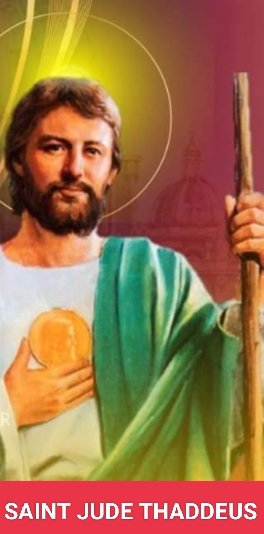 St. Jude, known as Thaddeus, was a brother of St. James the Less, and a relative of Our Saviour. He was one of the 12 Apostles of Jesus and his attribute is a club. Images of St. Jude often include a flame around his head, which represent his presence at Pentecost, when he accepted the Holy Spirit alongside the other apostles. Another attribute is St. Jude holding an image of Christ, in the Image of Edessa. Sometimes he can also be seen holding a carpenter’s ruler or is depicted with a scroll or book, the Epistle of Jude.
St. Jude was a son of Clopas and his mother Mary was the Virgin Mary’s cousin. Ancient writers tell us that he preached the Gospel in Judea, Samaria, Idumaea, Syria, Mesopotamia, and Lybia. According to Eusebius, he returned to Jerusalem in the year 62, and assisted at the election of his brother, St. Simeon, as Bishop of Jerusalem. St. Jude was the one who asked Jesus at the Last Supper why He would not manifest Himself to the whole world after His resurrection.
He is an author of an epistle (letter) to the Churches of the East, particularly the Jewish converts, directed against the heresies of the Simonians, Nicolaites, and Gnostics. Though St. Gregory the Illuminator has been credited as the “Apostle to the Armenians,” the Apostles Jude and Bartholomew are believed to have brought Christianity to Armenia, where Jude was rumored to have later been martyred. He is believed to have been martyred either in Armenia or Beirut.
Following his death, St. Jude’s body was brought to Rome and left in a crypt in St. Peter’s Basilica. Today his bones can be found in the left transept of St. Peter’s Basilica under the main altar of St. Joseph in a tomb he shares with the remains of the apostle Simon the Zealot.

Pilgrims came to St. Jude’s grave to pray and many reported a powerful intercession, leading to the title, “The Saint for the Hopeless and the Despaired.” Two Saints, St. Bridget of Sweden and St. Bernard, had visions from God asking them to accept St. Jude as “The Patron Saint of the Impossible.”
Roman Catholics invoke St. Jude when in desperate situations because his New Testament letter stresses that the faithful should persevere in the environment of harsh, difficult circumstances -just as their forefathers had done before them; therefore, he is the patron saint of desperate cases.
When the apostles are listed in Matthew 10:3 and Mark 3:18, Jude’s name does not appear but “Thaddeus” does. This occurrence led early Christians to believe Jude was known as both “Jude” and “Thaddeus,” the latter of which could have been a sort of nickname. “Thaddeus” may have become a popular nickname for Jude following Judas Iscariot’s betrayal.
PATRON: Desperate situations; forgotten causes; hospital workers; hospitals; impossible causes; lost causes;
PRAYER TO ST. JUDE
O most holy apostle, Saint Jude, faithful servant and friend of Jesus, the Church honoureth and invoketh thee universally, as the patron of hopeless cases, and of things almost despaired of. Pray for me, who am so miserable. Make use, I implore thee, of that particular privilege accorded to thee, to bring visible and speedy help where help was almost despaired of.
Come to my assistance in this great need, that I may receive the consolation and succor of Heaven in all my necessities, tribulations, and sufferings, particularly (here make your request) and that I may praise God with thee and all the elect throughout eternity. I promise thee, O blessed Jude, to be ever mindful of this great favour, to always honour thee as my special and powerful patron, and to gratefully encourage devotion to thee. Amen.
+++++++++++++++++++++++++++++++++++
ST. SIMON THE ZEALOT, APOSTLE

Saint Simon is surnamed the Canaanean or Canaanite, and the Zealot, to distinguish him from St. Peter, and from St. Simeon, the brother of St. James the Less, and his successor in the see of Jerusalem. Hammond and Grotius think that St. Simon was called the Zealot, before his coming to Christ, because he was one of that particular sect or party among the Jews called Zealots, from a singular zeal they possessed for the honour of God and the purity of religion.
A party called Zealots were famous in the war of the Jews against the Romans. They were main instruments in instigating the people to shake off the yoke of subjection; they assassinated many of the nobility and others in the streets, filled the temple itself with bloodshed and other horrible profanations, and were the chief cause of the ruin of their country.
But no proof is offered by which it is made to appear that any such party existed in our Saviour’s time, though some then maintained that it was not lawful for a Jew to pay taxes to the Romans At least if any then took the name Zealots, they certainly neither followed the impious conduct nor adopted the false and inhuman maxims of those mentioned by Josephus in his history of the Jewish war against the Romans.
St. Simon, after his conversion, was zealous for the honour of his Master, and exact in all the duties of the Christian religion; and showed a pious indignation toward those who professed this holy faith with their mouths, but dishonoured it by the irregularity of their lives. No further mention appears of him in the gospels than that he was adopted by Christ into the college of the apostles.
With the rest he received the miraculous gifts of the Holy Ghost, which he afterwards exercised with great zeal and fidelity. If this apostle preached in Egypt, Cyrene, and Mauritania, he returned into the East; for the Martyrologies of St. Jerome, Bede, Ado, and Usuard place his martyrdom in Persia, at a city called Suanir, possibly in the country of the Suani, a people in Colchis, or a little higher in Sarmatia, then allied with the Parthians in Persia; which may agree with a passage in the Acts of St. Andrew, that in the Cimmerian Bosphorus there was a tomb in a “rot, with an inscription importing that Simon the Zealot was interred there.
His death is said in these Martyrologies to have been procured by the idolatrous priests. Those who mention the manner of his death say he was crucified. St. Peter’s Church on the Vatican at Rome and the Cathedral of Toulouse are said to possess the chief portions of the relics of St. Simon and St. Jude.

(Taken from Vol. III of “The Lives of the Fathers, Martyrs and Other Principal Saints” by the Rev. Alban Butler.)
PATRON: Curriers; sawmen; sawyers; tanners.
PRAYER TO ST. SIMON
O Glorious St. Simon, you were a cousin of Jesus and a devoted follower as well. You were called “the Zealot,” indicating that you were willing to give your life for your religion and your freedom as a human person. Saint Simon, obtain for us the grace to be willing to give our lives for Christ and to labor for the freedom and peace that only God can give. Help us to spend ourselves for God on earth and be received by him in eternal bliss in heaven. Amen






2 Prayers
Amen 🙏
Lord, I beseech you to bless each n everyone of your children. Keep them safe, healthy and successful. Please grant this oh Lord 🙏🙏🙏