
TODAY’S GOSPEL READING – 15 FEBRUARY
February 15, 2026
2 John 1:6
February 16, 2026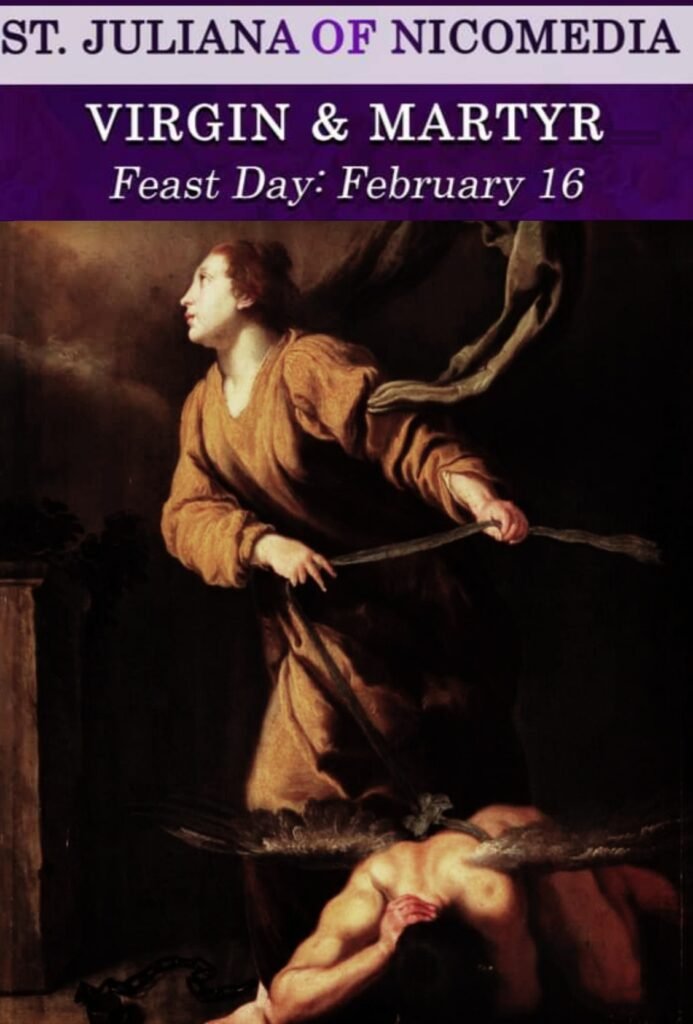

FEAST OF SAINT JULIANA OF NICOMEDIA VIRGIN AND MARTYR
FEAST DAY – 16th FEBRUARY
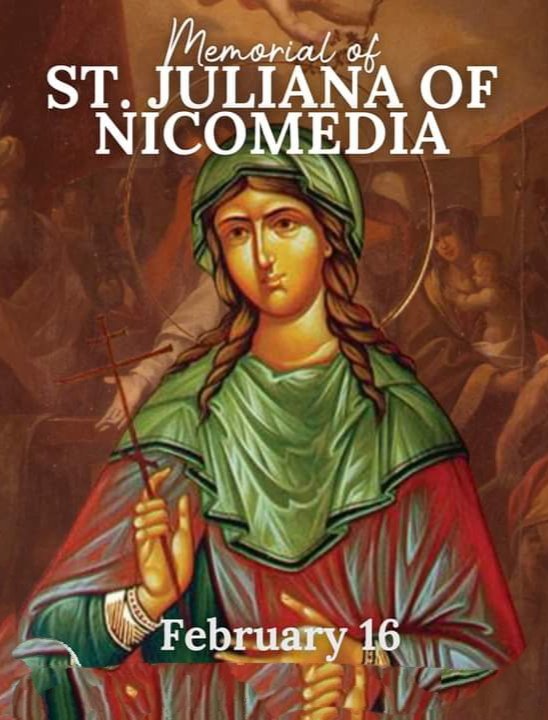
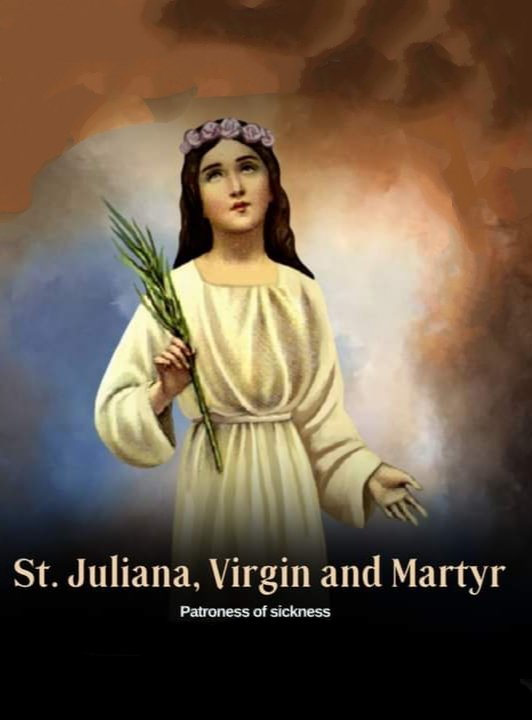
Saint Juliana of Nicomedia is said to have suffered Christian martyrdom during the Diocletian persecution in 304. She was popular in the Middle Ages, especially in the Netherlands, as the patron saint of sickness. Juliana was born in Cumae, Italy, around 285 A. D., the daughter of a pagan official named Africanus. Betrothed at a young age to a nobleman named Evilase, Juliana refused to marry until he first became the prefect of Nicomedia.
While he was working to meet this demand which he eventually did, Juliana converted to Christianity, and made a vow of chastity. She then insisted that Evilase convert, prior to marriage. As a Roman prefect, this was not something he could do and still maintain his position and status.

Juliana’s father, who himself despised Christians, beat and abused her in attempts to change her mind, but she would not relent, holding firm to her faith in Christ. Evilase, now well established as prefect, called Juliana before the tribunal, denouncing her as a Christian.
As this was during the persecution of Christians under the order of Emperor Maximianus, there was little choice than to have her executed unless she would recant her faith.

Juliana refused, finding her refuge in the Lord, and was made to undergo horrible torture, during which the Devil appeared to her in the guise of an angel, suggesting she give in to the torturer’s request. Juliana, trusting in the Lord, knew that the vision of the angel was a delusion.
Juliana was not to be fooled by the snares of the Devil, and praying to the Lord for guidance, she received a message from God. “Do thou seize this vile one and hold him fast, till that he rightly declare unto thee his purpose, even from the beginning what his kinship may be.” And the heart of the glorious maid became glad.
Juliana captured the Devil, holding fast to him, and forced him to recount his sinfulness. As he recounted a very long list of deceit and trickery, Juliana was dragged before the tribunal. She dragged the Devil with her—he, all the while, pleading for freedom. Juliana let the Devil free, but for her part, bravely met her executioner. As per her Acts, she was first partially burnt in flames, then plunged into a pot of boiling oil, and finally beheaded in 305 A.D.
The veneration of Saint Juliana of Nicomedia became very widespread, especially in the Netherlands. She became known as the patron saint of sickness, sick people and bodily ills.
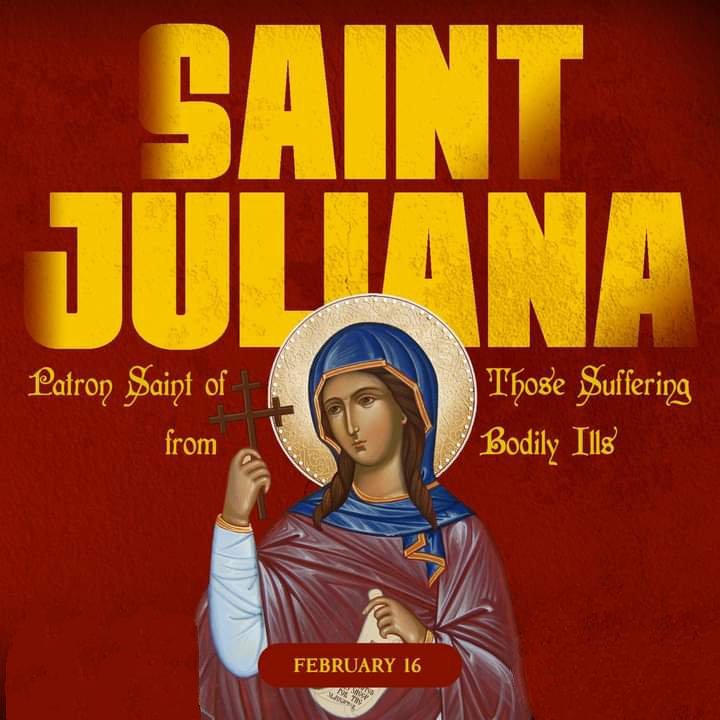
At the beginning of the 13th century her remains were transferred to Naples. The description of this translation by a contemporary writer is still extant. The feast of the saint is celebrated in the Latin Church on 16 February, in the Greek on 21 December.
Since her Acts describe the conflicts which she had with the devil, she is represented in pictures with a winged devil whom she leads by a chain. She is also shown enduring various tortures or fighting a dragon.

PRAYER
Eternal God, you bestowed on St. Juliana the crown of everlasting joy, because she sacrificed her life rather than renounce the virginity she had promised in witness to Christ. Edified by her brave generosity, enable us to rise out of the bondage of earthly desires, obtaining the rewards of your kingdom.
Grant this through our Lord Jesus Christ, your Son, who lives and reigns with you and the Holy Spirit, One God, for ever and ever. Amen
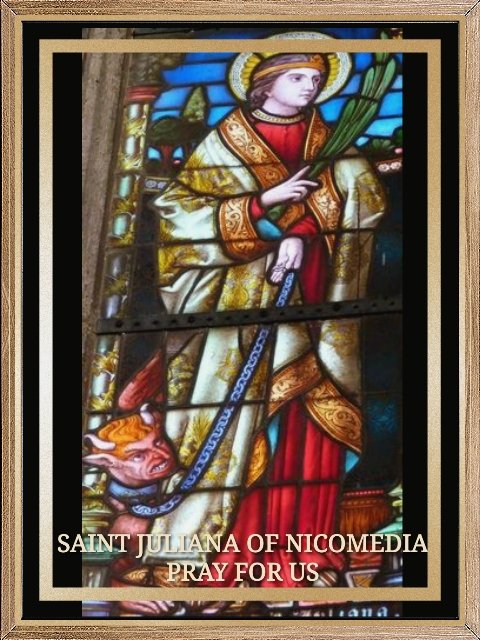
Saint Juliana of Nicomedia, pray for us.
**********************************
ALSO CELEBRATED:
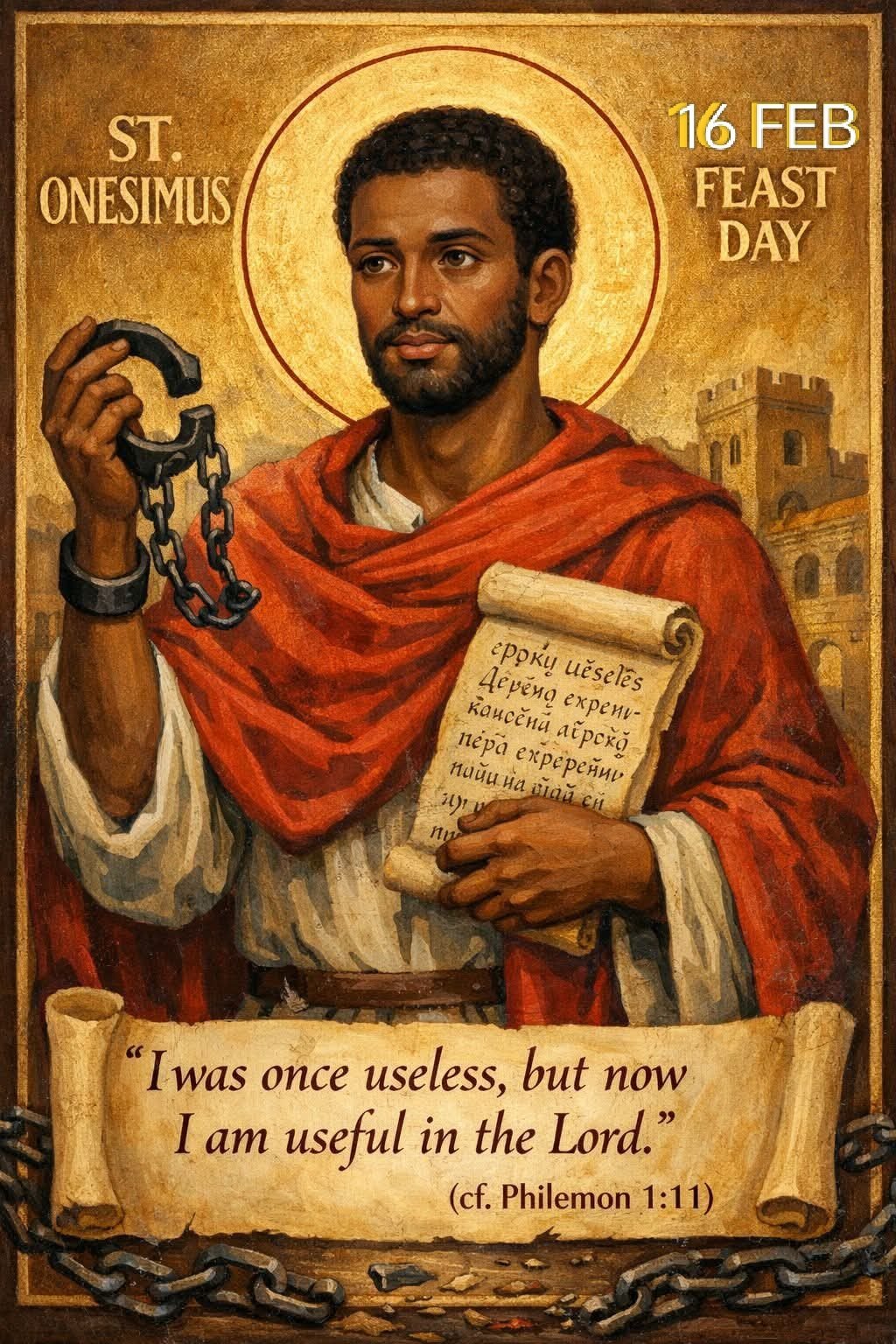
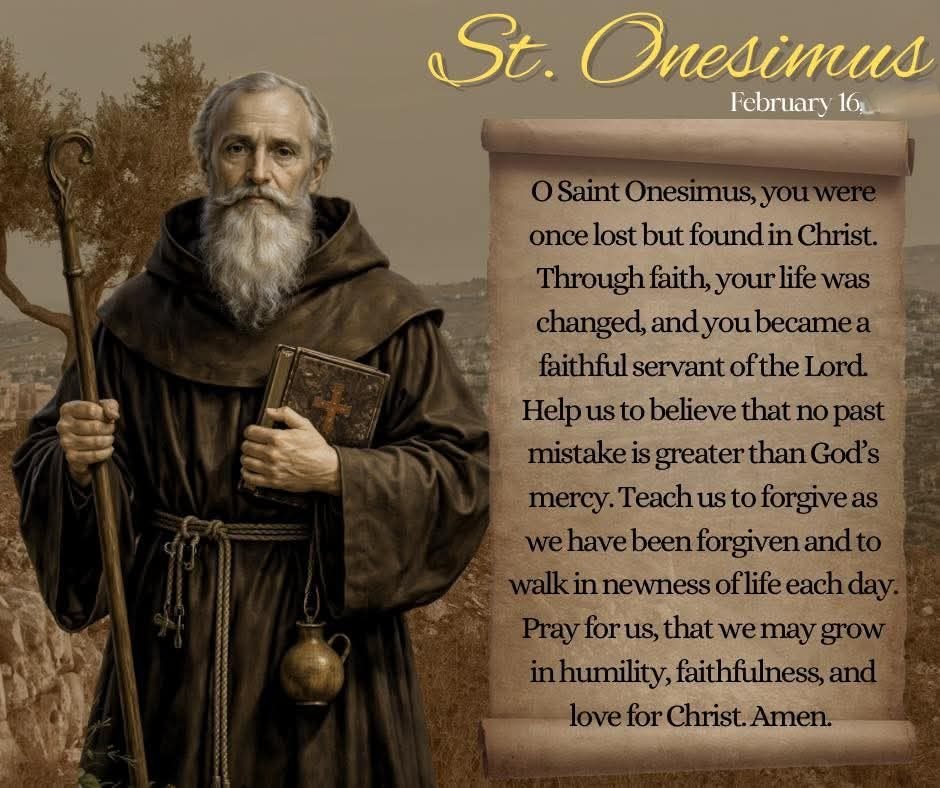
SAINT ONESIMUS – 16 FEBRUARY
Onesimus was a slave in the household of Philemon, a wealthy Christian convert in Colossae, Phrygia (modern-day Turkey), around the mid-1st century AD—likely during the 50s or early 60s AD, when Saint Paul was actively ministering. Onesimus wronged his master (possibly through theft or some other offense) and fled, seeking to escape punishment.
In God’s providence, Onesimus arrived in Rome, where he encountered Saint Paul, who was imprisoned there during his first Roman captivity (traditionally dated to around 60–62 AD). Paul received the runaway slave with fatherly love, shared the message of Christ, baptized him, and regarded him as his own spiritual son, calling him “my child Onesimus, whom I have begotten in my imprisonment” (Philemon 1:10).
Deeply changed by faith, Onesimus became a faithful helper to Paul. Yet Paul insisted on reconciliation: he sent Onesimus back to Philemon, carrying the personal Epistle to Philemon (written around 60–62 AD). In this letter, Paul appealed earnestly: receive him “no longer as a slave, but more than a slave, a beloved brother—especially dear to me, but even more to you, both as a man and in the Lord.” Paul offered to repay any debt Onesimus owed and asked Philemon to welcome him as he would welcome Paul himself.
Moved by Paul’s plea and the grace of Christ, Philemon forgave Onesimus and embraced him as a brother in faith. Tradition holds that Onesimus was later freed and continued serving the early Church faithfully. He is mentioned again in Paul’s Letter to the Colossians (also written around 60–62 AD), where he accompanies Tychicus as they deliver the letter to the Colossian community.
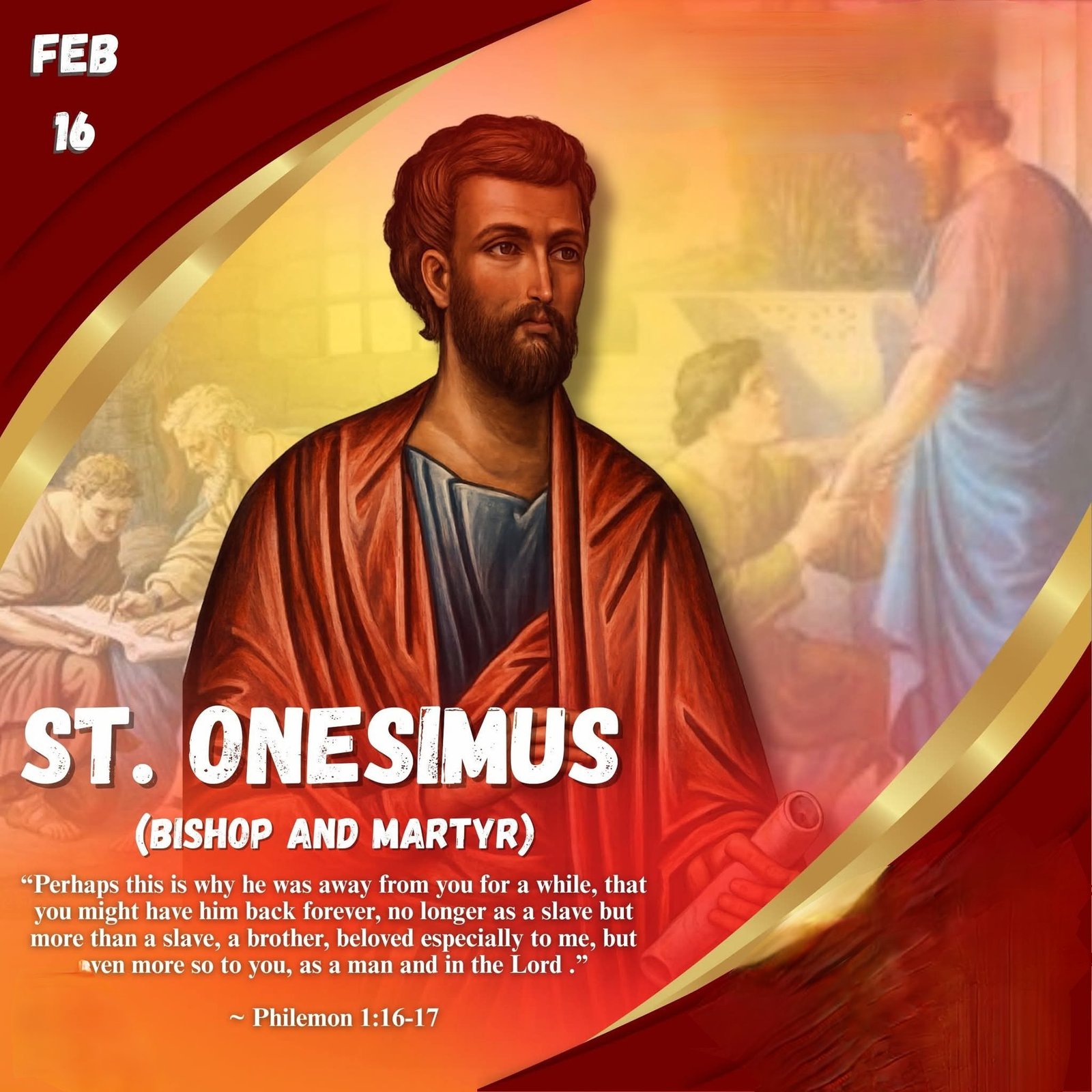
According to early Church tradition (including accounts from Saint Ignatius of Antioch and later sources), Onesimus went on to become bishop of Ephesus, succeeding Saint Timothy, and devoted his life to preaching the Gospel.
During the reign of Emperor Domitian (or Trajan in some accounts), Onesimus was arrested for his faith. He endured imprisonment and torture in Rome—his legs and thighs reportedly broken with clubs—before being stoned to death as a martyr. His martyrdom is traditionally dated to around 90 AD (some sources suggest c. 68–109 AD, but c. 90 is commonly cited). His body was later returned to Ephesus for burial.
In the Roman Catholic Church, Saint Onesimus is commemorated on February 15 (as listed in the current Roman Martyrology since 2004; formerly February 16 in the traditional Western calendar). The Eastern Orthodox Church also honors him primarily on February 15.
CONTEMPLATING THE LIFE OF SAINT ONESIMUS, FROM FUGITIVE TO BROTHER
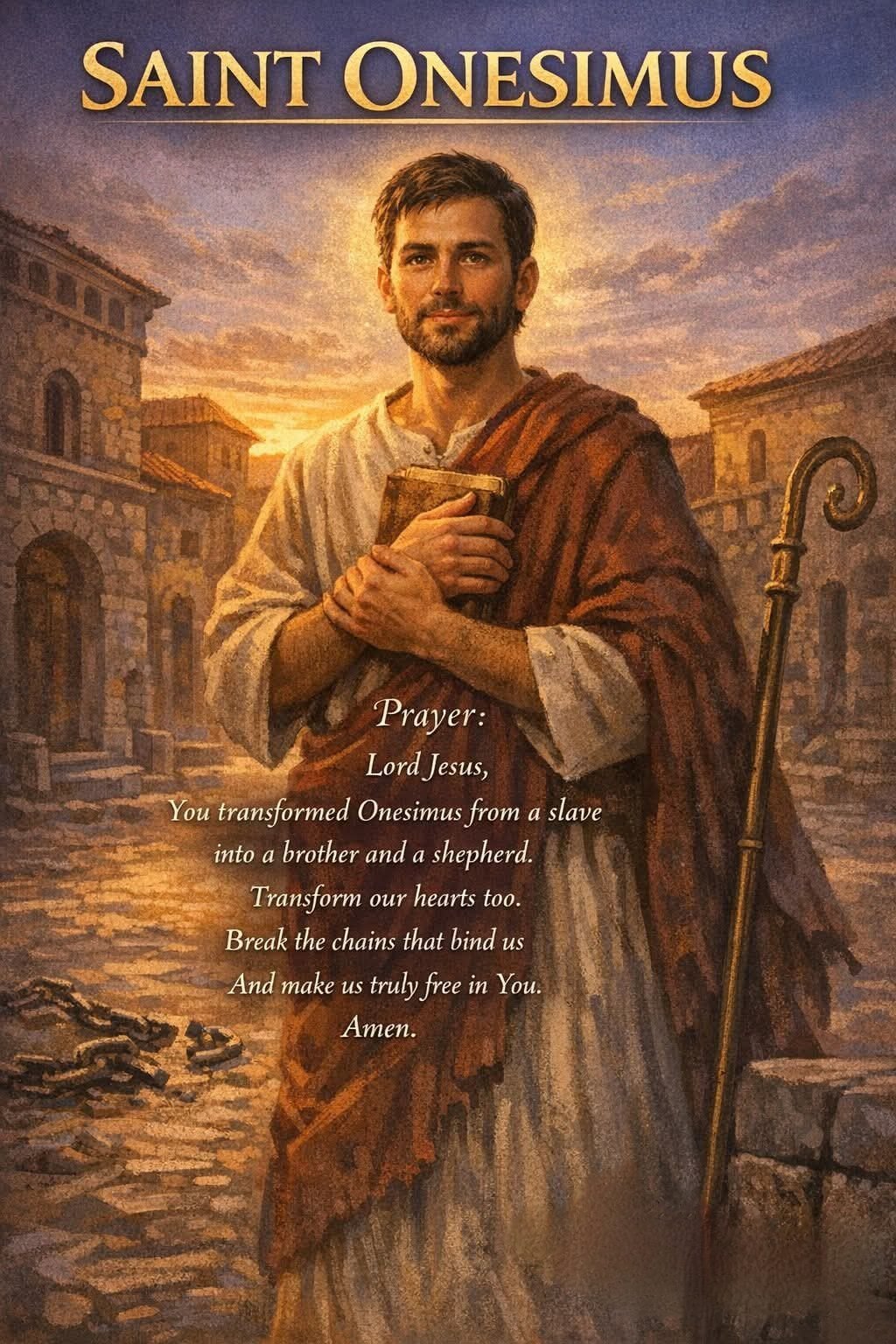
Onesimus in the New Testament
St. Onesimus appears in the Letter to Philemon, one of the shortest yet most touching books of Scripture. His story begins in secrecy and fear. He fled under the cover of night without farewells, plans, or security. Onesimus had been a slave in the household of Philemon, a Christian master living in Colossae. Something had clearly gone wrong—possibly theft, resentment, or sheer desperation. Under Roman law, runaway slaves faced brutal punishment if captured, including beating, branding, or even death. Yet, through these desperate circumstances, divine grace quietly began to unfold in his life.
A Chance Encounter in Chains
During his escape, Onesimus encountered a prisoner who, despite being physically bound, lived with deep spiritual freedom. This prisoner was St. Paul. Paul did not view Onesimus as a criminal or runaway slave but as a soul in need of redemption. In the darkness of the prison cell, Onesimus heard about Christ for the first time—a Master who became a servant, a Lord who humbled Himself to wash feet, and a Savior who forgave those who crucified Him. For someone who had lived as property, the message of a loving God who valued dignity and freedom was life-changing. Moved by this truth, Onesimus sought baptism, and Paul welcomed him as a spiritual son, later writing that he had become Onesimus’ father during his imprisonment. The runaway slave finally discovered belonging and spiritual home.
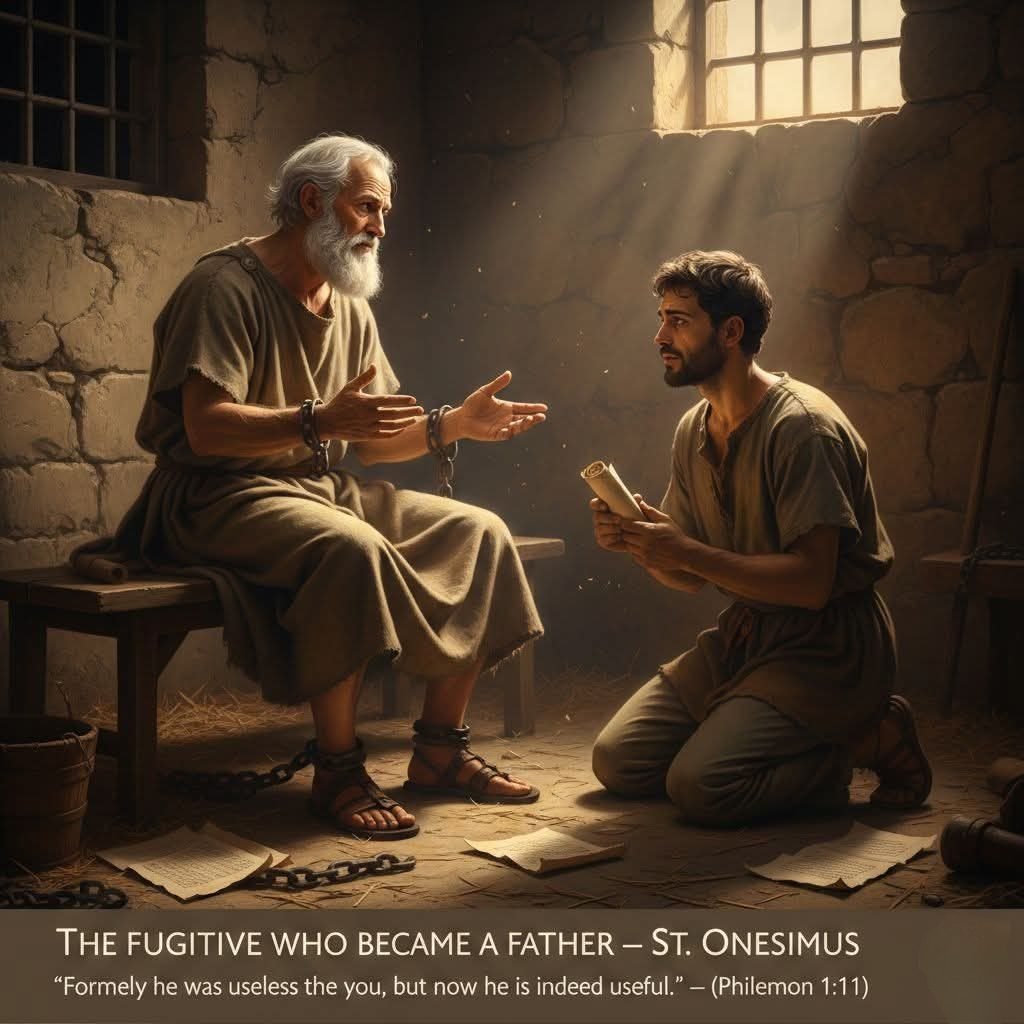
The Hardest Return
Paul grew deeply attached to Onesimus, who faithfully served and comforted him during imprisonment. However, Paul understood that true transformation required reconciliation. In a courageous and revolutionary decision, Paul sent Onesimus back to Philemon—not as a slave returning under compulsion, but as a brother carrying a personal letter. In this letter, Paul urged Philemon to receive Onesimus no longer as a slave but as a beloved brother in Christ. Rather than commanding obedience, Paul appealed to love and even offered to repay any debts Onesimus owed. Onesimus’ return must have been filled with anxiety and hope, as his fate rested on whether forgiveness or punishment awaited him. In many ways, the credibility of the Gospel message seemed tied to this moment of reconciliation.
A New Brotherhood
Christian tradition holds that Philemon accepted Paul’s plea, allowing grace to triumph over social hierarchy and resentment. Onesimus was welcomed not as property but as family. His life changed entirely from that moment. Once a fugitive living in fear, he became a devoted disciple and eventually a leader in the Church. Early tradition remembers him as bishop of Ephesus, guiding believers in a region where he had once known insecurity and shame. The man who had run away in fear eventually became a shepherd leading others toward faith and reconciliation.
Later Tradition and Martyrdom
Some early Christian records, including ancient martyrologies, suggest that Onesimus later suffered martyrdom, possibly during the persecutions under Roman emperors Domitian or Trajan. While historical details remain uncertain, the Church has long honored him as a saint who embodied reconciliation, Christian equality, and spiritual liberation through Christ.
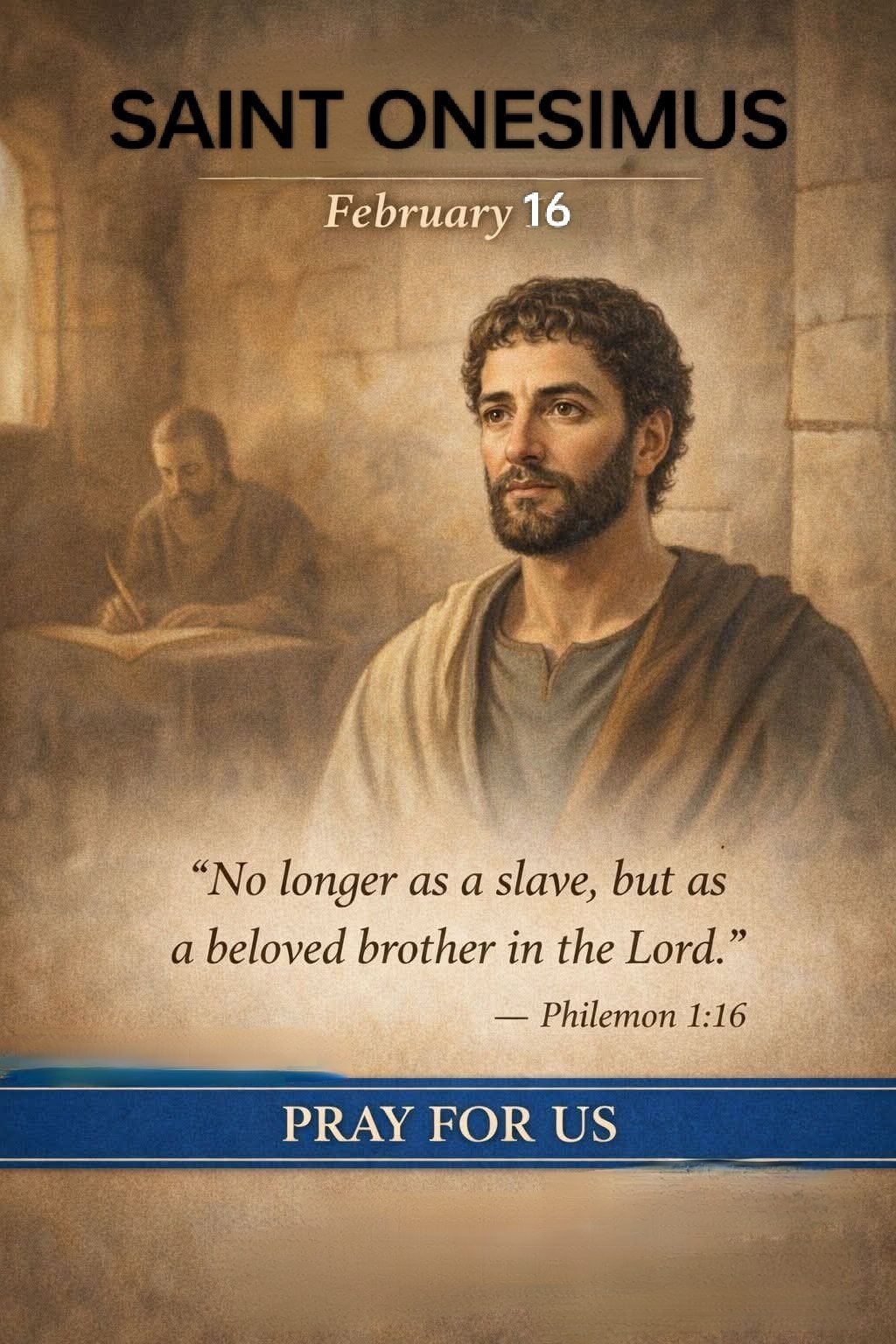
Why St. Onesimus Matters
Although Scripture mentions Onesimus only briefly, his story carries profound meaning. His journey from slave to brother demonstrates how Christianity transforms relationships from within. His transformation from fugitive to bishop reveals that grace does not erase the past but redeems it. His passage from being treated as property to being recognized as a person shows how Christ restores human dignity. Onesimus reminds believers that no one is permanently defined by past mistakes, reconciliation has the power to reshape lives, and Christian love quietly but powerfully dismantles barriers.
The account of Onesimus occupies only a single letter in Scripture, yet within it lies a spiritual revolution—dignity restored, relationships healed, identity transformed, and brotherhood born where ownership once ruled. The Gospel did not begin by overthrowing social systems outwardly but by transforming hearts inwardly. Through the life of one runaway slave, the Church discovered the true meaning of Christian freedom and brotherhood.
PRAYER
O Lord Jesus Christ, who in Your mercy turned the heart of Saint Onesimus from bondage to freedom in Your love, and raised him from fugitive slave to faithful bishop and martyr, grant us the grace to embrace true conversion in our own lives. As You inspired Paul to intercede and Philemon to forgive, teach us to forgive one another from the heart, to see every person as a brother or sister in You, and to serve Your Church with courage even unto death. Through the intercession of Saint Onesimus, whose feast we celebrate on February 15, make us useful servants in Your vineyard, living fully for Your glory now and forever. Amen