
TODAY’S GOSPEL READING – 25 FEBRUARY
February 25, 2026
Day Eight of Lent – Fidelity in All Things
February 26, 2026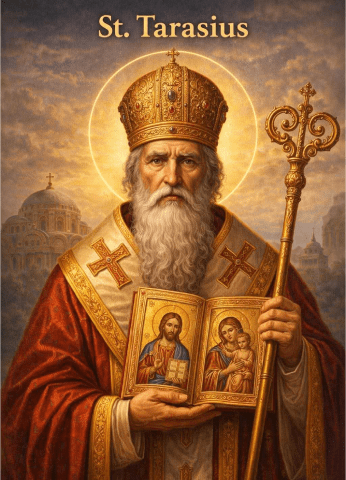
BACKGROUND AND PROVIDENTIAL CALL
Saint Tarasius was a high-ranking imperial official in Constantinople before being unexpectedly called to serve as Patriarch. Though a layman at the time of his election, he humbly accepted ordination for the sake of unity and truth in the Church. His life reveals that God often calls His servants from unexpected places to fulfill divine purposes.
“You did not choose Me, but I chose you and appointed you that you should go and bear fruit.”
— John 15:16
Leaving political prestige behind, he embraced spiritual responsibility, showing that obedience to God outweighs personal comfort or status.
DEFENDER OF HOLY TRADITION
During the turmoil of the iconoclastic controversy, Tarasius stood firm in defense of the veneration of holy images. He played a decisive role in convening the Second Council of Nicaea, which affirmed the rightful place of icons in Christian worship.
“Therefore, brethren, stand firm and hold to the traditions which you were taught.”
— 2 Thessalonians 2:15
He understood that honoring sacred images ultimately protects the truth of the Incarnation—Christ truly became visible flesh. His leadership reminds believers that safeguarding doctrine is an act of love for Christ and His Church.
HUMILITY IN AUTHORITY
Though elevated to one of the highest ecclesiastical offices, Tarasius governed with gentleness and pastoral care. He was known for charity toward the poor and for balancing firmness in doctrine with mercy in discipline.
“Whoever would be great among you must be your servant.”
— Matthew 20:26
His example teaches that spiritual authority is not domination but service. True leadership reflects the humility of Christ.
PEACEMAKER IN TIMES OF DIVISION
The Church in his time was fractured by theological disputes and political interference. Tarasius sought reconciliation without compromising truth, patiently working toward unity.
“Blessed are the peacemakers, for they shall be called sons of God.”
— Matthew 5:9
His perseverance in dialogue and prayer demonstrates that unity requires courage, wisdom, and deep trust in God’s providence.
A LIFE ROOTED IN PRAYER AND CHARITY
Beyond councils and controversies, Tarasius lived a life of personal holiness. He was devoted to prayer, generous to the needy, and attentive to the spiritual formation of clergy and faithful alike.
“Let your light so shine before others, that they may see your good works and give glory to your Father in heaven.”
— Matthew 5:16
His quiet fidelity reminds believers that public witness must flow from private communion with God.
MESSAGE FOR TODAY
Saint Tarasius speaks powerfully to a world marked by confusion and division. He shows that fidelity to truth, combined with humility and compassion, strengthens the Church and glorifies God.
“Watch, stand fast in the faith, be brave, be strong. Let all that you do be done in love”
— 1 Corinthians 16:13–14
His life assures us that when faith is challenged, God raises up courageous yet humble servants to guard the truth and guide His people toward unity and peace.
PRAYER TO SAINT TARASIUS
Saint Tarasius, faithful shepherd and defender of truth,
intercede for us that we may remain steadfast in faith,
humble in service, and courageous in doing what is right.
Guide us to love Christ and His Church with sincere hearts. Amen