
SPIRITUAL INSIGHTS INTO THE LIFE OF SAINT ATHANASIUS
May 2, 2026
Ezekiel 36:26
May 2, 2026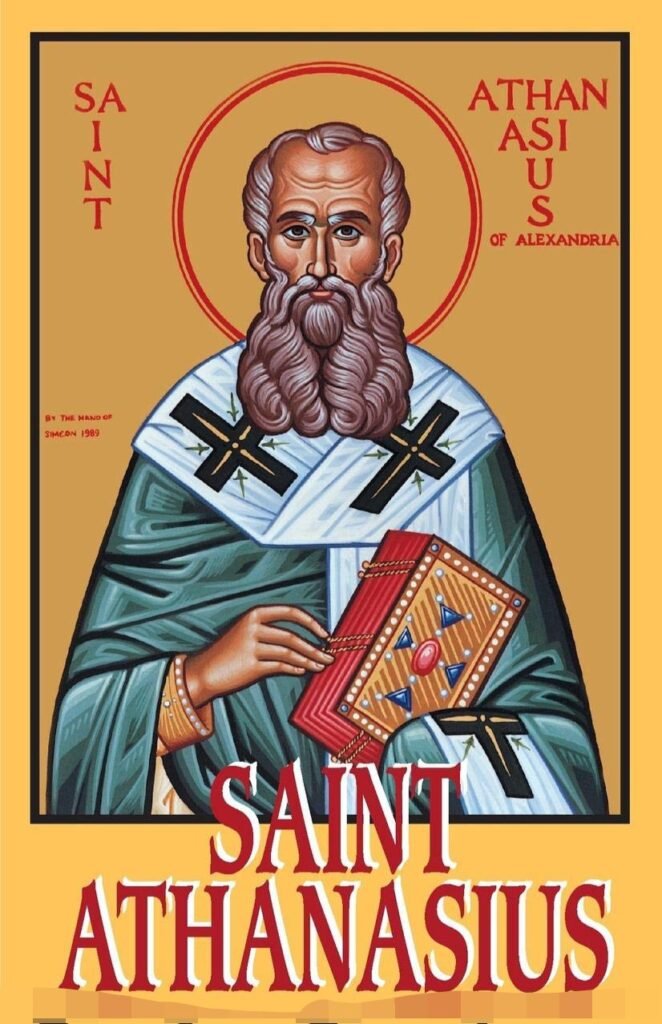
FEAST OF SAINT ATHANASIUS OF ALEXANDRIA
FEAST DAY – 2nd MAY

Athanasius I of Alexandria (c. 296–298 – 2 May 373), also called Athanasius the Great, Athanasius the Confessor or, primarily in the Coptic Orthodox Church, Athanasius the Apostolic, was a Greek church father and the 20th pope of Alexandria (as Athanasius I). His intermittent episcopacy spanned 45 years (c. 8 June 328 – 2 May 373), of which over 17 encompassed five exiles, when he was replaced on the order of four different Roman emperors.
Athanasius was a Christian theologian, a Church Father, the chief defender of Trinitarianism against Arianism, and a noted Coptic Christian (Egyptian) leader of the fourth century. Conflict with Arius and Arianism as well as successive Roman emperors shaped Athanasius’ career. In 325, at the age of 27, Athanasius began his leading role against the Arians as a deacon and assistant to Bishop Alexander of Alexandria during the First Council of Nicaea.
Roman emperor Constantine the Great had convened the council in May to August 325 to address the Arian position that the Son of God, Jesus of Nazareth, is of a distinct substance from the Father. Three years after that council, Athanasius succeeded his mentor as pope of Alexandria. In addition to the conflict with the Arians (including powerful and influential Arian churchmen led by Eusebius of Nicomedia), he struggled against the Emperors Constantine, Constantius II, Julian the Apostate and Valens.
He was known as Athanasius Contra Mundum (Latin for Athanasius Against the World). Nonetheless, within a few years of his death, Gregory of Nazianzus called him the “Pillar of the Church”. His writings were well regarded by subsequent Church fathers in the West and the East, who noted their devotion to the Word-become-man, pastoral concern and interest in monasticism.
Athanasius is considered one of the four great Eastern Doctors of the Church in the Catholic Church. In his Easter letter of 367, Athanasius was the first person to list the 27 books of the New Testament canon that is in use today. He is venerated as a Saint in the Eastern Orthodox Church, the Catholic Church, the Coptic Orthodox Church, the Anglican Communion, and Lutheranism.
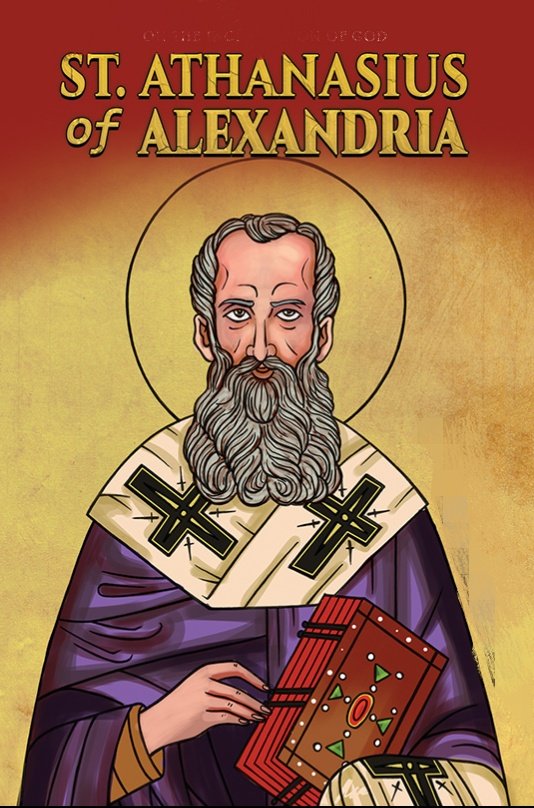
He is called the “Father of Orthodoxy,” the “Pillar of the Church” and “Champion of Christ’s Divinity.” Athanasius became one of the most dedicated opponents of the heresy of Arianism. Much of his life was a testimony to the divinity of Jesus Christ. Born in Alexandria, Egypt to a prominent Christian family, Athanasius received a wonderful education in Christian doctrine, Greek literature, philosophy, rhetoric and jurisprudence.
He was well studied in the Hebrew Scriptures and the Gospel accounts and the Christian texts which would later be recognized by the Church as the canon of the New Testament. Bishop Alexander became a strong influence in Athanasius’ life after Alexander witnessed him playing at administering Baptism as a young boy, with other children. Alexander, after questioning them, determined the baptisms were valid and they could train for priesthood.
As he grew up, Athanasius befriended many monks and hermits of the desert, including St. Antony, whose biography he wrote. Athanasius became Alexander’s secretary in 318 after being ordained a deacon. Around this time, Athanasius wrote his first work, a theological treatise on the Incarnation which is still quoted extensively in Christian theological studies and spiritual literature.
Around 323, Arius, an ambitious priest of the Alexandrian Church, denied the Divinity of Christ, and began spreading word that Jesus Christ was not truly divine, but merely created in time by the Eternal Father. Alexander demanded Arius produce a written statement on the false doctrine. It was condemned as heresy after two dissenting Bishops came forward. Arius and 11 other priests and deacons were deposed from their office, for teaching false doctrine.

Arius left for Caesarea, but continued to teach his false doctrine and enlisted support from the Bishop of Nicomedia, Eusebius and other Syrian prelates. Athanasius, as Alexander’s secretary, was present during the great Church debate. He stood alongside Alexander during the famous Council of Nicaea to determine the matters of dogma.
It was during this meeting, summoned by Emperor Constantine, that Arius’ sentencing was officially confirmed and the Nicene Creed was adopted as the Creed of the Church and a worthy symbol of the orthodox Christian faith. The early Christian Church, undivided, rejoiced at the defense of the true nature of Jesus Christ. Athanasius is regarded as the great defender of the Faith in both the Orthodox and Catholic Churches.
Just five months later, Alexander died and Athanasius succeeded him after being unanimously elected. He was consecrated as the new Bishop of Alexandria in 328 and continued the fight against Arianism. In 330, Eusebius approached Emperor Constantine and convinced him to command Athanasius to allow Arians back into communion. Athanasius refused, noting the Catholic Church could not hold communion with heretics attacking the divinity of Christ.
However, Eusebius did not give up on his cause, and he wrote to the Egyptian Meletians in efforts to have Athanasius impeached. The Meletians charged Athanasius with the crimes of exacting a tribute of linen for use in his church, sending gold to Philomenus, treason against the emperor and authorizing one of his deputies to destroy a chalice used at the altar by a Meletian priest.
He was tried and proved his innocence on all accusations. The Arians didn’t stop there though; they came forward with another charge, claiming he murdered a Meletian bishop. Athanasius was ordered to attend a council at Caesarea, but knowing the bishop was alive and in hiding, Athanasius ignored the summons. In 335, Emperor Constantine commanded Athanasius to go to the Council of Tyre, Lebanon.
The council was full of Athanasius’ opponents and was led by an Arian. Athanasius realized his condemnation was already pre-decided. He was exiled for the first time to Trier, Germany. While there, he kept in touch with his flock by letter. Athanasius’ exile lasted for two and a half years. He returned to Alexandria in 338 to find both Emperor Constantine and Arius had died.
Constantine’s empire was divided between his three sons, Constantine II, Constantius and Constans. After he returned to Alexandria, his enemies continued to try to bring him to exile. They accused him of raising sedition, of promoting bloodshed, and detaining his own use of corn.
Eusebius was able to obtain a second sentence of deposition against Athanasius and get the election of an Arian bishop for Alexandria approved.
After this, a letter was written to Pope St. Julius asking for his intervention and a condemnation of Athanasius. The case for Athanasius was set forth, and the pope accepted the suggestion offered by Eusebius for a synod to discuss the situation. Meanwhile, a Cappadocian named Gregory was installed in Alexandria, and Athanasius went to Rome to await his hearing.
Athanasius was completely vindicated by the synod, but was unable to return home to Alexandria until the death of the Cappadocian Gregory in 345. Athanasius returned to Alexandria to scenes of people rejoicing after he had been absent for eight years. However, in 353 Athanasius would face more condemnations by the Arians in the councils at Arles, France and again in 355 in Milan, Italy.
Persecution continued against Athanasius and escalated to physical attacks against him. While he was celebrating a vigil Liturgy in a church in Egypt, soldiers forced their way in and killed some of the congregation. Athanasius managed to escape and hid in the desert, where a group of monks kept him safe for six years. During his years as a hermit, he wrote his Apology to Constantius, the Apology for His Flight, the Letter to the Monks, and the History of the Arians.
Athanasius returned to Alexandria after the death of Constantius in 361 and the new emperor, Julian, revoked all sentences of exile enacted by his predecessor. This lasted only a few months though. Emperor Julian’s plan for paganizing the Christian world couldn’t get very far so long as Athanasius, the champion for Catholic faith, was around. Therefore, Julian exiled Athanasius and he once again sought refuge in the desert.
He stayed there until 363 when Julian died and the next emperor, Emperor Jovian reinstalled him. Jovian’s reign was a short one, and Athanasius was again banished just eight months later. Jovian’s successor, Valens issued an order banning all Orthodox bishops who were exiled by Constantius.
Four months later, Valens revoked his own order and Athanasius was restored permanently. Over the course of his life, Athanasius was banished five times and spent 17 years of his life in exile for the defense of the doctrine of Christ’s divinity. However, the last years of his life were peaceful and he died on May 2, 373 in Alexandria.
Athanasius was originally buried in Alexandria, Egypt, but his remains were later transferred to the Chiesa di San Zaccaria in Venice, Italy. During Pope Shenouda III’s visit to Rome (4–10 May 1973), Pope Paul VI gave the Coptic Patriarch a relic of Athanasius, which he brought back to Egypt on 15 May. The relic is currently preserved under the new Saint Mark’s Coptic Orthodox Cathedral in Cairo, Egypt. However, the majority of Athanasius’s corpse remains in the Venetian church.
All major Christian denominations which officially recognize saints venerate Athanasius. Western Christians observe his feast day on 2 May, the anniversary of his death. The Catholic Church considers Athanasius a Doctor of the Church. For Coptic Christians, his feast day is Pashons 7 (now circa 15 May). Eastern Orthodox liturgical calendars remember Athanasius on 18 January.
Gregory of Nazianzus (330–390, also a Doctor of the Church), said: “When I praise Athanasius, virtue itself is my theme: for I name every virtue as often as I mention him who was possessed of all virtues. He was the true pillar of the Church. His life and conduct were the rule of bishops, and his doctrine the rule of the orthodox faith.”
Athanasius is remembered in the Church of England with a Lesser Festival on 2 May. Historian Cornelius Clifford said in his account: “Athanasius was the greatest champion of Catholic belief on the subject of the Incarnation that the Church has ever known and in his lifetime earned the characteristic title of “Father of Orthodoxy”, by which he has been distinguished ever since.”
Historian Cornelius Clifford says: “His career almost personifies a crisis in the history of Christianity; and he may be said rather to have shaped the events in which he took part than to have been shaped by them.”
The greater majority of Church leaders and the emperors fell into support for Arianism, so much so that Jerome, 340–420, wrote of the period: “The whole world groaned and was amazed to find itself Arian”.[18] He, Athanasius, even suffered an unjust excommunication from Pope Liberius (352–366) who was exiled and leant towards compromise, until he was allowed back to the See of Rome. Athanasius stood virtually alone against the world.
CONTEMPLATING THE LIFE OF ATHANASIUS OF ALEXANDRIA
Bishop, Doctor of the Church, and champion of orthodoxy, Athanasius is remembered for defending the divinity of Christ against Arianism. Tradition sums up his life in the phrase “Athanasius against the world.”

THE BISHOP WHO REFUSED TO BEND
Alexandria was a place of brilliance and conflict, where ideas were debated and faith was constantly tested. In this setting, Athanasius was born. As a child, he showed unusual reverence, even in play, which caught the attention of a bishop who saw in him a deeper calling.
He grew into a man formed by Scripture, trained in theology, and shaped by the strong Christian tradition of his city. He became a deacon and close assistant to Bishop Alexander, who guided him carefully.
THE CRISIS OF ARIANISM
The Church faced a serious challenge when Arius taught that Jesus Christ was not truly God but a created being. Athanasius clearly saw the danger in this teaching. If Christ were not truly God, then He could not truly save humanity.
THE COUNCIL OF NICAEA
As a young deacon, Athanasius attended the Council of Nicaea with Bishop Alexander. There, the Church declared that Christ is of the same substance as the Father, fully and truly God. Athanasius strongly supported this truth, though its acceptance would take time.
THE COST OF CLARITY
After becoming Bishop of Alexandria, Athanasius faced immediate opposition. He was falsely accused, politically attacked, and repeatedly forced into exile by those who opposed his teaching.
FIVE EXILES, A BISHOP WITHOUT A HOME
Athanasius spent many years in exile, often hiding in deserts and among monks. He lived in danger, relying on the support of faithful friends. Even in such hardship, he remained calm and steadfast.
AGAINST THE WORLD
At times, it seemed that many leaders, including emperors, favored compromise. Athanasius stood firm, refusing to abandon the truth. He defended not just a doctrine, but the person of Christ, with quiet strength and unwavering conviction.
THE HIDDEN STRENGTH
During his exile, Athanasius continued his work through writing. He encouraged believers, clarified doctrine, and wrote the Life of St. Anthony, which helped spread monastic life throughout the Church. He turned suffering into an opportunity for deeper influence.
HIS WRITINGS AND THEOLOGY
Athanasius was both a pastor and a theologian. His writings explained the mystery of the Incarnation, defended the faith against error, and helped shape Christian teaching. He taught that God became man so that humanity might share in divine life through grace.
THE VINDICATION
Over time, the truth upheld at Nicaea was fully accepted. Athanasius lived to see his teaching affirmed, Arianism decline, and unity restored. The bishop who had endured exile and opposition became one of the clearest voices of Christian truth. He died in peace in 373.
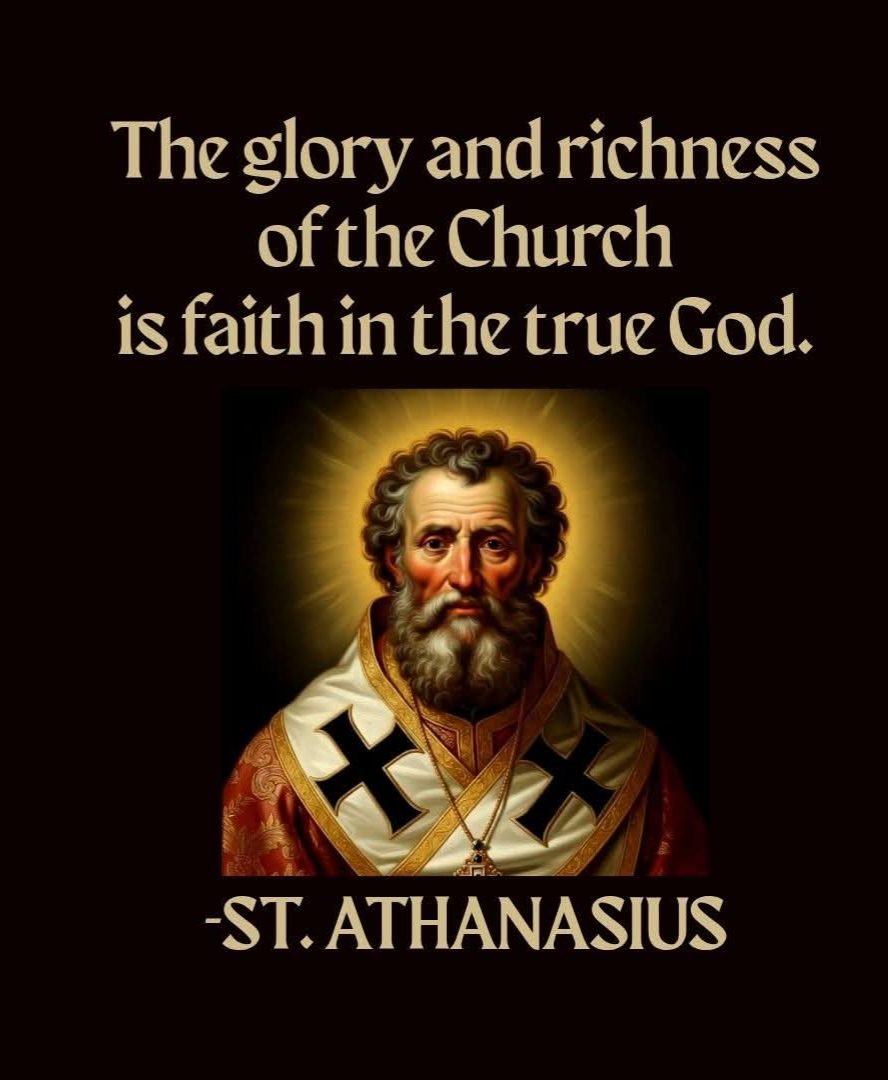
WHY ST ATHANASIUS MATTERS TODAY
His life shows that truth is not decided by majority opinion and that courage often requires standing alone. It reminds us that doctrine is essential, perseverance is necessary, and faith is preserved not by comfort but by conviction.
PRAYER
Father, you raised up Saint Athanasius to be an outstanding defender of the truth of Christ’s divinity. By his teaching and protection may we grow in your knowledge and love.
Through our Lord Jesus Christ, your Son, who lives and reigns with you in the unity of the Holy Spirit, one God, for ever and ever. Amen
Saint Athanasius, pray for us.