
What Is the Book of Genesis about? Understanding Its Meaning
September 19, 2026
Philippians 1:3
September 19, 2026
FEAST OF SAINT JANUARIUS, MARTYR FEAST DAY – 19th SEPTEMBER
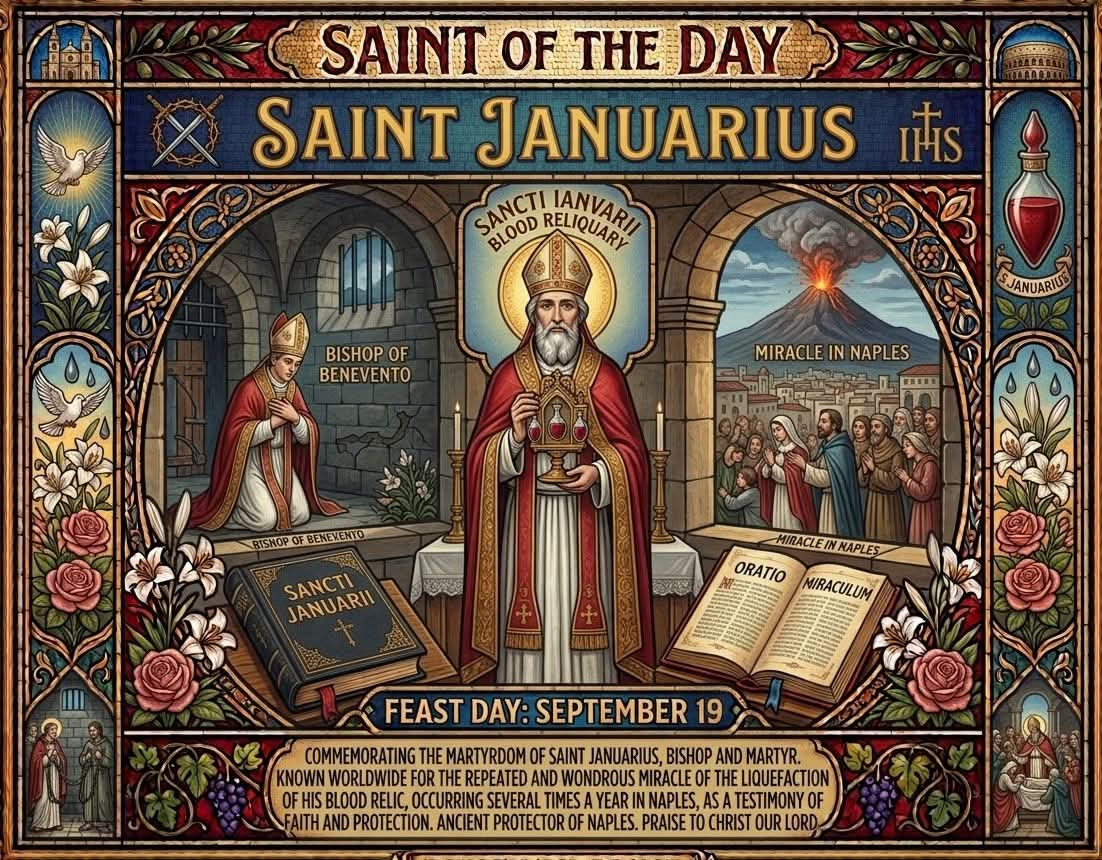
Januarius I of Benevento, was Bishop of Benevento and is a martyr and saint of the Catholic Church and the Eastern Orthodox Church. While no contemporary sources on his life are preserved, later sources and legends claim that he died during the Great Persecution,[3] which ended with Diocletian’s retirement in 305. Januarius is the patron saint of Naples, where the faithful gather three times a year in Naples Cathedral to witness the liquefaction of what is claimed to be a sample of his blood kept in a sealed glass ampoule.
According to various hagiographies, Januarius was born in Benevento to a rich patrician family that traced its descent to the Caudini tribe of the Samnites. At a young age of 15, he became local priest of his parish in Benevento, which at the time was relatively pagan. When Januarius was 20, he became Bishop of Naples and befriended Juliana of Nicomedia and Saint Sossius whom he met during his priestly studies.

During the 1+1⁄2-year-long persecution of Christians by Emperor Diocletian, he hid his fellow Christians and prevented them from being caught. Unfortunately, while visiting Sossius in jail, he too was arrested. He and his colleagues were condemned to be thrown to wild bears in the Flavian Amphitheater at Pozzuoli, but the sentence was changed due to fear of public disturbances, and they were instead beheaded at the Solfatara crater near Pozzuoli. Other legends state either that the wild beasts refused to eat them, or that he was thrown into a furnace but came out unscathed.
The earliest extant mention of him is contained in a 432 letter by Uranius, bishop of Nola, on the death of his mentor Saint Paulinus of Nola, where it is stated that the ghosts of Januarius and Saint Martin appeared to Paulinus three days before the latter’s death in 431. About Januarius, the account says only that he was “bishop as well as martyr, an illustrious member of the Neapolitan church”.
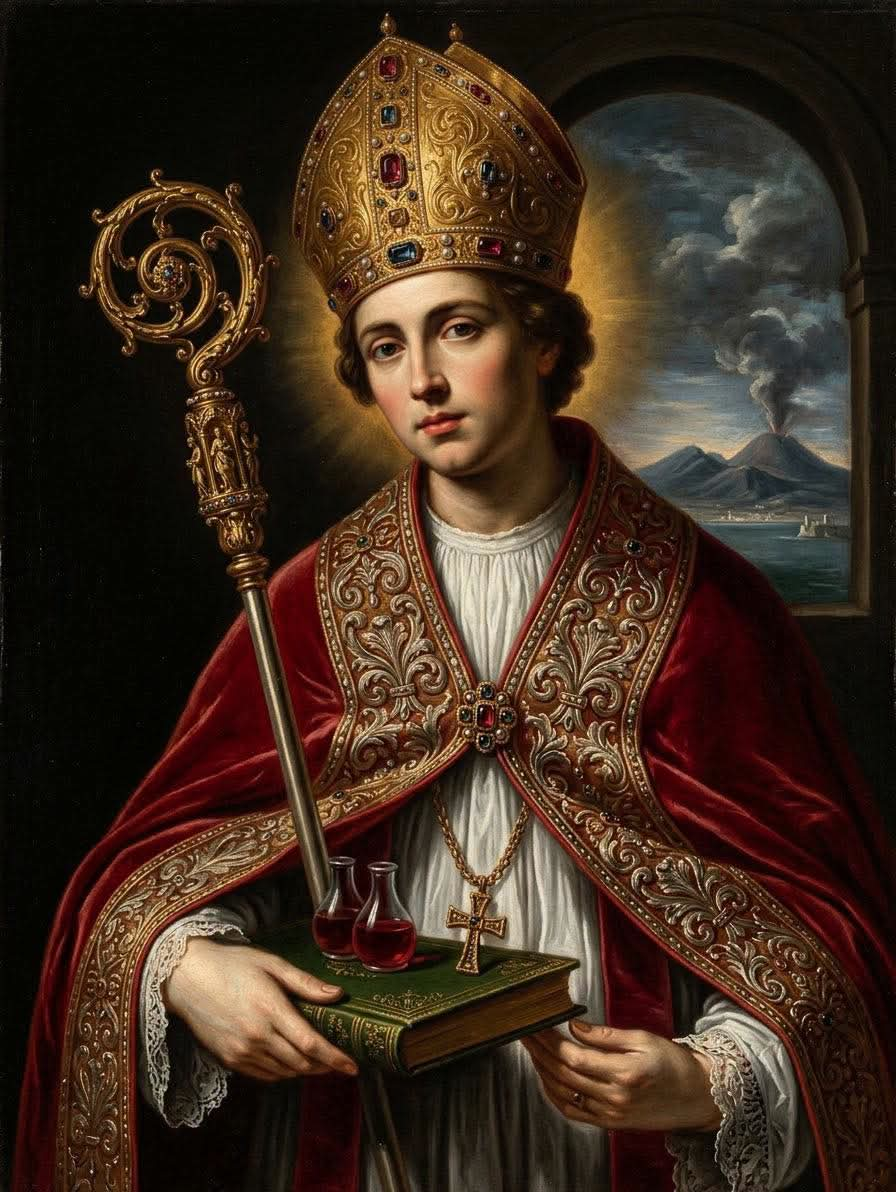
The Acta Bononensia says that “At Pozzuoli in Campania [is honored the memory] of the holy martyrs Januarius, Bishop of Beneventum, Festus his deacon, and Desiderius lector, together with Sossius deacon of the church of Misenum, Proculus, deacon of Pozzuoli, Eutyches, and Acutius, who after chains and imprisonment were beheaded under the emperor Diocletian”. Saint Januarius is the patron saint of of blood banks; Naples; volcanic eruptions.
Of all the miracles, wonders, and theological rarities that leave God’s family in awe, the miracle of today’s saint is one of the most astounding. Three times a year, on his day of martyrdom, September 19; on the day of his commemoration as Patron of Naples, December 16; and on the Saturday before the first Sunday of May, recalling the gathering together of his various relics, the blood of Saint Januarius liquefies.
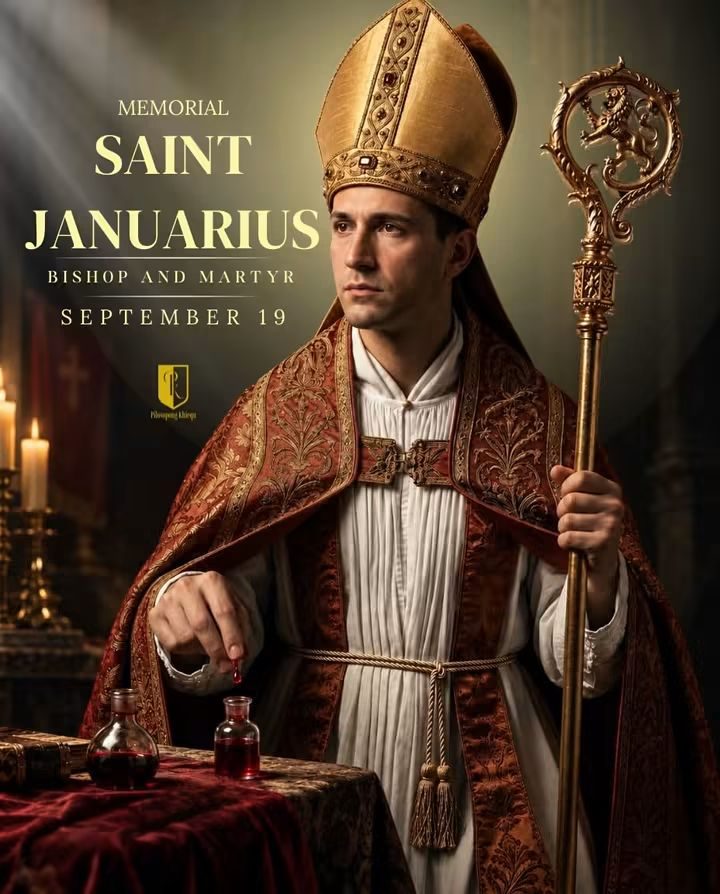
Perhaps the most interesting thing about the liquifying of Saint Januarius’ blood is that it occurs for no specific purpose. No sick person is healed, no sacrament is celebrated, no bishop is elected. It is a divine folly. It occurs to edify, to entertain, and to inspire, as if religion were a theological sport, with God simply putting His talents on display for all to behold the spectacle from the pews, to gaze, mouth agape, at a wonder that can neither be explained nor be resisted.
CONTEMPLATING THE LIFE OF SAINT JANUARIUS, BISHOP AND MARTYR

THE BLOOD OF FAITH: THE STORY OF ST. JANUARIUS
In the year 305 AD, during the fierce persecution of Christians under Emperor Diocletian, Bishop Januarius of Benevento courageously shepherded his flock. Though of noble bearing, he lived with humility and preached the Gospel with unwavering faith.
When Christians were imprisoned, Januarius visited and encouraged them, reminding them that Christ had conquered death and that the soul could not be destroyed by suffering. Because of his faith and his refusal to worship idols, he was arrested with his deacons and companions.
Brought before the governor at Pozzuoli, Januarius remained faithful to Christ despite the threat of death. According to tradition, wild beasts were set upon them but did not harm them. Eventually, Januarius was beheaded, sealing his witness to Christ with his blood.
THE BLOOD THAT WOULD NOT DIE
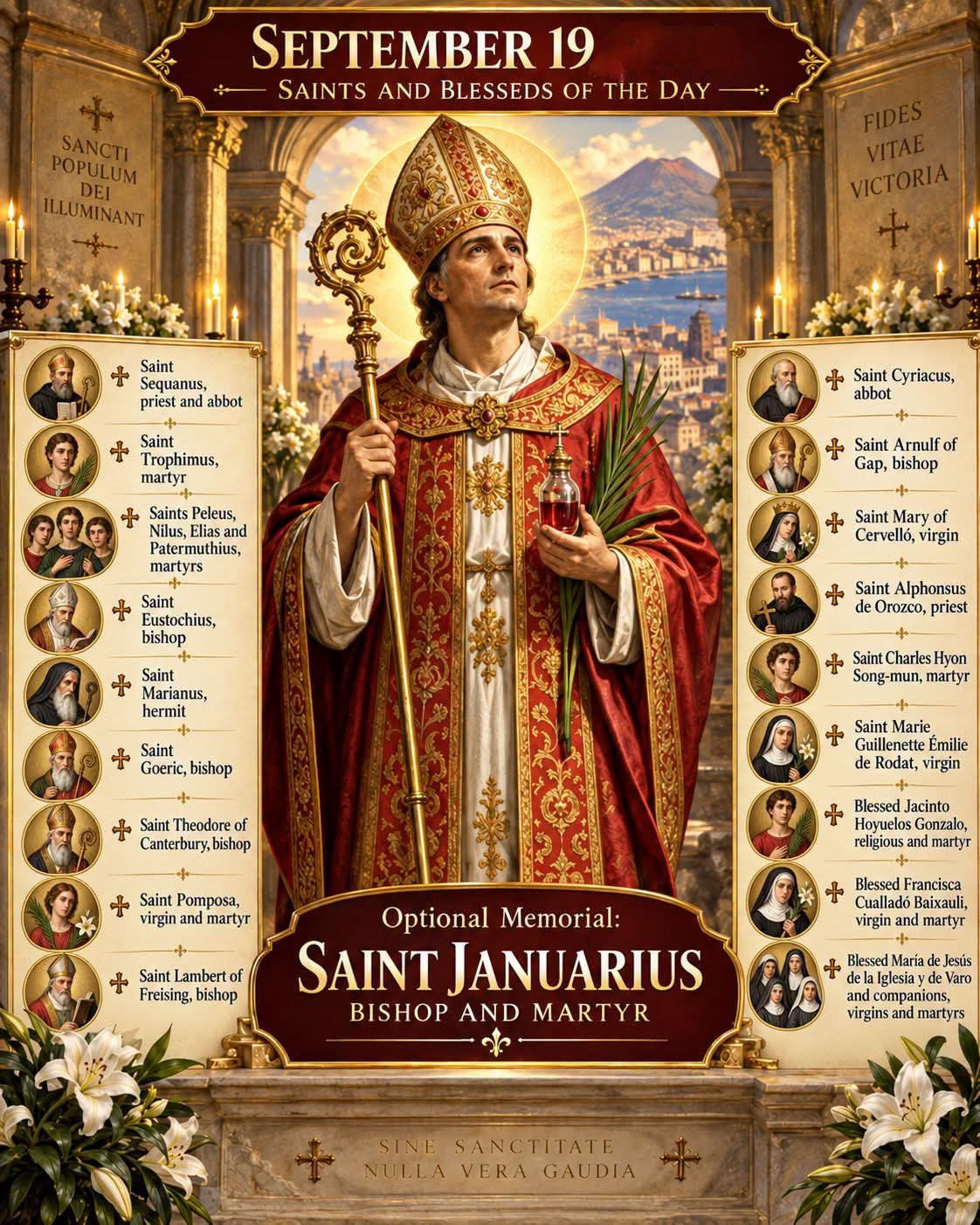
According to tradition, a Christian woman named Eusebia gathered the blood of Januarius in a small glass vial. Preserved for generations, the relic became deeply cherished by the faithful of Naples.
From the fourteenth century onward, reports have described the hardened blood becoming liquid on occasions connected with the saint’s feast and other celebrations. The people of Naples have regarded this phenomenon as a sign of the saint’s continuing intercession and protection.
FAITH AND SCIENCE
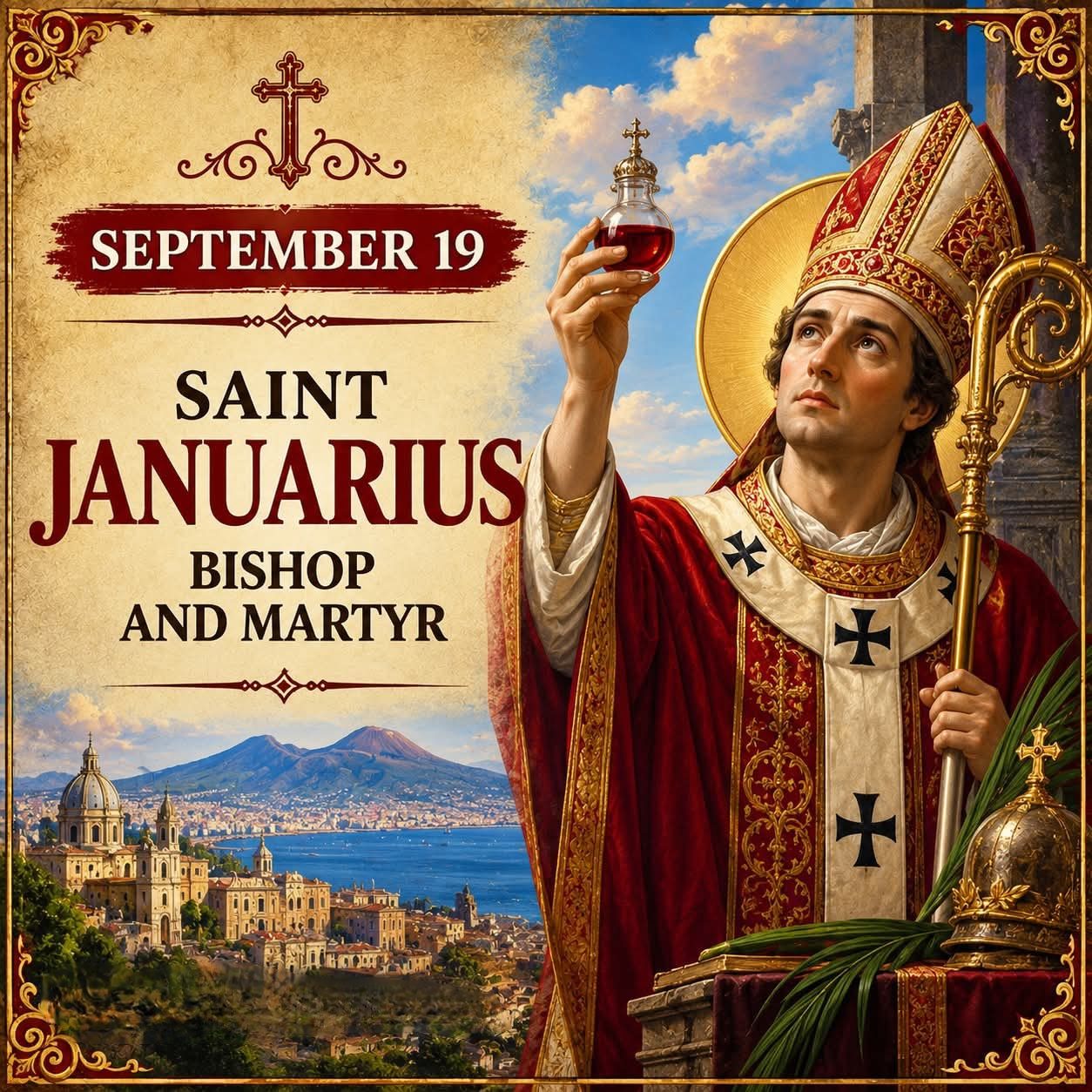
Scientists have proposed natural explanations for the changing state of the relic, including the possibility of a thixotropic substance that becomes fluid when disturbed. The Church does not require Catholics to believe that the liquefaction is miraculous.
What remains certain is the witness of Januarius himself. He lived, suffered and died for Christ, and his courage continues to inspire the faithful. The mystery surrounding his relic is left to personal devotion and reflection.
THE LEGACY OF A MARTYR

On September 19, the faithful gather in Naples to honour St. Januarius and await the traditional presentation of his relic. His memory continues to unite generations in prayer and devotion.
Long after his martyrdom, St. Januarius remains a powerful reminder that faith can overcome fear, that love is stronger than death, and that the witness of the martyrs continues to live in the Church.
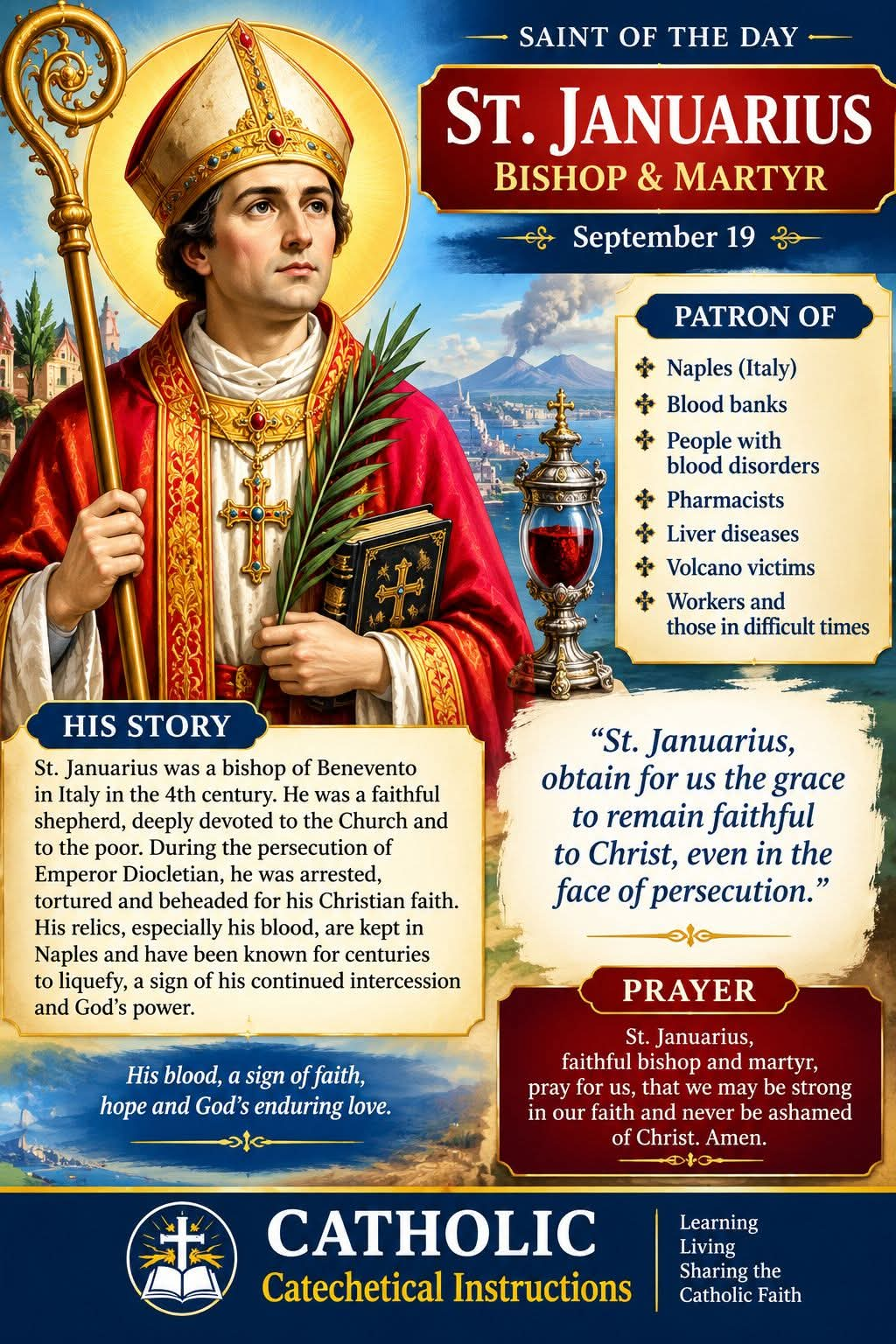
PRAYER
Heavenly God, you have granted us your Saint Januarius, that we venerate the memory of this Martyr Saint, give us, we pray, the same courage to live for the glory of your Holy Name, that we may have the joy of his company to sing your praises for all eternity.
We ask this through our Lord Jesus Christ, your Son, who lives and reigns with you in the unity of the Holy Spirit, God, for ever and ever. Amen

St. Januarius, pray for us.