
Psalm 34 – Taste and See That the Lord Is Good
June 8, 2026
Matthew 5:10
June 9, 2026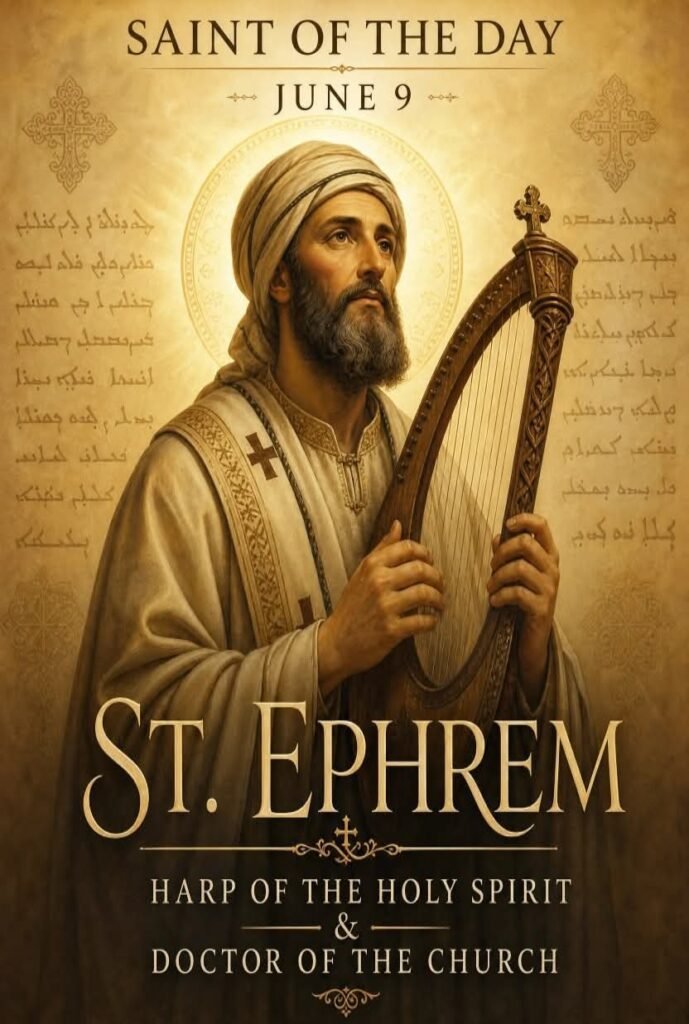
FEAST OF SAINT EPHREM, DEACON AND DOCTOR
FEAST DAY – 9th JUNE
Ephrem the Syrian (c. 306 – 373), also known as Saint Ephrem, Saint Ephraim, Ephrem of Edessa or Aprem of Nisibis, was a prominent Christian theologian and writer, who is revered as one of the most notable hymnographers of Eastern Christianity. He was born in Nisibis, served as a deacon and lived in Edessa.
Ephrem, was active a century prior to the great conclusions and clarifications of the fifth-century Councils. Although Ephrem did not deviate from what later Councils would explicitly teach, he used far different language to communicate the same truths, anticipating later teachings through poetry. Saint Ephrem was a poet and a musician first and foremost.
Ephrem is venerated as a saint by all traditional Churches. He is especially revered in Syriac Christianity, both in East Syriac tradition and West Syriac tradition, and counted as a Venerable Father (i.e., a sainted Monk) in the Eastern Orthodox Church. He was declared a Doctor of the Church in the Roman Catholic Church in 1920. Ephrem is also credited as the founder of the School of Nisibis, which, in later centuries, was the centre of learning of the Church of the East.
Ephrem wrote a wide variety of hymns, poems, and sermons in verse, as well as prose exegesis. These were works of practical theology for the edification of the Church in troubled times. So popular were his works, that, for centuries after his death, Christian authors wrote hundreds of pseudepigraphal works in his name. He has been called the most significant of all of the fathers of the Syriac-speaking church tradition, and patron of the Syriac people.
Ephrem was born around the year 306 in the city of Nisibis (modern Nusaybin, Turkey), in the Roman province of Mesopotamia, that was recently acquired by the Roman Empire. Internal evidence from Ephrem’s hymnody suggests that both his parents were part of the growing Christian community in the city, although later hagiographers wrote that his father was a pagan priest.
In those days, religious culture in the region of Nisibis included local polytheism, Judaism and several varieties of the Early Christianity. Most of the population spoke Aramaic language, while Greek and Latin were languages of administration. The city had a complex ethnic composition, consisted of “Assyrian, Arabs, Greeks, Jews, Parthians, Romans, and Iranians”.
Jacob, the second bishop of Nisibis, was appointed in 308, and Ephrem grew up under his leadership of the community. Jacob of Nisibis is recorded as a signatory at the First Council of Nicea in 325. Ephrem was baptized as a youth and almost certainly became a son of the covenant, an unusual form of Syriac proto-monasticism.
Jacob appointed Ephrem as a teacher (Syriac malp̄ānâ, a title that still carries great respect for Syriac Christians). He was ordained as a deacon either at his baptism or later. He began to compose hymns and write biblical commentaries as part of his educational office. In his hymns, he sometimes refers to himself as a “herdsman”, to his bishop as the “shepherd” and to his community as a ‘fold’.
Ephrem is popularly credited as the founder of the School of Nisibis, which, in later centuries, was the centre of learning of the Church of the East. In 337, Emperor Constantine I, who had legalised and promoted the practice of Christianity in the Roman Empire, died. Seizing on this opportunity, Shapur II of Persia began a series of attacks into Roman North Mesopotamia.
Nisibis was besieged in 338, 346 and 350. During the first siege, Ephrem credits Bishop Jacob as defending the city with his prayers. In the third siege, of 350, Shapur rerouted the River Mygdonius to undermine the walls of Nisibis. The Nisibenes quickly repaired the walls while the Persian elephant cavalry became bogged down in the wet ground.
Ephrem celebrated what he saw as the miraculous salvation of the city in a hymn that portrayed Nisibis as being like Noah’s Ark, floating to safety on the flood. One important physical link to Ephrem’s lifetime is the baptistery of Nisibis. The inscription tells that it was constructed under Bishop Vologeses in 359. In that year, Shapur attacked again.
The cities around Nisibis were destroyed one by one, and their citizens killed or deported. Constantius II was unable to respond; the campaign of Julian in 363 ended with his death in battle. His army elected Jovian as the new emperor, and to rescue his army, he was forced to surrender Nisibis to Persia (also in 363) and to permit the expulsion of the entire Christian population.
Ephrem, with the others, went first to Amida (Diyarbakır), eventually settling in Edessa (Urhay, in Aramaic) in 363. Ephrem, in his late fifties, applied himself to ministry in his new church and seems to have continued his work as a teacher, perhaps in the School of Edessa. Edessa had been an important center of the Aramaic-speaking world, and the birthplace of a specific Middle Aramaic dialect that came to be known as the Syriac language.
The city was rich with rivaling philosophies and religions. Ephrem comments that orthodox Nicene Christians were simply called “Palutians” in Edessa, after a former bishop. Arians, Marcionites, Manichees, Bardaisanites and various gnostic sects proclaimed themselves as the true church. In this confusion, Ephrem wrote a great number of hymns defending Nicene orthodoxy.
A later Syriac writer, Jacob of Serugh, wrote that Ephrem rehearsed all-female choirs to sing his hymns set to Syriac folk tunes in the forum of Edessa. After a ten-year residency in Edessa, in his sixties, Ephrem succumbed to the plague as he ministered to its victims. The most reliable date for his death is 9 June 373.
Ephrem wrote exclusively in his native Aramaic language, using the local Edessan (Urhaya) dialect, that later came to be known as the Classical Syriac. Ephrem’s works contain several endonymic (native) references to his language (Aramaic), homeland (Aram) and people (Arameans). He is therefore known as “the authentic voice of Aramaic Christianity”.
One of the early admirers of Ephrem’s works, theologian Jacob of Serugh (d. 521), who already belonged to the generation that accepted the custom of a double naming of their language not only as Aramaic but also as “Syriac”, wrote a homily dedicated to Ephrem, praising him as the crown or wreath of the Arameans and the same praise was repeated in early liturgical texts.
Only later, under the Greek influence, already prevalent in the works of Theodoret of Cyrus from the middle of the 5th century, it became customary to associate Ephrem with Syriac identity, and label him only as “the Syrian”, thus blurring his Aramaic self-identification, attested by his own writings and works of other Aramaic-speaking writers, and also by examples from the earliest liturgical tradition.
Several translations of his writings exist in Classical Armenian, Coptic, Old Georgian, Koine Greek and other languages. Soon after Ephrem’s death, legendary accounts of his life began to circulate. One of the earlier “modifications” is the statement that Ephrem’s father was a pagan priest of Abnil or Abizal. But internal evidence from his authentic writings suggest that he was raised by Christian parents.
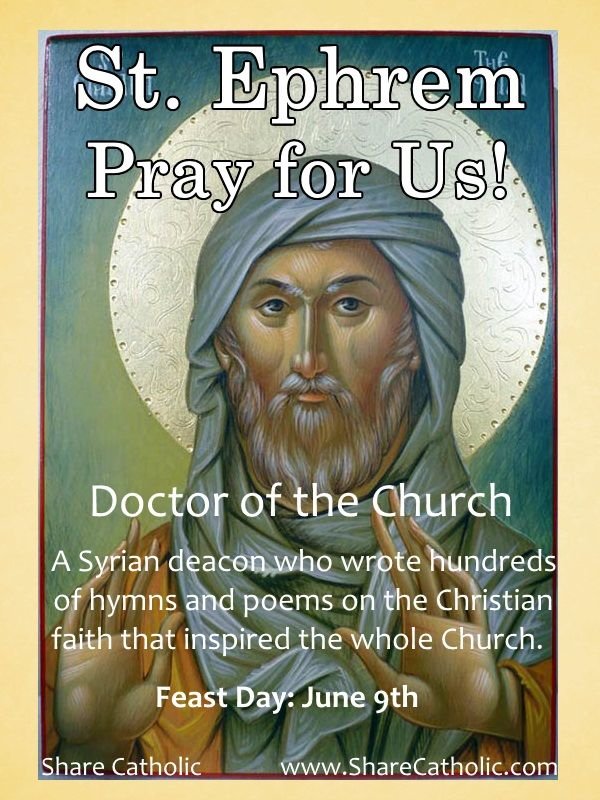
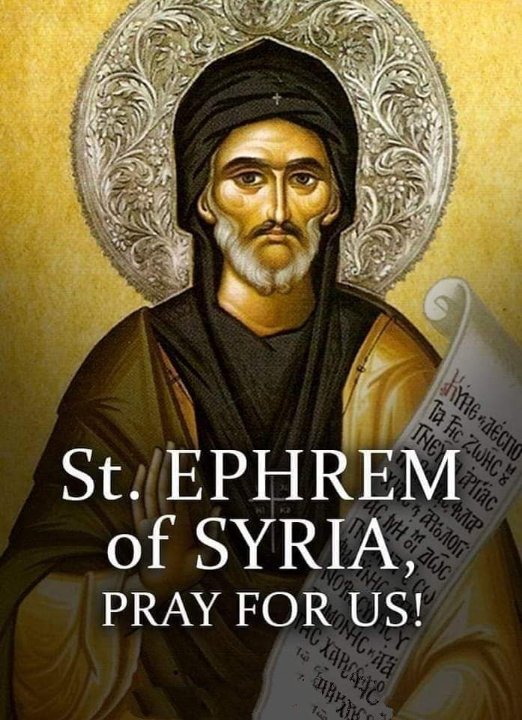
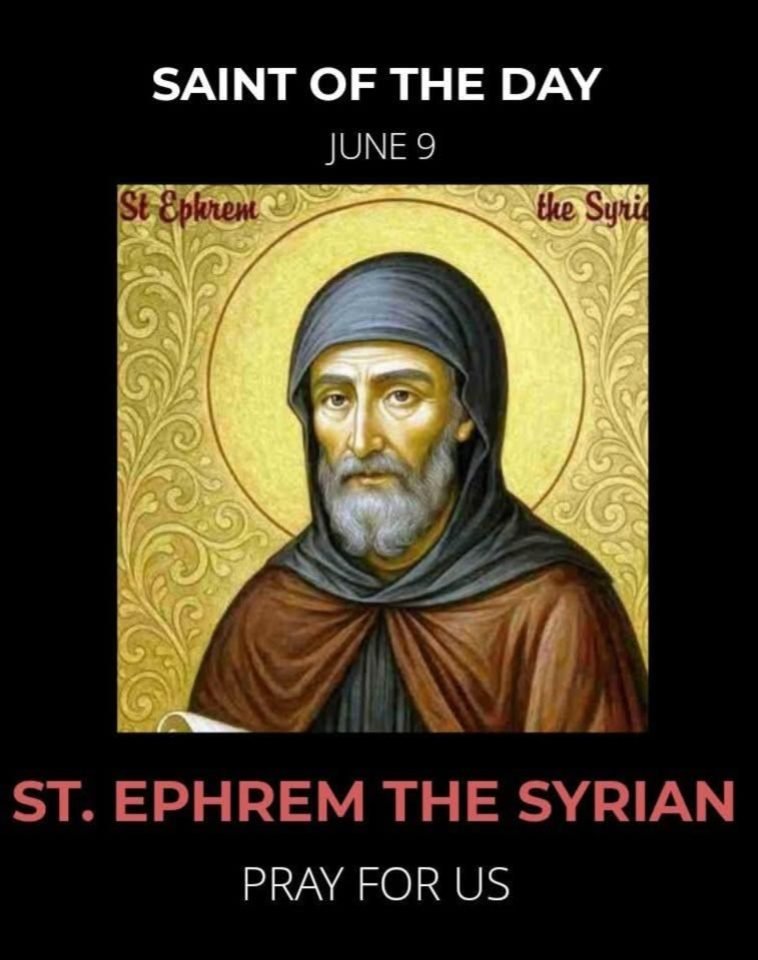
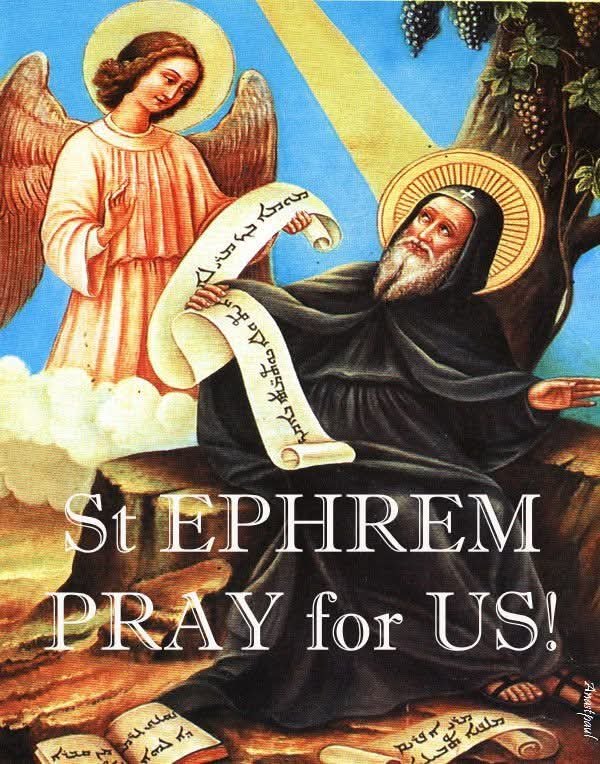
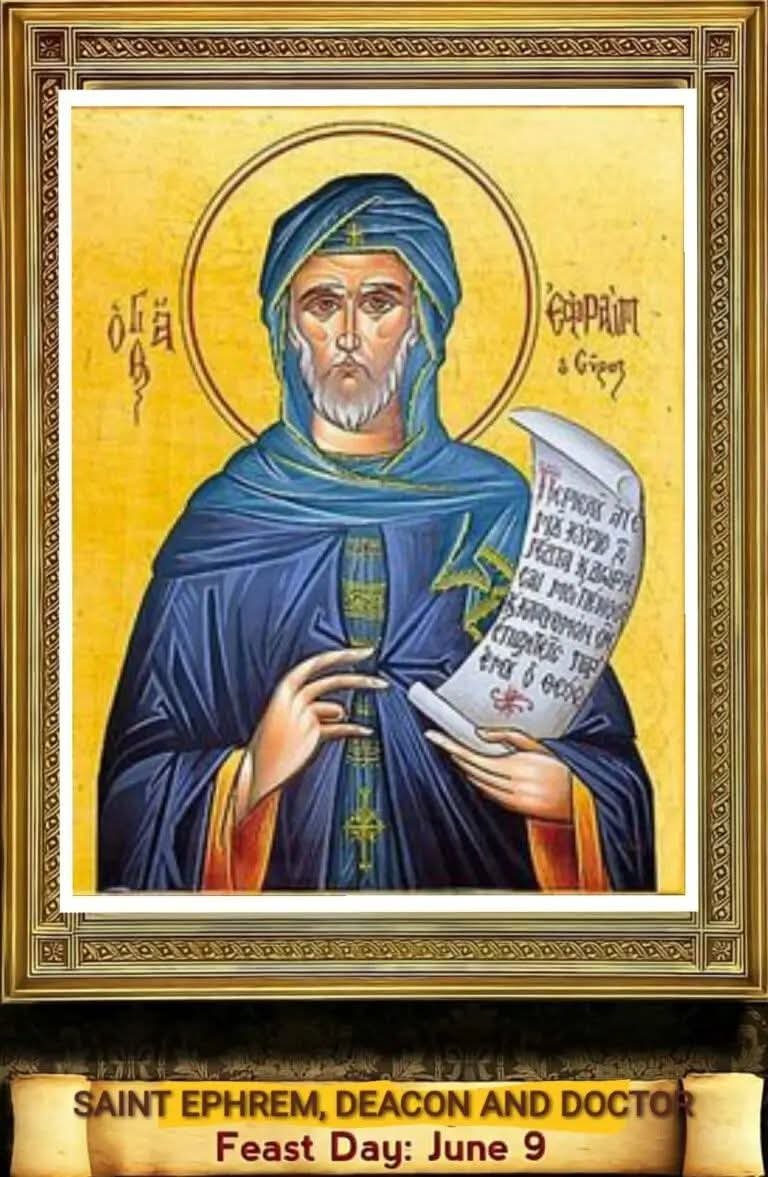
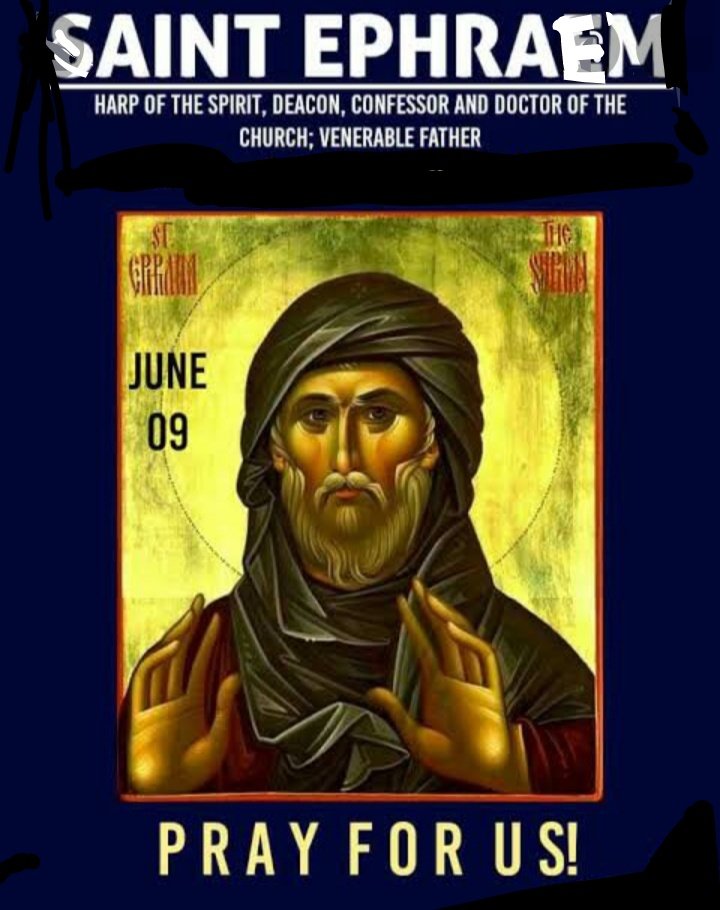
Saint Ephrem’s attributes are a Vine and scroll, deacon’s vestments and thurible; with Saint Basil the Great; composing hymns with a lyre. His Patronage is towards Spiritual directors, spiritual leaders and Syriacs/Arameans.
CONTEMPLATING THE LIFE OF SAINT EPHREM THE SYRIAN – THE HARP OF THE HOLY SPIRIT
Saint Ephrem the Syrian stands among the greatest saints, theologians, poets, and spiritual writers in Christian history. Though he was neither a priest nor a bishop, his holiness, wisdom, and devotion made him one of the most influential figures of the early Church. He served faithfully as a deacon and became renowned as a theologian, hymn writer, biblical commentator, defender of the faith, and Doctor of the Church.
For centuries, Christians have called him “The Harp of the Holy Spirit” because his hymns and poems became powerful instruments for teaching, defending, and celebrating the Christian faith. Rather than relying on complex philosophical arguments, Ephrem communicated profound spiritual truths through poetry, symbolism, imagery, prayer, and song. His writings remain treasured throughout the Christian world.
HISTORICAL BACKGROUND
Saint Ephrem lived during the fourth century, a crucial period in the history of Christianity. The Church was growing rapidly while facing theological controversies, the aftermath of persecution, and debates concerning the nature of Christ. It was a time that demanded both spiritual depth and doctrinal clarity, and Ephrem provided both through his teaching and writings.
THE DEACON WHO SANG THE MYSTERIES OF GOD
Born in the ancient city of Nisibis, located on the frontier of powerful empires, Ephrem grew up during a turbulent era marked by political struggles and religious challenges. While nations battled for power, God prepared a servant who would defend the faith not with weapons or authority, but through prayer, poetry, and sacred song.
THE YOUNG DISCIPLE
Although little is known about his early years, one important influence shaped his life: Saint Jacob of Nisibis. Under the guidance of this holy bishop, Ephrem grew in prayer, love for Scripture, theological understanding, and devotion to the Church.
As he matured, he became a deacon and remained one throughout his entire life. Though many sought higher positions, Ephrem chose humble service, finding joy in faithfully carrying out his vocation.
THE SCHOOL OF FAITH
Nisibis became an important center of Christian learning where Ephrem taught and formed believers. He understood that theology was not merely the study of ideas but an encounter with the living God. For him, the truths of faith were mysteries to be contemplated rather than problems to be solved. Even while teaching doctrine, his heart remained rooted in prayer.
THE EXPERIENCE OF EXILE
Political changes eventually forced many Christians to leave Nisibis. Ephrem lost the city that had shaped his life and became an exile. He later settled in Edessa, but the experience deeply influenced him.
His writings frequently express a longing for God, for heaven, and for the eternal homeland that surpasses every earthly dwelling place. This theme of spiritual yearning became a hallmark of his work.
THE CITY OF MANY VOICES
Edessa was a city filled with competing ideas and religious debates. Various groups promoted conflicting teachings about Christ and the faith. Recognizing the danger of confusion, Ephrem chose a unique response. Instead of relying solely on arguments, he answered error with beauty, truth, and song.
THE HARP OF THE HOLY SPIRIT
Ephrem composed hundreds of hymns rich in Scripture, theology, praise, and wonder. These hymns were sung in churches, homes, and communities, helping believers learn and live their faith.
Through his sacred poetry, he became a teacher, defender of orthodoxy, and spiritual guide for countless Christians. His extraordinary gift earned him the enduring title, “The Harp of the Holy Spirit.”
THE POET OF DIVINE MYSTERIES
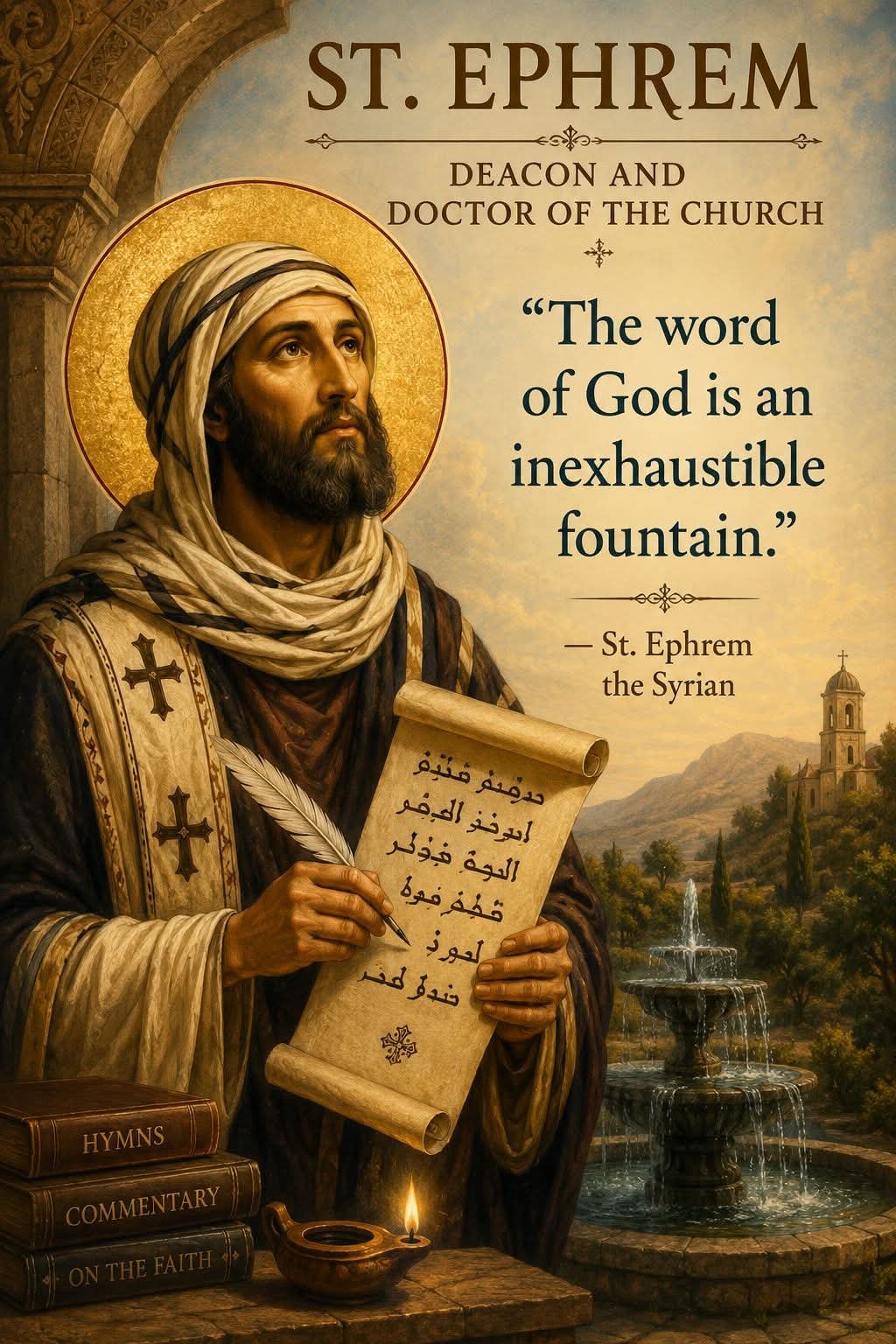
Ephrem believed that some divine truths were too profound for ordinary language. He used vivid images and poetic symbolism to express the beauty of God’s mysteries. Scripture, for him, was like an inexhaustible spring, and Christ was the source of endless wonder.
The more he learned about God, the more humble and filled with awe he became. He approached divine truth not as a scholar seeking mastery, but as a believer offering worship.
HIS DEVOTION TO THE BLESSED VIRGIN MARY
Among the many themes found in his writings, his love for the Blessed Virgin Mary shines brightly. He celebrated her purity, obedience, and unique role in salvation history through beautiful hymns and reflections.
His writings helped shape Christian devotion to Mary and influenced generations of believers.
LOVE FOR THE EUCHARIST
Saint Ephrem also had a profound devotion to the Eucharist. He saw in this sacrament the extraordinary humility of God, who comes close to humanity and shares His life with His people.
He encouraged believers to approach the Eucharist with reverence and awe, recognizing it as a sacred mystery to be adored.
CHARITY IN TIME OF FAMINE
Toward the end of his life, a severe famine struck Edessa. Rather than remaining only a scholar and writer, Ephrem actively served those in need. He organized relief efforts, distributed aid, and cared for the suffering.
His actions demonstrated that authentic contemplation always leads to love and service.
THE FINAL YEARS
After a lifetime devoted to prayer, teaching, writing, and service, Saint Ephrem died around the year 373. Though he left behind no worldly power or political achievements, he bequeathed to the Church a rich legacy of hymns, prayers, biblical reflections, and spiritual wisdom.
THE SAINT WHO TAUGHT THE CHURCH TO WONDER
Many theologians explain the faith, but Ephrem inspired people to marvel at it. Many scholars analyze mysteries, but Ephrem sang them. He taught that the ultimate purpose of theology is not simply knowledge but adoration, not merely understanding but love.
DOCTOR OF THE CHURCH
In 1920, Pope Benedict XV declared Saint Ephrem a Doctor of the Church, recognizing his immense contribution to Christian theology, spirituality, and sacred literature.
SPIRITUAL THEMES IN HIS LIFE
MYSTERY
Ephrem approached the realities of God with reverence, humility, and wonder.
POETRY AS THEOLOGY
He showed that beauty can be a powerful pathway to truth and faith.
HUMBLE SERVICE
Despite his extraordinary gifts, he remained a simple and faithful deacon throughout his life.
CHARITY
His deep contemplation of God naturally flowed into compassionate service to others.
PATRONAGE
Saint Ephrem is regarded as a patron of spiritual writers, poets, theologians, biblical scholars, and deacons. He is especially revered within the Eastern Christian traditions.
ARTISTIC REPRESENTATION
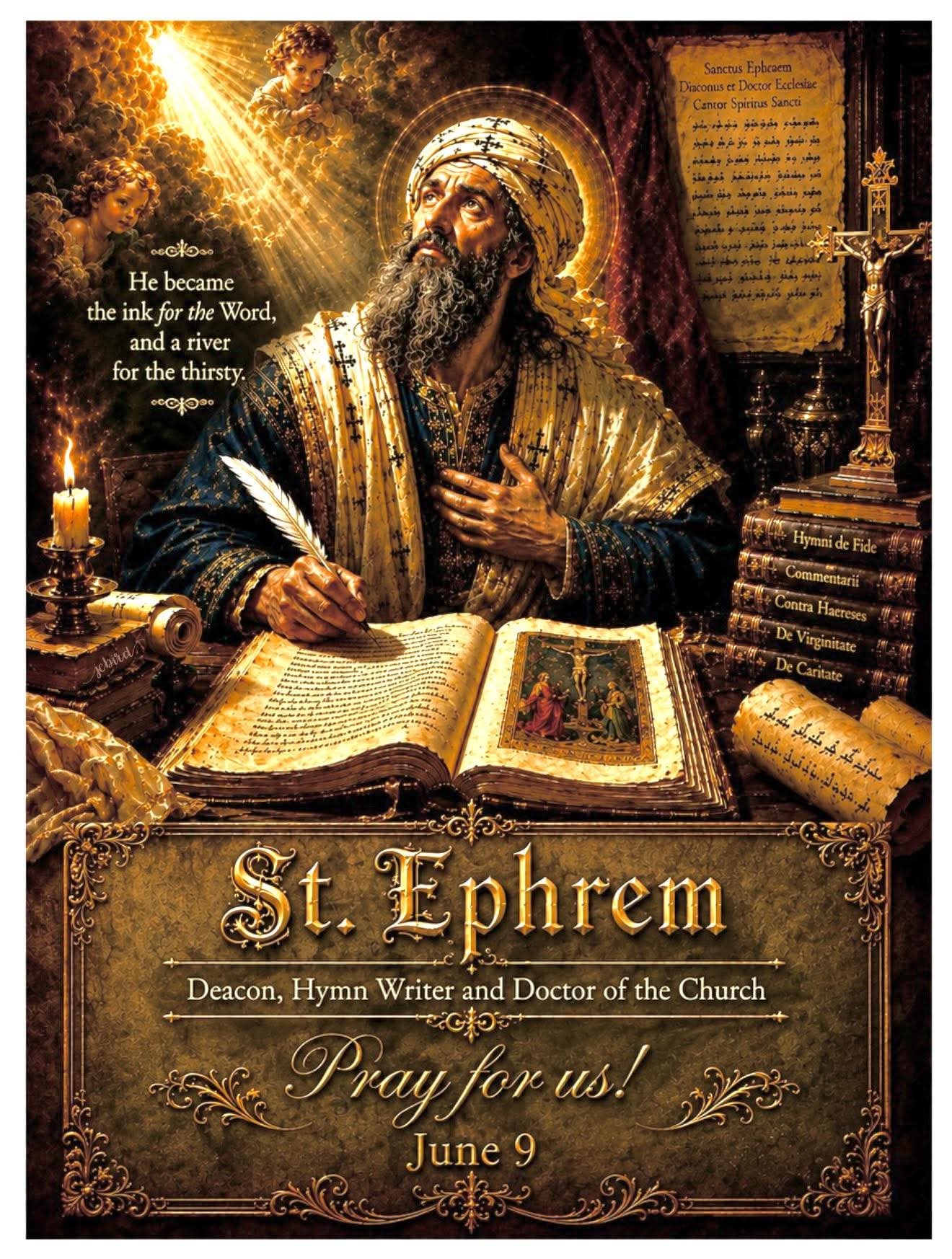
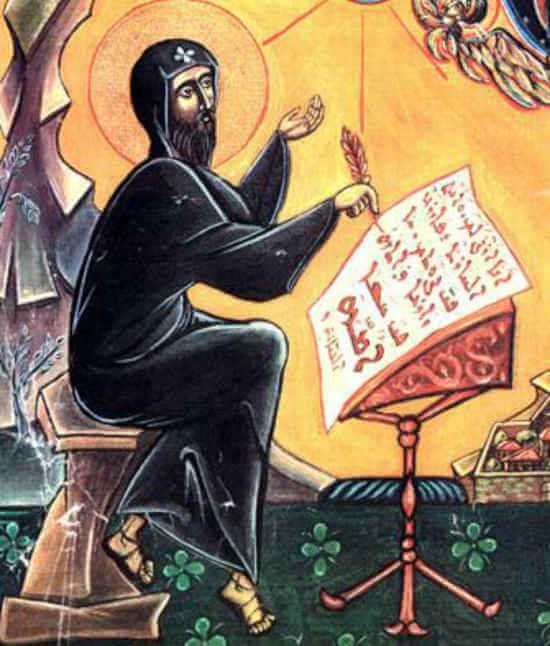
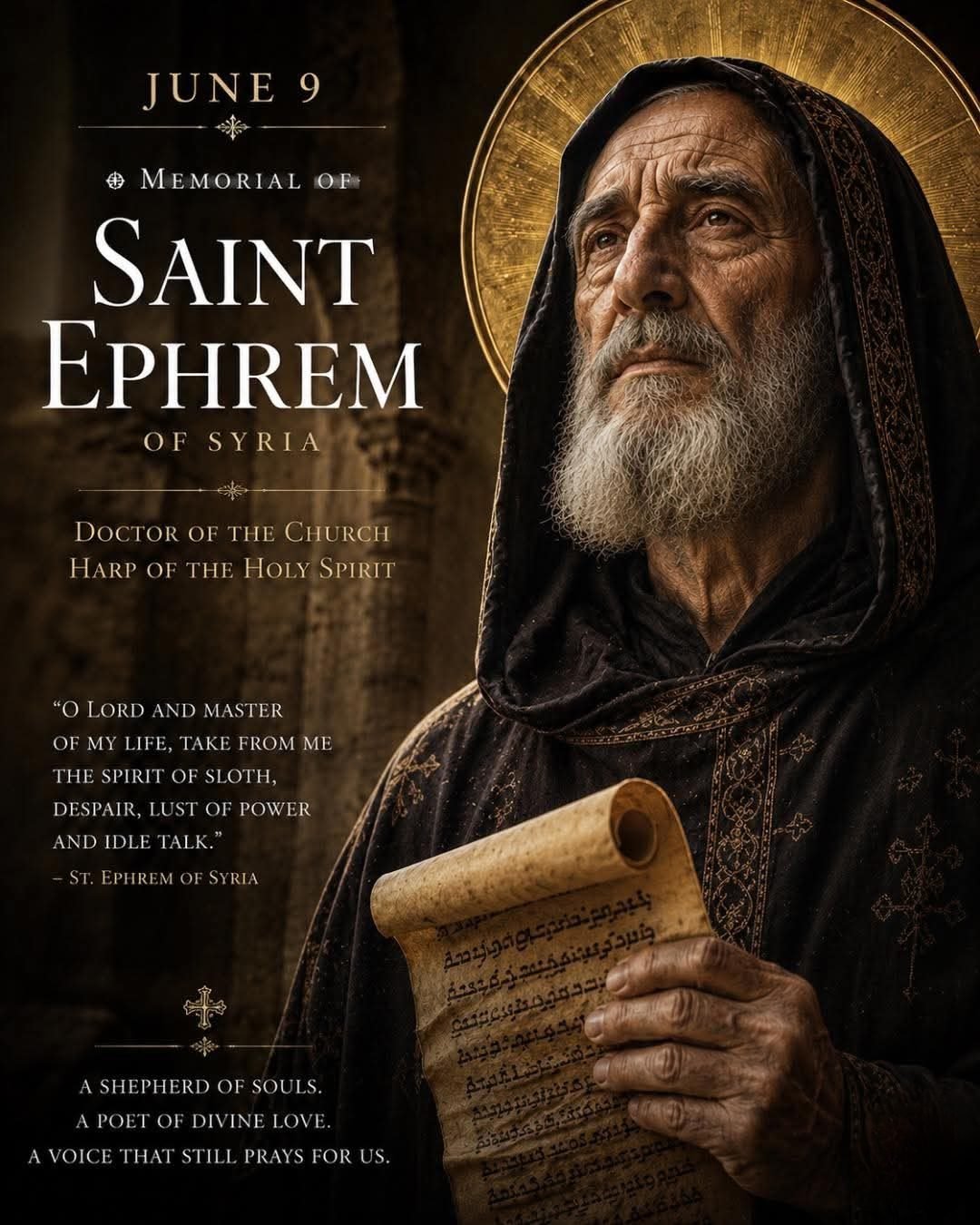
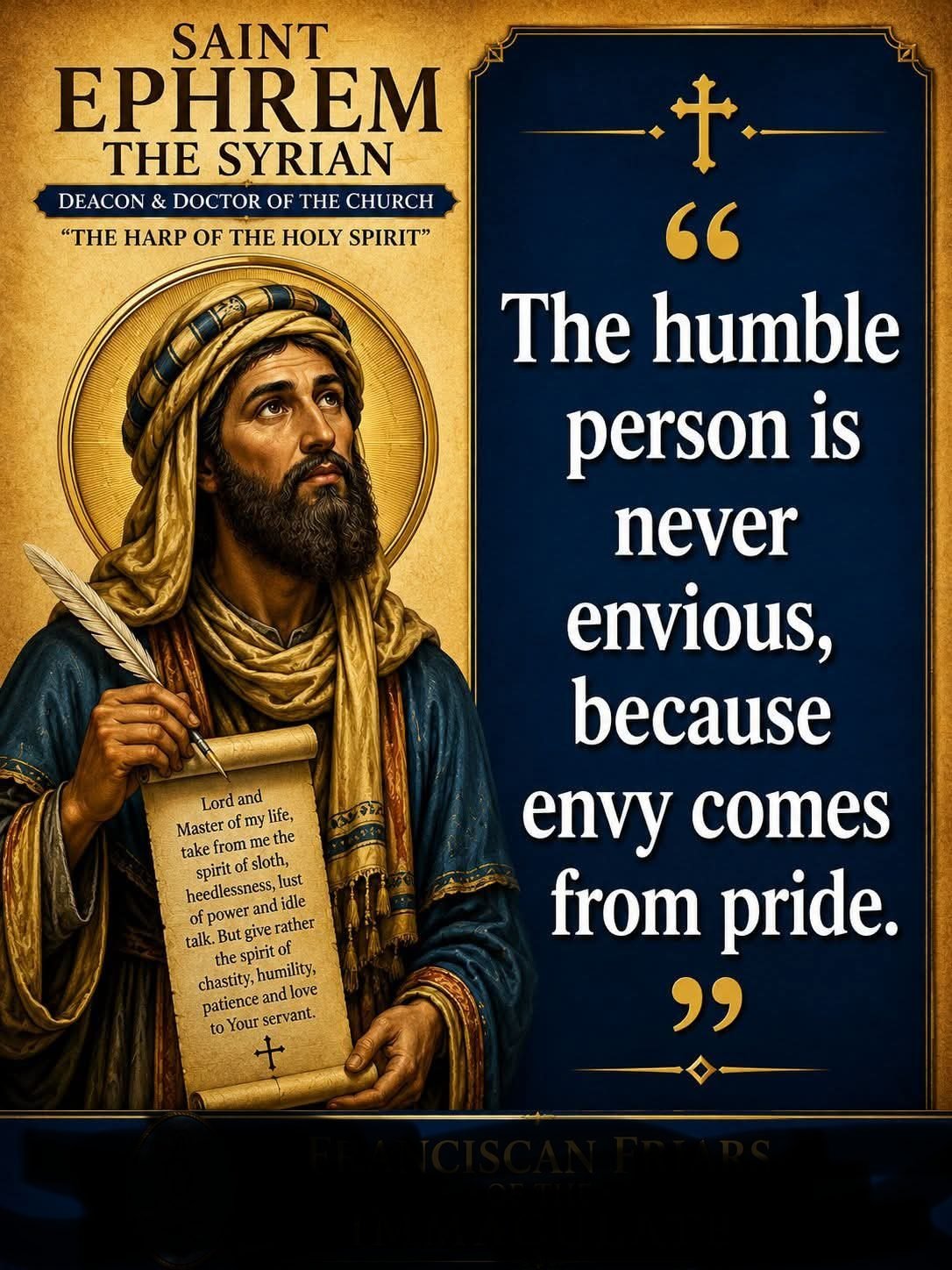
He is often portrayed as a deacon holding a scroll, writing hymns, teaching, or surrounded by symbols of Scripture. A harp is sometimes included, recalling his title as “The Harp of the Holy Spirit.”
WHY HE STILL MATTERS
Saint Ephrem united beauty and truth, intellect and prayer, theology and worship. He reminds believers that doctrine should inspire prayer, theology should awaken wonder, beauty can reveal truth, and humility deepens wisdom.
HIS ENDURING MESSAGE
Saint Ephrem spent his life singing of divine mysteries that can never be fully explained. He understood that God is greater than human language, yet he believed that poetry, worship, and contemplation can lead souls closer to Him.
His life teaches a timeless lesson: the deepest truths about God are not merely understood—they are adored. And the soul that learns to adore begins to glimpse the beauty of heaven.
PRAYER
Saint Ephrem, your writings and hymns are full of rich, poetic imagery drawn from biblical sources, folk tradition, telling lovingly about the truths of our faith. You used these to also warn your flock of the heresies that threatened to divide the early church.
Your hymns describe the Incarnation of Christ as fully human and divine. Help all Christian artists to stay true to the Truth and to propagate Jesus Christ to the world through beauty, music, and images that are uplifting and holy.
May they, as you intended, raise the mind and lift the heart to God Himself, remaining a popular source of inspiration throughout the Church.
Saint Ephrem, pray for us.