
SPIRITUAL INSIGHTS INTO THE LIFE OF SAINT PANTALEON
July 27, 2026
James 1:19
July 27, 2026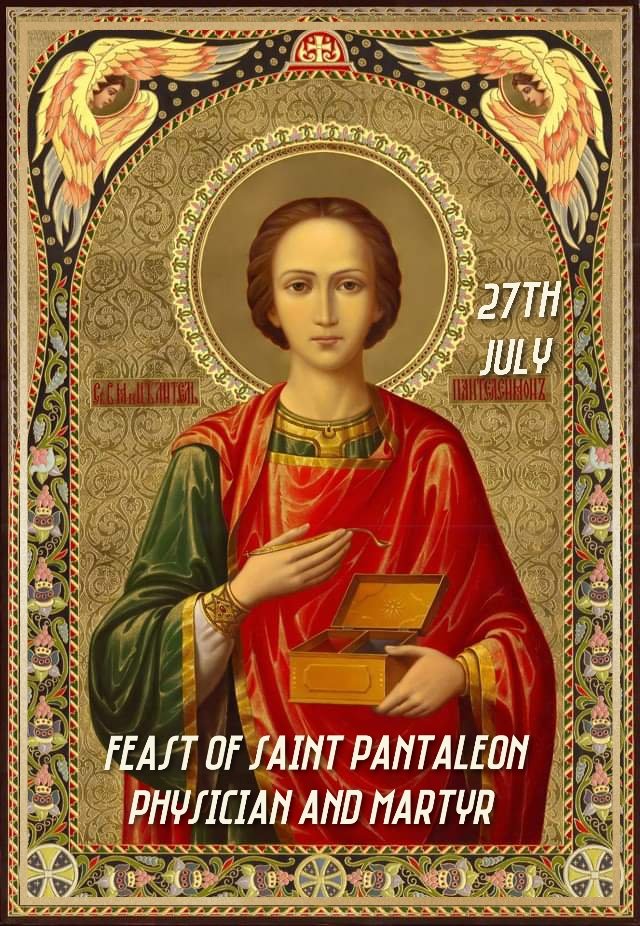
FEAST OF ST. PANTALEON, PHYSICIAN, MARTYR
FEAST DAY – 27th JULY
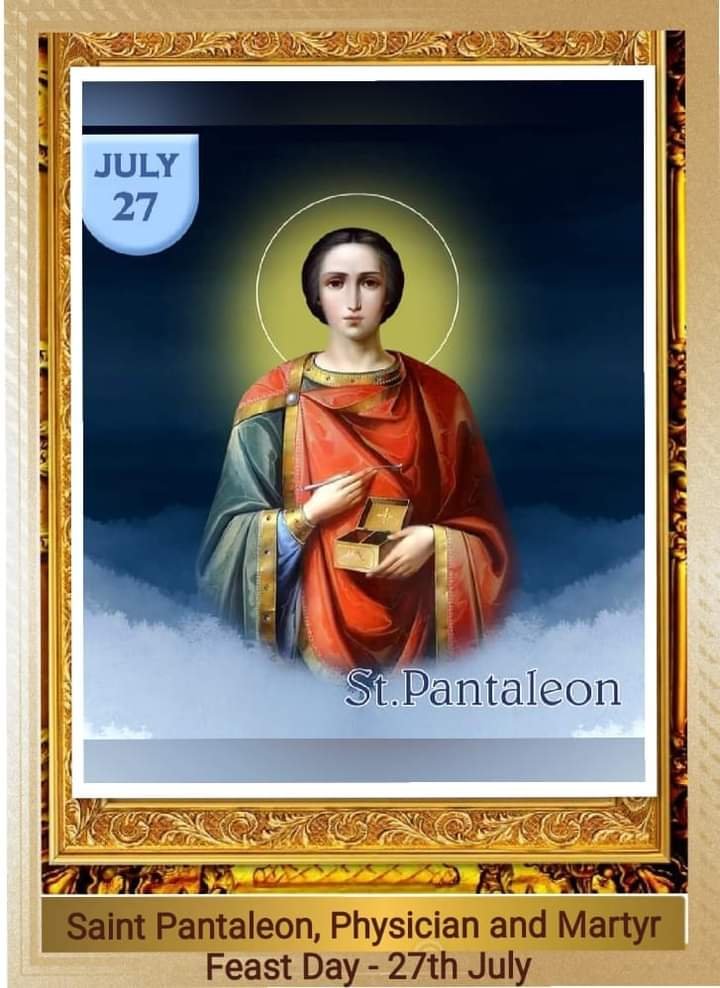
Saint Pantaleon (Greek: Παντελεήμων, Russian: Пантелеи́мон, romanized: Panteleímon; “all-compassionate”), counted in the West among the late-medieval Fourteen Holy Helpers and in the East as one of the Holy Unmercenary Healers, was a martyr of Nicomedia in Bithynia during the Diocletianic Persecution of 305 AD.
According to the martyrologies, Pantaleon was the son of a rich pagan, Eustorgius of Nicomedia, and had been instructed in Christianity by his Christian mother, Saint Eubula; however, after her death he fell away from the Christian church, while he studied medicine with a renowned physician Euphrosinos; under the patronage of Euphrosinos he became physician to the emperor, Galerius.
He was won back to Christianity by Saint Hermolaus (characterized as a bishop of the church at Nicomedia in the later literature), who convinced him that Christ was the better physician, signalling the significance of the exemplum of Pantaleon that faith is to be trusted over medical advice.
St. Alphonsus Liguori wrote regarding this incident:
“He studied medicine with such success, that the Emperor Maximian appointed him his physician. One day as our saint was discoursing with a holy priest named Hermolaus, the latter, after praising the study of medicine, concluded thus: “But, my friend, of what use are all thy acquirements in this art, since thou art ignorant of the science of salvation?”
By miraculously healing a blind man by invoking the name of Jesus over him, Pantaleon converted his father, upon whose death he came into possession of a large fortune. He freed his slaves and, distributing his wealth among the poor, developed a great reputation in Nicomedia. Envious colleagues denounced him to the emperor during the Diocletian persecution.
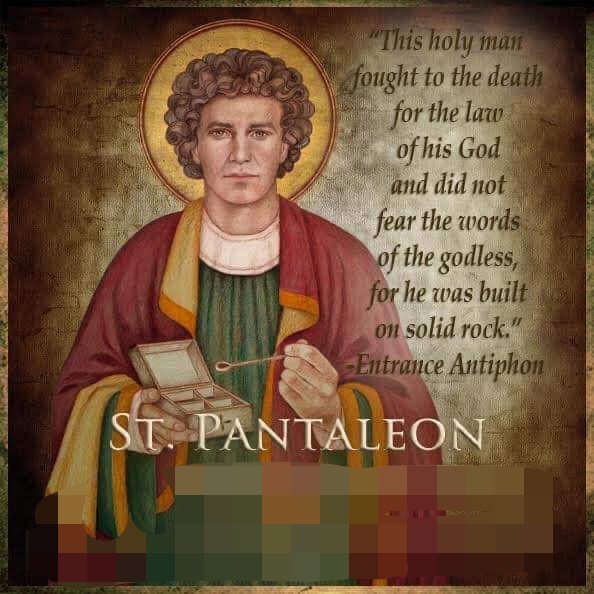
The emperor wished to save him and sought to persuade him to apostasy. Pantaleon, however, openly confessed his faith, and as proof that Christ was the true God, he healed a paralytic. Notwithstanding this, he was condemned to death by the emperor, who regarded the miracle as an exhibition of magic.
According to the legend, Pantaleon’s flesh was first burned with torches, whereupon Christ appeared to all in the form of Hermolaus to strengthen and heal Pantaleon. The torches were extinguished. Then a bath of molten lead was prepared; when the apparition of Christ stepped into the cauldron with him, the fire went out and the lead became cold.
Pantaleon was now thrown into the sea, loaded with a great stone, which floated. He was thrown to wild beasts, but these fawned upon him and could not be forced away until he had blessed them. He was bound on the wheel, but the ropes snapped, and the wheel broke. An attempt was made to behead him, but the sword bent, and the executioners were converted to Christianity.
Pantaleon implored Heaven to forgive them, for which reason he also received the name of Panteleimon (“mercy for everyone” or “all-compassionate”). It was not until he himself desired it that it was possible to behead him, upon which there issued forth blood and a white liquid like milk.
St. Alphonsus wrote:
“At Ravello, a city in the kingdom of Naples, there is a vial of his blood, which becomes blood every year [on his feast day], and may be seen in this state interspersed with the milk, as I, the author of this work, have seen it.”
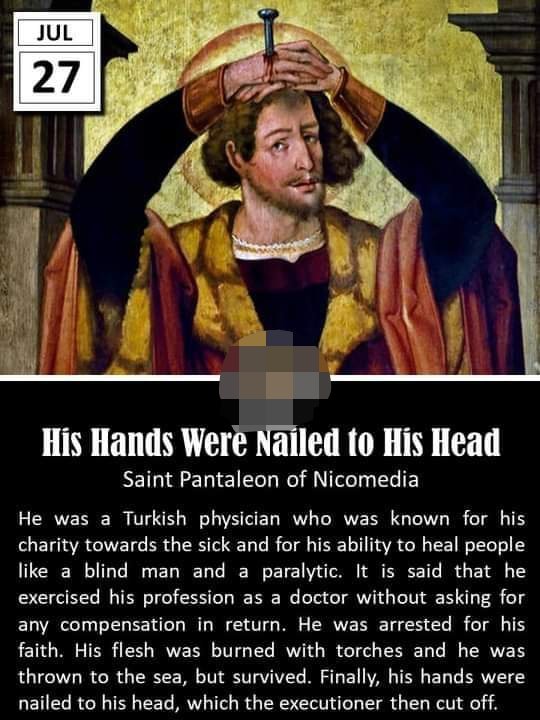
The vitae containing these miraculous features are all late in date and “valueless” according to the Catholic Encyclopedia. Yet the fact of his martyrdom itself seems to be supported by a veneration for which there is testimony in the 5th century, among others in a sermon on the martyrs by Theodoret (died c. 457); Procopius of Caesarea (died c. 565?), writing on the churches and shrines constructed by Justinian I tells that the emperor rebuilt the shrine to Pantaleon at Nicomedia; and there is mention of Pantaleon in the Martyrologium Hieronymianum.
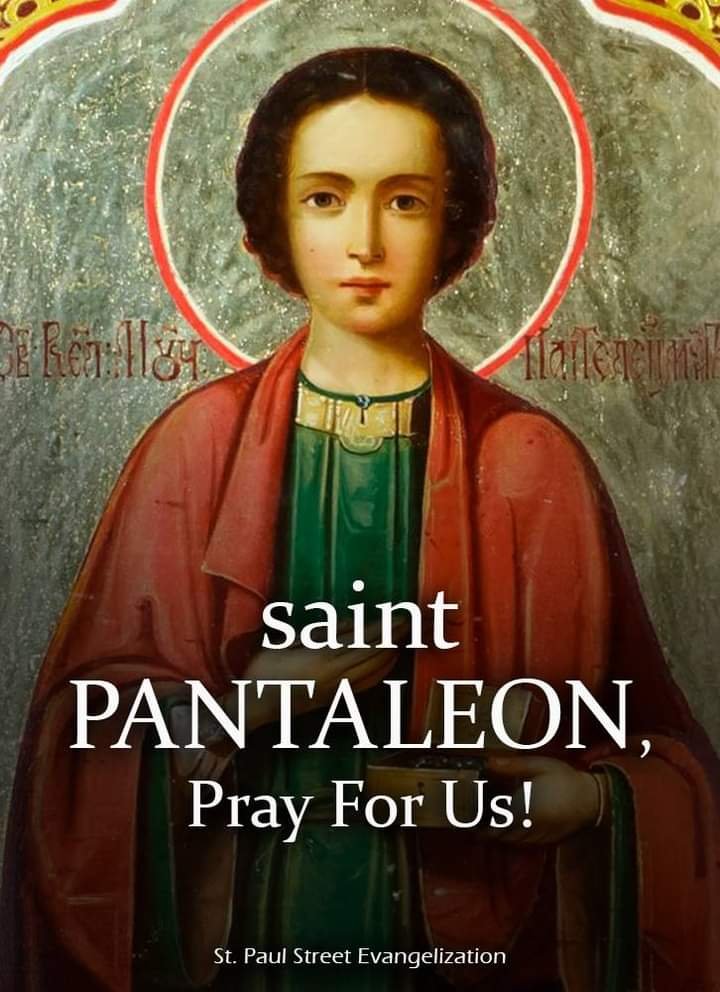
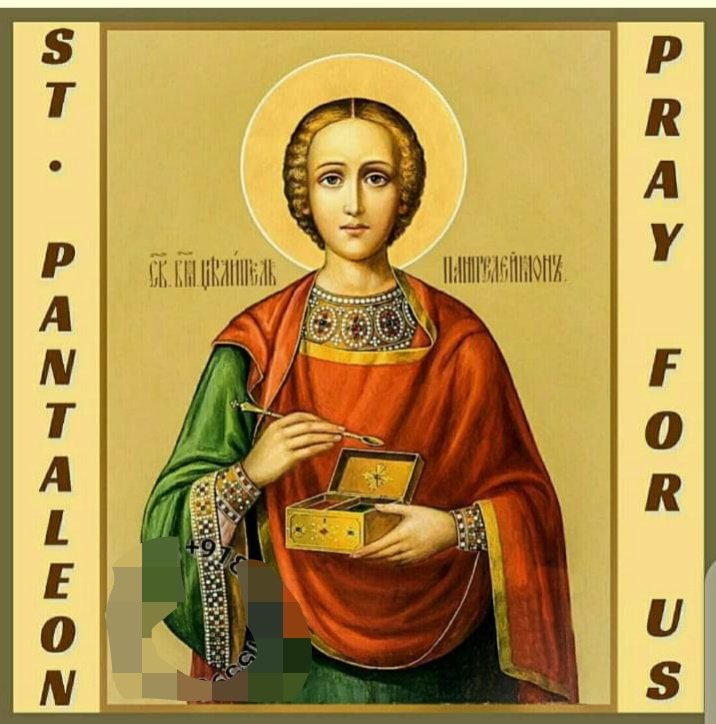
The Eastern tradition concerning Pantaleon follows more or less the medieval Western hagiography, but lacks any mention of a visible apparition of Christ. It states instead that Hermolaus was still alive while Pantaleon’s torture was under way, but was martyred himself only shortly before Pantaleon’s beheading along with two companions, Hermippas and Thermocrates. The saint is canonically depicted as a beardless young man with a full head of curly hair.
Pantaleon’s relics, venerated at Nicomedia, were transferred to Constantinople. Numerous churches, shrines, and monasteries have been named for him; in the West most often as St. Pantaleon and in the East as St. Panteleimon; to him is consecrated the St. Panteleimon Monastery at Mount Athos, Agios Panteleimon Monastery in Crete, St Panteleimon monastery in Myrtou, Cyprus, and the 12th-century Church of St. Panteleimon in Gorno Nerezi, North Macedonia.
According to Movses Kaghankatvatsi, his relics were brought to church built in the town of Tsri (then Caucasian Albania, near modern Barda, Azerbaijan) by St. Grigoris. Catholicos Lazar of Albania built Church of St. Pantaleon in his honor in Beghame’j (near modern Ağcabədi, Azerbaijan). King Vachagan III of Albania rediscovered his remains and interred them in the Amaras Monastery, located in modern Nagorno Karabakh and named his firstborn son after the saint.
After the Black Death of the mid-14th century in Western Europe, as a patron saint of physicians and midwives, he came to be regarded as one of the fourteen guardian martyrs, the Fourteen Holy Helpers. Relics of the saint are found at Saint Denis at Paris; his head is venerated at Lyon. A Romanesque church was dedicated to him in Cologne in the 9th century at the latest.
CONTEMPLATING THE LIFE OF SAINT PANTALEON
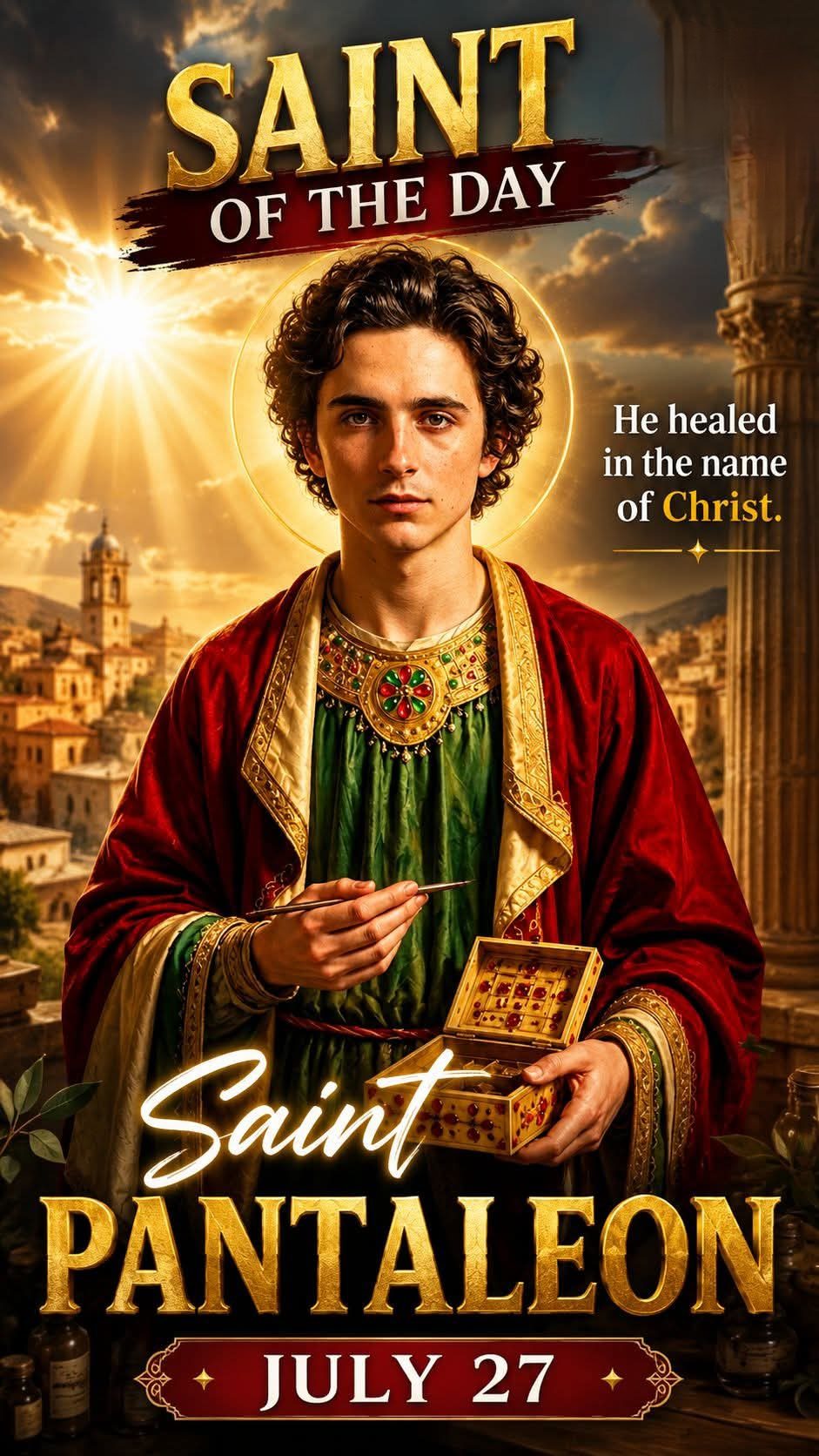
A LIFE CHOSEN BY GOD
Saint Pantaleon was born into a wealthy pagan family in Nicomedia during the third century. Gifted with intelligence and compassion, he studied medicine and became a physician to the Roman Emperor Maximian. Although raised by his pagan father after the death of his Christian mother, God’s grace gradually drew him towards the truth through the witness and teaching of the priest Hermolaus. His life reminds us that God never ceases to call hearts to Himself, regardless of their beginnings.
THE POWER OF FAITH
After learning about Jesus Christ from Hermolaus, Pantaleon witnessed the power of God when a child who had died from a snakebite was restored to life through fervent prayer in the name of Jesus. This miracle led him to embrace Christianity wholeheartedly and receive Baptism. His conversion teaches us that genuine faith transforms not only our beliefs but also our entire way of living.
A PHYSICIAN OF BODY AND SOUL
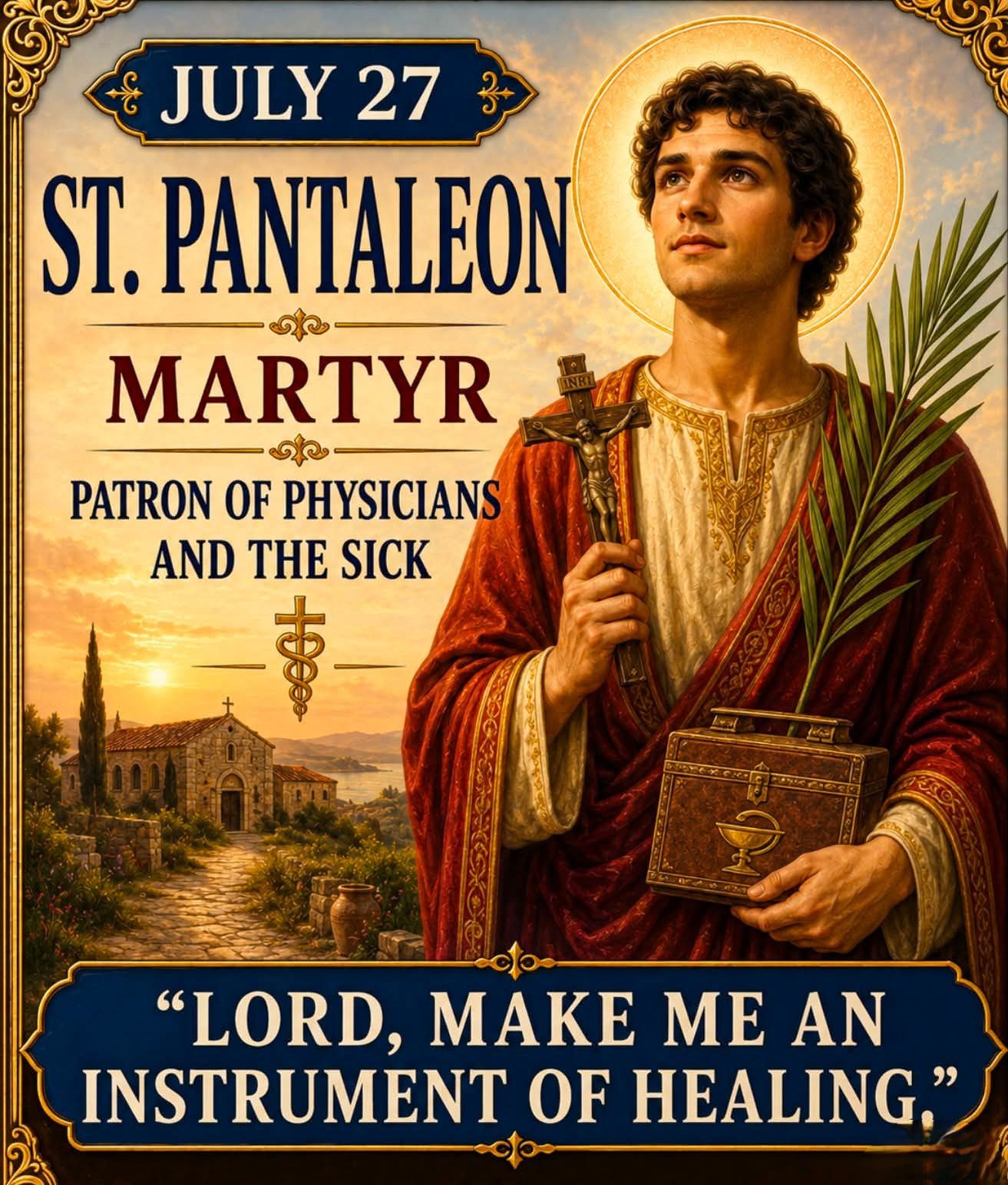
Pantaleon dedicated his medical knowledge to serving the poor without accepting payment. He healed the sick, comforted the suffering, and cared for those abandoned by society. His charity reflected the healing ministry of Christ, showing that true service seeks the welfare of both body and soul. His example encourages every Christian to use personal gifts for the good of others rather than for personal gain.
COMPASSION THAT REFLECTS CHRIST
The love of Christ overflowed in Pantaleon’s daily life. He treated every patient with dignity and kindness, seeing in each person the image of God. His compassion extended beyond physical healing to offering hope, encouragement, and the message of salvation. He teaches us that genuine compassion is rooted in selfless love and generous service.
COURAGE IN THE FACE OF PERSECUTION
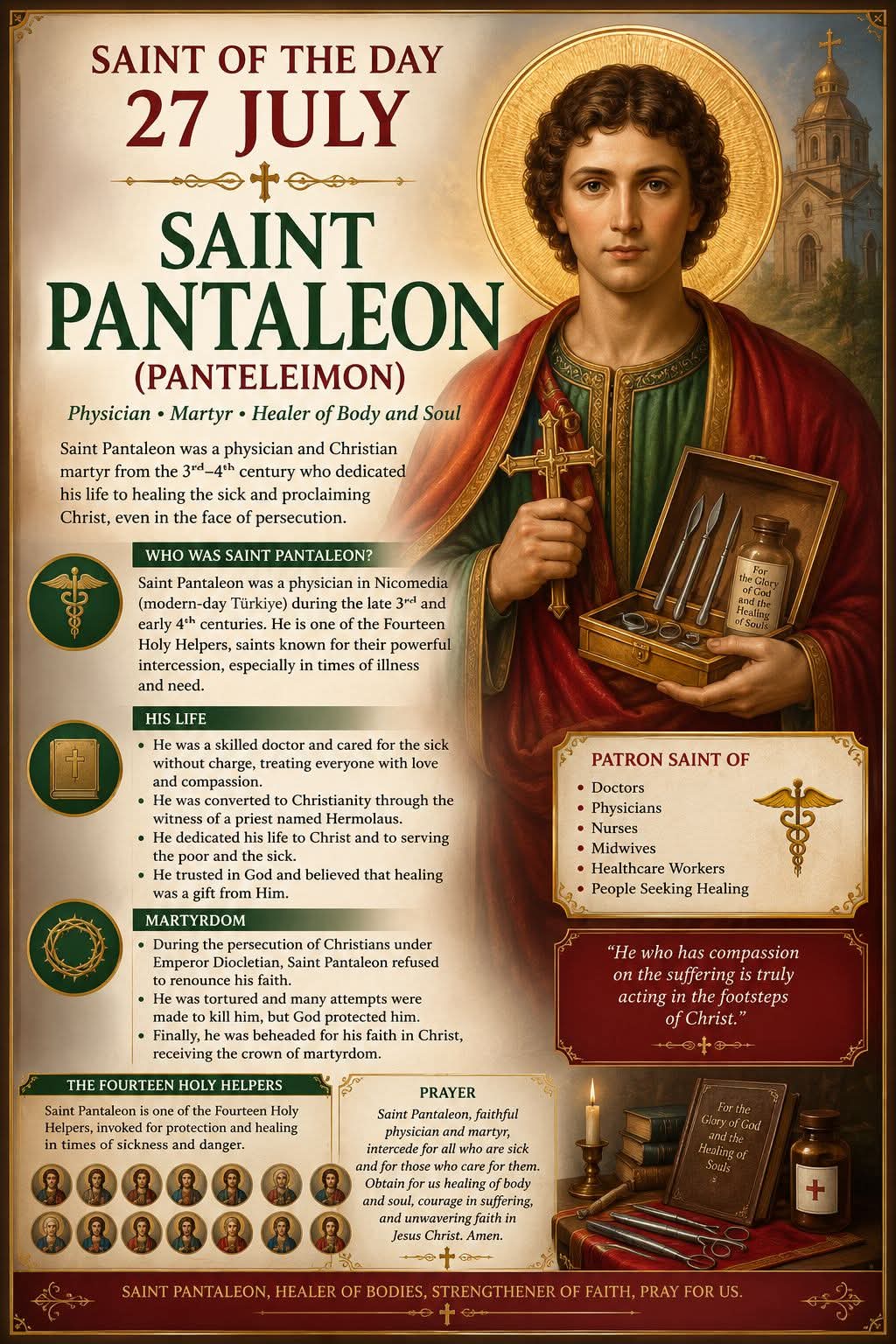
Pantaleon’s open profession of Christianity stirred the jealousy of other physicians and the anger of Emperor Maximian. Refusing to deny Christ despite threats and torture, he remained steadfast in his faith. His courage reminds us that true discipleship often demands sacrifice and that fidelity to Christ is worth every cost.
THE STRENGTH OF PRAYER
Throughout his trials, Pantaleon relied completely on God’s strength. Christian tradition recounts that the Lord protected him through several attempts to execute him until he willingly surrendered his life according to God’s will. His unwavering trust teaches us that prayer gives believers the courage to remain faithful even amid suffering.
THE CROWN OF MARTYRDOM
Saint Pantaleon was eventually beheaded around the year AD 305, joyfully offering his life for Christ. His martyrdom became the crowning witness of his love for God. The Church honours him as one of the great physician-martyrs whose blood became a testimony to the victory of faith over fear and eternal life over death.
A MODEL FOR MEDICAL PROFESSIONALS
Because of his life of compassionate service, Saint Pantaleon is honoured as the patron saint of physicians, healthcare workers, and those seeking healing. His example reminds all who care for the sick that their profession is also a sacred vocation of mercy, compassion, and respect for the dignity of every human life.
THE CALL TO HOLINESS
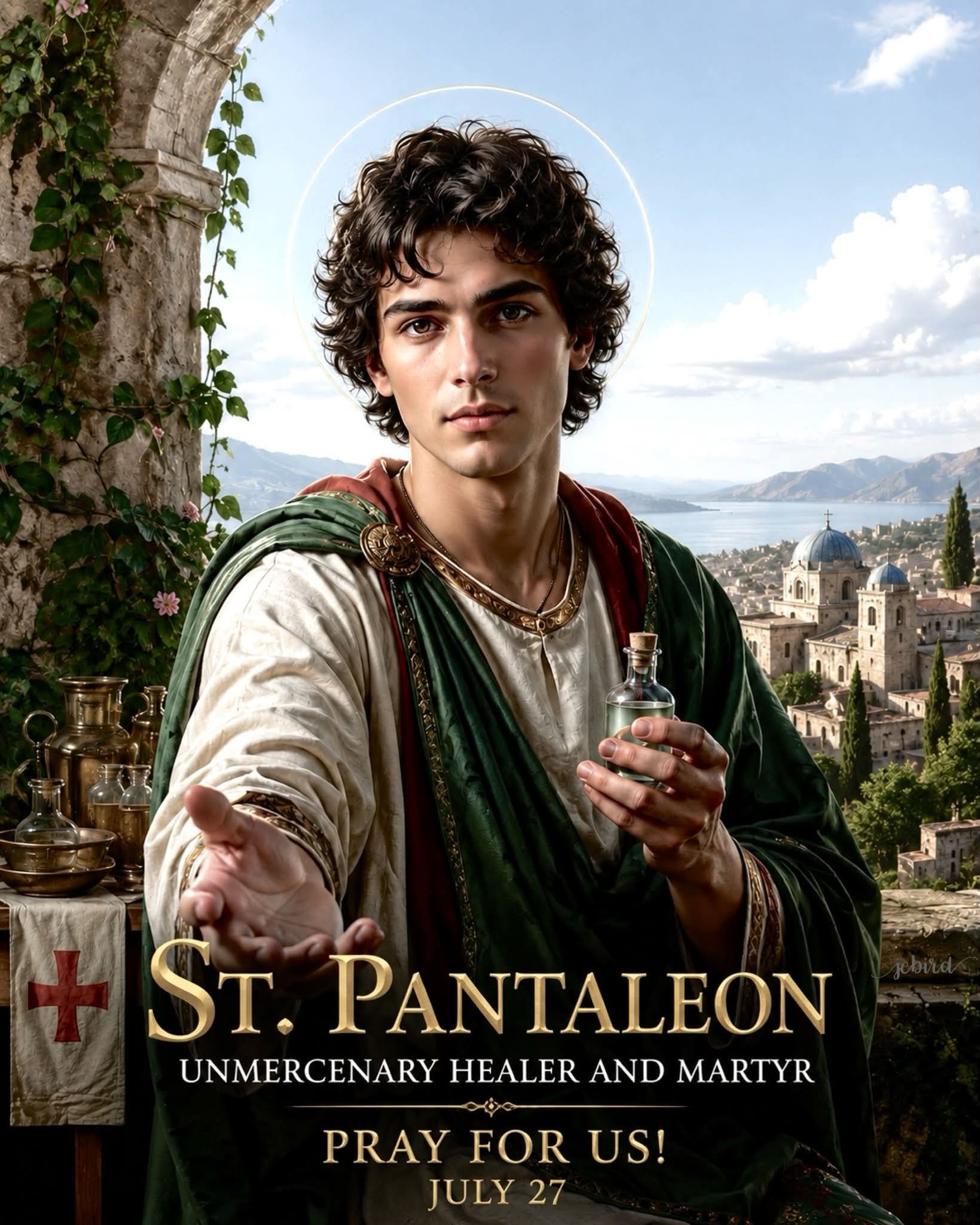
The life of Saint Pantaleon teaches that holiness is achieved through faithful obedience, generous service, steadfast courage, and complete trust in God. Whether we serve in medicine, family life, education, or any other vocation, we are called to reflect Christ’s healing love through acts of kindness, integrity, and unwavering faith.
A LIFE THAT CONTINUES TO INSPIRE
As we contemplate the life of Saint Pantaleon, we are inspired to become instruments of God’s healing and peace in a wounded world. May his example encourage us to place Christ at the centre of our lives, to serve others with compassion, to stand firm in our faith despite difficulties, and to trust that God will always strengthen those who remain faithful to Him.
PRAYER
Almighty and eternal God! With lively faith and reverently worshiping Thy divine Majesty, I prostrate myself before Thee and invoke with filial trust Thy supreme bounty and mercy.
Illumine the darkness of my intellect with a ray of Thy heavenly light and inflame my heart with the fire of Thy divine love, that I may contemplate the great virtues and merits of the saint in whose honor I make this prayer, and following his example imitate, like him, the life of Thy divine Son.
St. Pantaleon who during your life had great pity for the sick and with the help of God often relieved and cured them, I invoke your intercession with God, that I may obtain the grace to serve Him in good health by cheerfully fulfilling the duties of my state of life.
(Source of prayer: vatican.com)
Saint Pantaleon, pray for us.