
Why are today’s Youth Turning Away from God?
June 6, 2026
FEAST OF CORPUS CHRISTI – SOLEMNITY OF THE MOST HOLY BODY AND BLOOD OF CHRIST.
June 7, 2026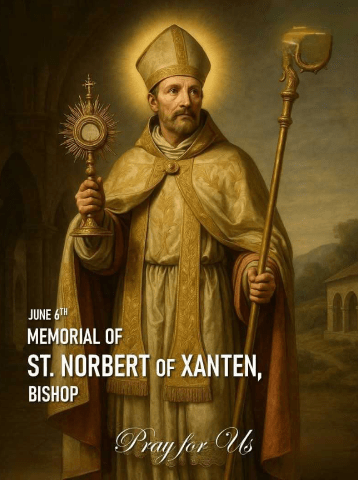
PRIVILEGED EARLY LIFE
Born into nobility, St. Norbert enjoyed education, influence, wealth, and access to imperial circles. He lived comfortably and pursued worldly success before recognizing the emptiness that material privilege alone could not satisfy.
“Do not store up for yourselves treasures on earth… but store up treasures in heaven.”
— Matthew 6:19–20
As a young cleric attached to the imperial court, Norbert enjoyed prestige and luxury but gradually sensed that God was calling him to something deeper.
Earthly success can never fully satisfy the soul’s deeper longing for God.
THE STORM AND THE FALL FROM HIS HORSE
A sudden storm dramatically changed Norbert’s life. While traveling on horseback, lightning struck near him, throwing him to the ground and leaving him shaken. This moment became the turning point of his spiritual awakening.
“Call upon Me in the day of trouble; I will deliver you, and you shall glorify Me.”
— Psalm 50:15
Around the age of thirty-three, this terrifying encounter led him to seriously examine his life and seek God with renewed sincerity.
God sometimes uses unexpected disruptions to redirect the soul toward its true vocation.
HIS RADICAL CONVERSION
Following his experience, Norbert gave up his comfortable lifestyle and embraced prayer, fasting, simplicity, and penance. His conversion was visible not only in words but also in action.
“Therefore, if anyone is in Christ, he is a new creation.”
— 2 Corinthians 5:17
He distributed much of his wealth, sought reconciliation with others, and dedicated himself fully to serving Christ.
A single moment of grace can transform the entire direction of a person’s life.
HIS LIFE AS A PREACHER
Norbert traveled across towns and villages preaching repentance, renewal, and deeper faith. His witness moved many people because he preached what he lived.
“Whatever you did for one of the least of these brothers and sisters of mine, you did for me”
— Matthew 25:40
He often used church resources and personal possessions to feed and support those in need.
PERSEVERANCE AMID OPPOSITION
Not everyone welcomed Norbert’s message. Many criticized him, resisted his reforms, and questioned his methods. Yet he continued faithfully.
“Blessed are those who are persecuted for righteousness’ sake.”
— Matthew 5:10
Some church leaders and wealthy individuals opposed his calls for reform because his teachings challenged comfortable habits and corruption.
Faithfulness to God’s mission often requires courage in the face of criticism and misunderstanding.
THE FOUNDING OF PRÉMONTRÉ
Norbert founded a religious community at Prémontré that combined prayer, community life, preaching, and service. This became the beginning of the Norbertine Order.
“Unless the Lord builds the house, those who build it labor in vain”
— Psalm 127:1
In a remote valley at Prémontré in France, he gathered followers who shared his vision of holiness and apostolic service.
When God inspires a holy work, its influence often extends far beyond its humble beginnings.
HIS LOVE FOR THE EUCHARIST
The Eucharist stood at the center of Norbert’s spirituality. He defended belief in Christ’s real presence and encouraged deep devotion to the Blessed Sacrament.
“I am the living bread that came down from heaven”
— John 6:51
Norbert strongly defended Eucharistic teaching against errors spreading during his time and encouraged reverence toward the Blessed Sacrament.
The soul draws its deepest strength and renewal from intimacy with Christ in the Eucharist.
HIS MINISTRY AS ARCHBISHOP
Though he preferred a simpler life, Norbert accepted the difficult role of Archbishop and used his position to strengthen the Church.
“Whoever wishes to become great among you must be your servant”
— Matthew 20:26
As Archbishop of Magdeburg, he worked tirelessly to reform clergy, restore discipline, and care for the faithful despite heavy responsibilities.
True leadership is measured not by power but by willingness to serve and sacrifice.
HIS WORK FOR UNITY AND REFORM
Norbert worked to heal divisions and renew the spiritual life of the Church through peace, discipline, and personal example
“Make every effort to maintain the unity of the Spirit in the bond of peace.”
— Ephesians 4:3
He helped mediate disputes, strengthened Church structures, and promoted reconciliation among divided groups.
Authentic reform begins with personal holiness and radiates outward to transform communities.
HIS LIFELONG FIDELITY
From conversion until death, Norbert remained faithful to God’s call despite challenges, responsibilities, and opposition.
“Be faithful unto death, and I will give you the crown of life.”
— Revelation 2:10
Even in illness and old age, he continued serving the Church until his death in 1134.
Holiness grows through daily perseverance and faithful surrender to God’s will.
PRAYER THROUGH THE INTERCESSION OF ST. NORBERT
O faithful Saint Norbert of Xanten, servant of the Eucharistic Lord and courageous reformer of the Church, pray for us that we may hear God’s voice amid the storms of life. Teach us to welcome conversion, remain faithful when challenges arise, and seek holiness above worldly success. Help us draw strength from Christ in the Eucharist, work for peace and renewal, and follow God’s will with courage and humility. May your example lead us ever closer to Christ.
Amen.