
SPIRITUAL INSIGHTS INTO THE LIFE OF SAINT MARIA GORETTI
July 6, 2026
Matthew 19:26
July 7, 2026
FEAST OF BLESSED RALPH MILNER, MARTYR
FEAST DAY – 7th JULY
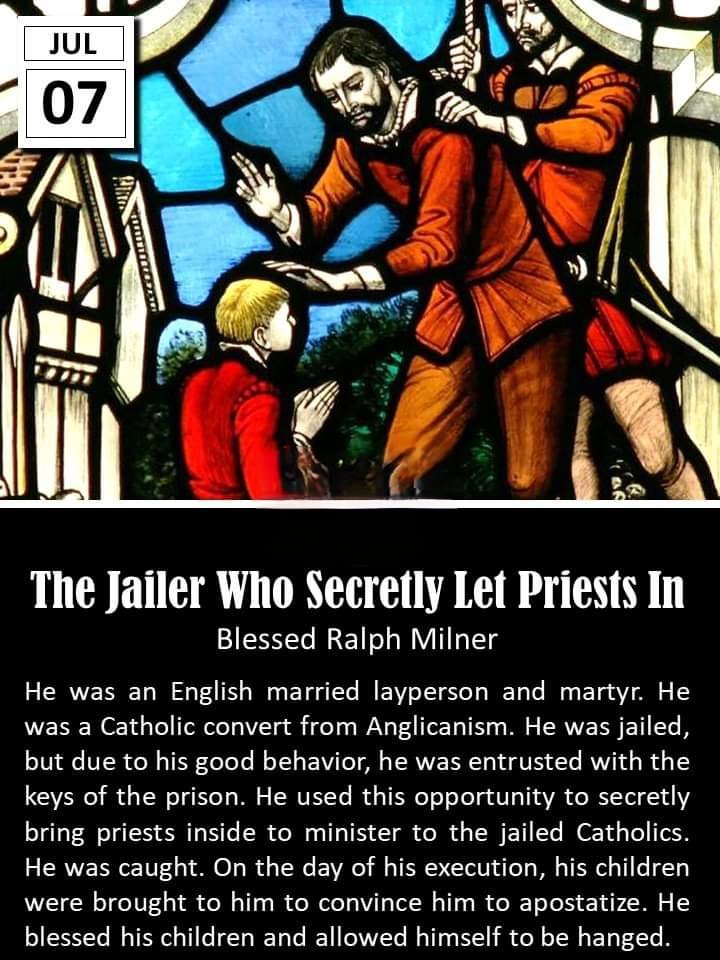
Ralph Milner (born at Slackstead, Hampshire, England, early in the sixteenth century; executed at Winchester, 7 July 1591) was an English Roman Catholic layman. He is a Catholic martyr, beatified in 1929.
The greater part of his life was probably passed in his native village, where, being practically illiterate, he supported his wife and eight children by manual labour. He was brought up an Anglican, but became a Catholic convert. On the very day of his first Communion, however, he was arrested for changing his religion.
He and his wife had raised eight children in the Protestant faith. Ralph’s neighbors, who were Catholic, inspired him to convert through their goodness and charity, and along with his entire family, he received instruction and was received into the Church. But he was arrested and committed to Winchester jail.
Here his good behaviour meant he was frequently allowed out on parole, and was even trusted with the keys of the prison. This leniency enabled him to introduce priests to administer the sacraments to Catholic prisoners. He then acted as escort first to Father Thomas Stanney, and later to his successor at Winchester, Father Roger Dicconson, conducting them to the different villages to minister to Catholics.
Finally seized with Father Dicconson, Milner was with him placed under close confinement in Winchester jail pending the approaching sessions. The judge urged Milner to attend even once the Protestant church and thus escape the gallows. He refused and began to prepare for death.
Every effort was made to persuade him to change his purpose and renounce the Catholic faith. When he was approaching the gallows with Father Dicconson, his children were led to him in the hope that he might even then relent. He was unshaken in his resolution, and gave his children his last blessing.
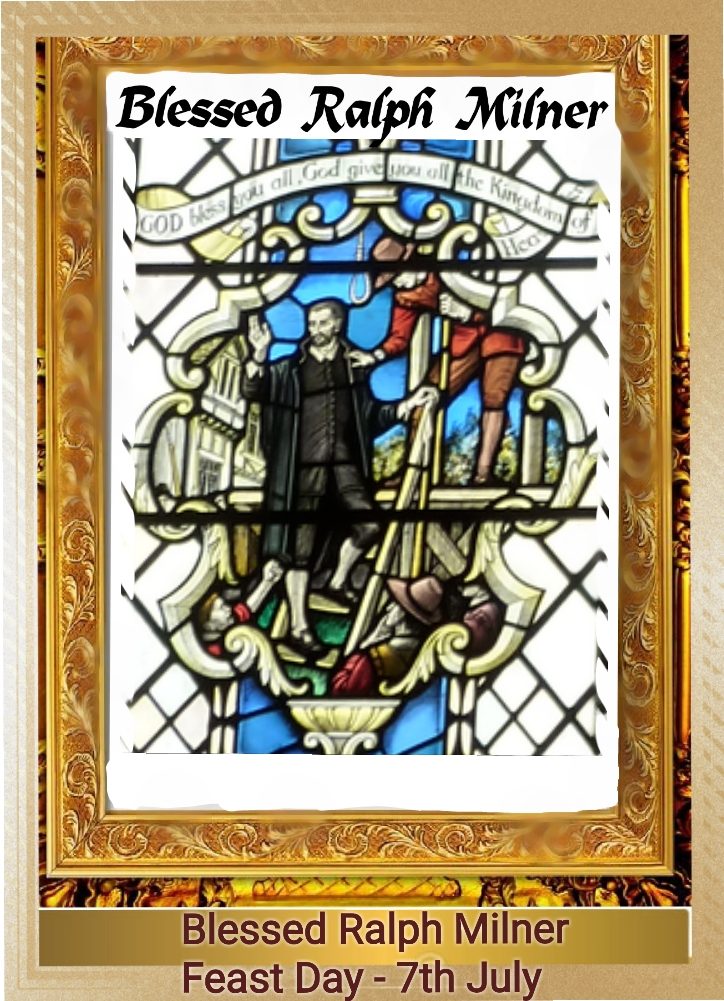
Ralph Milner’s paternal agony would have been particularly acute when his judge had the condemned traitor’s eight children paraded before their father to plead with him to compromise. Indeed, it would’ve been an easy compromise to make, since the judge merely asked the old man to make a token visit to a Protestant church in exchange for his freedom.
Yet, Blessed Ralph Milner did not succumb to the temptation of liberating his life, but died saving his faith and integrity. Without hesitation, he quietly and firmly refused the judge’s offer, proclaiming he would rather die for his faith, and refusing “to embrace a counsel so disagreeable to the maxims of the Gospel.”
Despite every effort by the judge and the guards who had come to like him, Ralph was unshaken in his resolution. After giving his children his last blessing, he declared that “he could wish them no greater happiness than to die for the like cause.” Unfortunately, that is exactly what happened. He was executed on July 7, 1591 at Winchester and beatified in 1929 by Pope Pius XI.
PRAYER
Eternal God, you bestowed upon your humble layman, the Blessed Ralph Milner, the courage and conviction of his faith, to desist the repeated attempts of the evil one to deny his faith in order to save his life. He rather lay down his life for his faith in the Living God.
May we, by his example be endowed with courage to proclaim and practice our faith openly. We ask this through Christ our Lord. Amen
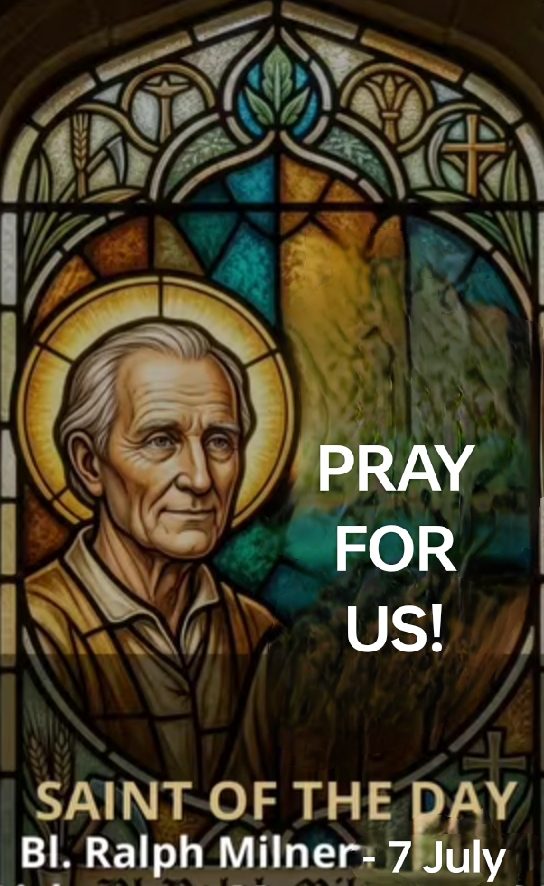
Blessed Ralph Milner, pray for us.
*********************************
ALSO CELEBRATED:

SAINT PANTAENUS, OF ALEXANDRIA
Pantaenus was chief of the catechetical school of Alexandria, in the latter part of the 2nd cent. and perhaps the early years of the 3rd. Of his previous life little is known with certainty. We are not informed whether he was originally a Christian or became one by conversion. Our authorities agree, however, that he was trained in the Greek philosophy, and owed to this training much of his eminence as a teacher. Origen, in a passage preserved by Eusebius (H. E. vi. 19), names him as an example—the earliest, apparently, that he can adduce—of a Christian doctor who availed himself of his heathen learning. Eusebius tells us (ib. v. 10) that in his zeal for the faith he undertook the work of an evangelist in the East, and penetrated as far as India.
He found that St. Bartholomew had already preached the Word and had left there a copy of St. Matthew’s Gospel in Hebrew characters, which was still treasured by the Christians there. Pantaenus brought this to Alexandria. He also represents that the people of India had heard his fame as a teacher and sent a deputation to solicit this mission. This is by no means incredible, considering the celebrity of Alexandria as a seat of learning. But Jerome raises a difficulty when he names Demetrius as the bishop by whom he was sent. For Eusebius places the accession of Demetrius to the patriarchate in the 10th year of Commodus (H. E. v. 22; cf. Chron.), a.d. 189; while he represents Pantaenus as head of the Alexandrian school in his 1st year (H. E. v. 9, 10) and distinctly conveys that this appointment was after his return from his Indian mission.
𝗦𝗮𝗶𝗻𝘁 𝗣𝗮𝗻𝘁𝗮𝗲𝗻𝘂𝘀 𝘁𝗵𝗲 𝗣𝗵𝗶𝗹𝗼𝘀𝗼𝗽𝗵𝗲𝗿: 𝗧𝗲𝗮𝗰𝗵𝗲𝗿 𝗼𝗳 𝗔𝗹𝗲𝘅𝗮𝗻𝗱𝗿𝗶𝗮 𝗮𝗻𝗱 𝗠𝗶𝘀𝘀𝗶𝗼𝗻𝗮𝗿𝘆 𝗼𝗳 𝘁𝗵𝗲 𝗘𝗮𝘀𝘁
Celebrated on July 7th, Saint Pantaenus is honored for his brilliant intellect, fervent faith, and his influential role in shaping early Christian theology. Living in the 2nd century, his legacy endures as one of the pioneers of Christian scholarship and evangelization.
Saint Pantaenus was born in Sicily and trained in Greek philosophy, particularly the Stoic tradition. A man of great learning and deep devotion, he converted to Christianity and journeyed to Alexandria in Egypt. There, he became head of the renowned Catechetical School, where he taught theology and philosophy, laying foundations for future Christian scholars like Clement of Alexandria and Origen.
One of the most remarkable aspects of Pantaenus’s life was his missionary zeal. Tradition holds that he traveled as a missionary to India (likely southern Arabia or possibly Ethiopia or parts of Persia; accounts vary), where he found Christians already practicing the faith and possessing a copy of the Gospel of Matthew in Hebrew. His journey demonstrated the early spread of Christianity far beyond the Roman Empire’s borders.
Pantaenus’s life was marked by his brilliant intellect and his commitment to proclaiming Christ both through words and reasoned discourse. He harmonized faith with philosophy, showing that the truths of Christianity could stand alongside the best of human wisdom. His influence shaped generations of Christian thinkers and played a vital role in the development of Christian theology in the early Church.
CONTEMPLATING THE LIFE OF SAINT PANTAENUS
THE PHILOSOPHER WHO BECAME A MISSIONARY OF CHRIST
Saint Pantaenus was one of the earliest and most influential Christian teachers of the second century. Though less well known than many later Church Fathers, he played a vital role in the development of Christian theology and biblical scholarship. A philosopher who embraced Christ, he became a gifted teacher, missionary, and the first known head of the renowned Catechetical School of Alexandria. His life demonstrates how faith and reason work together in the service of the Gospel. His feast is traditionally celebrated on July 7.
HISTORICAL BACKGROUND
Pantaenus lived during the late second century when Christianity faced persecution, the spread of heresies, and the challenge of explaining the faith to educated Greeks and Romans while forming future Christian leaders. Alexandria in Egypt, one of the great intellectual centers of the ancient world, provided the ideal setting for Christian learning and scholarship.
EARLY LIFE
Little is known about Pantaenus’ early life. According to the Church historian Eusebius of Caesarea, he was first trained as a Stoic philosopher, learning the values of self-discipline, virtue, wisdom, and mastery over the passions. These ideals prepared him to recognize their fulfillment in Jesus Christ. After his conversion, he devoted his knowledge and talents entirely to the service of the Gospel.
THE CATECHETICAL SCHOOL OF ALEXANDRIA
Pantaenus became the first known leader of the Catechetical School of Alexandria, a center for preparing catechumens for Baptism, deepening the study of Scripture, and forming future bishops and theologians. He encouraged students to see that all genuine truth ultimately leads to Christ.
HIS MOST FAMOUS STUDENT
Among his greatest disciples was Clement of Alexandria, who later succeeded him as head of the school and became one of the leading Christian thinkers of the early Church. Through Clement and later Origen, Pantaenus’ influence continued to shape Christian theology for generations.
THE MISSION TO THE EAST
Ancient tradition records that Pantaenus undertook a missionary journey to the East, possibly reaching India, though the exact location remains uncertain. He is said to have found an existing Christian community possessing a Hebrew or Aramaic copy of the Gospel of Matthew, believed to have been left by Saint Bartholomew the Apostle. This tradition reflects the early spread of Christianity beyond the Roman Empire.
HIS TEACHING
Pantaenus taught that faith and reason complement one another, philosophy can prepare people to receive the Gospel, Scripture is the supreme source of Christian truth, and Christ is the fulfillment of humanity’s search for wisdom. He saw learning as a path that should always lead to God.
HIS WRITINGS
None of Pantaenus’ writings have survived. His teachings are known through later authors, especially Eusebius and Clement of Alexandria. His lasting legacy is found not in written works but in the disciples he formed and the influence they carried forward.
HIS CHARACTER
Ancient sources describe Pantaenus as wise, humble, learned, zealous, and deeply devoted to Scripture. He united intellectual excellence with missionary zeal, believing that true wisdom always leads to worship, holiness, and evangelization.
HIS DEATH
The exact details of Pantaenus’ death are unknown. He is believed to have died peacefully around the beginning of the third century after many years of teaching and missionary service. The Church honors him for his faithful witness through learning, teaching, and preaching.
HIS LEGACY
Pantaenus laid important foundations for Christian theology by establishing the Alexandrian tradition of scholarship, promoting harmony between faith and reason, encouraging biblical study, forming influential Christian leaders, and supporting missionary work. His life shows that a mind dedicated to Christ becomes a powerful instrument of evangelization.
LESSONS FROM HIS LIFE
Saint Pantaenus reminds us that every search for truth finds its fulfillment in Christ, intellectual gifts are meant to serve God and His people, teaching is a sacred ministry, and evangelization includes both proclaiming the Gospel and forming minds. His life teaches that wisdom reaches its perfection when it leads to holiness.
WHY HE MATTERS TODAY
In a world where faith and reason are often seen as opposed, Saint Pantaenus offers a lasting example of their harmony. He demonstrates that sincere study strengthens faith, philosophy and science can support belief in God, Christian education is a form of evangelization, and intellectual humility opens the way to divine wisdom. His witness continues to inspire teachers, catechists, scholars, seminarians, missionaries, and all who seek to unite learning with faithful discipleship.
PRAYER
We honor you, Saint Pantaenus for your wisdom, missionary courage, and devotion to truth. May your life inspire us to seek knowledge, proclaim our faith boldly, and bring the light of Christ to all nations.
Saint Pantaenus, please pray for us.