
Day Nineteen of Lent – The Agony in the Garden
March 11, 2026
John 10:11
March 11, 2026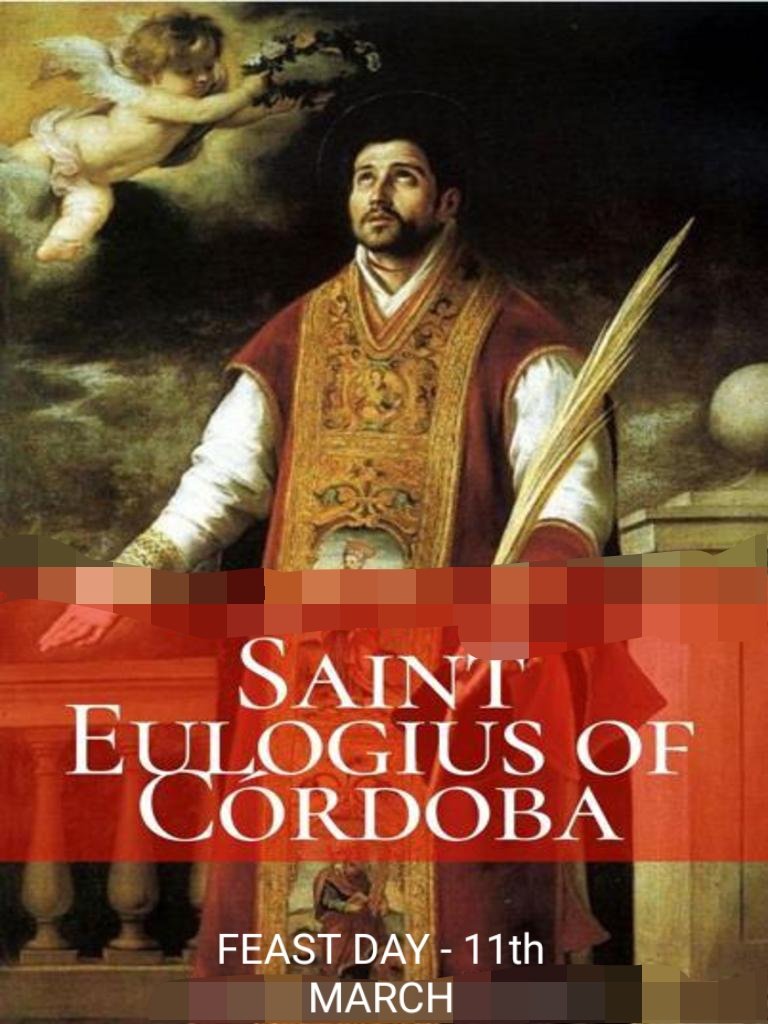
FEAST OF SAINT EULOGIUS OF CÓRDOBA, PRIEST AND MARTYR
FEAST DAY – 11th MARCH
Saint Eulogius of Córdoba (born before 819, died March 11, 857) was one of the Martyrs of Córdoba. He flourished during the reigns of the Cordovan emirs Abd-er-Rahman II and Muhammad I (mid-9th century). In the ninth century, the Muslim conquerors of Spain made Cordoba their capital. Christians were accorded a subaltern status, and subject to a monthly tax. Though restricted, they were permitted to worship. Some rose to high positions in the government.
St. Eulogius was of a senatorian family of Córdoba, at that time the capital of the Moors in Spain. He was educated among the clergy of the Church of St. Zoilus, a martyr who suffered with nineteen others under Diocletian. He distinguished himself, by his virtue and learning, and, being made priest, was placed at the head of the chief ecclesiastical school at Córdoba.
He joined assiduous watching, fasting, and prayer to his studies, and his humility, mildness, and charity gained him the affection and respect of every one. During the persecution raised against the Christians in the year 850, St. Eulogius was thrown into prison and there wrote his Exhortation to Martyrdom, addressed to the virgins Flora and Mary, who were beheaded on 24th of November, 851. Six days after their death Eulogius was set at liberty.
In the year 852 several others suffered martyrdom. St. Eulogius encouraged all these martyrs to their triumphs, and was the support of that distressed flock. The Archbishop of Toledo died in 858. St. Eulogius was elected to succeed him; but there was some obstacle that hindered him from being consecrated. A virgin, by name Leocritia, of a noble family among the Moors, had been instructed from her infancy in the Christian religion by one of her relatives, and privately baptized.
Her father and mother abused her very much, and scourged her day and night to compel her to renounce the Faith. Having made her condition known to St. Eulogius and his sister Anulona, intimating that she desired to go where she might freely exercise her religion, they secretly procured her the means of getting away, and concealed her for some time among faithful friends.
But the matter was at length discovered, and they were all brought before the cadi, who threatened to have Eulogius scourged to death. The Saint told him that his torments would be of no avail, for he would never change his religion. Whereupon the cadi gave orders that he should be carried to the palace and be presented before the king’s council. Eulogius began boldly to propose the truths of the Gospel to them.
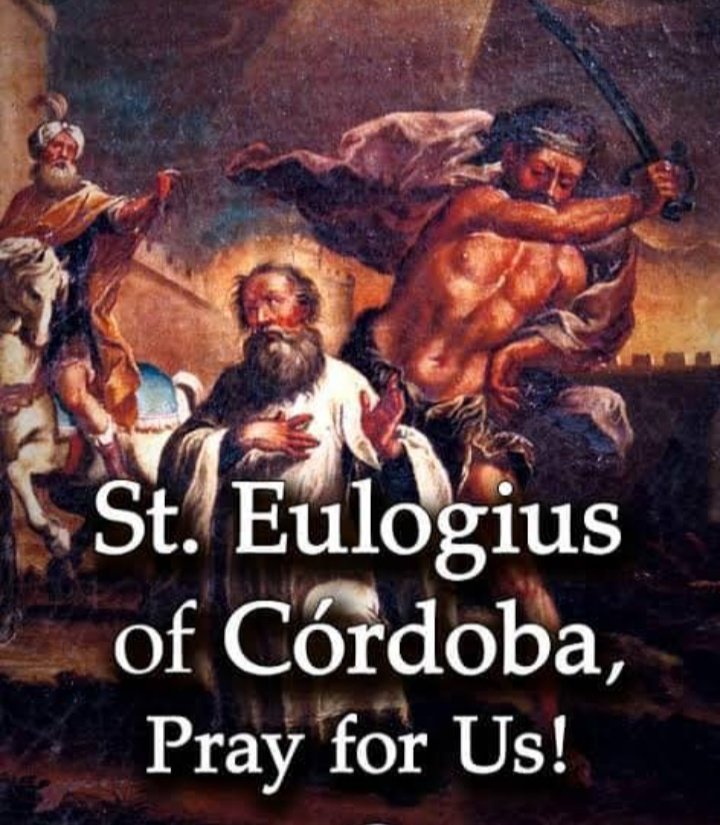
But, to prevent their hearing him, the council condemned him immediately to lose his head. As they were leading him to execution, one of the guards gave him a blow on the face; he turned the other cheek, and patiently received a second. He received the stroke of death with great cheerfulness, on the 11th of March, 859. St. Leocritia was beheaded four days after him, and her body thrown into the river Guadalquivir, but taken out by the Christians.
Paul Alvarus’ ‘Life of Eulogius’ records that a dove was seen flying above his martyred body, portraying his peacefulness and innocence, which could not be killed despite the attempts of the angered Muslims. St. Eulogius was chosen to fill the vacant Archepiscopal See of Toledo, but could not be consecrated as Archbishop of Toledo, owing to his imprisonment shortly before his execution by beheading.
St. Eulogius left a perfect account of the orthodox doctrine which he defended, the intellectual culture which he propagated, the imprisonment and sufferings which he endured; in a word, his writings show that he followed to the letter the exhortation of St. Paul: “Imitatores mei estote sicut et ego Christi”. St. Eulogius is buried in the Cathedral of Oviedo. His feast day is March 11.
(Excerpted from Lives of the Saints)
CONTEMPLATING THE LIFE OF SAINT EULOGIUS OF CÓRDOBA (c. 800–859)
THE VOICE THAT REFUSED TO BE SILENT: THE MARTYRDOM OF ST. EULOGIUS OF CÓRDOBA.
Eulogius of Córdoba was a priest, scholar, and martyr who lived in Muslim-ruled Spain during the 9th century. He became one of the most important leaders of the Christian community of Córdoba, encouraging believers to remain faithful during a time of intense religious pressure.
He is especially remembered for supporting and recording the stories of the Martyrs of Córdoba, a group of Christians who publicly professed their faith despite the risk of execution.
Historical Background
During the 9th century, Córdoba was the capital of the powerful Umayyad Emirate of al-Andalus.
Christians were allowed to practice their faith, but under restrictions. They were considered dhimmis (protected but subordinate religious minorities).
These limitations included:
* special taxes
* restrictions on public worship
* social pressure to convert to Islam.
Over time, many Christians gradually adopted Arabic culture and language.
Some church leaders feared that the Christian community was losing its identity.
It was in this context that St. Eulogius emerged as a courageous spiritual leader.
Early Life and Education
Eulogius was born around 800 AD into a Christian family in Córdoba.
He received an excellent education in the cathedral school, studying:
* Scripture
* theology
* classical literature
* Latin and Christian writings.
He later became a priest and gained a reputation for:
* holiness
* learning
* eloquent preaching.
He was also closely associated with another important Christian scholar of the time, Alvarus of Córdoba, who later wrote about his life.
Defender of the Martyrs of Córdoba
During the mid-9th century a remarkable movement of martyrdom occurred among Christians in Córdoba.
Some believers openly criticized Islam and proclaimed their faith in Christ before Muslim authorities.
Such public declarations were considered blasphemy under Islamic law and were punishable by death.
Many Christians were executed.
Eulogius became their spiritual supporter and chronicler.
He wrote detailed accounts of their witness in works such as:
* Memoriale Sanctorum
* Documentum Martyriale.
These writings preserved the stories of the martyrs and encouraged Christians to remain faithful.
Arrest and Imprisonment
Because of his involvement with the martyrs, Eulogius eventually came under suspicion.
Around 851, he was arrested and imprisoned.
During his imprisonment he continued writing and encouraging fellow Christians.
His courage strengthened many believers who were struggling with fear and uncertainty.
Eventually he was released, but the authorities continued to watch him closely.
The Case of St. Leocritia
Eulogius’ final conflict with the authorities came through his support of a young Christian woman named Leocritia.
Leocritia had been born into a Muslim family but secretly converted to Christianity.
When her conversion became known, her family tried to force her back to Islam.
Eulogius helped protect her and encouraged her in the faith.
This action was considered a serious offense by the authorities.
Martyrdom
In 859, Eulogius was arrested again.
He was brought before the judge and ordered to renounce his actions and return Leocritia to her family.
Instead, Eulogius openly professed his Christian faith.
For this he was condemned to death.
He was beheaded on March 11, 859 in Córdoba.
Leocritia herself was later executed as well.
His Writings and Legacy
St. Eulogius left behind important historical and spiritual writings that preserve the memory of the Martyrs of Córdoba.
His works include:
* _Memoriale Sanctorum_ – accounts of the martyrs
* _Documentum Martyriale_ – encouragement to Christians facing persecution
* _Liber Apologeticus Martyrum_ – defense of the martyrs’ witness.
These writings provide valuable insight into the life of Christians in Muslim Spain.
Archbishop-Elect of Toledo
Shortly before his death, Eulogius was chosen to become Archbishop of Toledo, one of the most important Christian sees in Spain.
However, he was executed before he could take up the position.
Veneration
St. Eulogius is honored especially in Spain as one of the great witnesses of Christian faith during the early medieval period.
His relics were eventually transferred to Oviedo, where they were venerated by the faithful.
In summary
St. Eulogius of Córdoba was not only a martyr but also a historian, pastor, and defender of Christian identity during a difficult period of cultural and religious pressure. Through his writings and his martyrdom, he preserved the memory of the courageous Christians of Córdoba and inspired generations to remain faithful to Christ.
PRAYER
Almighty God, through the intercession of Saint Eulogius, grant us the crowning gift of perseverance, by living a simple and virtuous life, renouncing the world and the devil once for all at our Baptism.
Help us to unhesitatingly look forward, not listening to suggestions against faith or virtue; but advancing day by day, along the road which you have chosen for us, in Jesus’ Name. Amen
Saint Eulogius, pray for us, that we may be ever mindful that all our gifts come from God, that we not be proud, but willing always to follow His lead. Amen