
SPIRITUAL INSIGHTS INTO THE LIFE OF SAINT PACIFICO OF SAN SEVERINO
September 24, 2026
Exodus 33:14
September 25, 2026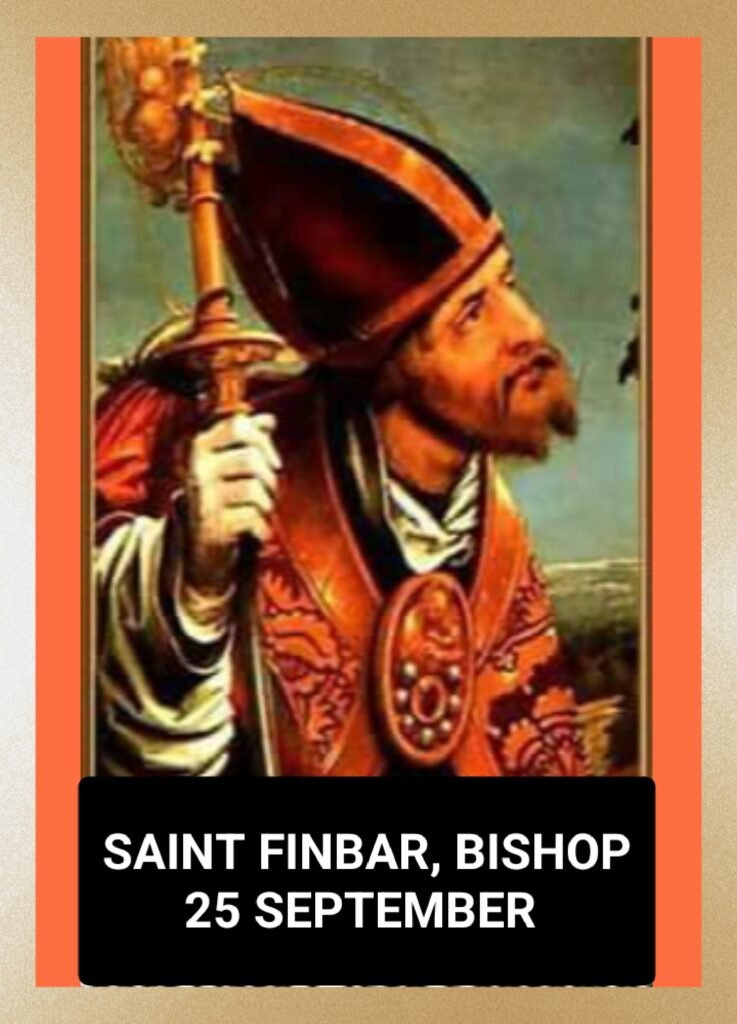
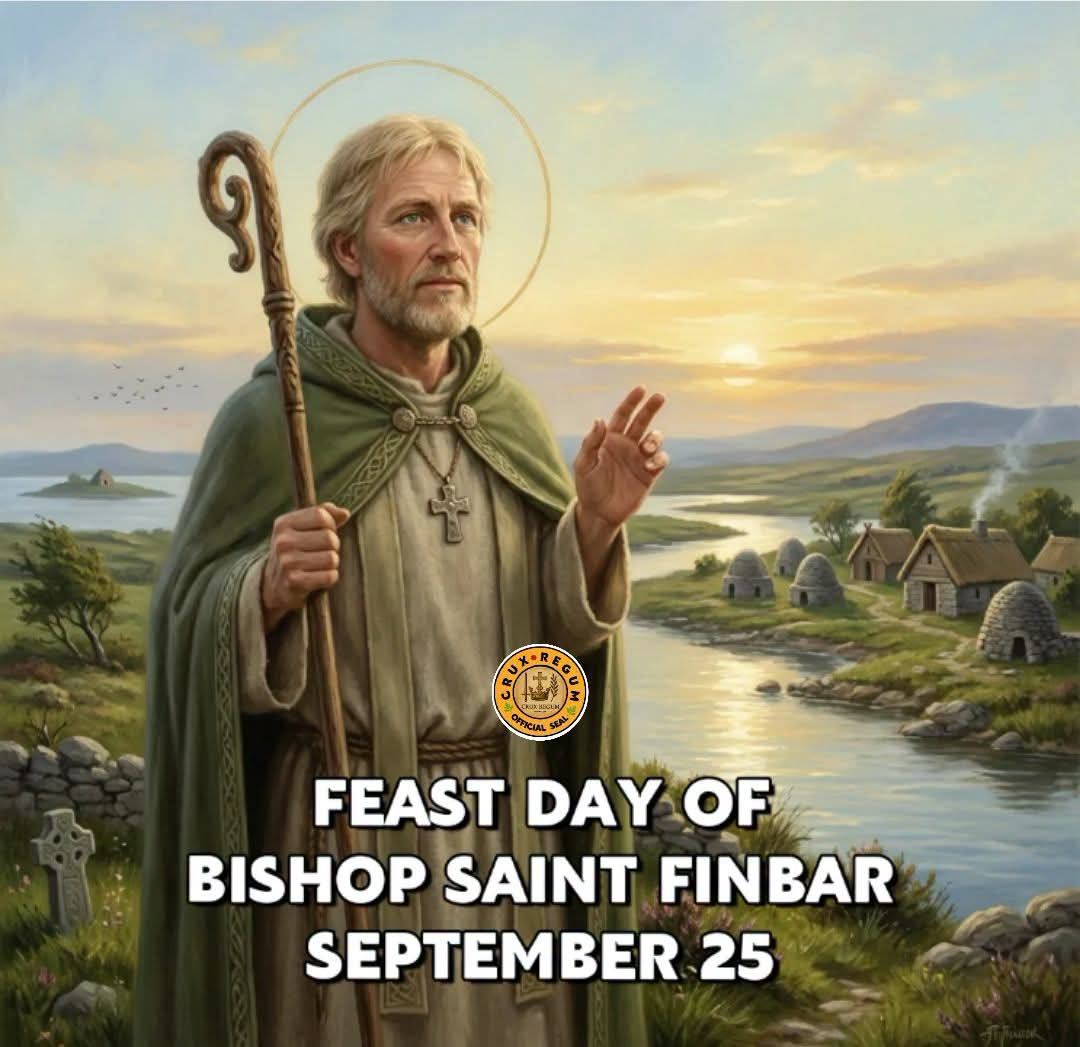
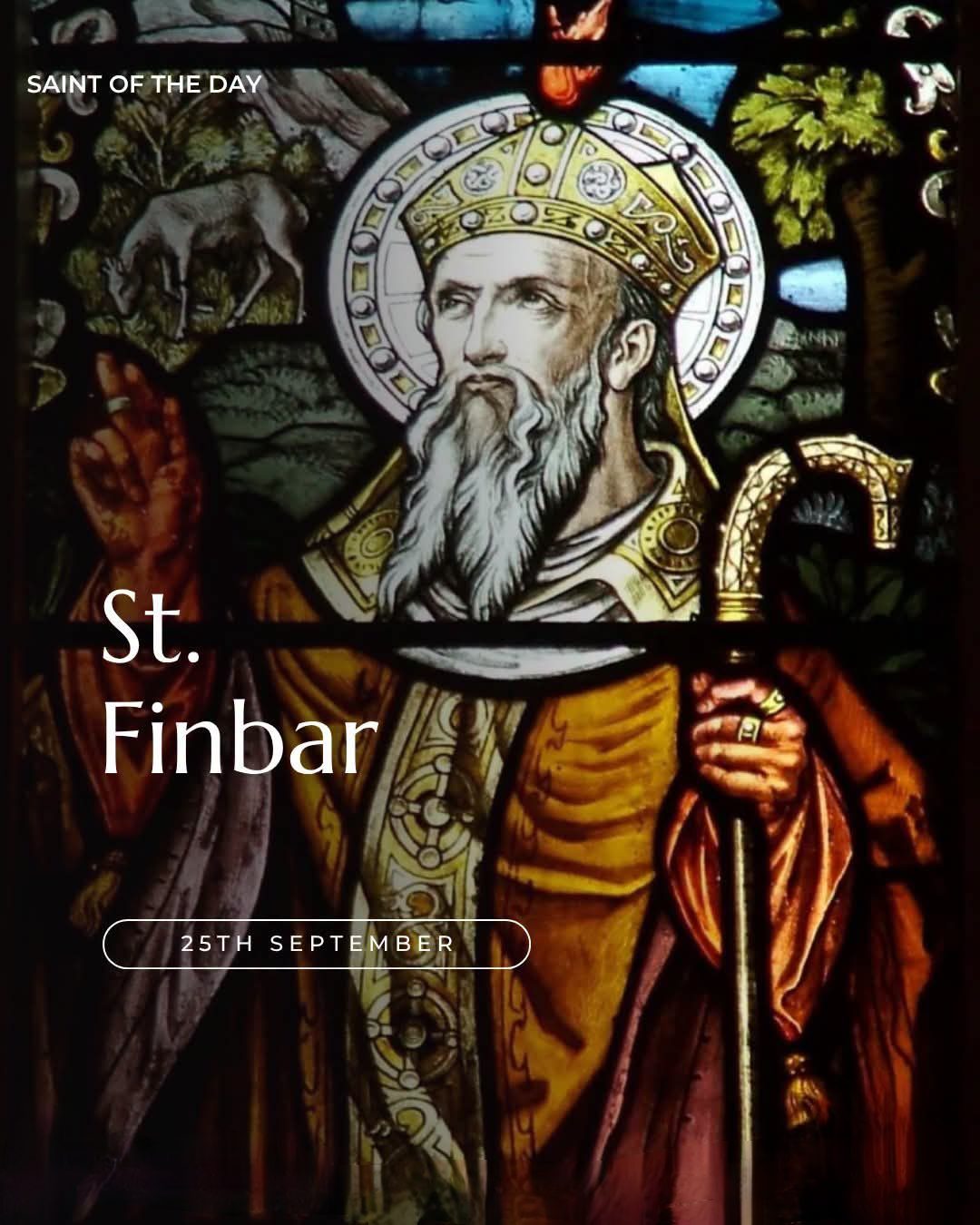
FEAST OF SAINT FINBAR, BISHOP OF CORK
FEAST DAY – 25th SEPTEMBER

Saint Finbar, Finbarr, very often abbreviated to Barra, (c. 550–25 September 623) was Bishop of Cork and abbot of a monastery in what is now the city of Cork, Ireland. He is patron saint of the city and of the Diocese of Cork. His feast day is 25 September. Having lived in Templemartin, which is near Bandon and originally named Lóchán (modern form, Loan), he was the son of Amergin of Maigh Seóla, a skilled craftsman originally from Galway.
He studied in Ossory, corresponding approximately to the present County Kilkenny. He was renamed “Fionnbharra” (Fairhead in Irish). He went on pilgrimage to Rome with some of the monks, visiting St David in Wales on the way back. On completion of his education he returned home and lived for some time on an island in the small lake, then called Loch Irce.
The island is now called Gougane Barra (the little rock-fissure of Finnbarr). He is reputed to have built small churches in various other places, including one in Ballineadig, County Cork, called Cell na Cluaine, anglicised as Cellnaclona and sometimes referred to as Cloyne, causing it to be confused with Cloyne (Cluain Uamha) in east Cork.
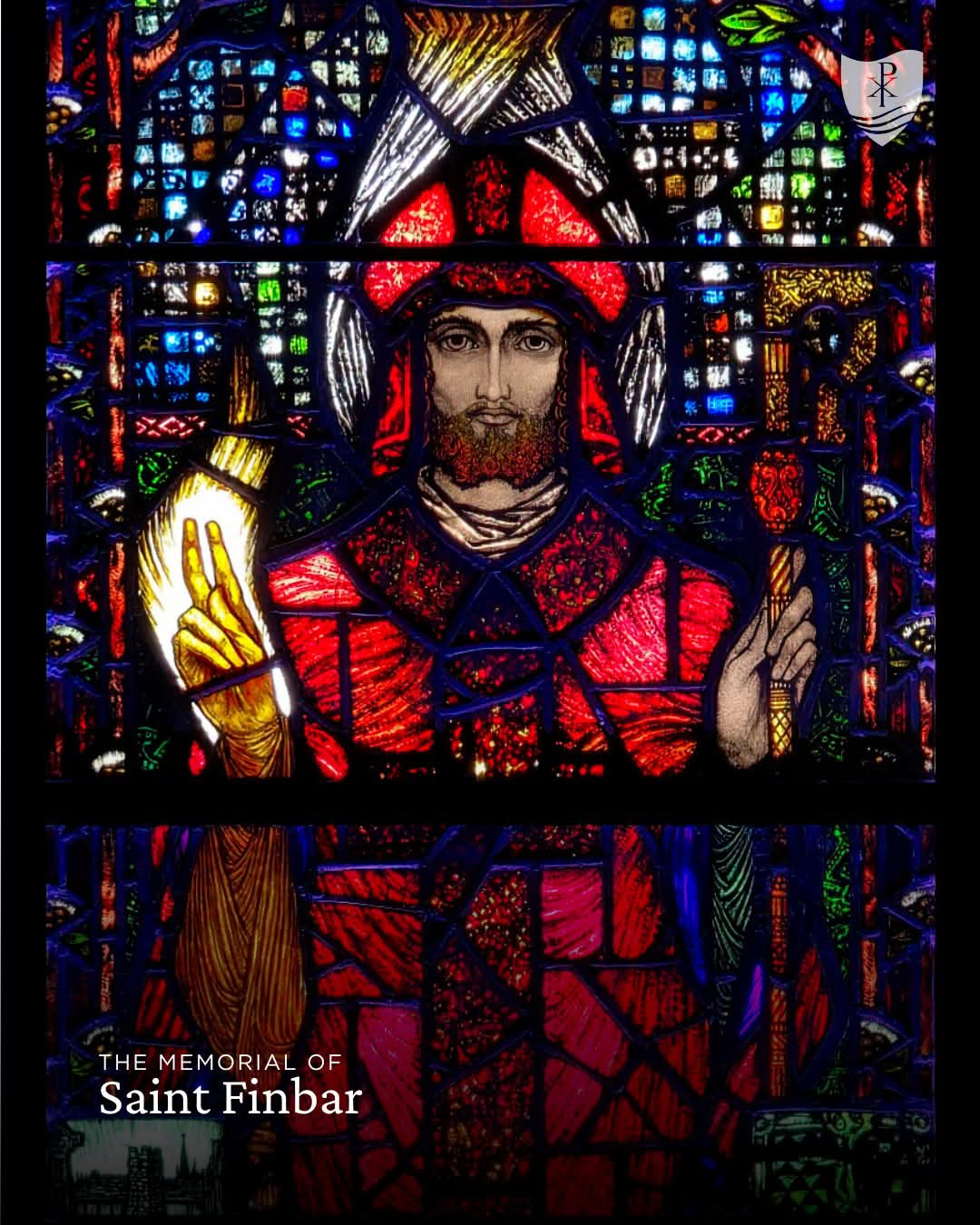
He settled for about the last seventeen years of his life in the area then known as Corcach Mór na Mumhan (the Great Marsh of Munster), now the city of Cork, where he gathered around him monks and students. This became an important centre of learning, giving rise to the phrase Ionad Bairre Sgoil na Mumhan. “Where Finbar taught let Munster learn”, is the motto of today’s University College Cork in English, though this is not a translation of the Irish motto “Ionad Bairre Sgoil na Mumhan” which means “Finbarr’s foundation, the School of Munster”.
The church and monastery he founded in 606 were on a limestone cliff above the River Lee, an area now known as Gill Abbey, after a 12th-century Bishop of Cork, Giolla Aedha Ó Muidhin. It continued to be the site of the cathedral of his diocese. The present building on the site, owned by the Church of Ireland, is called Saint Fin Barre’s Cathedral. The people of Cork often refer to the nearby Catholic church, also dedicated to St Finbar, in Dunbar Street in the South Parish as ‘the South Chapel’, distinguishing it from the North Cathedral, the Catholic Cathedral of Saint Mary and Saint Anne, sometimes called ‘the North Chapel’.

Finbar died at Cell na Cluaine, while returning from a visit to Gougane Barra. He was buried in the cemetery attached to his church in Cork. There are at least six St. Finbar’s schools in England, Chelsea, and Australia – at Ashgrove, Byron Bay, Invermay, Tasmania, Sans Souci (South Sydney, spelt St Finbar), East Brighton (Melbourne), Quilpie (South West Queensland), and Glenbrook, in the Blue Mountains.
There is a St. Finbarr’s school in Lagos, Nigeria. There is also a St. Finn Barr school and church in San Francisco, California. The original cathedral of the Diocese of Charleston, South Carolina, in the United States was named in honour of St. Finbar and remained standing until the Great Fire of Charleston during the Civil War.
 It is believed to have been named, because John England, the first bishop of Charleston, was originally from the County Cork and was consecrated a bishop in Saint Fin Barre’s Church before travelling to the United States.
In Coventry, England, St Finbarr’s Social Club was named in honour of the saint during the late 1980’s attracting large numbers from an Irish background to socialise. Upon demolition in 2006, a new housing scheme was completed in 2008 on the same site with the road name of Finbarr Close.
CONTEMPLATING THE LIFE OF SAINT FINBAR, BISHOP
THE EARLY YEARS OF A HOLY LIFE
Saint Finbar, also known as Finbarr of Cork, was an Irish bishop and missionary who lived in the sixth century. From his youth, he was drawn towards prayer, solitude and the service of God. His life became a journey of seeking Christ above worldly honours and possessions.
A LIFE OF PRAYER AND SOLITUDE
Finbar spent many years in prayer and contemplation, especially in places of solitude. His love for God grew through silence, penance and meditation. He understood that a heart which withdraws from worldly distractions can listen more clearly to the voice of the Lord.
A TEACHER OF THE FAITH
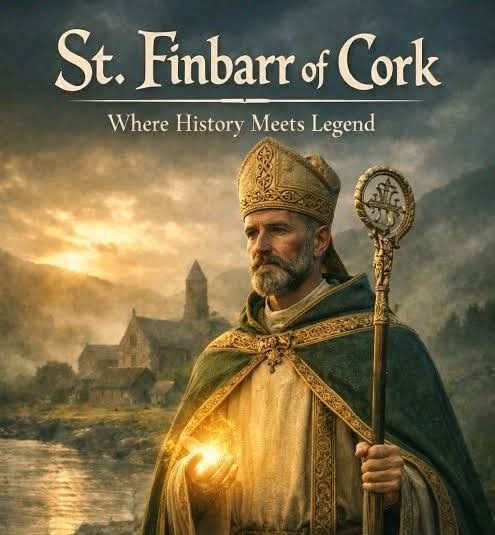
Saint Finbar became a spiritual teacher and attracted disciples who desired to learn from his wisdom and holiness. He instructed them not merely through words but through the example of his own life. His teaching was rooted in prayer, discipline and faithful living.
THE FOUNDATION OF GOUGANE BARRA
Finbar is traditionally associated with Gougane Barra, where he established a monastic settlement. This peaceful place became a centre of prayer and spiritual formation. His life reminds us that holy places are created not simply by buildings, but by hearts devoted entirely to God.
BISHOP AND SHEPHERD OF SOULS
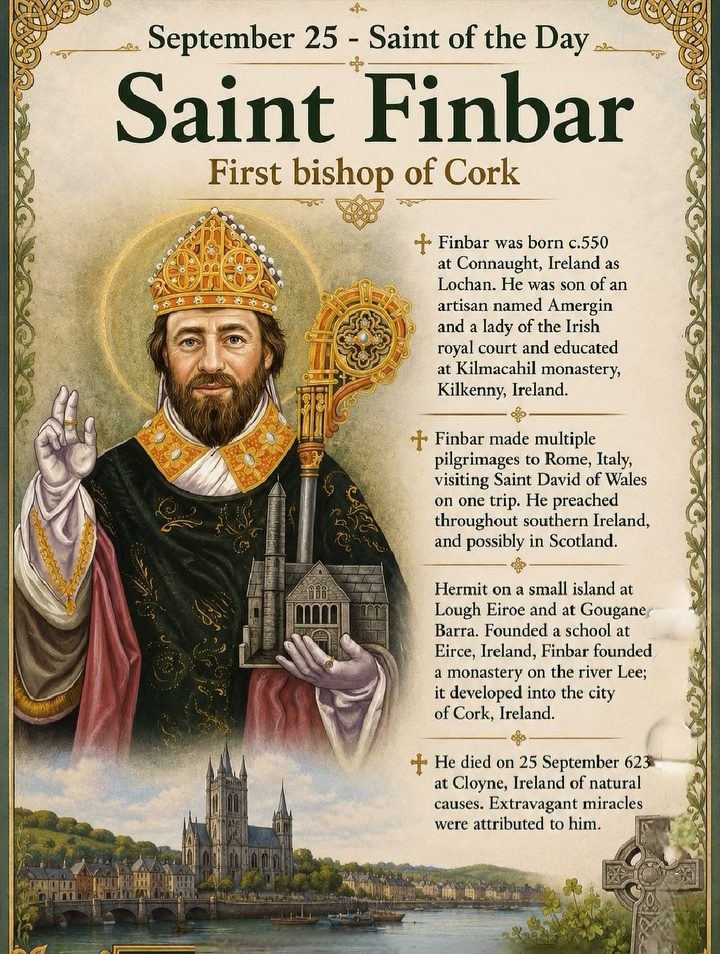
Saint Finbar eventually became a bishop and served the people entrusted to his care with dedication. He preached the Gospel, encouraged Christian communities and guided souls towards Christ. His episcopal ministry was marked by humility, prayer and pastoral concern.
THE FOUNDING OF CORK
Saint Finbar is traditionally regarded as the patron and founder of the Church of Cork. Around his monastery grew a Christian community that eventually became the city of Cork. His work shows how one person’s faithful response to God’s call can bear fruit for generations.
A LIFE OF HUMILITY
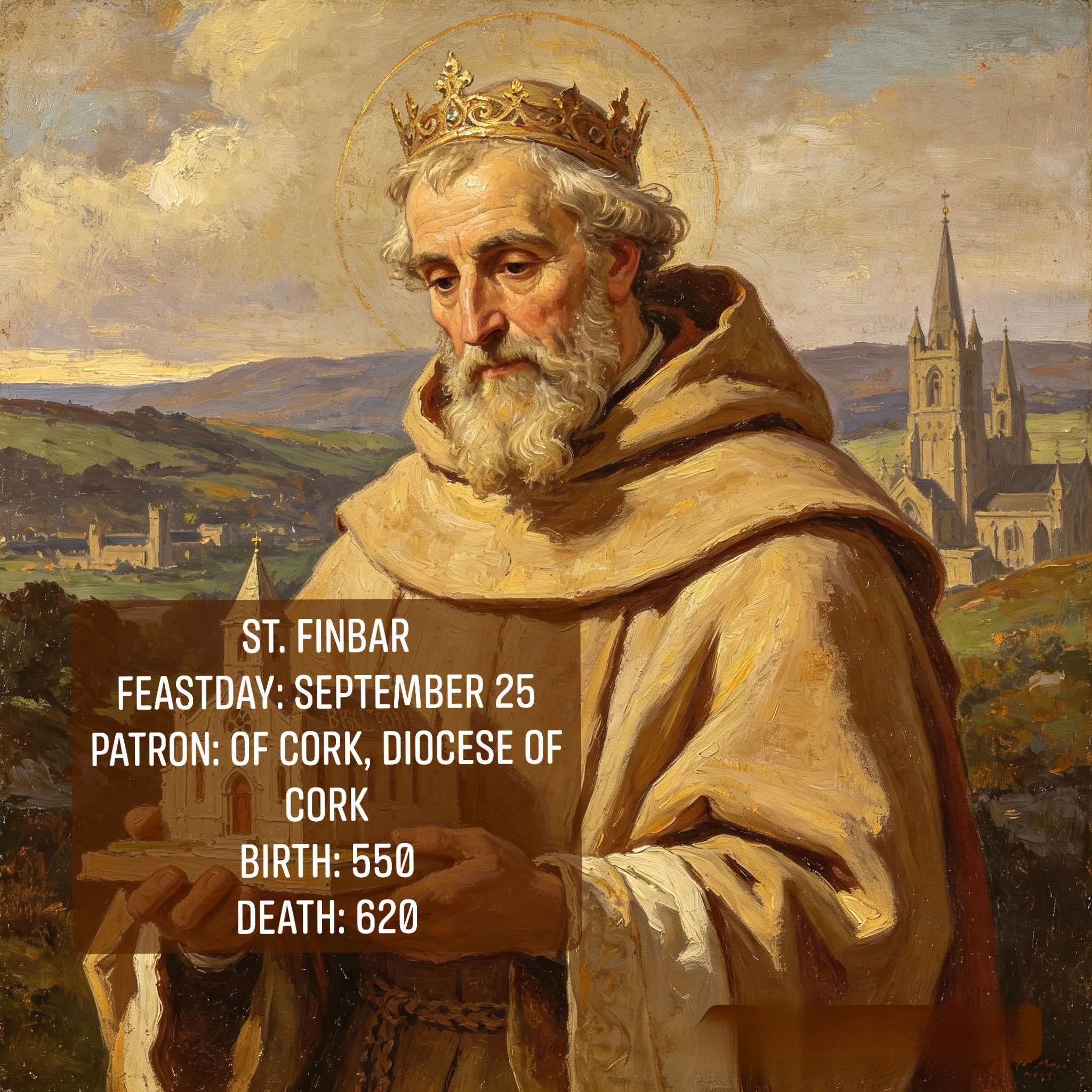
Although he became a bishop and respected spiritual leader, Finbar remained a man of prayer and simplicity. His greatness did not come from his position but from his closeness to God. He teaches us that true spiritual authority is expressed through humility and service.
A WITNESS TO CHRIST
Saint Finbar devoted his life to proclaiming Christ and helping others discover the way of salvation. His missionary spirit reminds us that faith is not meant to remain hidden within us. Those who encounter Christ are called to become witnesses through their words, actions and example.
A LEGACY OF HOLINESS
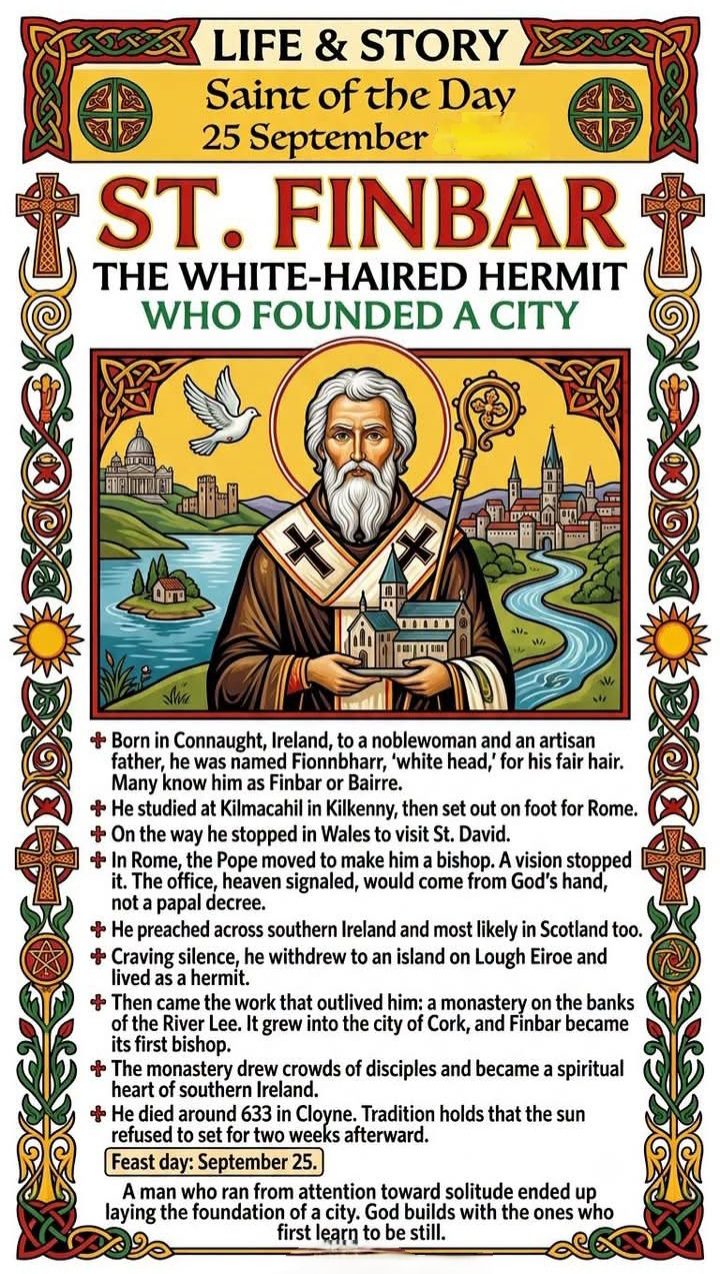
Saint Finbar died around the year 623 and was remembered as a faithful shepherd and servant of God. His memory continues particularly in Cork and at Gougane Barra. His life leaves behind a beautiful invitation to seek God in prayer, serve others with humility and remain faithful to the Gospel until the end.
PRAYER
Dear God, your devoted servant, Saint Finbar led an exemplary life, demonstrating great love and the outpouring of belief that impressed the world, and added him to the role of saintly Pastors.
May we, by his inercessions, persevere in faith and love and become partakers of this glory. We ask this through Jesus Christ our Lord. Amen

**********************************
ALSO CELEBRATED:
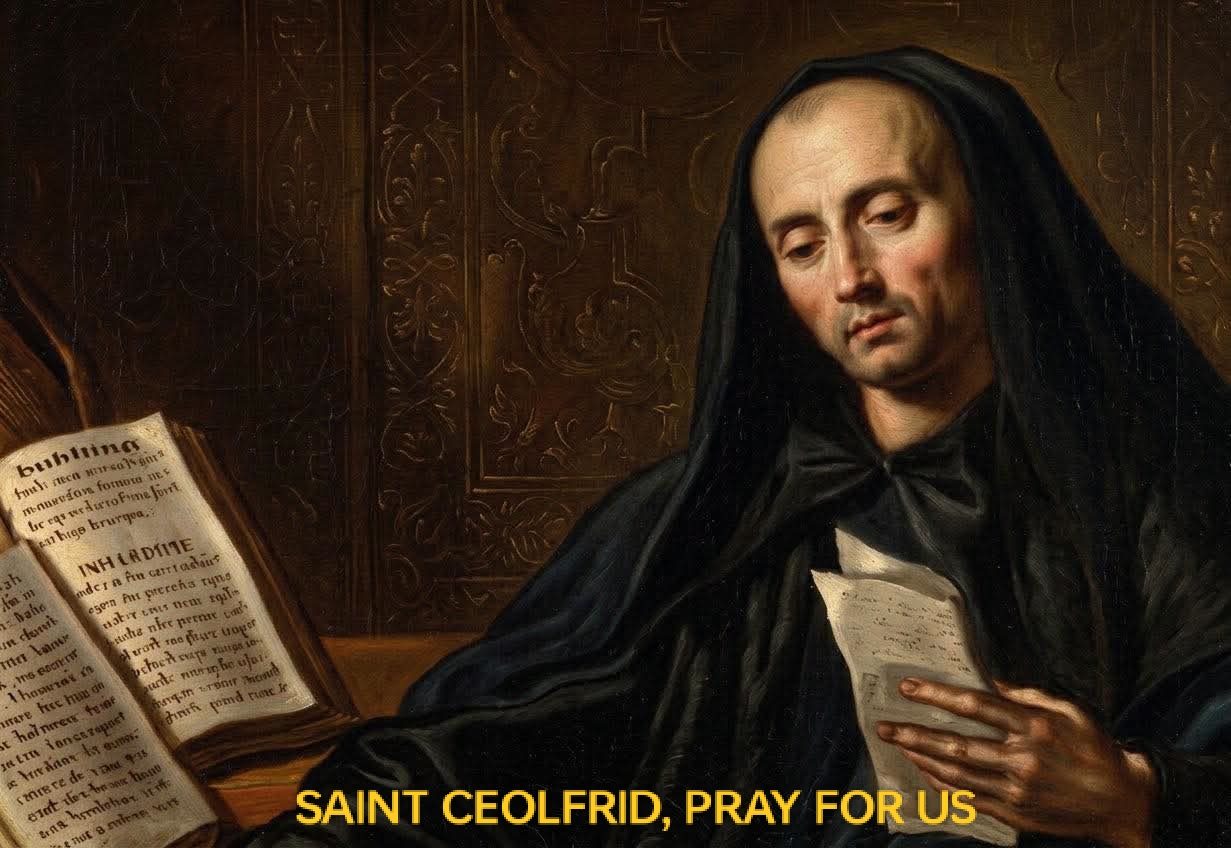
FEAST OF SAINT CEOLFRID, ABBOT
A.D. 716.
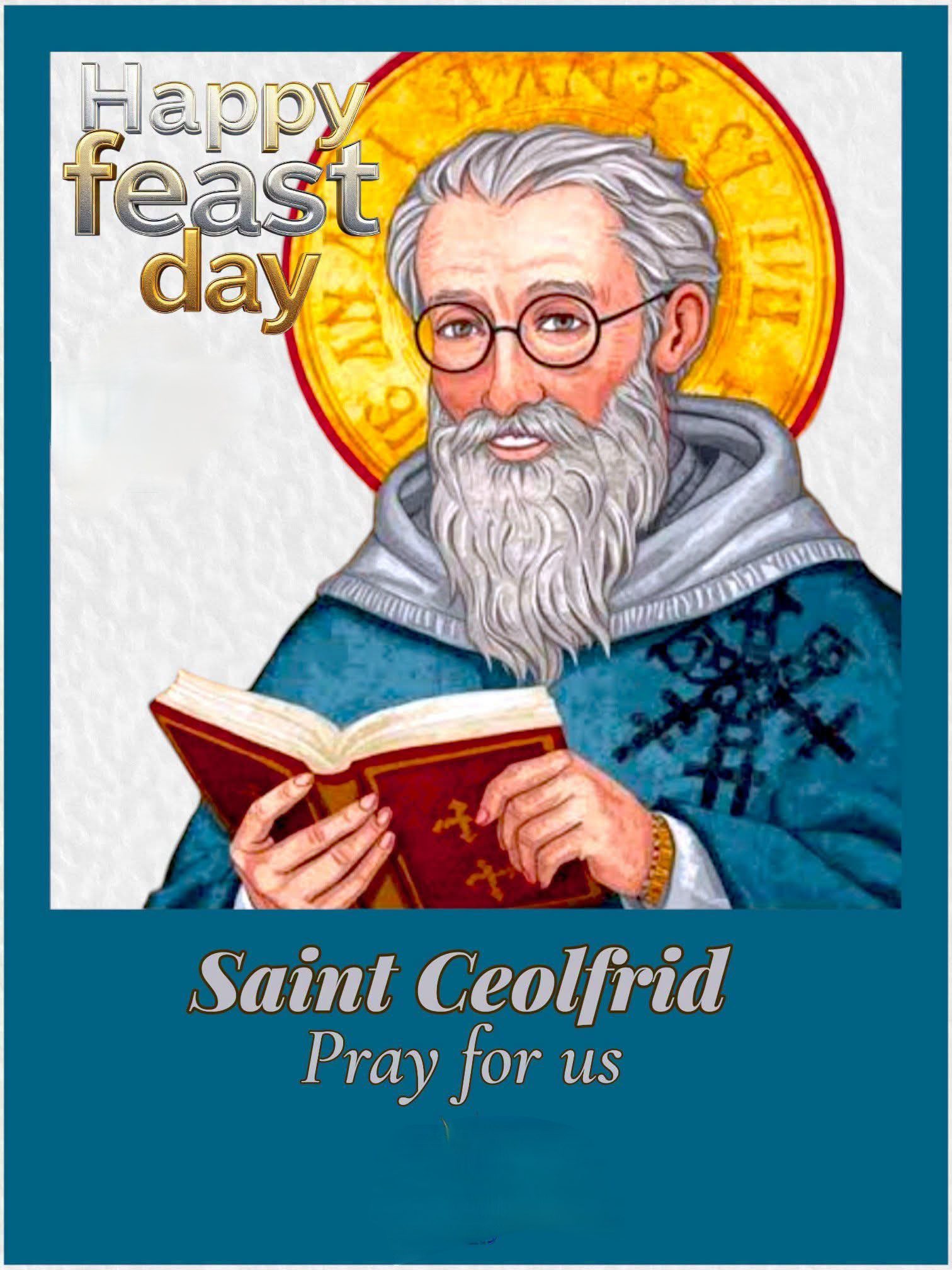
CEOLFRID is the same Teutonic name with Geoffrey, and signifies Joyful. The saint was nobly born in Bernicia, and related to St. Bennet Biscop, with whom he joined in the generous resolution of quitting the world. With him he made a journey to Rome, partly out of devotion, and partly for improvement in sacred studies and divine knowledge. After their return he was St. Bennet’s assistant in the foundation of his monastery of St. Peter at Wiremouth, on the north bank of the river, in the bishopric of Durham.
Saint Ceolfrid would have regarded it as his greatest felicity on earth, if he could have been as much forgotten by all creatures, and contemned by every one as he contemned and studied to forget himself: and he lived in his community as St. Antony and St. Hilarion lived on their mountains, in the most profound recollection, and in the practice of the most austere penance. When St. Bennet built the monastery of St. Paul at Jarrow, he sent Ceolfrid, with seventeen monks, to lay the foundation of that house, and appointed him abbot. Our saint governed this abbey seven years in St. Bennet’s life-time, and was constituted at the desire of that saint, in his last sickness, abbot also of Wiremouth: from which time he presided, for twenty-eight years, over both those monasteries, which for their propinquity and constant connexion were usually esteemed as one, and were generally subject to one abbot.
Saint Ceolfrid was diligent and active in everything he took in hand, of a sharp wit, mature in judgment, and fervent in zeal. Bede, who had the happiness to live under this admirable man, has left us most authentic testimonies of his learning, abilities, and extraordinary sanctity. He was a great lover of sacred literature, and enriched the libraries of his two monasteries with a great number of good books; but banished those which could only serve to entertain curiosity. To how great a pitch he carried the sacred sciences in his monasteries, Bede is an instance. He was himself very learned.
Naitan, king of the Picts, sent to him, desiring to be informed concerning the right time of celebrating Easter, and the true form of the clerical tonsure. The holy abbot strongly proved and recommended to him the Catholic custom of observing Easter and the Roman tonsure called St. Peter’s, by a letter which Bede hath inserted in his history. The king received it with great joy and satisfaction, and commanded both points to be received and observed throughout his dominions. This king likewise desired our saint to send him builders, who might erect a stone church, after the manner of the Romans, promising to dedicate it in honour of St. Peter. The abbot complied also with this request.
St. Ceolfrid finding himself broken with age and infirmities, and no longer capable of teaching his monks, by word and example, the perfect form of monastic observance, resigned his abbacy. The monks entreated him on their knees to alter his resolution; but were obliged to acquiesce, and, upon his recommendation, chose Hucthbert, or rather Hubert, a very learned priest, abbot of both monasteries, in which then lived six hundred monks. This being done, the saint having sung mass in the morning, made them a strong exhortation to mutual love and concord; and, for fear of being stopped by the grandees of the kingdom, who held him in great veneration, set out immediately with a design to perform a pilgrimage to the tombs of the apostles at Rome.
On the road, besides the canonical hours, he every day sung the whole psalter twice over, and also offered to God the saving victim in the mass which he sung every day, except one when he was upon the sea, and the three last days of his life. After travelling one hundred and fourteen days he arrived at Langres, in France, where, being stopped by sickness, he happily died on the 25th of September, in the year of our Lord 716, of his age seventy-four, of his sacerdotal character forty-seven, and his abbatial dignity thirty-five. He was buried in the church of the three twin martyrs, SS. Speusippus, Eleusippus, and Meleusippus. His relics were afterwards removed to his monastery of Jarrow, and thence, in the time of the Danish devastations, to Glastenbury.
Leland saw a square stone at Jarrow, on which was this inscription: “The dedication of the church of St. Paul at Jarrow, on the ninth day before the calends of May, in the fifteenth year of King Ecfrid, and the fourth of the Abbot Ceolfrid, the builder of this church.”
CONTEMPLATING THE LIFE OF SAINT CEOLFRID
THE ABBOT WHO NEVER REACHED ROME – BUT SENT THE WORD OF GOD AHEAD OF HIM
St. Ceolfrid (c. 642-716) was an Anglo-Saxon Benedictine monk and abbot of the twin monasteries of Wearmouth and Jarrow in Northumbria. He is particularly important because he was the mentor and superior of St. Bede the Venerable, helped develop Wearmouth-Jarrow into a great centre of Scripture, scholarship and manuscript production, and commissioned the enormous biblical manuscript now known as the Codex Amiatinus, the oldest surviving complete manuscript of the Latin Vulgate Bible.
His feast is traditionally celebrated on 25 September.
THE YOUNG MAN WHO CHOSE THE MONASTERY
Northumbria in the seventh century was a land where Christianity was still taking root.
The Church was young. Monasteries were beginning to appear. Missionaries and monks were bringing the Gospel into a world that had only recently begun to hear the name of Christ.
Into this world, around the year 642, a boy named Ceolfrid was born.
He came from a noble family. He could have expected the advantages that came with his social position – education, influence, security and perhaps a comfortable future.
But something else was growing within him.
A desire for God.
At about eighteen years of age, Ceolfrid entered monastic life.
He was not attracted merely to the appearance of holiness. He entered a world of discipline: long hours of prayer, study, manual labour, silence, obedience and community life.
He was learning something that would define his entire life:
_A monk does not merely study God. He gives his whole life to God._
THE YOUNG MONK WHO LEARNED TO SERVE
Ceolfrid was not content with being an educated monk.
He wanted to become a faithful one.
He learned the Scriptures. He studied theology. He received priestly formation. He travelled to places where he could deepen his knowledge of the Christian tradition.
But alongside learning, he learned something equally important:
humility.
The great test of a monk was not what he knew but whether he was willing to serve.
Ceolfrid became known for his discipline and his willingness to perform ordinary tasks.
He understood a secret that many leaders forget:
Holiness is not proved by the greatness of the task, but by the love with which we perform it.
God was preparing him – not simply to be a monk, but to become a father and formator to generations of monks.
THE MEETING WITH BENEDICT BISCOP
Then Ceolfrid’s life encountered another extraordinary man:
Benedict Biscop.
Benedict was a visionary monk who had travelled repeatedly to Rome and wanted to bring the richness of Roman Christianity to Northumbria.
He founded the monastery of Wearmouth.
Later, he established another monastery at Jarrow.
Ceolfrid became one of his closest collaborators.
He did not simply admire Benedict’s vision.
He helped build it.
Ceolfrid became prior at Wearmouth and eventually became the first abbot of Jarrow.
The two monasteries became something extraordinary.
They were not merely places where monks lived.
They became places where:
Scripture was studied,
manuscripts were copied,
theology was taught,
liturgy was celebrated,
sacred music was cultivated,
books were preserved,
young monks were formed,
and Christian culture was patiently built.
Ceolfrid understood that evangelization required more than preaching.
Sometimes the Gospel must be written, studied, taught and preserved so that generations yet unborn can encounter it.
TWO MONASTERIES, ONE VISION
When Benedict Biscop died in 690, Ceolfrid inherited responsibility for both Wearmouth and Jarrow.
It was no small responsibility.
He was now responsible for communities of monks, their spiritual formation, their education, their liturgical life and their material needs.
But Ceolfrid did not build his authority around himself.
He built a culture around Christ.
Under his leadership, Wearmouth and Jarrow became one of the great centres of Christian learning in Anglo-Saxon England.
And among the young monks entrusted to his care was a boy who would eventually become one of the greatest historians of the early medieval Church:
Bede.
Bede later remembered Ceolfrid with deep affection and respect.
The abbot was not simply managing a monastery.
He was shaping a future historian, theologian and teacher.
Ceolfrid probably could not have imagined the enormous influence Bede would have.
But that is the mystery of formation.
The person who teaches you today may influence people centuries after you are gone.
WHEN PLAGUE SILENCED THE MONASTERY
Then came one of the great trials of Ceolfrid’s leadership.
A plague struck the monastery.
Disease did not distinguish between the strong and the weak, the educated and the uneducated, the young and the old.
The community was devastated.
Many monks died.
The great monastery that had once been filled with voices suddenly became painfully quiet.
Yet Ceolfrid remained.
And Bede remained.
According to Bede’s account, they continued the daily celebration of the liturgy and the prayer of the Church.
Imagine the scene.
A monastery once filled with dozens of voices.
Now almost silent.
Yet somewhere in the darkness, the Psalms were still being prayed.
The candles were still burning.
The Scriptures were still being proclaimed.
The Church’s prayer had not ceased.
Ceolfrid was teaching without giving a lecture:
Faithfulness is most important when circumstances make faithfulness difficult.
THE MASTER OF A YOUNG BEDE
Among the young monks was Bede.
Bede had entered the monastery as a child and would spend almost his entire life there.
Under Ceolfrid, he learned the rhythm of monastic life:
Pray. Study. Work. Read. Write. Serve. Persevere.
Ceolfrid gave Bede something more important than information.
He gave him a spiritual environment in which knowledge could become wisdom.
The young Bede would eventually write his famous Ecclesiastical History of the English People, becoming one of the principal sources for our knowledge of early Anglo-Saxon Christianity.
But behind the great historian stood a community.
And behind that community stood a formator.
Ceolfrid’s greatness was therefore not only in what he himself wrote or built.
It was also in the people he formed.
THE BIBLE THAT TOOK YEARS TO WRITE
Ceolfrid’s vision went even further.
He wanted his monasteries to possess complete copies of the Bible.
Not merely fragments.
Not merely a Gospel book.
The entire Latin Bible.
Three enormous manuscripts were commissioned.
Producing such a Bible in the seventh and early eighth centuries was an astonishing undertaking.
There were no printing presses.
Every letter had to be written by hand.
Every page demanded concentration.
Every mistake could mean costly correction.
Hundreds of leaves had to be prepared.
Ink had to be made.
Parchment had to be prepared.
The work required years of patient labour.
One of the great surviving manuscripts associated with this project is the Codex Amiatinus, now preserved in Florence.
It is one of the oldest surviving complete Latin Bibles.
Think about what that means.
A man whose daily life consisted largely of prayer, administration, study and formation commissioned a book that would outlive kingdoms.
Ceolfrid was not building merely for his generation.
He was building for people he would never meet.
THE OLD ABBOT WHO BECAME A PILGRIM
Eventually Ceolfrid grew old.
He had spent decades serving the monasteries.
He had formed monks.
He had endured plague.
He had built communities.
He had overseen the production of Scripture.
He had carried responsibilities that would have exhausted a younger man.
And then he did something remarkable.
He resigned his office.
He did not cling to power.
He did not insist that the monastery could not function without him.
He stepped aside.
Then he began another journey.
He wanted to go to Rome.
And he planned to take with him the great Bible prepared under his direction as a gift for Pope Gregory II.
Imagine the old abbot setting out.
He had spent his life building a monastery.
Now he was leaving it.
The leader was becoming a pilgrim.
The teacher was becoming a traveller.
The abbot was becoming simply a Christian on the road.
THE JOURNEY THAT STOPPED AT LANGRES
But Ceolfrid never reached Rome.
The old man became ill during the journey.
He reached Langres, in what is now France.
There, in the year 716, his earthly pilgrimage ended.
He had set out for Rome.
He never arrived.
And yet perhaps there is something profoundly beautiful about that unfinished journey.
Ceolfrid had spent his life learning that the value of a Christian mission is not always measured by whether we personally reach the destination we imagined.
Sometimes we begin a work whose completion belongs to others.
Sometimes we plant a tree whose shade we will never enjoy.
Sometimes we teach a child who will influence generations.
Sometimes we write a page whose readers will come centuries later.
Sometimes we begin a journey that God does not allow us to finish.
And still –
the journey was worth making.
THE WORD OF GOD THAT WENT FURTHER THAN CEOLFRID
Ceolfrid died far from the monastery that had been his life’s work.
But his work continued.
The monks continued praying.
The Scriptures continued being copied.
Bede continued writing.
The Bible he helped commission survived.
And the Christian tradition he helped strengthen continued to spread.
Ceolfrid’s body could go no further.
But his mission did.
His journey to Rome stopped at Langres.
His work travelled much farther.
Centuries later, people would still open the pages of the Bible connected with his great project.
Students would still read Bede.
Historians would still study Wearmouth and Jarrow.
Christians would still benefit from the intellectual and spiritual culture he helped establish.
The old abbot had disappeared from the earthly scene.
But the seed he planted was still alive.
And perhaps that is one of the deepest lessons of his life:
We do not have to live long enough to see the full fruit of our fidelity.
We only have to be faithful enough to plant the seed.
PRAYER
Saint Ceolfrid, just as the example of all the saints shows us, that virtue is not to be attained without serious endeavours, and much pains, we learn from your example to counteract our depraved inclinations, which have taken a wrong bent, that they may recover their due rectitude. The seeds of all virtues must be planted in our hearts with such care, that they may take root, spring up, prosper, and bring forth fruit every day more and more abundantly.
Your life showed us that the various exercises of piety, religion, and penance, and all the conditions upon which God has promised his graces to us, must be performed with fervour, constancy, and perseverance. The slothful and faint-hearted think every thing above their strength, though they are never weary in labouring for this wretched world.
If they set about the business of their salvation in good earnest, they will soon do with ease and pleasure that which their indolence made them to look upon as impossible; and they will quickly find that there is a most delicious hidden manna in true virtue.
Saint Ceolfrid, your life shows us that the possession of true virtue is to the soul a spring of uninterrupted pure joy, far beyond the vain delights of the world, and sinful pleasures, even if these latter were not mixed with the bitter draughts which always attend them. Pray that we may ever labour to attain the heights of purity as you did. Amen