

SPIRITUAL INSIGHTS INTO THE LIFE OF SAINT EVARISTUS
October 26, 2026
James 1: 12
October 27, 2026
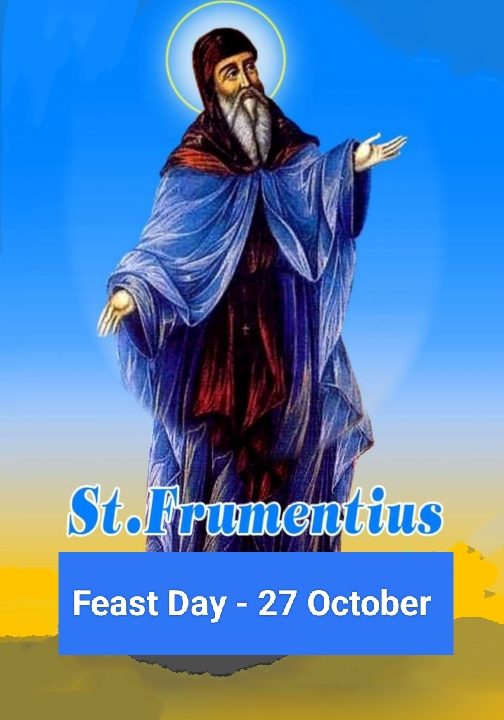
FEAST OF SAINT FRUMENTIUS
FEAST DAY – 27th OCTOBER
Called “Abuna” or “the father’ of Ethiopia, sent to that land by St. Athanasius, Frumentius was born in Tyre, Lebanon. Around the year 330, Meropius, a Christian philosopher of Tyre, undertook a voyage to the coast of Arabia. With him were two young pupils, Frumentius and Aedesius. On the voyage homeward, their vessel docked at an Ethiopian port. Falling out with some of the sailors, the natives massacred the crew and passengers, with the exception of the two lads who were studying under a tree at the time.
They were taken to the king who, impressed with their demeanor and knowledge, made Aedesius his cupbearer, and the elder, Frumentius, his secretary. On his deathbed, in gratitude for their services, this prince granted them liberty. But the queen, regent for her young son, begged them to stay and help her, which they did.

They introduced Christianity to that land. When Abreha and Asbeha inherited the Ethiopian throne from their father, Frumentius sought out St. Theodosius in Alexandria and talked to him about the conversion of the Ethiopians, entreating him to send a pastor to that country. Whereupon, St. Athanasius consecrated Frumentius bishop of Aksum, judging no one better suited for the task.
The consecration of Frumentius took place roughly around the year 350. Returning to Aksum, he gained numbers to the Faith through his preaching and miracles. The two royal brothers are said to have received baptism. But the conversion of the Aksumite kingdom was far from completed during the life of Frumentius, though the population held him in the highest esteem. He died about the year 383, and was reverently called Abuna – “Our Father” – and Aba Salama – “Father of Peace”. He is considered Patron of Ethiopia.
CONTEMPLATING THE LIFE OF SAINT FRUMENTIUS

THE APOSTLE OF ETHIOPIA
Saint Frumentius, known as the Apostle of Ethiopia and Abba Salama, meaning Father of Peace, was a fourth-century missionary who played a decisive role in bringing Christianity to the ancient Kingdom of Aksum, in present-day Ethiopia and Eritrea. His life reveals how God’s providence can transform unexpected circumstances into opportunities for evangelisation.
A JOURNEY THAT BECAME A DIVINE MISSION
Frumentius was born in Tyre, in present-day Lebanon. As a young man, he travelled with his relative Aedesius, but their ship was attacked near the Red Sea coast. They were taken to the Kingdom of Aksum, where they eventually gained the confidence of the royal household. Rather than allowing hardship to embitter him, Frumentius remained faithful to God and used his circumstances to serve others.
FAITH PLANTED THROUGH WITNESS
Frumentius and Aedesius were eventually entrusted with important responsibilities at the royal court. Frumentius encouraged Christian merchants to practise their faith and helped establish places where they could worship. Through his gentle witness, he gradually introduced the Christian faith to people who had never encountered the Gospel.
THE FIRST BISHOP OF ETHIOPIA

After the death of the king, Frumentius travelled to Alexandria and approached Saint Athanasius, the patriarch, requesting a bishop to guide the growing Christian community. Recognising Frumentius’s faith and missionary gifts, Athanasius consecrated him bishop and sent him back to Aksum. Frumentius continued his mission, helping Christianity take root in the kingdom. He is traditionally regarded as the first bishop of Ethiopia.
A LIFE DEVOTED TO THE GOSPEL
As bishop, Frumentius devoted himself to preaching Christ, nurturing Christian communities and strengthening the faith of new believers. His missionary work helped lay the foundations for Ethiopia’s enduring Christian tradition. His life reminds us that evangelisation begins not merely with words, but with prayer, integrity, service and a genuine love for others.
LESSONS FROM SAINT FRUMENTIUS

Saint Frumentius teaches us to trust God’s providence when life takes unexpected turns. He reminds us that our circumstances, however difficult, can become instruments of grace. His example encourages us to share our faith through kindness, patience and courageous witness, allowing God to work through our ordinary encounters.
PRAYERFUL REFLECTION
Saint Frumentius reminds us that God can transform adversity into mission, strangers into brothers and small beginnings into a lasting legacy of faith. Like him, we are called to carry Christ into our homes, workplaces and communities, becoming instruments of peace and hope wherever God places us.

PRAYER
Saint Frumentius you are called the Apostle of Ethiopia because, as a bishop, you were sent there to spread the Faith. The king had made you a member of his court. You realized that having such access to the king gave you a better opportunity to introduce Christianity into the country.
Pray that we remain deep rooted in our faith and with the same faithfulness and zeal spread the Word of God, thus fulfilling our mission, and performing our Christian duties, in Christ our Lord. Amen

Saint Frumentius, pray for us.
+++++++++++++++++++++++++++++++++
ALSO CELEBRATED:

Born on July 31, 1801, in Bergamo, Italy, as the eldest of seven children in a noble family. Her mother was Countess Elena Pedrocca-Grumelli and her father was Antonio Verzeri. Her brother later became the Bishop of Brescia.
She felt a strong early calling to religious life and studied with the Benedictine nuns of Santa Grata in Bergamo, taking the name Eustochio. Guided by her spiritual director, Canon Giuseppe Benaglio, she discerned a path focused on active apostolic work rather than strict cloistered life.
On February 8, 1831, she and Canon Benaglio co-founded the Daughters of the Sacred Heart of Jesus in Bergamo to educate troubled middle-class girls, orphans, and the youth.

After Benaglio’s death in 1836, she led the congregation independently, expanding its network of schools, orphanages, and care for the sick and elderly. She died on March 3, 1852, in Brescia at the age of 50 during a cholera epidemic.
She was beatified on October 27, 1946, by Pope Pius XII and canonized on June 10, 2001, by Pope John Paul II.

Educators and Teachers: She is recognized as a patron of educators, particularly those dedicated to the moral and spiritual instruction of young women and girls.
CONTEMPLATING THE LIFE OF SAINT TERESA EUSTOCHIO VERZERI

The Woman Who Found God in the Heart of Jesus
Saint Teresa Eustochio Verzeri, known in religious life as Mother Ignazia, was a woman of deep faith who discovered that her vocation extended beyond the silence of the cloister. Through prayer, education and compassionate service, she sought to reveal the love of the Sacred Heart of Jesus, especially to vulnerable young women and children. Her life teaches us that genuine contemplation must lead to generous service.
A HEART THAT LONGED FOR GOD

Teresa was born on 31 July 1801 in Bergamo, Italy, to Antonio Verzeri and Countess Elena Pedrocca Grumelli. The eldest of seven children, she learned to love God through her mother’s example and the Christian values nurtured in her family. Intelligent and thoughtful, she developed an early desire to discover God’s will for her life.
Guided by Canon Giuseppe Benaglio, she began discerning her vocation to religious life. Although she longed to dedicate herself entirely to God, discovering the precise form of her calling required patience, prayer and surrender.
THE CLOISTER WAS NOT HER FINAL DESTINATION
Teresa entered the Benedictine monastery of St Grata in Bergamo, hoping to find fulfilment in a life of contemplation. However, her discernment remained uncertain, and she eventually left the monastery to continue seeking God’s direction.
This experience taught her that a sincere desire for holiness does not guarantee an immediate understanding of one’s vocation. Rather than abandoning her search, she learned to surrender her expectations and trust God’s wisdom. The uncertainty that tested her faith also prepared her for the mission she would eventually undertake.
A JOURNEY THROUGH SPIRITUAL DARKNESS

Teresa experienced periods of profound spiritual dryness in which God seemed distant despite her sincere faith and devotion. Her prayers brought little consolation, yet she continued to trust in God’s love and providence.
Her experience echoed Christ’s cry from the Cross, “My God, my God, why have you forsaken me?” (Matthew 27:46). By uniting her suffering with Christ, Teresa learned to remain faithful even when she could not feel God’s presence.
This interior struggle deepened her understanding of human suffering and prepared her to accompany others with compassion, especially those who experienced loneliness, discouragement or spiritual uncertainty.
DISCOVERING THE HEART OF JESUS
After a prolonged period of discernment, Teresa recognised that her vocation lay in active service rather than a life confined to the cloister. With Canon Giuseppe Benaglio’s guidance, she founded the Congregation of the Daughters of the Sacred Heart of Jesus in Bergamo on 8 February 1831.
The congregation was dedicated to making Christ’s love visible through education, spiritual formation and charitable service. Teresa taught her sisters to look to the Heart of Jesus as the source and model of holiness.
Her contemplative life now found expression in classrooms, orphanages, homes for vulnerable girls and service to the sick. Prayer remained the foundation of her mission, while charity became its living expression.
EDUCATION ROOTED IN LOVE AND UNDERSTANDING

Teresa recognised the needs of poor, abandoned and vulnerable girls who required protection, education and guidance. Her congregation undertook various apostolic works, including teaching Christian doctrine, caring for orphans, conducting retreats and assisting the sick.
She believed that education should prevent harmful behaviour through timely guidance rather than rely solely on punishment after mistakes had occurred. Every young person deserved to be understood according to her individual needs, temperament and circumstances.
Teresa encouraged educators to guide children towards choosing what was good freely, through persuasion, patience and respect. She believed that correction should preserve dignity and that even a difficult child could grow through loving guidance.
Her approach reminds us that true education is an expression of preventive love, helping young people recognise their worth and develop their God-given potential.
PERSEVERING THROUGH TRIALS AND OPPOSITION
When Canon Giuseppe Benaglio died in 1836, Teresa lost an important spiritual guide and collaborator. She now had to carry greater responsibility for the congregation’s development and future.
The journey was difficult, involving obstacles from civil authorities and challenges within ecclesiastical circles. Nevertheless, Teresa continued to strengthen her congregation, form her sisters and seek the necessary approvals. The Holy See approved the institute in 1841.
Her perseverance demonstrated that fidelity to God’s call requires patience and courage, especially when circumstances become discouraging. She continued her mission through prayer, obedience and trust, even when the way forward was uncertain.
A MOTHER WHO FORMED OTHER HEARTS

Teresa understood that the congregation’s mission could endure only if her sisters deeply embraced its spirituality. Through her writings, constitutions, letters and the Book of Duties, she guided them in religious life and apostolic service.
She wanted her sisters to be contemplative without becoming indifferent, obedient without losing personal responsibility, disciplined without harshness and charitable without withdrawing from difficult situations.
The Heart of Jesus was to be their school of holiness. They were called to love people who were inconvenient or difficult, remain patient amid opposition and uphold the dignity of every person.
Teresa taught through both her words and her example that charity is not merely an emotion but a faithful commitment to doing good, even when it demands sacrifice.
A LIFE OFFERED ENTIRELY TO GOD
Teresa devoted her final years to the congregation and the mission entrusted to her. She died in Brescia on 3 March 1852, aged fifty, leaving behind a lasting legacy of prayer, education and compassionate service.
Her holiness was recognised by the Church when Pope Pius XII beatified her on 27 October 1946. Pope John Paul II canonised her on 10 June 2001.
Her life continues to inspire those who struggle to understand their vocation, experience dryness in prayer, encounter opposition or wonder whether difficult people can change. Teresa reminds us to persevere in seeking God, trust him even when he seems distant, and express our faith through loving service.
The woman who once searched for God within the walls of a monastery eventually discovered her mission among the vulnerable and forgotten. Through them, she found a practical way to make the love of Christ known to the world.
Saint Teresa Eustochio Verzeri teaches us that the deepest contemplation of the Sacred Heart of Jesus must lead us to become instruments of his love, bringing compassion, hope and dignity to everyone we encounter.

Saint Teresa Eustochio Verzeri, pray for us!