
TODAY’S GOSPEL READING – 7 JULY
July 7, 2026
Genesis 2:2-3
July 8, 2026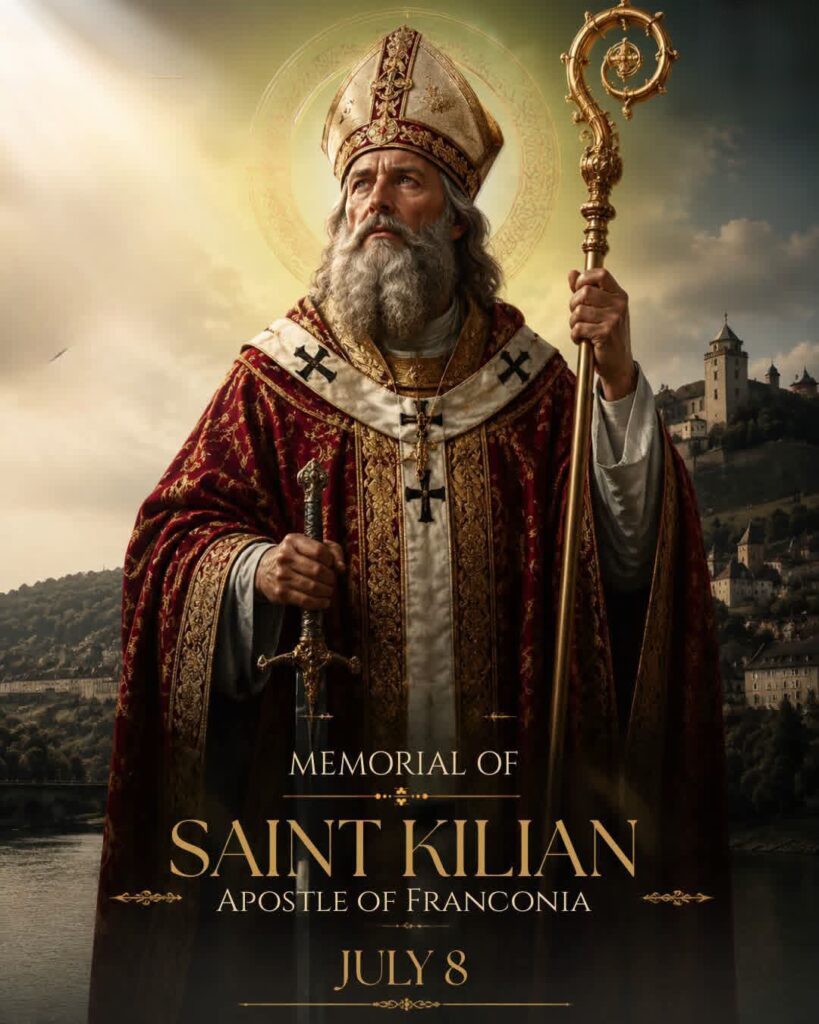
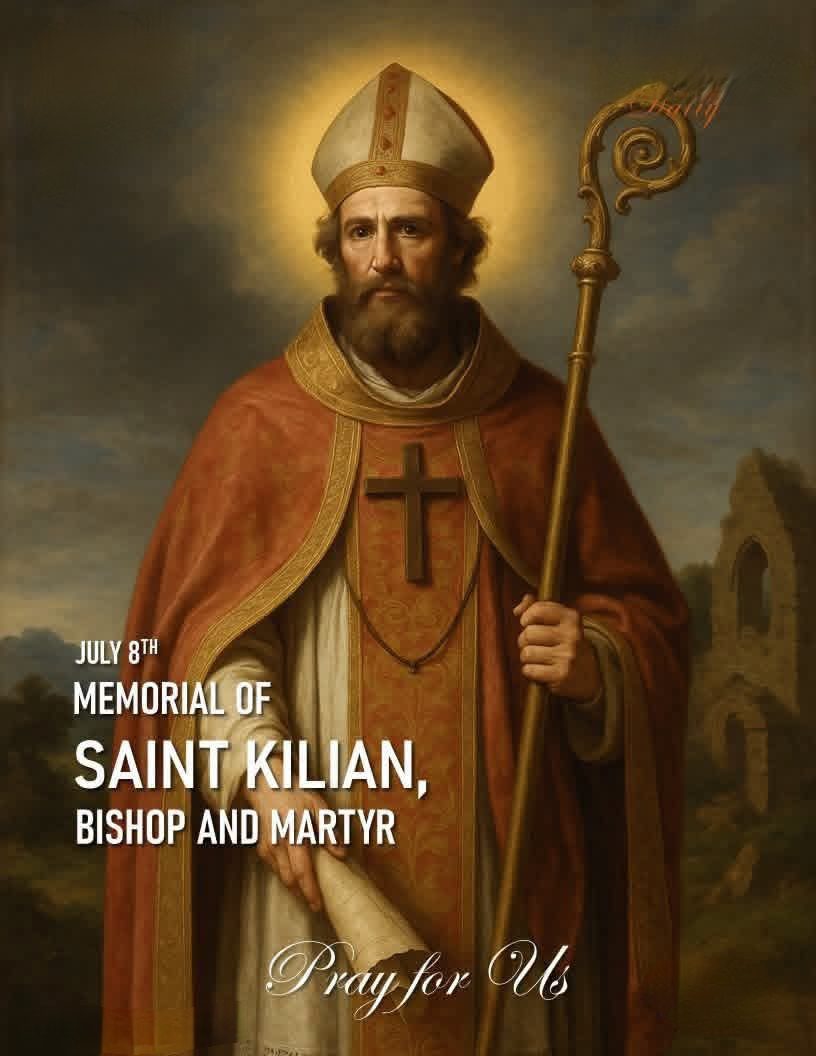
FEAST OF SAINT KILIAN, BISHOP AND MARTYR
FEAST DAY – 8th JULY
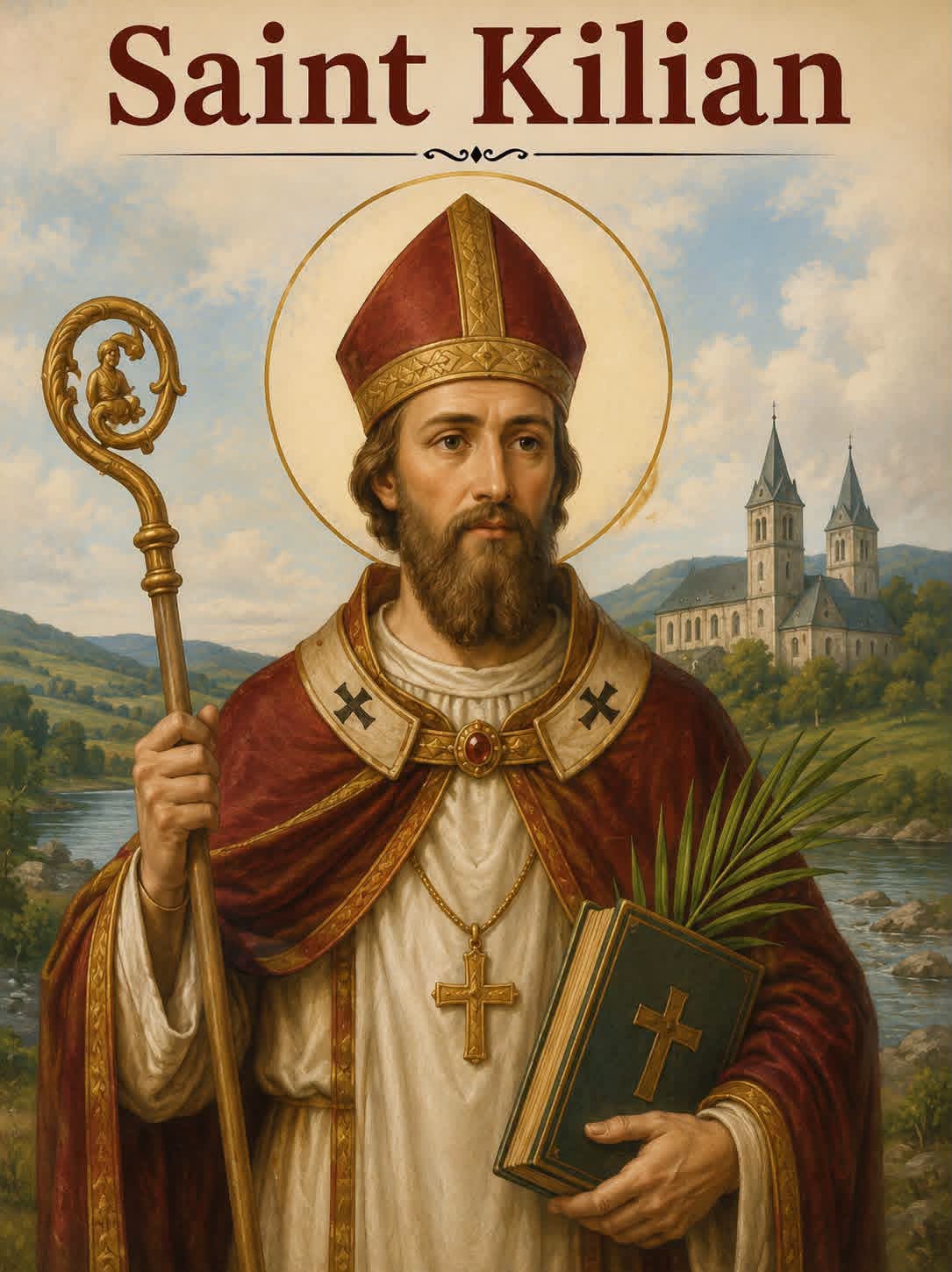
Kilian, also spelled Killian (or alternatively Irish: Cillian; Latin: Kilianus), was an Irish missionary bishop and the Apostle of Franconia (nowadays the northern part of Bavaria), where he began his labours in the latter half of the 7th century. His feast day is 8 July. The oldest texts which refer to him are an 8th-century necrology at Würzburg and the notice by Hrabanus Maurus in his martyrology.
According to Irish sources, Kilian was born to noble parents in approximately the year 640 in Cloughballybeg, near Mullagh in the south-east of what is now County Cavan in Ireland. Some records state that Kilian served as a monk in the celebrated monastery at Hy, Hy being an early name for what was later known as Iona. He began his education in Rosscarbery (the School of Ross), County Cork, and completed it in Tuosist in County Kerry.
In the summer of 686 Kilian, with eleven companions, travelled through Gaul to Rome to receive missionary faculties from the Pope, arriving in late autumn and meeting with Pope Conon. From there they traveled to the castle of Würzburg, which was inhabited by the East Frankish ruler, Herzog (Duke) Gozbert [de], who was, like his people, still pagan.
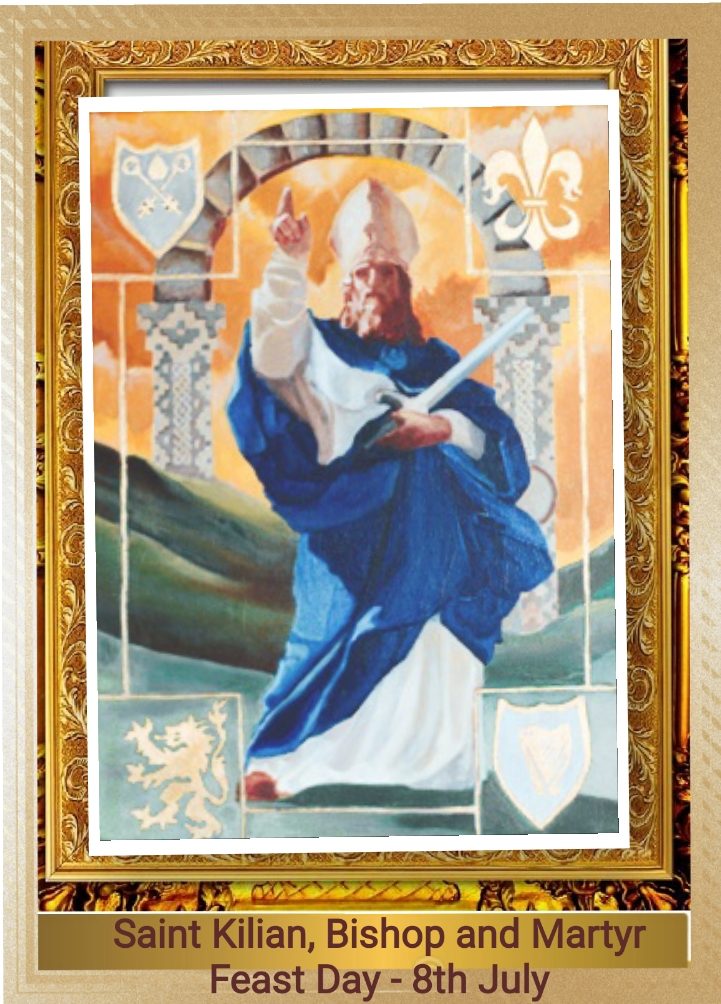
The original group separated – some departing to seek other fields of missionary work, while Kilian with two companions, the priest Colmán (also called Colonan or Kolonat) and the deacon Totnan, remained in Würzburg. Kilian made this town the base of his activity, which extended over an ever-increasing area in East Franconia and Thüringen (Thuringia). He converted Duke Gozbert with a large part of his subjects to Christianity.
Kilian told the Herzog (Duke) that he was in violation of sacred scripture by being married to his brother’s widow, Geilana. When Geilana, whom Kilian had failed to convert to Christianity, heard of Kilian’s words against her marriage, she was so angry that, in the absence of the Duke, she had her soldiers sent to the main square of Würzburg, where Kilian and his colleagues were preaching.
She plotted against the saint, and caused the murder of him, Colman and Totnan, and the burial of their corpses, sacred vessels, vestments, and holy writings at the crime scene. When the duke returned to her, Geilana denied knowing the location of the missionaries. The actual murderer went mad, confessed his crime, and died miserably. Geilana herself eventually died insane.
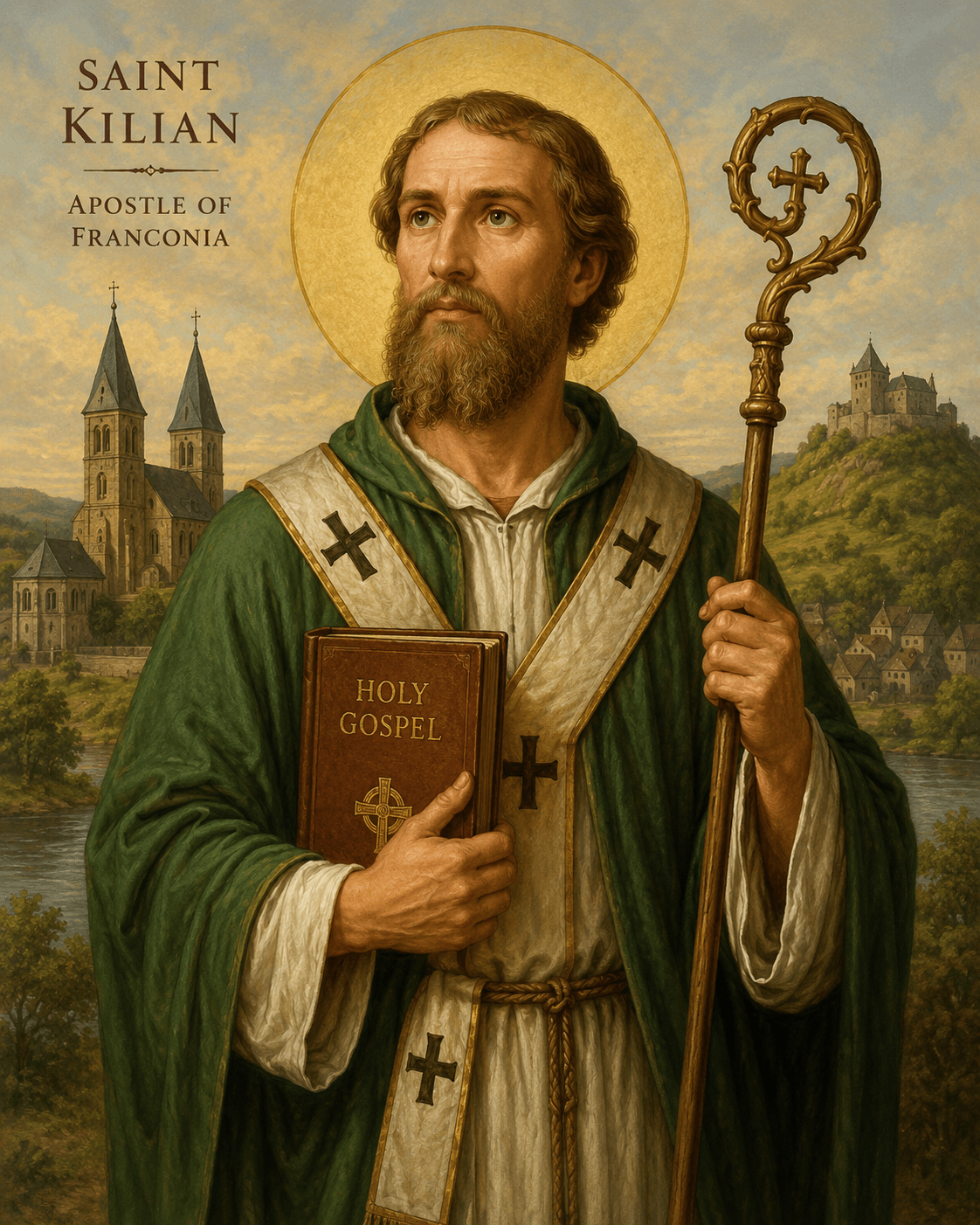
Kilian’s good work did not long survive him. When Saint Boniface arrived in Thuringia, he found evidence of his predecessor’s influence. The relics of the martyrs, after cures had brought fame to their burial place, were transferred to the Church of Our Lady in 743 by Saint Burchard, first Bishop of Würzburg.
After Burchard obtained Pope Zachary’s permission for their public veneration, they were solemnly transferred, probably on 8 July 752, to the newly finished Cathedral of the Saviour. Later they were buried in Saint Kilian’s vault in the new cathedral erected on the spot where tradition says they were martyred.
His skull is still preserved, is be-jewelled, and is processed on his feast day. Killian’s copy of the New Testament was preserved in Würzburg Cathedral until 1803, and since then has been in the university library.
On St Kilian’s Day, a glass case containing the three skulls is removed from a crypt, paraded through the streets before large crowds, and put on display in Würzburg Cathedral (dedicated to Kilian). Statues of these three saints (among others) line the famous Saints’ Bridge across the river Main. Kilian is one of the patron saints for sufferers of rheumatism.
Kilian is the patron saint of the parish of Tuosist, near Kenmare in County Kerry, where he is believed to have resided before travelling to Germany. A church and holy well are named after him and his feast day, July 8, is traditionally celebrated with a pattern when crowds visit the well for prayers, followed by evening social events.
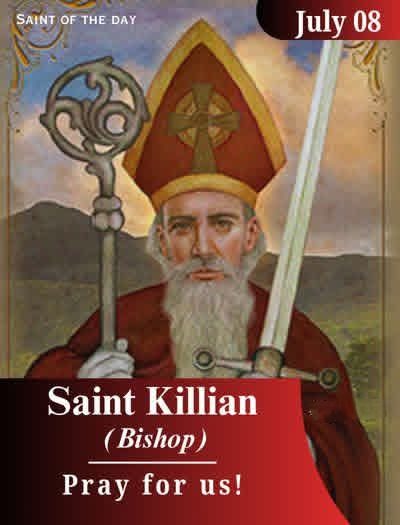
His patronage, besides rheumatism, is also against gout, whitewashers, Bavaria, Germany, archdiocese of Paderborn, Germany, diocese of Würzburg, Germany, Tuosist, County Kerry, Ireland (staging point for his mission to mainland Europe) is also the patron saint of Paderborn, Germany. He is portrayed wearing a bishop’s mitre and holding a sword, which was the instrument of his martyrdom (as in his statue at Würzburg).
CONTEMPLATING THE LIFE OF SAINT KILIAN
THE MISSIONARY MARTYR OF GERMANY
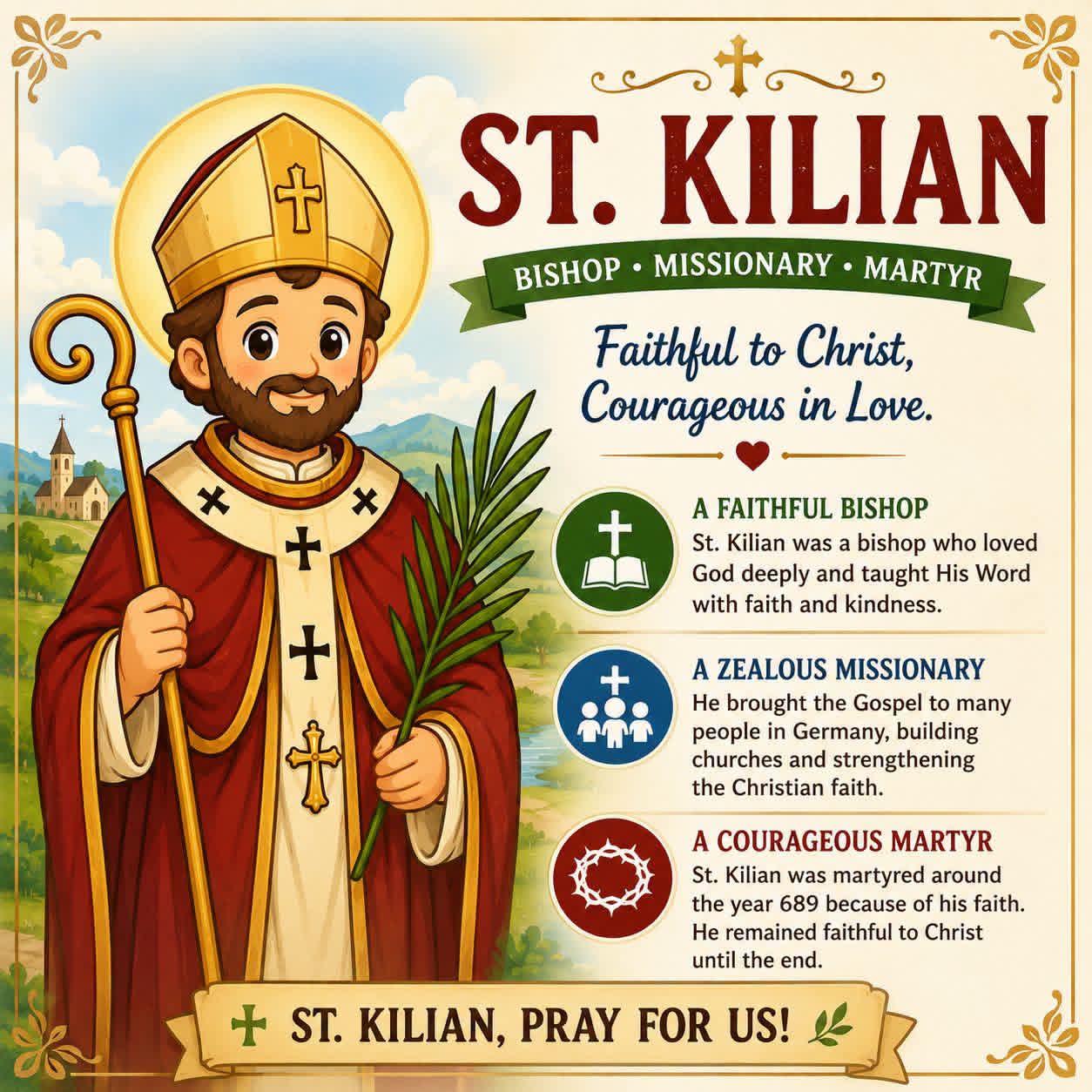
SAINT KILIAN was an Irish missionary bishop of the seventh century who courageously brought the Gospel to the people of Franconia in present-day Germany. Filled with zeal for Christ, he left the comfort of his homeland to proclaim the Good News in foreign lands. His life remains a powerful witness to missionary dedication, fearless preaching, and unwavering fidelity to the truth.
A LIFE SURRENDERED TO GOD
Born in Ireland around the year 640, Kilian received a solid Christian formation and was known for his holiness, wisdom, and love for Scripture. He embraced the missionary spirit that inspired many Irish monks and clergy to carry the Gospel beyond their own country. Trusting completely in God’s providence, he dedicated his life to evangelization.
MISSION TO GERMANY
After receiving the blessing of the Pope in Rome, Kilian journeyed with his companions, Saint Colman and Saint Totnan, to the region of Franconia. There they preached Christ with great conviction, baptized many converts, and established Christian communities. Their lives of simplicity, charity, and holiness attracted many people to the faith.
COURAGE TO PROCLAIM THE TRUTH
Kilian fearlessly called people to repentance and to live according to the teachings of Christ. He challenged Duke Gozbert to regularize an unlawful marriage that was contrary to Christian teaching. Though his message was spoken with love and concern for the salvation of souls, it provoked hostility from those who opposed the Gospel.
THE CROWN OF MARTYRDOM
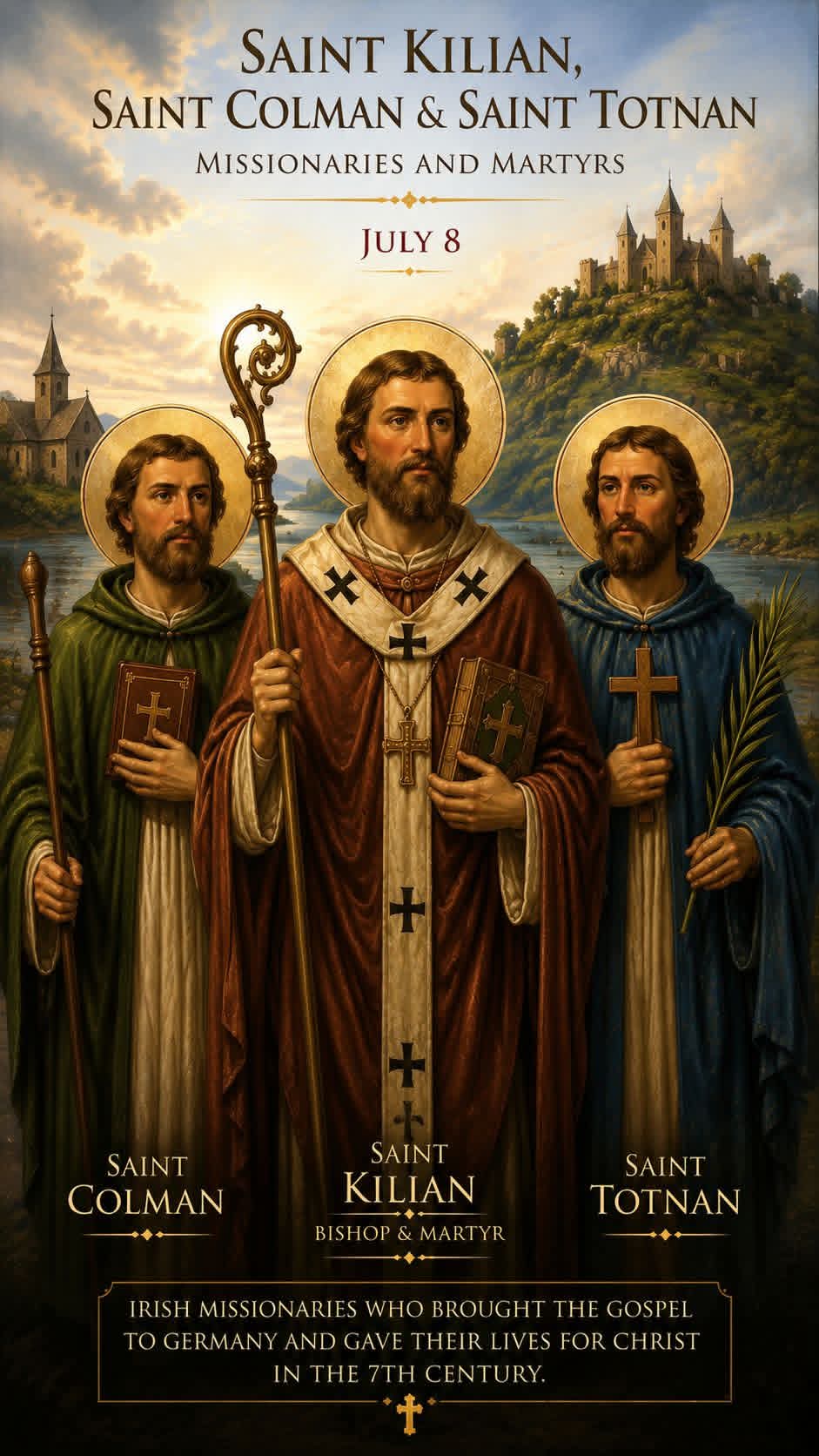
Around the year 689, while the duke was away, Kilian, Colman, and Totnan were murdered at the instigation of Geilana, the duke’s wife, who resented Kilian’s call to conversion. They willingly accepted death rather than compromise the truth of the Gospel. Their martyrdom became the seed of a flourishing Christian faith in the region.
A LASTING LEGACY
Saint Kilian is honored as the Apostle of Franconia and one of Germany’s great missionary saints. His relics are venerated in Würzburg, where he is remembered with deep devotion. His courageous witness inspired generations of missionaries to proclaim Christ with boldness, integrity, and unwavering faith.
LESSONS FROM HIS LIFE

The life of Saint Kilian teaches us that the Gospel must be proclaimed with both love and courage. He reminds us that true discipleship often demands sacrifice and that faithfulness to Christ is more valuable than earthly security. His example encourages Christians to remain steadfast in defending the truth while always seeking the salvation of others.
A SAINT FOR OUR TIMES
In an age when many hesitate to speak about faith, Saint Kilian calls believers to witness to Christ with humility, conviction, and compassion. His life inspires us to remain faithful to God’s commandments, to persevere in the face of opposition, and to trust that every sacrifice made for Christ bears lasting fruit.
PRAYER
Heavenly Father, your faithful servant Saint Kilian, notwithstanding threats to his life, undertook to accomplish the mission of evangelizing and converting pagans, even to the extent of courageously telling the Duke Gozbert that his marriage was a sin and being martyred for proclaiming the Gospel Truth.
Assist us, poor sinners, to emulate the same courage in performing our Christian duties, in Jesus’ Name. Amen
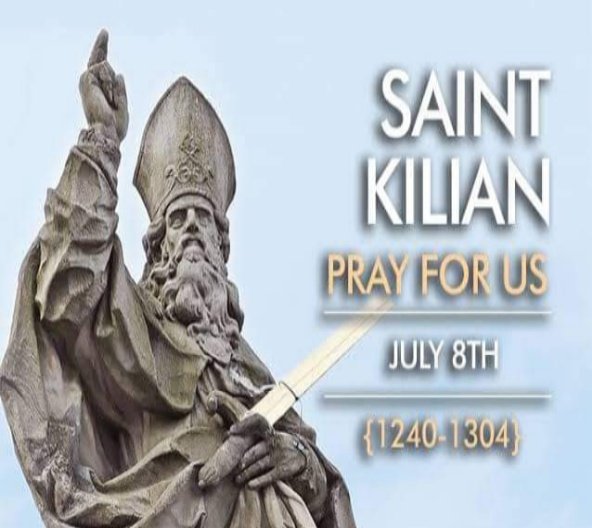
Saint Kilian, pray for us.
_________________________________________
ALSO CELEBRATED ON 8th JULY:
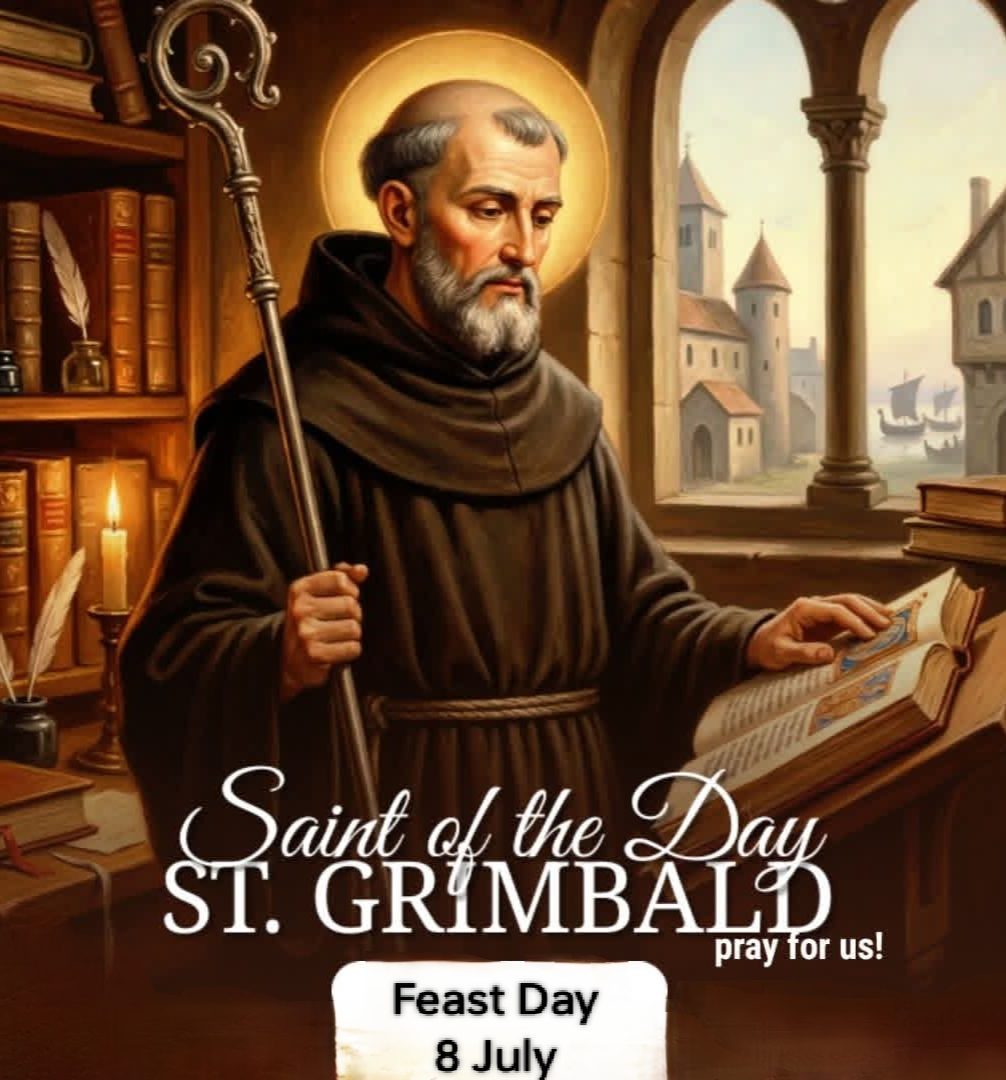
SAINT GRIMBALD OF WINCHESTER ABBOT
Grimbald became a monk about 840, was ordained priest in 870, and was abbot of Saint-Bertin. He entertained King Alfred on his way to Rome in 885. As a well-known scholar, he went to Rheims in 886.
Upon the advice of Archbishop Eldred of Canterbury and through Fulk of Rheims, Alfred invited Grimbald to England in 887. Grimbald accepted the offer. He lived in Winchester in a small “monastery” and served as a court-scholar, assisting Alfred with his translations of Latin works into Old English, including Saint Gregory’s Pastoral Care (Liber regulae pastoralis). Eventually, Grimbald was appointed the first professor of divinity at Oxford (some say that he actually founded the university).
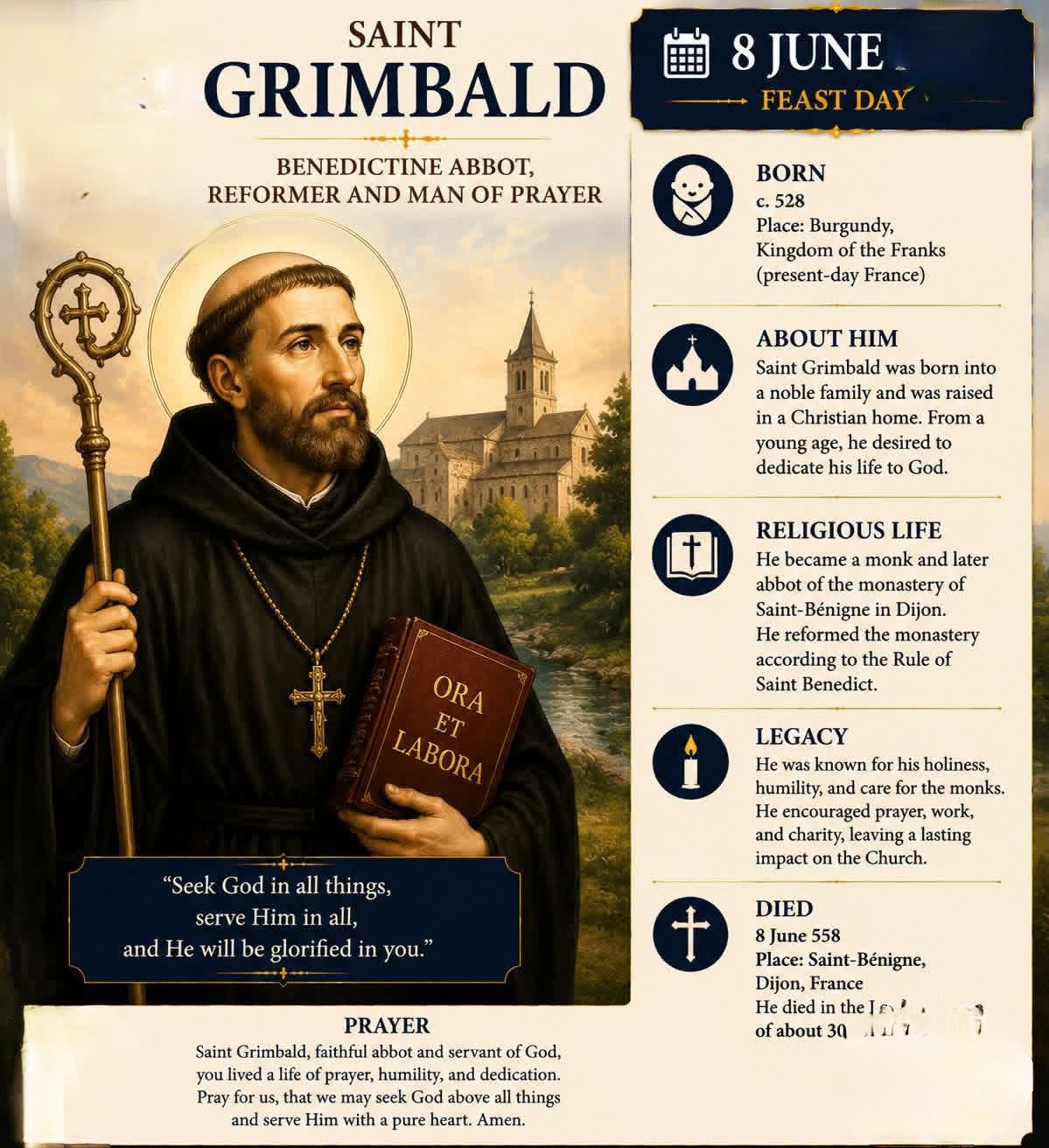
Upon the death of Eldred in 889, Alfred tried to persuade Grimbald to become archbishop of Canterbury, but he refused and became instead dean of the secular canons of New Minster at Winchester, the town-church where prominent citizens had burial rights. Alfred’s son, King Edward, reburied his father and mother (Queen Alswithe) in this new church, which probably absorbed the small community that Grimbald had previously governed. (Later, King Henry I removed New Minster to Hyde, now called Saint Grimbald’s monastery.)

Grimbald restored learning in England. He may have brought to England the 9th-century manuscript of Prudentius, now at Corpus Christi College in Cambridge, as well as the famous Utrecht Psalter.
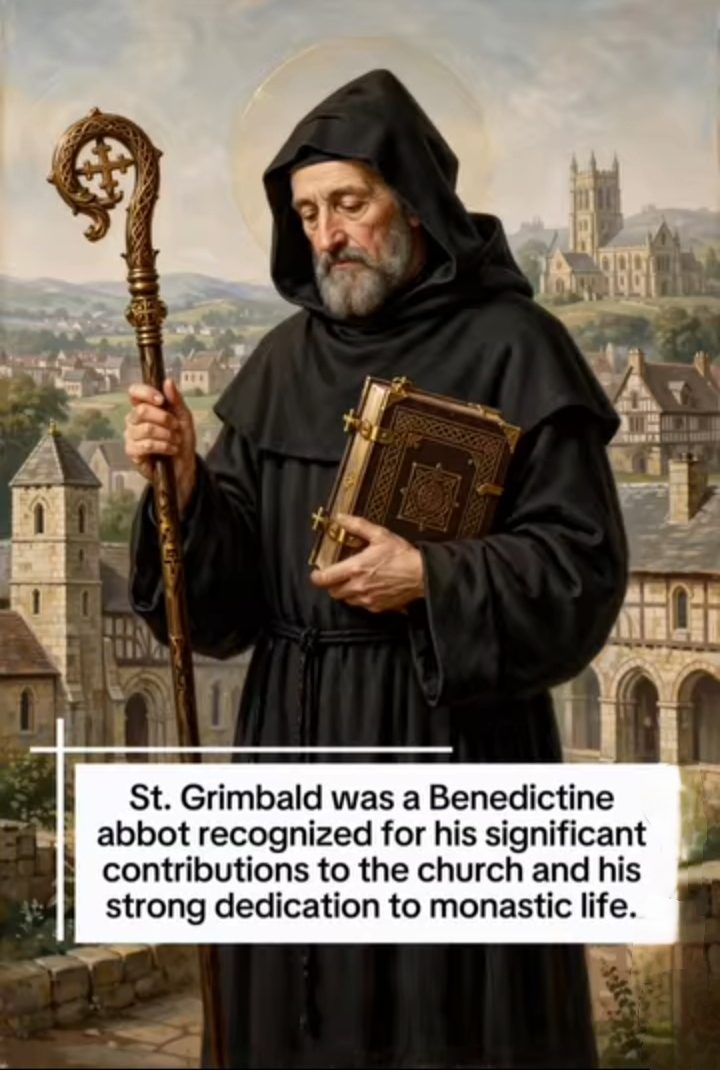
During his last illness, the extremely feeble Saint Grimbald rose out of bed and prostrated himself on the ground to receive the holy viaticum. Thereafter, he asked to be left alone with God for three days. On the fourth day the community was called into his chamber, and amidst their prayers the saint calmly breathed forth his happy soul.
St. Grimbald of Winchester, pray for us!