
SPIRITUAL INSIGHTS INTO THE LIFE OF SAINTS CRISPIN AND CRISPINIAN, MARTYRS
October 25, 2026
Isaiah 41:10
October 26, 2026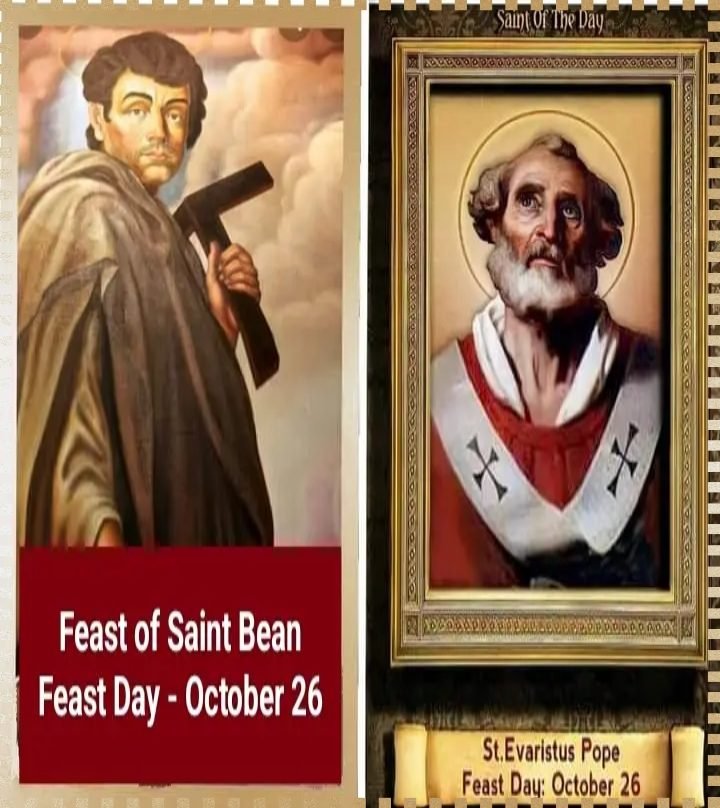
FEAST OF SAINT BEAN AND POPE ST EVARISTUS
FEAST DAY – 26th OCTOBER

On December 16, there is named in the Roman Martyrology and in certain Irish calendars a Saint Bean in Ireland, who had been confused with the St. Bean whose feast is still observed in the Scottish diocese of Aberdeen, but on October 26, as founder of the bishopric of Mortlach in Banff which was the forerunner of that of Aberdeen.
Nothing else is known about him. The fourteenth century chronicler Fordun, states that he was made bishop by Pope Benedict VIII, at the request of Malcolm Canmore, who is said to have founded an episcopal monastery at Mortlach. If true, this would be between 1012 and 1024; but the See of Mortlach is generally said to date from 1063.
St. Bean’s dwelling place is supposed to have been at Balvanie, near Mortlach (Bal-beni-mor, “the dwelling of Bean the Great”). His feast day is October 26th.

Holy Saint Bean, Pray to God for us!
++++++++++++++++++++++++++++++++++

SAINT EVARISTUS, POPE AND MARTYR 26th OCTOBER
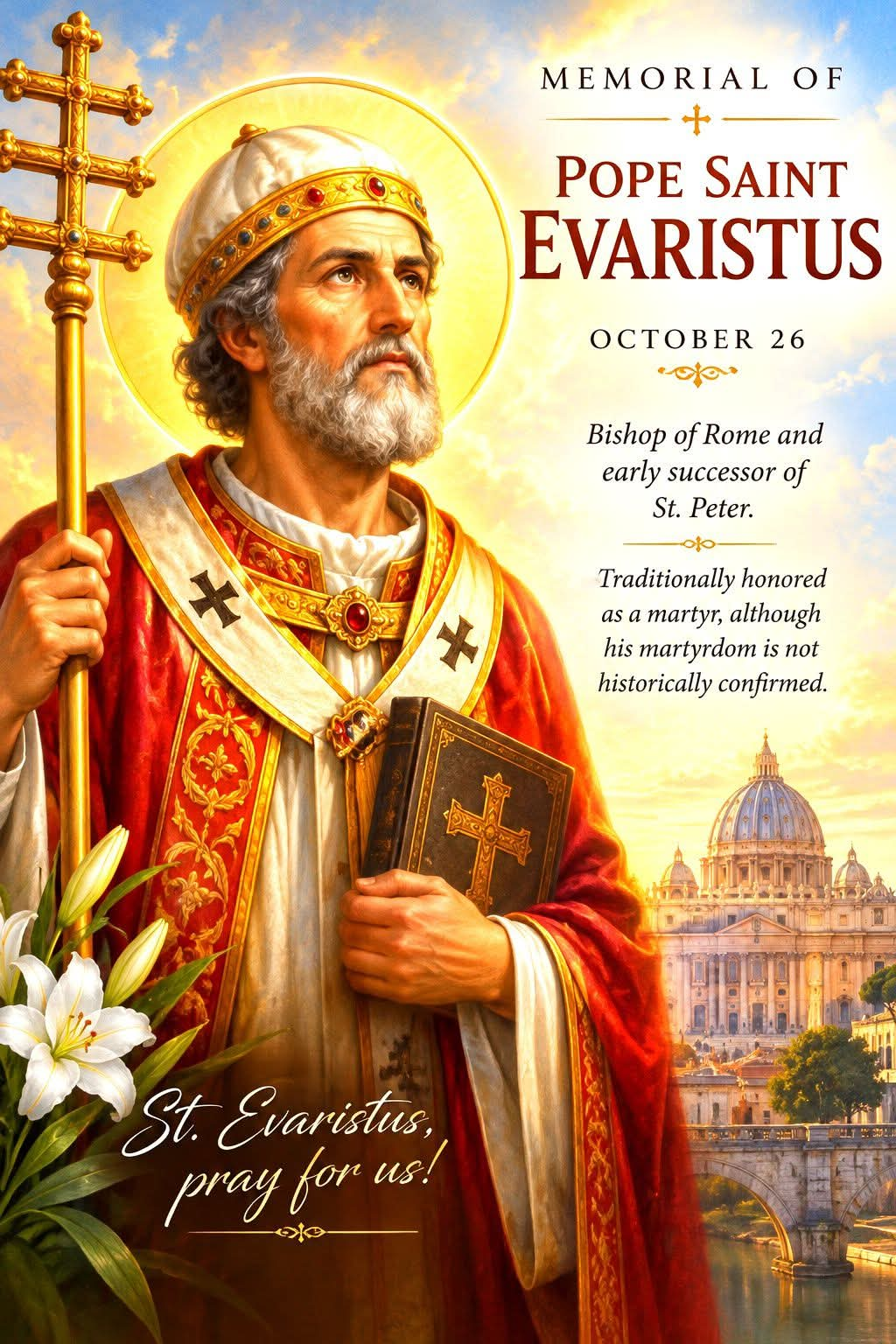
Today, October 26, we celebrate the feast day of Pope Saint Evaristus (died 107), fourth successor of Saint Peter. While little is known about this fifth pope, we do know that Saint Evaristus governed the Church for nine years, during which time he laid the groundwork for future Church policy. Saint Evaristus was profoundly committed to the expansion of vocations in the Church.
The institution of cardinal priests is ascribed to him, as he is the pope who first divided Rome into several titles or parishes, assigning a priest to each. He also appointed seven deacons to attend the bishop and conferred holy orders three times in the month of December which was quite unusual, given that these ceremonies were generally reserved for seasons of fasting and prayer.
Saint Evaristus lived in the second century. He was originally from a Jewish family in Bethlehem. He is often depicted in art accompanied by a crib, reflecting his close ties to Christ, due to the place of his birth. Saint Evaristus’ parents immigrated to Greece while he was very young, and the future pope was brought up in the Jewish faith. Pious, knowledgeable, and virtuous, Evaristus received the best education of the time.
As he grew, he was more and more drawn to Christianity, and eventually he became a priest, traveling to Rome, and engaging in ministry there despite the growing threat and persecution of Christians. He was much admired for his devotion to the Lord, service to others, and commitment to the teachings of Christ.

So loved was he that when Pope Anancletus (who had elevated him to bishop) was martyred, Saint Evaristus was selected to replace him. For his part, Evaristus proclaimed his belief that he was unworthy to take the throne of Peter, but the Lord saw to his ascension.
Pope Saint Evaristus led the Church for approximately eight years, during which time he organized the Roman See, instructed and encouraged the clergy, and prepared the faithful for the persecution that was imminent. He wrote several letters, each reinforcing the teachings of the Church.
In his first epistle, addressed to the bishops of Africa, Evaristus decreed that seven deacons were to monitor a bishop’s preaching, to ensure that he did not lapse from the true teachings. Evaristus did not wish to see undue accusations aimed at his bishops, yet reserved solely to the See of Rome the power to terminate any bishop as a result of this indiscretion. His second epistle drew a comparison between the lasting bond of husband and wife and that of a bishop and his diocese.
During Pope Saint Evaristus’ leadership, the clergy were strengthened and the Catholic believers grew at an astounding rate—chiefly due to his love and zeal for the truth of Christ. However, at that time of Church formation, Evaristus was eventually arrested during the reign of Emperor Domitian, and sentenced to death for being a Christian.

As he was taken to prison, his jailers were amazed to see the joy on his face, as he thought himself privileged to have been found worthy to suffer and die for Jesus. He was martyred by decapitation, and his remains were buried in the Vatican near the tomb of Saint Peter.
While little is known about the life of the fifth pope, we can feel certain of his commitment to, and love of, the Lord. Pope Saint Evaristus inherited a difficult task—to assume the leadership of a Church beset by persecution and suffering.
Rather than turning outward, this great leader looked within the Church, strengthening the roles of bishops and clergy, preparing the faithful to survive and thrive during their suffering, as Jesus did. His simple faith, love, and courage helped prepare the Church to weather the immense persecution.

St. Evaristus is traditionally considered a martyr, but there is no documentation of the event. He is buried in the Vatican, near Saint Peter. Saint Evaristus succeeded Saint Anacletus as pope. The text of the Liber Pontificalis, says of him:
“Evaristus, born in Greece of a Jewish father named Juda, originally from the city of Bethlehem, reigned for thirteen years, six months and two days, under the reigns of Domitian, Nerva and Trajan, from the Consulate of Valens and Veter (96) until that of Gallus and Bradua (108). This pontiff divided among the priests the titles of the city of Rome.
By a constitution he established seven deacons who were to assist the bishop and serve as authentic witnesses for him. During the three ordinations which he conducted in the month of December, he promoted six priests, two deacons and five bishops, destined for various churches. Evaristus received the crown of martyrdom. He was buried near the body of Blessed Peter in the Vatican, on the sixth day of the Calends of November (October 25, 108). The episcopal throne remained vacant for nineteen days.”
Pope Saint Evaristus is assumed to have given his life by martyrdom at the same time as St. Ignatius of Antioch. He is often represented with a sword because he was decapitated, or with a crib, because it is believed that he was born in Bethlehem, from which his father emigrated. His feast day is 26 October .
CONTEMPLATING THE LIFE OF SAINT EVARISTUS, POPE – THE SHEPHERD WHO GUARDED THE FLAME OF FAITH
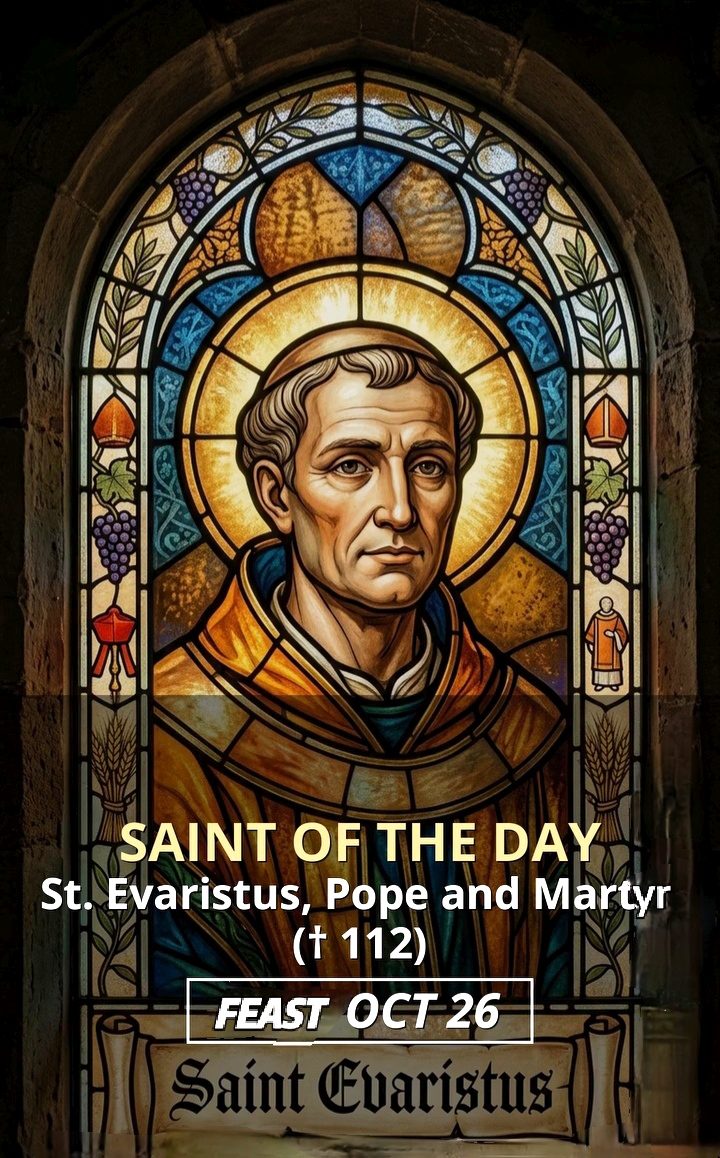
THE EARLY CHURCH AND ITS MISSION
Saint Evaristus lived when Christianity was still young and spreading throughout the Roman Empire. Although little is known about his personal life, he is remembered as an early successor of Saint Peter and a shepherd entrusted with guiding the Christian community in Rome around the beginning of the second century.
A CHURCH BORN IN THE SHADOWS
Rome was a powerful empire filled with magnificent temples and devoted to its traditional gods. Yet, within this vast civilisation, small Christian communities gathered in homes to pray, celebrate the Eucharist, share the teachings of Jesus and care for one another.
Little is known with certainty about Evaristus’s childhood or conversion. Later traditions suggest that he had Greek and Jewish roots, although these details cannot be independently verified. His place among the early successors of the apostles remains an important part of Church tradition.
THE WEIGHT OF AN APOSTOLIC INHERITANCE
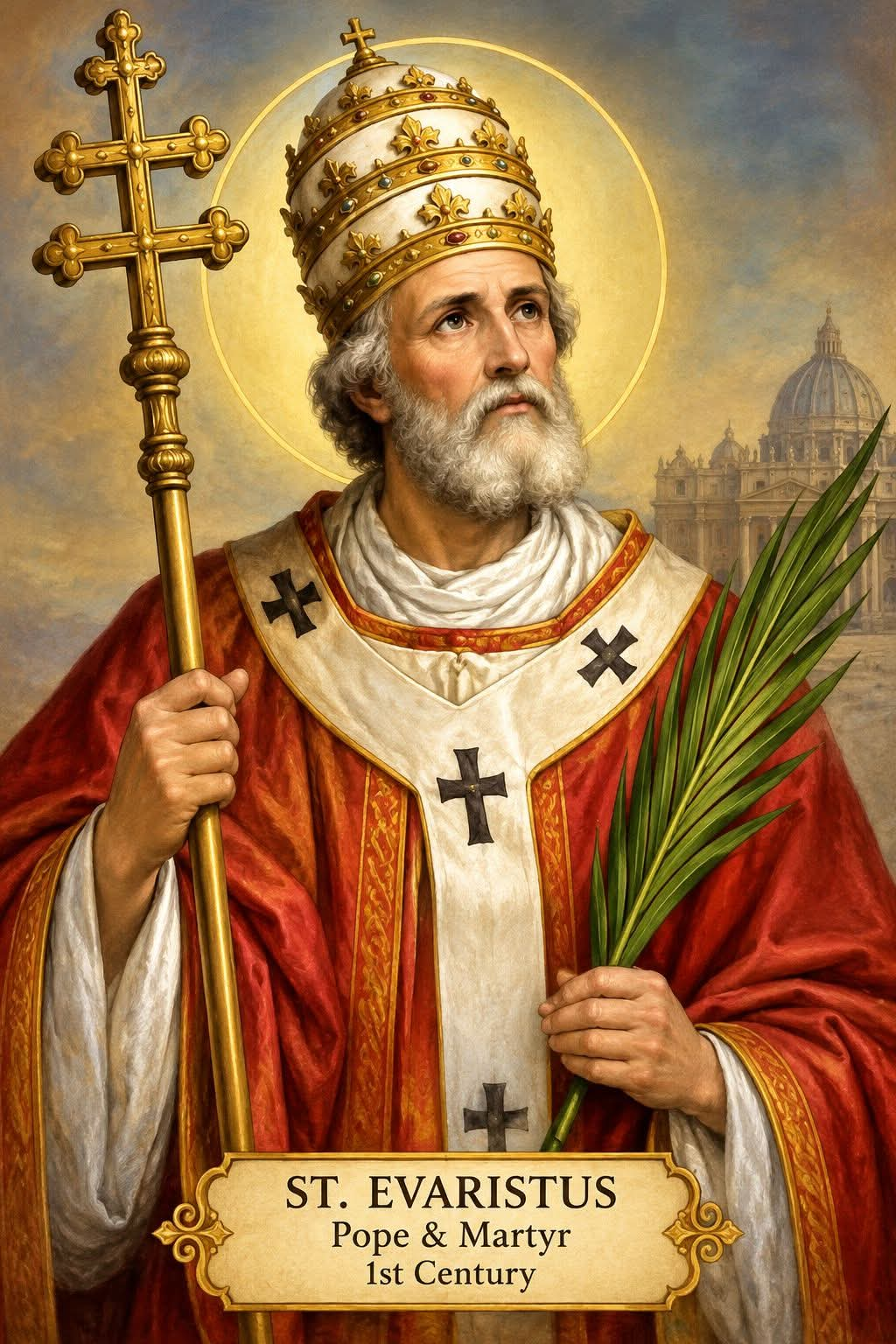
As Bishop of Rome, Evaristus carried forward the spiritual inheritance of Saints Peter and Paul and the early Christian leaders who had preserved the faith before him. His responsibility was to safeguard the teachings of Christ, strengthen the community, encourage charity and maintain unity among believers.
He received this responsibility not as a personal possession, but as a sacred trust. His example reminds us that authentic leadership in the Church is rooted in humble service and fidelity to the Gospel.
A SHEPHERD AMONG ORDINARY BELIEVERS
The early Christians of Rome came from different backgrounds and faced many difficulties. They needed spiritual guidance, encouragement and the assurance that they belonged to a community united by the love of Christ.
As Bishop of Rome, Evaristus belonged to the line of shepherds who nurtured this growing community. Although specific details of his ministry have not survived, his pastoral responsibilities would have included preserving apostolic teaching, guiding worship, encouraging generosity and strengthening Christian unity.
His place in Church history reminds us that faithful shepherds serve quietly, helping others remain steadfast in their faith.
GUARDING THE FLAME OF FAITH
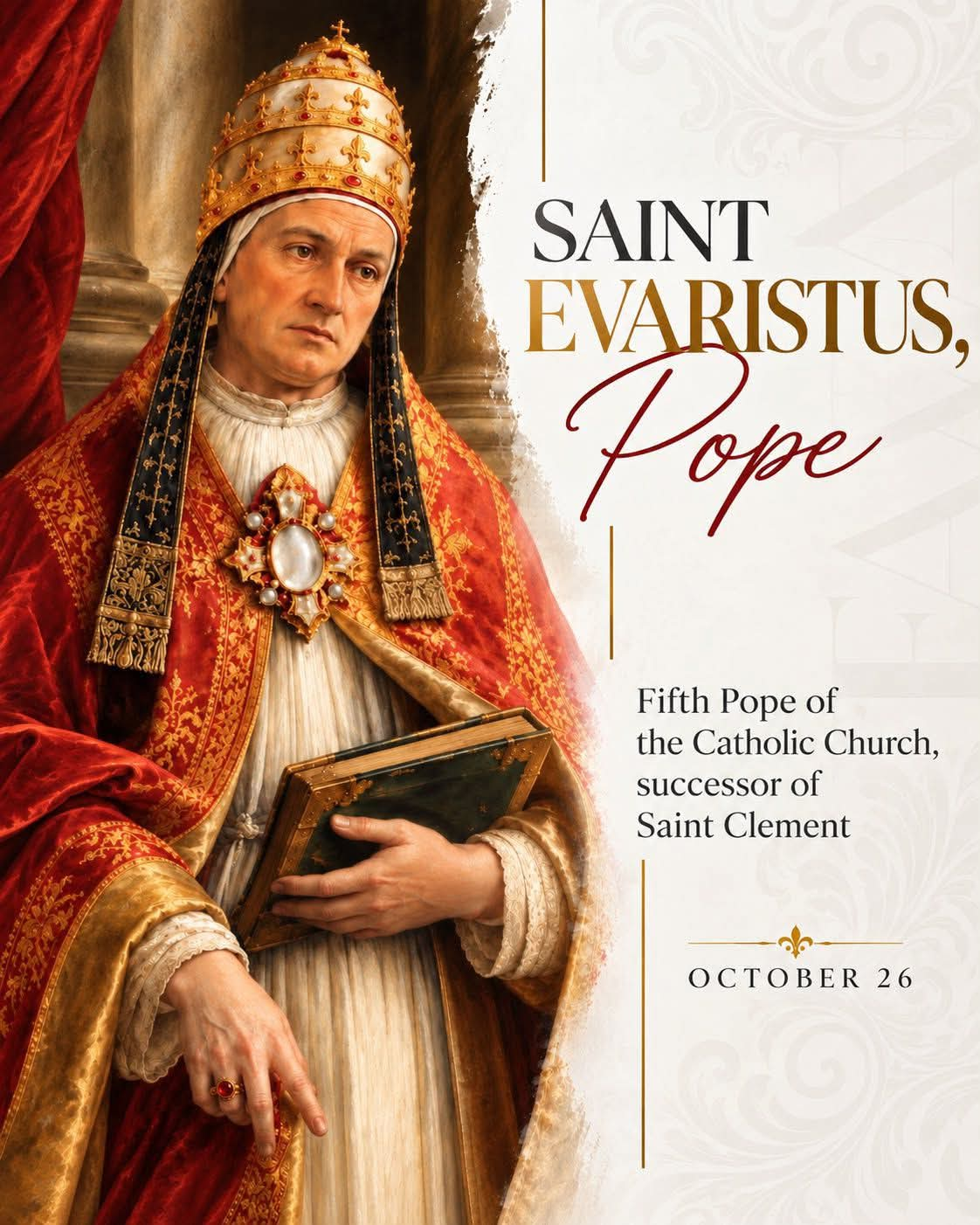
The faith of the early Church was like a small flame shining in an uncertain world. Each generation received this precious gift and became responsible for passing it on to the next.
Evaristus was one link in this unbroken chain of faith. His mission was to preserve the Gospel entrusted to him and ensure that the Christian community continued to live according to Christ’s teachings.
Although history has preserved few details of his life, his place among the early bishops reminds us that the Church has grown through generations of faithful servants. Their dedication, often unnoticed by the world, helped keep the light of Christ burning.
THE UNCERTAIN END OF AN EARLY SHEPHERD
Saint Evaristus is traditionally associated with a pontificate around AD 99 to 107 or 108, although the exact dates remain uncertain. Later traditions honour him as a martyr, but reliable early evidence does not establish the circumstances of his death.
What endures is his place in the Church’s memory. He served a small Christian community without knowing how widely the Gospel would eventually spread. He could not have foreseen the magnificent churches, great councils and countless believers who would follow in later centuries.
He was called to serve faithfully in his own generation, and that was enough.
THE FLAME WE MUST CARRY TODAY
Although Christians today live in circumstances very different from those of the early Church, our responsibility remains unchanged. We must live our faith, deepen it through prayer, celebrate it in the Eucharist and pass it on through our words and actions.
Parents transmit faith through their example, priests through pastoral care, teachers and catechists through instruction, and every Christian through love, forgiveness and service.
Saint Evaristus invites us to reflect on what we have received from those who came before us and how faithfully we are sharing that inheritance with future generations.
We may never know how far the light of our faith will travel, but we are called to protect it, nourish it and pass it on with love.
The greatness of a shepherd is measured not merely by what history remembers, but by the faithfulness with which he serves the people entrusted to his care.
PRAYER
O Eternal Shepherd, who appointed blessed Evaristus shepherd of the whole Church, let the prayers of this martyr and supreme pontiff move you to look with favor upon your flock and to keep it under your continual protection.
Through our Lord Jesus Christ, Thy Son, Who lives and reigns with Thee in the unity of the Holy Spirit, God, forever and ever. Amen.

Pope Saint Evaristus, Pray for us!