
SPIRITUAL INSIGHTS INTO THE LIFE OF SAINT PASCHAL BAYLON
May 17, 2026
1 Peter 3: 15
May 18, 2026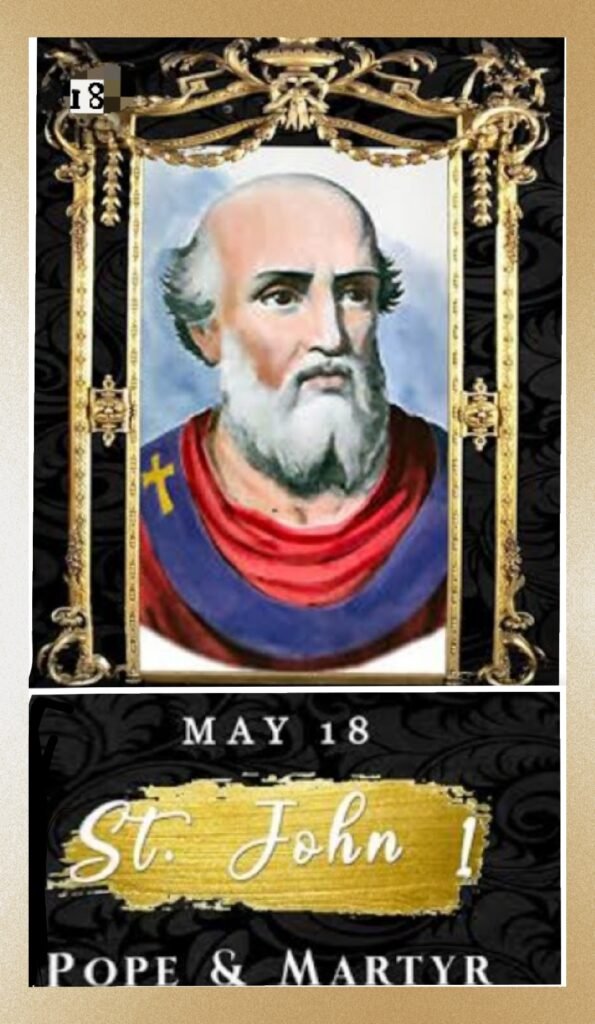

FEAST OF SAINT POPE JOHN I, MARTYR
FEAST DAY – 18th MAY
Pope John I (died 18 May 526) was the bishop of Rome from 13 August 523 to his death. He was a native of Siena in Italy. He was sent on a diplomatic mission to Constantinople by the Ostrogoth King Theoderic to negotiate better treatment for Arians. Although John was relatively successful, upon his return to Ravenna, Theoderic had him imprisoned for allegedly conspiring with Constantinople. The frail pope died of neglect and ill-treatment.
While a deacon in Rome, John is known to have been a partisan of the Antipope Laurentius, for in a libellus written to Pope Symmachus in 506, John confessed his error in opposing him, condemned Peter of Altinum and Laurentius, and begged pardon of Symmachus. He would then be the “Deacon John” who signed the acta (ecclesiastic publication) of the Roman synod of 499 and 502.
The fact the Roman church only had seven deacons at the time makes identifying him with this person very likely. He may also be the “Deacon John” to whom Boethius, the 6th-Century philosopher, dedicated three of his five religious tractates, or treatises, written between 512 and 520.
John was very frail when he was elected to the papacy. Despite his protests, Pope John was sent by Theodoric the Great, the Arian king of the Ostrogoths in Italy, to Constantinople to secure the moderation of a decree, issued in 523, of Justin I, emperor of the Eastern Roman Empire, against the Arians. the king threatened that if John failed in his mission, there would be reprisals against non-Arian Christians in the West.
John proceeded to Constantinople with a considerable entourage: including his fellow bishops Ecclesius of Ravenna, Eusebius of Fanum Fortunae, and Sabinus of Campania. His secular companions were the senators Flavius Theodorus, Inportunus, and the Patrician Agapitus. Emperor Justin is recorded as receiving John honorably. He promised almost everything the embassy asked of him.
With the exception that those converting from Arianism to Catholicism would not be allowed to retain their place in the Catholic hierarchy as deacons, priests, or bishops. Although John was successful in his mission, when he returned to Ravenna, Theoderic’s capital in Italy, Theoderic had John arrested on the suspicion of having conspired with Emperor Justin.
John had been elected Pope while he was still an archdeacon upon the death of Pope Hormisdas in 523. At that time, Theodoric the Goth subscribed to the Arian brand of Christianity, but had tolerated and even favored his Catholic subjects during the early part of his reign.
However, about the time of St. John’s accession to the Papacy, Theodoric’s policy underwent a drastic change as a result of two events: the treasonable (in the sovereign’s view) correspondence between ranking members of the Roman Senate and Constantinople and the severe edict against heretics enacted by the emperor Justin I, who was the first Catholic on the Byzantine throne in fifty years.
Spurred on by the appeals of Eastern Arians, Theodoric threatened to wage war against Justin but ultimately decided to negotiate with him through a delegation of five Bishops and four senators. At its head he named Pope John – much against the latter’s wishes. Little is known for certain about the nature of the message which the Pope bore and the manner in which he carried out his mission.
What is known is that he succeeded in persuading the Emperor to mitigate his treatment of the Arians and thus avoid reprisals against the Catholics in Italy. The Pope’s visit also brought about the reconciliation of the Western and Eastern Churches which had been plagued by a schism since 482 when Zeno’s Henoticon had been published.
However, Theodoric had been becoming more suspicious with each passing day. While waiting for the delegation to return, he ordered the execution of the philosopher Boethius and his father-in-law Symmachus on a charge of treason; and as he got word of the friendly relations between the Pope and the emperor, he concluded that they were plotting against him.
John was imprisoned at Ravenna, where he died of neglect and ill treatment. His body was transported to Rome and buried in the Basilica of St. Peter. The Liber Pontificalis credits John with making repairs to the cemetery of the martyrs Nereus and Achilleus on the Via Ardeatina, that of Felix and Adauctus, and the cemetery of Priscilla.
Pope John I is depicted in art as looking through the bars of a prison or imprisoned with a deacon and a subdeacon. He is credited with ending the Acacian Schism (484–519), thus reuniting the Eastern and Western churches by restoring peace between the papacy and the Byzantine emperor Justin I. He is venerated at Ravenna and in Tuscany. His feast day is 18 May, the anniversary of the day of his death.
CONTEMPLATING THE LIFE OF SAINT POPE JOHN I

HISTORICAL IDENTITY AND BACKGROUND
Saint Pope John I served as Pope from 523 to 526 AD during a troubled period after the fall of the Western Roman Empire. He is remembered as a pope, diplomat, confessor of the faith, and martyr.
Born in Tuscany, Italy, he became known for his courageous diplomatic mission to Constantinople and for suffering imprisonment under the Ostrogothic king Theodoric the Great.
His life unfolded during a time of political instability, theological conflict, and strained relations between the Church and imperial powers.
ST. JOHN I: THE POPE CAUGHT BETWEEN THRONES
The old Roman world was fading, and Europe was entering a new and uncertain age. Kingdoms rose from the ruins of the Roman Empire, while the Church stood amid growing divisions and struggles for power.
Into this fragile world came Pope John I. He inherited not peace, but tension.
A POPE IN A DANGEROUS TIME
John became pope in 523 AD as an elderly man during a period when politics and theology were deeply connected.
Italy was ruled by Theodoric the Great, a powerful ruler who followed Arian Christianity, while Rome remained firmly Catholic. This theological difference created deep tension beneath outward political stability.
THE INVISIBLE DIVIDE
The Catholic Church taught that Christ is fully divine and equal with the Father, while Arianism denied this fullness of divinity.
Though peace existed outwardly for a time, fear and suspicion gradually grew within Theodoric’s rule.
THE EMPEROR IN THE EAST
In Constantinople, Emperor Justin I strongly defended orthodox Christianity and began restricting Arian influence.
Theodoric feared an alliance between the Eastern Empire and Rome against him. Because of this, he ordered Pope John to travel to Constantinople on a diplomatic mission.
THE IMPOSSIBLE ASSIGNMENT
John’s mission was extremely difficult. He had to represent a ruler whose theology he did not share while also preserving peace and protecting the Church.
He carried the burden of diplomacy during a time filled with political fear and religious division.

THE JOURNEY TO CONSTANTINOPLE
When Pope John arrived in Constantinople, he was welcomed with great honor. Crowds gathered, ceremonies were held, and the pope from Rome received deep respect from the people.
For many Christians, his presence symbolized unity with the apostolic Church.
THE SUCCESS THAT BECAME FAILURE
John worked for peace and moderation, but Theodoric became increasingly suspicious after hearing of the pope’s warm reception in Constantinople.
Fear and distrust slowly consumed the king’s mind.
THE RETURN TO ITALY
When John returned to Italy, he was no longer treated as a diplomat but as a threat.
Theodoric ordered the arrest of the pope. Tragically, the Vicar of Rome was imprisoned not by pagans or foreign enemies, but by a ruler who claimed belief in Christ.
THE PRISON IN RAVENNA
John was imprisoned in Ravenna under harsh conditions. The elderly pope endured suffering, humiliation, isolation, and deprivation.
There was no public execution, only the slow suffering of neglect and mistreatment.
THE MARTYRDOM OF ENDURANCE
Saint John I died in prison in 526 AD. The Church honored him as a martyr because he suffered faithfully for truth and conscience.
His martyrdom became a witness of endurance, integrity, and fidelity amid political manipulation and injustice.
THE IRONY OF HISTORY
Soon after John’s death, Theodoric himself died. The powerful king passed away under the shadow of fear and suspicion, while the memory of the imprisoned pope endured through history.
The Church remembered not political power, but faithful witness.
SPIRITUAL THEMES IN HIS LIFE

FIDELITY AMID POLITICAL PRESSURE
John refused to become merely a political instrument and remained faithful to his mission.
SUFFERING FOR CONSCIENCE
He endured imprisonment rather than compromise truth and integrity.
THE FRAGILITY OF POWER
His life revealed how fear can corrupt earthly rulers and lead to injustice.
WITNESS THROUGH ENDURANCE
John showed that martyrdom is not always sudden violence but can also be faithful perseverance through prolonged suffering.
HISTORICAL IMPORTANCE
The life of Saint John I reveals the struggles of early medieval Christianity, the tensions between Church and state, and the difficulties of Christian political history.
His story reminds us that even after pagan persecutions ended, the Church continued to suffer through political suspicion, doctrinal conflict, and struggles for power.
A BRIEF NARRATIVE REFLECTION
Saint John I walked between divided worlds marked by political fear, theological conflict, and fragile alliances.
A mission of diplomacy became a journey of suffering. A once-tolerant king became consumed by suspicion, and the pope became a prisoner.
Yet history remembered not the ruler’s fear, but the pope’s fidelity. In the end, conscience endured longer than power.
COLLECT PRAYER
O God, who reward faithful souls and who have consecrated this day by the martyrdom of Pope Saint John the First, graciously hear the prayers of your people and grant that we, who venerate his merits, may imitate his constancy in the faith.
Through our Lord Jesus Christ, your Son, who lives and reigns with you in the unity of the Holy Spirit, God, for ever and ever. Amen
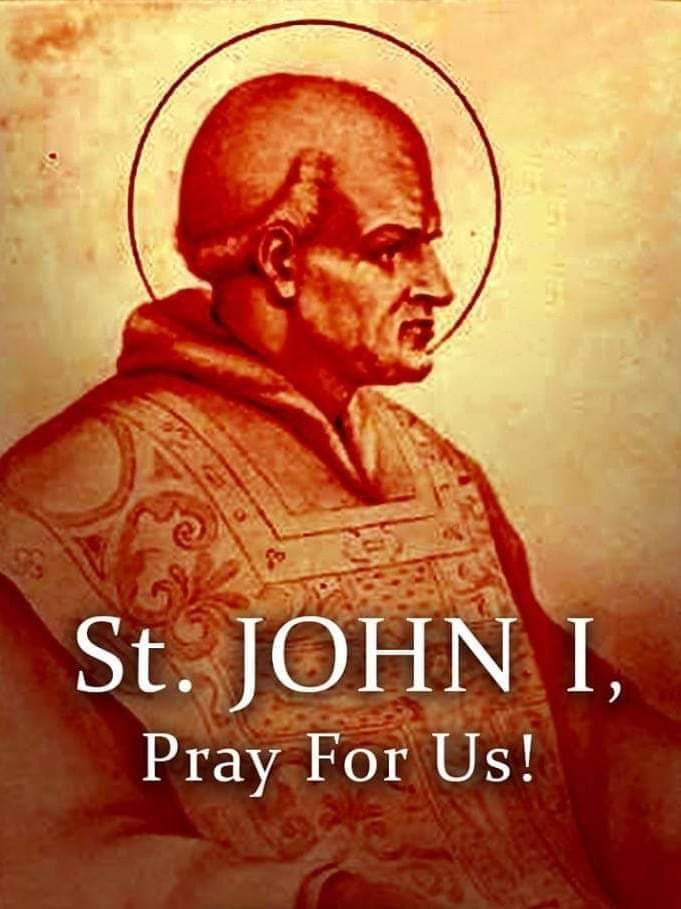 Saint Pope John I, pray for us.