
TODAY’S GOSPEL READING – 18 MAY
May 18, 2026
FEAST OF SAINT THEOPHILUS OF CORTE – 19th MAY
May 19, 2026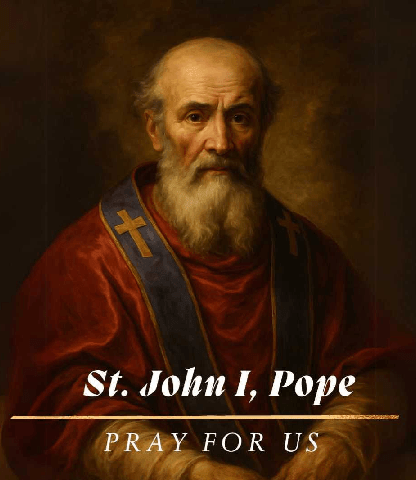
FEAR CORRUPTS THE HUMAN HEART
The downfall of King Theodoric began not first in cruelty, but in fear and suspicion. Fear slowly darkened his judgment until he saw enemies everywhere, even among faithful servants of God. Unchecked fear distorts perception and turns others into threats. Fear seeks control, isolates the soul, and destroys inner peace. Spiritual freedom comes only when the heart trusts God more than worldly security.
“Perfect love casts out fear.”
— 1 John 4:18
During his final years, John I was sent by Theodoric to Constantinople on a difficult political mission. Though the pope fulfilled his duty honorably, Theodoric’s fear and suspicion grew so strong that he accused John of betrayal and imprisoned him upon his return.
CONSCIENCE MUST REMAIN ABOVE POLITICAL PRESSURE
John I stood between competing political powers yet tried to preserve integrity and peace. He refused to allow his soul to become merely an instrument of worldly agendas. Truth requires steadiness of heart, especially in times of conflict. Integrity often becomes costly when political forces demand compromise.
“We must obey God rather than men.”
— Acts 5:29
As pope, John I traveled to Constantinople to negotiate on behalf of the Arian king Theodoric. Though pressured from many sides, he remained faithful to the dignity of the Church and his conscience before God.
MARTYRDOM IS NOT ALWAYS SUDDEN
John did not die dramatically in a public execution. His martyrdom came slowly through imprisonment, humiliation, exhaustion, and injustice. There are hidden martyrdoms that unfold quietly through endurance and suffering. Faithfulness during prolonged trials becomes a sacred witness before God.
“Be faithful unto death, and I will give you the crown of life.”
— Revelation 2:10
After returning from Constantinople, John was imprisoned in Ravenna under harsh conditions. Deprived of dignity and proper care, he eventually died from suffering and neglect while remaining faithful to his mission.
EARTHLY POWER IS FRAGILE
Theodoric ruled kingdoms, yet inward fear consumed him. External authority cannot heal interior insecurity. Political strength without spiritual grounding eventually becomes unstable. Human power fades quickly before eternity.
“For what will it profit a man if he gains the whole world and forfeits his soul?”
— Mark 8:36
Theodoric once appeared invincible as ruler of Italy, yet his fear and mistrust destroyed his peace. Meanwhile, the imprisoned pope whom he feared became remembered as a saint of fidelity and courage.
UNITY OFTEN REQUIRES CARRYING TENSION
John’s mission placed him between divided religious and political worlds. Peacemakers often suffer because they stand in painful spaces between opposing forces. Reconciliation carries spiritual burden, and those seeking unity are frequently misunderstood by all sides.
“Blessed are the peacemakers, for they shall be called sons of God.”
— Matthew 5:9
John I attempted to preserve peace between the Eastern Emperor Justin I and the Western ruler Theodoric during a time of intense division between Catholics and Arians. His efforts for unity ultimately placed him under suspicion.
PUBLIC HONOR DOES NOT GUARANTEE SAFETY
John was welcomed with extraordinary honor in Constantinople, where crowds celebrated his arrival with reverence. Yet shortly afterward he became a prisoner. Human praise is unstable and temporary. The soul rooted in God must remain detached from both applause and rejection.
“Do not put your trust in princes, in mortal man, who cannot save.”
— Psalm 146:3
Historical accounts describe how Emperor Justin I and the people of Constantinople received Pope John I with great ceremony and respect. But those honors could not protect him from suffering when he returned home.
SUFFERING PURIFIES ATTACHMENT TO REPUTATION
John likely endured accusations and misunderstanding in silence. One of the deepest spiritual purifications occurs when the soul no longer feels compelled to defend itself constantly. God sees what others misinterpret, and truth survives beyond temporary judgment.
“The Lord will fight for you, and you have only to be silent.”
— Exodus 14:14
Even after faithfully carrying out his mission, John I was accused unjustly of conspiracy. He accepted suffering without public rebellion or bitterness.
THE CHURCH SURVIVES THROUGH WITNESS, NOT POWER ALONE
John possessed no military strength or political armies. The deepest authority of the Church comes from holiness and fidelity rather than worldly dominance. Sanctity carries lasting spiritual force, and witness transforms history more deeply than coercion.
“My grace is sufficient for you, for my power is made perfect in weakness.”
— 2 Corinthians 12:9
Though imprisoned and powerless outwardly, John’s faithful witness endured long after kingdoms and rulers passed away. His holiness became stronger than political oppression.
BETRAYAL WITHIN SHARED FAITH WOUNDS DEEPLY
John suffered not from pagans, but within a world that still called itself Christian. Spiritual wounds inflicted within communities of faith often become especially painful. Yet holiness responds not with bitterness, but perseverance and charity.
“If possible, so far as it depends on you, live peaceably with all.”
— Romans 12:18
The conflicts between Arian Christians and Catholics deeply divided society during John’s time. Though caught within these tensions, John remained committed to peace and fidelity.
FIDELITY OUTLIVES FEAR
Theodoric’s fear eventually led to destruction and isolation. John’s fidelity led to sanctity and eternal remembrance. Fear contracts the soul, while faithfulness enlarges it. The soul anchored in truth leaves behind a deeper permanence than the soul consumed by control.
“I have fought the good fight, I have finished the race, I have kept the faith.”
— 2 Timothy 4:7
Though John I died in prison, the Church remembers him as a martyr and faithful shepherd. His witness endured far beyond the fearful politics of his age.
CONTEMPLATIVE CLOSING
St. John I walked between kingdoms carrying peace in fragile hands.
But the world around him had already begun surrendering to fear.
And so the pope became prisoner,
the peacemaker became suspect,
and the servant of unity died behind prison walls.
Yet hidden within that suffering was a deeper victory.
For while fear built prisons, fidelity opened eternity.
And his life still asks us quietly:
What fears rule our hearts?
What truths are we tempted to compromise for safety?
And what does it mean to remain faithful even when misunderstood by the world around us?
PRAYER INSPIRED BY ST. JOHN I
O St. John I, faithful shepherd and courageous witness amid political turmoil, strengthen us whenever truth becomes costly.
Help us remain faithful under pressure, patient amid misunderstanding,
and courageous in defending integrity.
Teach us to trust God more than human approval, and to persevere in holiness even during suffering.
May your witness remind us that earthly power fades, but fidelity to God endures forever.
Amen.